Nehemiah 4:1
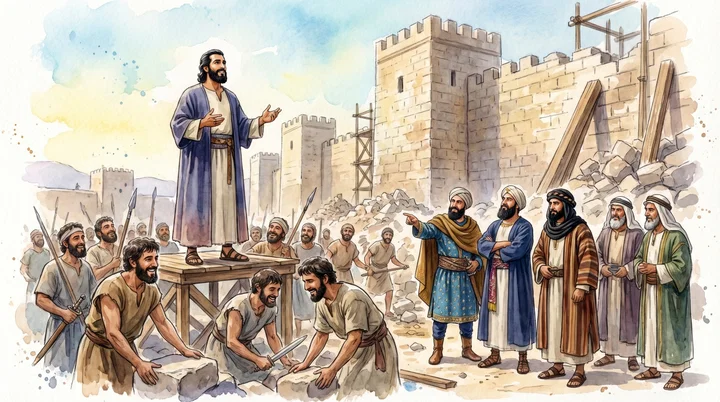
But it came to pass, that when Sanballat heard that we builded the wall, he was wroth, and took great indignation, and mocked the Jews.
Translations
But it came to pass, that when Sanballat heard that we built the wall, he was wroth, and took great indignation, and mocked the Jews.
King James Version, KJV Cambridge Paragraph Bible
But it came to pass, that when Sanballat heard that we builded the wall, he was wroth, and took great indignation, and mocked the Jews.
But it came to pass that when Sanballat heard that we were building the wall, he was wroth, and took great indignation, and mocked the Jews.
But it came to pass that, when Sanballat heard that we builded the wall, he was wroth, and took great indignation, and mocked the Jews.
But it came to pass that, when Sanballat heard that we were building the wall, he was wroth, and took great indignation, and mocked the Jews.
And it cometh to pass, when Sanballat hath heard that we are building the wall, that it is displeasing to him, and he is very angry and mocketh at the Jews,
And it came to pass that when Sanballat heard that we built the wall, he was angry and very indignant, and mocked the Jews.
But it came to pass, when Sanballat heard that we were building the wall, it angered him, and he was greatly displeased,—and mocked the Jews;
Berean Standard Bible, Majority Standard Bible
Now when Sanballat heard that we were rebuilding the wall, he was furious and filled with indignation. He ridiculed the Jews
But when Sanballat heard that we were building the wall, he was angry, and was very indignant, and mocked the Jews.
Now, Sanballat, hearing that we were building the wall, was very angry, and in his wrath made sport of the Jews.
But when Sanballat heard that we builded the wall, then was he wroth and sore grieued, and mocked the Iewes,
Douay-Rheims (Challoner revision)
And it came to pass, that when Sanaballat heard that we were building the wall he was angry: and being moved exceedingly he scoffed at the Jews.
Pictures
Cross-references
- Nehemiah 6:3
And I sent messengers unto them, saying, I am doing a great work, so that I cannot come down: why should the work cease, whilst I leave it, and come down to you?
Nehemiah refuses to leave the great work to meet his opponents.
- Nehemiah 2:19
But when Sanballat the Horonite, and Tobiah the servant, the Ammonite, and Geshem the Arabian, heard it, they laughed us to scorn, and despised us, and said, What is this thing that ye do? will ye rebel against the king?
Sanballat and his allies ridicule the rebuilding and accuse the Jews of rebellion.
- Nehemiah 4:7-9
But it came to pass, that when Sanballat, and Tobiah, and the Arabians, and the Ammonites, and the Ashdodites, heard that the walls of Jerusalem were made up, and that the breaches began to be stopped, then they were very wroth,
The enemies oppose the rebuilding, and Nehemiah and the people pray to God.
- Nehemiah 2:10
When Sanballat the Horonite, and Tobiah the servant, the Ammonite, heard of it, it grieved them exceedingly that there was come a man to seek the welfare of the children of Israel.
Sanballat and Tobiah oppose Nehemiah’s work.
- Nehemiah 4:6
So built we the wall; and all the wall was joined together unto the half thereof: for the people had a mind to work.
The people’s united work rebuilt the wall despite mockery.
- Nehemiah 6:15
So the wall was finished in the twenty and fifth day of the month Elul, in fifty and two days.
wall finished in fifty-two days despite opposition
- Nehemiah 2:4-8
Then the king said unto me, For what dost thou make request? So I prayed to the God of heaven.
Nehemiah prays, and the king grants help for the work.
- Daniel 9:25
Know therefore and understand, that from the going forth of the commandment to restore and to build Jerusalem unto the Messiah the Prince shall be seven weeks, and threescore and two weeks: the street shall be built again, and the wall, even in troublous times.
Daniel foretold Jerusalem’s wall being rebuilt in troubled times.
- Nehemiah 6:16
And it came to pass, that when all our enemies heard thereof, and all the heathen that were about us saw these things, they were much cast down in their own eyes: for they perceived that this work was wrought of our God.
enemies saw the work was wrought of God
Commentary
Each commentary is drawn from primary sources: the writings of Ellen G. White and Adventist pioneers and periodicals. Each commentary is separate. Its own words are not a quotation; follow the references to read the source passages.
Ellen G. White
8 sources
This verse belongs to the account of opposition to the rebuilding of Jerusalem's wall, when Sanballat and the other neighboring chiefs were jealous at Nehemiah's arrival and set themselves to hinder his work.PK 635.1 When Sanballat heard that the Jews were building the wall he was wroth with fierce anger and great indignation, with hatred, falsehood and treachery, breaking out in mockery and ridicule meant to stop the building.ST Dec 13, 1883PK 644.3PK 675.23T 573.3–574.1PK 676.2 That ridicule included the taunt that even what they built was so flimsy that if a fox went up it would break down their stone wall.3T 573.3–574.1
The opposition was made harder because disloyal persons among the Jews themselves joined with the enemies to oppose God's people.PK 675.2 The experience shows that those who do the work God has given them may meet serious hindrances, reproach, derision and contempt from open enemies, with sacred things made objects of mockery in order to turn the workers away from duty, and that such hostility may afterward grow into more violent measures.ST Dec 13, 1883PK 644.3Lt 139, 1903, par. 5–6 The enemies also sent messengers again and again soliciting a conference, used bold threats, and offered flattering inducements promising the builders freedom from restraint and wonderful privileges if they would unite their interests with the enemies and cease building, but Nehemiah refused to meet them, and the people were commanded not to engage in controversy with their enemies and to answer them not a word, so that no advantage of words might be given them.3T 573.3–574.1
Such contempt must be endured by those who remain faithful to God, and Nehemiah clung to the Lord, did not depart from following Him, and kept His commandments commanded through Moses.ST Dec 13, 18833T 573.3–574.1 He answered the contempt by prayer, Hear, O our God, for we are despised, and turn their reproach upon their own head, and by holding to the work with the answer, I am doing a great work, so that I cannot come down.3T 573.3–574.1 The Lord was with Nehemiah, for He hears the prayers of His servants and opens the way for the work to continue, moving even heathen kings to help carry out His purpose.3T 573.3–574.1Lt 139, 1903, par. 5–616MR 167.1–2 The hatred, falsehood, treachery and mockery are set in Scripture side by side with the nobility, devotion and self-sacrifice of Ezra and Nehemiah as a sharp contrast between sin and holiness, placing before every person a free choice which course to copy, with the fearful results of transgressing God's commands set over against the blessings of obedience, so that each must decide whether to suffer the one or enjoy the other.PK 676.2
Sources
Pioneers and periodicals
25 sources
When Sanballat heard that the Jews were rebuilding the wall of Jerusalem he was angry with great indignation and mocked them with contempt and ridicule as weak and their work as worthless, to discourage them and hinder the work.RH Dec 24, 1914 The opposition came from Sanballat the Horonite with Tobiah the Ammonite, Geshem the Arabian and others, expressing the growing bitterness and hostility between the Jews and the Samaritans after the return from Babylon.ST Oct 25, 1899RH Sep 21, 1916ST Oct 25, 1899 Against that anger and mockery Nehemiah laid the reproach before the Lord, and he and his people prayed and worked until all the wall was joined together unto half its height because the people had a mind to work.ST Feb 6, 1893ST Oct 25, 1899 The wall lying desolate was thus rebuilt amid opposition and trouble in troublous times, fulfilling Daniel's prophecy, and Sanballat's anger and mockery illustrate those difficult conditions of the restoration.ST Mar 18, 1889RH Nov 13, 1856 Those doing the work God has given them may face reproach, derision and contempt from its enemies and from people in authority, which is painful to bear but must be endured by those who remain faithful, for opposition begins with ridicule and turns to intimidation and attempts at compromise, yet it need not prevent doing what is right when workers seek the Lord's blessing and work with resolute determination until the victory is won.ST Dec 13, 1883RH Dec 17, 1901RH Apr 15, 1909RH Aug 19, 1915ST Aug 22, 1911
Historical Setting and Opposition
Nehemiah 4:1 belongs to the rebuilding of the wall of Jerusalem while Artaxerxes Longimanus was still emperor of Persia, when Nehemiah was governor of Judah and Ezra was religious teacher and scribe.ST Oct 25, 1899 It stands in the fulfillment of Nehemiah's praying after God moved the king to grant his request, after his journey to Jerusalem, his examination of the wall by night, his meeting with the rulers to make known his plan, and the division of the work among people of every sort and condition as it progressed.ST Oct 25, 1899 The rebuilding was an organized, shared work that continued despite opposition and was finished in fifty-two days from the time Nehemiah began, so that even enemies perceived that the work was wrought of God.RH Dec 24, 1914ST Feb 13, 1893 Afterward officers and watches were appointed, leading to the gathering for the reading of the law in B.C. 444.ST Feb 13, 1893 This followed the settlement of difficulties among the Jews over oppression by their brethren, with Nehemiah's rebuke, covenant and restitution, and came before the treacherous intent of Sanballat, Geshem and Tobiah to draw Nehemiah away from his work, with his answer that he was doing a great work so that he could not come down.ST Feb 13, 1893
The opposition came from Sanballat the Horonite with Tobiah the Ammonite, Geshem the Arabian and others.ST Oct 25, 1899ST Oct 25, 1899 It records the growing bitterness and hostility between the Jews and the Samaritans after the return from Babylon over rebuilding the temple and walls.RH Sep 21, 1916ST Jun 4, 1902 When Sanballat heard that the Jews were rebuilding Jerusalem's wall he was wroth with great indignation and mocked them.RH Dec 24, 1914RH Dec 17, 1901ST Jun 2, 1909ST Jun 20, 1911 His mockery was with anger, contempt and ridicule, treating them as weak and their work as worthless and questioning whether they could complete it.RH Dec 17, 1901ST Feb 6, 1893 That opposition was meant to discourage them and to hinder Nehemiah's work while it was underway.RH Dec 17, 1901ST Jun 2, 1909ST Jun 20, 1911
Their wrath proves their ridicule was insincere.ST Oct 25, 1899 Against that anger and mockery Nehemiah placed the reproach before the Lord, and he and his people prayed and worked until all the wall was joined together unto half its height because the people had a mind to work.ST Feb 6, 1893ST Oct 25, 1899 The rebuilding stood seventy-three years after Zechariah's vision, while the wall was not yet permanently restored and the Jews faced enemies.ST Apr 19, 1883 Those troubles while rebuilding Jerusalem show why God's promises of protection and peace seemed marvelous to them.ST Jun 21, 1883
Prophecy and Faithful Application
The anger and mockery at the building of the wall belong to the work of the fourth horn that scattered Judah, Israel and Jerusalem, when the adversaries of Judah and Benjamin resisted the returned exiles in rebuilding the temple and did so in the name of the king of Persia.ST Apr 12, 1883 Nehemiah is one of the four workmen or carpenters who came to restore the desolation caused by those horns, together with Zerubbabel, Joshua and Ezra.ST Apr 12, 1883 The enemies who opposed the rebuilding in the time of Zerubbabel and Joshua were afterward represented again by those who opposed Nehemiah.ST Apr 19, 1883
The wall lay desolate and was rebuilt under Nehemiah amid opposition and trouble in troublous times, fulfilling Daniel's prophecy.ST Mar 18, 1889RH Nov 13, 1856 Sanballat's anger and mockery illustrate the difficult conditions under which that restoration went forward.ST Mar 18, 1889 The verse introduces that opposition faced by Nehemiah as he rebuilt the city walls.ST Aug 22, 1911
Those doing the work God has given them may face reproach, derision and contempt from its enemies and from people in authority.ST Dec 13, 1883RH Aug 19, 1915 Sacred things may be made objects of mockery in order to turn workers away from duty.ST Dec 13, 1883 Such ridicule and contempt are painful to bear, but they must be endured by those who remain faithful to God.ST Dec 13, 1883RH Aug 19, 1915 Opposition to God's work begins with ridicule, and when that fails turns to intimidation and attempts at compromise, yet Nehemiah remained resolute in his work.RH Apr 15, 1909 Doing good can bring severe opposition, but such opponents need not prevent a person from doing what is right, and he dealt with them and won a glorious victory.ST Aug 17, 1915 The Jews completed the wall despite their enemies and severe difficulties because they sought the Lord's blessing and worked with determination, even though the opposition meant to discourage them by stressing that they were too weak to succeed.RH Dec 17, 1901
The same pattern belongs to opposition to the organized church's work while it is built, as to opposition to Israel while building.RH Nov 19, 1861 It belongs to apostolic times, to the days of Ezra and Nehemiah and the reformers, and to later work such as in Ontario.RH Dec 11, 1900 There many adversaries opposed the truth, including ministers and promoters of Sunday legislation who brought believers into prominent notice, passed resolutions to warn the people against their teachings and literature, urged ministers to defend Sunday observance, and misrepresented their work and belief.RH Dec 11, 1900 Yet adversaries do not prevent progress, and alongside opposition there is much to encourage because the canvassing work improves and persons accept the truth almost every week.RH Dec 11, 1900 The derision of Sanballat and others toward the Jews rebuilding Jerusalem's wall is likewise a comparison for opponents who watched a small group of believers build a church, hoping the effort would fail.RH May 8, 1879
Indifference, or watching the efforts of others with a question mark, is enough to hinder spiritual advancement without open opposition.RH Aug 21, 1913 Parents, teachers, ministers and conference officers who withhold cooperation from work for the young place themselves in the ranks of a modern Sanballat at the gateway of spiritual advancement among the young people in a church or a conference, especially when they have considerable influence.RH Aug 21, 1913
Sources