Nehemiah 2:18
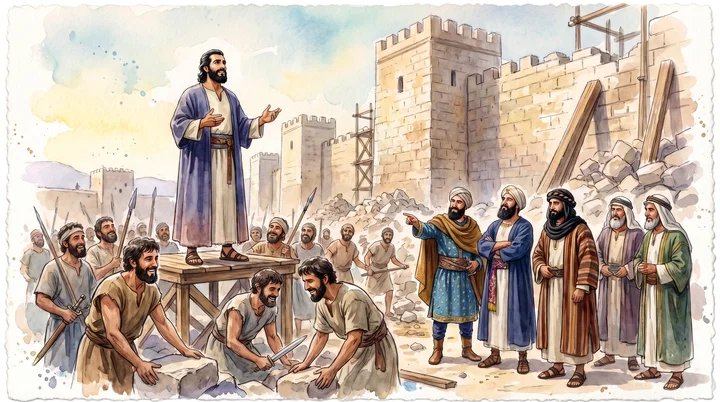
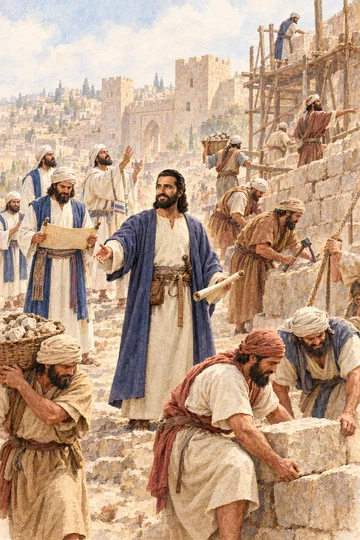
Then I told them of the hand of my God which was good upon me; as also the king’s words that he had spoken unto me. And they said, Let us rise up and build. So they strengthened their hands for this good work.
Translations
Then I told them of the hand of my God which was good on me; as also the king’s words that he had spoken to me. And they said, Let us rise up and build. So they strengthened their hands for this good work.
King James Version, KJV Cambridge Paragraph Bible
Then I told them of the hand of my God which was good upon me; as also the king’s words that he had spoken unto me. And they said, Let us rise up and build. So they strengthened their hands for this good work.
Then I told them of the hand of my God which was good upon me; as also the king's words that he had spoken to me. And they said, Let us rise and build. So they strengthened their hands for this good work.
And I told them of the hand of my God which was good upon me; as also of the king’s words that he had spoken unto me. And they said, Let us rise up and build. So they strengthened their hands for the good work.
And I told them of the hand of my God which was good upon me, as also of the king’s words that he had spoken unto me. And they said, Let us rise up and build. So they strengthened their hands for the good work.
And I declare to them the hand of my God that is good upon me, and also the words of the king that he said to me, and they say, 'Let us rise, and we have built;' and they strengthen their hands for good.
And I told them of the hand of my God which had been good upon me; as also of the king's words which he had said unto me. And they said, Let us rise up and build. And they strengthened their hands for the good [ work].
Then told I them, of the hand of my God, that, it, had been good upon me, as also of the words of the king, which he had spoken unto me,—so they said, We will arise and build! and they strengthened their hands right well.
Berean Standard Bible, Majority Standard Bible
I also told them about the gracious hand of my God upon me, and what the king had said to me.“ Let us start rebuilding,” they replied, and they set their hands to this good work.
I told them about the hand of my God which was good on me, and also about the king’s words that he had spoken to me.They said, “ Let’s rise up and build.” So they strengthened their hands for the good work.
Then I gave them an account of how the hand of my God was on me, helping me; and of the king's words which he had said to me. And they said, Let us get to work on the building. So they made their hands strong for the good work.
Then I tolde them of the hande of my God, (which was good ouer me) and also of the Kings wordes that he had spoken vnto me. And they sayd, Let vs rise, and buyld. So they strengthened their hand to good.
Douay-Rheims (Challoner revision)
And I shewed them how the hand of my God was good with me, and the king’s words, which he had spoken to me, and I said: Let us rise up, and build. And their hands were strengthened in good.
Pictures


Cross-references 20 of 21
- Nehemiah 6:15
So the wall was finished in the twenty and fifth day of the month Elul, in fifty and two days.
Nehemiah’s resolve to rebuild leads to the wall’s completion in fifty-two days.
- Daniel 9:25
Know therefore and understand, that from the going forth of the commandment to restore and to build Jerusalem unto the Messiah the Prince shall be seven weeks, and threescore and two weeks: the street shall be built again, and the wall, even in troublous times.
Nehemiah’s royal command to rebuild Jerusalem marks the prophecy’s starting point.
- Nehemiah 4:6
So built we the wall; and all the wall was joined together unto the half thereof: for the people had a mind to work.
The people’s willingness to work enables the wall’s rebuilding.
- Nehemiah 2:8
And a letter unto Asaph the keeper of the king’s forest, that he may give me timber to make beams for the gates of the palace which appertained to the house, and for the wall of the city, and for the house that I shall enter into. And the king granted me, according to the good hand of my God upon me.
The king grants support for rebuilding through God’s favor.
- Nehemiah 1:3
And they said unto me, The remnant that are left of the captivity there in the province are in great affliction and reproach: the wall of Jerusalem also is broken down, and the gates thereof are burned with fire.
The report of Jerusalem’s damaged walls precedes Nehemiah leading their restoration.
- Nehemiah 3:1-5
Then Eliashib the high priest rose up with his brethren the priests, and they builded the sheep gate; they sanctified it, and set up the doors of it; even unto the tower of Meah they sanctified it, unto the tower of Hananeel.
The people take assigned parts in repairing Jerusalem’s wall.
- Nehemiah 2:4
Then the king said unto me, For what dost thou make request? So I prayed to the God of heaven.
Nehemiah prays to God before answering the king.
- Nehemiah 1:11
O Lord, I beseech thee, let now thine ear be attentive to the prayer of thy servant, and to the prayer of thy servants, who desire to fear thy name: and prosper, I pray thee, thy servant this day, and grant him mercy in the sight of this man. For I was the king’s cupbearer.
Nehemiah prays for favor before the king and later receives the king’s support.
- Nehemiah 2:6
And the king said unto me, (the queen also sitting by him,) For how long shall thy journey be? and when wilt thou return? So it pleased the king to send me; and I set him a time.
The king grants Nehemiah time for the journey to restore Jerusalem.
- Nehemiah 2:12
And I arose in the night, I and some few men with me; neither told I any man what my God had put in my heart to do at Jerusalem: neither was there any beast with me, save the beast that I rode upon.
God’s guidance directs Nehemiah’s work to restore Jerusalem.
- Nehemiah 2:11
So I came to Jerusalem, and was there three days.
three days investigating before the call to build
- 2 Chronicles 15:7
Be ye strong therefore, and let not your hands be weak: for your work shall be rewarded.
Its appeal not to let hands grow weak echoes the call to support the work.
- Zephaniah 3:16
In that day it shall be said to Jerusalem, Fear thou not: and to Zion, Let not thine hands be slack.
both urge builders not to weaken
- Haggai 1:8
Go up to the mountain, and bring wood, and build the house; and I will take pleasure in it, and I will be glorified, saith the LORD.
both voice God's call to build
- Ezra 6:14
And the elders of the Jews builded, and they prospered through the prophesying of Haggai the prophet and Zechariah the son of Iddo. And they builded, and finished it, according to the commandment of the God of Israel, and according to the commandment of Cyrus, and Darius, and Artaxerxes king of Persia.
God directs and prospers the work of restoration.
- Ezra 9:9
For we were bondmen; yet our God hath not forsaken us in our bondage, but hath extended mercy unto us in the sight of the kings of Persia, to give us a reviving, to set up the house of our God, and to repair the desolations thereof, and to give us a wall in Judah and in Jerusalem.
The passage cites Ezra’s prayer as evidence that he understood his authority to include building the city and its wall.
- Nehemiah 4:17
They which builded on the wall, and they that bare burdens, with those that laded, every one with one of his hands wrought in the work, and with the other hand held a weapon.
Workers labor while keeping a weapon ready.
- Nehemiah 2:10
When Sanballat the Horonite, and Tobiah the servant, the Ammonite, heard of it, it grieved them exceedingly that there was come a man to seek the welfare of the children of Israel.
Opponents resent Nehemiah’s work for Israel.
- Nehemiah 4:7-8
But it came to pass, that when Sanballat, and Tobiah, and the Arabians, and the Ammonites, and the Ashdodites, heard that the walls of Jerusalem were made up, and that the breaches began to be stopped, then they were very wroth,
enemies conspire to fight and stop it
- Nehemiah 4:21
So we laboured in the work: and half of them held the spears from the rising of the morning till the stars appeared.
The workers labor together through the day while others guard them.
Commentary
Each commentary is drawn from primary sources: the writings of Ellen G. White and Adventist pioneers and periodicals. Each commentary is separate. Its own words are not a quotation; follow the references to read the source passages.
Ellen G. White
62 sources
Nehemiah told the leaders in Jerusalem how the good hand of God had answered his prayer by moving the Persian king to grant him permission, authority and practical help for their relief, so that he stood before them sustained by both Heaven and the king.PK 637.3–638.2ST Dec 6, 1883PK 636.2 When they heard of that favor they took courage, agreed with one voice to rebuild the wall, and strengthened their hands and one another for the work.PK 635PK 628.2ST Dec 6, 1883 His success came not by royal command alone but by winning their willing cooperation, for his careful knowledge of the city's ruin, his earnest appeal, and his hope and energy were contagious and united scattered hearts as well as hands.ST Dec 6, 1883PK 637.3–638.2PK 637.1–2PK 638.3 That united, courageous faith is what enables God's people to hold to duty and press forward despite danger, difficulty and opposition, which only drives them to firmer reliance on God.20MR 348.2–3Ms 121, 1898, par. 27–29Lt 116, 1905, par. 11–12ST Dec 13, 1883 The same word still calls believers to arise and build houses of worship, schools and sanitariums without delay, recounting God's help to encourage one another and strengthening the builders by cheerful, self-denying gifts of means and labor.Lt 13, 1894, par. 7–8OFWP 6.3RH Jul 14, 1904Ms 100, 1902, par. 37Ms 23, 1886, par. 18
Historical Setting and Background
Nehemiah reached Jerusalem in safety because he carried royal letters to the governors of the provinces along his route, which secured for him honorable reception, prompt assistance, and the protection of Persian power so that no enemy dared molest him.PK 635.1 He entered the city with a military escort that showed he had come on an important mission, and this excited the jealousy of the nearby heathen tribes.PK 635.1 Sanballat the Horonite, Tobiah the Ammonite, and Geshem the Arabian watched him critically and endeavored by every means to thwart his plans and hinder the building work.PK 635.1 He held a royal commission that required the inhabitants to cooperate with him in rebuilding the walls.PK 636.2 He first confided in a few men whom he knew to be worthy of confidence, telling them the circumstances that had led him to come to Jerusalem, the object he wished to accomplish, and the plans he proposed to follow, and this at once enlisted their interest and secured their assistance.PK 636.2
He did not depend on the exercise of authority but sought to gain the confidence and sympathy of the people, knowing that a union of hearts as well as of hands was essential to success.PK 637.1–2 When he called the people together he presented arguments calculated to arouse their dormant energies and unite their scattered numbers.PK 637.1–2 His success in leading them to rise up and build was greatly helped by his secret midnight circuit of the city, which he did not tell them about.PK 637.1–2 That inspection enabled him to speak of the condition of Jerusalem with an accuracy and minuteness that astonished his hearers, while the impression made upon him by its weakness and degradation gave earnestness and power to his words.PK 637.1–2 He was not a priest or a prophet and made no claim to high title, but was a reformer raised up for an important time whose aim was to set his people right with God.PK 675.3 Inspired with that great purpose, he bent every energy of his being to its accomplishment with high, unbending integrity.PK 675.3
Nehemiah's Appeal and Meaning
Nehemiah set before the people their reproach among the heathen, with their religion dishonored and their God blasphemed, and told how in a distant land he had heard of their affliction and entreated Heaven's favor on their behalf.PK 637.3–638.2 Telling them of the good hand of his God upon him meant recounting how as he prayed he resolved to ask the king for permission to come to their help, and asked God that the king would not only grant permission but invest him with authority and furnish the help needed for the work.PK 637.3–638.2 His prayer was answered in a way that showed the plan was of the Lord, and telling the king's words meant showing that he was sustained by the combined authority of the God of Israel and the Persian king.PK 637.3–638.2 The same telling showed the people how God had favored and sustained him and how the king had supported the work.ST Dec 6, 1883
He recognized God's hand as good upon him and drew confidence from the king's words, holding to the work despite opposition because God's support made it possible to continue in the plain path of duty.Ms 121, 1898, par. 27–29 He credited his success and influence to God's good hand upon him rather than to his own character, ability, or energy.Lt 83, 1898, par. 6 He recognized God as his safeguard, working through unseen agencies in every position of influence.Lt 83, 1898, par. 6 Because he did not exalt himself, God gave him wisdom to use his entrusted gifts well, and under God's supervision those gifts increased and served God's purposes.Lt 83, 1898, par. 6
His direct appeal asked whether they would take advantage of this opportunity and arise and build the wall.PK 637.3–638.2 When he called the people together he presented arguments calculated to arouse their dormant energies and unite their scattered numbers.PK 637.1–2 That appeal went straight to their hearts, and the thought of how Heaven's favor had been manifested toward them put their fears to shame.PK 637.3–638.2
United Courageous Response
Nehemiah made known both the favor of God that had been with him and the support promised by the king, and on hearing this combined evidence the people took courage to rebuild the wall of Jerusalem.PK 628.2ST Dec 6, 1883ST Dec 6, 1883ST Dec 6, 1883ST Dec 6, 1883 With one voice they agreed to rise up and rebuild, committing themselves to begin the work together and strengthening their hands for it.PK 635PK 628.2ST Dec 6, 1883ST Dec 6, 1883ST Dec 6, 1883 Each person strengthened and upheld the others in the undertaking, so that their resolve became mutual encouragement for the good work.PK 628.2ST Dec 6, 1883ST Dec 6, 1883ST Dec 6, 1883ST Dec 6, 1883
Success required united hearts as well as united effort and hands, and Nehemiah did not depend merely on the exercise of his royal commission requiring cooperation but sought to gain the confidence and sympathy and willing cooperation of the inhabitants.ST Dec 6, 1883PK 637.1–2 He knew that a union of hearts as well as of hands was essential to carrying the rebuilding through.ST Dec 6, 1883PK 637.1–2
He put his whole soul into the enterprise, and his hope and energy and enthusiasm and determination were contagious, filling others with the same high courage and lofty purpose.PK 638.3 Each worker became like Nehemiah in turn, helping to make stronger the heart and hand of his neighbor.PK 638.3 Believers strengthen one another's hands for God's work through fellowship and shared purpose and through holy energy and faith and hope while depending wholly on God.Lt 8a, 1893, par. 14Lt 102b, 1899, par. 20
Their answer, let us rise up and build, shows that faith in God with united effort strengthens people to carry out the work.ST Dec 13, 1883 Loyal and harmonious cooperation with God's purpose keeps adversaries from stopping His work, and opposition itself can lead to firmer reliance on God and more determined effort.ST Dec 13, 1883
Confidence that God's hand is with them enables people to rise and build and remain steadfast despite danger or difficulty, holding to the plain path of duty.20MR 348.2–3Ms 121, 1898, par. 27–29Lt 116, 1905, par. 11–12 The verse exemplifies firm adherence to just and holy principles and the determination and moral independence needed to defend truth and do the required work.20MR 348.2–3Lt 116, 1905, par. 11–12 Nehemiah was no priest or prophet and made no claim to high title, but was a reformer raised up for an important time whose aim was to set his people right with God, and inspired with that great purpose he bent every energy of his being to its accomplishment with high, unbending integrity.PK 675.3 As he met evil and opposition to right he took so determined a stand that the people were roused to labor with fresh zeal and courage, and seeing his loyalty and patriotism and deep love for God they were willing to follow where he led.PK 675.3
Principles for Leading Work
Nehemiah's report of divine help and royal backing shows that God's people may seek aid from those in authority to advance God's work, and such requests are to be made prudently and framed as service to the people and to God's work.Ms 47, 1907, par. 5 What prayer, faith, and wise, energetic action can accomplish is seen in Nehemiah, who was no priest or prophet and claimed no high title but was a reformer raised for an important time to set his people right with God.PK 675.3 Inspired by a great purpose, he bent every energy of his being to its fulfillment with high, unbending integrity.PK 675.3 When he met evil and opposition to right with so determined a stand, the people were roused to labor with fresh zeal and courage, and seeing his loyalty, patriotism, and deep love for God they were willing to follow where he led and give themselves to building.PK 675.3
Those who carry forward God's work are to be encouraged and supported, with believers acting in holy energy, faith, and hope, depending wholly on God and strengthening one another's hands for His work.11MR 12.2Lt 8a, 1893, par. 14 After God's favor and the king's support were made known, the people committed themselves to rebuild and strengthened one another for the task.Ms 38, 1904, par. 105–106 That strengthening of the builders means helping the work at Washington advance by furnishing the means it needs, with every church willingly doing its part.Ms 38, 1904, par. 105–106
Telling others how God has helped and recounting the support received encourages them to unite and undertake the work together.Ms 100, 1902, par. 37Ms 23, 1886, par. 18 The call to arise and build is a call to active faith and Christian service, in which faith works by love and binds the heart to God's service.Ms 23, 1886, par. 18 Applied to united effort in building a church school, it carries confidence that God's blessing will rest on those who do their best.Ms 100, 1902, par. 37
Calls to Build Churches
The words let us arise and build are a call to erect houses of worship in Melbourne and elsewhere, and despite high cost of land and building and apparent difficulty the people must arise and build.Lt 13, 1894, par. 7–8Lt 120, 1895, par. 620MR 165.4–166.1 Go forward is to be treated as a command, with God's people walking by faith, uniting in the work, and doing what they can.Lt 120, 1895, par. 620MR 165.4–166.1 When God's favor and the king's support were made known the people were encouraged to rise and build and strengthen themselves for the work, and while believers do what they can others who have means may be moved to help.Lt 13, 1894, par. 7–8Lt 120, 1895, par. 620MR 165.4–166.1
The same call applies to establishing a house of worship in Ashfield for Sabbath observers, where the work was urgent because opposition had closed places where meetings could be held, yet the people pledged money despite poverty and set themselves to the task.Lt 49, 1895, par. 7–9 It applies also to establishing churches and finding meeting places after camp-meeting tents are taken down, pressing ahead despite uncertainty and obstacles.Lt 125a, 1898, par. 14–15Lt 125, 1898, par. 14–15 Though uncertain and difficult, workers pray, plan, and advance step by step without seeing the outcome.Lt 125a, 1898, par. 14–15Lt 125, 1898, par. 14–15
The call applies to building chapels and meetinghouses where church and school are united and eager, beginning with the foundation with thought and prayer in reliance on the Lord's blessing, for progress depends on His blessing.Lt 39, 1897, par. 1–215MR 338.1–2 Those newly come to the faith are interested and should join in the work, and when the Spirit stirs workers they arise and build a meetinghouse in united rebuilding.Lt 218, 1897, par. 1Lt 205, 1897, par. 6 The chapel is built under God's direction with His light and the help of His angels, showing the Lord is with the builders and that His good hand is with the work.Ms 179, 1897, par. 6
The call applies to building a house for God in Stanmore, where despite doubts about funding faith in God's ownership of the earth and ability to provide gives confidence to move forward as He provided at Cooranbong.Ms 179, 1897, par. 8–10 Believers plan to build despite obstacles with pledges and reliance on the Lord's help, and the time has come to build with opportunity for all to contribute.12MR 349.3Lt 58, 1897, par. 9–12 Faith should stir zeal and good works, for God will help those who press forward rather than hold back.12MR 349.3
Church building is to be undertaken in faith with everyone contributing gifts, donations, money or labor, taking hold willingly in harmony when the Spirit moves and giving labor or money through shared zeal to complete it.Ms 175, 1897, par. 85–87Ms 23, 1886, par. 14Lt 151a, 1897, par. 30 The work should not be abandoned because money is scarce, nor should concern over debts hinder advance when opportunity is present.Ms 23, 1886, par. 14Lt 173, 1896, par. 6–9 God's people should care about suitable accommodations for worship and show at least as much interest in God's house as in their own homes, building plain but not shameful so construction reflects the faith and truth professed.Ms 23, 1886, par. 14Lt 99, 1897, par. 6
The call requires prompt obedience and willing action without delay, trusting God to accomplish what people cannot, obeying and moving forward in faith even when money is not in hand.RH Sep 7, 1905Lt 147a, 1897, par. 9–11 Unbelief that the work could be finished in time causes delay and keeps the building from completion even when workmen and materials are available.Lt 147a, 1897, par. 9–11 Acting in faith before funds are in hand leads to gifts and practical help that complete meetinghouses at Nashville and elsewhere, with workers giving time or money toward a home for the school proceeding to completion and with united effort in building a church school confident of God's blessing.RH Sep 7, 1905LSEGW 366.3–367.1Ms 100, 1902, par. 37Lt 216, 1897, par. 2
The same resolve applies to joining in one purpose and contributing materials and labor to build a place of worship in response to opposition.Ms 60, 1893, par. 2 Newly formed churches under ministerial guidance are to take up church building together, united by recounting God's favor and support for the work.Lt 65, 1900, par. 21–23 When God's help becomes clear and needed funds are discovered amid difficulties, His people can take courage and say we could indeed arise and build, with gratitude and praise to God.Ms 175, 1897, par. 42
Calls to Support Wider Work
The verse gives two commands for building up the work at the nation's capital at Washington, one to the workers to rise and build in establishing the cause there, and one to the people in all the conferences to strengthen the hands of the builders.OFWP 6.3RH Jul 14, 1904RH Jul 14, 1904Ms 38, 1904, par. 105–106Lt 223, 1904, par. 11 Strengthening the builders means cheerfully and willingly doing their part by furnishing means, investing entrusted means, and giving self-denying benevolence and willing offerings without delay or hindrance.OFWP 6.3RH Jul 14, 1904RH Jul 14, 1904Ms 38, 1904, par. 105–106 The building is to advance in straight lines with steadfast courage just as fast as means are furnished, and it must not be kept back for lack of means.RH Jul 14, 1904 The same call to arise and build and strengthen the hands of those doing the work urges aggressive work in the field.STB 71.4–72.1Lt 223, 1904, par. 11
Every church in every place is to act its part with no time to lose.RH Jul 14, 1904 God's people are to respond to the favor and bounty He bestows daily by placing all they have and are upon the altar of sacrifice.RH Jul 14, 1904 They are to be co-laborers with Him and His helping hand, returning to Him a part of what He has given as evidence that the truth has been doing its work upon their hearts.RH Jul 14, 1904 As Nehemiah urged the people to rise and build after telling them of God's favor and the king's support, so the school work at Avondale should begin without delay in confidence that God would provide the needed means.21MR 5.1–4
The verse also applies to building a sanitarium in Australia, with the people to move forward under God's direction as they did when building the school and church at Avondale.Lt 109, 1900, par. 10–11 They are to begin even if they can afford only the central part of the building, and be content with a simpler structure rather than delay for a larger one.Lt 109, 1900, par. 10–11 When they hear of God's favor and the king's support, their answer, let us rise up and build, expresses readiness to undertake the work and to strengthen themselves for it, and the needed money would enable the workers to arise and build the sanitarium.Lt 50, 1900, par. 12–13 The decision is to purchase the property and begin building the sanitarium at once if God opens the way, since confidence in God's help strengthens people to undertake a good work.Lt 153, 1899, par. 9–12 Once the needed supplies and funds are sent, the builders of the planned hospital will proceed despite earlier funds having been used for other urgent needs.Lt 28, 1899, par. 29–32 The call to rise and build is a call to give generously and act without delay in shared resolve to support the building work, here meeting the need for a sanitarium and a meetinghouse at Newcastle.Ms 111, 1899, par. 22–23
Strengthening hands for the good work means workers consulting together, worshiping together, and supporting one another through fellowship and shared purpose as they raise up laborers for the South.Lt 102b, 1899, par. 20 It is a call to engage in aggressive work.STB 71.4–72.1 It also encourages continued health-education work in Redlands and Riverside, since recounting God's help and the king's support encouraged the people to begin rebuilding and strengthened them for the work.Lt 164, 1907, par. 3
Sources
Pioneers and periodicals
68 sources
After surveying the ruined walls by night, Nehemiah set before the leaders the distress of the city lying waste and told them how the good favor of God had helped him obtain the king's personal permission and support, and they resolved together to rise up and rebuild and strengthened one another's hands for the good work.RH Dec 24, 1914ST May 21, 1912ST May 14, 1902RH Jul 28, 1863RH Dec 26, 1907 Their success required united hearts as well as united effort, joining earnest prayer and dependence on God with practical planning, diligent labor and use of available means, so that opposition only led to firmer reliance and more determined action.ST Dec 6, 1883ST Dec 13, 1883ST Jan 17, 1884RH Sep 21, 1916 The commission in the twentieth year of Artaxerxes was only verbal permission with letters for passage and timber for a fifty-two-day task, not the written decree to restore the civil and religious order of Jerusalem that begins the seventy weeks, which is the ample decree granted to Ezra in 457 B.C. thirteen years before.RH Dec 29, 1859ST Feb 23, 1882RH Jul 21, 1863ST Nov 1, 1877ST Feb 23, 1882 As Nehemiah's supplementing of Ezra's work by the final restoration of walls and gates, it is typical of God's work in the last days, when the building is no longer a dead wall for time but a living temple for eternity accomplished by giving the gospel message to all the world despite every effort to hinder.RH Sep 9, 1902ST Jun 2, 1909ST May 21, 1896 The same call now admits of no delay or compromise, summoning workers to rise and build and God's people everywhere to strengthen the builders' hands by cheerful self-denying gifts, labor and faithful service until the work is finished.RH Jul 14, 1904RH Jul 21, 1904RH Nov 11, 1862RH Jul 14, 1904RH Apr 15, 1909
Words and Historical Setting
After three days in Jerusalem Nehemiah inspected the ruined walls by night before gathering the leaders, and his resolve followed prior training with careful survey, investigation and arranging of plans on reaching the field of labor.ST May 14, 1902RH Dec 26, 1907ST Feb 18, 1886 He spoke to the priests, nobles, rulers and the rest of the people at Jerusalem, setting before them the distress of the city lying waste with its gates burned and calling them to build the wall so that the reproach would end.ST May 14, 1902RH Jul 28, 1863RH Sep 13, 1870 The good hand of God upon him was God's favor and providence toward him in obtaining permission and help, and the king's words were the spoken words of Artaxerxes Longimanus, verbal personal permission granted to Nehemiah individually and not a written Persian decree.RH Feb 22, 1870RH May 23, 1854RH Jul 28, 1863RH Sep 13, 1870 That permission was accompanied by letters to the governors beyond the river for safe passage and help to Judah and by an order for timber for the work.RH Jul 28, 1863ST Nov 1, 1877RH Sep 13, 1870
Nehemiah was cup-bearer or butler to the Persian king Artaxerxes Longimanus, an office with the privilege of admission to the king's most private seclusion with the king's life in a measure in his hands, which enabled his plea for Jerusalem and for assistance in rebuilding.ST Oct 9, 1901 He afterward served as governor and returned with a colony of Jews. The commission belongs to the twentieth year of Artaxerxes, reckoned as 444 B.C., thirteen years after the ample written decree to Ezra in 457 B.C., though it is also reckoned as 445 B.C. and as 455 B.C. by those who held those datings.RH Jun 4, 1857RH Jul 28, 1863RH Sep 13, 1870 Nehemiah found rulers, priests, nobles and people already engaged in rebuilding under Ezra's earlier decree, and his own particular work on the wall was finished in fifty-two days.ST Feb 23, 1882RH Jul 28, 1863ST Nov 1, 1877RH Sep 13, 1870
The restoration belongs to the days of Ezra and Nehemiah, a period of life adjoining Israel confirmed by discoveries in ancient lands, and the wall was not permanently restored until seventy-three years after Zechariah's vision.ST Apr 19, 1883ST Mar 10, 1909 From the first the work faced bitter opposition from Sanballat the Horonite, Tobiah the Ammonite, Geshem the Arabian and others, who were grieved that one had come to seek Israel's welfare.ST Feb 18, 1886ST Aug 17, 1915RH Apr 15, 1909 That opposition brought charges of rebellion, mocking and ridicule, then conspiracy by Arabians, Ammonites and Ashdodites to fight and stop the work, with weakness in Judah saying they were not able to build, and intrigue with a disaffected mixed multitude inside Jerusalem having no sympathy for Israel's prosperity who united with outside enemies to bring the work into disrepute and frustrate the rebuilding.RH Apr 15, 1909ST May 21, 1896
Encouragement to United Action
Nehemiah heartened the people by recounting how the good hand of God had favored and sustained him in gaining permission and help, and by reporting the king's words of support, and seeing this combined evidence of divine favor and royal authority they took courage to act.ST Dec 6, 1883RH Dec 24, 1914ST May 21, 1912RH Apr 8, 1902ST Oct 25, 1899 He told them how God had helped him and that the king had agreed to support the work, and that practical support together with the recognition of God's help gave the workers courage for the good work.RH Dec 24, 1914ST May 21, 1912RH Apr 8, 1902ST Aug 23, 1910ST Apr 9, 1896 They answered, Let us rise up and build, resolving together to begin rebuilding Jerusalem's wall and strengthening their hands and one another for this good work.ST Dec 6, 1883ST Dec 6, 1883RH Dec 24, 1914ST May 21, 1912ST Oct 25, 1899 Each person strengthened and upheld others in it, and their shared commitment and organized cooperation advanced the common task.ST Dec 6, 1883ST Dec 6, 1883RH Dec 24, 1914
Success required united hearts as well as united effort, for Nehemiah sought their confidence and willing cooperation rather than relying only on his royal authority.ST Dec 6, 1883ST Dec 13, 1883 Loyal harmonious cooperation with God's purpose keeps adversaries from stopping the work, and opposition leads to firmer reliance on God and more determined effort.ST Dec 13, 1883 Their courage grew through his love for God, concern for his people, and hopeful wholehearted zeal and committed spirit, which inspired others with courage and purpose to join and strengthen one another.ST Feb 7, 1911ST Jan 17, 1884ST Feb 7, 1911 That power came from deep living personal testimony, including three months of struggle before relinquishing his high court position to give himself wholly to God's work, which imparted the same spirit of self-sacrifice so that they rose to build.RH Jul 2, 1908 A leader's usefulness and power are measured by the depth of his own Christian experience, since no worker can impart what he has not received, and earnest leadership that plans broadly and shows godly zeal can make disunited, dispirited workers united, strong, hopeful and eager.ST Feb 7, 1911RH Jul 2, 1908
The work joined earnest silent prayer and dependence on God with practical action, for before making his request to the king Nehemiah silently prayed for divine guidance, and the leaders looked to the Lord and acted in unity.RH Sep 21, 1916 Rebuilding depended not only on prayer and God's help but also on careful planning, diligent work, and using available means, and God works for His servants as they faithfully do their part.ST Nov 29, 1883RH Sep 21, 1916 God directly guided and provided for the restoration of the city.ST Apr 9, 1896 A leader's call in this way recognizes need and prompts practical organized action rather than complaint, modeling spiritual upbuilding through shared organized effort.ST Sep 11, 1884 Nehemiah arose in the name of the Lord when Israel was confused, disheartened and blinded by sin and had lost faith in the literal statements of the prophets concerning the building, and without claiming to be prophet, priest or king he as a thorough businessman demanded that they put away their sins instead of sitting down to complain, since their own course for scores of years had stood in the way of what they most desired.RH Jul 30, 1908 In every important work committed to His people God raises up and qualifies men to lead in accomplishing it, and the church has the duty to strengthen the hands of those on whom such responsibilities are laid.RH Nov 18, 1873 The success of re-establishing God's people hinges on such strong, hard-working, self-sacrificing leadership that knows what ought to be done and how to lead others in doing it.RH Jun 25, 1914
The account belongs to Nehemiah as governor appointed of the Lord and given the burden of restoring Jerusalem, standing in the story of ups and downs, battles and conflicts, defeats and victories of the Jews at Jerusalem under the last reformation.ST Jun 2, 1909 That story shows God carrying the work to glorious success despite every effort to hinder.ST Jun 2, 1909
Prophecy and the Decree
The commission belongs to the twentieth year of Artaxerxes and is dated to 444 B.C., with 445 B.C. given as its date by those who reckon it so.RH Jan 7, 1858RH Jun 4, 1857RH Sep 13, 1870 It stands as one of four possible acts that could answer Daniel's commandment to restore and build Jerusalem.RH Jan 7, 1858RH Sep 13, 1870 Whether the seventy weeks of years, 490 years in all, and the 2300 days begin here or with the decree granted to Ezra remains to be decided between these two grants.RH Jan 7, 1858RH Jun 4, 1857RH Sep 13, 1870
The grant to Nehemiah was personal verbal permission to go to Jerusalem and repair its walls and gates, not a written Persian decree commanding the restoration and building of Jerusalem.RH Dec 29, 1859ST Feb 23, 1882ST Nov 1, 1877RH Feb 22, 1870RH May 23, 1854 The walls and gates in view had already been rebuilt and were afterward broken down, so the work was repair rather than restoration by decree.RH Dec 29, 1859 For that reason this permission is not the decree from which the seventy weeks are counted.ST Feb 23, 1882ST Nov 1, 1877
Those whom Nehemiah addressed — rulers, priests, nobles, and people — were already engaged in rebuilding Jerusalem under the ample written decree given to Ezra thirteen years before, in 457 B.C.ST Feb 23, 1882ST Nov 1, 1877ST Feb 23, 1882RH Jul 28, 1863RH Sep 13, 1870 To restore Jerusalem is to restore its civil state and polity and its civil and religious order, which distinguishes the decree to Ezra from decrees concerned with the temple only.RH Jul 21, 1863ST Nov 1, 1877 It likewise distinguishes that decree from what Nehemiah carried, namely letters to the governors beyond the river for safe passage and help into Judah with an order for timber, by which his own particular task was finished in fifty-two days.RH Jul 28, 1863ST Nov 1, 1877RH Sep 13, 1870
On this reckoning the 444 B.C. date does not fit the stated milestones of the prophecy as well as the decree to Ezra, and Ezra's decree is therefore favored as the starting point.RH Jul 21, 1863 The same conclusion holds against dating Nehemiah's mission to 445 B.C. as the command to restore and rebuild Jerusalem for the beginning of the 2300 days.RH Jun 4, 1857 It holds also against placing his return with a colony of Jews in 455 B.C., even where his governorship, his former office as cup-bearer to Artaxerxes Longimanus, the people's answer to rise up and build, and God's prospering of his diligent and zealous work against Sanballat, Tobiah, and Geshem are fully affirmed.
Doctrinal and Typological Lessons
The ancient task was to raise a lifeless temple and a lifeless wall out of lifeless material for time, while the present task is to build up Jerusalem by raising a living temple out of living material for eternity, and that building is done by preaching the gospel of the kingdom to all the world.RH Sep 9, 1902 As Jerusalem lying waste and burned was then a reproach, so the long delay in preparing the way for the Lord's coming is now a reproach upon God's name and truth, and the call of the hour is consecrated service in giving the message to all the world so as to be no more a reproach.RH Sep 9, 1902 When God's work lies in distress and waste and burned with fire, the resolve to rise up and build gives renewed confidence in His high purpose for an institution of His own planting, fulfilled when the latter house rises from the ruins of the former and the laying of its cornerstone becomes prophetic of coming glory after the lesson written in smoke and ruins is made clear.RH May 20, 1902
Nehemiah's call supplementing Ezra's work with the final restoration of walls and gates that had first been set up and then broken down again belongs to the story of ups and downs, battles, defeats and victories under a governor appointed of the Lord with the burden of restoring Jerusalem.ST Jun 2, 1909ST May 21, 1896 That story is typical of God's work in other ages, especially in the last days, where adversaries put forth every possible effort to hinder yet God carries the work to glorious success notwithstanding all efforts to hinder.ST Jun 2, 1909 The call admitted of no delay and no unholy alliance or compromise, and its strength lay in sustained loyalty and faithfulness, with no time for bickering and no place for compromise.RH Apr 15, 1909 Ridicule was first employed without result, then intimidation and repeated efforts to stop operations by conference, but resolute steadfastness prevailed and God honored honesty of purpose by accomplishing a great work through it, even when met at once with charges of rebellion, mocking, conspiracy to fight and stop the work, and weakening within Judah, until the work was finished with sword in one hand and working tool in the other after the rich restored lands and vineyards to the poor and equality was more fully established.RH Apr 15, 1909ST May 21, 1896
The rebuilding shows that God blesses His people as they engage in right-doing and good work, and that despite opposition and difficulty His favor prospers diligent zeal to restore neglected Bible truth until it is completed.RH Nov 11, 1862RH Apr 3, 1855 God does not reward idleness, and the strengthening of hands for the good work shows that divine anointing and the outpouring of the Holy Spirit have a definite purpose in active service, with the anointing as the initiatory rite calling for willingness to do the work rather than seeking preparation without labor.RH Apr 23, 1908 When Jerusalem was lost and its walls broken down in long desolation, God commanded a people not responsible for the ruin to arise and build, showing that guilt for destruction does not excuse from restoration.RH May 14, 1901 All should therefore cheerfully labor and sacrifice for the rebuilding, and those who so build and give are blessed by the Lord, so that what is restored stands again in glory, blessed of Heaven and made a source of blessing.RH May 14, 1901
Telling others how God helped and encouraged the work strengthens them to arise and build, and in trust that God will prosper the effort this calls for increased labor to make the Sabbath known throughout the earth.RH Apr 3, 1855ST Jun 25, 1874 The labor was divided among people and priests with each working opposite or nearest his own house until the wall was finished in fifty-two days, after prior training, careful survey, three days of investigating and arranging plans, and hardship even to tears that fired the heart for united commitment.RH Dec 26, 1907ST Feb 18, 1886 By the same principle, if every Christian built up the wall of Christian character opposite his own house, troubles in the church would cease and God's work would prosper.ST Feb 18, 1886
Calls to Build Today
The verse lays two commands upon the present building up of the work at the capital of the nation, one to the workers to rise up and build and one to God's people in all the conferences to strengthen the hands of the builders.RH Jul 14, 1904RH Jul 14, 1904RH Jul 21, 1904 The workers are to take up the establishing of God's cause there and to build memorials for Him in straight lines, without delay or hindrance, with steadfast courage, rallying to establish the publishing house, the sanitarium, schools, and evangelistic work.RH Jul 14, 1904RH Jul 14, 1904RH Jul 14, 1904RH Aug 11, 1904 The building is to advance just as fast as the Lord's people furnish the means, and it must not be kept back or hindered for lack of money, even though the enemy will try to hinder it.RH Jul 14, 1904RH Jul 14, 1904RH Aug 11, 1904 Every church in every place is to act its part cheerfully and willingly, with no time to lose, laying right hold of the work in self-denial and self-sacrifice and not waiting for more appeals.RH Jul 14, 1904RH Aug 11, 1904 God's people are to be co-laborers with Him as His helping hand, returning to Him a part of what He has daily bestowed, asking whether He has entrusted them with means for His cause and investing what He asks, giving self-denying benevolence and willing offerings as evidence that the truth has done its work upon their hearts and thereby making seeming impossibilities into possibilities.RH Jul 14, 1904RH Aug 11, 1904
The same call to rise up and build is God's providence calling to rebuild and support the publishing work of the Pacific Press after awful loss.ST Aug 8, 1906ST Aug 8, 1906 Its types and presses are more needed than ever for the needs of the work and of perishing souls, and devoted servants answer with determination to build and strengthen their hands for this good work.ST Aug 8, 1906 Every brother and friend is therefore called to help it by gifts and pledges.ST Aug 8, 1906ST Aug 8, 1906
The verse also gives the words for God's people when His work lies in distress and waste and burned with fire, that it be no more a reproach, after telling of the good hand of God and of the favorable words of the king.RH May 20, 1902 It expresses renewed confidence in the high purpose of God for an institution of His own planting at the laying of the cornerstone of the new sanitarium after the fire.RH May 20, 1902 The lesson written in smoke and ruins being made clear, the laying of its cornerstone is prophetic of its coming glory when the latter house rises from the ruins of the former.RH May 20, 1902
To strengthen the builders' hands is to support the work they are called to do by providing the equipment and secure foundation needed for the medical missionary training school at Loma Linda.RH Mar 2, 1916RH Sep 21, 1916 The call to rise up and build is thus to build a memorial hospital and to uphold the medical school.RH Sep 21, 1916 In this way consecrated workers can be trained and more medical missionaries prepared for foreign fields.RH Mar 2, 1916RH Sep 21, 1916
The call applies to obeying God in securing a meeting-house at Nashville by arising and building and moving forward in faith even when the money needed is not yet in hand.RH Sep 7, 1905 It applies likewise where there is urgent need for a meeting place for God's people, as in Georgia, where all saying together that they will build and willingly helping at once makes the undertaking easy and brings the building up quickly.RH Feb 6, 1908 Such united building is followed by blessing and rejoicing.RH Feb 6, 1908
The same resolve applies to rebuilding after calamity rather than leaving the building waste and suffering reproach, as with the Texas Tract Society renewing its effort and continuing its work.ST Apr 3, 1884 It applies to the growth of the publishing work in Washington, accomplished by God's help and to His praise, and to shared enterprise in disposing of the Battle Creek College property, where each contributes what circumstances allow through land, time, or labor and all work together in the Lord's name and by His Spirit.RH Aug 17, 1905 It applies to the resolve to rebuild the school in Argentina after the cyclone damaged its buildings, proceeding in faith that help will come though the reason for the disaster and the source of repair funds are unknown, and to taking courage to rise and build the Lord's house in Algeria despite a great task, seeking the prayers of others in the effort.RH Nov 24, 1910RH Dec 30, 1902 Guilt for destruction does not excuse from restoration, for when Jerusalem was lost and its walls broken down in long desolation God commanded a people not responsible for the ruin to arise and build, so all should cheerfully labor and sacrifice, and those who pray and give to lift debt on the publishing house share in Heaven's richest blessing, with what is restored standing again in glory, blessed of Heaven and made a source of blessing.RH May 14, 1901
Let us rise up and build is a fitting motto for the work, especially at the beginning of a new year and in shaping institute efforts, calling workers to join in building.RH Mar 21, 1907RH Feb 18, 1909 Building solidly from the foundation requires thorough attention to practical details, since a strong structure depends on getting the little things right, with organized work, trained workers, and strength from the Spirit.RH Feb 18, 1909RH Mar 21, 1907 So built carefully and solidly, success will endure rather than be followed by decline.RH Mar 21, 1907RH Mar 21, 1907
Sources