Nehemiah 2:20
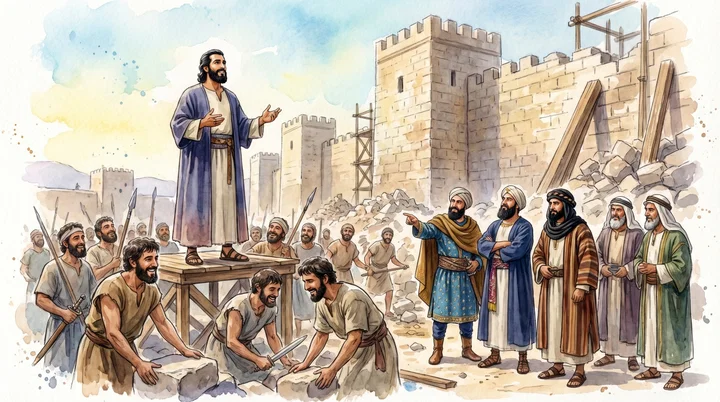
Then answered I them, and said unto them, The God of heaven, he will prosper us; therefore we his servants will arise and build: but ye have no portion, nor right, nor memorial, in Jerusalem.
Translations
Then answered I them, and said to them, The God of heaven, he will prosper us; therefore we his servants will arise and build: but you have no portion, nor right, nor memorial, in Jerusalem.
King James Version, American Standard Version
Then answered I them, and said unto them, The God of heaven, he will prosper us; therefore we his servants will arise and build: but ye have no portion, nor right, nor memorial, in Jerusalem.
Then answered I them, and said unto them, The God of heaven, he will prosper us; therefore we his servants will arise and build: but you have no portion, nor right, nor memorial, in Jerusalem.
Then I answered them, and said to them, The God of heaven, he will prosper us; therefore we his servants will arise and build: but ye have no portion, nor right, nor memorial, in Jerusalem.
Then answered I them, and said unto them, The God of heaven, he will prosper us; therefore we his servants will arise and build: but ye have no portion, nor right, nor memorial in Jerusalem.
And I return them word, and say to them, 'The God of the heavens — He doth give prosperity to us, and we His servants rise and have built; and to you there is no portion, and right, and memorial in Jerusalem.'
And I answered them, and said to them, The God of the heavens, he will prosper us, and we his servants will arise and build; but ye have no portion, nor right, nor memorial in Jerusalem.
Then answered I them, and said to them—The God of the heavens—he, will prosper us, therefore, we his servants, will arise and build,—But, to you, pertaineth no portion, nor right, nor memorial, in Jerusalem.
Berean Standard Bible, Majority Standard Bible
So I answered them and said, “ The God of heaven is the One who will grant us success. We, His servants, will start rebuilding, but you have no portion, right, or claim in Jerusalem.”
Then I answered them, and said to them, “ The God of heaven will prosper us. Therefore we, his servants, will arise and build; but you have no portion, nor right, nor memorial in Jerusalem.”
Then answering them I said, The God of heaven, he will be our help; so we his servants will go on with our building: but you have no part or right or any name in Jerusalem.
Then answered I them, and sayd to them, The God of heauen, he will prosper vs, and we his seruants will rise vp and buylde: but as for you, ye haue no portion nor right, nor memoriall in Ierusalem.
Douay-Rheims (Challoner revision)
And I answered them, and said to them: The God of heaven he helpeth us, and we are his servants: let us rise up and build: but you have no part, nor justice, nor remembrance in Jerusalem.
Pictures
Cross-references
- Daniel 9:25
Know therefore and understand, that from the going forth of the commandment to restore and to build Jerusalem unto the Messiah the Prince shall be seven weeks, and threescore and two weeks: the street shall be built again, and the wall, even in troublous times.
Nehemiah’s commission is considered as the command to restore Jerusalem that starts the prophetic weeks.
- Nehemiah 2:16
And the rulers knew not whither I went, or what I did; neither had I as yet told it to the Jews, nor to the priests, nor to the nobles, nor to the rulers, nor to the rest that did the work.
The people were already engaged in rebuilding Jerusalem.
- Nehemiah 4:6
So built we the wall; and all the wall was joined together unto the half thereof: for the people had a mind to work.
The people build the wall together with a mind to work despite opposition.
- Ezra 7:11-26
Now this is the copy of the letter that the king Artaxerxes gave unto Ezra the priest, the scribe, even a scribe of the words of the commandments of the LORD, and of his statutes to Israel.
Ezra’s decree authorized Jerusalem’s restoration before Nehemiah arrived.
- Nehemiah 6:15
So the wall was finished in the twenty and fifth day of the month Elul, in fifty and two days.
Nehemiah completed the wall in fifty-two days, fulfilling his declaration that God would prosper the work.
- Ezra 1:2-3
Thus saith Cyrus king of Persia, The LORD God of heaven hath given me all the kingdoms of the earth; and he hath charged me to build him an house at Jerusalem, which is in Judah.
Cyrus’s decree authorized rebuilding the house of God in Jerusalem.
- Zechariah 2:4-5
And said unto him, Run, speak to this young man, saying, Jerusalem shall be inhabited as towns without walls for the multitude of men and cattle therein:
Promises Jerusalem’s growth and God’s protection as a wall of fire.
- Ezra 4:3
But Zerubbabel, and Jeshua, and the rest of the chief of the fathers of Israel, said unto them, Ye have nothing to do with us to build an house unto our God; but we ourselves together will build unto the LORD God of Israel, as king Cyrus the king of Persia hath commanded us.
Both texts exclude outsiders from joining the restoration work.
- Zechariah 1:16
Therefore thus saith the LORD; I am returned to Jerusalem with mercies: my house shall be built in it, saith the LORD of hosts, and a line shall be stretched forth upon Jerusalem.
God promised that His house would be built in Jerusalem.
- Nehemiah 1:3
And they said unto me, The remnant that are left of the captivity there in the province are in great affliction and reproach: the wall of Jerusalem also is broken down, and the gates thereof are burned with fire.
gives the ruin and reproach Nehemiah came to repair
- Nehemiah 3
Then Eliashib the high priest rose up with his brethren the priests, and they builded the sheep gate; they sanctified it, and set up the doors of it; even unto the tower of Meah they sanctified it, unto the tower of Hananeel.
The chapter recounts the restoration of Jerusalem’s wall.
- 2 Chronicles 36:17-19
Therefore he brought upon them the king of the Chaldees, who slew their young men with the sword in the house of their sanctuary, and had no compassion upon young man or maiden, old man, or him that stooped for age: he gave them all into his hand.
Describes Jerusalem’s earlier destruction because of sin.
- Nehemiah 2:6
And the king said unto me, (the queen also sitting by him,) For how long shall thy journey be? and when wilt thou return? So it pleased the king to send me; and I set him a time.
The king grants leave and support for rebuilding Jerusalem.
- Nehemiah 2:10
When Sanballat the Horonite, and Tobiah the servant, the Ammonite, heard of it, it grieved them exceedingly that there was come a man to seek the welfare of the children of Israel.
shows the first grief and displeasure at Nehemiah's arrival
- Haggai 1:2-5
Thus speaketh the LORD of hosts, saying, This people say, The time is not come, the time that the LORD’s house should be built.
Calls God’s people to build the Lord’s house rather than leave it neglected.
- Haggai 2:4-9
Yet now be strong, O Zerubbabel, saith the LORD; and be strong, O Joshua, son of Josedech, the high priest; and be strong, all ye people of the land, saith the LORD, and work: for I am with you, saith the LORD of hosts:
God strengthens the builders with his presence and promises the temple glory.
- Ezra 6:1-12
Then Darius the king made a decree, and search was made in the house of the rolls, where the treasures were laid up in Babylon.
The decree renewed support for the temple work.
- Haggai 1:8
Go up to the mountain, and bring wood, and build the house; and I will take pleasure in it, and I will be glorified, saith the LORD.
God’s people are called to gather materials and build his house.
- Zechariah 3
And he shewed me Joshua the high priest standing before the angel of the LORD, and Satan standing at his right hand to resist him.
Named among the chapters to study as the history is repeated.
Commentary
Each commentary is drawn from primary sources: the writings of Ellen G. White and Adventist pioneers and periodicals. Each commentary is separate. Its own words are not a quotation; follow the references to read the source passages.
Ellen G. White
41 sources
Nehemiah spoke to Sanballat, Tobiah, and Geshem when they mocked the Jews for hoping to rebuild and accused them of rebelling against the king, answering with confidence that the God of heaven would give success, that he and his fellow servants would get up and do the building, and that those enemies had no share or right or lasting place in Jerusalem.PK 635.1PK 638.4 The God of heaven is the great Overseer of all and the source of strength who prospers His servants in building, and the declaration was used to encourage the workers until its echo thrilled every heart on the wall.ST Dec 6, 1883PK 639.3–640.1 God's servants can keep building despite opposition and difficulty because God lives and reigns and will prosper His work if they remain loyal, work together, and rise to carry it forward rather than dwell on discouragement.Ms 69, 1903, par. 32–34Lt 116, 1905, par. 11–12ST Dec 13, 1883SLP 159.1 Arising to build means acting promptly in faith when means and opportunity are available, using every helpful means without waiting to see every step or the final outcome.Ms 176, 1897, par. 38–39Ms 70, 1897, par. 8–11 It means beginning when God indicates the work should be done without waiting for human approval, and proceeding even when the project seems beyond reach and the money is not yet in hand, trusting the needed means will come.Ms 179, 1898, par. 23–25Lt 215, 1897, par. 3–4Lt 25, 1904, par. 2–3 So the call applies to building houses of worship and meetinghouses, chapels, schools, sanitariums, and new mission fields by faith, moving forward with earnest prayer and trust in God's provision without delay and without taking on debt.Lt 22, 1897, par. 1–3Lt 101, 1897, par. 7–8Lt 8, 1900, par. 9–14Lt 163, 1897, par. 12Lt 159, 1897, par. 5
Setting and Wording
The reply was addressed to Sanballat the Horonite, Tobiah the Ammonite, and Geshem the Arabian, chiefs of the heathen tribes living near Jerusalem who had often shown enmity against the Jews by injury and insult.PK 635.1 It came after arrival in Jerusalem bearing royal letters to the provincial governors and accompanied by a military escort, showing an important mission carried out under the guard and favor of the Persian king.PK 635.1 That display of royal backing excited their jealousy, and from the first they watched every movement with critical eyes and endeavored by every means to thwart the plans and hinder the building work.PK 635.1
It answered them when, hearing what was hoped to be accomplished, they laughed the Jews to scorn and charged them with rebelling against the king.PK 638.4 Against that scorn and charge it declares confidence that the God of heaven will give success, and on that ground commits His servants to get up and do the building.PK 638.4 At the same time it denies those enemies any part or right or lasting place in Jerusalem.PK 638.4
The God of heaven named here is the great Overseer of all and the source of strength, who will prosper His servants in building.PK 639.3–640.1 The words were spoken after the work was actually begun, while the leader's heart was constantly uplifted to God in prayer.PK 639.3–640.1 With tireless vigilance he superintended the building along the whole three miles of wall, directing the workmen, noting hindrances, providing for emergencies, watching the movements of enemies, encouraging the fearful, arousing the laggard, and approving the diligent.PK 639.3–640.1
That declaration that God would prosper the work was used to encourage the workers.ST Dec 6, 1883PK 639.3–640.1 Echoed and reechoed along the line, the words thrilled the hearts of all the workers on the wall.PK 639.3–640.1
Promise and Resolve
The rebuilding was to succeed by divine strength joined with the united labor of divine servants, and while that loyalty and cooperation lasted no opposition could arrest it.ST Dec 13, 1883 Because the living and reigning God undertakes to give prosperity to His own work, His servants are to rise and press the building forward even under hostile pressure, after the pattern of Nehemiah and his fellow laborers.SLP 159.1 The declaration is confidence that God will prosper the undertaking and that His servants will arise and build, a firm and morally independent adherence to truth and righteous principle in the face of danger and difficulty carried into resolute action in an entrusted task.Lt 116, 1905, par. 11–12
That assurance gives courage to keep building amid difficulties and hindrances instead of lingering over discouragement, since the work rests on faith in a God who will prosper His servants and therefore calls them to rise and advance it.Ms 69, 1903, par. 32–34 The straits encountered in restoring the wall, the hearing of prayer and the opening of a way, together with the denial to opponents of any share or right or enduring claim in Jerusalem, stand as a pattern for divine servants meeting obstacles in their own work.Lt 139, 1903, par. 5–6 The summons to arise and build required prompt action in rebuilding the temple, a command left unheeded through disobedience and through deference to the opinions of others.Ms 116, 1897, par. 17–19
Faithful Way to Build
To arise and build is to undertake a work in faith in God's help, acting promptly when means and opportunity are available without waiting to see every step or the final outcome, using every helpful means and suggestion rather than holding back until the whole end is visible.Ms 176, 1897, par. 38–39Ms 70, 1897, par. 8–11
When God indicates that a work should be done, a chosen person may call others together and begin building without waiting for a board's approval or advice, working steadily until completion while seeking God, who can impress and use chosen workers to carry it forward.Ms 179, 1898, par. 23–25
Confidence that God will prosper His servants underlies arising to build churches and houses of worship by faith even when poor and the source of funds is uncertain, for God accepts willing hearts and enables the work.Lt 101, 1897, par. 7–8
Builders are to proceed even when a project seems beyond reach and all the required money is not yet in hand, trusting that the needed means will come and the building will be completed free from debt.Lt 215, 1897, par. 3–4Lt 25, 1904, par. 2–3
The work is to move forward promptly with earnest prayer and trust in God's provision and help, going forward without delay and without taking on debt, in reliance on God who will prosper His servants in building a house of worship and meetinghouse.Lt 163, 1897, par. 12Lt 159, 1897, par. 5
The call is a watchword to press ahead with God's work and to begin a house for God without delay, with confidence that God will provide, prosper the work, and be with those carrying it forward.Lt 216, 1897, par. 5–6Lt 11, 1898, par. 4–5
God enables His servants to arise and build a meetinghouse, so they should rise to build a place of worship in faith and move forward even with limited faith and means.Lt 90, 1897, par. 1Lt 90, 1897, par. 4–6
In the shared work of building a chapel, God is asked to open the way and strengthen everyone's resolve as builders do their best, and failure to finish on time would mean the victory was withheld because completion was not safe.Ms 175, 1897, par. 77
Where to Arise and Build
The resolve to arise and build becomes united resolve to erect a house of worship when opposition shuts believers out of the small building they had been using, and that resolve is answered by gifts of land and building materials and by offers of free labor.Ms 86, 1893, par. 16–20 The verse calls believers to advance the cause by constructing a house of worship, acting in faith to provide what is needed for worship because God will prosper the work.Lt 22, 1897, par. 1–3Lt 162, 1897, par. 1–2 When a small company is newly established in the faith, those new believers are themselves to arise and build even a humble house of worship and to back the work with practical investment.Lt 24, 1894, par. 1 The same call encourages the building of a meetinghouse for the Lord and the pressing forward of God's work in Sydney, for God helps those who move forward in faith and do not hold back.Lt 37, 1897, par. 15–16
At Cooranbong the resolve takes the definite form of constructing a chapel, undertaken in trust that the Lord will help the work advance.Lt 112, 1896, par. 10–11 At the school the presence of the school itself creates the need to arise and build a church, to be made a worthy offering according to the light given and joined with seeking God's approval and presence.Ms 175, 1897, par. 62–64 The school home is likewise to be taken in hand by laying its foundation and raising its frame in trust that the Lord will favor the work and bring it to completion.Lt 216, 1897, par. 2
In Washington the verse stands as God's command to workers there to arise and build without delay and to advance His work with steadfast courage.Ms 38, 1904, par. 105–106Lt 223, 1904, par. 11 That building moves forward as God's people supply the needed means and willingly take part, while believers across the conferences are called to strengthen the hands of those doing the work.Ms 38, 1904, par. 105–106Lt 243, 1904, par. 9–11 Establishing the work in Washington and providing the means to carry it forward is the required response to the call.Ms 38, 1904, par. 72–74 The command also embraces the building of a sanitarium, and at Sydney the workers so called trusted that God would provide help and deliver them in His own time despite delays and distress.Lt 8, 1900, par. 9–14Lt 159, 1902, par. 2 God's servants are therefore to proceed with sanitarium building by faith in reliance on His help and blessing rather than wait for others to act.11MR 223.4–224.1
Obeying the command includes using entrusted money to advance God's work by providing meetinghouses, sanitariums, and schools where people can learn truth and receive spiritual and physical help.Ms 38, 1904, par. 49–51 It means supporting and carrying forward work that has been neglected.OFWP 8.3 Workers whom God calls to arise and build by opening the work in new fields are to receive liberal support from those responsible for the work elsewhere, rather than being left to sustain themselves amid hostile and unfavorable conditions.Ms 96, 1902, par. 17
Sources
Pioneers and periodicals
38 sources
Nehemiah spoke to Sanballat the Horonite, Tobiah the Ammonite servant, and Geshem the Arabian after they laughed the builders to scorn, despised them, and charged them with rebelling against the king.RH Apr 8, 1902ST May 14, 1902 He declared that the God of heaven would give His servants success, and that they His servants would therefore rise and build with moral courage and confidence despite enemies.RH Oct 8, 1908RH Sep 21, 1916ST May 14, 1902ST Apr 19, 1883 To the opponents he declared that they had no share, no claim or right, and no lasting memorial in the city, shutting them out from any part in the work.ST Dec 13, 1883RH Apr 8, 1902ST Aug 22, 1911ST Aug 17, 1915ST Jun 20, 1911 The prosperity comes through God's strength and is carried out through organized, united cooperation, with the people working together, encouraging one another, and having a mind to work to complete the wall.ST Dec 6, 1883RH Dec 24, 1914 The story of hindrance overcome under this last reformation is typical of God's work in other ages, especially in the last days, when God carries the work to glorious success notwithstanding every effort of the adversary to hinder.ST Jun 2, 1909
Setting and Opponents
The reply was spoken to Sanballat the Horonite, Tobiah the Ammonite servant, and Geshem the Arabian after the builders had begun again and these men laughed them to scorn, despised them, and charged them with rebelling against the king.RH Apr 8, 1902ST May 14, 1902 Nehemiah knew he had been appointed to seek the welfare of Israel, and the scorn only increased his interest and determination.RH Apr 8, 1902
He had been cup-bearer, or butler, to the Persian king Artaxerxes Longimanus, and through that close and private relationship was enabled to present the plea for Jerusalem.ST Oct 25, 1899ST Oct 9, 1901 His prayer was fulfilled when God moved the emperor to grant his request, and he went as governor of Judah while Ezra served as religious teacher and scribe.ST Oct 25, 1899 In one reckoning he returned with a colony of Jews in 455 B.C. by the king's permission to join the restoration begun under Ezra the priest, ever diligent and zealous for God and continually pleading the Lord's blessing in prayer.
Before speaking he went by night without the knowledge of the rulers, priests, nobles, and others to view the broken walls and burned gates.RH Apr 8, 1902ST Oct 25, 1899 He then told a few faithful friends how God's hand had been good upon him and what the king had said, met the rulers with his plan, and they agreed to rise and strengthen their hands for the good work.RH Apr 8, 1902ST Oct 25, 1899 The work was then divided among people of every sort and condition as it progressed.ST Oct 25, 1899
The permission he carried was only verbal and pertained to him individually, with nothing said about others going up with him.ST Feb 23, 1882RH Jul 28, 1863RH Sep 13, 1870 The king only inquired how long the journey would take and when he would return, and gave him letters to the governors beyond the river to help him on his way to Judah and an order on the keeper of the king's forest for timber for beams.RH Jul 28, 1863RH Sep 13, 1870 When he arrived he found rulers, priests, nobles, and people already engaged in building under Ezra's earlier decree, and the work he came to accomplish was finished in fifty-two days.ST Feb 23, 1882RH Jul 28, 1863RH Sep 13, 1870
The call to arise and build concerned repairing walls that had been built before and later broken down.RH Dec 29, 1859 The city's wall was not permanently restored until Nehemiah's time, and the rebuilding was a work God would prosper.ST Apr 19, 1883 The narrative belongs to Babylonian life in the days of Ezra and Nehemiah, confirmed by discoveries in ancient lands adjoining Israel that had dealings with that people.ST Mar 10, 1909
The opposition included bitter resistance from the surrounding heathen powers, who feared the restoration of a national center that had been a rebuke and menace to them.RH Apr 8, 1902RH Apr 15, 1909 With it was intrigue from a mixed multitude inside Jerusalem with no sympathy for Israel's prosperity, who united with outside enemies to bring the work into disrepute and frustrate the rebuilding.RH Apr 15, 1909
Promise to Prosper and Build
The God of heaven would prosper the rebuilding of Jerusalem, and therefore his servants would rise and build.RH Oct 8, 1908RH Sep 21, 1916ST Apr 19, 1883ST Aug 22, 1911ST Jul 1, 1908 That declaration was the answer to the charge of rebelling against the king, spoken with moral courage and with confidence that the work God had given would succeed despite enemies.RH Oct 8, 1908RH Sep 21, 1916ST Apr 19, 1883 The rebuilding was a work God would prosper, and that assurance gave the builders confidence to rise and build even while opposed.ST Apr 19, 1883ST Aug 22, 1911ST Jul 1, 1908
The answer repeated the answer given by Zerubbabel and Joshua at the first restoration, that the God of heaven would give His servants success and that as His servants they would arise and build.ST May 14, 1902 The prosperity came through God's strength and was carried out through organized, united cooperation.ST Dec 13, 1883RH Dec 24, 1914 The people worked together to complete the wall, encouraged one another, acted in unity, sought divine guidance through earnest prayer and dependence on God, and had a mind to work.ST Dec 6, 1883RH Dec 24, 1914RH Mar 3, 1904 That confidence was used to encourage the workers, inspired cooperation among the Israelites, helped bring about the rebuilding of the city walls and the restoration of some of Jerusalem's former glory, and showed that those opposing the work would be unable to stop it if God's people remained loyal and worked together.ST Dec 6, 1883ST Dec 13, 1883RH Mar 3, 1904
The secret of strength was sustained loyalty and faithfulness.RH Apr 15, 1909 The building prospers when the builders hold to the God of heaven as commander of the work instead of being in contact with the adversary.RH Jun 25, 1908 That course means praying constantly as difficulties thicken yet never slackening effort, taking no credit but giving all honor to God, withstanding ridicule, then intimidation, then repeated efforts to effect a compromise, giving no time to bickering and no place to compromise.RH Jul 2, 1908RH Apr 15, 1909 It means refusing to stop to parley, mourn, or answer the enemy, leaving opposers with the Lord while hastening the given work with tools and weapons in hand from daylight to stars, sharing every hardship and danger day and night with undaunted courage born of simple trust.RH Jul 2, 1908 The story of ups and downs, battles and conflicts, defeats and victories under this last reformation is typical of God's work in other ages, especially in the last days, and God carries the work to glorious success notwithstanding every effort of the adversary to hinder.ST Jun 2, 1909
Exclusion From Jerusalem
The God of heaven would prosper the work of rebuilding Jerusalem's walls, so those serving Him would rise and build despite opposition.ST Aug 22, 1911ST Aug 17, 1915ST Jun 20, 1911RH Apr 22, 1902 The answer presents the rebuilding as God's work undertaken by God's servants with confidence in His success.ST Aug 17, 1915ST Jun 20, 1911 At the same time it denies the opponents any share, any claim or right, and any lasting memorial, remembrance, or claim in Jerusalem.ST Aug 22, 1911ST Aug 17, 1915ST Jun 20, 1911RH Apr 22, 1902
That denial shuts the opponents out from any portion, right, or memorial in Jerusalem and from any part in the work.RH Apr 8, 1902 Those opposing the work would be unable to stop it if God's people remained loyal and worked together, with prosperity coming through God's strength and united cooperation.ST Dec 13, 1883RH Apr 8, 1902
The same exclusion is brought against hesitation in God's cause, with church members who hesitate likened to those who consult with Sanballat and Tobiah, the opponents named in the surrounding account.RH Jan 26, 1869
Command in Prophecy
The account to which the verse belongs is the commission Artaxerxes gave to Nehemiah in the king's twentieth year, dated to 444 B.C., thirteen years after the decree granted to Ezra in 457 B.C.RH Jul 21, 1863ST Feb 23, 1882RH Jan 7, 1858RH Jul 28, 1863RH Sep 13, 1870 One account dates that commission to 445 B.C. and contrasts it with the decree given to Ezra in 457 B.C. as the proposed starting point of the 2300-year period, while another places Nehemiah's return with a colony in 455 B.C. to join the restoration work begun under Ezra.RH Jun 4, 1857
The commission is considered as a candidate for the command to restore and build Jerusalem in the seventy-weeks prophecy because it concerned restoring Jerusalem's civil state and polity, not merely rebuilding the temple and restoring temple worship.RH Jul 21, 1863 It is listed as one of four acts that might answer to Daniel's command, the others being the decree of Cyrus in 536 B.C., the decree of Darius in 519 B.C., and the decree of Artaxerxes to Ezra in 457 B.C., with the decree to Ezra and the commission to Nehemiah remaining as the two possible starting points from which the seventy weeks, being weeks of years or 490 years in all, are to be dated.RH Jan 7, 1858RH Sep 13, 1870 Other accounts cite it as a possible starting point without settling whether it is the command meant by the prophecy.ST Nov 1, 1877
The commission is distinguished from the prophetic command and is not treated as the command that began the restoration.ST Feb 23, 1882RH Dec 29, 1859ST Feb 23, 1882 It was granted to Nehemiah personally by verbal permission rather than by written signed Persian decree, with nothing said about others going up with him, only inquiry about how long the journey would take and when he would return, with letters to the governors beyond the river to help him on his way to Judah and an order on the keeper of the king's forest for timber for beams.ST Feb 23, 1882RH Jul 28, 1863RH Sep 13, 1870 When he arrived he found rulers, priests, nobles, and people already engaged in building under Ezra's earlier decree, and the work he came to accomplish was finished in fifty-two days.ST Feb 23, 1882RH Jul 28, 1863RH Sep 13, 1870 The call to arise and build concerns repairing walls that had been built before and later broken down.RH Dec 29, 1859
Application to God's Work
The God of heaven will prosper His servants as they arise and build, and that promise belongs to the sharing of the message of the soon-coming Saviour throughout the world through organized, united cooperation in which the people work together to complete the wall.RH Dec 24, 1914 In gospel harvest work it teaches that faithful, prayerful workers who repair the breaches and have a mind to work can rejoice in a finished work.RH Dec 24, 1914
The arising and building calls for a renewed and increased effort to make the seventh-day Sabbath known throughout the earth and to turn people from Sunday observance.ST Oct 17, 1878RH Jun 9, 1874ST Jun 25, 1874 It is a general uprising to go up and possess the land, not to monopolize the Sabbath, by doubling labor at once and then continually increasing it until the Sabbath has been made known in all the earth and compasses the world.RH Jun 9, 1874ST Jun 25, 1874 Those who do this work trust God to make it succeed even when opponents ridicule or discourage them.ST Oct 17, 1878RH Jun 9, 1874ST Jun 25, 1874
The call to arise and build also directs concrete building enterprises undertaken with limited means, in confidence that God will open the way and help.RH May 25, 1916RH Sep 28, 1916RH Apr 27, 1905 It applies to moving forward to establish a fully equipped medical school, to joining willingly and working together to build an enterprise that safeguards the spiritual interests of young people, and to constructing a church in Sumatra despite limited funds.RH May 25, 1916RH Sep 28, 1916RH Apr 27, 1905
The declaration rebukes those who think the time is too short and the work too great to be finished in this generation, as Judah judged the work too great and the rubbish sure to hinder it because Judah was in contact with the adversary.RH Jul 2, 1908RH Jun 25, 1908 The wall that others had been nearly a century trying to build was finished in fifty-two days because the builders were in communication with the God of heaven as commander of the work instead of with the enemy.RH Jul 2, 1908RH Jun 25, 1908 The answer to give when enemies laugh to scorn is that God in heaven gives success and His servants therefore rise and build, taking no credit but giving all honor to God.RH Jul 2, 1908RH Jun 25, 1908 That means praying constantly as difficulties thicken yet never slackening effort, refusing every compromise, refusing to stop to parley, mourn, or answer the enemy, leaving opposers with the Lord while hastening the given work with tools and weapons in hand from daylight to stars and sharing every hardship and danger day and night with undaunted courage born of simple trust.RH Jul 2, 1908 When workers in the third angel's message are so absorbed in hastening the work that they have no time nor words for the enemy, the same connection with God will accomplish a mighty work in very short time in the loud cry of the last warning message.RH Jul 2, 1908RH Jun 25, 1908
Sources