Nehemiah 4:2
And he spake before his brethren and the army of Samaria, and said, What do these feeble Jews? will they fortify themselves? will they sacrifice? will they make an end in a day? will they revive the stones out of the heaps of the rubbish which are burned?
Translations
And he spoke before his brothers and the army of Samaria, and said, What do these feeble Jews? will they fortify themselves? will they sacrifice? will they make an end in a day? will they revive the stones out of the heaps of the rubbish which are burned?
And he spake before his brethren and the army of Samaria, and said, What do these feeble Jews? will they fortify themselves? will they sacrifice? will they make an end in a day? will they revive the stones out of the heaps of the rubbish which are burned?
And he spake before his brethren and the army of Samaria, and said, What do these feeble Jews? will they fortify themselves? will they sacrifice? will they make an end in a day? will they revive the stones out of the heaps of the rubbish which are burnt?
And he spoke before his brethren, and the army of Samaria, and said, What do these feeble Jews? will they fortify themselves? will they sacrifice? will they make an end in a day? will they revive the stones out of the heaps of the rubbish which are burned?
And he spake before his brethren and the army of Samaria, and said, What do these feeble Jews? will they fortify themselves? will they sacrifice? will they make an end in a day? will they revive the stones out of the heaps of rubbish, seeing they are burned?
And he spake before his brethren and the army of Samaria, and said, What are these feeble Jews doing? will they fortify themselves? will they sacrifice? will they make an end in a day? will they revive the stones out of the heaps of rubbish, seeing they are burned?
and saith before his brethren and the force of Samaria, yea, he saith, 'What [are] the weak Jews doing? are they left to themselves? do they sacrifice? do they complete in a day? do they revive the stones out of the heaps of the rubbish? — and they burnt!'
And he spoke before his brethren and the army of Samaria, and said, What do these feeble Jews? shall they be permitted to go on? Will they offer sacrifices? Will they finish in a day? Will they revive the stones out of the heaps of rubbish, when they are burned?
and spake before his brethren, and the army of Samaria, and said, What are, these feeble Jews, doing? will they fortify themselves? will they sacrifice? will they make an end in a day? will they bring to life the stones out of the heaps of dust, when, they, have been burned up?
Berean Standard Bible, Majority Standard Bible
before his associates and the army of Samaria, saying, “ What are these feeble Jews doing? Can they restore the wall by themselves? Will they offer sacrifices? Will they complete it in a day? Can they bring these burnt stones back to life from the mounds of rubble?”
He spoke before his brothers and the army of Samaria, and said, “ What are these feeble Jews doing? Will they fortify themselves? Will they sacrifice? Will they finish in a day? Will they revive the stones out of the heaps of rubbish, since they are burned?”
And in the hearing of his countrymen and the army of Samaria he said, What are these feeble Jews doing? will they make themselves strong? will they make offerings? will they get the work done in a day? will they make the stones which have been burned come again out of the dust?
And sayde before his brethren and the armie of Samaria, thus he sayde, What doe these weake Iewes? wil they fortifie them selues? wil they sacrifice? will they finish it in a day? will they make the stones whole againe out of the heapes of dust, seeing they are burnt?
Douay-Rheims (Challoner revision)
And said before his brethren, and the multitude of the Samaritans: What are the silly Jews doing? Will the Gentiles let them alone? will they sacrifice and make an end in a day? are they able to raise stones out of the heaps of the rubbish, which are burnt?
Pictures
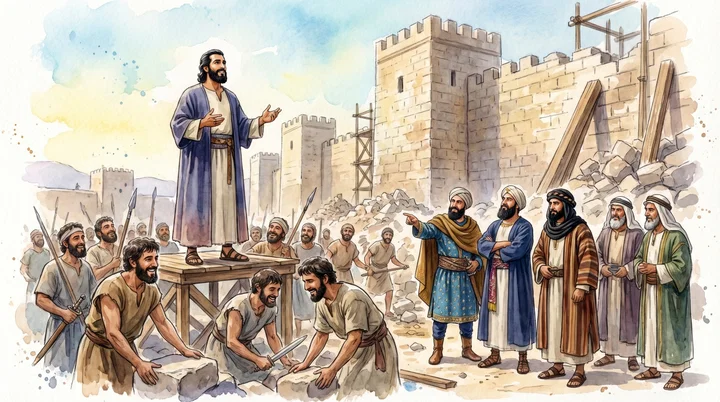
Cross-references
- Nehemiah 4:6
So built we the wall; and all the wall was joined together unto the half thereof: for the people had a mind to work.
The wall advances as the people work despite their enemies’ mockery.
- Nehemiah 4:8
And conspired all of them together to come and to fight against Jerusalem, and to hinder it.
Enemies conspire to stop the wall’s construction.
- Nehemiah 6:2-3
That Sanballat and Geshem sent unto me, saying, Come, let us meet together in some one of the villages in the plain of Ono. But they thought to do me mischief.
Nehemiah refuses an invitation intended to draw him away from rebuilding.
- Ezra 4:1-5
Now when the adversaries of Judah and Benjamin heard that the children of the captivity builded the temple unto the LORD God of Israel;
Adversaries weaken and frustrate the Jews’ rebuilding work.
- Nehemiah 2:19-20
But when Sanballat the Horonite, and Tobiah the servant, the Ammonite, and Geshem the Arabian, heard it, they laughed us to scorn, and despised us, and said, What is this thing that ye do? will ye rebel against the king?
Describes the chiefs’ efforts to oppose the wall’s restoration.
- Nehemiah 2:10
When Sanballat the Horonite, and Tobiah the servant, the Ammonite, heard of it, it grieved them exceedingly that there was come a man to seek the welfare of the children of Israel.
Names leaders hostile to Nehemiah’s work.
- Nehemiah 6:15
So the wall was finished in the twenty and fifth day of the month Elul, in fifty and two days.
wall finished in fifty-two days despite plots
- Daniel 9:25
Know therefore and understand, that from the going forth of the commandment to restore and to build Jerusalem unto the Messiah the Prince shall be seven weeks, and threescore and two weeks: the street shall be built again, and the wall, even in troublous times.
Foretells Jerusalem’s rebuilding in troublous times.
- Nehemiah 4:11
And our adversaries said, They shall not know, neither see, till we come in the midst among them, and slay them, and cause the work to cease.
The enemies plot to attack and stop the work.
- Nehemiah 1:3
And they said unto me, The remnant that are left of the captivity there in the province are in great affliction and reproach: the wall of Jerusalem also is broken down, and the gates thereof are burned with fire.
The broken walls and burned gates show Jerusalem’s desolation and the people’s plight.
- John 4:9
Then saith the woman of Samaria unto him, How is it that thou, being a Jew, askest drink of me, which am a woman of Samaria? for the Jews have no dealings with the Samaritans.
The woman notes that Jews have no dealings with Samaritans.
Commentary
Each commentary is drawn from primary sources: the writings of Ellen G. White and Adventist pioneers and periodicals. Each commentary is separate. Its own words are not a quotation; follow the references to read the source passages.
Ellen G. White
10 sources
The verse belongs to the opposition to the rebuilding of Jerusalem's walls, when the neighboring chiefs Sanballat, Tobiah, and Geshem watched Nehemiah's actions and tried to thwart his plans and hinder the work.PK 635.1 Sanballat speaks with scorn before his brethren and the army of Samaria, calling the Jews weak and feeble and mocking their ruined condition and their ability to fortify the city, to finish the work quickly in a day, and to revive usable stones out of heaps of burned rubbish.PK 635ST Dec 13, 1883PK 641.1–2 His question about sacrificing ridicules their ability to restore worship through sacrifice.ST Dec 13, 1883 The taunts were meant to sow doubt, discourage and divide the builders, and portray their undertaking as impossible and destined to fail.ST Dec 13, 1883PK 641.1–2
The verse displays the scorn, hostility, hatred, falsehood, and treachery of Sanballat and Tobiah toward the Jews as they worked.PK 675.2PK 676.2 It stands side by side with the nobility, devotion, and self-sacrifice of Ezra and Nehemiah as a sharp contrast between sin and holiness, between the fearful results of transgressing God's commands and the blessings of obedience.PK 676.2 That contrast is placed in Scripture so that beholders may shun sin and accept holiness and may freely choose whether to suffer transgression or enjoy obedience.PK 676.2
What the builders faced is typical of what God's workers face, as the enemies of God's work use contempt and ridicule to discourage its workers, make sacred things seem ridiculous, and encourage one another to turn people from their duty.ST Dec 13, 1883PK 644.3 That opposition includes contempt and cruelty from enemies and also discouragement and betrayal from professed or pretended friends, whose rebellious wills oppose God's requirements by supporting evil and giving the Lord's enemies material to use against His people.PK 644.3PK 675.2 Such contempt can be followed by more violent measures and persecution, especially when God's workers are active and successful.ST Dec 13, 1883PK 644.3 Although zealous opposition and hindrances at times nearly stopped the work, the Lord heard prayer and opened the way for it to continue, moving rulers to help carry out His purpose.Lt 139, 1903, par. 5–616MR 167.1–2
Sources
Pioneers and periodicals
31 sources
Sanballat spoke before his brethren and the army of Samaria to mock the Jews as feeble while they rebuilt Jerusalem's wall after the Babylonian captivity amid Samaritan and allied opposition.ST Dec 8, 1914RH Sep 21, 1916ST Aug 22, 1911 His taunting questions ridiculed whether they could fortify themselves, restore sacrifice and worship, finish quickly in a day, and revive usable stones out of heaps of burned rubbish.ST Dec 8, 1914ST May 14, 1902 The contempt was insincere and angry at their progress, meant to sow doubt and discourage the builders by making the work seem impossible, hopeless and destined to fail.ST Oct 25, 1899RH Dec 17, 1901 Yet the work continued and prospered because the people were united and organized, had a mind to work, prayed and persevered until the wall was joined, and God blessed them.RH Dec 24, 1914ST May 14, 1902 That scorn pictures the slander, conspiracy and treachery that still meet God's work and those who uphold His commandments and the third angel's message, while reviving stones from burned rubble shows that work for outcasts and downtrodden humanity will likewise draw scoffing yet can be prospered beyond expectation.ST Dec 13, 1883RH Dec 26, 1907RH Jun 24, 1852RH May 8, 1879RH Nov 12, 1901
Mockery and Historical Setting
Sanballat spoke these words before his brethren and the army of Samaria, calling the Jews feeble as they rebuilt the wall of Jerusalem after the return from Babylonian captivity, amid opposition from the Samaritans and others allied against them.ST Dec 8, 1914RH Sep 21, 1916ST Aug 22, 1911ST Jun 4, 1902 The growing bitterness between Jews and Samaritans is seen in his contemptuous challenge to their work.RH Sep 21, 1916
His taunting questions ridiculed whether they could fortify themselves and their city, whether they could offer sacrifices and restore worship, whether they could make an end in a day and finish the work quickly, and whether they could revive usable stones out of heaps of burned rubbish and rubble.ST Dec 13, 1883ST Dec 8, 1914ST May 14, 1902ST Jun 20, 1911 He called them weak and mocked the scale and speed of rebuilding from such ruin as futile.ST May 14, 1902ST Feb 6, 1893 The mockery was contemptuous and insincere, expressing anger at the Jews' progress rather than honest judgment.ST Oct 25, 1899 It stressed their weakness and suffering and derided their ability, and it was meant to sow doubt and discourage the builders, to make the work seem impossible and hopeless and destined to fail.ST Dec 13, 1883ST Dec 13, 1883RH Dec 17, 1901RH Feb 21, 1907
The setting is Nehemiah's restoration of Judah and Jerusalem, its wall and temple, with God's servants, opposed by factions led by Sanballat, Tobiah and Geshem and their allies.ST Apr 12, 1883ST Apr 19, 1883ST Oct 25, 1899 That opposition was carried out in the name of the king of Persia.ST Apr 12, 1883 The wall's restoration under Nehemiah took place seventy-three years after Zechariah's vision, while the Jews were surrounded by enemies.ST Apr 19, 1883 In B.C. 444 the settlement of oppression by brethren, with rebuke followed by covenant and restitution, came before the treacherous attempt to draw Nehemiah away from his work, before the wall was finished in fifty-two days so that even enemies perceived it was wrought of God, and before the appointing of officers and watches and the numbering of the Jews.ST Feb 13, 1893 The rebuilding amid opposition and difficult conditions took place in troublous times, fulfilling Daniel's prophecy that Jerusalem's walls and streets would be rebuilt after lying desolate.ST Mar 18, 1889RH Nov 13, 1856 That hardship and opposition made God's promise of restored peace and protection seem astonishing.ST Jun 21, 1883
Opposition Overcome and Applied
Despite the ridicule the work on the wall continued and prospered because the people were united, organized and cooperative and had a mind to work.RH Dec 24, 1914ST May 14, 1902ST Jun 20, 1911 They prayed and sought the Lord's blessing and persevered with determination through difficult conditions until the task was completed, and even completed quickly.RH Dec 24, 1914ST May 14, 1902RH Dec 17, 1901 After grief over the desolation with fervent prayer and confession, they repaired the breaches and waste places until the wall was joined to half its height, and God blessed and prospered the restoration despite bitter opposition from factions led by Sanballat, Tobiah and Geshem.ST Jun 2, 1909ST Jun 20, 1911 The adversaries' efforts to hinder the rebuilding belong to the conflicts surrounding God's work, which ultimately succeeds despite their opposition.ST Jun 2, 1909
The ridicule stands for the fierce opposition that can meet those carrying out God's work.ST Dec 13, 1883RH Dec 26, 1907 That opposition may include slander, conspiracy and treachery, and may come from within as well as from outside.RH Dec 26, 1907 Sacred things are made ridiculous, and scoffers encourage one another to turn people from duty.ST Dec 13, 1883 Such contempt and reproach confront workers for God, making their efforts and even their damaged materials seem too weak and hopeless to succeed, and such contempt can lead to more violent persecution when God's workers are active and successful.ST Dec 13, 1883RH Dec 26, 1907
The lesson is to strengthen those who build God's house rather than hinder them.RH Nov 19, 1861 Trying to be good brings a hard time, so believers should not be surprised when they have a hard time trying to be good.ST Aug 17, 1915 Nehemiah's course, saturated in the mind, shows exactly how to deal with modern Sanballats, Tobiahs and Geshams, so that instead of being undone by them believers gain a glorious victory over them as he did.RH Nov 19, 1861ST Aug 17, 1915
The same reproach confronts those who uphold God's commandments and teach the third angel's message, and as God was with Nehemiah's people so He is with them.RH Jun 24, 1852 As the work of Ezra and Nehemiah faced many adversaries, so did the work in apostolic times and in the days of the reformers, and so does the work in Ontario where organized opposition over Sunday observance stands against it, yet there is much to encourage because the canvassing work is improving and persons are accepting truth almost every week.RH Jun 24, 1852RH Dec 11, 1900 The Jews are described as feeble, despised, weak and trembling, and their weakness and suffering helped draw Nehemiah to share their lot and work for them.RH Oct 8, 1908RH May 8, 1879 When a few weak believers begin to build up God's work, opposers look on with derision and confidently expect every outward sign to prove failure, only to have their hopes turned to dismay when the workers are prospered beyond expectation and the cause is settled on a permanent foundation.RH Oct 8, 1908RH May 8, 1879
The reviving of stones out of heaps of burned rubble applies to work for outcasts and the downtrodden and lost humanity, and such service for lost humanity will likewise draw scoffing from those who slight it.RH Nov 12, 1901 Sanballat's questioning and scorning at the gateway of advancement is repeated today by anyone who hinders spiritual advancement among young people in a church or a conference.RH Aug 21, 1913 This need not be open opposition, for indifference or watching the efforts of others with a question mark puts a person in the ranks of a modern Sanballat, especially a person of considerable influence such as a parent, teacher, minister or conference officer.RH Aug 21, 1913 Because cooperation is fundamental to success in helping the young, such lack of united sympathetic cooperation causes failure in forming right thinking, action and character in youth and in rescuing many going down to eternal ruin.RH Aug 21, 1913
Sources