Nehemiah 4:19
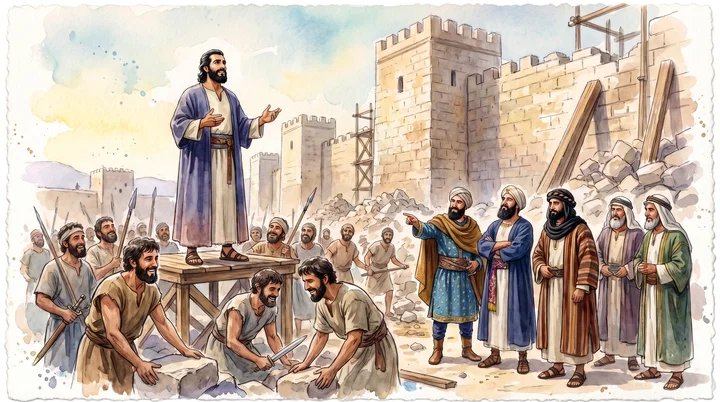
And I said unto the nobles, and to the rulers, and to the rest of the people, The work is great and large, and we are separated upon the wall, one far from another.
Translations
And I said to the nobles, and to the rulers, and to the rest of the people, The work is great and large, and we are separated on the wall, one far from another.
King James Version, KJV Cambridge Paragraph Bible
And I said unto the nobles, and to the rulers, and to the rest of the people, The work is great and large, and we are separated upon the wall, one far from another.
And I said to the nobles, and to the rulers, and to the rest of the people, The work is great and large, and we are separated upon the wall, one far from another.
Revised Version, American Standard Version
And I said unto the nobles, and to the rulers and to the rest of the people, The work is great and large, and we are separated upon the wall, one far from another:
And I say unto the freemen, and unto the prefects, and unto the rest of the people, 'The work is abundant, and large, and we are separated on the wall, far off one from another;
And I said to the nobles, and to the rulers, and to the rest of the people, The work is great and extended, and we are scattered upon the wall, one far from another:
So I said unto the nobles and unto the deputies, and unto the rest of the people, The work, is great and large,—and, we, are separated upon the wall, far away, each man from his brother:
Berean Standard Bible, Majority Standard Bible
Then I said to the nobles, the officials, and the rest of the people: “The work is great and extensive, and we are spread out far from one another along the wall.
I said to the nobles, and to the rulers and to the rest of the people, “The work is great and widely spread out, and we are separated on the wall, far from one another.
And I said to the great ones and the chiefs and the rest of the people, The work is great and widely spaced and we are far away from one another on the wall:
Then saide I vnto the Princes, and to the rulers, and to the rest of the people, The worke is great and large, and we are separated vpon the wall, one farre from another.
Douay-Rheims (Challoner revision)
And I said to the nobles, and to the magistrates, and to the rest of the common people: The work is great and wide, and we are separated on the wall one far from another:
Pictures
Cross-references
- Nehemiah 6:3
And I sent messengers unto them, saying, I am doing a great work, so that I cannot come down: why should the work cease, whilst I leave it, and come down to you?
Nehemiah refuses to leave his great work to meet his enemies.
- Nehemiah 4:6
So built we the wall; and all the wall was joined together unto the half thereof: for the people had a mind to work.
The people’s willingness to work supports the coordinated rebuilding.
- Nehemiah 6:15
So the wall was finished in the twenty and fifth day of the month Elul, in fifty and two days.
The wall is completed in fifty-two days through God’s work.
- Daniel 9:25
Know therefore and understand, that from the going forth of the commandment to restore and to build Jerusalem unto the Messiah the Prince shall be seven weeks, and threescore and two weeks: the street shall be built again, and the wall, even in troublous times.
Foretells Jerusalem’s rebuilding in troubled times.
- Nehemiah 2:3-11
And said unto the king, Let the king live for ever: why should not my countenance be sad, when the city, the place of my fathers’ sepulchres, lieth waste, and the gates thereof are consumed with fire?
These chapters describe the wall project and how the work was divided.
- Nehemiah 1:3
And they said unto me, The remnant that are left of the captivity there in the province are in great affliction and reproach: the wall of Jerusalem also is broken down, and the gates thereof are burned with fire.
The broken wall of Jerusalem prompts the work of rebuilding it.
- Nehemiah 3:28
From above the horse gate repaired the priests, every one over against his house.
Priests repair the wall near their own houses as part of the work.
- Nehemiah 4:23
So neither I, nor my brethren, nor my servants, nor the men of the guard which followed me, none of us put off our clothes, saving that every one put them off for washing.
Nehemiah and his companions remained ready even during rest.
Commentary
Each commentary is drawn from primary sources: the writings of Ellen G. White and Adventist pioneers and periodicals. Each commentary is separate. Its own words are not a quotation; follow the references to read the source passages.
Ellen G. White
2 sources
The work on the wall was great and large, a vast undertaking extending over a long circuit.ST Dec 13, 1883PK 644.1 The laborers were distributed along its length, stationed far apart from one another with wide intervals between them.ST Dec 13, 1883PK 644.1 Because they were thus scattered and separated, they could not see or aid each other directly, so a warning sound was appointed to call them together for united action when danger appeared.ST Dec 13, 1883PK 644.1 At that signal they were to hasten without delay to the place under threat and gather there to meet the attack as one body.ST Dec 13, 1883PK 644.1 Priests with trumpets gave the alarm, and the sounding was the pledge that God Himself would fight on behalf of the builders.ST Dec 13, 1883
Sources
Pioneers and periodicals
22 sources
The verse describes the rebuilding of Jerusalem after the captivity as a great and large wall-building work with the workers separated far apart upon the wall along its whole length, so they could not easily support one another and coordination was difficult while guarding against attack.RH Dec 24, 1914ST Feb 6, 1893ST Feb 6, 1893 The work was divided among people of every sort with each company knowing the portion for which it was directly responsible, yet no one's work was finished until all was done, so leaders arranged trumpet signals to rally all without delay to the threatened point with the assurance that God would fight for them, while the people prayed and watched with half working and half standing guard.RH Dec 24, 1914ST Feb 6, 1893RH Apr 8, 1909RH Aug 10, 1916 It illustrates strength in united effort and gospel order, one work and one wall and one people cooperating as one man until united effort achieved success.RH Apr 8, 1909RH Aug 10, 1916 Nehemiah's account of opposition and perseverance is a pattern for God's work in other ages, especially the last days, and applies to workers separated across mission fields where distance and the scale of the work make vigilance, alertness, and cooperation necessary, with readiness to summon one another's help and trust that God will fight for them.RH Dec 26, 1907RH Oct 8, 1908RH Nov 19, 1861ST Jun 2, 1909 When the enemy's attack is concentrated at one point, all the scattered workers must gather to that place in response while still advancing the whole work, answering as Nehemiah did when drawn away that they are doing a great work and cannot come down.ST Feb 13, 1893ST Nov 29, 1899
The Work on the Wall
The work was great and large, a wall-building spread across a long length with the laborers stationed far apart from one another upon it.RH Dec 24, 1914ST Feb 6, 1893RH Dec 26, 1907 Because they were separated one far from another along its whole extent, they could not easily support one another, and coordination was difficult while they also had to guard against attack.ST Feb 6, 1893ST Feb 6, 1893 The sections were laid out so that the whole wall could be covered and completed at about the same time, which made coordinated cooperation necessary in so large an undertaking.RH Dec 24, 1914
It was the rebuilding of Jerusalem after the captivity, with the labor divided among people of every sort and condition and advancing despite opposition.RH Apr 8, 1909RH Aug 10, 1916ST Oct 25, 1899 The work was systematically planned so that each company knew exactly the portion for which it was directly responsible, yet no one's work was finished until all was done.RH Apr 8, 1909RH Aug 10, 1916 This was Nehemiah's work of restoring Judah and Jerusalem, carried on while adversaries opposed the builders in the name of the king of Persia.ST Apr 12, 1883 The opposition came from the same class that had hindered the earlier work, and the wall was not permanently restored until his time, seventy-three years after Zechariah's vision.ST Apr 19, 1883ST Apr 19, 1883 Its restoration mattered because the Jews were surrounded by enemies, and the troubles of the restoration made God's promise of peace and security seem astonishing.ST Apr 19, 1883ST Jun 21, 1883
Because the great work left them scattered, those with general supervision arranged trumpet signals, sounded by priests, so that all could rally without delay to the threatened point in a crisis.RH Apr 8, 1909RH Aug 10, 1916ST May 14, 1902 The distance made such a coordinated signal necessary, with instructions for gathering together at its sound and the assurance that God would fight for them.ST Feb 6, 1893ST Feb 6, 1893ST May 14, 1902 The people prayed and watched and more thoroughly organized their forces, half working at the work with tools while the other half stood on guard with weapons.RH Apr 8, 1909RH Aug 10, 1916RH Jul 2, 1908 They kept watch through the night, laboring together despite separation, having a mind to work and calling for courage, continued effort, and trust in God while working against opposition.RH Apr 8, 1909RH Aug 10, 1916RH Jul 2, 1908
The work went on amid internal difficulties from oppression by brethren, which were settled by Nehemiah's rebuke with covenant and restitution.ST Feb 13, 1893 Enemies without and within renewed efforts to bring confusion and break down the organized effort as the work drew toward completion.RH Apr 8, 1909RH Aug 10, 1916 There were plots by Sanballat, Geshem and Tobiah to draw Nehemiah away, which he met with the answer that he was doing a great work so that he could not come down.ST Feb 13, 1893 That resolve to continue rather than be drawn away was shown amid opposition from surrounding enemies and unsympathetic people within the city.RH Apr 15, 1909 Despite machinations and plots the wall was finished in fifty-two days from the time he began, so that even enemies perceived the work was wrought of God, showing that hard opposition can be overcome in glorious victory.ST Feb 13, 1893ST Aug 17, 1915
United Effort and Application
The rebuilding stands as an illustration of strength in united effort and gospel order, one work and one wall carried by one people cooperating as one man until united effort achieved success.RH Apr 8, 1909RH Aug 10, 1916 The work was systematically planned so that each company knew exactly the portion for which it was directly responsible, yet no one's work was finished until all was done.RH Apr 8, 1909RH Aug 10, 1916 Because the work was great and extensive with the people separated far from one another upon the wall, they were exposed to enemies without and within who renewed efforts to bring confusion and break down the organized effort.RH Apr 8, 1909RH Aug 10, 1916 The answer was prayer and watchfulness with more thorough organization, half working at the work while the other half stood on guard, all having a mind to work.RH Apr 8, 1909RH Aug 10, 1916 Those with general supervision arranged trumpet signals so that all could rally without delay to the same place at the sound of the trumpet in a crisis, with the assurance that God would fight for them.RH Apr 8, 1909RH Aug 10, 1916
Nehemiah's account of opposition and perseverance in that large and demanding work, with workers spread far apart along the wall, is a pattern for God's work in other ages, especially the last days.ST Jun 2, 1909 It applies to workers separated across mission fields, where distance and the scale of the great and extensive work make vigilance, alertness, and cooperation necessary.RH Dec 26, 1907RH Oct 8, 1908 Spread far apart along a large work, they must remain alert and be ready to summon one another's help, trusting that God will fight for them.RH Dec 26, 1907RH Oct 8, 1908 The same picture warns against hindering the work and supports helping the builders in their large undertaking.RH Nov 19, 1861
The distance required them to respond together when the trumpet called for help at a particular point, while still continuing to advance the whole work. So when the enemy's attack is concentrated at one point, as in the crisis in missions, all the Lord's scattered workers must gather there in response.ST Nov 29, 1899ST Sep 15, 1898 The concentrated assault on missions is like the danger faced by the builders, with the scattered workers summoned to the place where the enemy's attack is focused.ST Nov 29, 1899ST Sep 15, 1898 The work went on amid internal difficulties from oppression by brethren, settled by rebuke with covenant and restitution, and amid plots by Sanballat, Geshem and Tobiah to draw Nehemiah away, which he met by answering that he was doing a great work so that he could not come down, an answer Christians should imitate when the tempter would seduce them from their work, and despite machinations the wall was finished in fifty-two days so that even enemies perceived it was wrought of God.ST Feb 13, 1893
Sources