Nehemiah 4:18
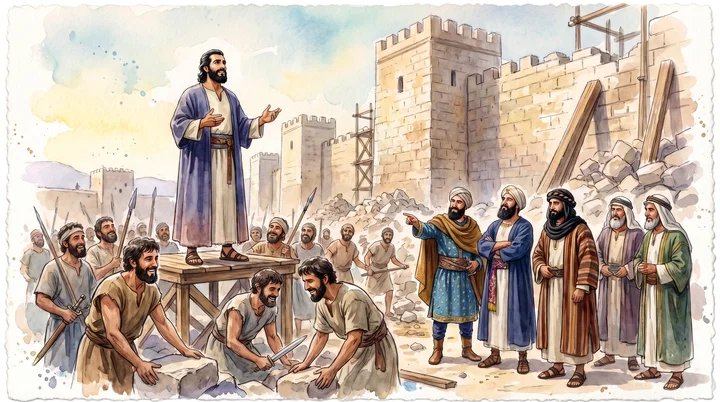
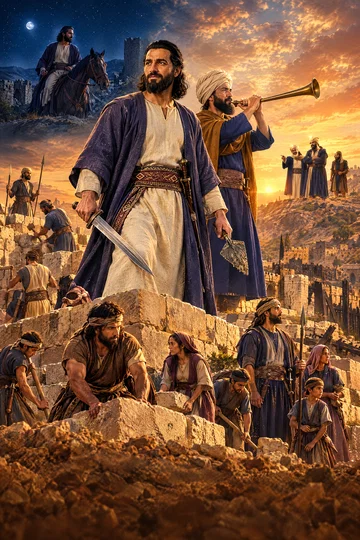
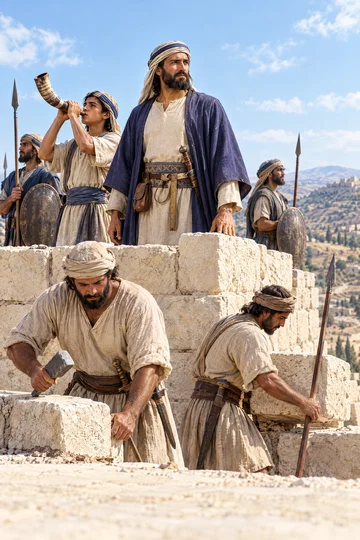
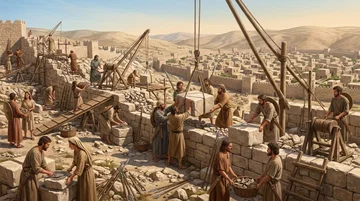
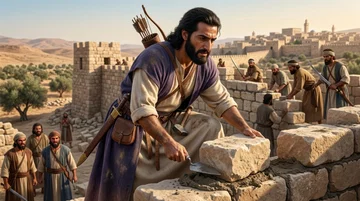
For the builders, every one had his sword girded by his side, and so builded. And he that sounded the trumpet was by me.
Translations
American King James Version, Webster Bible
For the builders, every one had his sword girded by his side, and so built. And he that sounded the trumpet was by me.
King James Version, KJV Cambridge Paragraph Bible
For the builders, every one had his sword girded by his side, and so builded. And he that sounded the trumpet was by me.
Revised Version, American Standard Version
and the builders, every one had his sword girded by his side, and so builded. And he that sounded the trumpet was by me.
And the builders [are] each with his sword, girded on his loins, and building, and he who is blowing with a trumpet [is] beside me.
And the builders had every one his sword girded by his side, and built. And he that sounded the trumpet was by me.
Even they who were building, every man, had his sword girded upon his loins, and so was building,—and, he that sounded the horn, was by my side.
Berean Standard Bible, Majority Standard Bible
And each of the builders worked with his sword strapped at his side. But the trumpeter stayed beside me.
Among the builders, everyone wore his sword at his side, and so built. He who sounded the trumpet was by me.
Every builder was working with his sword at his side. And by my side was a man for sounding the horn.
For euery one of the buylders had his sworde girded on his loynes, and so buylded: and he that blewe the trumpet, was beside me.
Douay-Rheims (Challoner revision)
For every one of the builders was girded with a sword about his reins. And they built, and sounded with a trumpet by me.
Pictures
Cross-references
- Nehemiah 4:14
And I looked, and rose up, and said unto the nobles, and to the rulers, and to the rest of the people, Be not ye afraid of them: remember the Lord, which is great and terrible, and fight for your brethren, your sons, and your daughters, your wives, and your houses.
The call to remember the Lord and resist fear precedes the builders’ work with swords.
- Nehemiah 3
Then Eliashib the high priest rose up with his brethren the priests, and they builded the sheep gate; they sanctified it, and set up the doors of it; even unto the tower of Meah they sanctified it, unto the tower of Hananeel.
The wall’s restoration took place in Nehemiah’s time.
- Nehemiah 4:6
So built we the wall; and all the wall was joined together unto the half thereof: for the people had a mind to work.
The people willingly worked together to rebuild the wall.
- Nehemiah 2:17-18
Then said I unto them, Ye see the distress that we are in, how Jerusalem lieth waste, and the gates thereof are burned with fire: come, and let us build up the wall of Jerusalem, that we be no more a reproach.
Nehemiah’s account describes the wall’s restoration and the people’s resolve to rebuild.
- Nehemiah 4:22
Likewise at the same time said I unto the people, Let every one with his servant lodge within Jerusalem, that in the night they may be a guard to us, and labour on the day.
People lodge within Jerusalem to keep watch at night and work by day.
- Nehemiah 4:23
So neither I, nor my brethren, nor my servants, nor the men of the guard which followed me, none of us put off our clothes, saving that every one put them off for washing.
Nehemiah and his companions remain clothed and prepared for service.
- Nehemiah 4:9
Nevertheless we made our prayer unto our God, and set a watch against them day and night, because of them.
The people prayed and kept watch against attack.
- Nehemiah 6:15
So the wall was finished in the twenty and fifth day of the month Elul, in fifty and two days.
wall finished despite plots after chapter 4
- Nehemiah 1:3
And they said unto me, The remnant that are left of the captivity there in the province are in great affliction and reproach: the wall of Jerusalem also is broken down, and the gates thereof are burned with fire.
The broken wall reported here was later restored in Nehemiah’s time.
- Nehemiah 4:10
And Judah said, The strength of the bearers of burdens is decayed, and there is much rubbish; so that we are not able to build the wall.
The builders’ weariness and the rubbish obstruct their work.
- Nehemiah 6:3
And I sent messengers unto them, saying, I am doing a great work, so that I cannot come down: why should the work cease, whilst I leave it, and come down to you?
next plot to draw Nehemiah from building
- Daniel 9:25
Know therefore and understand, that from the going forth of the commandment to restore and to build Jerusalem unto the Messiah the Prince shall be seven weeks, and threescore and two weeks: the street shall be built again, and the wall, even in troublous times.
The prophecy foretells Jerusalem’s rebuilding in troubled times.
Commentary
Each commentary is drawn from primary sources: the writings of Ellen G. White and Adventist pioneers and periodicals. Each commentary is separate. Its own words are not a quotation; follow the references to read the source passages.
Ellen G. White
10 sources
Every builder had his sword girded by his side as he built the wall of Jerusalem, so the rebuilding went forward in the midst of danger while each worker stayed ready to defend himself and the work against enemies.ST Dec 13, 1883PK 635PK 643.3 This is described as building with one hand while fighting with the other.Lt 30, 1888, par. 24–26 The man who sounded the trumpet remained by Nehemiah to give the alarm, while priests bearing sacred trumpets were stationed at different parts of the wall.PK 635ST Dec 13, 1883PK 644.1GC 56.2–3 At their signal the people were to come without delay to the place in danger, so that all could respond together at the threatened point.PK 635ST Dec 13, 1883PK 644.1 That trumpet call also signified that God would fight for them.ST Dec 13, 1883
Work that advances the kingdom of Christ meets opposition and therefore requires building while resisting it, with perseverance and readiness to resist attacks upon the truth.Lt 30, 1888, par. 24–26 It requires keeping on through difficulty and discouragement while armed against hindrance.18MR 329.2–3GC 56.2–3 For builders of Christ's church, to work with a tool in one hand and a weapon in the other means both to build up the temple of God and to tear down and fight against bigotry, prejudice, violence, and false foundations.8RED 79.1–3 Paul and his fellow workers thus build living stones of converted Jews and Gentiles upon Christ while contending continually against opposition that hinders the work.8RED 79.1–3 Stone after stone is still added until the church increases, because new workers take the place of those who fall by persecution, as Stephen, James, Paul, Peter, and John fell.8RED 79.1–3
Faithful builders upon the true foundation keep building with sword girded by the side when the rubbish of false doctrine obstructs the work and when persecution, fraud, iniquity, and every hindrance oppose its progress.4SP 59.3 Though wearied by constant struggle, they are tempted to turn away from the true foundation for the sake of peace and the security of property and life.4SP 59.3 The undaunted ones refuse to fear their enemies, remember the Lord who is great and terrible, and proceed with the work armed and ready.4SP 59.3
Sources
Pioneers and periodicals
35 sources
Every builder kept his sword girded at his side while he built the wall, and the man who sounded the trumpet stayed beside Nehemiah.ST Feb 6, 1893ST Dec 20, 1899ST Feb 6, 1893 The building and the armed watching went on together under threat of attack, and the trumpet signal was appointed to summon the people without delay to the place in danger, as a sign that God would fight for them.ST Oct 25, 1899RH Oct 8, 1908ST Mar 18, 1889ST Feb 6, 1893ST Oct 25, 1899 As the builders held building tools and weapons together until the work was finished, serving God involves continual conflict and requires both the trowel of duty and the sword of spiritual warfare.RH Feb 10, 1859RH Aug 21, 1856 Building with sword in hand means joining hard labor with constant vigilance, self-denial, sacrifice, and loyalty until the work is done despite opposition and discouragement.RH Dec 19, 1912RH Apr 22, 1902ST May 21, 1896 The workers spread over the whole wall and its sections rising together show that organized cooperation completes a shared work, and those who furnish material and means share in it as truly as the builders themselves.RH Dec 24, 1914RH Nov 19, 1861RH May 14, 1914
Building Amid Opposition
Every builder kept his sword girded at his side while he built the wall, continuing the repair work armed and ready to defend himself, and the man who sounded the trumpet stayed by Nehemiah.ST Dec 13, 1883ST Feb 6, 1893ST Dec 20, 1899ST Feb 6, 1893 The rebuilding of Jerusalem thus went forward amid opposition and under threat of attack, with swords fastened at the builders' sides as they worked.ST Dec 13, 1883ST Jun 2, 1909
The building and the armed watching went on together while enemies conspired to fight against Jerusalem, every builder working armed and ready for battle.ST Oct 25, 1899ST Oct 25, 1899ST Oct 25, 1899 The trumpet signalman remained beside Nehemiah to sound warning and alarm, as part of the arrangement for guarding the work and coordinating the people, so that building and watchfulness stood as united duties amid danger.ST Oct 25, 1899ST Feb 6, 1893ST Oct 25, 1899ST Oct 25, 1899 When danger threatened the trumpet sounded to alert and gather the builders to the threatened place.ST Mar 18, 1889RH Jul 2, 1908ST Aug 12, 1886
The verse belongs to the whole account of rebuilding the wall from Nehemiah 2:11 to 7:73, especially chapter 4, which fulfills Nehemiah's praying.ST Oct 25, 1899 It took place when Artaxerxes Longimanus was still emperor of Persia, Nehemiah was governor of Judah, and Ezra was religious teacher and scribe, after God moved the king to grant Nehemiah's request, after his journey to Jerusalem, his night examination of the wall, his meeting with the rulers to acquaint them with his plan, and the division of the work among people of every sort and condition, in the face of opposition from Sanballat the Horonite, Tobiah the Ammonite, and Geshem the Arabian.ST Oct 25, 1899 It is part of the central work of restoring the city and its government, the rebuilding of Jerusalem's walls in troubled times.RH Sep 21, 1916RH Nov 13, 1856 The wall was not permanently restored until Nehemiah's time, seventy-three years after Zechariah's vision, against the same class of adversaries who had hindered the rebuilding of the temple.ST Apr 19, 1883ST Apr 19, 1883 Chapter 4 comes after the work on the wall with its settlement of difficulties among the Jews arising from oppression by their brethren, Nehemiah's rebuke, and the covenant and restitution that followed, and before the plot of Sanballat, Geshem and Tobiah to draw Nehemiah away.ST Feb 13, 1893
The armed building displays Nehemiah's faithfulness, courage, and thorough organization amid unbelief and indifference among the Jews and persistent activity of adversaries to hinder the work, with thorough preparations for defense while carrying on the building unto glorious success.ST Mar 13, 1893 The troubles the Jews faced while rebuilding made God's promise of peace and a flourishing Jerusalem seem astonishing to them, though God was able to fulfill it.ST Jun 21, 1883 Nehemiah moved among the builders with a trumpeter to summon help wherever danger arose, and priests with sacred trumpets were stationed at different points; if danger arose their signal summoned the people without delay to gather when needed at the point threatened.ST Dec 13, 1883RH Oct 8, 1908ST Mar 18, 1889RH Jul 2, 1908 That trumpet alarm also signified that God would fight for them, not that the work was done or the enemy defeated in human strength.ST Dec 13, 1883ST Mar 13, 1893
Lessons For God's Work
The builders kept their building tools and their weapons together until the work was finished, and the Christian in the same way needs the trowel of duty as well as the sword of spiritual warfare, because serving God involves continual conflict.RH Feb 10, 1859RH Aug 21, 1856 This is laboring on at the rebuilding of spiritual Jerusalem despite opposition, building while remaining armed and ready to defend the work.RH Feb 10, 1859RH Aug 21, 1856
To build with the trowel in one hand and the sword in the other is to join hard manual labor with constant vigilance and self-denial, and the building went forward with sacrifice, loyalty, and long hours with weapons ready at the side.RH Dec 19, 1912RH Apr 22, 1902 Despite opposition and discouragement the builders finished restoring the wall while armed against attack, carrying the sword as they worked.ST May 21, 1896 The same joining of labor and vigilance applies to teachers and students building up a missionary training-school, holding instruments of labor in one hand and books in the other.RH Dec 19, 1912 They did brickmaking, masonry, hodcarrying, and carpentry themselves, much of it by student labor frequently without pay, to supply meager facilities under necessity.RH Dec 19, 1912
The rebuilding was organized so that workers covered the whole wall and its sections progressed together, each man working near his own house, showing how organized cooperation completes a shared work.RH Dec 24, 1914 Applied to the organized work of the church, its builders should be strengthened, and believers should not hinder them by opposing organization, while the trumpet sounding to coordinate the armed builders belongs to that order.RH Dec 24, 1914RH Nov 19, 1861 The wall called constantly for more mortar and material to build with, and those who furnished the material and means were as important to the building as the builders themselves.RH May 14, 1914 So also God's work now requires both workers and means, the Lord will supply them, and it is a privilege to be partners with the Lord in finishing His work.RH May 14, 1914
The trumpet summoned the builders with weapons at hand to gather where danger was greatest, and that call applies to an urgent missionary crisis, calling workers to concentrate their efforts at the point where the enemy's attack is focused.ST Sep 15, 1898
Nehemiah carried on the great work given him of restoring the city of his fathers and relieving his brethren with sustained loyalty and faithfulness, remaining resolute and unyielding through ridicule, intimidation, and attempted compromise.RH Apr 15, 1909 From the first his efforts invited bitter opposition from Sanballat, Tobiah, and Geshem in the surrounding territory, joined by a mixed multitude inside Jerusalem with no sympathy for Israel, who united in intrigue to bring the work into disrepute and frustrate the rebuilding.RH Apr 15, 1909 Ridicule was employed first without result, then intimidation, then attempted compromise to stop operations for conference, but there was no time for bickering and no place for compromise or unholy alliance or delay.RH Apr 15, 1909 God recognized such honesty of purpose and steadfastness of endeavor and accomplished through him a great work for the cause of truth in the earth.RH Apr 15, 1909 His faithfulness, courage, and organization carried the building unto glorious success amid unbelief and indifference among the Jews and persistent activity of adversaries to hinder it, with the sword-girded builders and the trumpeter by his side as thorough preparation for defense.ST Mar 13, 1893 That armed preparation did not mean doing the work or defeating the enemy in human strength, for God would fight for them.ST Mar 13, 1893 It teaches the wickedness of slander and backsliding and the value of righteousness and faithfulness, and that both work and readiness to defend it are necessary parts of acceptable service, since the builders continued their work in danger with weapon ready while they built.ST Mar 13, 1893RH Nov 12, 1901
The carrying of swords while continuing to build, with a man sounding the trumpet nearby, concerned the defense of a material wall-building project in Nehemiah's time.ST Jan 23, 1893ST Jan 23, 1893 It belonged to his civil work as governor, carried out under God's appointment and the authority granted by the king of Persia, with material defenses suited to that work and its setting against material enemies.ST Jan 23, 1893 It does not establish civil force as a method for advancing the spiritual work of the gospel.ST Jan 23, 1893
Sources