Nehemiah 8:4
And Ezra the scribe stood upon a pulpit of wood, which they had made for the purpose; and beside him stood Mattithiah, and Shema, and Anaiah, and Urijah, and Hilkiah, and Maaseiah, on his right hand; and on his left hand, Pedaiah, and Mishael, and Malchiah, and Hashum, and Hashbadana, Zechariah, and Meshullam.
Translations
And Ezra the scribe stood on a pulpit of wood, which they had made for the purpose; and beside him stood Mattithiah, and Shema, and Anaiah, and Urijah, and Hilkiah, and Maaseiah, on his right hand; and on his left hand, Pedaiah, and Mishael, and Malchiah, and Hashum, and Hashbadana, Zechariah, and Meshullam.
King James Version, KJV Cambridge Paragraph Bible, Webster Bible
And Ezra the scribe stood upon a pulpit of wood, which they had made for the purpose; and beside him stood Mattithiah, and Shema, and Anaiah, and Urijah, and Hilkiah, and Maaseiah, on his right hand; and on his left hand, Pedaiah, and Mishael, and Malchiah, and Hashum, and Hashbadana, Zechariah, and Meshullam.
Revised Version, American Standard Version
And Ezra the scribe stood upon a pulpit of wood, which they had made for the purpose; and beside him stood Mattithiah, and Shema, and Anaiah, and Uriah, and Hilkiah, and Maaseiah, on his right hand; and on his left hand, Pedaiah, and Mishael, and Malchijah, and Hashum, and Hashbaddanah, Zechariah, and Meshullam.
And Ezra the scribe standeth on a tower of wood that they made for the purpose, and Mattithiah standeth near him, and Shema, and Anaiah, and Urijah, and Hilkiah, and Maaseiah, on his right; and on his left Pedaiah, and Mishael, and Malchijah, and Hashum, and Hashbaddana, Zechariah, Meshullam.
And Ezra the scribe stood upon a high stage of wood, which they had made for the purpose. And beside him stood Mattithiah, and Shema, and Anaiah, and Urijah, and Hilkijah, and Maaseiah on his right hand; and on his left hand, Pedaiah, and Mishael, and Malchijah, and Hashum, and Hashbaddana, Zechariah, Meshullam.
And Ezra the scribe stood upon a lofty platform of wood, which they had made for the purpose, and there stood, beside him, Mattithiah and Shema and Anaiah and Uriah and Hilkiah and Maaseiah, on his right hand,—and, on his left, Pedaiah and Mishael and Malchijah and Hashum and Hashbaddanah, Zechariah, Meshullam.
Berean Standard Bible, Majority Standard Bible
Ezra the scribe stood on a high wooden platform built for this occasion. At his right side stood Mattithiah, Shema, Anaiah, Uriah, Hilkiah, and Maaseiah, and at his left were Pedaiah, Mishael, Malchijah, Hashum, Hash-baddanah, Zechariah, and Meshullam.
Ezra the scribe stood on a pulpit of wood, which they had made for the purpose; and beside him stood Mattithiah, Shema, Anaiah, Uriah, Hilkiah, and Maaseiah, on his right hand; and on his left hand, Pedaiah, Mishael, Malchijah, Hashum, Hashbaddanah, Zechariah, and Meshullam.
And Ezra the scribe took his place on a tower of wood which they had made for the purpose; and by his side were placed Mattithiah and Shema and Anaiah and Uriah and Hilkiah and Maaseiah on the right; and on the left, Pedaiah and Mishael and Malchijah and Hashum and Hashbaddanah, Zechariah and Meshullam.
And Ezra the Scribe stoode vpon a pulpit of wood which he had made for the preaching, and beside him stood Mattithiah, and Shema, and Ananiah, and Vriiah, and Hilkiah, and Maaseiah on his right hande, and on his left hand Pedaiah, and Mishael, and Malchiah, and Hashum, and Hashbadana, Zechariah, and Meshullam.
Douay-Rheims (Challoner revision)
And Esdras the scribe stood upon a step of wood, which he had made to speak upon, and there stood by him Mathathias, and Semeia, and Ania, and Uria, and Helcia, and Maasia, on his right hand: and on the left, Phadaia, Misael, and Melchia, and Hasum, and Hasbadana, Zacharia and Mosollam.
Pictures
Cross-references
- Ezra 7:10
For Ezra had prepared his heart to seek the law of the LORD, and to do it, and to teach in Israel statutes and judgments.
Ezra prepares to study, practice, and teach God’s law.
- Ezra 7:6
This Ezra went up from Babylon; and he was a ready scribe in the law of Moses, which the LORD God of Israel had given: and the king granted him all his request, according to the hand of the LORD his God upon him.
Describes Ezra, the scribe who read the law in Nehemiah.
- Joshua 8:34
And afterward he read all the words of the law, the blessings and cursings, according to all that is written in the book of the law.
Both describe the public reading of the law.
- Ezra 7:14
Forasmuch as thou art sent of the king, and of his seven counsellors, to enquire concerning Judah and Jerusalem, according to the law of thy God which is in thine hand;
Ezra brings the law to the people in Nehemiah 8.
- Leviticus 23:34-43
Speak unto the children of Israel, saying, The fifteenth day of this seventh month shall be the feast of tabernacles for seven days unto the LORD.
Sets out the feast whose celebration is described in Nehemiah 8.
- Nehemiah 9
Now in the twenty and fourth day of this month the children of Israel were assembled with fasting, and with sackclothes, and earth upon them.
The law reading is linked with repentance and returning to the Lord.
Commentary
Each commentary is drawn from primary sources: the writings of Ellen G. White and Adventist pioneers and periodicals. Each commentary is separate. Its own words are not a quotation; follow the references to read the source passages.
Ellen G. White
7 sources
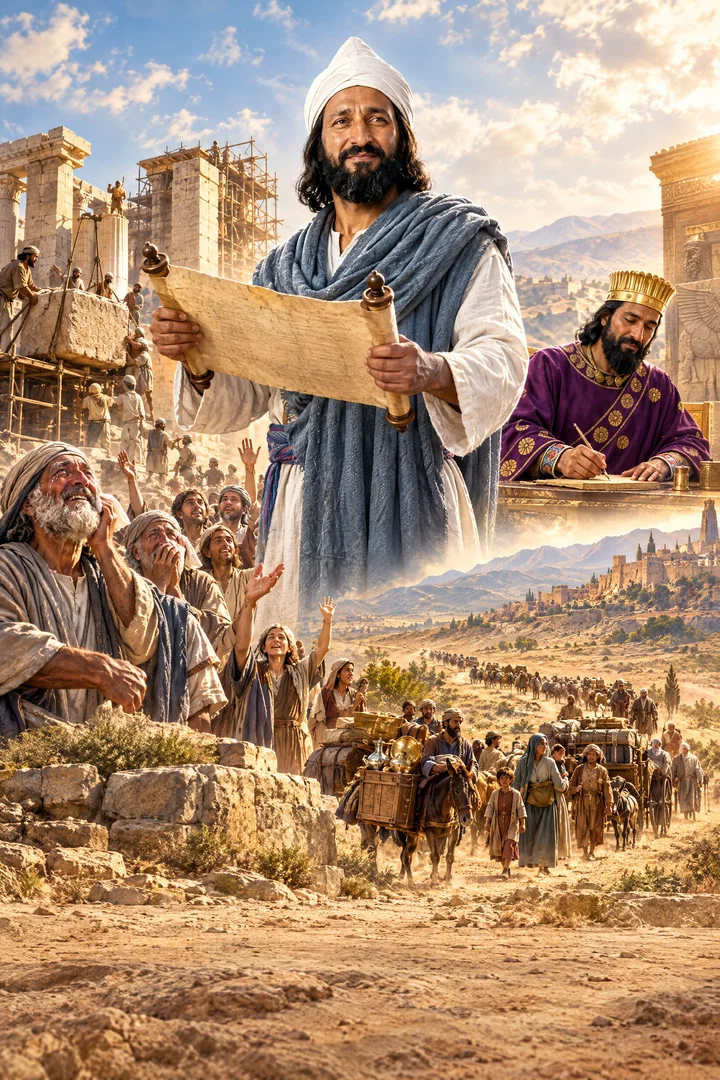
The time was the Feast of Trumpets, after the wall of Jerusalem had been rebuilt and the gates set up.PK 661.1–2 A large part of the city was still in ruins, with roughly built and partly ruined buildings standing on every hand.PK 661.1–2PK 661 Those ruins were sad reminders of Judah's departed glory surrounding the wooden pulpit that stood on a platform erected for the purpose in one of the broadest streets.PK 661.1–2PK 661
The children of the covenant had assembled at Jerusalem from all the surrounding country after the return from captivity.PK 661.1–2ST Apr 28, 1898 They formed a sea of heads, a large and attentive assembly of men gathered in organized order before the readers.PK 661.1–2Ms 53, 1910, par. 21–23PK 661 They had come at their own request for the public reading, following their repentance.ST Apr 28, 1898
Ezra the scribe was now an aged man, standing on the raised wooden pulpit and holding open the Book of the Law of Moses, which includes the Ten Commandments.PK 661.1–2PK 661 Beside him on his right hand and on his left stood his brother Levites and other named leaders and influential men.PK 661.1–2Ms 53, 1910, par. 21–23PK 661ST Apr 28, 1898Ms 41, 1900, par. 37–39 Their place with him on the platform gave dignity to the occasion.Ms 41, 1900, par. 37–39
He read the Scriptures publicly from morning until midday.ST Apr 28, 1898 Because intermarriage with other nations had corrupted the Hebrew language, priests and Levites helped explain the law in the people's own language.PK 661.3 In this way the reading was made understandable to the listeners.PK 661.3
The hearing of God's requirements brought the people to recognize their sins and their turning from God.Ms 121, 1898, par. 7–8 That turning had separated them from Him and led Him to permit heathen nations to rule over them.Ms 121, 1898, par. 7–8 Yet the public reading was a privilege meant for joy in God's mercy rather than gloom, so their sorrow over sin was to give way to rejoicing.Ms 41, 1900, par. 37–39
Sources
Pioneers and periodicals
19 sources
Ezra the scribe stood on a raised wooden platform built for the occasion so the great congregation could see and hear the public reading of the law.ST Dec 20, 1899ST Feb 25, 1886 Thirteen named leaders stood beside him on his right and on his left as appointed teachers to give dignity to the teaching place.ST Dec 20, 1899ST May 21, 1885 Men, women and children gathered at their own request and listened attentively for hours from morning till midday while the reading was made distinct and explained in language they could understand because copies were rare and their Hebrew had been corrupted.ST Apr 28, 1898RH Apr 22, 1902ST May 21, 1885ST May 21, 1896 The hearing belonged to a revival after neglect and decay, bringing conviction of transgression with weeping, then confession, putting away of sin, worship and answering Amen.RH Apr 22, 1902ST Feb 25, 1886ST May 21, 1896ST Aug 19, 1897 It led to prompt obedience to what was discovered, rejoicing in the Lord, keeping the Feast of Tabernacles and covenanting to obey, showing the preached Word mighty by the Spirit to restore and transform.RH Apr 7, 1904ST May 21, 1896ST Feb 12, 1885ST Aug 19, 1897ST Aug 12, 1897
The Public Reading Described
Ezra the scribe stood elevated on a raised wooden pulpit or platform built temporarily for the purpose of the public reading of God's law, set in the broad street by the water gate so the large congregation could see and hear.ST Dec 20, 1899ST Feb 25, 1886ST May 21, 1885 The raised platform, with its accompanying stands, was arranged in an organized public setting that helped the vast assembly hear the reading of Scripture.ST Dec 20, 1899ST Feb 25, 1886ST May 21, 1885 The elevation allowed Ezra to be seen and heard as he read, and the presence of others in the teaching place added dignity to the service.ST May 21, 1885RH Apr 7, 1904
Beside him stood thirteen men in all, named leaders ranged on his right hand and on his left.ST Dec 20, 1899ST May 21, 1885RH Apr 7, 1904ST May 21, 1896 They were Levites gathered with him as God-appointed teachers of the congregation.RH Apr 22, 1902RH Apr 7, 1904ST May 21, 1896 Their standing with Ezra at the reading gave order and weight to the place of instruction.ST Dec 20, 1899RH Apr 7, 1904ST Feb 12, 1885
The reading gathered a great company of men, women, and children who came at their own request after repentance.ST Apr 28, 1898RH Apr 22, 1902 They listened attentively to the reading of the law and the teaching of the Levites, joining actively by answering Amen to what they understood.RH Apr 22, 1902ST Feb 25, 1886ST Feb 25, 1886 They patiently endured a lengthy service in an inconvenient posture.RH May 24, 1870
The setting was Jerusalem after the return from Babylonian captivity and after the rebuilding of the wall and gates, while much of the city still lay in ruins recalling its former glory.ST Apr 28, 1898RH Apr 22, 1902 The occasion belonged to the time of the Feast of Tabernacles.RH Jan 14, 1862 The period is the age of Ezra and Nehemiah studied for Babylonian life and archaeological evidence bearing on the Bible narrative.ST Mar 10, 1909
The law was read from morning till midday, for the fourth part of the day, with hours of reading and teaching by Ezra and the Levites.ST Apr 28, 1898RH Apr 22, 1902ST Aug 19, 1897 The people remained through that long reading, listening to the Word read distinctly with the sense given so they understood.RH Apr 22, 1902ST Aug 19, 1897
Copies of the sacred books were then so rare that the people depended on hearing Scripture read and explained, and access to that public hearing brought overwhelming joy.ST Aug 12, 1897 Their Hebrew had become corrupted through contact with other nations, so the speakers needed to explain the law in language the people could understand. The law was therefore read distinctly and its meaning explained, a pattern of genuine preaching that gives God's word and helps people understand it.ST May 21, 1885ST May 21, 1896ST Aug 19, 1897
Revival Through the Word
The verse belongs to a religious revival and reformation that followed the building of the walls after the people had grown negligent in the study of the Scriptures and after general decay that had deprived the Levites of their work.RH Apr 22, 1902ST May 21, 1896ST Aug 19, 1897 In that revival the people were turned back to the law of Moses in separation from the world, gathering as a great company of men, women, and children about Ezra and the Levites and listening for hours, even the fourth part of the day, to the reading of the law and the teaching of the Levites.RH Apr 22, 1902ST May 21, 1896 The Levites stood before the congregation as God-appointed teachers, the Word was read from morning till midday distinctly with the sense given so the people understood, and the reading was followed by confessions, the putting away of sin when sins were revealed, and the worship of God.RH Apr 22, 1902ST Aug 19, 1897
Hearing the law read and explained brought conviction and recognition of transgression with weeping which Ezra calmed.ST May 21, 1896ST Aug 19, 1897 The people listened, joined in worship, and took an active part by answering Amen to what they understood.RH Apr 22, 1902ST Feb 25, 1886 That understanding led to putting away the sins revealed and to worship, showing the work done through the Word of God.RH Apr 22, 1902ST Aug 19, 1897
The hearing led to rejoicing in the Lord, to keeping the Feast of Tabernacles, and to covenanting to obey.ST May 21, 1896 It led to prompt obedience upon discovering a command in the law, showing that written duty is to be followed even when earlier generations have not practiced it.ST May 21, 1896ST Feb 12, 1885 That study of God's Word also led the people to recognize their duty to support the worship of God's house.ST May 21, 1896RH Jul 9, 1908
The people entered into a solemn covenant to keep the law of Moses that Ezra had brought home with him, and that covenant established the Pentateuch as the canonical and authoritative book of the Jews, a standing it has kept without question to the present.ST Sep 26, 1895 In this Ezra carried out at Jerusalem in the restoration after the Babylonian captivity what he had prepared his heart to do, to seek the law of the Lord and to do it and to teach statutes and judgments in Israel.ST Sep 26, 1895RH Oct 16, 1900
The Word preached from the temporary wooden platform was mighty in restoring Jerusalem and the temple and in transforming the people.ST May 24, 1899ST May 24, 1899 Though copies of the sacred books were so rare that the people depended on hearing Scripture read and explained, access to that public reading brought them overwhelming joy.ST Aug 19, 1897ST Aug 12, 1897 That work was not by might nor by army but by the Spirit of God, showing that the outpouring of the Spirit comes in connection with study of the Word.ST Aug 19, 1897 Though there was much business to attend to, no other priests are shown holding business meetings elsewhere, while Ezra stood on the raised platform with thirteen others beside him in the teaching place adding dignity to the service.RH Apr 7, 1904ST Aug 19, 1897
Sources