Nehemiah 8:3
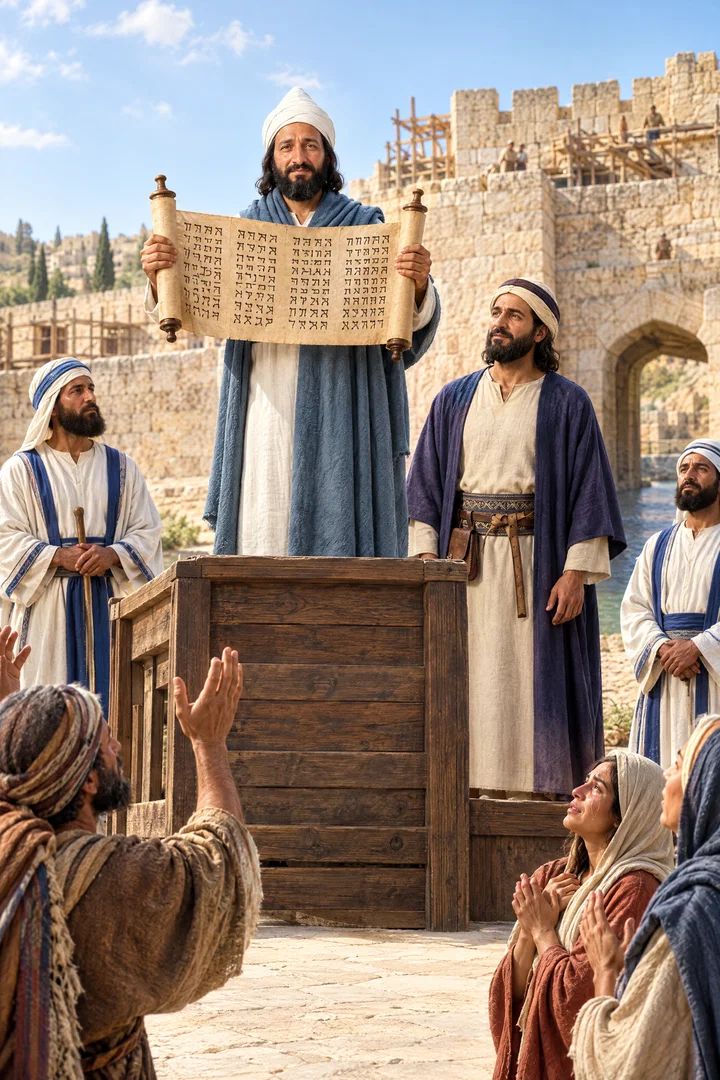
And he read therein before the street that was before the water gate from the morning until midday, before the men and the women, and those that could understand; and the ears of all the people were attentive unto the book of the law.
Translations
And he read therein before the street that was before the water gate from the morning until midday, before the men and the women, and those that could understand; and the ears of all the people were attentive to the book of the law.
King James Version, KJV Cambridge Paragraph Bible
And he read therein before the street that was before the water gate from the morning until midday, before the men and the women, and those that could understand; and the ears of all the people were attentive unto the book of the law.
And he read therein before the street that was before the water-gate from the morning until mid-day, before the men and the women, and those that could understand; and the ears of all the people were attentive to the book of the law.
Revised Version, American Standard Version
And he read therein before the broad place that was before the water gate from early morning until midday, in the presence of the men and the women, and of those that could understand; and the ears of all the people were attentive unto the book of the law.
and he readeth in it before the broad place that [is] before the water-gate, from the light till the middle of the day, over-against the men, and the women, and those intelligent, and the ears of all the people [are] unto the book of the law.
And he read in it before the open place that was before the water-gate from the morning until midday, in presence of the men and the women, and those that could understand. And the ears of all the people were [ attentive] to the book of the law.
and read therein, before the broad place which was before the water-gate, from the time it was light, until the noon of the day, in presence of the men and the women, and such as had understanding,—and, the ears of all the people, were unto the book of the law.
Berean Standard Bible, Majority Standard Bible
So Ezra read it aloud from daybreak until noon as he faced the square before the Water Gate, in front of the men and women and those who could understand.And all the people listened attentively to the Book of the Law.
He read from it before the wide place that was in front of the water gate from early morning until midday, in the presence of the men and the women, and of those who could understand. The ears of all the people were attentive to the book of the law.
He was reading it in the wide place in front of the water-doorway, from early morning till the middle of the day, in the hearing of all those men and women whose minds were able to take it in; and the ears of all the people were open to the book of the law.
And he read therein in the streete that was before the watergate (from the morning vntill the midday) before men and women, and them that vnderstoode it, and the eares of all the people hearkened vnto the booke of the Lawe.
Douay-Rheims (Challoner revision)
And he read it plainly in the street that was before the water gate, from the morning until midday, before the men, and the women, and all those that could understand: and the ears of all the people were attentive to the book.
Pictures
Cross-references
- Nehemiah 8:8
So they read in the book in the law of God distinctly, and gave the sense, and caused them to understand the reading.
The law is read distinctly and explained so the people understand it.
- Deuteronomy 31:24-26
And it came to pass, when Moses had made an end of writing the words of this law in a book, until they were finished,
Moses writes the law in a book and commands that it be placed beside the ark.
- 2 Chronicles 34:30
And the king went up into the house of the LORD, and all the men of Judah, and the inhabitants of Jerusalem, and the priests, and the Levites, and all the people, great and small: and he read in their ears all the words of the book of the covenant that was found in the house of the LORD.
The book of the covenant is read aloud to the people.
- Nehemiah 9:3
And they stood up in their place, and read in the book of the law of the LORD their God one fourth part of the day; and another fourth part they confessed, and worshipped the LORD their God.
The people hear the law read and respond with confession and worship.
- 2 Chronicles 34:14
And when they brought out the money that was brought into the house of the LORD, Hilkiah the priest found a book of the law of the LORD given by Moses.
Both identify Mosaic law as a book.
- Ezra 7:10
For Ezra had prepared his heart to seek the law of the LORD, and to do it, and to teach in Israel statutes and judgments.
Nehemiah’s public reading carries out Ezra’s purpose to teach the law.
- Deuteronomy 31:9-11
And Moses wrote this law, and delivered it unto the priests the sons of Levi, which bare the ark of the covenant of the LORD, and unto all the elders of Israel.
Moses gives the written law to the priests and commands its public reading.
- Deuteronomy 31:10-13
And Moses commanded them, saying, At the end of every seven years, in the solemnity of the year of release, in the feast of tabernacles,
Commands the law to be read publicly to the people.
- Galatians 3:10
For as many as are of the works of the law are under the curse: for it is written, Cursed is every one that continueth not in all things which are written in the book of the law to do them.
Both texts refer to the book of the law.
- Ezra 7:6
This Ezra went up from Babylon; and he was a ready scribe in the law of Moses, which the LORD God of Israel had given: and the king granted him all his request, according to the hand of the LORD his God upon him.
Identifies Ezra as a scribe of the law read.
- Joshua 8:34
And afterward he read all the words of the law, the blessings and cursings, according to all that is written in the book of the law.
Both describe the public reading of the law.
- Nehemiah 8:9-10
And Nehemiah, which is the Tirshatha, and Ezra the priest the scribe, and the Levites that taught the people, said unto all the people, This day is holy unto the LORD your God; mourn not, nor weep. For all the people wept, when they heard the words of the law.
The people wept at the law, then were urged to rejoice.
- Nehemiah 8:12
And all the people went their way to eat, and to drink, and to send portions, and to make great mirth, because they had understood the words that were declared unto them.
The people rejoiced because they understood what was read.
- 2 Kings 22:8
And Hilkiah the high priest said unto Shaphan the scribe, I have found the book of the law in the house of the LORD. And Hilkiah gave the book to Shaphan, and he read it.
The discovered book is called the law of Moses.
- Nehemiah 8:14-17
And they found written in the law which the LORD had commanded by Moses, that the children of Israel should dwell in booths in the feast of the seventh month:
After studying the law, the people observe the feast they find written there.
- Psalms 119:18
Open thou mine eyes, that I may behold wondrous things out of thy law.
Prays for open eyes to see the law’s meaning.
- Isaiah 30:9
That this is a rebellious people, lying children, children that will not hear the law of the LORD:
Contrasts attentive listening with refusing to hear God’s law.
- 2 Kings 23:21
And the king commanded all the people, saying, Keep the passover unto the LORD your God, as it is written in the book of this covenant.
Both call Mosaic law a book.
Commentary
Each commentary is drawn from primary sources: the writings of Ellen G. White and Adventist pioneers and periodicals. Each commentary is separate. Its own words are not a quotation; follow the references to read the source passages.
Ellen G. White
9 sources
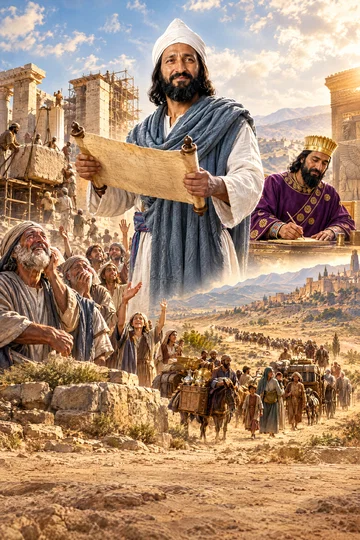
The verse belongs to the public reading of the law at Jerusalem after the wall and gates had been rebuilt, while much of the city still lay in ruins, held in the broad street before the Water Gate.PK 661.1–2Ms 156, 1902, par. 17–20PK 661 The reading took place because the returned Jews requested the Scriptures, and such public reading was commanded but had not been observed during the captivity.ST Apr 28, 1898 Ezra stood on a raised wooden platform holding open the Book of the Law of Moses, which contains the Ten Commandments, with priests, Levites and other men beside him.PK 661.1–2PK 661.3PK 661 He read distinctly from morning until midday.PK 661.1–2PK 661.3PK 661ST Apr 28, 1898
Before him was gathered a large assembly from the surrounding country of men, women and all who could understand.PK 661.1–2Ms 156, 1902, par. 17–20PK 661.3PK 661ST Apr 28, 1898 They listened attentively and reverently from morning until midday, showing readiness to hear God's instruction.Ms 156, 1902, par. 17–20PK 661.3PK 661PK 662.1–2ST Apr 28, 1898 Some raised their hands and leaned forward, and after the blessing they answered with amen, bowed their heads and worshiped.PK 661.1–2PK 661 Because intermarriage with other nations had corrupted the Hebrew language, careful explanation was required.PK 661.3 So the reading was given in the language of the people and those who understood explained the sense of its principles to the many who were ignorant, so that all might understand it.PK 661.3Ms 41, 1900, par. 37–39
What was read set forth God's requirements and recalled His blessings for obedience and warnings for disobedience, and its influence revealed the people's response to His word.Ms 121, 1898, par. 7–8Ms 41, 1900, par. 37–39 As the meaning was explained the people recognized their guilt and mourned their sins with sorrow over their national sins.PK 662.1–2Ms 41, 1900, par. 37–39 It was a deep response of repentance and return to the Lord of the kind later expected when the law was read.DA 215.3–216.1PK 662.1–2Ms 41, 1900, par. 37–39
The occasion was a high privilege and joyful one on a commanded festival day of rejoicing, so the people were told to restrain their grief and rejoice in God's mercy.PK 662.1–2Ms 41, 1900, par. 37–39 The day was devoted first to religious exercises and then to sharing food, recounting God's blessings and sending portions to the poor.PK 662.1–2 And they rejoiced because the law had been read and understood.PK 662.1–2Ms 41, 1900, par. 37–39
Sources
Pioneers and periodicals
28 sources
Ezra read the book of the law aloud in public in the street before the Water Gate from morning until midday, for hours, about a quarter of the day.RH Apr 22, 1902ST Feb 12, 1885RH Sep 21, 1916 Men and women and all who could understand, including children, stood and listened with sustained, eager attention through the long reading because God's word was precious to them.RH Apr 22, 1902ST Feb 25, 1886ST Feb 25, 1886 It was read distinctly and then explained by Ezra's assistants and the Levites so the people could grasp its real meaning and understand what God required, help made necessary because copies were rare and the Hebrew Scriptures were not readily understood by all.ST Dec 20, 1899ST May 21, 1896 The book read was the book of the law of Moses commanded to Israel, written by Moses' hand and containing their covenant and ordinances, distinct from the Ten Commandments God wrote on stone and placed in the ark, which could have been read in a few minutes.RH Oct 21, 1851RH Apr 30, 1857RH Oct 8, 1857RH Apr 21, 1851RH Aug 5, 1851 Hearing and understanding convicted the people of transgression, moved them to weep, and wrought spiritual renewal and reformation not by excitement or human might but by the Spirit working through the Word, leading them to obey plainly revealed duty and to rejoice because the joy of the Lord was their strength.ST May 21, 1896ST Aug 19, 1897ST Feb 13, 1893ST Dec 30, 1913
The Public Reading
The reading was public, held in the open street before the Water Gate, with Ezra reading the book of the law aloud from morning until midday, for hours through the morning, about a quarter of the day.RH Apr 22, 1902ST Feb 12, 1885ST Aug 19, 1897RH Apr 30, 1857 The long reading from morning to midday was followed by teaching from the Levites, and the people listened closely during the public reading of God's law.RH Apr 22, 1902RH Sep 21, 1916
Those gathered were the men and the women and all who could understand, including children, who stood and listened attentively the whole time from dawn to midday.RH Apr 22, 1902ST Feb 25, 1886ST Feb 25, 1886ST Jun 12, 1879ST Jun 12, 1879 Their sustained, close attention through so long a gathering showed eagerness to hear God's word read and explained, and patience in a long service because it was precious to them.ST Jun 12, 1879ST Jun 12, 1879RH Jul 2, 1908 Such attention was fitting because the words of Moses' book were truly God's words, showing reverence for Scripture when read and respect for its divine Author.ST Feb 25, 1886ST Feb 25, 1886
The law was read distinctly and its real meaning made clear so the people could understand what God required, with Ezra's assistants and the Levites helping them understand it by simple explanation.ST Dec 20, 1899ST May 21, 1896ST Jun 12, 1879 Making its broad requirements clear in this way is the duty of religious teachers, calling for gifted, Spirit-guided teachers even though its words are brief and plain.ST Dec 20, 1899 Such help was needed because copies of the sacred books were then so rare that the people depended on hearing Scripture read and explained, and because the Hebrew Scriptures were not readily understood by everyone.ST Aug 12, 1897ST Jun 12, 1879
The event belongs to the restoration of Jerusalem after the return from Babylonian captivity, when Nehemiah served as governor and Ezra as priest.ST Sep 26, 1895RH Oct 16, 1900 It is recorded in Nehemiah 8-10 as the last reform on Nehemiah's return to Jerusalem, about 446-408, when he worked always with the highest good of Jerusalem in mind, for God and for the Lord's city and the Lord's people.ST Aug 23, 1910 It belongs to the time when affliction and captivity had turned the minds of Israel to the Lord and His word after a time when little regard was paid to the word of God and the people mocked the messengers of God and despised His words and misused His prophets until there was no remedy.STRH Oct 16, 1900
The returned Jews had requested the Scriptures for this public reading, which had been commanded but had not been observed during the captivity.ST Apr 28, 1898 Ezra had brought the law of Moses up to Jerusalem from Babylon after it had fallen into disuse, to seek the law of the Lord and to do it and to teach statutes and judgments in Israel.ST Sep 26, 1895RH Oct 16, 1900 It thus belongs to the beginning of attention to the sacred books of the law and prophets, since commentaries on them did not exist until after the return from captivity.RH Oct 16, 1900
The surrounding account is that of the Feast of Tabernacles, celebrated after the people had gathered the land's produce and involving rejoicing before the Lord and dwelling in booths to remember Israel's wilderness sojourn.RH Jan 14, 1862
Revival Through God's Word
The reading and clear explanation of the law convicted the hearers of transgression, warned them of danger, awakened their consciences, and laid open sins that had to be put away.ST May 21, 1896ST Aug 19, 1897 That conviction moved the whole assembly to weep when they understood what they heard.ST May 21, 1896 The great reformation after the Babylonian captivity was wrought in this way through the Word of God, bringing spiritual renewal through extended Bible instruction in which the people desired to learn God's will.ST Aug 19, 1897ST Feb 13, 1893ST Dec 30, 1913 It was accomplished not by might nor by army but by the Spirit of God, showing that a genuine outpouring and lasting work of the Spirit comes in connection with study of God's Word and with new light in reproof or instruction from that Word.ST Aug 19, 1897
The revival was stirred by Scripture itself and not by efforts to manufacture excitement. Their grief was intense but unhelpful, so Ezra calmed it and the people were encouraged to rejoice because the joy of the Lord was their strength.ST May 21, 1896 Access to the Word thus brought overwhelming joy.ST May 21, 1896ST Aug 12, 1897 Hearing the law when it was plainly found in God's written Word led directly to obedience, without waiting to see whether ancestors had done so.ST Feb 12, 1885 That same study led them to recognize their duty to support the worship of God's house.RH Jul 9, 1908
Remembrance that neglect of God's law had caused the exile produced determined rigid observance after the return.ST That determined strictness was then pushed by the enemy of the law into fanatical over-observance, with rabbis loading the Sabbath with fanciful opinions and oppressive ceremonial restrictions having little reference to its true meaning.ST So when Jesus came as the very embodiment of the true Sabbath idea He was persecuted.ST The account, set at the Feast of Tabernacles kept after gathering the land's produce with rejoicing before the Lord and dwelling in booths to remember the wilderness sojourn, probably typifies the rejoicing after God's people are finally gathered into His kingdom.RH Jan 14, 1862 It is typical of God's work in other ages, especially the last days.RH Jan 14, 1862ST Jun 2, 1909
The public reading from morning until midday was central to the gathering and taught the value of reading God's Word and making it plain, which strengthens Christians.ST Dec 20, 1899ST Feb 13, 1893RH Jul 2, 1908 Making its real meaning clear so the people could grasp what God required is the duty of religious teachers.ST Dec 20, 1899 That work calls for gifted, Spirit-guided teachers to expound the law's broad requirements, even though its words are brief and plain.ST Dec 20, 1899 The long reading is Bible instruction and does not describe a Sunday observance.ST Feb 13, 1893
The Book Of Moses
The book Ezra brought and read was the book of the law of Moses which the Lord had commanded to Israel.RH Oct 21, 1851RH Oct 8, 1857RH Apr 21, 1851 It is called the Book of the Law of Moses and the book of the covenant, written by the hand of Moses in a book.RH Oct 21, 1851RH Apr 21, 1851RH Aug 5, 1851 It contained the agreement between God and Israel and the ordinances of their religion.RH Aug 5, 1851RH Dec 9, 1851 The people asked for it to be brought and it was read aloud to the assembled men, women, and all who could understand, who listened attentively to its extended reading.RH Oct 8, 1857RH Apr 21, 1851RH Dec 9, 1851
Its public reading from morning until midday distinguishes it from the Ten Commandments, which could have been read in a few minutes.RH Oct 21, 1851RH Apr 30, 1857 It is therefore distinct from the Ten Commandments that God wrote on tables of stone.RH Oct 21, 1851RH Aug 5, 1851RH Dec 9, 1851 Those commandments were placed in the ark, while this was a book law written in a book.RH Oct 21, 1851RH Apr 30, 1857 The length of the reading proves the book of the covenant to be the typical law of Moses and not the law on stone.RH Apr 30, 1857RH Aug 5, 1851RH Dec 9, 1851
Though written in Moses' book, its words were truly God's words.ST Feb 25, 1886ST Feb 25, 1886 Attentive hearing of the reading from morning until midday by men and women and all able to understand showed reverence for Scripture when read.ST Feb 25, 1886ST Feb 25, 1886 Such attention was fitting and showed respect for its divine Author.ST Feb 25, 1886ST Feb 25, 1886
Ezra had brought the law of Moses up to Jerusalem from Babylon after it had fallen into disuse.ST Sep 26, 1895 He succeeded in leading the people returned from Babylon to return to the practice of the laws and forms of worship enjoined by the writings of Moses.ST Sep 26, 1895 The men and women who could understand listened attentively to the book of the law and entered into a solemn covenant to keep it.ST Sep 26, 1895 That covenant established the Pentateuch as the canonical and authoritative book of the Jews, so remaining to the present time and never questioned even when admission of later books was discussed.ST Sep 26, 1895
Sources