Joshua 8:34
And afterward he read all the words of the law, the blessings and cursings, according to all that is written in the book of the law.
Translations
American King James Version, King James Version, KJV Cambridge Paragraph Bible, Webster Bible
And afterward he read all the words of the law, the blessings and cursings, according to all that is written in the book of the law.
Revised Version, American Standard Version
And afterward he read all the words of the law, the blessing and the curse, according to all that is written in the book of the law.
And afterwards he hath proclaimed all the words of the law, the blessing and the reviling, according to all that is written in the book of the law;
And afterwards he read all the words of the law, the blessing and the curse, according to all that is written in the book of the law.
And, after that, read he all the words of the law, the blessing and the cursing,—according to all that was written in the scroll of the law.
Berean Standard Bible, Majority Standard Bible
Afterward, Joshua read aloud all the words of the law— the blessings and the curses—according to all that is written in the Book of the Law.
Afterward he read all the words of the law, the blessing and the curse, according to all that is written in the book of the law.
And after, he gave them all the words of the law, the blessing and the curse, as it is all recorded in the book of the law;
Then afterwarde hee read all the wordes of the Lawe, the blessings and cursings, according to all that is written in the booke of the Lawe.
Douay-Rheims (Challoner revision)
After this he read all the words of the blessing and the cursing and all things that were written in the hook of the law.
Pictures
Cross-references
- Deuteronomy 27:11-26
And Moses charged the people the same day, saying,
Moses assigns the tribes to the mountains and specifies the curses proclaimed there.
- Deuteronomy 28
And it shall come to pass, if thou shalt hearken diligently unto the voice of the LORD thy God, to observe and to do all his commandments which I command thee this day, that the LORD thy God will set thee on high above all nations of the earth:
Sets out the law’s blessings for obedience and curses for disobedience.
- Deuteronomy 31:11-12
When all Israel is come to appear before the LORD thy God in the place which he shall choose, thou shalt read this law before all Israel in their hearing.
The law is read aloud to all Israel so they may learn and obey it.
- Deuteronomy 27:2-8
And it shall be on the day when ye shall pass over Jordan unto the land which the LORD thy God giveth thee, that thou shalt set thee up great stones, and plaister them with plaister:
the command for plastered stones that Joshua fulfilled
- Deuteronomy 11:29-30
And it shall come to pass, when the LORD thy God hath brought thee in unto the land whither thou goest to possess it, that thou shalt put the blessing upon mount Gerizim, and the curse upon mount Ebal.
Moses directed Israel to proclaim the blessings and curses at Ebal and Gerizim.
- Exodus 20:1-17
And God spake all these words, saying,
Joshua repeated the Ten Commandments, including the Sabbath command grounded in creation.
- Deuteronomy 27:8
And thou shalt write upon the stones all the words of this law very plainly.
Both describe the law’s words being written on stones.
- 2 Kings 23:2-3
And the king went up into the house of the LORD, and all the men of Judah and all the inhabitants of Jerusalem with him, and the priests, and the prophets, and all the people, both small and great: and he read in their ears all the words of the book of the covenant which was found in the house of the LORD.
Josiah read the covenant book aloud, and the people pledged to keep its words.
- Deuteronomy 31:9
And Moses wrote this law, and delivered it unto the priests the sons of Levi, which bare the ark of the covenant of the LORD, and unto all the elders of Israel.
commands periodic public reading
- Deuteronomy 11:18-20
Therefore shall ye lay up these my words in your heart and in your soul, and bind them for a sign upon your hand, that they may be as frontlets between your eyes.
Both call Israel to keep God’s words and teach them to their children.
- Deuteronomy 27:15
Cursed be the man that maketh any graven or molten image, an abomination unto the LORD, the work of the hands of the craftsman, and putteth it in a secret place. And all the people shall answer and say, Amen.
A specific curse from the law recited at Mount Ebal.
- Nehemiah 8:1-3
And all the people gathered themselves together as one man into the street that was before the water gate; and they spake unto Ezra the scribe to bring the book of the law of Moses, which the LORD had commanded to Israel.
Both describe the public reading of the law.
- Genesis 12:6-7
And Abram passed through the land unto the place of Sichem, unto the plain of Moreh. And the Canaanite was then in the land.
Shechem recalled God’s covenant with Abraham.
- 2 Kings 22:13
Go ye, enquire of the LORD for me, and for the people, and for all Judah, concerning the words of this book that is found: for great is the wrath of the LORD that is kindled against us, because our fathers have not hearkened unto the words of this book, to do according unto all that which is written concerning us.
Josiah recognized that Judah had failed to obey the law’s words.
- Joshua 24:1
And Joshua gathered all the tribes of Israel to Shechem, and called for the elders of Israel, and for their heads, and for their judges, and for their officers; and they presented themselves before God.
vows renewed at Shechem before Joshua's death
Commentary
Each commentary is drawn from primary sources: the writings of Ellen G. White and Adventist pioneers and periodicals. Each commentary is separate. Its own words are not a quotation; follow the references to read the source passages.
Ellen G. White
6 sources
The verse records a covenant renewal on entering Canaan, with Mount Ebal and Mount Gerizim standing as witnesses to Israel's solemn vows, vows that were later renewed when the tribes assembled at Shechem before Joshua's death.PP 522.4Ms 135, 1899, par. 7 The place at Shechem recalled God's covenant with Abraham and Jacob.PP 522.4Ms 135, 1899, par. 7 That later renewal recalled the evidences of what God had done in giving Israel a land for which they did not labor, cities they did not build, and vineyards and oliveyards they did not plant.Ms 135, 1899, par. 7
The gathering was to recognize God's law and renew covenant loyalty before taking possession of the inheritance, putting this higher religious duty before further military operations.PP 499.2–3 All Israel was present, including men, women, children, and resident strangers.PP 499.2–3 While the people remained faithful to God they were protected even among unconquered enemies.PP 499.2–3
Joshua publicly read the blessings for obeying God's law and the curses for disobeying it, so that everyone could know the covenant terms for possessing Canaan and assent to the consequences of obeying or neglecting them.PP 500.3PP 500.4ST May 12, 1881 The tribes stationed on Gerizim and on Ebal answered Amen to their respective portion.PP 500.3 He then read the rest of the law, including the statutes and judgments delivered through Moses, and he also repeated the Ten Commandments and the statutes and precepts recorded through Moses.PP 500.3ST May 12, 1881 The law had been written out where all could read it, as well as preserved in the ark.PP 500.4 This public reading came only weeks after Moses had delivered Deuteronomy to the people.PP 500.4
Sources
Pioneers and periodicals
19 sources
Soon after Israel entered the promised land and took Ai after an earlier defeat there, distinct from what took place at Mount Sinai, Joshua built an altar of whole stones on Ebal, inscribed a copy of the law on great plastered stones, and with all Israel standing half toward Gerizim and half toward Ebal around the ark read the law aloud as Moses had commanded.ST Sep 26, 1906RH Mar 25, 1902 What was read was every word of the blessings and cursings exactly as written in the book of the law with nothing omitted, including not only the ten precepts spoken from Sinai but the statutes and precepts communicated to Moses and written by him, read before the whole congregation with the women and little ones and strangers.RH Jul 28, 1863RH Jan 4, 1912 The blessings were for obedience and the faithful and the cursings for disobedience and sin, and the altar standing on the mount of cursing showed that transgression had justly incurred wrath which would at once fall except for the atonement represented by the sacrifice.ST Jun 25, 1912ST Aug 27, 1896 The book so read contained moral, civil, and ceremonial laws given to regulate the Jewish theocracy, though it was held by some to be the temporary levitical system distinct from the perpetual moral law of God.ST Dec 16, 1897RH Aug 20, 1872 Joshua's withholding of nothing teaches that a minister should faithfully declare every command of God, that the law should be read publicly at appointed times so all may know and practice it, and that the choice between blessing and curse still confronts every hearer with victory already given by faith over every sin and besetment.ST Jan 17, 1884RH Jul 28, 1863RH Apr 29, 1875ST Jun 25, 1912RH Apr 20, 1911
Ceremony and Setting
The reading belongs to the days soon after Israel had crossed the Jordan and entered the promised land, just after the taking of Ai when Israel returned under changed circumstances after an earlier defeat there.ST Sep 26, 1906ST Oct 16, 1884 One account places the rehearsal of the word on Ebal and Gerizim as Israel was about to enter Canaan, and another places the gathering at Shechem after the conquest of Canaan.RH Mar 25, 1902ST Sep 8, 1898 The episode is distinct from what took place at Mount Sinai.ST Oct 16, 1884
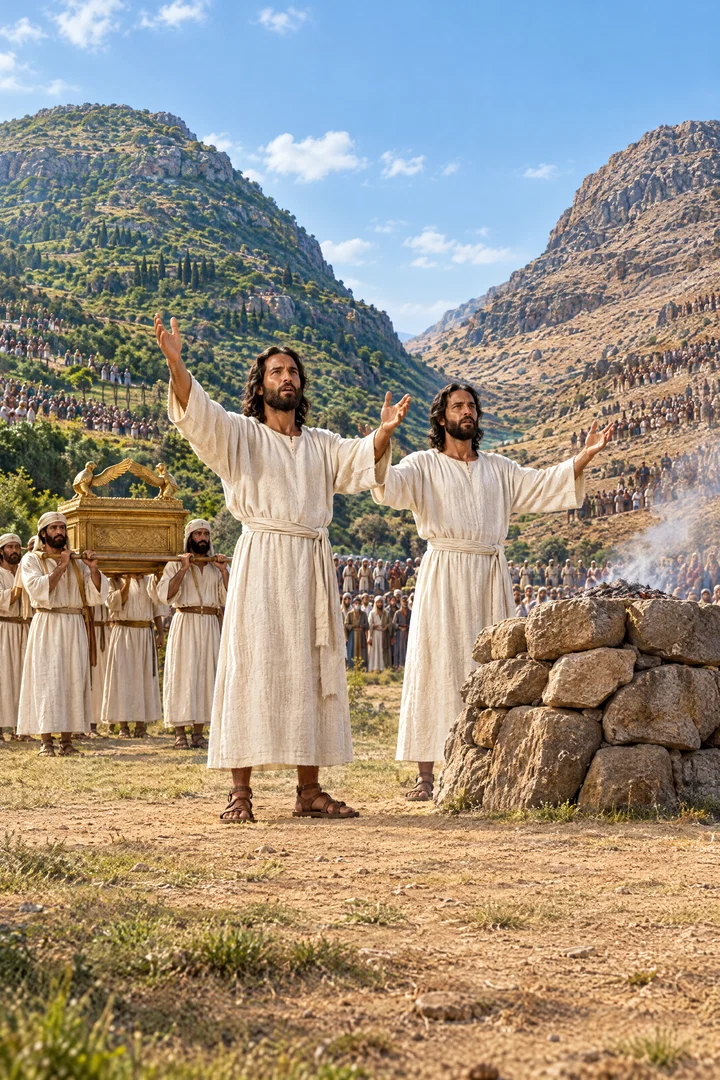
The reading followed the building of an altar of whole stones on Mount Ebal and the inscribing of a copy of the law of Moses upon great plastered stones. All Israel then stood half over against Mount Gerizim and half over against Mount Ebal before the ark. After the law was so inscribed at the altar, it was read aloud as Moses had commanded.
The gathering was in the valley of Sychar a short distance east of Shechem, between Mount Ebal, the mount of cursing, and Mount Gerizim, the mount of blessing.RH Apr 29, 1875ST Sep 8, 1898ST Aug 20, 1912 Ebal and Gerizim stand on either side of the road south to Jerusalem at Shechem.ST Aug 20, 1912 Mount Ebal is 3,077 feet high and barren from its base, while Mount Gerizim is 2,848 feet high with its foot green with verdure.ST Sep 8, 1898
The ark rested midway in the valley with the priests and Levites around it.RH Apr 29, 1875 Half the tribes stood toward Gerizim to pronounce the blessings and six tribes toward Ebal to pronounce the curses.RH Apr 29, 1875ST Sep 8, 1898 The Levites pronounced the curses from Ebal and the blessings from Gerizim. The sons of Rachel with Benjamin and Joseph shared the honor of Gerizim together with all the sons of Leah except Zebulun and Reuben, and all the rest stood on Ebal.RH Apr 29, 1875
At the leader's command the priests turned first to Gerizim to speak blessing, as blessed is the man that never makes a graven image, and the answer came in loud amens that shook the mountain.RH Apr 29, 1875 Then they turned northward to Ebal to chant cursing, as cursed is the man that makes any molten image, answered by a deep loud amen.RH Apr 29, 1875 Every blessing and every curse was so recited with the people's fearful, awestruck assent.RH Apr 29, 1875 The tribes standing around the altar answered the words with a united amen.RH Apr 29, 1875RH Jan 4, 1912
What was read was all the words of the law, the blessings and cursings, exactly as written in the book of the law, with not one word of all that was commanded omitted.RH Jul 28, 1863ST Jun 25, 1912 It included not only the ten precepts spoken from Sinai but the laws communicated to Moses and written by him in a book, including the Ten Commandments and the statutes and precepts he recorded.ST May 12, 1881 The reading was before the whole congregation, with the women and little ones and strangers present.RH Jul 28, 1863
The book of the law so read contained moral, civil, and ceremonial laws, given to regulate the Jewish theocracy.ST Dec 16, 1897 Those who distinguished the two laws taught that the law publicly read with its blessings and cursings was the temporary levitical ceremonial system given to the children of Israel, distinct from the perpetual moral law of God.RH Aug 20, 1872
The blessings were pronounced for the faithful and for obedience, and the cursings for the disobedient and for disobedience, representing the consequences of choosing obedience or sin.ST May 12, 1881ST Jun 25, 1912ST Aug 27, 1896 The altar standing on Ebal, the mountain of the curse, showed that Israel by transgression had justly incurred wrath which would at once fall except for the atonement represented by the altar of sacrifice. God honored Ebal and Gerizim by having His words pronounced from them.ST Aug 27, 1896
Connections and Application
The blessings read at Mount Gerizim belong to the place later regarded by the Samaritans as their place of worship, where their ancestors worshiped for more than four hundred years before Christ.ST Sep 3, 1894ST Sep 3, 1894 The surrounding account in chapters 7 and 8 shows the awful results of even one sin and one sinner among God's people. That result appeared in Israel's humiliation at Ai because of self-sufficiency, followed by final triumph over that place by faith.RH Apr 20, 1911
The curses pronounced from Mount Ebal have been literally fulfilled, and the fulfillment is still visible in the whole country around Shechem, Ebal, Gerizim, Sychar, Jacob's well and Joseph's burial place.ST Sep 8, 1898 The valley east of the well is naturally fertile but now lies indifferently cultivated, showing that fulfillment.ST Sep 8, 1898 Joshua's example of reading all the words of the law before the whole congregation, including both blessings and curses and omitting none of what was written, teaches that a minister should faithfully declare every command and withhold nothing given by God.RH Jul 28, 1863
Moses and Joshua commanded that the law be read publicly at appointed times so all the people would know its commands and put them into practice.ST Jan 17, 1884 The Sabbath was part of that law, marking Israel as worshippers of the Creator.ST Jan 17, 1884 Its appointed day was the day God rested, not a day people could choose.ST Jan 17, 1884
The imposing scene of reciting every blessing and every curse made a memorial the listening, gazing children will never forget to their dying day.RH Apr 29, 1875 It is pictured as a New-Year gathering between Ebal and Gerizim, where the tribes stand around the altar and answer the words of blessing with a united amen.RH Apr 29, 1875RH Jan 4, 1912 Israel there heard the whole law read aloud, including its blessings and curses.RH Jan 4, 1912
The blessings and curses represented the consequences of choosing obedience or sin, a choice that applies to a nation's present crisis.ST Jun 25, 1912 The lesson of victory at Ai is that God has already given victory by faith over sins of commission and omission, over indolence and slothfulness, over every besetment, over pride, love of the world, selfishness, and over every wrong word and action.RH Apr 20, 1911 Believers must by faith take that victory and enter into the freedom of the children of the King, resulting in the manifestation of the Spirit, the revelation of divine power, the turning of many souls from error to truth, the lighting of the earth with glory, the falling of the latter rain, the cutting short of the work in righteousness, and the gathering of God's people when the Lord comes in power and great glory.RH Apr 20, 1911
Sources