Numbers 11:35
And the people journeyed from Kibroth-hattaavah unto Hazeroth; and abode at Hazeroth.
Translations
And the people journeyed from Kibrothhattaavah to Hazeroth; and stayed at Hazeroth.
King James Version, KJV Cambridge Paragraph Bible
And the people journeyed from Kibroth-hattaavah unto Hazeroth; and abode at Hazeroth.
And the people journeyed from Kibroth-hattaavah to Hazeroth: and abode at Hazeroth.
Revised Version, American Standard Version
From Kibroth-hattaavah the people journeyed unto Hazeroth; and they abode at Hazeroth.
From Kibroth-Hattaavah have the people journeyed to Hazeroth, and they are in Hazeroth.
From Kibroth-hattaavah the people journeyed to Hazeroth; and they were at Hazeroth.
From Kibroth-hattaavah, the people set forward to Hazeroth,—and they remained in Hazeroth.
Berean Standard Bible, Majority Standard Bible
From Kibroth-hattaavah the people moved on to Hazeroth, where they remained for some time.
From Kibroth Hattaavah the people traveled to Hazeroth; and they stayed at Hazeroth.
From Kibroth-hattaavah the people went on to Hazeroth; and there they put up their tents.
From Kibroth-hattaauah ye people tooke their iourney to Hazeroth, and abode at Hazeroth.
Douay-Rheims (Challoner revision)
And that place was called, The graves of lust: for there they buried the people that had lusted. And departing from the graves of lust, they came unto Haseroth, and abode there.
Pictures
Cross-references
- Numbers 12:1
And Miriam and Aaron spake against Moses because of the Ethiopian woman whom he had married: for he had married an Ethiopian woman.
Miriam and Aaron speak against Moses after the people arrive at Hazeroth.
- Numbers 12:16
And afterward the people removed from Hazeroth, and pitched in the wilderness of Paran.
traces next move to Paran
- Numbers 33:18-36
And they departed from Hazeroth, and pitched in Rithmah.
lists eighteen camps to Kadesh-barnea
- Numbers 11:4-6
And the mixt multitude that was among them fell a lusting: and the children of Israel also wept again, and said, Who shall give us flesh to eat?
The people’s longing for Egypt’s food began the episode.
- Psalms 78:26-31
He caused an east wind to blow in the heaven: and by his power he brought in the south wind.
God provides the people meat in answer to their desire, then judges them.
- 1 Corinthians 10:11
Now all these things happened unto them for ensamples: and they are written for our admonition, upon whom the ends of the world are come.
Israel’s wilderness experiences are examples for later believers.
Commentary
Each commentary is drawn from primary sources: the writings of Ellen G. White and Adventist pioneers and periodicals. Each commentary is separate. Its own words are not a quotation; follow the references to read the source passages.
Ellen G. White
1 source
Numbers 11:35 belongs to the account of Israel's rebellion in the wilderness.PP 378.4–379.1 Its chapter setting places the march from Kibroth-hattaavah to Hazeroth after a renewed outbreak of murmuring against God.PP 378.4–379.1 That context includes the earlier judgment at Taberah, where fire consumed some of the complainers.PP 378.4–379.1 Their complaining had passed beyond mere discontent and had become rebellion against God, calling forth that consuming judgment.PP 378.4–379.1
Sources
Pioneers and periodicals
15 sources
After the judgment on those who lusted for flesh, the people left Kibroth-hattaavah, the graves of lust where the lustful were buried, and journeyed to Hazeroth and remained there a much longer time than usual.ST May 6, 1913ST May 13, 1889RH Mar 12, 1867ST May 6, 1889 The stay followed their lusting for flesh and for the food of Egypt, fish, cucumbers, melons, leeks, onions and garlic, while complaining against God despite the simple, wholesome manna He rained from heaven.RH Apr 17, 1879ST Apr 22, 1889RH Jul 10, 1916 After they greedily ate the quail, a very great plague slew many, for God gave their request but sent leanness of soul, and the murmuring generation except Caleb and Joshua and the children perished in the wilderness without entering the promised land.RH Apr 17, 1879ST Apr 22, 1889ST May 6, 1913RH Jul 25, 1907RH Aug 15, 1912 The giving of animal food here was only by concession because of repining and murmuring, not part of God's original plan when man's diet was every herb bearing seed and every tree with fruit yielding seed.RH Jun 25, 1914 Looking back with longing while doubting His promises shows a divided, double-minded heart prizing earth above heaven, whereas one must look only unto Jesus and seek first the kingdom of God and His righteousness.ST Apr 22, 1889RH Jul 10, 1916
Wording and Wilderness Setting
After the judgment on those who lusted for flesh, the people journeyed from Kibroth-hattaavah, where those who lusted were buried, to Hazeroth and stayed there, moving on only after the graves had been filled and that judgment had ended.ST May 6, 1913RH Mar 12, 1867ST May 6, 1889RH Aug 15, 1912 The name Kibroth-hattaavah means graves of lust and marked the place as a lasting reminder of sin meant to lead to humility.ST May 6, 1913 Their demand for flesh despite the manna provided was sinful and displeasing to God.RH Mar 12, 1867 That journey brought them to the place where Miriam and Aaron spoke against Moses.ST May 6, 1889
The word abode means they remained at Hazeroth a much longer time than usual, a long stay after the punishment of Miriam and before the sending of the spies.ST May 13, 1889 Hazeroth lay only a few miles from Sinai, with the wilderness of Paran beginning a few miles north and extending to the Promised Land.ST May 13, 1889
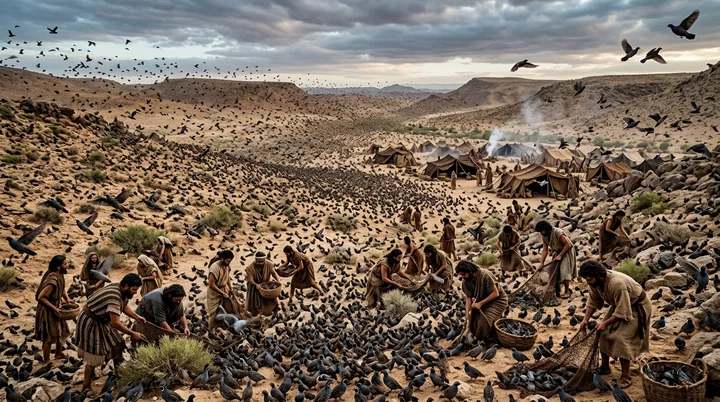
The verse belongs to the second giving of quails, distinct from the first giving in the Wilderness of Sin when quails came at evening before manna fell the next morning, coming a year later.ST Apr 22, 1889 At the close of the account Israel lusted after flesh and the Lord sent quails for a full month, bringing them from the sea and letting them fall by the camp a day's journey on each side as it were two cubits high upon the face of the earth, which means the birds flew about three feet high above the ground within reach where anyone could take as many as he chose, not that they were packed solid three feet deep over a territory forty miles across.RH Jan 11, 1915
Sin, Judgment, and Warning
The chapter shows Israel under wilderness trials lusting for flesh and for the food of Egypt — fish, cucumbers, melons, leeks, onions and garlic used in idolatrous feasts — complaining against God and His dealings and continually looking back with desire for things left behind, despite the simple, wholesome, nourishing manna God rained from heaven.RH Apr 17, 1879ST Apr 22, 1889RH Jul 10, 1916 Their demand for flesh despite the manna provided was sinful and displeasing to God.RH Jun 26, 1860RH Mar 12, 1867 It stands as an example of peevishness, fretfulness, and murmuring that God regards as sin and that shows how a holy God views this spirit.RH Jun 26, 1860
After the people greedily ate the quail sent to them, a very great plague struck them and many people were slain.ST May 6, 1913RH Jul 25, 1907 God gave them their request for flesh but sent leanness of soul, bringing physical and spiritual loss.ST Apr 22, 1889RH Jul 10, 1916 Their continued murmuring was followed by the withdrawal of God's protecting care; they wandered in the wilderness, and the generation that had left Egypt, except Caleb and Joshua and the children, perished without entering the promised land.RH Apr 17, 1879 This warns that people whose hearts remain in Egypt, consumed by desires and murmuring, are not ready to enter the promised land.RH Apr 17, 1879RH Aug 15, 1912
They later blamed Moses for not warning them of the result of eating the quail and regarded the wilderness sentence as his arbitrary decision to destroy them.RH Jul 25, 1907 The episode is an extremely sad but important lesson showing the awful consequences of lust.ST Feb 20, 1912
Doctrine and Moral Application
The eating of animal food in the desert was permitted only by concession to repining and murmuring, not as part of God's original and eternal plan.RH Jun 25, 1914 Before sin animal food formed no part of man's diet, which was only every herb bearing seed and every tree with fruit yielding seed, and though after sin God permitted flesh foods His original purpose remained unchanged.RH Jun 25, 1914 In leading Israel out of Egypt He rained bread from heaven, giving animal food in Numbers 11 only upon complaint, and later safeguarding health by distinguishing clean and unclean beasts for diet.RH Jun 25, 1914
Intemperate craving and discontent with God's healthful provision brings judgment rather than blessing.RH Jul 10, 1916 Israel complained against God's dealings and longed for the food of Egypt instead of remaining content with the simple, wholesome and nourishing manna God rained from heaven.RH Jul 10, 1916 God gave them their desire for flesh food but sent leanness into their soul, bringing physical and spiritual loss.RH Jul 10, 1916 That lesson is repeated today by those who reject plain nourishing food.RH Jul 10, 1916
The verse belongs to the second giving of quails, distinct from the first giving in the Wilderness of Sin when quails came at evening before manna fell the next morning, coming a year later.ST Apr 22, 1889 The mixed multitude of Egyptian and Israelitish blood had become weary of manna and fell a lusting for the fish, cucumbers, melons, leeks, onions and garlic of Egypt used in idolatrous feasts, continually looking back and desiring things left behind while the promised land of milk and honey was eclipsed.ST Apr 22, 1889 They doubted God's promises of the land and His power to supply present food, so God gave them their request but sent leanness of soul.ST Apr 22, 1889 The Christian who looks back with longing shows a divided, double-minded, unstable heart lacking faith and consecration, prizing earth above heaven and the temporal above the eternal.ST Apr 22, 1889 He must instead look only unto Jesus and seek first the kingdom of God and His righteousness, since any other way to earthly prosperity brings leanness of soul.ST Apr 22, 1889
The people's complaints showed that the manna, though it testified to the Sabbath, had become ordinary to them.RH Jan 7, 1862 Their murmuring against the bread sent from heaven reflected hardened disregard for that testimony.RH Jan 7, 1862
The verse belongs to the account where Moses complained of his excessive burdens and the Lord relieved him by bidding him gather seventy men of the elders of Israel to the tabernacle.RH Mar 22, 1870 The Lord then came down and took of the Spirit that was upon Moses to endow the whole company of seventy.RH Mar 22, 1870 This testifies to the broad spirit of Moses and to the gifts and graces he possessed, yet it left him with great loss.RH Mar 22, 1870 The episode shows the awful consequences of lust and also the broad spirit of Moses. If God calls to great labors He gives great grace, and it is wiser to cheerfully bear heavy burdens than to meet the loss of divine help.RH Mar 22, 1870
Sources