Numbers 12:5
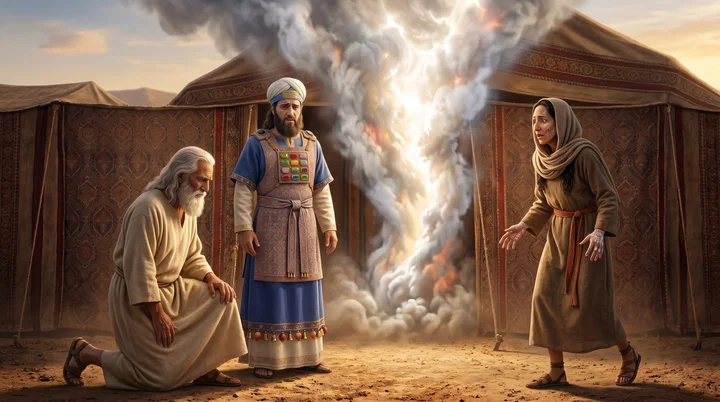
And the LORD came down in the pillar of the cloud, and stood in the door of the tabernacle, and called Aaron and Miriam: and they both came forth.
Translations
American King James Version, King James Version, Webster Bible
And the LORD came down in the pillar of the cloud, and stood in the door of the tabernacle, and called Aaron and Miriam: and they both came forth.
And the Lord came down in the pillar of the cloud, and stood in the door of the tabernacle, and called Aaron and Miriam: and they both came forth.
And the LORD came down in a pillar of cloud, and stood at the door of the Tent, and called Aaron and Miriam: and they both came forth.
And Jehovah came down in a pillar of cloud, and stood at the door of the Tent, and called Aaron and Miriam; and they both came forth.
And Jehovah cometh down in the pillar of the cloud, and standeth at the opening of the tent, and calleth Aaron and Miriam, and they come out both of them.
And Jehovah came down in the pillar of the cloud, and stood at the entrance of the tent, and called Aaron and Miriam; and they both came forth.
Then Yahweh came down in a pillar of cloud, and stood at the entrance of the tent,—and called Aaron and Miriam, and they both went forth.
Berean Standard Bible, Majority Standard Bible
and the LORD came down in a pillar of cloud, stood at the entrance to the Tent, and summoned Aaron and Miriam. When both of them had stepped forward,
The LORD came down in a pillar of cloud, and stood at the door of the Tent, and called Aaron and Miriam; and they both came forward.
And the Lord came down in a pillar of cloud, taking his place at the door of the Tent, and made Aaron and Miriam come before him.
Then the Lord came downe in the pillar of the cloude, and stoode in the doore of the Tabernacle, and called Aaron and Miriam, and they both came forth.
Douay-Rheims (Challoner revision)
The Lord came down in a pillar of the cloud, and stood in the entry of the tabernacle calling to Aaron and Mary. And when they were come,
Pictures
Cross-references
- Numbers 12:13
And Moses cried unto the LORD, saying, Heal her now, O God, I beseech thee.
Moses pleads with God to heal Miriam after she is struck with leprosy.
- Exodus 33:9-11
And it came to pass, as Moses entered into the tabernacle, the cloudy pillar descended, and stood at the door of the tabernacle, and the LORD talked with Moses.
The Lord speaks with Moses at the tabernacle beneath the cloud.
- Deuteronomy 31:15
And the LORD appeared in the tabernacle in a pillar of a cloud: and the pillar of the cloud stood over the door of the tabernacle.
God appeared in the cloud at the tabernacle entrance.
- Numbers 16:3
And they gathered themselves together against Moses and against Aaron, and said unto them, Ye take too much upon you, seeing all the congregation are holy, every one of them, and the LORD is among them: wherefore then lift ye up yourselves above the congregation of the LORD?
Korah’s revolt echoes the challenge to Moses as God’s appointed leader.
- Exodus 33:9
And it came to pass, as Moses entered into the tabernacle, the cloudy pillar descended, and stood at the door of the tabernacle, and the LORD talked with Moses.
God met Moses at the tabernacle entrance.
- Exodus 25:22
And there I will meet with thee, and I will commune with thee from above the mercy seat, from between the two cherubims which are upon the ark of the testimony, of all things which I will give thee in commandment unto the children of Israel.
God speaks from above the mercy seat, while meeting Aaron and Miriam at the tabernacle entrance.
- Numbers 12:9-10
And the anger of the LORD was kindled against them; and he departed.
The LORD’s anger at the meeting leads to Miriam’s punishment.
- Numbers 12:15
And Miriam was shut out from the camp seven days: and the people journeyed not till Miriam was brought in again.
Miriam’s punishment delayed Israel’s progress for seven days.
- Exodus 13:21
And the LORD went before them by day in a pillar of a cloud, to lead them the way; and by night in a pillar of fire, to give them light; to go by day and night:
The Lord appears in the guiding cloud by day.
- Micah 6:4
For I brought thee up out of the land of Egypt, and redeemed thee out of the house of servants; and I sent before thee Moses, Aaron, and Miriam.
Names Aaron and Miriam as leaders alongside Moses in bringing Israel out of Egypt.
- Exodus 29:42
This shall be a continual burnt offering throughout your generations at the door of the tabernacle of the congregation before the LORD: where I will meet you, to speak there unto thee.
God promises to meet at the tabernacle entrance.
- Exodus 40:34-35
Then a cloud covered the tent of the congregation, and the glory of the LORD filled the tabernacle.
The Lord’s glory filled the tabernacle as the cloud marked his presence there.
- 1 Kings 8:10-11
And it came to pass, when the priests were come out of the holy place, that the cloud filled the house of the LORD,
The LORD’s cloud marks his presence in the tabernacle and fills the temple with his glory.
- 2 Chronicles 5:13-14
It came even to pass, as the trumpeters and singers were as one, to make one sound to be heard in praising and thanking the LORD; and when they lifted up their voice with the trumpets and cymbals and instruments of musick, and praised the LORD, saying, For he is good; for his mercy endureth for ever: that then the house was filled with a cloud, even the house of the LORD;
The Lord’s glory filled the sanctuary with a cloud.
Commentary
Each commentary is drawn from primary sources: the writings of Ellen G. White and Adventist pioneers and periodicals. Each commentary is separate. Its own words are not a quotation; follow the references to read the source passages.
Ellen G. White
16 sources
The Lord suddenly ordered Moses, Aaron, and Miriam out to the meeting tent while Israel journeyed in the wilderness, then descended in the pillar of cloud to stand in its entrance and call Aaron and Miriam forward to hear Him.SG4 20.21SP 287.2Ms 164, 1902, par. 5–7 He summoned them to answer their jealous murmuring against Moses, whom He declared His meek, faithful, chosen servant with whom He speaks mouth to mouth, greater than a prophet.SG4 20.21SP 287.2Ms 201, 1898, par. 1–5PP 396.3 Their envy at the prominent place God had given Moses was disloyalty to God Himself and a challenge to the heavy burden He had laid on His appointed leader, which God confronted lest it spread rebellion through the camp.Lt 88, 1894, par. 14–17RH Aug 14, 1900PP 384.3Lt 28, 1859, par. 17–19 That personal, public coming made clear He had heard their words, standing as witness and authority to vindicate Moses, judge the challengers, and warn all Israel not to speak against him or rebel.Lt 7, 1894, par. 18–22RH Aug 14, 19001SP 296.1SG4 27.3PP 396.3 The same signal displeasure meets criticism, disrespect, evil surmising, and disparaging of His appointed messengers, requiring His people to guard one another's interests sacredly and purge the leaven of accusing and judging in little as well as large things.Lt 14a, 1898, par. 10–13
Context and Divine Summons
While Israel was traveling through the wilderness the Lord spoke suddenly and ordered Moses and Aaron and Miriam to come out to the tabernacle of the congregation.1SP 287.2Ms 164, 1902, par. 5–7 Then He came down in the pillar of the cloud and stood in the door of the tabernacle and called Aaron and Miriam to come forth to hear Him.SG4 20.21SP 287.2Ms 164, 1902, par. 5–7 This summons brought them before God Himself to answer their complaints and murmuring against Moses.SG4 20.21SP 287.2 In answering them He declared Moses very meek above all men and His faithful servant, distinctive for faithfulness and for direct communion with Him.SG4 20.21SP 287.2 His words were a rebuke to them for speaking against His faithful servant Moses.SG4 20.21SP 287.2 The Lord's coming in this way to give instruction illustrates that God often chooses the silence of the night, when minds are free from confusion and daytime busyness, to gain freer access to the hearts of His servants, making Himself known in a vision and speaking in a dream.Ms 164, 1902, par. 5–7
The coming down in the cloud to the entrance of the tabernacle was a personal, public intervention to address Aaron and Miriam after they spoke against Moses.Lt 7, 1894, par. 18–22RH Aug 14, 1900 His presence there made clear that He had heard their words against Moses.Lt 7, 1894, par. 18–22RH Aug 14, 1900 It stood as witness to them and as authority to vindicate Moses and to judge their opposition and their challenge to the responsibility and heavy burden God had given him.Lt 7, 1894, par. 18–22RH Aug 14, 1900
After the Lord had called Aaron and Miriam to answer for their complaints against Moses His chosen servant, the cloud was removed because His wrath rested on Miriam.1SP 288.1 It did not return until she was put out of the camp.1SP 288.1
Vindication of Moses
The summons brings Aaron and Miriam before God Himself to answer their complaints and murmuring against Moses.SG4 20.21SP 287.2ST Aug 19, 18801SP 288.1 The Lord descends in the cloud to the entrance of the tabernacle and calls Aaron and Miriam to come out and come forth to hear His rebuke of them for speaking against His faithful servant.SG4 20.21SP 287.2ST Aug 19, 18801SP 288.1 In answering them He declares Moses very meek above all men, His faithful and chosen servant, and His chosen instrument to carry out His will and purposes.SG4 20.21SP 287.2Ms 201, 1898, par. 1–5ST Aug 19, 18801SP 288.1 Moses is distinguished by distinctive faithfulness and direct communion with God, identified as greater than a prophet, with whom He speaks mouth to mouth.SG4 20.2PP 396.3
Their jealous whispering, envy and murmuring came after God had placed Moses in a prominent position.Lt 88, 1894, par. 14–17Lt 28, 1859, par. 17–19PP 425.4 That challenge to the responsibility and heavy burden God had given him was disloyalty not only to God's appointed leader but to God Himself, who heard their words against Moses and would judge them.Lt 88, 1894, par. 14–17RH Aug 14, 1900PP 384.3Lt 28, 1859, par. 17–19PP 425.4 God intervened because unchecked jealousy could lead the whole camp into rebellion.Lt 88, 1894, par. 14–17 He is displeased with those who criticize the one carrying a heavy burden for His work while refusing to bear that burden themselves.Lt 88, 1894, par. 14–17Lt 28, 1859, par. 17–19
Warning and Application
In confronting Aaron and Miriam over their complaints against Moses, the Lord made Miriam an example and a warning to all in Israel who might be tempted to rebel against him or speak against him.1SP 296.1SG4 27.3PP 396.3 The judgment for jealousy and complaints warned not only those two but all Israel, whom God had instructed that Moses was greater than a prophet and one with whom He spoke mouth to mouth.PP 396.3 The event shows that God sees hidden motives and brings them to light.Lt 88, 1894, par. 14–17 Jealous whispering against Moses was disloyalty to God's appointed leader and to God Himself, and God intervened because unchecked jealousy could lead the whole camp into rebellion.Lt 88, 1894, par. 14–17 Ambition for recognition can blind people to sacred things and lead them to accuse those God has called to serve.Lt 88, 1894, par. 14–17
The coming down of the Lord Himself in the pillar of cloud to call Aaron and Miriam forth to account for their words against His servant means that God personally confronts criticism of His appointed messengers with signal displeasure.Lt 14a, 1898, par. 10–13 That same displeasure will meet a similar course of remarks and disrespect, evil surmising and seeking to be first, criticizing and condemning brethren, putting human estimate upon God's messengers, disparaging their work, and cutting away the influence God appointed them to have.Lt 14a, 1898, par. 10–13 What is required instead is guarding sacredly the interests of one another, doing God's word in little as well as large things, and purging the leaven of criticism and accusing.Lt 14a, 1898, par. 10–13 For just as men judge others in little things, so God will judge what they have done which dishonors His name.Lt 14a, 1898, par. 10–13
The Lord's coming to give instruction illustrates that God often chooses the silence of the night to gain freer access to the hearts of His servants.Ms 164, 1902, par. 5–7 When minds are free from confusion and daytime busyness, He makes Himself known in a vision and speaks in a dream.Ms 164, 1902, par. 5–7
Sources
Pioneers and periodicals
35 sources
The Lord came down in the pillar of cloud, stood in the door of the tabernacle, and called Aaron and Miriam to come forth before Him.RH Jun 25, 1872RH Jun 12, 1913ST Feb 17, 1909 He summoned them because they had spoken against Moses over his marriage and his place, claiming God had also spoken by them as by him.RH Dec 17, 1901ST Apr 29, 1913RH Nov 1, 1906 He then vindicated Moses as faithful in all His house, declaring that to a prophet He makes Himself known in vision and dream, but with Moses He speaks mouth to mouth plainly as a man to his friend.RH Jan 14, 1873RH Aug 10, 1916ST Nov 3, 1898ST Feb 28, 1906RH Nov 1, 1906 God leads His people through chosen human instrumentalities, so to follow His servant is to follow His voice, and to speak against His appointed leader is to speak against Himself.RH Mar 7, 1907ST Feb 28, 1906RH Nov 1, 1906 His wrath fell in leprosy upon Miriam that required Moses' forgiving prayer, left as an ensample and lifetime warning that He hears murmuring and rebellion and will judge it.RH Jun 25, 1872RH Mar 7, 1907RH Apr 26, 1906RH May 20, 1873
Cloud and Confrontation
The Lord came down in the pillar of the cloud, stood in the door of the tabernacle, and called Aaron and Miriam, and they both came forth to meet Him at the entrance.RH Aug 14, 1900RH Jun 25, 1872RH Jun 12, 1913ST May 6, 1889RH Jan 14, 1873 This was His direct intervention in their challenge to Moses, the sudden manifestation of His displeasure with their faultfinding and the proof that He takes speech against servants He has chosen with utmost seriousness.RH Aug 14, 1900RH Jun 25, 1872RH Jun 12, 1913ST Feb 17, 1909 Both were summoned to the entrance to hear Him, in a scene that belongs to Israel's murmuring and to His approval of Moses over against their envy.ST Feb 17, 1909ST May 6, 1889RH Jan 14, 1873 His presence there made clear that He had heard their words against Moses and would judge their challenge to the responsibility He had given him.RH Aug 14, 1900
The summons came because they spoke against Moses for marrying an Ethiopian woman, envying his place and claiming the Lord had also spoken by them on a par with him.RH Dec 17, 1901ST Apr 29, 1913RH Nov 1, 1906 His personal coming in the cloud to call them forth was a rebuke of complaint exercised over the color line against one who respected an Ethiopian, with His anger kindled against them and Miriam made leprous white as snow.RH Dec 17, 1901 Their envy sprang from unwillingness to bear anyone above them however worthy or well fitted for the place, paining their selfish hearts with discontent until bringing Moses down seemed their only hope of being exalted.ST Apr 29, 1913 Though Miriam was a prophetess and Aaron was prophet and priest through whom the Lord spoke, Moses was honored above every other prophet by speaking face to face as a man speaks to his friend and by mighty miracles, being not merely a prophet but more than a prophet, a messenger with reproof to the erring and encouragement to the meek and lowly, a distinction Aaron and Miriam and all the people were required to recognize.RH Nov 1, 1906ST May 6, 1889 Yet Moses remained meek, teachable in receiving counsel, unselfish in sharing the Spirit and burden of leadership without envy, and tender and forgiving in praying God to forgive and heal his opposers.ST May 6, 1889
The Lord heard their question whether He had spoken only by Moses and not also by them, and suddenly answered in an awe-inspiring scene with a voice from the door of the tabernacle calling them out in tones impossible to resist.ST Mar 31, 1909 In that coming in the cloud He vindicated Moses His servant, upheld His own choice of Moses' appointed role, rebuked their contemptuous challenge, and confronted their wrongdoing directly.RH May 26, 1863ST Mar 31, 1909 It gives a strong practical lesson for a lifetime that the Lord hears the same deed when people speak against His appointed servant without thinking He hears.ST Mar 31, 1909 In this episode Miriam fell under divine wrath and Aaron shared in the wrong, and Moses prayed for her healing.ST Feb 15, 1905ST Mar 31, 1909
The confrontation ended in judgment as Miriam was struck with leprosy and chastened when the Lord departed, so that Moses' prayer was needed for her restoration.RH Jun 12, 1913RH Apr 26, 1906ST May 23, 1911 Her foolish complaint against Moses brought this striking consequence upon her, among the judgments that came after murmuring against him, as she and Aaron came forward to answer for their conduct.RH Apr 26, 1906RH May 20, 1873ST May 23, 1911 The whole account stands within the ceremonies, service, wanderings, murmurings, jealousy, slander, and strict order of Israel in Numbers 11-14, the order God had among His children to teach them systematic character.RH Apr 17, 1879ST Mar 4, 1913 There some disobeyed, complained because they could not live like the world, lusted after food eaten in Egypt, and kept murmuring until the Lord withdrew His protecting care, so they wandered until all but Caleb and Joshua and the children perished and never entered the promised land, though He had been with them and worked many miracles for them.RH Apr 17, 1879 It was a grave mistake made while God was visibly leading Israel, and the position of high priest and prophetess did not keep Aaron and Miriam from erring.RH Feb 24, 1916
Moses Above Prophets
The summons at the tabernacle door introduces the Lord's own explanation of how He communicates, for to a prophet He makes Himself known in a vision and speaks in a dream, but with Moses He speaks mouth to mouth, even apparently and not in dark sayings, as a man speaks to his friend.RH Jan 14, 1873ST Nov 3, 1898RH Nov 1, 1906 This direct speech did not mean Moses had to see God's face, yet Moses beheld the Lord's form and was declared faithful in all His house.RH Jan 14, 1873ST Nov 3, 1898RH Nov 1, 1906 The account is used as evidence that God instructed His people and made His law known through chosen messengers.ST Feb 28, 1906
Moses was honored above every other prophet by this direct revelation and by the mighty miracles worked through him, holding the leading prophetic role.RH Aug 10, 1916ST May 6, 1889 He was not merely a prophet but more than a prophet, a messenger with a message of reproof to the erring and encouragement to the meek and lowly.RH Nov 1, 1906 Miriam herself was a prophetess and Aaron was a prophet, and the Lord spoke through them, but that gift gave Miriam no authority to criticize Moses and place her work on a par with his.RH Aug 10, 1916RH Nov 1, 1906 The Lord's answer establishes that Moses was specially chosen and appointed by God and received revelation more directly than a prophet, and the rebuke for not fearing to speak against His servant Moses with the judgment that followed was required to be recognized by Aaron and Miriam and all the people as a warning to all Israel.RH Nov 12, 1903ST Sep 9, 1880RH Nov 1, 1906
Moses did not set himself up as leader but was ordained by God to lead Israel from Egyptian bondage toward the land of Canaan, and God upheld His own choice when it was challenged.RH Mar 7, 1907RH May 26, 1863 The coming down in the pillar of the cloud to call Aaron and Miriam forth proves the need and importance of having such a leader.RH Mar 7, 1907 Their high positions as Israel's high priest and prophetess did not keep them from erring, and they made a grave mistake while God was visibly leading Israel.RH Feb 24, 1916 God always leads His people by human instrumentalities and speaks through His chosen servants to make known His will, instruction, and law, so it is not the human instrument as a person that is followed but the voice of God spoken through His servant.RH Mar 7, 1907ST Feb 28, 1906 Speaking against the leader is speaking against God, and the fearful judgment that came answers this beyond doubt.RH Mar 7, 1907
God stepped in suddenly when Aaron and Miriam turned against Moses and spoke against him over a tender and embarrassing personal matter, maligning him and treating him contemptuously.RH May 26, 1863ST May 6, 1889ST Feb 15, 1905 Yet Moses remained meek under opposition, teachable in receiving counsel, unselfish in sharing the Spirit and the burden of leadership with others without envy, and tender and forgiving toward his opposers.ST May 6, 1889 When Miriam fell under divine wrath, Moses prayed for God to forgive their sin and to heal her, seeking her healing and restoration.ST May 6, 1889ST Feb 15, 1905
Presence, Justice, Warning
The great and dreadful God Himself came down wrapped in a cloud of glory and stood in the door of the tabernacle to call Aaron and Miriam forth.RH Jun 18, 1861RH Jun 8, 1869 This shows He is a person with form and parts who can come and stand and speak mouth to mouth, even apparently, face to face as with Moses.RH Jun 18, 1861RH Jun 8, 1869 He spoke under the veil of the cloud, so the cloud could be seen but not His face, which possesses a dazzling brightness greater than a thousand suns.RH Jun 18, 1861 This resolves how Moses could speak with God face to face and yet could not see His face.RH Jun 18, 1861
The cloud symbolizing the presence of God stood in the door of the tabernacle and called Aaron and Miriam to come forth, which means the divine presence and glory were manifested not only above the mercy-seat between the cherubim in the holiest but also in the door of the first apartment.RH Jul 7, 1853RH Jul 29, 1875 God met there with Moses, Aaron, Joshua and Israel, and He did not always meet Moses from between the cherubim but also came down in the cloud to meet Moses, Aaron and Miriam at the tabernacle entrance.RH Jul 7, 1853RH Jul 29, 1875ST Aug 5, 1875 God's presence and communication were therefore not confined to the space between the cherubim in the most holy place.RH Jul 29, 1875ST Aug 5, 1875 For this reason Christ having gone into the presence of God in the true holy places does not by itself prove He entered the holiest of all at His ascension.RH Jul 7, 1853
The coming carries out His design to live with man even after the fall by dwelling among Israel after their deliverance from Egyptian slavery and their leading toward the land set apart for them where He could be their daily Guide and Counselor.ST Jan 27, 1914 The Lord came down in the pillar of cloud that had guided the march by cloud by day and fire by night and stood at the tabernacle containing the law, the ten pillars of divine government, taking position just above it when the camp was pitched.ST Jan 27, 1914 From that vantage-point His voice was heard in daily regulation of every movement for the people's good.ST Jan 27, 1914
The account shows the holiness of God's work and how particular He is that everything in His sanctuary and worship be performed exactly, with sacredness attaching to His ordinances in the punishment that followed Miriam's sin.ST Jun 17, 1889 Slander is a sin abhorrent to God.RH Feb 24, 1916 God is no respecter of persons, treating the greatest among men and His own people even as the lowest with strict justice, so that no outward provocation is an excuse for sin and the root of sin is wholly in the heart of man.ST Jun 17, 1889
The Lord intervened in Aaron and Miriam's challenge to Moses by coming in the cloud to the tabernacle and summoning them, showing He takes seriously speech against servants He has chosen.RH Jun 25, 1872RH Mar 7, 1907ST Mar 31, 1909 He heard it when Aaron, possibly influenced by Miriam, spoke against Moses their brother asking whether the Lord had spoken only by Moses and not also by them, and suddenly in an awe-inspiring scene His voice came from the door of the tabernacle calling them out to the tabernacle of the congregation in tones impossible to resist.RH Nov 12, 1903ST Mar 31, 1909 Moses did not set himself up as leader but was ordained by God to lead Israel from Egyptian bondage to the land of Canaan, and God always leads His people by human instrumentalities and speaks through His chosen servants to make known His will, so it is not the human instrument as a person that is followed but the voice of God spoken through His servant and speaking against the leader is speaking against God.RH Mar 7, 1907 A spirit of rebellion or murmuring against God's appointed workers cannot be tolerated among God's people, and those who sympathize and take sides with rebels make themselves unworthy of fellowship, just as all who sympathized with Satan in his rebellion were cast out with him.RH Nov 18, 1862 The fearful judgment that came upon Miriam answers this beyond doubt and served as a warning to all Israel not to speak against Moses, giving a strong practical lesson for a lifetime that the Lord hears the same deed when people do it without thinking He hears, for all these things happened for ensamples and are written for the admonition of those upon whom the ends of the world are come.RH Nov 12, 1903RH Mar 7, 1907ST Mar 31, 1909
Sources