Numbers 12:9
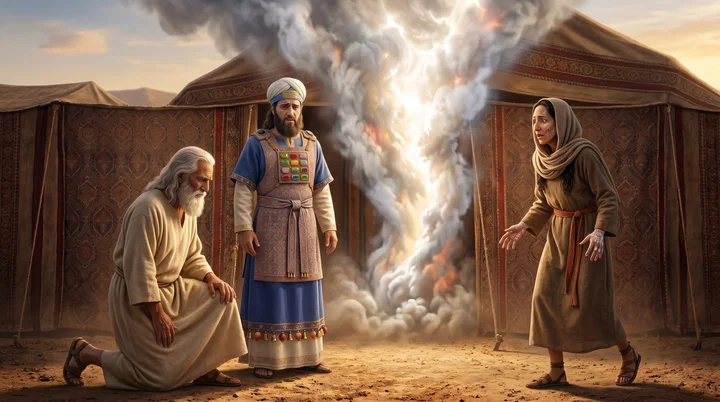
And the anger of the LORD was kindled against them; and he departed.
Translations
American King James Version, King James Version, Webster Bible, Revised Version
And the anger of the LORD was kindled against them; and he departed.
And the anger of the Lord was kindled against them; and he departed.
And the anger of Jehovah was kindled against them; and he departed.
And the anger of Jehovah burneth against them, and He goeth on,
And the anger of Jehovah was kindled against them, and he went away;
And the anger of Yahweh kindled upon them and he departed.
Berean Standard Bible, Majority Standard Bible
So the anger of the LORD burned against them, and He departed.
The LORD’s anger burned against them; and he departed.
And burning with wrath against them, the Lord went away.
Thus the Lord was very angrie with them, and departed.
Douay-Rheims (Challoner revision)
And being angry with them he went away:
Pictures

Cross-references
- Numbers 12:2
And they said, Hath the LORD indeed spoken only by Moses? hath he not spoken also by us? And the LORD heard it.
God hears Miriam and Aaron’s complaint against Moses and judges it.
- Numbers 12:14-15
And the LORD said unto Moses, If her father had but spit in her face, should she not be ashamed seven days? let her be shut out from the camp seven days, and after that let her be received in again.
Miriam is excluded for seven days, and the people wait for her return.
- Numbers 12:13
And Moses cried unto the LORD, saying, Heal her now, O God, I beseech thee.
Moses pleads with God to heal Miriam.
- Numbers 12:4
And the LORD spake suddenly unto Moses, and unto Aaron, and unto Miriam, Come out ye three unto the tabernacle of the congregation. And they three came out.
sudden summons after God heard
- Joshua 7:1
But the children of Israel committed a trespass in the accursed thing: for Achan, the son of Carmi, the son of Zabdi, the son of Zerah, of the tribe of Judah, took of the accursed thing: and the anger of the LORD was kindled against the children of Israel.
Achan’s sin kindles the LORD’s anger against Israel.
- Micah 6:4
For I brought thee up out of the land of Egypt, and redeemed thee out of the house of servants; and I sent before thee Moses, Aaron, and Miriam.
Names Moses, Aaron, and Miriam as leaders sent before Israel during the exodus.
- Numbers 12:3
(Now the man Moses was very meek, above all the men which were upon the face of the earth.)
good report obtained on this occasion
- 1 Corinthians 10:10
Neither murmur ye, as some of them also murmured, and were destroyed of the destroyer.
Both texts warn against murmuring and its judgment.
- Numbers 11:29
And Moses said unto him, Enviest thou for my sake? would God that all the LORD’s people were prophets, and that the LORD would put his spirit upon them!
Moses does not envy Eldad and Medad for prophesying.
Commentary
Each commentary is drawn from primary sources: the writings of Ellen G. White and Adventist pioneers and periodicals. Each commentary is separate. Its own words are not a quotation; follow the references to read the source passages.
Ellen G. White
15 sources
The Lord's anger was kindled against Miriam and Aaron because they spoke, murmured and complained against Moses, His chosen, faithful servant upon whom He placed His Spirit and with whom He spoke mouth to mouth directly.1SP 287.2SG4 20.2Lt 7, 1894, par. 18–22 They acted from jealousy of his prominent position, losing in family familiarity the sense that God had appointed him, resenting helpers, claiming equal standing because God had also spoken through them, and thinking he took too much upon himself.Ms 201, 1898, par. 1–5PP 382.4–383.1Lt 28, 1859, par. 17–19 His departing meant He withdrew His presence from them and from the tabernacle, the cloud leaving as a mark of displeasure and sign of judgment that did not return until Miriam was removed from the camp.1SP 287.2SG4 20.2Lt 7, 1894, par. 18–22 When He left, His wrath rested on Miriam and she became leprous while Aaron witnessed and was rebuked, then she was shut out seven days amid acknowledged sin and Moses' prayer while the people waited for her return.1SP 287.2SG4 20.2Lt 7, 1894, par. 18–22 To complain against God's chosen servant is irreverence toward God Himself and brings serious judgment, standing as a warning against jealous criticism of those He entrusts with His work, for though God bears long with the impenitent there are limits to His forbearance when presumptuous sin is reached and punishment becomes certain.RH Aug 14, 19001SP 288.11SP 296.1SG4 27.3RH Aug 14, 1900
Setting and Judgment
The anger was kindled against both Miriam and Aaron for speaking, murmuring and complaining against Moses.1SP 287.2SG4 20.2Lt 7, 1894, par. 18–22ST Aug 19, 1880RH Aug 14, 1900 Moses was the one God had chosen, appointed, vindicated and distinguished as His faithful servant.1SP 287.2SG4 20.2Lt 7, 1894, par. 18–22ST Aug 19, 1880RH Aug 14, 1900 God had placed His Spirit upon Moses and spoke with him mouth to mouth, directly.1SP 287.2SG4 20.2SG4 21.1 To speak against him was therefore to oppose God's appointed servant.RH Aug 14, 1900SG4 21.1
They acted from jealousy of his prominent position.PP 382.4–383.1Lt 28, 1859, par. 17–19 In family familiarity, as his own brother and sister joined with him in the work, they lost the sense that Moses was God's chosen instrument to carry out His will and purposes.Ms 201, 1898, par. 1–5 They resented the appointment of additional helpers and claimed equal standing and authority because God had also spoken through them as well as through Moses.Ms 201, 1898, par. 1–5PP 382.4–383.1 They murmured that he took too much responsibility upon himself.Lt 28, 1859, par. 17–19
His departure means He withdrew His presence from them and from the tabernacle.Lt 7, 1894, par. 18–22ST Aug 19, 1880SG4 21.1 When the Lord departed, the cloud left the tabernacle.1SP 287.2SG4 20.2Lt 7, 1894, par. 18–22ST Aug 19, 1880RH Aug 14, 1900 The removal of the cloud showed that His displeasure rested upon them and was a sign of judgment.ST Aug 19, 1880SG4 21.1 It did not return until Miriam was removed from the camp.SG4 21.1
When He departed, His wrath rested on Miriam and she became leprous.1SP 287.2SG4 20.2RH Aug 14, 1900SG4 21.1 Aaron witnessed her condition and was rebuked.Lt 7, 1894, par. 18–22 She was shut out of the camp for seven days.ST Aug 19, 1880 Aaron acknowledged their sin, Moses prayed for her, and the people waited until she returned.ST Aug 19, 1880
Warning and Application
Complaining against God's chosen servant is irreverence toward God Himself, for Moses had been appointed and distinguished as faithful in His service, chosen and having His Spirit placed upon him, and jealousy against him led to anger followed by departure with the cloud leaving the tabernacle and not returning until Miriam was put out of the camp, when she became leprous.RH Aug 14, 19001SP 288.1 Presuming on God's goodness while opposing His appointed servant brings serious judgment.RH Aug 14, 1900 Miriam's punishment and the judgment that followed stand as a warning to all Israel not to speak against God's servant from jealousy and rebellion.1SP 296.1PP 396.3 It is a warning to all tempted to rebel against Moses.SG4 27.3 It is applied specifically to Korah in his later rebellion.1SP 296.1
Their murmuring warns against jealousy and complaints against those God appoints to carry the burden of His work, for God withdrew His presence when wrath rested on Miriam.SG4 21.11SP 288.1 He is displeased when people refuse to bear burdens themselves yet criticize the person He has entrusted with them, who were jealous of his prominent position and thought he took too much responsibility upon himself.Lt 28, 1859, par. 17–19 Because in family connection Aaron and Miriam, Moses' own brother and sister joined with him in the work, lost the sense that Moses was the Lord's chosen instrument to carry out His will and purposes, it is unsafe to link relatives together in the same work, since family influence weakens respect for God's appointment and brings His displeasure.Ms 201, 1898, par. 1–5 Following the course of Miriam and Aaron by criticizing, condemning, despising and disparaging His appointed servants meets God's signal displeasure.Lt 14a, 1898, par. 10–13 Giving loose rein to the tongue to cut away the influence God appointed them to have, much of it born of evil surmising and seeking to be first, meets His judgment, and those in positions of responsibility must sacredly guard one another's interests and be doers of His Word in little as well as large things.Lt 14a, 1898, par. 10–13 Those who feel at liberty to criticize are wholly out of sympathy with God and angels, and just as they judge others in little things, so God will judge them in the things they have done which dishonor His name.Lt 14a, 1898, par. 10–13
Though God bears long with the impenitent and offers full pardon if they repent, there are limits to His forbearance that can be reached.RH Aug 14, 1900 When presumptuous sin against God in deed, in word, or even in thought, as in the cases of Miriam and Aaron, reaches that boundary, His anger is kindled and punishment is certain though delayed, and He will not cease till He has made a full end.RH Aug 14, 1900 He is not too good to punish the offender, but while He is a being of infinite love and compassion He is also a consuming fire, even a jealous God.RH Aug 14, 1900
Sources
Pioneers and periodicals
29 sources
The verse concerns Aaron and Miriam speaking against Moses as God's appointed and faithful servant to lead Israel from Egypt to Canaan, and the Lord's anger kindling against them and departing from them and the tabernacle, the cloud's removal showing His displeasure and vindication of His servant.RH Jun 25, 1872ST May 6, 1889RH Jun 12, 1913RH Aug 10, 1916 They envied his superiority and success, claimed the Lord had spoken by them and not by Moses only, and treated him with contempt, with Aaron led into wrong by Miriam.ST Mar 31, 1909ST Apr 29, 1913RH Apr 10, 1866 The departure was at once followed by judgment on Miriam, who became leprous white as snow and was shut out of the camp seven days, delaying Israel until she could return healed in answer to Moses' prayer.ST May 6, 1889RH Jun 12, 1913RH Dec 17, 1901 To speak against God's chosen instrument is to speak against God Himself, whom God defends, for He always leads His people by human instrumentalities whose voice is to be followed as the voice of God.RH Jun 25, 1872RH Aug 10, 1916RH Mar 7, 1907 Slander and envy are abhorrent to Him, and jealousy, murmuring and faultfinding destroy the soul as leprosy destroys the body; though He bears long, there are limits to His forbearance, and when presumptuous opposition to His appointed servant reaches that boundary His anger is kindled and punishment is certain.RH Aug 14, 1900RH Aug 14, 1900RH May 23, 1912ST Apr 29, 1913RH Feb 24, 1916
Setting and Judgment
The verse concerns Aaron and Miriam speaking against Moses, God's appointed and faithful servant and chief leader brought to lead Israel from Egypt to Canaan.ST Aug 19, 1880RH Jun 25, 1872RH Aug 10, 1916RH Mar 7, 1907RH Apr 26, 1906 The Lord heard their words at once, confronted them at the tabernacle, kindled his anger against them for the attack on the one he had chosen to lead his work, and then departed.ST Aug 19, 1880RH Jun 25, 1872ST May 6, 1889RH Mar 7, 1907ST Mar 31, 1909 Though Miriam was herself a prophetess, she was not permitted to challenge Moses as the leading prophet whom God recognized over Israel.RH Aug 10, 1916RH Mar 7, 1907
They envied Moses' superiority and success, claimed the Lord had also spoken by them and not by Moses only, plotted against him and treated him with contempt.ST Mar 31, 1909ST Apr 29, 1913RH Apr 10, 1866ST May 6, 1889 Their envy was pain, uneasiness, mortification and discontent at the sight of his superiority, accompanied by hatred and desire to depreciate him in order to be exalted, for they could not bear to have anyone above them however worthy or well fitted for the place.ST Apr 29, 1913 Aaron was influenced by Miriam and easily led into wrong, while together they quarreled with Moses, were ready to head a rebellion, and their jealous complaints brought a warning meant not only for them but for all Israel.RH Nov 12, 1903ST Mar 31, 1909RH Apr 10, 1866ST May 6, 1889 Their attack included reproaching Moses for marrying an Ethiopian woman, with Miriam jealous of her sister-in-law and joining Aaron in murmuring.RH Dec 17, 1901RH May 23, 1912RH Apr 10, 1866 That complaint was a rebuke of being exercised over the color line and complaining against respect for Ethiopians.RH Dec 17, 1901
The anger of the Lord was kindled against them and he departed from them and from the tabernacle, the cloud's removal showing his displeasure, rebuke, vindication of his servant, and withdrawal from rebels.ST Aug 19, 1880RH Jun 25, 1872RH Jun 12, 1913RH Mar 7, 1907RH Apr 26, 1906 His departure was manifested displeasure and fearful judgment upon rebellion against his chosen instrument.RH Mar 7, 1907 The departure was at once followed by judgment on Miriam, who became leprous white as snow and was shut out of the camp seven days.ST Aug 19, 1880ST May 6, 1889RH Jun 12, 1913RH Dec 17, 1901RH May 23, 1912 Aaron acknowledged their sin, and Miriam's punishment delayed Israel's progress until she could return, while she was healed in answer to Moses' prayer and the people waited.ST Aug 19, 1880ST May 6, 1889RH Jun 12, 1913RH May 23, 1912RH Apr 26, 1906
Moses himself was not moved to answer or complain but showed meekness through tenderness, forgiveness, and hearty prayer for his provoking sister.RH Apr 10, 1866ST May 6, 1889ST Feb 15, 1905 He made no complaint to God and no answer to them, saying nothing until he prayed heartily for her while she was under the tokens of God's displeasure, even after she and his brother had maligned him and she was struck by divine wrath.RH Apr 10, 1866ST Feb 15, 1905 On this occasion he obtained the report that he was very meek above all men on the face of the earth.RH Apr 10, 1866 The episode belongs to the ceremonies, service, wanderings, murmurings, discontent and rebellion of Israel in the wilderness, including the chastening at Hazeroth.ST Mar 4, 1913ST May 23, 1911 It shows the very strict order God had among his children, given not because he needed it but because they needed to learn, since carrying out system forms a systematic character, and it stands as an admonition to later generations against unbelief and hardness of heart and not to doubt God or resist those who speak courageously in faith.ST Mar 4, 1913RH Feb 28, 1907
The anger and departure also mean God's protecting care withdrawn from Israel after disobedience, complaining, lusting after the food of Egypt and wanting to live like the world.RH Apr 17, 1879 Though the Lord had been with them since Egypt and had wrought many miracles for them, they murmured and wandered until all but Caleb and Joshua and the children perished without entering the promised land.RH Apr 17, 1879
Teaching and Warning
To speak against Moses was to speak against God who had ordained him to lead Israel from Egyptian bondage to Canaan and had not set himself up as leader, and the kindling of anger followed by departure was God's manifested displeasure and fearful judgment upon rebellion against His chosen instrument.RH Jun 25, 1872RH Mar 7, 1907 God did not forego His own choice to accept man's preference but defended Moses against contemptuous treatment even when a pretext was offered, and the same rebuke and displeasure will visit now those who forget that God is not the author of confusion but of peace and order in all the churches and who defame His chosen servants and presume to usurp their office as overseers over the flock, except they repent of their contempt.RH May 26, 1863 The record stands as an admonition to later generations not to doubt God in unbelief and hardness of heart or to resist those who speak courageously in faith, and it warns all Israel not to speak against Moses or challenge God's appointment and not to murmur in fearful distrust and rebellion against those God has chosen to lead.ST Sep 9, 1880RH Feb 28, 1907RH May 20, 1873
God always leads His people by human instrumentalities, raising up men or women to lead out in every phase of His work, and His people are to follow not the human person but the voice of God spoken through His servant.RH Mar 7, 1907 Though a prophetess, Miriam was not permitted to challenge Moses, whom God recognized as Israel's chief leader and the leading prophet.RH Aug 10, 1916
The less a man strives for himself, the more God in honor and faithfulness is engaged to appear for him, as was proved when Moses was not moved by the affront from those of his own house, made no complaint to God and no answer to them, and said nothing until he prayed heartily for his provoking sister while she was under the tokens of God's displeasure.RH Apr 10, 1866 It was on this occasion that Moses obtained the report that he was very meek above all men on the face of the earth, after God heard Miriam the prophetess and Aaron the saint of the Lord when they quarreled with Moses, spoke against him, envied his honor, reproached his marriage, and were ready to head a rebellion against him, and became displeased with them.RH Apr 10, 1866
God is particular that everything in His ordinances and holy work be performed exactly, for the sacredness of His ordinances and the holiness of His work require exactness, and His anger kindled and His departure in punishment for sin mean that He is no respecter of persons but treats the greatest among men and His own people even as the lowest with strict justice.ST Jun 17, 1889 No outward provocation is an excuse for sin, whose root is wholly in the heart of man.ST Jun 17, 1889
Slander is abhorrent to God.RH Feb 24, 1916 Envy is pain, uneasiness, mortification and discontent excited by the sight of another's superiority and success, accompanied by hatred and a desire to depreciate him, and Aaron and Miriam could not bear to have anyone above them however worthy or well fitted for the place, their selfish hearts being pained and made discontented and thinking their only hope of being exalted was to have Moses brought down.ST Apr 29, 1913 Jealousy of a sister-in-law joining in murmuring against Moses brought anger that issued in leprosy white as snow, teaching that jealousy, murmuring, and faultfinding are to the spiritual life what leprosy is to the physical being, destroying the soul as leprosy destroys the body, until after the lesson was taught healing came in answer to Moses' prayer.RH May 23, 1912
Presuming on God's goodness and opposing His appointed servant whom He had appointed and distinguished as faithful in His service brought serious judgment, when anger followed by departure and the cloud leaving the tabernacle was followed by Miriam becoming leprous.RH Aug 14, 1900 Though God bears long with the impenitent and offers full pardon if they repent, there are limits to His forbearance and the boundary of His long-suffering can be reached, and when presumptuous sin against God in deed, in word, or even in thought reaches that boundary His anger is kindled and punishment is certain though delayed, and He will not cease till He has made a full end.RH Aug 14, 1900 God is not too good to punish the offender, for while He is a being of infinite love and compassion He is also a consuming fire, even a jealous God.RH Aug 14, 1900
The Lord heard at once the words saying the Lord had also spoken by them and not by Moses only, then in an awe-inspiring scene called Moses, Aaron, and Miriam out to the tabernacle, revealing the mind of the Lord toward speaking against His appointed servant and giving a lesson for a lifetime, because people are many times guilty of the same deed without thinking that the Lord hears.ST Mar 31, 1909 The judgment and warning were meant not only for Miriam and Aaron with their jealous complaints but for all Israel.RH Nov 12, 1903ST Mar 31, 1909 The same lesson is seen when the whole camp murmured and when Korah, Dathan, Abiram and the 250 princes rose up, these things having happened as examples written for admonition upon whom the ends of the world are come.RH Mar 7, 1907
The sin of one person can delay God's people, as Miriam's leprosy manifesting displeasure delayed Israel's progress for seven days until she could return to the camp, warning each person to be careful not to be counted among those whose sin brings such a delay.RH Jun 12, 1913 Even leaders close to God could fail and face His displeasure after a grievous mistake, when God opposed Aaron and Miriam and His anger was kindled against them before He departed.RH Feb 24, 1916 The event warns against fearful distrust and rebellion against those God has chosen to lead.RH May 20, 1873
A spirit of murmuring and rebellion among His people makes God angry and causes Him to withdraw from the rebels, so such a spirit cannot be tolerated and those who sympathize with rebels and take their side against the faithful are unworthy of fellowship and must be rejected, just as all who sympathized with Satan in his rebellion were cast out with him.RH Nov 18, 1862 Aaron fully shared the wrong-doing in speaking against Moses his brother, and the anger brought extreme smiting upon his beloved sister Miriam, made completely white with leprosy, a disease imperiling the life of all who touched her, over whom Aaron sorrowed deeply.ST Mar 31, 1909 The deed was a lapse from rectitude, yet God, ever ready to forgive and ever mindful of the sacred service His tested servant had rendered, forgave him and afterward enriched him.ST Mar 31, 1909
Sources