Numbers 12:4
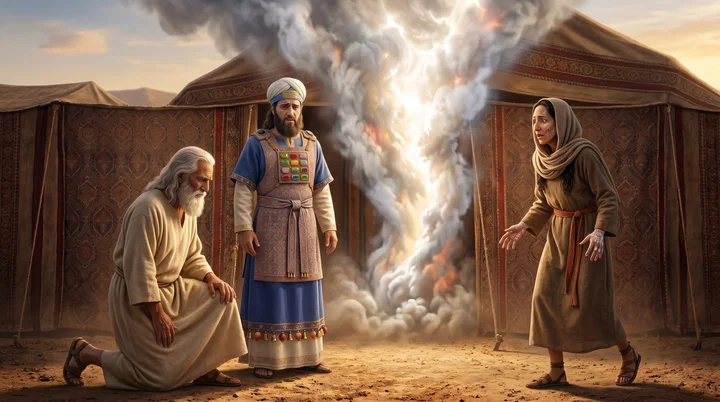
And the LORD spake suddenly unto Moses, and unto Aaron, and unto Miriam, Come out ye three unto the tabernacle of the congregation. And they three came out.
Translations
And the LORD spoke suddenly to Moses, and to Aaron, and to Miriam, Come out you three to the tabernacle of the congregation. And they three came out.
And the LORD spake suddenly unto Moses, and unto Aaron, and unto Miriam, Come out ye three unto the tabernacle of the congregation. And they three came out.
And the Lord spake suddenly unto Moses, and unto Aaron, and unto Miriam, Come out ye three unto the tabernacle of the congregation. And they three came out.
And the LORD spoke suddenly to Moses, and to Aaron, and to Miriam, Come out ye three to the tabernacle of the congregation. And they three came out.
And the LORD spake suddenly unto Moses, and unto Aaron, and unto Miriam, Come out ye three unto the tent of meeting. And they three came out.
And Jehovah spake suddenly unto Moses, and unto Aaron, and unto Miriam, Come out ye three unto the tent of meeting. And they three came out.
And Jehovah saith suddenly unto Moses, and unto Aaron, and unto Miriam, 'Come out ye three unto the tent of meeting;' and they three come out.
Then Jehovah spoke suddenly to Moses, and to Aaron, and to Miriam, Come out ye three unto the tent of meeting. And they went out, they three.
Then said Yahweh suddenly, unto Moses, and unto Aaron, and unto Miriam, Come out ye three unto the tent of meeting. And they three went out.
Berean Standard Bible, Majority Standard Bible
And suddenly the LORD said to Moses, Aaron, and Miriam, “ You three, come out to the Tent of Meeting.” So the three went out,
The LORD spoke suddenly to Moses, to Aaron, and to Miriam, “ You three come out to the Tent of Meeting!”The three of them came out.
And suddenly the Lord said to Moses and Aaron and Miriam, Come out, you three, to the Tent of meeting. And the three of them went out.
And by and by the Lord sayd vnto Moses, and vnto Aaron, and vnto Miriam, come out yee three vnto the Tabernacle of the Congregation: and they three came forth.
Douay-Rheims (Challoner revision)
Immediately he spoke to him, and to Aaron and Mary: Come out you three only to the tabernacle of the covenant. And when they were come out,
Pictures
Cross-references
- Numbers 12:13
And Moses cried unto the LORD, saying, Heal her now, O God, I beseech thee.
Moses prays for Miriam’s healing after Aaron confesses their sin.
- Numbers 12:9-10
And the anger of the LORD was kindled against them; and he departed.
God’s anger follows the confrontation, and Miriam is struck with leprosy.
- Numbers 12:14-15
And the LORD said unto Moses, If her father had but spit in her face, should she not be ashamed seven days? let her be shut out from the camp seven days, and after that let her be received in again.
Miriam is excluded from the camp for seven days, delaying Israel’s journey until she returns.
- Numbers 12:8
With him will I speak mouth to mouth, even apparently, and not in dark speeches; and the similitude of the LORD shall he behold: wherefore then were ye not afraid to speak against my servant Moses?
God rebukes them for speaking against Moses, whom he addresses directly.
- Micah 6:4
For I brought thee up out of the land of Egypt, and redeemed thee out of the house of servants; and I sent before thee Moses, Aaron, and Miriam.
Names Moses, Aaron, and Miriam as leaders in Israel’s exodus from Egypt.
- Exodus 33:11
And the LORD spake unto Moses face to face, as a man speaketh unto his friend. And he turned again into the camp: but his servant Joshua, the son of Nun, a young man, departed not out of the tabernacle.
Moses speaks with God face to face.
- Numbers 16:3
And they gathered themselves together against Moses and against Aaron, and said unto them, Ye take too much upon you, seeing all the congregation are holy, every one of them, and the LORD is among them: wherefore then lift ye up yourselves above the congregation of the LORD?
The rebels accuse Moses of taking too much authority.
Commentary
Each commentary is drawn from primary sources: the writings of Ellen G. White and Adventist pioneers and periodicals. Each commentary is separate. Its own words are not a quotation; follow the references to read the source passages.
Ellen G. White
13 sources
The Lord suddenly summoned Moses, Aaron and Miriam together to the tabernacle to answer their secret criticism, murmuring and rebellion against Moses.1SP 287.2SG4 20.2Lt 7, 1894, par. 18–22 The sudden call was His direct intervention to vindicate Moses and to confront and rebuke Miriam and Aaron, for He was present and heard their words though they thought Him far away.Lt 7, 1894, par. 18–22RH Aug 14, 1900ST Aug 19, 1880 Their complaint was not merely against a man but against the servant and chosen instrument God had appointed to carry out His will, springing from jealousy and envy of Moses' prominent position, which Aaron shared and failed to oppose.SG4 20.2Ms 201, 1898, par. 1–51SP 288.1Lt 28, 1859, par. 17–19PP 425.4 God made Miriam an example under His wrath to warn all Israel, and Korah in particular, against jealousy, complaining and rebellion toward those entrusted with His work.1SP 288.11SP 296.1SG4 27.3PP 396.3 He takes notice of criticism, evil surmising and seeking to be first among His workers and meets it with signal displeasure, requiring His people to guard one another's interests, to refrain from judging and disparaging His appointed messengers, and not to murmur against the one He has placed under the burden when they do not bear it themselves.Lt 28, 1859, par. 17–19Lt 14a, 1898, par. 10–13
God's Sudden Intervention
The Lord spoke suddenly, abruptly calling Moses and Aaron and Miriam all three together to come out to the tabernacle of the congregation to answer for murmuring and complaints and rebellion and secret criticism against Moses.1SP 287.2SG4 20.2Lt 7, 1894, par. 18–22Ms 201, 1898, par. 1–5RH Aug 14, 1900 The summons was sudden because it was God's own direct intervention in the dispute.Lt 7, 1894, par. 18–22ST Aug 19, 1880 Its suddenness marked His purpose to vindicate Moses and to confront and rebuke Miriam and Aaron.Lt 7, 1894, par. 18–22ST Aug 19, 1880
God had been present and had heard their words against Moses even though they thought Him far away.RH Aug 14, 1900 By that call He brought their challenge to Moses' appointed place and role directly before Himself.RH Aug 14, 1900 Their complaint was not merely against Moses as a man but against the servant God had chosen.SG4 20.2ST Aug 19, 1880 They had lost the sense that Moses was the Lord's chosen instrument selected to carry out His will and purposes, and their self-exalting judgment about him did not agree with God's view of him.SG4 20.2Lt 7, 1894, par. 18–22Ms 201, 1898, par. 1–5ST Aug 19, 1880
Aaron and Miriam spoke from jealousy and envy of Moses' prominent position, feeling that he took too much upon himself.1SP 288.1Lt 28, 1859, par. 17–19PP 425.4 Aaron joined Miriam in that envy and murmuring instead of opposing her complaint as he could have done.1SP 288.1Lt 28, 1859, par. 17–19PP 425.4
Warning Against Murmuring
Complaining against Moses, God's chosen servant, was irreverence toward God Himself, and in response to that complaint came the sudden summons of Moses, Aaron, and Miriam to the tabernacle.1SP 288.1 Aaron shared Miriam's jealousy though he could have opposed her complaint, and God's wrath rested upon Miriam so that the cloud was removed from the tabernacle and did not return until she was put out of the camp.1SP 288.1 In making Miriam an example, God warned all Israel and all who might be tempted to rebel against Moses against jealousy and complaining about those entrusted with God's work and against speaking against God's servant.1SP 288.1SG4 27.3PP 396.3
That dealing with Miriam warned Korah in particular, whose rebellious heart and secret work against Moses had not yet openly developed.1SP 296.1 The warning stood because God had established Moses as chief governor and had given the priesthood to Aaron and his sons.1SP 296.1 Those who do not take up the burden themselves should not murmur against the person God has placed under its weight, for Aaron and Miriam murmured from jealousy of Moses' prominent position, thinking he took too much upon himself, and their complaint displeased God.Lt 28, 1859, par. 17–19
God acted suddenly to call the three to the tabernacle of the congregation when fellow servants of God were criticized, showing that He takes notice of criticism, evil surmising, contempt, and seeking to be first among His workers, and meets such a course with His signal displeasure.Lt 14a, 1898, par. 10–13 Giving loose rein to the tongue in criticizing and condemning brethren is wholly out of sympathy with God and angels, and the duty instead is to guard sacredly one another's interests.Lt 14a, 1898, par. 10–13 The warning is not to judge others in little things, not to put human estimate upon any of God's messengers, not to disparage their work or cut away the influence God appointed them to have, lest as men judge so God judge them for things that dishonor His name.Lt 14a, 1898, par. 10–13
Sources
Pioneers and periodicals
30 sources
The Lord suddenly called Moses, Aaron, and Miriam out to the tabernacle of the congregation after Aaron and Miriam spoke against Moses over the wife he had married.ST May 6, 1889RH Dec 17, 1901ST Mar 31, 1909RH Feb 24, 1916ST May 6, 1889 Though they acted as if He were far away, He heard their envious challenge to Moses' appointed place and answered at once by summoning all three to meet Him.RH Jun 25, 1872ST May 6, 1889ST Apr 29, 1913RH Apr 20, 1876 That sudden summons was His direct intervention in displeasure, coming down in the pillar of cloud to rebuke them.ST Aug 19, 1880RH Dec 17, 1901RH Mar 7, 1907 He vindicated Moses as His ordained chief instrument and leading prophet, with whom He speaks mouth to mouth beyond visions and dreams, so that contempt for Moses was contempt for God speaking through him.RH Nov 12, 1903RH Jun 25, 1872RH Mar 7, 1907RH Aug 10, 1916RH Nov 1, 1906 He struck Miriam leprous and delayed Israel till she was restored, while meek Moses left the matter to God and prayed for her healing.RH Jun 12, 1913RH Dec 17, 1901RH Apr 26, 1906ST May 6, 1889ST Feb 15, 1905 The account thus warns against jealous murmuring, fault-finding, and siding with rebels against those God has chosen to lead.RH Jun 25, 1872RH Feb 24, 1916RH Feb 24, 1916
Setting and Sudden Summons
The summons came because Miriam and Aaron had spoken against Moses, challenging his authority and appointed role, over the Ethiopian woman he had married in a matter tender and embarrassing to him.RH Dec 17, 1901ST Mar 31, 1909ST May 6, 1889ST Feb 20, 1912 It stands as an ancient example of being exercised over the color line and complaining against one who respected an Ethiopian.RH Dec 17, 1901 The sudden call made clear that the Lord had heard their words and treated their opposition as a matter requiring His direct attention.ST Mar 31, 1909
Their attack was driven by envy, pain, uneasiness, discontent and hatred excited by the sight of Moses's superiority and success, with a desire to depreciate him.RH Jun 25, 1872ST May 6, 1889ST Apr 29, 1913 They felt less honored than they wished and sought equal footing with him, unwilling to have anyone above them however worthy or well fitted for the place.RH Jun 25, 1872ST Apr 29, 1913 They thought their only hope of being exalted was to have Moses brought down, and Miriam's jealous complaints warned all Israel by what followed not to speak against him.RH Nov 12, 1903ST Apr 29, 1913 The chapter is thus a story of jealousy and the Lord's vindication of Moses.
Though they acted as if God were far away, He was present and heard their words, and He responded at once by speaking suddenly.RH Aug 14, 1900ST May 6, 1889RH Feb 24, 1916 He summoned Moses and Aaron and Miriam to come out to the tabernacle of the congregation, where He meets with His people, and they three obeyed and came out.ST Sep 9, 1880ST May 6, 1889RH Feb 24, 1916RH Apr 20, 1876 The summons brought their challenge to Moses' appointed role before God, where He would address it and affirm His chosen servant.RH Aug 14, 1900ST Sep 9, 1880
That sudden summons marks God's direct intervention in the dispute and His manifested displeasure against speaking toward Moses.ST Aug 19, 1880RH Mar 7, 1907 He came down in the pillar of the cloud to the door of the tabernacle and called Aaron and Miriam forth to rebuke them, kindling His anger against them.RH Dec 17, 1901 Speaking against Moses so ordained was speaking against God speaking through His chosen human instrument to lead Israel from Egyptian bondage to Canaan.RH Mar 7, 1907
The episode belongs to the ceremonies, service, wanderings and murmurings of Israel in Numbers 9 through 24, especially Numbers 11-14, including Miriam's chastening at Hazeroth.RH Apr 17, 1879ST Mar 4, 1913ST May 23, 1911 It shows the very strict order and system God kept among His children, kept not because He needed it but because they needed to learn, forming systematic character by carrying out system.ST Mar 4, 1913 It stands in the record of unbelief as an admonition to later generations not to let difficulties fuel doubt and discouragement.RH Feb 28, 1907 Their continued complaining because they could not live like the world, and lusting after the food eaten in Egypt, led to His protecting care being withdrawn, so they wandered until all but Caleb and Joshua and the children perished without entering the promised land, though they had come out with many miracles wrought for them.RH Apr 17, 1879
Moses Vindicated, Murmurers Judged
Moses did not set himself up as leader but was ordained by God to bring Israel out of Egyptian bondage toward Canaan and to make His statutes and laws known.RH Mar 7, 1907ST Feb 28, 1906 Aaron and Miriam were chosen with him to lead Israel out of Egypt, yet Moses held the leading place as chief and leading prophet, faithful in all God's house and answerable to God alone.RH Mar 7, 1907RH Aug 10, 1916 Miriam, though herself a prophetess, was therefore not permitted to criticize him.RH Aug 10, 1916
The sudden call of the three to the tent of meeting led to the Lord's own explanation of Moses' distinct standing.RH Nov 12, 1903ST Sep 9, 1880RH Nov 1, 1906 Unlike other prophets, who receive visions or dreams, Moses is spoken to directly, mouth to mouth, because he is faithful in all God's house.RH Nov 1, 1906 He is thus a prophet and more than a prophet, given a special commission and responsibility beyond others, and his authority stands affirmed as that of God's chosen servant.RH Nov 12, 1903ST Sep 9, 1880RH Nov 1, 1906
To speak contemptuously against him was to speak against God speaking through His chosen human instrument.RH Jun 25, 1872RH Mar 7, 1907 Such fault-finding, whether pointing to real or supposed errors in leaders from motives of gaining notice and honor and hiding own faults, selfishness, and malice, weakens confidence in His work, dishonors God, and questions His wisdom in choosing His instruments.RH Jun 25, 1872 God defends the servants He has chosen and does not set aside His choice for human preference, but retains them in His work while bringing light esteem in return upon their accusers.RH Jun 25, 1872RH May 26, 1863
The Lord manifested His displeasure and kindled His anger against Aaron and Miriam, coming down in the pillar of cloud to the door of the tabernacle and calling Aaron and Miriam forth.RH Jun 12, 1913RH Dec 17, 1901 Miriam was struck leprous, white as snow, a disease imperiling the life of all who touched her, over which Aaron sorrowed deeply.RH Dec 17, 1901ST Mar 31, 1909 Israel's progress was delayed until she could be restored and return to the camp, warning that one person's sin can delay God's people and that opposition to the leading prophet is a grievous sin with disastrous consequences.RH Jun 12, 1913RH Apr 26, 1906
Moses met the plotting against him over a matter tender and embarrassing to him with true meekness.ST May 6, 1889ST Feb 15, 1905 He did not retaliate or abandon his work but left the matter to God and prayed for God to forgive their sin and heal Miriam.ST May 6, 1889ST Feb 15, 1905 She was restored only after his prayer, showing that meekness is tender and forgiving.RH Apr 26, 1906ST May 6, 1889ST Feb 15, 1905
That judgment proves the holiness of His work and the sacredness of His ordinances, showing that His rules are not meaningless.ST Jun 17, 1889 God is particular and requires everything to be performed exactly as commanded.ST Jun 17, 1889 He is no respecter of persons but treats the greatest among men and His own people with the same strict justice as the lowest, accepts no outward provocation as excuse for sin, and exposes the root of sin as wholly in the heart.ST Jun 17, 1889
Aaron fully shared in the wrongdoing with Miriam in speaking against Moses.ST Mar 31, 1909 The lapse was forgiven.ST Mar 31, 1909 It happened nineteen years before God declared to Aaron that He Himself was Aaron's part and inheritance, after Aaron had served with ability and fidelity as priest of the most high God and had been disciplined by great trials.ST Mar 31, 1909
Warning Against Murmuring
The chapter is a story of jealousy against Moses and of the Lord's vindication of His servant, an account of slander against Moses in which the Lord suddenly summoned Moses, Aaron, and Miriam to come together to the tabernacle of the congregation.RH Feb 24, 1916 It belongs to the account of Miriam's murmuring against Moses and the judgment that followed, and serves as a warning against distrust and rebellion toward those God has chosen to lead.RH May 20, 1873 A spirit of rebellion or murmuring cannot be tolerated among God's people, and those who sympathize with rebels and take sides with them against the faithful are unworthy of fellowship and share in their rejection, as all who sympathized with Satan were cast out with him.RH Nov 18, 1862
The sudden call of Moses, Aaron, and Miriam out to the tabernacle of the congregation came after Aaron and Miriam reproached the character of Moses because they felt less honored than they wished and sought equal footing with him.RH Jun 25, 1872 That sudden summons is the Lord's jealous care over the reputation of the few through whom He speaks to the world for the salvation of His people, and His judgment on conduct that weakens confidence in His work by pointing to real or supposed errors in its leaders from motives of gaining notice and honor and hiding own faults, selfishness, and malice.RH Jun 25, 1872 While God retains chosen leaders in His work, fault-finding against them questions the wisdom of God in choosing His instruments, dishonors God, and brings light esteem in return.RH Jun 25, 1872 Careless speakers against God's servants stand exposed to the hand of the Lord until they are in haste for the very servant they attacked to entreat the Lord for them.RH Jun 25, 1872
After the Lord summoned Moses, Aaron, and Miriam He showed His displeasure toward Aaron and Miriam, Miriam was struck with leprosy, and Israel's progress was delayed until she could return to the camp.RH Jun 12, 1913 The account therefore warns that one person's sin can delay God's people and that each person must take care not to become an Achan, an Ananias, or a Miriam.RH Jun 12, 1913 The chapter stands as part of Israel's record of unbelief and as an admonition for later generations, warning against letting difficulties fuel doubt and discouragement.RH Feb 28, 1907 Even leaders serving God, including Moses, could fail while God was leading Israel, and their grievous mistakes show that wrongs can arise within God's church, so believers need God's keeping peace rather than losing peace over others' faults.RH Feb 24, 1916
Sources