Translations
American King James Version, King James Version, Webster Bible, Revised Version
And Moses took the rod from before the LORD, as he commanded him.
And Moses took the rod from before the Lord, as he commanded him.
And Moses took the rod from before Jehovah, as he commanded him.
And Moses taketh the rod from before Jehovah, as He hath commanded him,
And Moses took the staff from before Jehovah, as he had commanded him.
And Moses took the staff from before Yahweh,—as he commanded him.
Berean Standard Bible, Majority Standard Bible
So Moses took the staff from the LORD’s presence, just as he had been commanded.
Moses took the rod from before the LORD, as he commanded him.
And Moses took the rod from before the Lord as he gave him orders.
Then Moses tooke the rod from before the Lord, as he had commanded him.
Douay-Rheims (Challoner revision)
Moses therefore took the rod, which was before the Lord, as he had commanded him,
Pictures
Cross-references
- Exodus 17:5-6
And the LORD said unto Moses, Go on before the people, and take with thee of the elders of Israel; and thy rod, wherewith thou smotest the river, take in thine hand, and go.
Moses took the rod as God commanded and struck the rock, bringing water to Israel.
- Psalms 106:33
Because they provoked his spirit, so that he spake unadvisedly with his lips.
The people provoked Moses to speak rashly at Meribah.
- 1 Corinthians 10:4
And did all drink the same spiritual drink: for they drank of that spiritual Rock that followed them: and that Rock was Christ.
Identifies the rock that supplied Israel’s water as Christ.
- Numbers 20:4-5
And why have ye brought up the congregation of the LORD into this wilderness, that we and our cattle should die there?
Israel complained when water ceased, driving its leaders to seek God.
- Genesis 14:7
And they returned, and came to En-mishpat, which is Kadesh, and smote all the country of the Amalekites, and also the Amorites, that dwelt in Hazezon-tamar.
identifies the springs as En-Mishpat
Commentary
Each commentary is drawn from primary sources: the writings of Ellen G. White and Adventist pioneers and periodicals. Each commentary is separate. Its own words are not a quotation; follow the references to read the source passages.
Ellen G. White
27 sources
Moses taking the rod from before the Lord was itself obedience to God's command, for after he and Aaron fell on their faces at the door of the tabernacle God directed them to take the rod, gather the assembly, and speak to the rock before their eyes so it would give water for the people and their animals.ST Sep 30, 18801SP 309.2–3RH Dec 31, 19031SP 310.1PP 417.1–3
The command came in a final test on the borders of the promised land after forty years of wandering, when the living stream ceased in order to prove whether Israel would trust God's promise and providence instead of murmuring as their fathers had done.PP 414.1–2RH Dec 31, 1903RH Aug 23, 19061SP 309.1PP 413.3–4
The offense was not in taking the rod but in failing to complete the command, for Moses in anger struck the rock twice instead of speaking to it as God had said.ST Sep 30, 1880RH Dec 31, 1903SG4 38.1–21SP 310.1PP 425.4
In calling the people rebels and asking whether he and Aaron must bring water, he took the glory to himself, failed to sanctify God before Israel, and showed distrust at the very moment God would have displayed His power to soften hearts and lead to repentance.EW 132.3–133.1SG1 41.1–42.1SG4 39.1RH Jul 29, 187310MR 151.3
For that public failure to honor God, Moses and Aaron were judged not to lead the congregation into the land but to die before crossing the Jordan, a solemn warning that God's word must be followed exactly to the letter and that He does not excuse sin in the exalted any sooner than in the humble.SG1 41.1–42.1RH Aug 23, 1906RH Jul 29, 1873Ms 120, 1909, par. 15–16Ms 187, 1907, par. 8
Setting and Command
The verse belongs to a test just before Israel was permitted to enter Canaan, on the borders of the promised land after forty years of wandering, near Kadesh and before reaching Edom.PP 414.1–2PP 413.3–4Ms 15, 1908, par. 6 Israel was brought again into the wilderness to the very place where God had proved them soon after leaving Egypt, and the rock there that had brought forth water had continued to flow until just before they came again to the rock.PP 414.1–21SP 309.1 The murmuring at Kadesh over the lack of water led to punishment and to the journey around Edom, which became a further trial for them.Ms 15, 1908, par. 6PP 428.1–2
The living stream that had sustained Israel for years ceased to flow, and the Lord caused it to cease to prove His people again.PP 414.1–2RH Dec 31, 19031SP 309.1 The cessation was appointed to prove whether they would believe God's promise, trust His providence, endure the trial of faith, and walk by faith instead of by sight.PP 414.1–2RH Dec 31, 1903RH Aug 23, 19061SP 309.1PP 413.3–4 The shortage tested whether they would trust God, but instead they doubted His promise.PP 414.1–2PP 413.3–4
Instead of turning to God for help they showed the same turbulent, unthankful spirit manifested by their fathers.PP 414.1–2RH Aug 23, 1906 As soon as the cry for water arose they forgot the hand that had supplied their wants for many years.PP 414.1–2RH Aug 23, 1906 They murmured against Moses and Aaron for water for themselves, their children, their cattle, their beasts and their animals to drink.PP 414.1–21SP 309.2–3EW 132.3–133.1RH Aug 23, 1906 They complained that they had been brought out of Egypt into an evil wilderness place with no seed, figs, vines, pomegranates, and no water.PP 414.1–21SP 309.2–3RH Aug 23, 1906 They wished they had died when their brethren died before the Lord in the rebellion of Korah, and they accused their leaders of bringing them out to kill them and charged their calamities upon them.PP 414.1–21SP 309.2–3EW 132.3–133.1
When the people murmured, Moses and Aaron left the assembly for the door of the tabernacle and fell on their faces, and the glory of the Lord appeared to them.1SP 309.2–3RH Dec 31, 1903PP 417.1–3 God then directed Moses to take the rod of God from before the Lord and with Aaron his brother gather the assembly.ST Sep 30, 18801SP 309.2–3RH Dec 31, 1903SG4 38.1–2PP 417.1–3 He was to speak to the rock before their eyes so it would give water for the congregation, their beasts, and their animals to drink.ST Sep 30, 18801SP 309.2–3RH Dec 31, 1903SG4 38.1–2PP 417.1–3
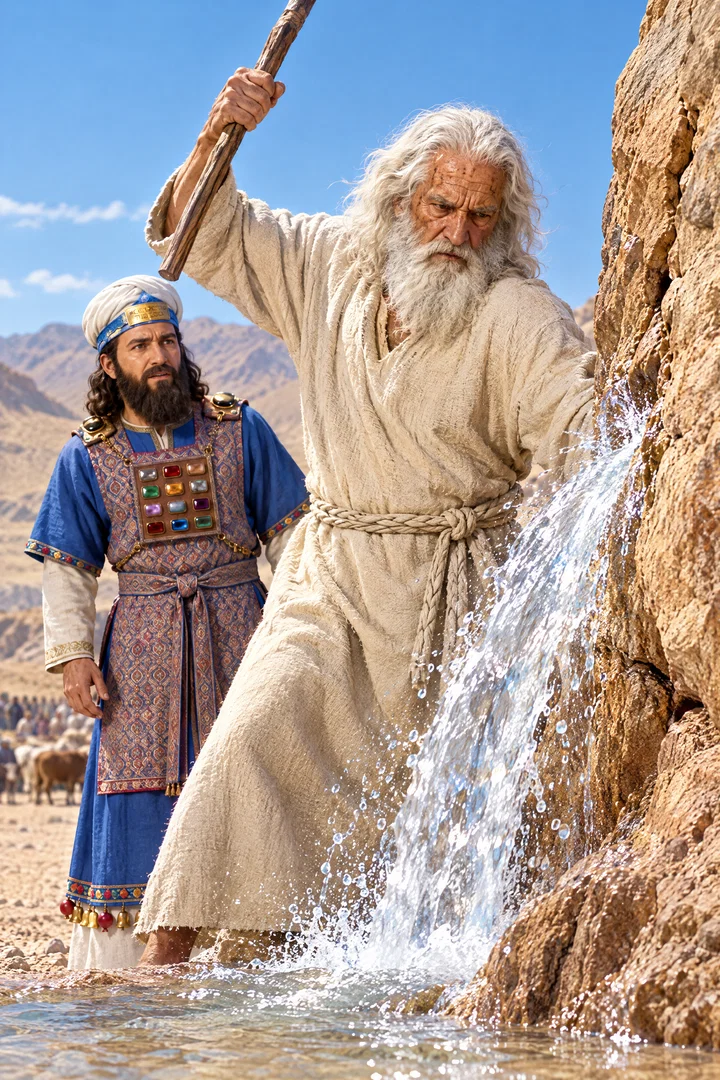
Moses taking the rod from before the Lord was itself obedience to God's command.ST Sep 30, 1880SG4 38.1–21SP 310.1PP 417.1–3PP 425.4 He took the rod of God in his hand as commanded and went with his brother before the multitude as aged men who had long borne Israel's rebellion and obstinacy.RH Dec 31, 1903RH Aug 23, 1906PP 417.1–3 The offense at Kadesh was not the taking of the rod but the failure to complete the command to speak to the rock so it would give water.ST Sep 30, 1880SG4 38.1–21SP 310.1PP 425.4
Disobedience and Judgment
Moses did not speak to the rock as commanded but in anger struck it twice with the rod, though God had given no command to strike but only to speak so that water would come forth.ST Sep 30, 1880RH Dec 31, 1903SG4 38.1–2SG4 39.1Ms 120, 1909, par. 15–16 The taking of the rod itself was obedience, but he failed to complete the command to speak to the rock before the eyes of the assembly for the congregation and their animals to drink.ST Sep 30, 1880RH Dec 31, 1903SG4 38.1–2 In asking whether he and Aaron must bring water from the rock and in calling the people rebels, he spoke as if he could provide the water and took the glory to himself.EW 132.3–133.1SG1 41.1–42.1SG4 39.11SP 310.1Ms 187, 1907, par. 8 He failed to honor God, to ascribe to Him the power and glory for causing water to flow again from the flinty rock, to tell the people God would show another evidence of His power, and to magnify and sanctify Him before Israel.EW 132.3–133.1SG4 39.11SP 310.1Ms 187, 1907, par. 8
Wearied and provoked by continual complaining, waywardness, and unreasonable faultfinding, Moses took the murmurings as a great personal trial and dishonor to himself.EW 132.3–133.1RH Jul 29, 1873Ms 120, 1909, par. 15–16PP 418.3 He thought only of how deeply he was wronged and how little gratitude was shown for his deep love, and for a time forgot how much the Lord had borne with them.EW 132.3–133.1Ms 120, 1909, par. 15–16 He forgot that their murmuring was not against him as a man appointed to carry out God's purpose but against God, insulting their best friend and murmuring at His providence by charging their calamities upon their leaders.EW 132.3–133.1RH Jul 29, 1873PP 418.3 In that moment of greatest weakness his strength failed, his will weakened, and his faith let go its hold upon infinite power and ceased to repose in God, so that even the meekest man forgot himself.Ms 187, 1907, par. 8Ms 15, 1908, par. 6 Satan, whose policy is to overcome even the faithful when faith loosens and confidence is shaken, had stirred the people to murmur until Moses lost command of himself.Ms 15, 1908, par. 610MR 159.3–6
By yielding Moses transgressed God's law, placed himself on Satan's side and under Satan's dominion and power, and became subject to death, though the sin was not premeditated but he was surprised into it.10MR 159.3–6 The blow of a human hand could not provide the water, for only God's power could do so, so striking instead of speaking showed distrust and unbelief.ST Sep 30, 1880 As God's representatives Moses and Aaron lost a golden opportunity at a time when God would mercifully display His glory to soften and subdue hearts, lead them to repentance, and show His long-suffering and tender pity.RH Jul 29, 1873 The people in fact sinned against Christ their invisible leader, who was the one they offended and who suffered most intensely.10MR 151.3
For failing to sanctify God in the eyes of Israel, Moses and Aaron were judged not to bring the congregation into the given land or lead them into the promised land, but to die with rebellious Israel before crossing the Jordan.SG1 41.1–42.1RH Aug 23, 1906RH Jul 29, 1873Ms 191, 1905, par. 13–14 Though Moses pleaded and begged to go over, God would not reverse the judgment because pardoning the public transgression would make His word of little account.Ms 120, 1909, par. 15–16Ms 191, 1905, par. 13–14 Though Moses later confessed the one transgression that marred his record in humility and faith and sought pardon, their disobedience marred lives that might have been illustrious to the close and cost them the privilege of entering Canaan.RH Jul 29, 1873ST Mar 31, 1881 This shows God does not excuse sin in those in exalted position any sooner than in the humble.RH Jul 29, 1873
Warning for Later Generations
God often brings His people into strait places and then in their necessity delivers them by His power, that they may realize His love and care for them and thus be led to serve and honor Him.EW 132.3–133.1 Israel was answered with water when they accused their leaders of bringing them out to kill them and their children, yet their unbelief brought punishment, for they had to cross the desert again and drink from the miraculous spring they would no longer have needed if they had trusted Him.EW 132.3–133.1PP 424.2 Their murmuring at Kadesh over lack of water led to that punishment and to the journey around Edom, which became a further trial for them.PP 424.2PP 428.1–2
God's word is precious and must be followed exactly to the letter by every soul, without thinking deviation will come out just as well or excusing disobedience as inconvenient.Ms 120, 1909, par. 15–16Ms 187, 1907, par. 8 It does not pay to forget or become careless in any of God's requirements, for even the meekest man forgot when provoked by unreasonable faultfinding and continual murmuring.Ms 120, 1909, par. 15–16Ms 187, 1907, par. 8 This includes keeping the seventh day as the Sabbath and not substituting the first day of the week.Ms 120, 1909, par. 15–16
When self is exalted God's work is neglected and He is dishonored, while God works counter to those who work counter to Him and His name alone is to be magnified.RH Aug 23, 1906 As leader, teacher, and example on the borders of the promised land, Moses' mistake in taking prominence to himself instead of believing and sanctifying God before Israel dishonored God.RH Aug 23, 1906Ms 191, 1905, par. 13–14 It is a solemn lesson to those in responsibility, especially in schools and to presidents.RH Aug 23, 1906
The sin of a man favored of God and entrusted with great responsibility is faithfully narrated with stern facts not glossed over, as evidence of divine wisdom and justice.ST May 31, 1910 The record is given for the benefit and warning of God's people in all following generations, that unbelief may be avoided and wrath escaped.ST May 31, 1910 Seeing where he struggled and fell, desponding hearts are encouraged not to despair but to press on, knowing that through God's grace fresh vigor can be gained to rise above evil nature and renew the conflict.ST May 31, 1910
Sources
Pioneers and periodicals
30 sources
Moses took the rod of God from before the Lord at the door of the tabernacle where His glory appeared, an obedient act in itself but not the whole command, which was to take the rod, gather the assembly with Aaron, and speak to the rock before their eyes so it would give water for the people and their cattle.ST Sep 30, 1880RH Dec 31, 1903RH Aug 23, 1906RH Aug 4, 1853ST Apr 25, 1906 This was in the wilderness of Zin at Kadesh, called Meribah, on the borders of the promised land when the stream that had supplied Israel ceased to test whether they would trust God's providence, and crazed with thirst they murmured against Moses and Aaron and against Jehovah for bringing them to die in a wilderness with no water, seed, figs, vines or pomegranates.RH Dec 31, 1903RH Aug 23, 1906RH Jul 29, 1873RH Aug 4, 1853ST Though he obeyed in taking the rod, Moses then disobeyed by speaking angrily to the people as rebels and saying must we fetch water, as if he and Aaron must bring it without even naming the Lord, and by striking the rock twice instead of speaking to it.ST Sep 30, 1880RH Aug 4, 1853ST Apr 25, 1906ST Jan 13, 1914ST For this unbelief and failure to sanctify and honor God before Israel at a time to display His glory, Moses and Aaron were judged not to bring the congregation into the given land but to die before crossing the Jordan, marring an otherwise illustrious record by one transgression.RH Aug 23, 1906RH Jul 29, 1873ST Jan 13, 1914STST Mar 18, 1903 The rock was a symbol of Christ the Rock of Ages to be smitten once for all, so striking it a second time marred that meaning, teaching that God's commands must be followed exactly, that a wrong word is a great sin enough to keep even Moses from Canaan, and that God has no favorites but requires greater faithfulness of those in exalted position.RH Aug 4, 1853ST Jan 13, 1914RH Jan 12, 1869RH Dec 9, 1909ST Jul 23, 1912
Setting and Obedience
Moses took the rod of God from before the Lord in obedience to the command given him, taking it from His presence at the door of the tabernacle where the glory of the Lord appeared after he and Aaron had fallen on their faces.ST Sep 30, 1880RH Dec 31, 1903ST Apr 25, 1906 That taking was obedience in part, but it did not by itself mean he had obeyed the whole command, for he afterward spoke angrily and struck instead of speaking as directed.ST Sep 30, 1880ST Oct 7, 1880ST Apr 25, 1906RH Dec 9, 1909 The direction to which the taking belonged was to take the rod, gather the assembly together with Aaron, and speak to the rock before their eyes so that it would give forth water for the people and their cattle.RH Dec 31, 1903RH Aug 23, 1906RH Aug 4, 1853ST Mar 18, 1903RH Mar 25, 1873
The setting was the wilderness of Zin at Kadesh, called Meribah, on the borders of the promised land where Israel must show belief before entering Canaan.RH Dec 31, 1903RH Aug 23, 1906RH Jul 29, 1873 There the stream that had supplied them for years ceased to flow, to test whether they would trust God's providence and walk by faith instead of by sight.RH Dec 31, 1903RH Aug 23, 1906 Israel, crazed with thirst and forgetting the hand that had supplied their wants, murmured against Moses and Aaron and against Jehovah for bringing them into a wilderness with no seed, figs, vines, pomegranates, or water to die there with their cattle.RH Aug 23, 1906RH Aug 4, 1853STST Jul 14, 1914RH Mar 25, 1873
At Kadesh-Barnea the drying of the original upper fountain by the cliff left the assembled hosts crying out, and the later striking brought to light two other living fountains near the surface, of perpetual strength and not wells.ST Jul 14, 1914 Those two were six feet deep and stoned up from the bottom, with ten other bubbling outlets centering in the head springs.ST Jul 14, 1914 One of these was En-Mishpat, the spring of judgment, by the side of which Moses administered justice.ST Jul 14, 1914
The chapters around the verse tell of ceremonies, service, wanderings, and murmurings of the children of Israel and show the very strict order God had among His children.ST Mar 4, 1913 That order was given not because He needed it but because they needed to learn it.ST Mar 4, 1913 He who carries out system forms a systematic character in the doing of it.ST Mar 4, 1913 On the journey from Egypt to Canaan Edom refused Israel passage through its land, reflecting the long-standing enmity between the descendants of Esau and Jacob, linked to the attempt to secure by human schemes what God had promised.ST Oct 1, 1902
Sin and Judgment
Moses took the rod from before the Lord exactly as he had been commanded, obeying that part of the instruction after falling on his face at the door of the tabernacle where the glory of the Lord appeared.ST Sep 30, 1880RH Dec 31, 1903RH Aug 23, 1906ST Apr 25, 1906RH Dec 9, 1909 He then went before the multitude with the rod in his hand as an aged man who had long borne rebellion, but his patience gave way and he disobeyed by speaking in anger to the people and by smiting the rock twice instead of speaking to it before their eyes so that it would give water for the people and their animals.ST Sep 30, 1880RH Dec 31, 1903RH Aug 23, 1906ST Apr 25, 1906RH Dec 9, 1909 God had directed him to gather the assembly with Aaron and speak to the rock, not strike it, so the angry words and the double stroke failed to follow the command and failed to honor God before Israel.ST Sep 30, 1880RH Aug 23, 1906RH Dec 9, 1909 The rock was to be smitten once for all, and the added second stroke was no unimportant detail.ST Jan 13, 1914
He spoke a wrong word when he called the people rebels and said must we fetch you water out of this rock, speaking as if he and Aaron must bring the water themselves.RH Aug 23, 1906RH Aug 4, 1853STST Jul 23, 1912ST Mar 18, 1903 He did not even mention the name of the Lord, and by claiming the power of opening the rock he took to himself and to Aaron the glory that belonged to God, for the rod was only an instrument and only God's power could provide the water.RH Jul 29, 1873STST Jul 23, 1912ST Mar 18, 1903 His act was presumption, distrust, and unbelief that failed to sanctify and honor God before Israel.RH Aug 23, 1906ST Sep 30, 1880ST Mar 18, 1903 The rock of Meribah is the one possible case urged for acting on his own authority in saying must we fetch you water, but since the act forfeited entrance into the promised land it proves the opposite, that God alone has ever been Lawgiver.ST Jun 17, 1886
Wearied and provoked by continual complaining when no water was found, Moses and Aaron took the murmurings as a great personal trial and dishonor to themselves.RH Aug 23, 1906RH Jul 29, 1873 They forgot that Israel in grieving and murmuring at providence was sinning against and dishonoring God and not them as men appointed to carry out His purpose, insulting their best friend by charging their calamities upon them.RH Jul 29, 1873 At a time when God was to mercifully display His glory to soften and subdue hearts and lead them to repentance, they lost a golden opportunity to sanctify the Lord in their midst and to show His long-suffering and tender pity for the people.RH Aug 23, 1906RH Jul 29, 1873 The blow of a human hand was not what could provide the water.ST Sep 30, 1880
God's work and ordinances are sacred and must be obeyed exactly, and outward provocation does not excuse sin, whose root is in the human heart.ST Jun 17, 1889 No person is exempt from God's strict justice.RH Jul 29, 1873ST Jun 17, 1889 For this failure to obey exactly and to give God the glory, Moses and Aaron were judged not to bring the congregation into the given land but to die with rebellious Israel before crossing the Jordan, barred from entering the promised land.RH Aug 23, 1906STST Sep 10, 1902RH Dec 9, 1909 Aaron was told in Israel's fortieth year to go up Mount Hor and die without seeing the land of his ancestors, and Moses' life of great achievement came to a disappointing close in death, the one transgression marring an otherwise illustrious record and failing the supreme test.ST Jan 13, 1914ST Jun 17, 1886ST Sep 10, 1902ST Mar 31, 1909
God has no favorites and does not excuse sin in those in exalted position any sooner than in the more humble.RH Jul 29, 1873RH Jan 12, 1869ST Jun 17, 1889 The nearer He has come to a man by His presence, the greater the sin to speak or act wrong in His sight, so greater wisdom and privilege require keeping farther from folly and not presuming safety to do what other men must not touch at all.RH Jan 12, 1869 By this very principle He will decide men's cases in the day of judgment.RH Jan 12, 1869
Symbol and Lesson
The rock that gave water was Christ, the Rock of Ages to be smitten once for all and offered once for the sins of many.ST Oct 7, 1880ST Jan 13, 1914ST Jul 23, 1912 To strike it a second time at Kadesh marred that meaning, for the added stroke was no unimportant detail and the sacrifice of Christ was not to be repeated.ST Oct 7, 1880ST Jan 13, 1914 Those who seek the blessings of grace receive them by asking in Jesus' name in penitential prayer that presents His wounds before God, so that life-giving blood flows afresh as the water flowed for Israel.ST Oct 7, 1880 The rod itself was only an instrument, for the power to bring the water belonged to God alone, and Moses was to speak to the rock as the symbol of Christ rather than claim the work with must we bring water.ST Jul 23, 1912
After the rock had once been struck, Moses was told to speak to it so that water would come forth, contrasting the earlier outward sign with receiving the Spirit without requiring another identical manifestation.RH Feb 11, 1915 The waters of Meribah springing forth in copious streams to quench perishing thirst picture how the water of life springs forth when the Scriptures are searched with the touch of faith, without need for an aged bucket iron-bound by creeds and traditions.RH Dec 7, 1916 The rock of Meribah is the one possible case urged for Moses acting on his own authority when he said must we fetch you water out of this rock, but since that act forfeited his entrance into the promised land it proves the opposite.ST Jun 17, 1886 God alone has ever been Lawgiver, and Moses never acted except by the authority of God.ST Jun 17, 1886
The episode teaches that God's commands must be followed exactly, and disobedience cannot be treated as obedience even when a faithful leader takes the rod as commanded yet speaks angrily and strikes twice instead of speaking as directed.RH Dec 9, 1909 Everyone, even Moses, must depend on God and recognize that dependence in everything, for He alone is the provider of the needed water and failure to give Him the glory bars from the promised land.RH Dec 9, 1909ST Sep 17, 1902 That one wrong word kept Moses from Canaan and shows that a wrong or idle word is a great sin enough to sink a soul.RH Aug 4, 1853 Because God is unchangeable, such words are no less sin for those living in the last days.RH Aug 4, 1853
After forty years of humble, faithful leadership as shepherd and as leader out of Egypt, Moses let pride take the place of humility by taking prominence to self and taking the honor to himself and Aaron without even mentioning the name of the Lord.RH Aug 23, 1906RH Mar 25, 1873 When self is exalted God's work is neglected and He is dishonored, and God works counter to those who work counter to Him while His name alone is to be magnified.RH Aug 23, 1906 This is a solemn lesson to those in responsibility in schools and especially presidents, on the borders of the promised land where Israel must show belief before entering Canaan and where the ceasing of water was an opportunity to walk by faith instead of by sight.RH Aug 23, 1906 The sin of these noble leaders is faithfully narrated with stern facts not glossed over, as evidence of divine wisdom and justice.ST May 31, 1910 It was given for the benefit and warning of God's people in all following generations, that unbelief may be avoided and wrath escaped.ST May 31, 1910
Seeing where Moses struggled and fell, desponding hearts are encouraged not to despair but to press on, gaining through grace fresh vigor to rise above evil nature and renew the conflict.ST May 31, 1910 Moses himself later confessed this one transgression that marred his record in humility and faith and sought pardon in the name of Jesus.ST Mar 31, 1881 The water God gave also served the herds, for He preserved Israel's cattle on their journeys.RH Aug 4, 1853ST May 13, 1913 That provision recalled His care and served as a sign that He had answered prayer for a favorable place to establish a permanent headquarters.RH Jul 1, 1915 Only because Jesus the Son of God as merciful High Priest is now pleading His blood in the Most Holy Place of the heavenly sanctuary are sinners kept from a place where hope and mercy could never reach them.RH Aug 4, 1853
Sources