Numbers 20:8
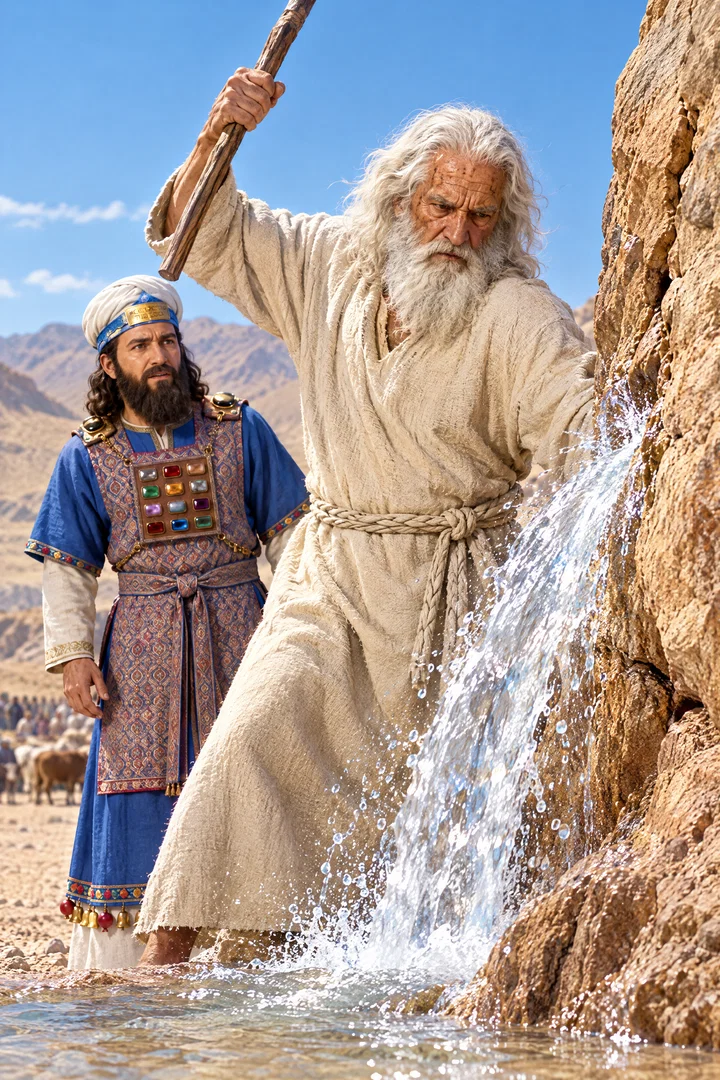
Take the rod, and gather thou the assembly together, thou, and Aaron thy brother, and speak ye unto the rock before their eyes; and it shall give forth his water, and thou shalt bring forth to them water out of the rock: so thou shalt give the congregation and their beasts drink.
Translations
Take the rod, and gather you the assembly together, you, and Aaron your brother, and speak you to the rock before their eyes; and it shall give forth his water, and you shall bring forth to them water out of the rock: so you shall give the congregation and their beasts drink.
King James Version, KJV Cambridge Paragraph Bible
Take the rod, and gather thou the assembly together, thou, and Aaron thy brother, and speak ye unto the rock before their eyes; and it shall give forth his water, and thou shalt bring forth to them water out of the rock: so thou shalt give the congregation and their beasts drink.
Take the rod, and convene thou the assembly, thou, and Aaron thy brother, and speak ye to the rock before their eyes; and it shall give forth its water, and thou shalt bring forth to them water out of the rock: so thou shalt give drink to the congregation and their beasts.
Take the rod, and assemble the congregation, thou, and Aaron thy brother, and speak ye unto the rock before their eyes, that it give forth its water; and thou shalt bring forth to them water out of the rock: so thou shalt give the congregation and their cattle drink.
Take the rod, and assemble the congregation, thou, and Aaron thy brother, and speak ye unto the rock before their eyes, that it give forth its water; and thou shalt bring forth to them water out of the rock; so thou shalt give the congregation and their cattle drink.
'Take the rod, and assemble the company, thou and Aaron thy brother; and ye have spoken unto the rock before their eyes, and it hath given its water, and thou hast brought out to them water from the rock, and hast watered the company, and their beasts.'
Take the staff, and gather the assembly together, thou, and Aaron thy brother, and speak ye unto the rock before their eyes, and it shall give its water; and thou shalt bring forth to them water out of the rock, and shalt give the assembly and their beasts drink.
Take the staff and gather together the assembly, thou, and Aaron thy brother, then shall ye speak unto the cliff before their eyes and it shall give forth its waters,—so shalt thou bring forth unto them water, out of the cliff, and shalt cause the assembly, and their cattle to drink.
Berean Standard Bible, Majority Standard Bible
“ Take the staff and assemble the congregation. You and your brother Aaron are to speak to the rock while they watch, and it will pour out its water. You will bring out water from the rock and provide drink for the congregation and their livestock.”
“ Take the rod, and assemble the congregation, you, and Aaron your brother, and speak to the rock before their eyes, that it pour out its water. You shall bring water to them out of the rock; so you shall give the congregation and their livestock drink.”
Take the rod, you and Aaron, your brother, and make all the people come together, and before their eyes give orders to the rock to give out its water; and so make water come out of the rock for them, and give the people and their cattle drink.
Take the rod, and gather thou and thy brother Aaron the Congregation together, and speake yee vnto the rocke before their eyes, and it shall giue foorth his water, and thou shalt bring them water out of the rocke: so thou shalt giue the Congregation, and their beastes drinke.
Douay-Rheims (Challoner revision)
Take the rod, and assemble the people together, thou and Aaron thy brother, and speak to the rock before them, and it shall yield waters. And when thou hast brought forth water out of the rock, all the multitude and their cattle shall drink.
Pictures
Cross-references
- Exodus 17:6
Behold, I will stand before thee there upon the rock in Horeb; and thou shalt smite the rock, and there shall come water out of it, that the people may drink. And Moses did so in the sight of the elders of Israel.
God brings water from the rock after Moses strikes it.
- Numbers 20:12
And the LORD spake unto Moses and Aaron, Because ye believed me not, to sanctify me in the eyes of the children of Israel, therefore ye shall not bring this congregation into the land which I have given them.
God judges Moses and Aaron for failing to trust and honor him before Israel.
- 1 Corinthians 10:4
And did all drink the same spiritual drink: for they drank of that spiritual Rock that followed them: and that Rock was Christ.
Identifies the wilderness rock as Christ.
- Psalms 106:33
Because they provoked his spirit, so that he spake unadvisedly with his lips.
Israel provoked Moses, and he spoke rashly at Meribah.
- Numbers 20:3
And the people chode with Moses, and spake, saying, Would God that we had died when our brethren died before the LORD!
The people’s complaint provoked the command to bring water from the rock.
- Psalms 78:15-20
He clave the rocks in the wilderness, and gave them drink as out of the great depths.
Recalls God providing water from the rock despite Israel’s lack of trust.
- John 7:37
In the last day, that great day of the feast, Jesus stood and cried, saying, If any man thirst, let him come unto me, and drink.
Christ still invites the thirsty to drink
- Isaiah 32:2
And a man shall be as an hiding place from the wind, and a covert from the tempest; as rivers of water in a dry place, as the shadow of a great rock in a weary land.
Pictures Christ as shelter and water.
- John 4:14
But whosoever drinketh of the water that I shall give him shall never thirst; but the water that I shall give him shall be in him a well of water springing up into everlasting life.
springing water quenches thirst
- Genesis 14:7
And they returned, and came to En-mishpat, which is Kadesh, and smote all the country of the Amalekites, and also the Amorites, that dwelt in Hazezon-tamar.
En-Mishpat is identified as a place of judgment.
- 1 Corinthians 10:11
Now all these things happened unto them for ensamples: and they are written for our admonition, upon whom the ends of the world are come.
Israel’s wilderness event serves as an example for those in the last days.
- Deuteronomy 32:51
Because ye trespassed against me among the children of Israel at the waters of Meribah-Kadesh, in the wilderness of Zin; because ye sanctified me not in the midst of the children of Israel.
Moses’ failure at Meribah kept him from entering the land.
- Revelation 22:17
And the Spirit and the bride say, Come. And let him that heareth say, Come. And let him that is athirst come. And whosoever will, let him take the water of life freely.
Both invite all to drink freely.
- Isaiah 12:3
Therefore with joy shall ye draw water out of the wells of salvation.
Meribah waters illustrate drawing from wells
Commentary
Each commentary is drawn from primary sources: the writings of Ellen G. White and Adventist pioneers and periodicals. Each commentary is separate. Its own words are not a quotation; follow the references to read the source passages.
Ellen G. White
27 sources
At Meribah at Kadesh God told Moses to take the rod and with Aaron gather the assembly and speak to the rock before their eyes, with the promise that it would give its water to drink for the congregation and their beasts.Ms 93, 1908, par. 45–46Ms 169, 1903, par. 9–10Ms 69, 1912, par. 10–12 Israel had come again after nearly forty years wandering to the place where God had proved them, and in a thirsty place with no water they forgot His long provision and murmured against God and against Moses and Aaron.Ms 93, 1908, par. 45–46Ms 169, 1903, par. 9–101SP 309.2–3 The command required speaking to the rock and not smiting it, because speaking was enough for water to come abundantly by God's power and to make clear before Israel that God and not Moses would provide it and receive the glory.Ms 169, 1903, par. 9–10RH Dec 31, 1903ST Sep 30, 1880 Moses let patience give way under continual murmuring, spoke from irritated passion and claimed the glory to himself, and angrily struck the rock twice, though those who held the other account teach that he struck three times.Ms 93, 1908, par. 45–46Ms 69, 1912, par. 10–12RH Dec 31, 1903Ms 191, 1905, par. 13–14 Because they believed not and did not sanctify God, judgment was pronounced that they would not bring the congregation into the land, which teaches that God's Word must be followed exactly to the letter and that God does not excuse sin in the exalted any sooner than in the humble.Ms 93, 1908, par. 45–46RH Aug 23, 1906SG4 39.1Ms 120, 1909, par. 15–16Ms 187, 1907, par. 8
Setting and Command
The command was given at Meribah at Kadesh on the borders of the promised land within sight of the hills of Canaan, as Israel approached Edom on the route to Canaan after nearly forty years of wandering and was brought back to the very place where God had proved them soon after leaving Egypt.Ms 169, 1903, par. 9–101SP 309.2–3RH Aug 23, 19061SP 309.1PP 413.3–4 The living stream that had followed Israel through the desert and flowed wherever they encamped, first supplied when Moses was told to smite the rock, ceased just before they came again to the rock.Ms 93, 1908, par. 45–46Ms 169, 1903, par. 9–10Ms 9, 1903, par. 10–17RH Dec 31, 19031SP 309.1 Its stopping was to test whether they would trust God's providence and walk by faith and not by sight before entering Canaan, and to signal that the wandering was ending, not that God had abandoned them, for with Edom lying on their route they had permission to buy food and water there.Ms 9, 1903, par. 10–17PP 414.1–2RH Dec 31, 1903RH Aug 23, 1906PP 413.3–4
In that thirsty, evil place with no seed, figs, vines, pomegranates, or water, the people forgot the hand that had supplied their wants for years and God's power that had brought water from the rock before.1SP 309.2–3SG1 41.1–42.1RH Aug 23, 1906 They murmured against God and against Moses and Aaron for bringing them from Egypt into the wilderness to perish, wishing they had died with their brethren who died before the Lord in the plague in the rebellion of Korah, Dathan, and Abiram.Ms 169, 1903, par. 9–101SP 309.2–3SG1 41.1–42.1RH Aug 23, 1906 Moses and Aaron, two aged leaders who had long borne Israel's rebellion, left the murmuring assembly, went to the door of the tabernacle, fell on their faces, and the glory of the Lord appeared to them.Ms 169, 1903, par. 9–10Ms 9, 1903, par. 10–171SP 309.2–3
Then God told Moses to take the rod of God in his hand and with Aaron his brother gather the assembly together and speak to the rock before their eyes.Ms 93, 1908, par. 45–46Ms 169, 1903, par. 9–10Ms 69, 1912, par. 10–12Ms 9, 1903, par. 10–17RH Dec 31, 1903 The promise was that it would give forth its water and he would bring forth to them water out of the rock, so to give the congregation and their beasts drink.Ms 169, 1903, par. 9–10Ms 69, 1912, par. 10–12Ms 9, 1903, par. 10–17PP 414.1–21SP 309.2–3 The command required speaking to the rock, not smiting it.Ms 169, 1903, par. 9–10RH Dec 31, 1903ST Sep 30, 1880SG4 38.1–2PP 417.1–3
Speaking was enough, for the water would come abundantly by God's power and not by a blow from a human hand.PP 414.1–2ST Sep 30, 1880ST Sep 30, 1880 The form of the command was meant to sanctify God in the eyes of Israel and to make clear that God, not Moses, would provide the water and receive the glory.RH Dec 31, 1903ST Sep 30, 1880PP 417.1–3ST Sep 30, 1880 God meant the merciful provision as a display of His glory, long-suffering, and tender pity to soften and subdue hearts and lead to repentance.EW 132.3–133.1SG1 41.1–42.1RH Jul 29, 1873
It was His plan often to prove Israel by bringing them into strait places and then in great necessity exhibiting His power, that He might live in their memory and they might glorify Him.EW 132.3–133.1SG1 41.1–42.1 But their unbelief kept them from trusting Him and going on without the miraculous spring, so they had to cross the desert again and drink from it.PP 424.2
Disobedience and Punishment
Moses, though very meek above all men and long patient with rebellion, was provoked, harassed, perplexed and wearied by continual murmuring, complaining, faultfinding, unbelief and rebellion over lack of water, until patience gave way and for a moment faith let go its hold on infinite power.Ms 93, 1908, par. 45–46Ms 69, 1912, par. 10–12RH Aug 23, 19061SP 310.1RH Jul 29, 1873 In that moment he lost sight of God's glory and forgot how much God had borne with the people.Ms 93, 1908, par. 45–46SG1 41.1–42.1RH Jul 29, 1873 Forgetting the words directing him to speak to the rock, he thought only of himself, how deeply he was wronged and how little gratitude they showed for his deep love.Ms 69, 1912, par. 10–12SG1 41.1–42.1RH Jul 29, 1873Ms 120, 1909, par. 15–16Ms 187, 1907, par. 8 He took their murmuring against God to himself as a great trial and dishonor to himself, forgetting that Israel was grieving God, sinning against God, dishonoring God and murmuring at God's providence, not against men appointed to carry out His purpose.SG1 41.1–42.1RH Jul 29, 1873
Speaking from irritated human passion, he called the people rebels and claimed that he and Aaron would bring them water from the rock, thus giving prominence to self and taking to himself the glory belonging to God alone.Ms 69, 1912, par. 10–12RH Aug 23, 1906RH Jul 29, 1873Ms 120, 1909, par. 15–16Ms 187, 1907, par. 8 Instead of speaking to the rock and declaring that God would show another evidence of His power and ascribing to God the power and glory for causing water to flow again from the flinty rock, he angrily struck the rock twice with the rod.Ms 93, 1908, par. 45–46Ms 69, 1912, par. 10–12RH Dec 31, 1903ST Sep 30, 18801SP 310.1 That blow wrongly suggested that human action supplied the power, obscured God's power before the people, and by his angry words wrongly presented human passion as God's judgment.RH Dec 31, 1903ST Sep 30, 18801SP 310.1PP 417.1–3 Those who hold to one account describe him as striking the rock three times while angrily rebuking the people.Ms 191, 1905, par. 13–14
The act was disobedience showing lack of faith and unbelief, neglecting God's work and failing to believe, honor, magnify and sanctify God before Israel and to show the people their guilt before Him.Ms 93, 1908, par. 45–46EW 132.3–133.1SG4 38.1–2RH Aug 23, 1906SG4 39.1 Without premeditation and surprised into sin, he failed to keep God's law, appropriated God's glory, and placed himself on Satan's side under Satan's claim of control and ownership.Ms 93, 1908, par. 45–46ST Sep 30, 1880EW 132.3–133.1SG4 38.1–2RH Aug 23, 1906 Judgment was immediately pronounced that because they believed not and did not sanctify God, Moses and Aaron would not bring the congregation into the land given them but must die with rebellious Israel before crossing the Jordan.Ms 93, 1908, par. 45–46RH Aug 23, 1906SG4 39.11SP 310.1 Though Moses begged to go over, God refused to rescind the judgment, because excusing open disobedience before Israel would make God's Word of little account.Ms 93, 1908, par. 45–46Ms 120, 1909, par. 15–16Ms 191, 1905, par. 13–14 This was Moses' first recorded failure as leader, denied entry to convince all Israel that there must be no departure from God's commandments in spirit or in word.Ms 93, 1908, par. 45–46
Moses mourned his sin and felt he had caused Israel to sin, but the sin was Israel's own murmuring and complaining spirit that led him to do wrong.10MR 151.3 He was not the greatest sufferer and did not feel in his heart the full depth of their sin, for Christ, their invisible leader, was the one they transgressed against and offended and suffered most intensely and would bear their iniquities.10MR 151.3
Warning and Obedience
Numbers 20:8 shows that God's Word is precious and must be followed exactly to the letter, without supposing that a deviation will come out just as well. Ms 120, 1909, par. 15–16Ms 187, 1907, par. 8 To forget is not profitable, and to become careless in any of God's requirements does not pay. Ms 187, 1907, par. 8 This is as true of the Sabbath commandment, which requires keeping the seventh day as the Sabbath of the Lord, as of speaking to the rock rather than striking it, for to substitute the first day of the week for convenience is the same kind of departure. Ms 120, 1909, par. 15–16 To excuse open disobedience before Israel would make God's Word of little account. Ms 120, 1909, par. 15–16
The sin of noble, greatly exalted and honored leaders cut short lives that might have been illustrious to the close. RH Jul 29, 1873 God does not excuse sin in those in exalted position any sooner than in the more humble. RH Jul 29, 1873 Those in positions of responsibility learn that God works counter to those who work counter to Him, and that His name alone is to be magnified on the earth. RH Aug 23, 1906 Because Moses held a responsible position as teacher and example, this one mistake cost him the right to enter Canaan, and the judgment was not rescinded when he pleaded. Ms 191, 1905, par. 13–14
Moses' failure came after being wearied by forty years of wandering with Israel, when for a moment his faith let go its hold upon infinite power. Ms 15, 1908, par. 6 It proves that Satan assails with the fiercest temptations in the time of greatest weakness. Ms 15, 1908, par. 6 When strength fails and will power weakens and faith ceases to rest in God, even one who has stood long and valiantly for the right can be overcome. Ms 15, 1908, par. 6
The episode warns God's people against complaining, distrusting God, and dishonoring Him by their conduct. Ms 191, 1905, par. 13–14 The people's murmuring when water ceased led to punishment in the journey around Edom as a consequence of their sin. PP 428.1–2 God had intended a better course for them, and in turning them aside He punished them lightly. PP 428.1–2
The faithful record of the sin that overcame Moses stands with the sins of Noah, Lot, Abraham, David, Solomon, Elijah, Jonah, Israel, Peter, and the contention of Paul and Barnabas. ST May 31, 1910 Together they show that men favored of God and entrusted with great responsibility were overcome by temptation and fell, even as people of the present day strive, waver, and fall into error. ST May 31, 1910 The record is kept for benefit and warning, to teach obedience to the law of God and the sure punishment of disobedience. ST May 31, 1910 It is kept also for encouragement, that through God's grace those who fell could gain fresh vigor to rise above evil nature, take heart again and conquer, so that later generations seeing where they struggled and fell and conquered may renew the conflict and press on. ST May 31, 1910
Sources
Pioneers and periodicals
29 sources
At Kadesh-Barnea when the stream failed, Moses was told to take the rod and with Aaron his brother gather the assembly and speak to the rock before their eyes, with the promise that it would give water for the congregation and their beasts to drink.RH Dec 31, 1903RH Aug 23, 1906STST May 27, 1889ST Jun 17, 1886
Only speaking was required, not smiting as at Rephidim, for the rock was to be struck only once and afterward water was to come by speaking.RH Dec 31, 1903ST Apr 25, 1906
The command was meant to sanctify God before Israel and make clear that He alone by His own power would provide the water and receive the glory.RH Dec 31, 1903ST Sep 30, 1880ST Jul 23, 1912
Moses disobeyed when provoked by the murmuring people, speaking harshly to them as rebels and striking the rock twice instead of speaking to it, taking glory to himself, and for this failure to honor God he and Aaron were judged not to bring Israel into the land.RH Aug 23, 1906RH Aug 4, 1853ST Apr 25, 1906STST Jun 17, 1886
The rock symbolized Christ smitten once upon Calvary for the sins of the world and not to be smitten again, so that speaking to the rock means coming to Him in faith for pardon and righteousness, and the water is the freely flowing gift of the Holy Spirit and salvation.ST May 26, 1914ST Jan 13, 1914ST Jul 23, 1912RH Feb 11, 1915
Command and Setting at Kadesh
The command was given at Kadesh on the borders of Canaan, just before entering the promised land, when the stream that had supplied Israel for years ceased to flow in order to test whether the people would trust divine providence and walk by faith rather than by sight.RH Dec 31, 1903RH Aug 23, 1906ST Israel forgot the hand that had supplied their wants for years and murmured against Moses and Aaron for bringing them out of Egypt into an evil place with no seed, figs, vines, pomegranates, or water to drink.RH Aug 23, 1906 Their complaint provoked Moses, who spoke rashly and took glory to himself instead of giving glory to God.ST
After Moses and Aaron left the murmuring assembly, fell on their faces at the door of the tabernacle, and the glory of the Lord appeared, direction was given for what to do next.ST May 27, 1889 Moses was to take the rod of God and, together with Aaron his brother, gather the assembly and speak to the rock before their eyes, with the promise that it would give forth water for the congregation and their beasts to drink.RH Dec 31, 1903ST Sep 30, 1880RH Aug 23, 1906ST May 27, 1889ST Jun 17, 1886 That gathering and speaking was to be done openly before the people, so that all would see from whom the water came.ST Sep 30, 1880RH Dec 9, 1909
What was required was only speaking to the rock, not smiting it, which was different from Rephidim where Moses had been told to smite the rock.RH Dec 31, 1903ST Apr 25, 1906 The rock needed to be struck only once, and afterward water was to come by speaking to it.RH Feb 11, 1915 To strike again was therefore to change and add to the plain command.ST Apr 25, 1906
The reason for speaking rather than striking was to sanctify God in the eyes of the children of Israel and to make clear that God, not Moses, would provide the water and receive the glory.RH Dec 31, 1903ST Sep 30, 1880RH Dec 9, 1909 It was a merciful display of His glory, long-suffering and tender pity, meant to soften and subdue hearts and lead to repentance.RH Jul 29, 1873 Speaking was enough because the water came by God's power, not by a blow from a human hand, and striking wrongly suggested that human action supplied the power.ST Sep 30, 1880ST Jul 23, 1912 Moses was only the instrument, and claiming credit misrepresented who had acted.ST Jul 23, 1912
At Kadesh-Barnea living fountains flow near the surface with perpetual strength.ST Jul 14, 1914 The thirst of the assembled hosts came from the drying of the original fountain, the upper spring nearest the cliff that still sometimes holds water.ST Jul 14, 1914 The bringing of water from the rock answered to the opening of the two other prominent six-foot-deep springs stoned up from the bottom with time-worn rocks to give the congregation drink.ST Jul 14, 1914 One of these springs is En-Mishpat, the spring of judgment, beside which justice was administered.ST Jul 14, 1914
The verse thus stands as a display of God's power to provide water from a rock for Israel and their animals in the wilderness.ST Mar 31, 1881RH Jul 1, 1915ST Sep 17, 1902 That provision was recalled when water burst from the rock, showing how God provides for His people.ST Mar 31, 1881 Its like was seen when a spring flowing from rocks answered prayer for a favorable place to establish a permanent headquarters.RH Jul 1, 1915 The welfare of the people required them to recognize their dependence on Him as provider.ST Sep 17, 1902
Disobedience and Divine Judgment
The command was plain, to gather Israel and speak to the rock so it would give water, yet Moses addressed the people as rebels and spoke wrongly instead of speaking to the rock.ST Sep 30, 1880RH Aug 23, 1906RH Aug 4, 1853ST Apr 25, 1906 Provoked a second time by perverse complaints and false accusations against himself and against God, his spirit, though meek above all men and long patient with rebellion, gave way to indignation and irritated human passion.RH Aug 23, 1906ST Apr 25, 1906ST In that anger he lifted his hand and struck the rock twice with the rod rather than speaking to it as commanded.ST Sep 30, 1880RH Aug 23, 1906ST Apr 25, 1906RH Dec 9, 1909 The people had murmured for lack of water, forgetting the hand that had supplied their wants for years and charging Moses and Aaron with bringing them out of Egypt into an evil place with no seed, figs, vines, pomegranates, or water to drink.RH Aug 23, 1906 Although water still came forth, the act departed from the specific instruction and failed to honor God before the people.ST Sep 30, 1880RH Dec 9, 1909
In striking he changed and added to the command, treating the manner and number as if an added stroke were an unimportant detail.ST Apr 25, 1906ST Jan 13, 1914 He acted from weariness under continual complaining, from pride in an unguarded moment after forty years of humble leading, and from unbelief and distrust, with his mind occupied by personal matters.RH Aug 23, 1906RH Jul 29, 1873ST Jan 13, 1914 He gave prominence to self by saying, in effect, that he and Aaron would fetch water out of the rock, acting on his own authority as if he himself were the giver.RH Aug 23, 1906ST Jun 17, 1886ST Mar 18, 1903 He claimed the miracle for himself without mentioning the Lord, took glory to himself instead of giving glory to God, and misrepresented that the water flowed by God's power and not by Moses, who was only the instrument.RH Jul 29, 1873STST Jun 17, 1886ST Jul 23, 1912 By so doing he failed to sanctify and honor God before the people, neglected God's work, dishonored Him, and wrongly suggested that human action supplied the power.RH Aug 23, 1906RH Jul 29, 1873ST Jul 23, 1912ST Mar 18, 1903
For this sin judgment was immediately pronounced that because they believed not, Moses and Aaron would not bring the congregation into the land given them.RH Aug 23, 1906ST Mar 18, 1903 They must die with rebellious Israel before crossing the Jordan, and Moses lost the earthly Canaan, was not permitted to lead the people in, and lost his life.RH Aug 23, 1906ST Apr 25, 1906ST Sep 10, 1902 Aaron shared the sentence, including Aaron in his sacred office as representative of Christ and high priest, and he was not permitted to enter the promised land but was sent to die on Mount Hor in the fortieth year after leaving Egypt.RH Aug 23, 1906ST Mar 31, 1909ST Mar 18, 1903 This exclusion came even though water came at the stroke and even though Moses spoke with God face to face.ST Apr 25, 1906RH Dec 9, 1909 His failure to do exactly as commanded and to give God glory led to his exclusion from the promised land.ST Sep 10, 1902RH Dec 9, 1909
The incident teaches that God's commands must be followed exactly, and that even a faithful leader's public deviation cannot be treated as obedience.RH Dec 9, 1909ST Jun 17, 1889 Nearness to God did not exempt Moses from accountability, for when he spoke or acted wrongly in God's presence his sin was especially serious, and God does not excuse sin in those in exalted position any sooner than in the more humble.RH Jul 29, 1873RH Jan 12, 1869 God has no favorites and shows no partiality, but judges even the greatest among His people with strict justice.RH Jan 12, 1869ST Jun 17, 1889 Provocation does not excuse sin, whose root lies in the human heart, for Moses took the murmurings as a great trial and dishonor to himself and forgot that Israel was grieving and dishonoring God and murmuring at God's providence, not against men appointed to carry out His purpose.RH Jul 29, 1873ST Jun 17, 1889 Disobedience to the plain command warns that as Moses lost the earthly Canaan so disobedience will cause loss of the heavenly Canaan.ST Apr 25, 1906
The faithful record of the sin that overcame Moses stands with the sins of Noah, Lot, Abraham, David, Solomon, Elijah, Jonah, Israel, Peter, and the contention of Paul and Barnabas.ST May 31, 1910 It shows that men favored of God and entrusted with great responsibility were overcome by temptation and committed sin even as people of the present day strive, waver, and fall into error.ST May 31, 1910 The record is kept for benefit and warning, to teach obedience to the law of God and the sure punishment of disobedience.ST May 31, 1910 It is kept also for encouragement, that through God's grace those who fell could gain fresh vigor to rise above evil nature, take heart again and conquer, so that later generations seeing where they struggled and fell and conquered may renew the conflict and press on.ST May 31, 1910
Christ the Smitten Rock
The water-bearing rock was Christ, smitten once upon Calvary's cross in crucifixion and offered once for the sins of the world, and He must not be smitten again.ST Oct 7, 1880ST Oct 7, 1880ST May 26, 1914ST May 26, 1914 Because the rock had already been smitten once, the command to speak instead of smiting teaches that sinners are not to smite Him again.ST May 26, 1914ST May 26, 1914 Moses through impatience disobeyed and struck twice, and thereby marred the beautiful symbol of Christ kept before Israel through all the desert wanderings, so that the ceremony failed of its significance as a symbol of the smiting of the Rock of Ages once for all.ST Oct 7, 1880ST Oct 7, 1880ST Jan 13, 1914ST May 26, 1914 The water flowed by God's power and not by Moses', for Moses was only the instrument, and claiming credit for bringing the water misrepresented who had acted.ST Jul 23, 1912
To speak to the rock is to speak to Christ for salvation by coming to Him in faith.ST May 26, 1914ST May 26, 1914 It is to tell Him weariness of sin and longing to accept His righteousness, to give Him sins, to confess sins and claim pardon, and to ask in Jesus' name with repentant prayer that presents His wounds before God.ST Oct 7, 1880ST May 26, 1914ST May 26, 1914 He will then give the healing waters of salvation and clothe the sinner with His righteousness.ST Oct 7, 1880ST May 26, 1914ST May 26, 1914
The water is the life-giving gift of the Holy Spirit and salvation, which after Christ the true Rock was struck was poured out abundantly and now flows freely as a refreshing life-giving stream by every encampment for all to drink.ST May 26, 1914 The rock needed to be struck only once, and afterward water was to come by speaking to it, which is the assurance that believers may seek the Spirit from Christ and receive the help that transforms character. The Spirit's power does not require another outward manifestation like Pentecost, because the Comforter has come and awaits reception, the river of life remains available, and the blessing given at Pentecost is intended for God's people to the end of time.RH Feb 11, 1915 Those who lack the Spirit and a victorious, transformed life are therefore urged to come to Christ in faith to receive this gift.
The same demand for exact obedience to God's definite number applies to the word seventh in the Sabbath commandment, which must not be changed to first, for as Moses treated the number of strokes as an unimportant detail and with his mind occupied by personal matters added a second stroke, so the added stroke closed a life of extraordinary achievement in disappointment.ST Jan 13, 1914 For the wrong word with which Moses addressed the people as rebels instead of speaking to the rock as told, he was not permitted to enter Canaan, showing that careless or sinful speech has serious consequences before God.RH Aug 4, 1853 The people's welfare required them to recognize their dependence on God as provider, and Moses was barred from the promised land because he failed to give God glory as the one who provided the water.ST Sep 17, 1902 The waters bursting forth in copious streams from the rock to quench the thirst of perishing souls picture the water of life obtained by searching the Scriptures, which springs forth freely at the touch of faith without having to be drawn to the surface by creeds and traditions.RH Dec 7, 1916
Sources