Numbers 20:10
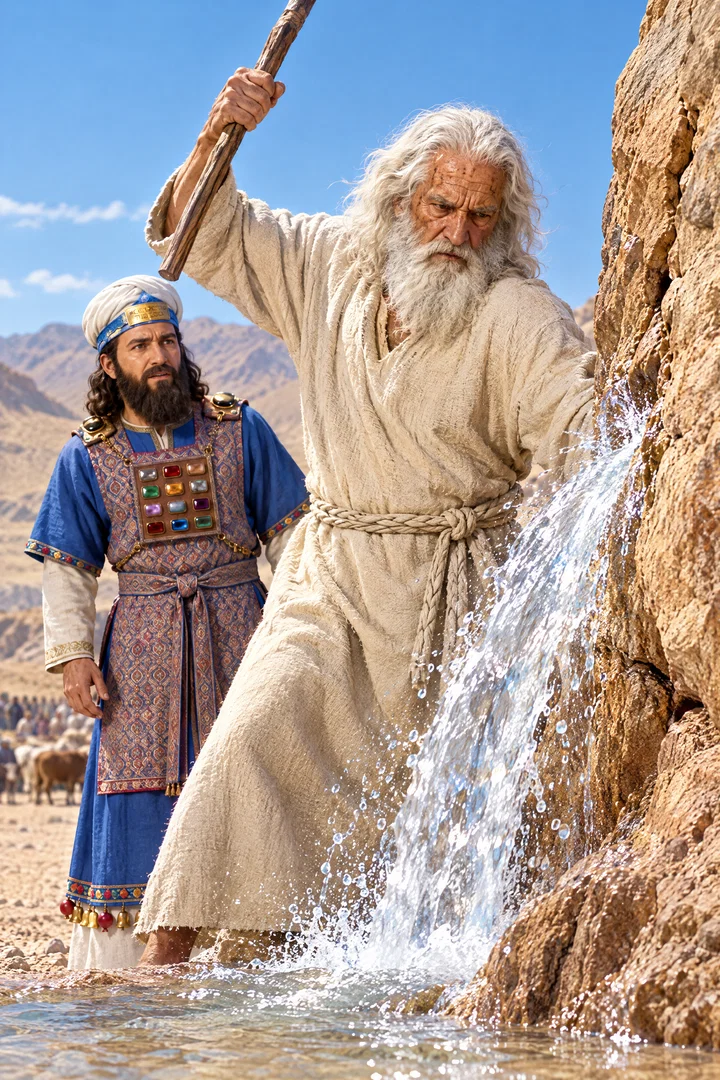
And Moses and Aaron gathered the congregation together before the rock, and he said unto them, Hear now, ye rebels; must we fetch you water out of this rock?
Translations
And Moses and Aaron gathered the congregation together before the rock, and he said to them, Hear now, you rebels; must we fetch you water out of this rock?
King James Version, KJV Cambridge Paragraph Bible
And Moses and Aaron gathered the congregation together before the rock, and he said unto them, Hear now, ye rebels; must we fetch you water out of this rock?
And Moses and Aaron assembled the congregation before the rock, and he said to them, Hear now, ye rebels; must we fetch you water out of this rock?
Revised Version, American Standard Version
And Moses and Aaron gathered the assembly together before the rock, and he said unto them, Hear now, ye rebels; shall we bring you forth water out of this rock?
and Moses and Aaron assemble the assembly unto the front of the rock, and he saith to them, 'Hear, I pray you, O rebels, from this rock do we bring out to you water?'
And Moses and Aaron gathered the congregation together before the rock, and he said to them, Hear now, ye rebels: shall we bring forth to you water out of this rock?
And Moses and Aaron gathered together the convocation before the cliff,—and he said unto them: Hear I pray you ye rebels! Out of this cliff, must we bring forth for you water?
Berean Standard Bible, Majority Standard Bible
Then Moses and Aaron gathered the assembly in front of the rock, and Moses said to them, “ Listen now, you rebels, must we bring you water out of this rock?”
Moses and Aaron gathered the assembly together before the rock, and he said to them, “ Hear now, you rebels! Shall we bring water out of this rock for you?”
Then Moses and Aaron made the people come together in front of the rock, and he said to them, Give ear now, you people whose hearts are turned from the Lord; are we to get water for you out of the rock?
And Moses and Aaron gathered the Congregation together before the rocke, and Moses sayd vnto them, Heare nowe, ye rebels: shall we bring you water out of this rocke?
Douay-Rheims (Challoner revision)
And having gathered together the multitude before the rock, he said to them: Hear, ye rebellious and incredulous: Can we bring you forth water out of this rock?
Pictures
Cross-references 20 of 24
- Psalms 106:33
Because they provoked his spirit, so that he spake unadvisedly with his lips.
Israel’s provocation leads Moses to speak rashly.
- Exodus 17:6
Behold, I will stand before thee there upon the rock in Horeb; and thou shalt smite the rock, and there shall come water out of it, that the people may drink. And Moses did so in the sight of the elders of Israel.
An earlier complaint for water is answered when God brings water from a rock.
- 1 Corinthians 10:4
And did all drink the same spiritual drink: for they drank of that spiritual Rock that followed them: and that Rock was Christ.
Christ is identified as the Rock who provided water for Israel.
- Numbers 20:4-5
And why have ye brought up the congregation of the LORD into this wilderness, that we and our cattle should die there?
records complaints that provoked Moses words
- Numbers 12:3
(Now the man Moses was very meek, above all the men which were upon the face of the earth.)
Moses’ exceptional meekness contrasts with his angry words at the rock.
- Deuteronomy 32:51-52
Because ye trespassed against me among the children of Israel at the waters of Meribah-Kadesh, in the wilderness of Zin; because ye sanctified me not in the midst of the children of Israel.
Moses’ failure at Meribah leads to the Lord’s judgment that he will not enter the promised land.
- Numbers 20:26
And strip Aaron of his garments, and put them upon Eleazar his son: and Aaron shall be gathered unto his people, and shall die there.
Aaron’s garments and priestly office pass to Eleazar as Aaron is told he will die.
- Deuteronomy 4:21
Furthermore the LORD was angry with me for your sakes, and sware that I should not go over Jordan, and that I should not go in unto that good land, which the LORD thy God giveth thee for an inheritance:
Moses recalls that God barred him from entering the land because of his failure.
- Deuteronomy 3:26-27
But the LORD was wroth with me for your sakes, and would not hear me: and the LORD said unto me, Let it suffice thee; speak no more unto me of this matter.
God refuses Moses entry into the promised land.
- Deuteronomy 34:4
And the LORD said unto him, This is the land which I sware unto Abraham, unto Isaac, and unto Jacob, saying, I will give it unto thy seed: I have caused thee to see it with thine eyes, but thou shalt not go over thither.
Moses sees the promised land but is not allowed to enter it after his mistake.
- Numbers 20:6
And Moses and Aaron went from the presence of the assembly unto the door of the tabernacle of the congregation, and they fell upon their faces: and the glory of the LORD appeared unto them.
shows leaders sought God just before the outburst
- Deuteronomy 1:37
Also the LORD was angry with me for your sakes, saying, Thou also shalt not go in thither.
identifies this as when God became angry with Moses
- Revelation 22:17
And the Spirit and the bride say, Come. And let him that heareth say, Come. And let him that is athirst come. And whosoever will, let him take the water of life freely.
Both offer freely given water from the Rock.
- John 7:37
In the last day, that great day of the feast, Jesus stood and cried, saying, If any man thirst, let him come unto me, and drink.
Jesus invites the thirsty to come to him and drink.
- Numbers 20:3
And the people chode with Moses, and spake, saying, Would God that we had died when our brethren died before the LORD!
The people's desperate complaint provoked Moses.
- 1 Corinthians 10:11
Now all these things happened unto them for ensamples: and they are written for our admonition, upon whom the ends of the world are come.
Israel’s experiences serve as examples and warnings for later believers.
- John 4:14
But whosoever drinketh of the water that I shall give him shall never thirst; but the water that I shall give him shall be in him a well of water springing up into everlasting life.
both speak of life-giving water springing forth
- Hebrews 3:17
But with whom was he grieved forty years? was it not with them that had sinned, whose carcases fell in the wilderness?
records nearly all left Egypt died
- Isaiah 12:3
Therefore with joy shall ye draw water out of the wells of salvation.
Meribah’s waters illustrate the wells of salvation.
- Genesis 14:7
And they returned, and came to En-mishpat, which is Kadesh, and smote all the country of the Amalekites, and also the Amorites, that dwelt in Hazezon-tamar.
identifies one spring as En-Mishpat
Commentary
Each commentary is drawn from primary sources: the writings of Ellen G. White and Adventist pioneers and periodicals. Each commentary is separate. Its own words are not a quotation; follow the references to read the source passages.
Ellen G. White
72 sources
At the borders of Canaan after forty years of wandering, when Israel murmured again for water in a waterless place, God told Moses to gather the people before the rock and speak to it, but Moses gathered them and instead spoke to the people in anger and struck the rock twice, though water still flowed abundantly for them and their beasts.Ms 169, 1903, par. 9–10RH Dec 31, 1903FE 508.5–509.41SP 309.2–31SP 310.1 His charge that they were rebels was true, yet he spoke it in irritation and human passion rather than holy zeal for God, and even truth must not be spoken to gratify anger.Ms 9, 1903, par. 10–17PP 414.1–2RH Dec 31, 1903 By asking whether he and Aaron must fetch them water he spoke as if the power were his own, putting himself where God should be, taking to man the glory belonging to God alone and showing distrust of God's promise.Lt 188, 1903, par. 36–40Ms 69, 1912, par. 10–12Ms 18, 1905, par. 25–28 In that solemn moment he failed to believe God and to honor Him before the people, so God judged that he and Aaron would not lead Israel into the promised land.Ms 9, 1903, par. 10–17Ms 65, 1906, par. 25–30SG4 38.1–2FE 508.5–509.4 Though Moses repented and was forgiven, he had to accept the punishment without murmuring and died short of Canaan, yet after a short rest in the grave he was raised by Christ and taken to heaven, leaving a warning that exalted position magnifies guilt and that leaders must show meekness, self-control and exact obedience.Ms 31, 1903, par. 13–16RH Dec 31, 19034T 369.21SP 310.21SP 336.2
Setting at the Rock
The words were spoken at the same proving rock where water had first been brought from it nearly forty years before.SG4 38.1–21SP 309.1 Ever since that first miracle the living stream had flowed wherever Israel encamped, until just before they came again to the rock God caused it to cease.Ms 169, 1903, par. 9–10SG4 38.1–21SP 309.1 This was to prove the people again, to see whether they would endure the trial of faith and trust God or would murmur again as their fathers had done.SG4 38.1–21SP 309.1PP 413.3–4 Their demand for water and loss of hope showed the same unbelief, and though God still gave them water their unbelief brought punishment and forced them to cross the desert again.PP 413.3–4PP 424.2
When the water failed the people murmured for water against Moses and Aaron.Ms 169, 1903, par. 9–10EW 132.3–133.1RH Aug 23, 1906 They accused them of bringing them up from Egypt into the wilderness to perish in an evil, waterless place with no seed or figs or vines or pomegranates.Ms 169, 1903, par. 9–10RH Aug 23, 1906 They charged Moses with leading them out to kill them and their children.EW 132.3–133.1SG1 41.1–42.1
God commanded Moses to take the rod, gather the congregation together before the rock, and speak to the rock before their eyes so that it would give its water.Ms 169, 1903, par. 9–101SP 309.2–31SP 310.1Ms 187, 1907, par. 8PP 425.4 Moses and Aaron gathered the thirsty, impatient and murmuring congregation together before the rock as commanded, but instead of speaking to the rock he spoke to the people.Ms 169, 1903, par. 9–101SP 309.2–31SP 310.1 He lifted his hand and without command struck the rock twice, acting as though a human blow were needed to accomplish what God's word alone could do.1SP 309.2–31SP 310.1ST Sep 30, 1880Ms 187, 1907, par. 8 Water still came out abundantly for the congregation and their beasts to drink.1SP 309.2–3
It took place within sight of the hills of Canaan on the borders of the promised land near Kadesh.Ms 169, 1903, par. 9–10FE 508.5–509.4RH Aug 23, 1906PP 425.4 It came after forty years of wandering and unbelief, when years of leading Israel through the wilderness had passed.RH Dec 31, 1903PK 173.3 Moses was then an aged man who had long borne with Israel's rebellion, obstinacy and continual murmuring.Ms 169, 1903, par. 9–10RH Dec 31, 1903FE 508.5–509.4RH Aug 23, 1906 Wearied, harassed and perplexed, with weariness weakening his hold on faith, his patience at last gave way at the border.Ms 169, 1903, par. 9–10RH Dec 31, 1903RH Aug 23, 1906PK 173.3
Words Moses Spoke
Moses called the congregation rebels, and the charge was true, yet he spoke it in irritation, anger, impatience and human passion rather than holy indignation because God had been dishonored.Ms 9, 1903, par. 10–17PP 414.1–2RH Dec 31, 1903ST Sep 30, 1880PP 417.1–3 Even truth is not to be spoken in passion or impatience, nor to gratify anger, and his loss of patience and self-control in that moment grieved the Spirit of God and did the people only harm.Ms 9, 1903, par. 10–17RH Dec 31, 1903ST Sep 30, 1880ST Sep 30, 1880PP 417.1–3 Instead of speaking to the rock as commanded, he spoke to the people from irritated feeling after long bearing with their rebellion as an aged leader, and that failure joined with striking the rock brought judgment upon him and Aaron.Ms 9, 1903, par. 10–17RH Dec 31, 1903PP 417.1–3 His course gave the people occasion to question whether his past course had been under God's direction, to excuse their own sins and anger, and to find pretext for rejecting all reproofs sent through him.PP 414.1–2ST Sep 30, 1880PP 417.1–3
In asking whether he and Aaron must fetch water from the rock, he spoke as though the power to provide it belonged to them by their own power, giving prominence to self instead of magnifying God's name alone.Lt 188, 1903, par. 36–40Ms 156, 1902, par. 23Ms 65, 1906, par. 25–30ST Sep 30, 1880ST Sep 30, 1880 He thereby placed himself where God alone should be, put human beings where God should be, and took to man the glory belonging to God alone, for the water from the split rock was supplied by God and not created by Moses, who was only the human instrument through whom God worked.Lt 188, 1903, par. 36–40Ms 69, 1912, par. 10–12Ms 18, 1905, par. 25–28Ms 156, 1902, par. 23Ms 65, 1906, par. 25–30 His words manifested distrust, as if the Lord would not do what He promised, and showed him harassed, perplexed, provoked and angry after continual murmuring rather than believing and honoring God before Israel.Lt 188, 1903, par. 36–40Ms 69, 1912, par. 10–12Ms 18, 1905, par. 25–28Ms 169, 1903, par. 12Ms 65, 1906, par. 25–30
By that language he virtually told the people they were right to believe he was doing the mighty works in their behalf and right to charge him with leading them out of Egypt, confirming their false belief, unbelief and murmuring that a man was leading them instead of God their true leader.Ms 69, 1912, par. 13–141SP 310.2PP 419.3 Israel in all their wanderings was tempted to credit Moses with God's special work and mighty miracles in delivering them from Egyptian bondage, although the Lord had given evidence after evidence that He Himself was working for their deliverance, had manifested Himself wonderfully to Moses, specially favored him with His presence, revealed to him His exceeding glory, taken him into sacred nearness on the mount, and talked with him as a man speaks to a friend.Ms 69, 1912, par. 13–141SP 310.2 God therefore had to prove the admission false by declaring that Moses and Aaron would not bring the congregation into the land He had given them, allowing their leader to die before entering Canaan to dispel forever the idea that a man was leading them and requiring him to declare to all Israel the reason he could not enter, for He does not regard sin in a leader as He does in those who are led.Ms 69, 1912, par. 13–141SP 310.2
The speech was hasty, unadvised and presumptuous, provoked by the people's unbelief and by weariness under continual complaining taken as personal trial, insult and dishonor to themselves.EW 132.3–133.14T 369.23T 301.4RH Jul 29, 1873Lt 174, 1902, par. 12–14 For the moment he forgot how much the Lord had borne with Israel and forgot that their murmuring was not against him but against God, against God's providence, insulting the Spirit of God.EW 132.3–133.14T 369.2SG1 41.1–42.13T 301.4RH Jul 29, 1873 He thought only of himself, how deeply he was wronged and how little gratitude they showed in return for his deep love, became like the murmurers, and revealed great weakness and marked lack of self-control when he should have been an example of forbearance and patience.EW 132.3–133.14T 369.2SG1 41.1–42.1 At the very time God meant to display His glory in mercy, long-suffering and tender pity to soften and subdue hearts and lead to repentance, Moses and Aaron put themselves forward in God's place and exalted themselves instead of exalting God, and the greatest sin in the words was assuming to take the place of God.4T 369.23T 301.4RH Jul 29, 1873
Failure to Sanctify God
On a solemn occasion that required a manifestation of divine power, the command to speak to the rock before the eyes of the congregation was set aside, and instead of announcing that God would show another evidence of His power, the leaders spoke to the people and struck the rock twice, though water still came out abundantly for the congregation and their beasts.Ms 65, 1906, par. 25–30SG4 38.1–21SP 309.2–3 By asking whether they themselves would fetch water from the flinty rock, prominence was given to self and the work of giving water was taken to man, rather than power and glory being ascribed to its true Author for bringing water again.SG4 38.1–2FE 508.5–509.4SG4 39.1 That failure to believe God and to magnify and honor Him before Israel was a failure to sanctify Him in the eyes of the children of Israel, and for it judgment fell at once that Moses and Aaron would not bring the congregation into the land given them but must die with rebellious Israel before crossing the Jordan.Ms 65, 1906, par. 25–30SG4 38.1–2FE 508.5–509.4 The moment should have displayed God's glory, long-suffering and tender pity in a way to soften hearts and lead to repentance, with the people's murmuring understood not as personal insult but as grief and dishonor done to God.Ms 9, 1903, par. 10–173T 301.4 God works counter to those who work counter to Him, for His name and His alone is to be magnified on the earth.FE 508.5–509.4
By taking it upon himself to accuse the congregation, the leader neglected God's work and put himself and his fellow leader forward in God's place, exalting self before the people instead of exalting God.Ms 9, 1903, par. 10–174T 369.2Ms 169, 1903, par. 13 In crying out for water as if the power lay in themselves, glory belonging to God alone was taken to man, and by these words Christ the invisible Leader was greatly dishonored.Ms 31, 1903, par. 13–16Ms 169, 1903, par. 1310MR 151.3 The Spirit of God was grieved, for even a true charge is not to be spoken in irritated feeling, human passion, impatience or self-willed offense, rather than in holy indignation that God has been dishonored and in grief that His Spirit is insulted.Ms 9, 1903, par. 10–17PP 414.1–24T 369.2 Meant to represent God's character and to impress Israel with reverence for God and strengthen faith in His power and goodness, he instead became like the murmurers, forgot for a moment that their murmuring was against God and not against him, revealed great weakness and lack of self-control when forbearance and patience should have been exemplified, and misrepresented the character he was meant to represent.Ms 31, 1903, par. 13–164T 369.2Ms 169, 1903, par. 13 So the people were only harmed, given excuse to question past leadership under God's direction, to reject reproofs sent through him, and to dishonor God and unsettle faith.Ms 9, 1903, par. 10–17PP 414.1–2
Though the meekest man on earth, after God had trusted him with light and evidence and power and grace, he in that moment forgot God, yielded to the natural impulses and feelings of his heart, and yielded to Satan's temptation.2SP 329.2–330.13RED 118.2–119.1Ms 187, 1907, par. 8SG1 42.2–43.1LC1 47.1–2 With mind engrossed by Israel's unbelief, ingratitude, waywardness and continual murmurings, enraged and acting as though he himself gave the water, he appropriated and took to himself the honor and glory due to God alone.2SP 329.2–330.13RED 118.2–119.1SG1 42.2–43.1 By that self-exalting act he fell under the power of Satan, and his otherwise illustrious character was marred, showing that even a leader especially honored by God could be overcome.2SP 329.2–330.12RED 23.2SG1 42.2–43.1 Unlike breaking the tables of stone in wrath for God, which was not sin, these words in wrath over the people dishonored God and displeased Him.SG1 42.2–43.1
The sin belonged to Moses and Aaron, not to the provoking people whose wicked course provoked them.3T 302.1PP 418.3 No judgment was pronounced on the people, and all the reproof fell on the leaders because as God's representatives they had not honored Him, demonstrating that the sin of the leader is greater than the sin of those who are led and that honored position does not excuse sin but magnifies guilt.4T 369.23T 302.1Ms 169, 1903, par. 13PP 418.3 It was his one sin and his first sin after forty years of labor and burdens for Israel, when labor seemed almost in vain because of evil hearts of unbelief.Ms 187, 1907, par. 81SP 338.1 It was not premeditated or wilful but came by surprise under sudden temptation, from weariness, disappointment and grief over continual rebellion and from losing command of himself while taking complaint against God as though directed against himself.RH Dec 31, 19031SP 338.110MR 159.3–6 Yet the words to the rebels were real sin, not to be lightly passed over, for God does not see as man sees and in no case justifies sin.4T 369.2Ms 169, 1903, par. 8
Judgment and Forgiveness Granted
For that failure judgment came at once that Moses and Aaron had not believed and had not sanctified God before Israel, and therefore they would not bring the congregation into the land He had given them but must die with rebellious Israel before crossing the Jordan.Ms 9, 1903, par. 10–17Ms 65, 1906, par. 25–30RH Dec 31, 1903FE 508.5–509.4RH Aug 23, 1906 The sentence fell because angry words gave prominence to self and claimed the work of giving water for man, neglecting God's work and dishonoring Him in the eyes of the people.Ms 65, 1906, par. 25–30FE 508.5–509.4RH Aug 23, 1906 It was unbelief made public on the borders of the promised land, where the ceasing of water was meant as an opportunity to walk by faith, and it taught that when self is made prominent God is dishonored and He will work counter to those who work counter to Him, for His name and His alone is to be magnified.FE 508.5–509.4RH Aug 23, 1906
Moses greatly deplored his sin, confessed it upon the mount, implored pardon with heartfelt repentance, and was forgiven and accepted, yet the punishment could not be remitted and he had to bear it humbly without murmuring.Ms 31, 1903, par. 13–16RH Dec 31, 19031SP 336.2Lt 174, 1902, par. 12–14 His sin had come by sudden temptation under weariness rather than as premeditated wilful sin, but the harm done among the people forbade remission, for to pardon that public transgression before Israel would make the Word of God of little account.RH Dec 31, 1903Ms 120, 1909, par. 15–16 He therefore forfeited the right to enter Canaan and to lead Israel in, and God did not grant his plea to reverse that judgment, though no stain was left to rest upon his character.Ms 31, 1903, par. 13–16Ms 191, 1905, par. 13–14Lt 174, 1902, par. 12–141SP 342.2–3 The Word proved precious and to be followed exactly to the letter with no deviation, even at the cost of terrible loss.Ms 120, 1909, par. 15–16
By that one transgression he came under the dominion of death and under the power of Satan, who triumphed in causing him to displease God and claimed his body as his own.2SP 329.2–330.1SG4 57.43RED 118.2–119.11SP 342.2–3SG1 42.2–43.1 Had he remained steadfast and faithful and not taken glory to himself, the Lord would have brought him into the promised land and then translated him to heaven without seeing death.2SP 329.2–330.1SG4 57.43RED 118.2–119.1SG1 42.2–43.1PP 478.2–479.1 Instead he was forbidden to enter the promised land and passed through death like the rebellious host.2SP 329.2–330.13RED 118.2–119.1SG1 42.2–43.1 Satan even boasted over his fall that he could overcome the Saviour of the world.SG1 42.2–43.1
After he had remained in the grave a short time his name stood untarnished in the heavenly book with no stain upon his character.1SP 342.2–3 Then Michael, who is Christ, with the angels that had buried him, came down from heaven, and the Son of God gave him life before his body saw corruption.2SP 329.2–330.13RED 118.2–119.11SP 342.2–3SG1 42.2–43.1 He rebuked Satan and disputed his claim to the body, meekly referring him to the Father with the words, The Lord rebuke thee.1SP 342.2–3SG1 42.2–43.1 Thus resurrected, Moses was borne with a resurrected and glorified body to the courts of heaven.2SP 329.2–330.13RED 118.2–119.1
His loss of patience and self-control in that solemn hour wrought only harm to the people.Ms 9, 1903, par. 10–17PP 414.1–2PP 417.1–3 By taking it upon himself to accuse them apart from God's bidding and by speaking truth in passion and impatience, he grieved the Spirit of God, misrepresented God's work, and himself offended God like them.PP 414.1–2ST Sep 30, 1880PP 417.1–3 His course gave the people occasion to question whether his past course had been under God's direction, to excuse their own sins and their own anger, and to find a pretext for rejecting all the reproofs God had sent them through him.PP 414.1–2ST Sep 30, 1880PP 417.1–3Lt 25, 1880, par. 7Ms 130, 1906, par. 9 Even a leader greatly honored and greatly favored is not excused from sin, and the failure of one so patient set a wrong example that others used to justify themselves.Lt 25, 1880, par. 7Ms 130, 1906, par. 9
Warning to Leaders Today
The honored standing as representative of Christ did not lessen the guilt of the angry words at the rock but greatly magnified it, and a life of past fidelity and hitherto blameless service could not atone for the present sin.4T 369.21SP 310.2RH Jul 29, 18733T 302.1Lt 25, 1880, par. 7 God does not regard sin in a leader as He does in those who are led, and He does not excuse sin in those in exalted position any sooner than in the more humble.1SP 310.2RH Jul 29, 18733T 302.1 Even one greatly favored and long trusted can err, and must repent, confess, and correct the wrong so others are not led astray or mistake faults for virtues.Ms 31, 1903, par. 13–16Lt 25, 1880, par. 7Ms 130, 1906, par. 9 The failure of one so favored can also lead others to excuse their own sins.Lt 25, 1880, par. 7Ms 130, 1906, par. 9
It is a warning to all who today occupy positions of trust to stop and think what it means to become angry.Lt 174, 1902, par. 12–14Ms 130, 1906, par. 9Ms 9, 1903, par. 18–19 God condemns a hard, hasty, condemnatory, self-willed, offended spirit, and requires instead meekness, self-control, forbearance and patience as example under provocation.4T 369.2Lt 174, 1902, par. 12–14Ms 9, 1879, par. 20Ms 1, 1895, par. 48–49Lt 9a, 1894, par. 9–10 The leader should have been grieved that the Spirit of God was insulted, not become like the murmurers, and should have been an example of forbearance when greatly harassed by undeserved reproach.4T 369.2Ms 130, 1906, par. 9Ms 1, 1895, par. 48–49 A single failure to restrain anger misrepresents God, dishonors Him, gives Satan advantage, sets a wrong example for others to follow, and gives the people grounds to excuse their own anger.Ms 130, 1906, par. 9Ms 9, 1879, par. 20Ms 1, 1895, par. 48–49Lt 9a, 1894, par. 9–10
The words that put self forward in God's place warn against placing human beings where God alone should be and spoiling a good work by self-promotion.Ms 18, 1905, par. 25–284T 369.2Ms 69, 1912, par. 20 The greatest sin in them was assuming to take the place of God, speaking of self as worker of the miracle, taking to self the glory due to God, and claiming for human wisdom and power what God had given and done.Ms 18, 1905, par. 25–284T 369.2SG1 42.2–43.1Ms 69, 1912, par. 20 The same danger appears when men and women become exalted because of talents God has given and, as soon as God manifests His power for them, take the glory to themselves instead of exalting Him, so that God can do but little for one who exalts self.RH Aug 23, 1906Ms 69, 1912, par. 20 Ambition to climb higher and still higher, getting above the real virtues and simplicity of appointed work and disregarding heaven's holy principles, brings sure displeasure, and those at the head of a school and others entrusted with responsibility must put undivided interest into making the work just what God designed, seek Him with deep humiliation of soul, and be converted that He may heal their transgressions.RH Aug 23, 1906Lt 188, 1903, par. 42–44
No authority or liberty was given to pronounce judgment against rebellious Israel.Lt 18, 1895, par. 713MR 312.1 To address them as rebels in judgment displayed glaring weakness in God's agent.Lt 18, 1895, par. 713MR 312.1 That weakness will bring its reward.Lt 18, 1895, par. 713MR 312.1
The failure came after forty years of wandering and unbelief, just upon the borders of the promised land, when weariness weakened faith and the hold upon infinite power, so that strength failed, will power weakened, and faith for the moment ceased to repose in God.PK 173.3Ms 191, 1905, par. 13–14DA 120.2Ms 15, 1908, par. 6 It proves that Satan assails with the fiercest temptations in the time of greatest weakness to prevail, and that even those who have stood long and valiantly for the right can then be overcome.Ms 15, 1908, par. 6 By striking without command instead of speaking as exactly required, the lesson was left that the Word of God is precious and must be followed exactly to the letter with no deviation at the cost of terrible loss, as in keeping the seventh day as the Sabbath of the Lord rather than taking the first day of the week for convenience.Ms 120, 1909, par. 15–16Ms 191, 1905, par. 13–14
Unlike breaking the tables of stone in wrath for God when Israel worshiped the calf, which was not sin, these words dishonored God and displeased Him.SG1 42.2–43.1 The faithful recording of the error fulfills justice by telling the naked truth about human frailty, though the doer was a man favored of God and entrusted with great responsibility.1SP 331.1ST May 31, 19104T 12.1–3 It was written to instruct in obedience to the law of God, to warn against unbelief and disobedience by showing the sure penalty and retribution that follow sin, and to encourage desponding hearts that through God's grace sinners can gain fresh vigor, rise above evil nature, take heart again, renew the conflict, and conquer.ST May 31, 19104T 12.1–3 In that warning the erring just as he was about to enter the promised land stands beside William Miller, who also erred shortly before entering the heavenly Canaan.SG1 168.1ST Mar 31, 1881
Sources
Pioneers and periodicals
56 sources
At Kadesh the congregation thirsted and quarreled, and Moses answered by calling them rebels and asking if he and Aaron must bring water from the rock, taking to himself power that belonged to God alone.RH Aug 4, 1853ST May 26, 1914RH Feb 10, 1859ST May 27, 1889ST Sep 9, 1886 God had told him only to speak to the rock so water would come by word alone, but he spoke to the people instead and struck the rock twice.RH Dec 31, 1903ST Apr 25, 1906RH Dec 9, 1909 The outburst came from irritation and impatience after long provocation, and though the charge was true it was spoken in anger to gratify feeling, dishonoring God on an occasion meant to show His mercy.ST Sep 30, 1880RH Jul 29, 1873ST Apr 25, 1906ST May 26, 1914ST Jan 13, 1914 The struck rock pictured Christ offered once on Calvary, so striking again marred the symbol, for sinners are not to smite Him anew by works but to speak to Him in confession and prayer to receive living water.ST Oct 7, 1880ST Jul 23, 1912ST May 26, 1914 Because he failed to believe and honor God before Israel, Moses with Aaron was shut out from leading the people into Canaan, proving God shows no favoritism but judges leaders strictly according to light and responsibility.RH Jul 29, 1873ST Apr 25, 1906RH Feb 10, 1859ST Jun 17, 1886RH Jan 12, 1869
Setting and Wording
The verse belongs to Israel's demand for water at Kadesh, called Meribah and the waters of strife, where the congregation was gathered together before the rock and in thirst murmured against Moses and Jehovah.ST Oct 14, 1880STST May 27, 1889ST Sep 9, 1886RH May 17, 1860 The upper spring nearest the cliff had dried up, and the ceasing of the water just before entering Canaan was a test of trust, an opportunity to walk by faith and not by sight after God's long supply.RH Dec 31, 1903RH Aug 23, 1906ST Jul 14, 1914 The people accused Moses and Aaron for bringing them up from Egypt into a waterless evil place with no seed or figs or vines or pomegranates, forgetting God's provision, and the repeated murmurings of the mixed multitude grieved Moses and insulted God.RH Aug 23, 1906ST Apr 25, 1906RH Mar 13, 1866RH Nov 25, 1873
Moses called the people rebels and asked, must we fetch you water out of this rock, and the word we means himself and Aaron.RH Aug 4, 1853ST May 26, 1914RH Feb 10, 1859ST May 27, 1889RH Mar 25, 1873 He spoke without even mentioning the Lord, as if the power to provide belonged to them rather than to God.ST Sep 30, 1880ST Sep 30, 1880ST May 26, 1914RH Feb 10, 1859RH Mar 25, 1873
God had commanded Moses to speak to the rock before the people so that speaking alone would bring water, the rock having been struck once before.RH Dec 31, 1903ST Sep 30, 1880ST Apr 25, 1906RH Dec 9, 1909RH Feb 11, 1915 But Moses spoke to the people instead and then struck the rock twice.RH Dec 31, 1903ST Sep 30, 1880ST Apr 25, 1906RH Dec 9, 1909RH Mar 25, 1873
The place was Kadesh-Barnea before the rock by the cliff.ST Jul 14, 1914 Striking brought to light two other living fountains, not wells, near the surface of perpetual strength, six feet deep and stoned up from the bottom.ST Jul 14, 1914 One is En-Mishpat, the spring of judgment, where Moses administered justice.ST Jul 14, 1914
Nature of Disobedience
Moses spoke from irritated feeling, anger, impatience and human passion rather than holy indignation for God's dishonor, after long bearing with rebellion and at last losing patience when the water ceased as a test of trust and when he was occupied with personal matters.RH Dec 31, 1903ST Sep 30, 1880ST Apr 25, 1906ST May 26, 1914ST Jan 13, 1914 In anger at the people's accusation he addressed them as rebels and asked whether he and Aaron must bring water from the rock, speaking unadvisedly and harshly and then striking the rock twice although he had been commanded to speak to it.ST Oct 7, 1880ST Apr 25, 1906ST May 26, 1914ST Jan 13, 1914 His impatient and accusing words displayed his own spirit, and by suggesting that he and Aaron would fetch the water they changed the command and contributed to the sin that kept him from entering Canaan.RH Dec 31, 1903ST Apr 25, 1906ST May 26, 1914 Worn down by repeated murmuring, he spoke in human weakness instead of relying on God, and though he could have honored and glorified God by obeying, he dishonored Him before the congregation.RH Dec 31, 1903ST Sep 30, 1880ST Oct 7, 1880
The accusation of rebellion was true, but even truth must not be spoken in passion or impatience to gratify anger.RH Dec 31, 1903ST Sep 30, 1880ST Sep 30, 1880 By taking it upon himself to accuse the people he grieved the Spirit of God, harmed the people, and spoke unadvisedly with his lips at the waters of strife, because the Israelites had angered him and provoked his spirit.RH Dec 31, 1903ST Sep 30, 1880ST May 27, 1889 For their sakes it went ill with him, for in not believing God and not sanctifying Him before Israel he and Aaron would not bring the congregation into the land God had given them.RH Dec 31, 1903ST Sep 30, 1880ST May 27, 1889 Answering the foolish complaint about being brought into the wilderness to die in this manner was answering folly in a foolish manner, in the manner of the fool rather than in the manner his foolishness requires, becoming too much like those opposed.RH Dec 31, 1903ST May 27, 1889
By saying must we, Moses took to himself glory that belonged to God alone, exalting self before the people as if the water came by his own power.STRH Feb 10, 1859ST Jul 23, 1912RH Mar 25, 1873 The word we means himself and Aaron, taking to themselves the honor of fetching water from the rock without even mentioning the name of the Lord, wrongly suggesting that the power to provide belonged to them rather than to God.ST Sep 30, 1880ST Sep 30, 1880ST Jul 23, 1912RH Mar 25, 1873 Wearied and provoked by continual complaining, they took the complaints as a personal trial and dishonor to themselves, forgetting that Israel was grieving and sinning against God and murmuring at His providence, not against them as men appointed by Him.ST Sep 30, 1880RH Jul 29, 1873RH Mar 25, 1873 In presuming upon God's power and claiming what belonged to God, they failed to honor, believe, and sanctify Him before Israel, and because they did not believe and sanctify Him they were barred from entering the earthly Canaan.RH Jul 29, 1873RH Feb 10, 1859ST Mar 18, 1903RH Mar 25, 1873 The verse thus warns against taking credit for God's work and connects this pride with the danger of losing the hope of entering the heavenly Canaan.STRH Feb 10, 1859ST Jul 23, 1912
He acted on his own authority and changed the command, treating the definite order as an unimportant detail.ST Apr 25, 1906ST Jan 13, 1914ST Jun 17, 1886 The rock was to be smitten only once, but he treated the number of strokes as immaterial and struck a second time, in a test of loyalty that seems trivial but reveals disposition.ST Apr 25, 1906ST Jan 13, 1914RH Dec 9, 1909 God had told him to speak to the rock before the people so that speaking alone would bring water, but he spoke to the people instead and struck it twice, acting as though a human blow were needed to accomplish what God's word alone could do.ST Sep 30, 1880ST Apr 25, 1906RH Dec 9, 1909 This displayed distrust and disobedience, wrongly claimed for human agents power that belonged to God, and God counted it as sin that forfeited entrance into the promised land.ST Sep 30, 1880ST Apr 25, 1906ST Jun 17, 1886RH Dec 9, 1909 From the burning bush to his death he never did anything on his own authority but only what the Lord commanded, except this self-asserting word, and even a faithful leader is strictly accountable for obeying God's instructions exactly, since disobedience cannot be treated as though it were obedience.ST Jan 13, 1914ST Jun 17, 1886RH Dec 9, 1909
This was the one moment of temptation and failure after he became Israel's leader, the sole fault recorded against him.ST Mar 18, 1903ST Nov 15, 1899ST Feb 15, 1905 Though by nature meek and shrinking from meeting men, and though he served God and not man and sought God's glory in every other instance, in speaking to the rebels at the rock he did not seek God's glory.ST Mar 23, 1882ST Nov 15, 1899ST Feb 15, 1905 In an unguarded moment after forty years as a shepherd and forty years of humble, faithful leadership he allowed pride to take the place of humility.ST Mar 18, 1903RH Mar 25, 1873ST Mar 23, 1882 Under severe provocation this rare instance of self-exaltation and irritability manifested the power of sin even in a true servant of God, was punished by premature death as a public reproof, and thereby lost part of the honor and glory that belonged to his position and work.ST Mar 23, 1882ST Nov 15, 1899ST Dec 21, 1915 Its faithful record stands as both example and warning for the people of God, given for encouragement and testifying to the truthfulness of the Bible.ST Mar 23, 1882ST Nov 15, 1899ST Dec 21, 1915
The sin marred a solemn occasion when God meant to display His glory in mercy to soften and subdue the hearts of the people and lead them to repentance.ST Sep 30, 1880RH Jul 29, 1873 Moses lost a golden opportunity to sanctify the Lord before Israel and to show His long-suffering and tender pity.ST Sep 30, 1880RH Jul 29, 1873 This misuse of a solemn occasion misrepresented God's work and gave the people reason to excuse their own sins.ST Sep 30, 1880RH Jul 29, 1873
Judgment on Moses
Because they did not believe and sanctify God before Israel, Moses and Aaron were barred from bringing the congregation into the land God had given them and from leading Israel into the earthly Canaan.ST Apr 25, 1906RH Feb 10, 1859ST May 27, 1889ST Sep 9, 1886ST Sep 10, 1902 Gathering the congregation before the rock, Moses addressed them as rebels and asked whether he and Aaron must fetch water from it, speaking unadvisedly with his lips in anger at their accusation and provocation of his spirit at the waters of strife.ST Apr 25, 1906RH Feb 10, 1859ST May 27, 1889 Although commanded to speak to the rock, he spoke to the people instead and then struck the rock twice, acting hastily, changing the definite command, failing to give God the glory, and exalting self as if the water came by his own power.ST Apr 25, 1906RH Feb 10, 1859ST Sep 9, 1886ST Sep 10, 1902 This was counted as disobedience and sin, provoked by the people's perversity and failure to do exactly as the Lord commanded.ST Apr 25, 1906ST Sep 10, 1902 From the burning bush to his death he had never acted on his own authority but only what the Lord commanded, except in this self-asserting word, which forfeited his entrance into the promised land and proves the authority he exercised was always the authority of God, which is the authority of Christ.ST Jun 17, 1886 For their sakes it went ill with Moses, and the episode warns that disobedience, though it seems little, can cost the inheritance of the heavenly Canaan.ST Apr 25, 1906RH Feb 10, 1859ST May 27, 1889
The immediate judgment was that Moses and Aaron would die with rebellious Israel before crossing the Jordan and would not bring the congregation into the given land.RH Dec 31, 1903RH Aug 23, 1906 Moses was allowed to see the land from afar but not to enter it, nor even with Aaron to see the land of his fathers, so that a life of extraordinary achievement closed in disappointment at the boundary.ST Jan 13, 1914ST Mar 31, 1909RH May 17, 1860 As an aged leader bearing the rod of God after long endurance of rebellion, he lost patience when the ceasing of water became a test of trust before entering Canaan and an opportunity to walk by faith and not by sight.RH Dec 31, 1903RH Aug 23, 1906 Instead of speaking to the rock as commanded, occupied with personal matters and provoked by complaint, murmuring, and accusation of bringing Israel from Egypt into a waterless evil place with no seed or figs or vines or pomegranates, he spoke to the people from irritated feeling and human passion rather than holy indignation for God's dishonor, and smote the rock angrily and twice.RH Dec 31, 1903RH Aug 23, 1906ST Jan 13, 1914RH May 17, 1860 The accusation of rebellion was true, but even truth must not be spoken in passion or impatience to gratify anger, and by taking accusation upon himself he grieved the Spirit of God, harmed the people, neglected God's work, and dishonored Him by self-exaltation, unbelief, and failure to sanctify Him in the eyes of Israel.RH Dec 31, 1903RH Aug 23, 1906 The rock was to be smitten only once, and by treating the number of strokes as an unimportant detail he disobeyed a definite divine order in a seemingly trivial test of loyalty that reveals disposition and marred the ceremony's significance as a symbol of the smiting of the Rock of Ages once for all, on the same principle that the ordinal seventh in the Sabbath commandment cannot be treated as immaterial and replaced by first.ST Jan 13, 1914
The punishment was premature death as a public reproof that could not be remitted because of the harm done among the people, even though the sin came by sudden temptation rather than wilful sin.RH Dec 31, 1903ST Nov 15, 1899 This rare instance of self-exaltation by a man of God, speaking rashly when provoked in spirit and failing in meekness, brought divine rebuke and ended his earthly work at the boundary of the land, though the sin seemed little.ST Nov 15, 1899RH Apr 10, 1866ST Aug 20, 1902 Yet heartfelt repentance and hearty submission were accepted and forgiven, and he confessed his sin in humility and faith, seeking pardon through Jesus, the Promised One who would die as humanity's sacrifice.RH Dec 31, 1903ST Mar 31, 1881RH Apr 10, 1866ST Aug 20, 1902 His fall warns against trusting oneself to stand firm under provocation, while showing that one who repents need not despair of pardon.RH Apr 10, 1866
God dealt tenderly with His faithful servant, giving him before death a divinely aided vision of the pleasant land while reminding him of his mistake.RH Sep 13, 1906ST Aug 20, 1902 Though meek above all men upon the face of the earth and marred in his work by saying must we fetch you water, He did not leave it to the people who had grievously erred and provoked his spirit to correct His servant upon whom He had placed so great responsibility, but took the correction into His own hands.RH Sep 13, 1906 He did not deprive him of the gift of prophecy, but through Moses pointed out Joshua through whom He would continue to lead Israel after his decease, and continued His work among the people through other leaders.RH Sep 13, 1906RH Jul 2, 1857 Even Moses, God's special representative, could speak rashly, fail, and die before entering Canaan without meeting God's standard, yet his failure did not mean God had stopped leading His people.RH Jun 25, 1914RH Jul 2, 1857
Aaron shared in the sin at Meribah and in its punishment, for the serious error at the rock was shared by Aaron and Moses.ST Oct 7, 1897ST Mar 31, 1909 Because of it Aaron was not permitted to enter or even see the land of his fathers.ST Mar 31, 1909 Israel's murmuring brought Moses to the brink of despair and contributed to his sin against God by which he was barred from leading the people into Canaan, and their rebellion also prolonged their wilderness stay and cost them the leadership of the man best fitted to guide them.RH Mar 13, 1866
Christ the Rock
The rock that had been struck once and poured out water was Christ, offered once to bear sin and smitten once upon Calvary's cross.ST Oct 7, 1880ST Jul 23, 1912ST May 26, 1914 Moses was only to speak to that rock, a symbol of Christ, and God would bring out the water.ST Jul 23, 1912 By striking the rock again when God had commanded speaking to it, he marred this symbol and acted as if the Rock must be smitten again.ST Oct 7, 1880ST Jan 13, 1914ST May 26, 1914 Christ was not to be sacrificed a second time, and treating the number of strokes as an unimportant detail caused the ceremony to fail of its significance as a symbol of the smiting of the Rock of Ages once for all.ST Oct 7, 1880ST Jan 13, 1914ST May 26, 1914
The sinner must not try to smite Christ again by works but must speak to the Rock.ST May 26, 1914 That speaking means telling Him weariness of sin and longing for His righteousness, giving Him sins in confession, and asking in Jesus' name with penitence and prayer.ST Oct 7, 1880ST May 26, 1914 Such prayer brings Christ's wounds before God, and He will take the sins and clothe the soul with His righteousness.ST Oct 7, 1880ST May 26, 1914 The water flowing from Him is the life-giving stream of salvation and His life-giving blood available to the thirsty, flowing by every encampment and every door so that all who will may dip and drink freely and be led into the sunlight of God's presence under His sheltering care.ST Oct 7, 1880ST May 26, 1914 Those copious streams from Meribah picture the water of life obtained by searching the Scriptures, springing forth responsive to the touch of faith to quench the thirst of perishing souls.ST Oct 7, 1880ST May 26, 1914RH Dec 7, 1916
God's Impartial Justice
The verse proves that God has no favorites and applies strict justice without favor, never winking at sin in those dear to Him nor excusing it in the exalted any sooner than in the humble, and He will decide men's cases in the day of judgment by this very principle.RH Jul 29, 1873RH Jan 12, 1869ST Jun 17, 1889 Wearied and provoked by continual complaining for water, Moses and Aaron took the murmurs as personal trial and dishonor to themselves, forgetting that Israel was sinning against God and murmuring at His providence rather than against men appointed by God.RH Jul 29, 1873 By speaking as though power to open the rock belonged to themselves, they claimed what belonged to God at the very moment He meant to display His glory in mercy to soften and subdue hearts and lead them to repentance, and so they lost a golden opportunity to sanctify the Lord and show His long-suffering and tender pity.RH Jul 29, 1873 Their sin was great, and though they had been greatly exalted and honored and their lives might have been illustrious to the close, nearness to God by His presence only made a wrong word or act greater sin in His sight.RH Jul 29, 1873RH Jan 12, 1869 Solomon should have learned from this that greater wisdom did not allow him to do safely what other men must not touch at all, but required him to keep farther from folly than any other man.RH Jan 12, 1869
The greater the light and responsibility entrusted, the greater the duty to act faithfully, and past faithfulness does not excuse sin, for God held Moses strictly accountable for unbelief and hasty speech that did not honor Him before the people.ST Oct 7, 1880ST Oct 7, 1880RH Jan 12, 1869 Even a faithful life marked by self-sacrifice and special gifts does not excuse a lapse in watchfulness, and what seems no great crime by human standards becomes impatience and unbelief bringing judgment when spoken in anger at the waters of strife.ST Oct 7, 1880ST Oct 7, 1880 No outward provocation excuses sin, for sin comes from the human heart, and even a faithful leader is strictly accountable for obeying God's instructions exactly, since disobedience cannot be treated as though it were obedience.ST Oct 14, 1880RH Dec 9, 1909ST Jun 17, 1889 Moses was told to speak to the rock, yet he spoke in anger to Israel calling them rebels and asking whether he and Aaron must bring water, wrongly suggesting the water came through them, and then struck the rock twice, failing to trust and honor God and bringing upon himself the consequence of not leading the people into the promised land.ST Oct 14, 1880RH Dec 9, 1909RH Mar 17, 1904 Despite forty years of service and patience God did not reverse that judgment, showing He requires careful obedience.ST Oct 14, 1880RH Dec 9, 1909RH Mar 17, 1904
From the burning bush to his death Moses never did anything on his own authority but only what the Lord commanded, except this self-asserting word before the rock at Meribah when he spoke as if he and Aaron themselves would bring water for rebellious Israel.ST Jun 17, 1886 That word forfeited his entrance into the promised land, proving he was never the Lawgiver in the spiritual universe and that the authority he exercised was always the authority of God, which is the authority of Christ.ST Jun 17, 1886 The misdeed of the one who talked with God face to face as friend with friend is pointed out and not passed by in silence or glossed over, showing Scripture has no heroes or heroines whose sins are hidden, exhibits no national prejudice, and keeps an impartial and faithful record without peer in all literature.ST May 31, 1910ST Dec 21, 1915ST This one instance of irritability manifests the power of sin even in a true servant of God, and its faithful narration tells the naked truth about human frailty for the benefit of all who read.ST May 31, 1910ST Dec 21, 1915ST It is given to instruct in obedience to the law of God and to warn against unbelief and disobedience by showing the sure penalty and retribution that follow sin, and to encourage desponding hearts that through grace sinners can gain fresh vigor, rise above evil nature, take heart again, renew the conflict, and conquer.ST May 31, 1910ST Dec 21, 1915 Even so, the mistake of God's special representative was a human failing distinct from the divine message spoken through him, and his failure to meet God's standard did not mean God had stopped leading His people.RH Jun 25, 1914RH Feb 26, 1914
Warnings for Believers
Moses' rash question to the rebels about fetching water from the rock was a wrong word that counted as serious sin, even for those living in the last days.RH Aug 4, 1853 In anger at accusation he spoke unadvisedly and struck twice though commanded to speak, changing the command, and God counted the disobedience as sin that barred him from leading Israel into the promised land.ST Apr 25, 1906 The self-exalting we honored self instead of God, and for not believing and sanctifying Him Moses and Aaron were shut out of earthly Canaan, warning against pride that forfeits hope of the heavenly Canaan.RH Feb 10, 1859 Despite forty years of service and patience the judgment was not reversed, showing God requires careful obedience.RH Mar 17, 1904 The failure to give God glory as provider brought grave consequence, for He requires His people to recognize dependence on Him in everything.ST Sep 17, 1902
When self is made prominent God is dishonored and He will work against those in responsibility, for His name alone is to be magnified.RH Aug 23, 1906 After long meek endurance the ceasing of water at the border was an opportunity to walk by faith rather than sight, yet forgetfulness of long supply turned to murmuring about a waterless evil place with no seed or figs or vines or pomegranates, and Moses disobeyed by smiting angrily with a rebuke claiming the work for self in unbelief.RH Aug 23, 1906 Ambition to climb higher above the real virtues and simplicity of appointed work while disregarding holy principles brings sure displeasure, and the unfaithful need deep humiliation and conversion that transgression may be healed, with undivided interest in making the work what the Lord designed, as one at the head of a school must do.RH Aug 23, 1906
The case stands as example and warning, for though meek and shrinking by nature and entrusted with present truth, Moses was not beyond temptation when responsibility was assumed, and in saying must we he took glory belonging to God and lost part of the honor of his position.ST Mar 23, 1882 His rash speech under provocation warns against trusting oneself to stand firm, while showing that one who repents need not despair of pardon.RH Apr 10, 1866 After long provocation in which murmuring grieved Moses and insulted God, impatience overcame him, proving even the best leaders can fall through the evil influence of unconverted people pressing upon God's army.RH Nov 25, 1873 Satan tempted even the meek man to claim glory God claimed, and boasted over that fall with the death of nearly all who left Egypt as proof that the Son of God with Moses and Joshua could not resist his power and lead His people to Canaan.ST Feb 22, 1883RH Jul 28, 1874
The added stroke was disobedience to definite order, for the rock was to be smitten only once and Moses treated number as unimportant detail when occupied with personal matters and speaking harshly.ST Jan 13, 1914 That seemingly trivial test of loyalty revealed disposition and closed a life of extraordinary achievement in disappointment while marring the symbol of the Rock of Ages smitten once for all, and the same principle condemns calling the ordinal seventh in the Sabbath commandment immaterial and substituting first, for definite numbers in God's commands matter.ST Jan 13, 1914 Provoked by the foolish complaint of being brought into the wilderness to die, Moses spoke unadvisedly and thus answered folly in a foolish manner, becoming like those he opposed instead of answering as their folly required. The account belongs to the ceremonies, wanderings and murmurings under God's very strict order, given not because He needed it but because Israel needed to learn system in order to form systematic character.ST Mar 4, 1913 The wilderness water from the rock parallels finding a clear spring flowing from rocks in dry country as evidence the Lord answers prayer for a suitable place to establish work.RH Jul 1, 1915 Retelling the story only as a wrathful God making Moses go up a mountain to die gives children a false picture of wrath rather than a loving Father and friend.
Sources