Leviticus 10:1
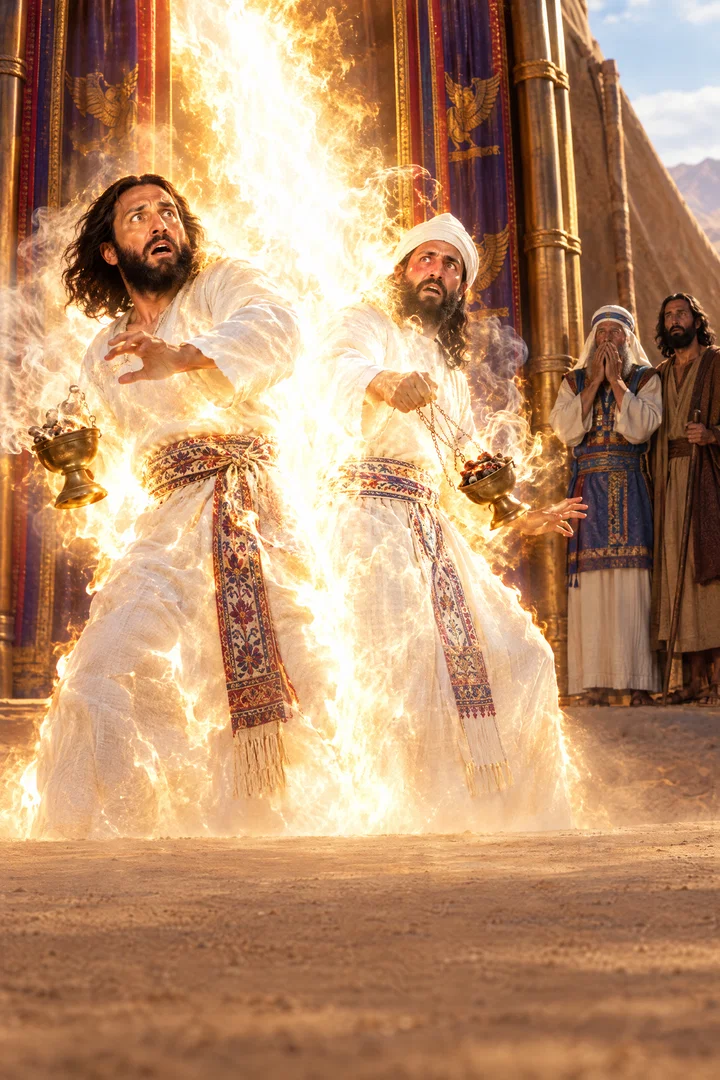
And Nadab and Abihu, the sons of Aaron, took either of them his censer, and put fire therein, and put incense thereon, and offered strange fire before the LORD, which he commanded them not.
Translations
American King James Version, King James Version
And Nadab and Abihu, the sons of Aaron, took either of them his censer, and put fire therein, and put incense thereon, and offered strange fire before the LORD, which he commanded them not.
And Nadab and Abihu, the sons of Aaron, took either of them his censer, and put fire therein, and put incense thereon, and offered strange fire before the Lord, which he commanded them not.
And Nadab and Abihu, the sons of Aaron, took each of them his censer, and put fire in it, and put incense on it, and offered strange fire before the LORD, which he commanded them not.
And Nadab and Abihu, the sons of Aaron, took each of them his censer, and put fire therein, and laid incense thereon, and offered strange fire before the LORD, which he had not commanded them.
And Nadab and Abihu, the sons of Aaron, took each of them his censer, and put fire therein, and laid incense thereon, and offered strange fire before Jehovah, which he had not commanded them.
And the sons of Aaron, Nadab and Abihu, take each his censer, and put in them fire, and put on it perfume, and bring near before Jehovah strange fire, which He hath not commanded them;
And the sons of Aaron, Nadab and Abihu, took each of them his censer, and put fire in it, and put incense on it, and presented strange fire before Jehovah, which he had not commanded them.
Then Aaron’s sons, Nadab and Abihu, took each man his censer and placed therein fire, and put thereon incense,—and brought near before Yahweh strange fire, which he had not commanded them.
Berean Standard Bible, Majority Standard Bible
Now Aaron’s sons Nadab and Abihu took their censers, put fire in them and added incense, and offered unauthorized fire before the LORD, contrary to His command.
Nadab and Abihu, the sons of Aaron, each took his censer, and put fire in it, and laid incense on it, and offered strange fire before the LORD, which he had not commanded them.
And Nadab and Abihu, the sons of Aaron, took their vessels and put fire in them and perfume, burning strange fire before the Lord, which he had not given them orders to do.
But Nadab and Abihu, the sonnes of Aaron, tooke either of them his censor, and put fire therein, and put incense thereupon, and offred strange fire before the Lord, which hee had not commanded them.
Douay-Rheims (Challoner revision)
And Nadab and Abiu, the sons of Aaron, taking their censers, put fire therein, and incense on it, offering before the Lord strange fire: which was not commanded them.
Pictures
Cross-references 20 of 38
- Leviticus 9:24
And there came a fire out from before the LORD, and consumed upon the altar the burnt offering and the fat: which when all the people saw, they shouted, and fell on their faces.
The Lord’s fire consumed the appointed offering, contrasting with judgment on unauthorized fire.
- Leviticus 10:9-10
Do not drink wine nor strong drink, thou, nor thy sons with thee, when ye go into the tabernacle of the congregation, lest ye die: it shall be a statute for ever throughout your generations:
Priests abstain from wine so they can distinguish the holy from the common.
- 1 Samuel 15:22
And Samuel said, Hath the LORD as great delight in burnt offerings and sacrifices, as in obeying the voice of the LORD? Behold, to obey is better than sacrifice, and to hearken than the fat of rams.
Obedience to God matters more than offerings made against his command.
- 2 Samuel 6:6-7
And when they came to Nachon’s threshingfloor, Uzzah put forth his hand to the ark of God, and took hold of it; for the oxen shook it.
Both men die after handling holy things contrary to God’s command.
- Leviticus 6:13
The fire shall ever be burning upon the altar; it shall never go out.
The altar fire was to burn continually, unlike the strange fire they offered.
- Numbers 16:35
And there came out a fire from the LORD, and consumed the two hundred and fifty men that offered incense.
Fire from the Lord consumed those who offered incense unlawfully, as it did Nadab and Abihu.
- Exodus 30:9
Ye shall offer no strange incense thereon, nor burnt sacrifice, nor meat offering; neither shall ye pour drink offering thereon.
Forbids unauthorized incense and offerings on the altar.
- Ezekiel 22:26
Her priests have violated my law, and have profaned mine holy things: they have put no difference between the holy and profane, neither have they shewed difference between the unclean and the clean, and have hid their eyes from my sabbaths, and I am profaned among them.
Both condemn priests for failing to distinguish the holy from the common.
- 2 Chronicles 26:16-19
But when he was strong, his heart was lifted up to his destruction: for he transgressed against the LORD his God, and went into the temple of the LORD to burn incense upon the altar of incense.
Uzziah is struck with leprosy for unlawfully taking priestly incense service upon himself.
- Exodus 24:9-10
Then went up Moses, and Aaron, Nadab, and Abihu, and seventy of the elders of Israel:
Nadab and Abihu had witnessed God’s glory on the mount before offering strange fire.
- Leviticus 16:12
And he shall take a censer full of burning coals of fire from off the altar before the LORD, and his hands full of sweet incense beaten small, and bring it within the vail:
Both describe priests using a censer and incense, with fire taken from the altar.
- Exodus 19:22
And let the priests also, which come near to the LORD, sanctify themselves, lest the LORD break forth upon them.
God warned priests who approached him to sanctify themselves.
- 1 Corinthians 10:11
Now all these things happened unto them for ensamples: and they are written for our admonition, upon whom the ends of the world are come.
Nadab and Abihu’s death serves as a recorded example and warning.
- Malachi 1:7-8
Ye offer polluted bread upon mine altar; and ye say, Wherein have we polluted thee? In that ye say, The table of the LORD is contemptible.
Both condemn polluted, unacceptable offerings made contrary to what God requires.
- Isaiah 1:12
When ye come to appear before me, who hath required this at your hand, to tread my courts?
God rejects worship and service he did not require.
- Numbers 3:4
And Nadab and Abihu died before the LORD, when they offered strange fire before the LORD, in the wilderness of Sinai, and they had no children: and Eleazar and Ithamar ministered in the priest’s office in the sight of Aaron their father.
Recalls Nadab and Abihu’s death after offering unauthorized fire.
- Revelation 8:3-4
And another angel came and stood at the altar, having a golden censer; and there was given unto him much incense, that he should offer it with the prayers of all saints upon the golden altar which was before the throne.
Incense is offered before God, with the saints’ prayers.
- Deuteronomy 4:2
Ye shall not add unto the word which I command you, neither shall ye diminish ought from it, that ye may keep the commandments of the LORD your God which I command you.
Forbids adding to or taking from God’s commands.
- Hebrews 12:28
Wherefore we receiving a kingdom which cannot be moved, let us have grace, whereby we may serve God acceptably with reverence and godly fear:
both call for serving God with reverence
- Numbers 16:6-7
This do; Take you censers, Korah, and all his company;
Moses proposes a censer test to show whom God has chosen.
Commentary part 1 of 2
Each commentary is drawn from primary sources: the writings of Ellen G. White and Adventist pioneers and periodicals. Each commentary is separate. Its own words are not a quotation; follow the references to read the source passages.
Ellen G. White
102 sources
Nadab and Abihu, the sons of Aaron ministering as priests, each took his censer and put common, unauthorized fire and incense upon it before the Lord, which He had commanded them not to offer.CEv 91.3SG4 11.2–3GW 20.2–3 God had commanded that only fire kindled by Himself be kept burning continually and used in His service, and any deviation was forbidden under penalty of death.3MR 324.3Ms 109, 1899, par. 5–6Ms 78, 1897, par. 67–69 Their minds were beclouded by wine so that they could no longer distinguish between the holy and the common, yet their intoxication did not excuse them because they had become responsible for every act when they put the cup to their lips.SG4 11.2–3GW 20.2–31SP 276.2–277.1 Fire went out from the Lord and devoured them before Him, showing that God will be sanctified in those who come near Him and must be approached with reverence in His own appointed way.CEv 91.3GW 20.2–31SP 276.2–277.1 The sacred fire represents God Himself and the Holy Spirit working through Christ alone, while strange fire is every human invention, selfishness and self-devised worship offered instead of what God provides and commands.3MR 324.3Ms 109, 1899, par. 5–6Lt 49a, 1896, par. 26–27LC1 186.12RED 82.1–2
The Unauthorized Offering
Nadab and Abihu were the sons of Aaron, priests ministering in holy office, and each took his censer, put fire and incense on it, and offered common, strange, unauthorized fire before the Lord, which He commanded them not.CEv 91.3SG4 11.2–3GW 20.2–31SP 276.2–277.1Ms 27, 1893, par. 14 They offered incense with common fire instead of the sacred fire God had kindled on the altar and commanded the priests to use, in direct violation of His express command.SG4 11.2–3GW 20.2–31SP 276.2–277.1Ms 27, 1893, par. 14Ms 109, 1899, par. 5–6 Their act was irreverent, unrighteous, and greatly dishonoring to God, who does not tolerate unrighteousness among those responsible for His service.CEv 91.33MR 324.3Ms 109, 1899, par. 5–6 Fire went out from the Lord and destroyed them, and they died before the Lord in the sight of the people.GW 20.2–3Ms 27, 1893, par. 14Ms 109, 1899, par. 5–6 Their sacred office required careful self-examination and sanctification, for God will be sanctified in those who come near Him and glorified before all the people.SG4 11.2–3GW 20.2–31SP 276.2–277.1Ms 109, 1899, par. 5–6
The sin occurred just after God had accepted the appointed sacrifices by sending fire from the Lord to consume the offering on the altar while the people shouted and worshiped.ST Jul 17, 1884 The brothers acted from carelessness, recklessness and self-indulgence without stopping to think of the consequences.STMW10 10.1–2 They meant no harm, and nearly everything else in that solemn worship had been done as commanded, yet their disobedience in using fire God had not commanded brought His wrath.ST Jul 17, 1884 God exactly marks iniquity, including sins of thoughtlessness, negligence, forgetfulness and ignorance, and good intentions are no excuse when light has been given.ST Jul 17, 1884 He must be approached with reverence and awe in His own appointed manner, and He is not pleased with partial obedience.ST Jul 17, 1884
God had given explicit directions for every part of His service so that all sacred worship would accord with His holy character.2RED 82.1–2 He commanded the priests to offer always only fire of His own kindling from heaven, kindled by Himself for the altar and for incense, kept burning continually day and night and never extinguished, to be put upon the censer and used in all their service.Ms 109, 1899, par. 5–6Ms 78, 1897, par. 67–69Ms 63, 1897, par. 6–8ST Jul 1, 18802RED 82.1–2 That sacred fire represented God Himself.3MR 324.3Ms 109, 1899, par. 5–6 Any deviation in His holy service was punishable with death, and presenting common fire with incense had been warned would bring death.2RED 82.1–2 Their presenting of strange fire insulted the infinite God by positive disregard of His express directions, for which God consumed them by fire.2RED 82.1–2
Aaron did not murmur nor rebel at the death of his two sons but humbly submitted to God's justice and bore the loss without rebelling, upholding the sacredness and divine authority of the priestly office.ST Oct 14, 1880PP 425.4 The ban on their relatives' mourning underscored the seriousness of the judgment and protected the people from further wrath.RH Feb 27, 1900 The history was carefully treasured in Israel and taught to children, often put into song so they would become familiar with the truth.Ms 122, 1897, par. 27–29 Daniel and his three companions had been educated in that history along with the histories of Abel, Seth, Enoch and Noah, and cherished the truth handed down by human lips from one generation to another, so that the image of God engraved upon the heart guarded them against dishonor to God at the king's table.Ms 122, 1897, par. 27–29 Their history taught Daniel and his companions that wine could become a snare, injure physical and mental powers, confuse the senses and weaken discernment in sacred matters, so they resolved to avoid indulgences that might dishonor God and compromise obedience.4MR 125.3–126.3Ms 51, 1898, par. 4–8PK 482.112MR 121.3–123.1
Sacred Versus Strange Fire
Strange fire is common, unauthorized fire offered by human choice instead of as commanded, while sacred fire is fire kindled by God Himself to represent Him and His holy principles, kept burning continually day and night and never extinguished, to be used in all service.3MR 324.3Ms 109, 1899, par. 5–6Lt 49a, 1896, par. 26–272RED 82.1–2ST Mar 4, 1875 Substituting the common for the sacred treats as common what God appointed as sacred, has no virtue in it, dishonors God who will not tolerate unrighteousness among those responsible for His service, confuses the ability to distinguish sacred from common, and brings His displeasure, rejection and punishment.Ms 109, 1899, par. 5–6Lt 49a, 1896, par. 26–27Lt 81, 1896, par. 6–8STMW6 17.4FE 409.1–2 Putting self-serving and self-pleasing purposes into God's work, carrying it by human principles, self, pride of opinion, Pharisaism, human inventions, human wisdom and human plans, and taking God's place to assume unauthorized rule over fellow men is offering common fire which God despises.Lt 49a, 1896, par. 26–27Lt 81, 1896, par. 6–8STMW6 17.4FE 409.1–2
The divine fire represents the communication and access between God and man opened through Jesus Christ alone.LC1 186.12RED 82.1–2ST Mar 4, 1875RH Mar 25, 1875 The true altar is Christ and the true fire is the Holy Spirit, who inspires, leads and guides into safe counsel, and only the person led by the Spirit is a safe counselor.5MR 411.2–412.1Ms 196, 1898, par. 6 He must be sought in prayer, with methods tested by Scripture as supreme authority, and turning from God to seek counsel at a strange altar or unauthorized source brings an answer according to one's deeds.5MR 411.2–412.1Ms 196, 1898, par. 6
Incense kindled by the holy fire, rising before God mingled with the earnest prayers of the people without, is an emblem of the mediation of Christ.LC1 186.12RED 82.1–2ST Mar 4, 1875RH Mar 25, 1875 All works in which no divine Saviour is represented are as the offering of Cain and are unacceptable to God.LC1 186.12RED 82.1–2ST Mar 4, 1875RH Mar 25, 1875
No sacrifice or service is acceptable unless salted and seasoned with divine fire.2RED 82.1–2ST Mar 4, 1875RH Mar 25, 1875 Worship and service must use what God provides and kindles, not what men devise themselves, with human, unholy practices and worldly ideas and methods left out and not even a spark of human invention belonging in it.2RED 82.1–2ST Mar 4, 1875STMW6 17.47T 267.2Lt 6, 1896, par. 2 Zealous effort does not make such human service acceptable, and those handling sacred responsibilities may be blind to the harm it causes.Lt 6, 1896, par. 2
God's sacred fire is His love and the holy oil and Holy Spirit received into the heart and character, kindled from the divine altar where fire is kept burning day and night by the power of God.STMW9 12.2–3Ms 7, 1895, par. 24–26Lt 48, 1897, par. 39–40Lt 84, 1899, par. 3–5 Received and brought into the character it makes people tender, kind, sympathetic, courteous, gentle and Christlike, with the oil of grace in the heart, golden oil in the vessels, the lamp of life trimmed by the very hand that lit it, and the life surrendered to Christ's guidance and service in His footsteps.STMW9 12.2–3Ms 7, 1895, par. 24–26Lt 48, 1897, par. 39–40Lt 84, 1899, par. 3–5 Common fire is selfishness, intemperance, lust, commonness, cheapness and other corrupt traits, including harsh, sharp, critical, blunt, severe, condemning and overbearing treatment of souls in danger, which dishonors God, misrepresents Christ's sacred character, and must be consumed by His fire and left out of all councils and dealings.STMW9 12.2–3STMW9 13.3Ms 43a, 1901, par. 22Ms 7, 1895, par. 24–26Lt 84, 1899, par. 3–5
Wine Clouded Judgment
Wine and indulged appetite had benumbed the senses of Nadab and Abihu until they were partly intoxicated, debased their faculties, beclouded intellect, enervated the brain and weakened nerve power.SG4 11.2–3GW 20.2–31SP 276.2–277.1Ms 27, 1893, par. 14RH Mar 25, 1875 Their minds were confused and discernment destroyed so they could not distinguish between sacred and common, holy and unholy, right and wrong, and clean and unclean, treating as holy what was common.SG4 11.2–31SP 276.2–277.1Ms 27, 1893, par. 14RH Mar 25, 1875ST Mar 4, 1875 Their free use of wine as their usual custom had clouded judgment and dulled the sense of the difference between sacred and common things, disqualifying them for holy office though that office required careful self-examination and sanctification.SG4 11.2–31SP 276.2–277.1Ms 27, 1893, par. 14 Their act in offering incense with common, unauthorized fire instead of the sacred fire God had kindled and commanded violated an express command and dishonored their sacred office, and fire from the Lord killed them before the people to show God requires those who draw near Him to honor His holiness.SG4 11.2–3GW 20.2–31SP 276.2–277.1Ms 27, 1893, par. 14 The account warns that appetite and habits of life must be kept under strict control, especially in work requiring clear judgment before God, and that all work is done under God's watch.STB 640.3–4CH 396.3Ms 53, 1907, par. 24
Their intoxication did not excuse disobedience, for they became responsible for all acts done under its influence when they put the cup to their lips.RH Mar 25, 1875CTBH 18.2–19.1LC1 187.1–2ST Mar 4, 18752RED 83.1–2 Having chosen to drink wine freely before entering the tabernacle and going in to minister as usual, indulgence of appetite cost them their lives.RH Mar 25, 1875LC1 187.1–2ST Mar 4, 18752RED 83.1–2 God expressly forbade wine and strong drink that would becloud the intellect to those ministering in holy office so they would keep clear power of discrimination and discernment, give correct judgment, discern between holy and unholy and between clean and unclean, and have unclouded reason to teach Israel all His statutes.RH Mar 25, 1875ST Mar 4, 1875 Their confused minds did not excuse the act of treating common fire as fit for offering, and fire from God's presence destroyed them.RH Mar 25, 1875CTBH 18.2–19.1SG4 124.3–125.2
The punishment showed God is to be honored by those who draw near Him, and the ban on relatives' mourning underscored the seriousness of the judgment and protected the people from further wrath.RH Feb 27, 1900 The incident teaches those engaged in God's work to practice strict temperance, keep the whole being under God's protection with clear minds and control of reason, and never tempt the Spirit of God.RH Feb 27, 1900HSFM 208.1–2CTBH 18.2–19.1 Their dulled senses illustrate how indulgence in liquor or tobacco can blur the distinction between sacred and common, and worship offered with minds and bodies impaired by liquor, tobacco, gluttony and narcotics, with polluted mouths, breath and benumbed brains, is compared to their offering and is an offense and insult to a holy God risking the same judgment.STB 640.3–4CH 396.3Ms 53, 1907, par. 24ST Mar 4, 1875
Fermented wine bewilders the brain, confuses the senses, perverts God-given powers, paralyzes intellect and gives the destroyer opportunity to enter and dethrone reason, taking away ability to put difference between holy and unholy and between clean and unclean.ST Sep 6, 1899ST Mar 4, 1875Ms 16, 1899, par. 17–21 Their deaths led to strict limits afterward, with strict temperance required of those connected with sacred service who were prohibited from touching wine or using grapes in any way when coming before the Lord, that they might avoid becoming familiar with fermented wine and guard against impaired reason and further profanation.ST Sep 6, 1899ST Mar 4, 1875Ms 16, 1899, par. 17–21 Food or drink that bewilders the brain dishonors God, while the safe drink God gives to all humanity is the pure, unfermented juice of the grape, as shown by Christ who made only unfermented wine and never placed fermented liquor to His own lips or to the lips of His disciples.Ms 16, 1899, par. 17–21
Habits and Accountability
The disobedience in offering unauthorized fire was not a sudden lapse but the fruit of years of self-indulgence and long-cherished habits.2RED 82.1–2ST Mar 4, 1875ST Jul 1, 1880PP 360.1CE 226.3–227.1 Drinking wine freely had become their usual custom, gratifying appetite until indulgence mastered them and repeated draughts became a controlling habit stronger than even elevation to sacred office.2RED 82.1–2ST Mar 4, 1875ST Jul 1, 1880 Desire encouraged by wine, lack of self-control and discipline, following inclination, and failure to understand their own weakness left their faculties debased and their power of discernment gone.2RED 82.1–2ST Mar 4, 1875ST Jul 1, 1880
They had not been trained in self-control nor taught to respect their father's authority and to obey God exactly.3T 295.1–3RH Jul 29, 1873CE 226.3–227.1 Aaron's yielding disposition and neglect to require respect, reverence, obedience, self-denial and reverence contributed to their ruin and prepared them for divine judgment.3T 295.1–3RH Jul 29, 18733T 293.3–294.1PP 360.1CE 226.3–227.1 The reverence they failed to give their father led them to disregard the positive requirements of God, so that even the responsibility of sacred office could not break habits formed in youth.ST Jul 1, 1880PP 360.1CE 226.3–227.1
They had been especially honored as elders brought into close connection with God to be instructed in His will and way.ST Jul 1, 1880ST Jul 1, 1880 They had witnessed God's glory on the mount and fully understood the holy character of the typical service and the awful solemnity and responsibility of presenting themselves in the sanctuary where His presence was manifested.1SP 276.2–277.1ST Jul 1, 18802RED 82.1–2ST Mar 4, 1875 Yet they failed the careful self-examination and sanctification required of those who come near Him and come into the sanctuary where God is manifested.1SP 276.2–277.1ST Jul 1, 1880 Those entrusted with greater light, privileges and responsibility face more severe punishment when they sin, and God will not work a miracle to keep men from the consequence of deliberate departure from light.Ms 174, 1898, par. 8–12Ms 10, 1899, par. 9
God was testing their character to bring into exercise the highest powers of the mind.ST Jul 1, 1880 Their fatal mistake shows there is not a virtue nor a vice, nor an act of body or of mind, to which a person may not be chained by force of habit.ST Jul 1, 1880 Neglect of parents in forming character bears this fruit, and many promising young men are ruined by one false step at the commencement of life in forming habits of intemperance.ST Jul 1, 1880
Judgment Reveals Holiness
Fire went out from the Lord and devoured Nadab and Abihu, and they died before the Lord in sight of the people for offering common, unauthorized fire He had not commanded in His sacred service.CEv 91.3GW 20.2–3Ms 27, 1893, par. 14Ms 109, 1899, par. 5–6Ms 29, 1895, par. 4–6 Their irreverent act dishonored their sacred office and violated His express command, showing that those who draw near to Him must honor His holiness, for He will be sanctified in them that come nigh Him and glorified before all the people.CEv 91.3GW 20.2–3Ms 109, 1899, par. 5–6Ms 29, 1895, par. 4–6 The sacred fire they should have used represented God Himself, kindled by Him to burn continually day and night and to be used in all service, and the lesson for all bearing responsibilities in His service is that He and not man is to be praised and honored, His work must be preserved from commonness and cheapness now just as fully as in ancient Israel, and strict obedience is demanded to every word from His mouth.CEv 91.3GW 20.2–3Ms 109, 1899, par. 5–6 God must therefore be approached with reverence and awe in His own appointed manner, honored and treated as holy, with the careful self-examination and sanctification required of those who come where His presence is manifested, a preparation they failed though they had witnessed His glory on the mount.1SP 276.2–277.1Ms 109, 1899, par. 5–6Ms 29, 1895, par. 4–6 He exactly marks iniquity, including sins of thoughtlessness, negligence, forgetfulness and ignorance, and good intentions are no excuse when light has been given and His requirements have been directly contravened.1SP 276.2–277.1Ms 27, 1893, par. 14Ms 109, 1899, par. 5–6
God does not tolerate unrighteousness among those responsible for His service, and He is no respecter of persons, so self-will and resistance that brings unauthorized fire before a God not feared is consumed in judgment.3MR 324.3Ms 109, 1899, par. 5–6Ms 25, 1887, par. 19 He will not work a miracle to keep men from the consequence of deliberate departure from light, and those who disregard His directions to indulge appetite must bear the result of their course, with those entrusted with greater light, privileges and responsibility facing more severe punishment when they sin.Ms 174, 1898, par. 8–12Ms 10, 1899, par. 9Ms 25, 1887, par. 19 His punishments are just, and His people must acknowledge their justice even when wrath comes very near.SG4 13.3 Those who sympathize with one who deserves reproof and try to lessen the burden of correction oppose God and His servants and share guilt with the one at fault, and such false sympathy can keep erring persons from being saved.SG4 13.3
He has not changed, but is as particular and exact in His requirements now as in the days of Moses, refusing defiled sacrifice and service as He refused their incense.LC1 189.2–190.12RED 85.2–86.1RH Mar 25, 1875 Worship defiled by liquor, tobacco, narcotics and bodily defilement is no more acceptable than their offering of strange fire, and prayers, songs of praise, preaching of Bible truth and holiness, and bowing to worship with lips stained by tobacco, breaths polluted with liquor fumes and nerves trembling from narcotics is strange fire, indeed positive defilement.LC1 189.2–190.12RED 85.2–86.1RH Mar 25, 1875 Such mingling of truth and prayer with the stench of tobacco and brandy is an offense and insult to a holy and sin-hating God dwelling in unapproachable light, and is incense most acceptable to Satan, warning against treating sacred things as common.LC1 189.2–190.1RH Mar 25, 1875 Indulgence of appetite and passion in eating and drinking, smoking and chewing tobacco, gluttony and drunkenness blunts the sensibilities as with Nadab and Abihu, so that professed Christians make no difference between sacred and common, bring holy things down to defiled breaths, benumbed brains and polluted souls, fail to discern the inconsistency of their worship, and still talk of overcoming as Christ overcame while gratifying appetite.RH Mar 25, 1875
Sabbath Substitution Warned
Nadab and Abihu were commanded to offer always only fire of God's own kindling, kept burning before Him day and night, yet they put common fire in their censers with incense and offered strange fire which He commanded them not.Ms 78, 1897, par. 67–69Ms 63, 1897, par. 6–8ST Mar 31, 1898ST Oct 6, 1898 Their minds were confused by wine used too freely, so they could not distinguish between the sacred and the common.Ms 78, 1897, par. 67–69Ms 63, 1897, par. 6–8ST Mar 31, 1898ST Oct 6, 1898 Their act was putting the common in place of the sacred and dishonoring the Lord God of Israel, and fire went out from the Lord and devoured them so that they died before Him.Ms 78, 1897, par. 67–69Ms 63, 1897, par. 6–8ST Mar 31, 1898 This putting of a common thing in place of what God sanctified and blessed is the sure pattern for exalting Sunday, a common working day and spurious sabbath, in place of the seventh day which the Lord sanctified and blessed.Ms 78, 1897, par. 67–69ST Oct 6, 18981SP 279.3–280.1ST Jul 8, 1880 Those who ignore the Lord's Sabbath to keep holy the first day of the week take a common day upon which God placed no sanctity and clothe it with sacred prerogatives, presenting it to the world as the Christian Sabbath without a Thus saith the Lord for its authority, which God will not accept at their hands and which dishonors Him.Ms 63, 1897, par. 6–8ST Mar 31, 1898ST Jul 8, 1880Lt 100, 1895, par. 27–30
God's exact directions for worship are not to be altered on the assumption that a substitute will do just as well.SG4 14.1–21SP 279.3–280.1ST Jul 8, 1880 Just as He commanded what offering to bring, He commands which day is holy, and men are not free to substitute another day or say it makes no difference.SG4 14.1–21SP 279.3–280.1ST Jul 8, 1880 The fourth commandment requires keeping holy the seventh day, not the sixth nor the first, to commemorate His rest after the six days of creation.1SP 279.3–280.1ST Jul 8, 1880 To labor on God's holy time and rest on the first day honors a common working day on which God did not rest and placed no sacred honor, and to substitute a common day for the sacred insults the Maker of heaven and earth.ST Jul 8, 1880Lt 100, 1895, par. 27–30 A day without God's blessing cannot be made holy by human decision or law, just as common fire could not replace the fire God appointed, and setting aside His commandment as unimportant dishonors Him.Ms 63, 1897, par. 6–8ST Jul 8, 1880Lt 100, 1895, par. 27–30 God has given explicit directions in regard to His own worship that must be followed in the exact course He prescribed, for God means just what He says.ST Jul 8, 1880
Although Sabbath transgression is not now immediately punished with temporal death as their transgression was, God regards disobedience no more lightly.SG4 14.1–21SP 279.3–280.1ST Jul 8, 1880 He bears long with those who set aside His law as of no consequence, yet the transgressor must surely bear punishment for his sin.ST Oct 6, 18981SP 279.3–280.1ST Jul 8, 1880 Death is the final punishment for all who reject light and persist in transgression and continue in it.SG4 14.1–21SP 279.3–280.1ST Jul 8, 1880 It is dangerous to deviate from the commands of God, whose statutes are to be reverenced and obeyed.ST Oct 6, 1898ST Jul 8, 1880
Faithfulness in Sacred Service
All who handle sacred work — publications of wide circulation, preaching, teaching, councils and mission work — must keep God's work distinct from common affairs, ideas, politics, worldly theories and cheapness.7T 152.3–153.2MC 22.3–23.2Lt 89, 1899, par. 6–7STMW10 10.1–2STMW6 17.4 They are to give pure wheat and solid spiritual food, precious instruction thoroughly winnowed from chaff, rather than common matter, human opinions, unsanctified propositions born wholly of self, and the lives and sentiments of men who do not know the Word.Ms 23, 1890, par. 4Lt 89, 1899, par. 6–7STMW10 10.1–2 Even words are to be pure, holy and carefully chosen, because the work concerns the salvation of souls and people are watching.MC 22.3–23.2Ms 23, 1890, par. 4 To mingle the sacred with the common in a careless manner cheapens truth, corrupts decisions, harms others and leads astray, repeating the carelessness, recklessness and self-indulgence of those who offered what He had not commanded without stopping to think of consequences.7T 152.3–153.2STMW10 10.1–2STMW6 17.4 God will be sanctified in them that come nigh Him and glorified before all the people.Lt 89, 1899, par. 6–7STMW10 10.1–2
Using common fire means carrying the work by human principles, self, pride of opinion, Pharisaism, human inventions, human wisdom, human plans and unsanctified selfishness instead of being worked by the Holy Spirit.Lt 81, 1896, par. 6–8STMW9 28.1SPBC 188.2Lt 89, 1896, par. 2–3 It is trusting self, devising methods to display self and make a show, taking the place of God to assume unauthorized rule and authority over fellow men, and letting one's own spirit and sentiments prevail without vital connection with God and without soul regeneration.Lt 81, 1896, par. 6–8STMW9 28.1SPBC 188.2Lt 89, 1896, par. 2–3 Leaders who substitute their own plans and opinions for God's order, press them by loud voices and determined will, frame resolutions without humble prayer and never thought of in the councils of heaven, and remain long in office under their own management until they think themselves a necessity, offer strange fire that God despises.Lt 81, 1896, par. 6–8Lt 89, 1896, par. 2–3 Such offerings include harsh words, self-importance, self-exaltation, self-righteousness, arbitrary authority, domineering, oppression, and restricting God's people with human plans and rules, which are not acknowledged by God and continually misrepresent His character.STMW9 14.2STMW9 28.1 A good purpose cannot make unjust or selfish methods acceptable, and God did not excuse departure from His requirements.Ms 30, 1900, par. 18–22
Turning from sacred to common fire includes fraudulent transactions, diverting means raised for an appointed purpose, worldly policy, covetous appropriation of entrusted goods, bargaining with property devoted to God, grasping for advantage, defrauding rights, oppression, robbery, injustice and dishonest dealings.SPBC 177.7–8Lt 55, 1895, par. 3–7Lt 98, 1899, par. 11Lt 94, 1899, par. 15–17STMW9 30.1–3 Sacred fire is God's holy principles, and handling it means handling means the Lord moves His people to give for a certain purpose with a sharp sense of justice, equity and righteous principle, exerting holy influence marked by practical benevolence, self-denial and self-sacrifice in family, school and church.SPBC 177.7–8Lt 98, 1899, par. 11Lt 94, 1899, par. 15–17 Calling injustice or dishonest dealings service to God and necessary to advance His cause does not make them acceptable or righteous when they violate truth and justice, and His cause cannot advance through oppression, robbery or violating people's rights.SPBC 177.7–8Lt 55, 1895, par. 3–7STMW9 30.1–3 Those at the head of the work who work upon a worldly, fraudulent policy dishonor God, for He will be sanctified in all them that come near Him, and He holds the doers accountable and does not accept or bless these practices.Lt 55, 1895, par. 3–7Lt 98, 1899, par. 11 Offense against God is measured by position of trust occupied, with mind acting upon mind according to position, and responsibility for influence proportionate to trust given.Lt 94, 1899, par. 15–17
Ministers and teachers who enter work with exhausted minds and nerves without taking time to seek the Lord and ask in faith for the Holy Spirit use common fire instead of God's sacred fire.GW 271.4Ms 101, 1902, par. 1–3 Their strained efforts disappoint hearers and harm the speaker, and relying on outward embellishment, theatrical preaching, display, startling notices, expensive methods, amusing stories, cheap trifling words and cheap illustrations that give false conceptions of Christ offends God, hinders truth and dishonors the cause.RH Dec 22, 1904GW 271.4Lt 51, 1902, par. 18–19Ms 51, 1903, par. 10 God's work is to be carried forward with humility and Christlike methods, allowing truth to make progress without being hindered by display, and workers who seek recognition for themselves do not reveal Christ's character nor make His holiness prominent.Lt 51, 1902, par. 18–19Ms 51, 1903, par. 10 In publishing this means not putting too much common matter and not enough of the sacred — long articles with no reference to the signs of the near coming of the Son of man with power and great glory, things other newspapers publish, and dependence on pictures unrelated to vital issues — but being a faithful householder giving meat in due season, giving the trumpet a certain sound, with fewer pictures and more real, solid, spiritual food.Lt 89, 1899, par. 1–2
The censers give a lesson for speech: harsh, sharp, critical, severe, combative, passionate, rash and ill-advised words, common utterances, quick severe speech, murmuring, jealousy, evil-surmising and a drop of gall mixed with truth are common fire.STMW9 12.2–3STMW9 14.213MR 310.2STMW9 6.1Ms 17, 1895, par. 4–5 Such words chafe spirits, stir rebellion, ruin souls, destroy hope, courage and faith, and multiply evil as others copy the example.STMW9 12.2–3STMW9 6.1Ms 17, 1895, par. 4–5 Without Christ abiding in the heart and without continual reliance on grace and wisdom through Christ, people fail to distinguish sacred from common and words become common and harmful, while faith working by love purifies the soul.STMW9 6.1Ms 17, 1895, par. 4–5 Sacred service requires words cleansed, kindled from sacred coals by the Holy Spirit and spoken in love with the law of kindness on the lips, tender, kind and sympathetic, for God's own sacred fire is His love.STMW9 12.2–3
Even pure doctrine becomes strange fire when mingled with self, peculiar traits, unpurified spirit, passion and self-directed zeal.Lt 7, 1895, par. 2–36T 159.1Ms 14, 1896, par. 313MR 310.2 Such presentation depreciates truth, misrepresents God's character and the sacred character of Christ, strengthens prejudice, turns people from light, brings truth and His work into disrepute, and causes loss of souls.Lt 7, 1895, par. 2–36T 159.113MR 310.2 Selfishness brought into God's work must not be mingled with sacred service, and weaving self and a common spirit into solemn work incurs His displeasure.Ms 14, 1896, par. 3RCOC 50.1 Those in positions of trust bear great responsibility because right performance of God's work and salvation of souls depend in great degree on their spiritual condition, their own well-being and eternal destiny decided by the spirit cherished, and unless they can distinguish sacred fire from common they should remove their hands from the work.Ms 14, 1896, par. 3 Living every word from God's mouth and presenting it meekly in the Spirit makes it a savor of life, while condemned practices used in place of practical godliness — walking in the Spirit and serving one another in love — are strange fire He condemned.STMW10 11.1–2
Seeking counsel at a strange altar, consulting unsanctified men and lawyers in church matters instead of God, is using common fire in place of sacred fire, greatly dishonoring God and proving loss of spiritual discernment.Ms 91, 1899, par. 25MR 411.2–412.1 The true altar is Christ and the true fire is the Holy Spirit who guides into safe counsel, while introducing commercial work and worldly business practices into sacred institutions corrupts the institution, displaces the work God gave it, joins workers to the enemy, and amounts to using something profane in place of what God kindled.Ms 91, 1899, par. 2Ms 12, 1903, par. 6–75MR 411.2–412.1 Following deceptive spiritualistic teachings and calling rejected light from God strange fire while resisting His message repeat the sin, and practicing even the least injustice while claiming it makes no difference rejects His authority, perils interest in Christ's atonement, and calls for cleansing of moral defilement from His church.Lt 4, 1895, par. 29 Only those emptied of self, converted as little children, watchful in prayer and abiding in Christ avoid it.ST Jul 8, 1880 God purposed to connect Nadab and Abihu with Himself, and He purposes to connect youth and all who submit their will to Him in the same way if they heed His commands, bringing will into submission, controlling inclination and passion in the strength of Jesus, winning daily victories, and living pure and fragrant like the lily among stagnant waters.ST Jul 8, 1880
Sources