Psalms 51:19
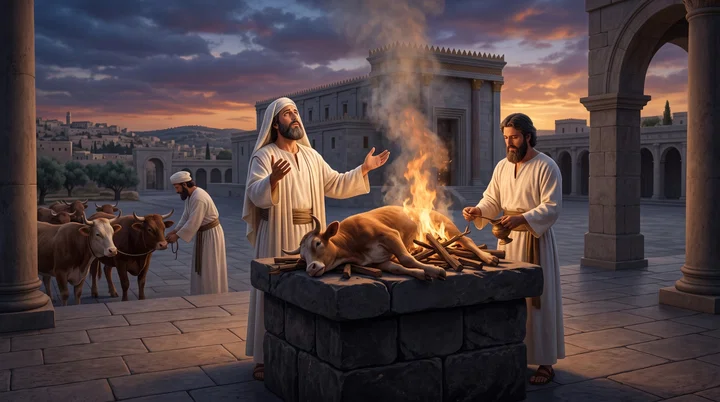
Then shalt thou be pleased with the sacrifices of righteousness, with burnt offering and whole burnt offering: then shall they offer bullocks upon thine altar.
Translations
Then shall you be pleased with the sacrifices of righteousness, with burnt offering and whole burnt offering: then shall they offer bullocks on your altar.
Then shalt thou be pleased with the sacrifices of righteousness, with burnt offering and whole burnt offering: then shall they offer bullocks upon thine altar.
Then shalt thou be pleased with the sacrifices of righteousness, with burnt offering and whole burnt offering:
Then shall they offer bullocks upon thine altar.Then shalt thou be pleased with the sacrifices of righteousness, with burnt-offering and whole burnt-offering: then shall they offer bullocks upon thy altar.
Then shalt thou delight in the sacrifices of righteousness, in burnt offering and whole burnt offering: then shall they offer bullocks upon thine altar.
Then wilt thou delight in the sacrifices of righteousness,
In burnt-offering and whole burnt-offering:
Then will they offer bullocks upon thine altar.Then Thou desirest sacrifices of righteousness, Burnt-offering, and whole burnt-offering, Then they offer bullocks on thine altar!
Then shalt thou have sacrifices of righteousness, burnt-offering, and whole burnt-offering; then shall they offer up bullocks upon thine altar.
Then, shalt thou desire the sacrifices of righteousness, Ascending-sacrifice and whole burnt-offering, Then, shall ascend upon thine altar, young bulls.
Berean Standard Bible, Majority Standard Bible
Then You will delight in righteous sacrifices,
in whole burnt offerings;
then bulls will be offered on Your altar.Then you will delight in the sacrifices of righteousness,
in burnt offerings and in whole burnt offerings.
Then they will offer bulls on your altar.Then you will have delight in the offerings of righteousness, in burned offerings and offerings of beasts; then they will make offerings of oxen on your altar.
Then shalt thou accept ye sacrifices of righteousnes, euen the burnt offering and oblation: then shall they offer calues vpon thine altar.
Douay-Rheims (Challoner revision)
Then shalt thou accept the sacrifice of justice, oblations and whole burnt offerings: then shall they lay calves upon thy altar.
Pictures
Cross-references
- 2 Samuel 11:2-27
And it came to pass in an eveningtide, that David arose from off his bed, and walked upon the roof of the king’s house: and from the roof he saw a woman washing herself; and the woman was very beautiful to look upon.
David’s sin involving Bath-sheba and Uriah is reflected in his confession.
- 2 Samuel 12:1-13
And the LORD sent Nathan unto David. And he came unto him, and said unto him, There were two men in one city; the one rich, and the other poor.
Nathan’s reproof of David leads to the repentance expressed in Psalm 51.
- Micah 6:6-8
Wherewith shall I come before the LORD, and bow myself before the high God? shall I come before him with burnt offerings, with calves of a year old?
Both contrast burnt offerings with the life and conduct God requires.
- Hosea 6:6
For I desired mercy, and not sacrifice; and the knowledge of God more than burnt offerings.
God values mercy and knowledge of him above sacrifice.
- Psalms 51:10-13
Create in me a clean heart, O God; and renew a right spirit within me.
A clean heart leads to a changed life and service to God.
- 2 Samuel 12:14
Howbeit, because by this deed thou hast given great occasion to the enemies of the LORD to blaspheme, the child also that is born unto thee shall surely die.
David’s sin and its penalty precede his penitence in Psalm 51.
Commentary
Each commentary is drawn from primary sources: the writings of Ellen G. White and Adventist pioneers and periodicals. Each commentary is separate. Its own words are not a quotation; follow the references to read the source passages.
Ellen G. White
5 sources
This closing promise belongs to David's pouring out of his soul before God in penitence and humiliation when convicted of sin.ST Jan 28, 1886ST Jan 28, 1913 He showed that he could endure the loss of his crown but could not be deprived of God's favor, valuing God's favor more than his crown.ST Jan 28, 1886ST Jan 28, 1913 God is pleased with the sacrifices of righteousness, with burnt offering and whole burnt offering, and with bullocks offered upon His altar, only after the heart has been made ready, when a broken spirit and a broken and contrite heart that He will not despise are offered instead of mere outward sacrifice.Ms 145, 1907, par. 3Ms 47, 1907, par. 1–3
That readiness involves having a clean heart created and a right spirit renewed, having His presence and Holy Spirit retained and not taken away, having the joy of salvation restored and guilt for sin removed, and having the lips opened to praise Him.Ms 145, 1907, par. 3 That readiness also involves God doing good to Zion by building the walls of Jerusalem.Ms 47, 1907, par. 1–3 Only then do teaching transgressors His ways and offering right service become acceptable to God.Ms 145, 1907, par. 3
Its lessons must be practiced in purity and Christlikeness, since merely nominal profession leaves influence unsavory and worthless like salt without savor.Lt 79, 1901, par. 13 Sinners who have fallen should without delay seek God for mercy and pardon, because mercy is still extended and the blessing of God may be theirs if they heed the pleading voice of His Spirit.ST Jan 28, 1886 David's prayer for preparation of heart for acceptable service should be the prayer of every believer today.Ms 145, 1907, par. 3 For His people this means laying aside pride in opening new fields, not keeping work closely confined to their own institutions, but showing interest in the colored schools in the South by visiting them with experienced wisdom, becoming acquainted with their work, cherishing earnest sympathy between teachers, accepting invitations to speak precious truths, and using opportunities in large institutions to build up present truth and remove prejudice.Ms 47, 1907, par. 1–3
Sources
Pioneers and periodicals
29 sources
This verse closes David's confession of adultery and murder concerning Uriah the Hittite, made in sorrow and humility of heart after Nathan reproved his sin against God.RH Jul 27, 1869ST Apr 29, 1908RH Mar 12, 1861RH Oct 12, 1869 When God has done good for Zion, He is pleased with the sacrifices of righteousness, with burnt offering and whole burnt offering and bullocks upon His altar.RH Apr 16, 1901ST Jul 17, 1884RH Nov 19, 1908 He is pleased with them only when they arise from a broken and contrite heart, not when they are mere form or soulless ceremony, for ritual, penance, or treasure cannot buy favor.ST Jan 17, 1906ST Apr 15, 1889ST Jul 17, 1884 Humble confession of particular sins must go before, for sin hides God's face until it is confessed and put away, and then the pardoned one is healed and his worship is accepted.ST Apr 15, 1897ST Jun 10, 1889RH Jul 10, 1860 It is a prayer inspired by the Spirit that repentant sinners can also pray sincerely, making it their own as they see how sinful sin is and tell it all to God without excuse or self-justification.ST Jun 14, 1910ST Jun 4, 1912RH May 10, 1870ST Feb 18, 1886 David's humble, thorough repentance shows that God can completely cleanse even one guilty of shocking sins and crimes.ST Jan 28, 1886RH Aug 22, 1871ST Dec 2, 1913
David's Fall and Confession
Then shalt thou be pleased with the sacrifices of righteousness belongs to David's confession of adultery and double murder concerning Uriah the Hittite, made in sorrow and humility of heart after the prophet Nathan reproved his sin against God.ST Apr 29, 1908RH Mar 12, 1861RH Oct 12, 1869 The psalm is associated with David's sin and forgiveness concerning Uriah the Hittite, with its setting in 2 Samuel 11-12, though the connection is not stated as certain, and it is presented as a lesson for every sinner because all have sinned. The verse is part of David's open record of most heartfelt and earnest repentance after very grievous sin, written when he awoke to his awful situation and acted with energy and decision.RH Jul 27, 1869 He refused in it to cover guilt, excuse crime, throw blame on others, or conceal repentance from future ages, being ashamed of sin but not ashamed to make penitence known, so that it stands as one of the most humble confessions of guilt ever penned.RH Jul 27, 1869
The verse belongs to frank confession of the enormity and bloodguiltiness of transgression, made with a realizing sense of deep depravity and a plea for undeserved pardon, without extenuation, excuse, or plea of unsound mind.ST Jun 10, 1889 It stands in a prayer where true confession is connected with contrition and brokenness of heart and soul, where the sinner sees by God's Word how sinful sin is and how fully it has permeated and intertwined his whole being.ST Apr 15, 1897 There the sinner makes no excuse and no comparison with the sins of others, but acknowledges his own transgressions with his sin ever before him, and tells it all to God without self-justification, excuse, or extenuation.ST Apr 15, 1897 The verse belongs to David's prayer after grievous sins in which he acknowledges sins and pleads for mercy and pardon, showing that though chosen king as a man after God's own heart he sinned grievously and made no profession of sinless perfection but confessed need of forgiveness.RH Dec 22, 1868
The verse shows the bruises left by David's fall into sin.ST Jul 24, 1879 Personal language about one's own experience in the psalm is not egotistical when it gives all glory to God, with David's use of I, my, and me expressing real experience rather than self-praise.RH Jan 5, 1860
Sacrifices That Please God
God will faithfully receive the sacrifice of righteousness.RH Apr 16, 1901 When he has done good for Zion and rebuilt Jerusalem, he is pleased with righteous sacrifices, including burnt offering and whole burnt offering, and then bullocks are offered upon his altar.RH Nov 19, 1908 This is David's prophetic prayer concerning a future condition of the city, and that forward look does not make it unsuitable to his own time nor weaken its place in the psalm.ST Jul 17, 1884
Acceptable sacrifice is bound to righteousness before God, for the sacrifice of righteousness is a broken and contrite heart brought to him through confession.ST Jul 17, 1884 Reconciliation with him then brings joy and delights greater than sinful pleasures.ST Jul 17, 1884 He is pleased with sacrifices and burnt offerings when they spring from a contrite spirit, not when they are mere form or soulless ceremony.ST Apr 15, 1889 A broken heart answers divine mercy with gratitude and faithful worship, whereas ritual, penance, bodily affliction, or treasure cannot purchase his favor.ST Apr 15, 1889
His pleasure in sacrifices of righteousness, burnt offering, and bullocks upon his altar follows only after humble confession of particular sins.RH Jul 10, 1860 Sin stands like a thick cloud hiding his face so that prayer cannot enter, until filthy garments are put away and crimson sins, including transgressions connected with affliction, are poured out in confession with blood sprinkling the horns of the golden altar.RH Jul 10, 1860 Then the one confessing is pardoned and the forgiven soul is healed, suits are accepted, and the answer of peace comes from the mercy-seat with petitions crowned with the olive branch.RH Jul 10, 1860 So a heart made humble and clean through conversion finds pleasure in worship and offers sacrifices that please God.ST Jan 17, 1906
Those sacrifices of righteousness, burnt offering, and whole burnt offering are spiritual sacrifices that render the worship of sinful beings acceptable with or without ritual service and with or without a typical temple and typical sacrifices. They belong to the permanent essence of the whole sanctuary service covered by the continual in Daniel 8. That essence is a present Christ, the Lamb slain from the foundation of the world, as the living sacrifice for a fallen world. Offering them requires union between Christ and the believer, so that the believer in Christ becomes priest and temple and offering, and this is the worship that alone is acceptable to God. The verse also shows conscience at work under the old dispensation just as under the new, proving that God carries on his work in man by conscience even where man has no name for it.ST Feb 20, 1907
Pattern for Repentant Sinners
Psalm 51:19 belongs to a prayer inspired by the Spirit that others can also pray sincerely, a practical prayer Christians make their own by praying it into personal experience as they see themselves in the light of the cross.ST Jun 14, 1910ST Jun 4, 1912 It belongs to a psalm expressing genuine repentance after reproof, whose spirit is wiser than stubborn resistance or the worldly sorrow that leads to death.ST Aug 26, 1875 It belongs to a psalm expressing genuine repentance that does not need to be repented of, whose spirit is wiser than stubborn hardness of heart and worldly sorrow that leads to death.RH Dec 22, 1868
The psalm shows how to regard sin and what kind of confession and prayer God accepts, giving guidance for honest, wholehearted confession rather than excuses that excuse sin.RH May 10, 1870 It gives the language of true repentance, where repentance is the revolt of conscience against wrong because it is wrong, not regret for sin because of its consequences and not reformation because a sinful life costs much and pays little.ST Feb 18, 1886 Yet the verse is among biblical phrases people may repeat in prayer without truly experiencing the confession expressed, for words alone do not make prayer genuine or show piety.ST Jun 21, 1883
The verse belongs to David's pouring out of his soul in penitence and humiliation when convicted of sin, showing he could endure loss of his crown but could not be deprived of God's favor and valued that favor more than his crown.ST Jan 28, 1886ST Jan 28, 1913 It shows fallen sinners should without delay seek mercy and pardon because mercy is still extended and blessing may be theirs if they heed the Spirit's pleading voice.ST Jan 28, 1886 The psalm shows David's grievous sin and the commendable quality of his repentance after God reproved him.ST Feb 20, 1879
The psalm shows David's repentance after adultery and gives greater evidence of penitence than any other person in Scripture, expressing deep heartfelt repentance and firm abiding faith in which David stands eminent among saints of both Testaments.RH Aug 22, 1871 It proves the truth taught in his age condemned sin because his wrong was condemned and he repented when reproved, vindicating his character by that repentance.RH Aug 22, 1871 The verse belongs to David's account of humble, thorough repentance, and his case shows God can completely cleanse even a sinner guilty of shocking sins and crimes.ST Dec 2, 1913
Sources