2 Samuel 11:2
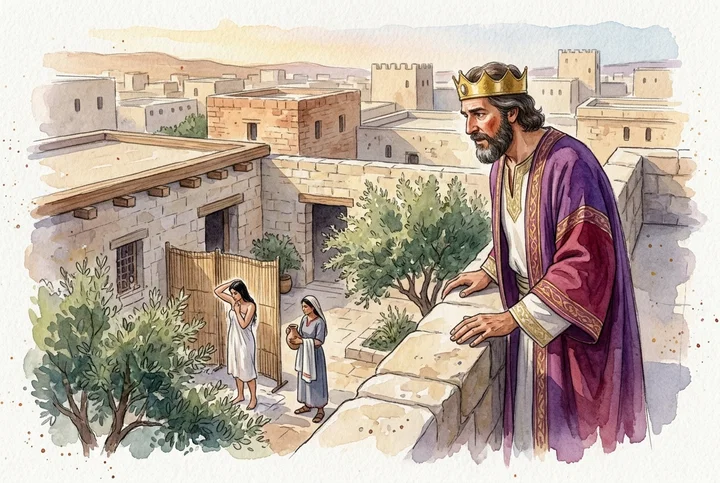
And it came to pass in an eveningtide, that David arose from off his bed, and walked upon the roof of the king’s house: and from the roof he saw a woman washing herself; and the woman was very beautiful to look upon.
Translations
And it came to pass in an evening, that David arose from off his bed, and walked on the roof of the king’s house: and from the roof he saw a woman washing herself; and the woman was very beautiful to look on.
King James Version, KJV Cambridge Paragraph Bible
And it came to pass in an eveningtide, that David arose from off his bed, and walked upon the roof of the king’s house: and from the roof he saw a woman washing herself; and the woman was very beautiful to look upon.
And it came to pass in an evening, that David arose from off his bed, and walked upon the roof of the king's house: and from the roof he saw a woman washing herself; and the woman was very beautiful to look upon.
Revised Version, American Standard Version
And it came to pass at eventide, that David arose from off his bed, and walked upon the roof of the king’s house: and from the roof he saw a woman bathing; and the woman was very beautiful to look upon.
and it cometh to pass, at evening-time, that David riseth from off his couch, and walketh up and down on the roof of the king's house, and seeth from the roof a woman bathing, and the woman [is] of very good appearance,
And it came to pass at evening time that David arose from off his couch, and walked upon the roof of the king's house; and from the roof he saw a woman bathing, and the woman was very beautiful;
And it came to pass that, at eventide, David arose from his couch, and walked to and fro on the roof of the king’s house, when, from the roof, he saw a woman bathing herself,—the woman being exceeding beautiful to look upon.
Berean Standard Bible, Majority Standard Bible
One evening David got up from his bed and strolled around on the roof of the palace. And from the roof he saw a woman bathing— a very beautiful woman.
At evening, David arose from his bed and walked on the roof of the king’s house. From the roof, he saw a woman bathing, and the woman was very beautiful to look at.
Now one evening, David got up from his bed, and while he was walking on the roof of the king's house, he saw from there a woman bathing; and the woman was very beautiful.
And when it was euening tide, Dauid arose out of his bed, and walked vpon the roofe of the Kings palace: and from the roofe he sawe a woman washing her selfe: and the woman was very beautifull to looke vpon.
Douay-Rheims (Challoner revision)
In the mean time it happened that David arose from his bed after noon, and walked upon the roof of the king’s house: and he saw from the roof of his house a woman washing herself, over against him: and the woman was very beautiful.
Pictures





Cross-references
- 2 Samuel 12:1-14
And the LORD sent Nathan unto David. And he came unto him, and said unto him, There were two men in one city; the one rich, and the other poor.
Nathan rebukes David for taking Bathsheba and announces forgiveness and punishment.
- Psalms 51:1-4
Have mercy upon me, O God, according to thy lovingkindness: according unto the multitude of thy tender mercies blot out my transgressions.
David confesses his sin and pleads for mercy and cleansing.
- 2 Samuel 11:15-17
And he wrote in the letter, saying, Set ye Uriah in the forefront of the hottest battle, and retire ye from him, that he may be smitten, and die.
David arranges Uriah’s death to conceal his adultery.
- 2 Samuel 12:14
Howbeit, because by this deed thou hast given great occasion to the enemies of the LORD to blaspheme, the child also that is born unto thee shall surely die.
David’s sin gave the Lord’s enemies occasion to blaspheme.
- Psalms 51:10
Create in me a clean heart, O God; and renew a right spirit within me.
David pleads for a clean heart and renewal after his sin.
- 2 Samuel 11:27
And when the mourning was past, David sent and fetched her to his house, and she became his wife, and bare him a son. But the thing that David had done displeased the LORD.
David’s conduct in Uriah’s case displeased the Lord.
- 1 Kings 15:5
Because David did that which was right in the eyes of the LORD, and turned not aside from any thing that he commanded him all the days of his life, save only in the matter of Uriah the Hittite.
Identifies the matter of Uriah as David’s exception.
- 1 Kings 2:13-25
And Adonijah the son of Haggith came to Bath-sheba the mother of Solomon. And she said, Comest thou peaceably? And he said, Peaceably.
Adonijah’s plot ends in death among the troubles linked to David’s sin.
- 2 Samuel 16:21-22
And Ahithophel said unto Absalom, Go in unto thy father’s concubines, which he hath left to keep the house; and all Israel shall hear that thou art abhorred of thy father: then shall the hands of all that are with thee be strong.
Absalom’s public act occurs on the roof associated with David’s sin.
- 2 Samuel 12:7
And Nathan said to David, Thou art the man. Thus saith the LORD God of Israel, I anointed thee king over Israel, and I delivered thee out of the hand of Saul;
Nathan's rebuke awakened David's repentance
- Matthew 5:28
But I say unto you, That whosoever looketh on a woman to lust after her hath committed adultery with her already in his heart.
Lustful desire is adultery in the heart.
- 2 Samuel 12:12
For thou didst it secretly: but I will do this thing before all Israel, and before the sun.
Nathan foretells public punishment for David’s secret sin.
- Psalms 51:4
Against thee, thee only, have I sinned, and done this evil in thy sight: that thou mightest be justified when thou speakest, and be clear when thou judgest.
David confesses that his sin was against God.
- Exodus 20:14
Thou shalt not commit adultery.
David’s desire breaches the command against adultery.
- 2 Samuel 13
And it came to pass after this, that Absalom the son of David had a fair sister, whose name was Tamar; and Amnon the son of David loved her.
shows Nathan's denunciation fulfilled
- Psalms 32:1-5
Blessed is he whose transgression is forgiven, whose sin is covered.
David’s sin is followed by confession and forgiveness.
- Deuteronomy 17:17
Neither shall he multiply wives to himself, that his heart turn not away: neither shall he greatly multiply to himself silver and gold.
The law warned Israel’s kings against multiplying wives.
Commentary
Each commentary is drawn from primary sources: the writings of Ellen G. White and Adventist pioneers and periodicals. Each commentary is separate. Its own words are not a quotation; follow the references to read the source passages.
Ellen G. White
19 sources
The verse opens the account of David's fall, when at ease and unguarded in Jerusalem after leaving the war against the Ammonites to Joab, he rose idle from his bed in the evening and walked on the roof and saw a very beautiful woman washing herself.PP 719.2–3PP 719.4–720.1PP 718.14T 411.1–412.2GW92 168.3 In that self-secure idleness he let go his hold upon God, leaving his unoccupied mind open for the tempter to seize and occupy.PP 718.14T 411.1–412.2GW92 168.3 Drawn by lustful desire for her beauty and indulging appetite and passion, he was seduced into sensual sin and then, to conceal the adultery and maintain his honor, added murder by arranging the death of her husband Uriah in battle.LC1 47.1–2LC1 136.2PP 718.3PP 457.221MR 169.1 His former faithfulness did not excuse or justify the grievous sin, and one wrong step led to further wrongs until he was rebuked.SG4 86.2–87.11SP 378.1–379.1ST May 31, 1910 He afterward acknowledged his guilt with sincere remorse and was forgiven and spared, yet still punished because he had given occasion for blasphemy, so the record stands as a warning against disobedience and not as an excuse for it.SG4 86.2–87.11SP 378.1–379.1ST May 31, 19104T 12.1–3
David's Setting and Fall
This evening scene on the roof stands at the beginning of the account of David's fall from faithful rule into sin.PP 719.1PP 719.2–3PP 719.4–720.1 It belongs to the departure from God in which he misused God-given authority to arrange the death of Uriah, a faithful soldier.PP 719.1PP 719.2–3PP 719.4–720.1 On receiving the report he told Joab to continue the attack.PP 719.4–720.1
David was then at ease and unguarded in Jerusalem after leaving the conduct of the army against the Ammonites to Joab.PP 718.1 The end of the war had not yet come, but the Syrians had already submitted and the complete overthrow of the Ammonites appeared certain.PP 718.1 He was surrounded by the fruits of victory and the honors of wise and able rule.PP 718.1
In that ease and self-security he let go his hold upon God, and the tempter seized the opportunity to occupy his mind.PP 718.1 God's close connection with him and great favor toward him should have been the strongest incentive to keep his character unblemished, yet he yielded.PP 718.1 He, the Heaven-appointed leader of the nation chosen to execute God's law, himself trampled its precepts, and by his own act strengthened the hands of evil-doers.PP 718.1
He was idle and unoccupied on the roof when he should have been engaged in useful work.4T 411.1–412.2GW92 168.3 That idleness led to the actions that ended in Uriah's murder.4T 411.1–412.2GW92 168.3 It illustrates the danger of unused time and an unoccupied mind, which useful work could have kept him from.4T 411.1–412.2GW92 168.3
He was drawn and led into sin through lustful desire and the indulgence of appetite and passion.LC1 47.1–2LC1 136.22RED 32.2RH Jul 28, 1874 That gratification of lustful passion brought God's displeasure.LC1 47.1–2LC1 136.22RED 32.2ST Feb 22, 18831RED 47.1–2 His fall is an example of Satan using such desires to tempt even people especially favored by God.2RED 32.2ST Feb 22, 18831RED 47.1–2RH Jul 28, 1874
This is where he stumbled, caught and overthrown by the enticing power of woman enlisted in Satan's service to entrap and destroy souls.PP 457.2 Seduced from integrity by beauty into sensual sin, he stands as one of the many strong men cast down wounded and slain by her.PP 457.2 His desire for the beautiful woman he saw led into conduct that stained his once-excellent reputation.21MR 169.1
The scene begins an adultery that he tried to conceal and could not hide.PP 718.3 Having betrayed himself into Satan's power, surrounded by danger and facing dishonor more bitter than death, he in desperation added murder to adultery.PP 718.3 He reasoned that if Uriah died by enemies in battle the guilt could not be traced to the king, Bathsheba would be free to become his wife, suspicion could be averted, and royal honor maintained.PP 718.3 The same tempter who compassed the destruction of Saul sought his ruin through different temptations leading to the same transgression of God's law.PP 718.3
Sin's Warning and Grace
The evening sight on the roof belongs to the grievous crime against Uriah and Bath-sheba, a sin before God that was neither excused nor justified.SG4 86.2–87.11SP 378.1–379.1 Former faithfulness did not justify the later sin or protect from its consequences, showing that even a man favored by God and entrusted with great responsibility could be overcome by temptation and fall.1SP 378.1–379.1ST May 31, 1910 It marked a departure from God in which one wrong step led to further wrongs.SG4 86.2–87.11SP 378.1–379.1 David excused his conduct until Nathan rebuked him.1SP 378.1–379.1 He then acknowledged his guilt with remorse and sincere grief rather than making excuses, and because he repented God forgave him and spared his life, yet still punished him because his conduct had given the Lord's enemies occasion to blaspheme.SG4 86.2–87.11SP 378.1–379.1
Such failures are preserved as warnings, not as excuses for wrongdoing, teaching the consequences of disobedience.ST May 31, 1910 The fall into temptation is recorded so later generations can avoid the same evil.ST May 31, 19104T 12.1–3 They also encourage those who struggle and fall to take heart again, to renew the conflict, and to rise and conquer through God's grace.ST May 31, 19104T 12.1–3
Desire for the beautiful woman seen from the roof led into conduct that stained a once-excellent reputation, showing that a person is steadfast while guided by God's Word, but turning from its teachings and forsaking them brings ruin.21MR 169.1
Sources
Pioneers and periodicals
64 sources
In the eveningtide David rose idly from sleep and walked on the roof of his palace, where he saw the very beautiful Bathsheba washing herself.RH Jul 27, 1869ST Mar 22, 1883RH Aug 17, 1869RH Dec 12, 1865 That lingering look was already adultery in desire and began his grave double crime of adultery with her followed by murder of Uriah to conceal it.STRH Apr 26, 1870ST Mar 31, 1881ST Sep 27, 1883ST Apr 17, 1907 The outward fall came from inward backsliding, for prayerless, unwatched and secure in prosperity and pride he exposed himself to temptation instead of fleeing it.RH Jul 27, 1869RH Jun 9, 1868ST Dec 16, 1880ST Jun 23, 1887ST Dec 19, 1916 God did not excuse or conceal the sin but condemned it through Nathan and visited retribution on David for the rest of his life, chiefly in his own house in Amnon and Tamar, Absalom's rebellion on that same roof, and the death of his child.RH Apr 26, 1870ST Mar 31, 1881ST Mar 22, 1883RH Mar 30, 1869RH Mar 19, 1861 Brought under deep conviction David repented with hearty humble confession and was pardoned and restored, yet bore the temporal consequences, so the plainly recorded fall stands as a beacon that even the highly favored must watch and pray lest he fall.RH Sep 11, 1860RH Jul 27, 1869ST Sep 10, 1896ST Jul 29, 1889ST Aug 19, 1886
Verse Setting and Details
The sin begun here took place in 1035 B.C., when David was about fifty years old.ST Jul 27, 1904 The book to which the verse belongs was written by Nathan or Gad, perhaps by both together, and tells of the rise of David's kingdom and the moving of his capital from Hebron to Jerusalem.ST Apr 29, 1913 The verse shows David spending the afternoon in idle ease and luxury, sleeping and then arising from his bed in the eveningtide instead of engaging in his duties.RH Jul 27, 1869ST Dec 19, 1916 He was idle rather than busy, unwatched and prayerless in that idle hour instead of keeping watch against temptation and seeking to save someone.RH Jul 27, 1869RH Feb 16, 1911ST Dec 19, 1916 That idleness and lack of vigilance preceded and opened the way to temptation, adultery, and the plot to kill in order to conceal sin.RH Feb 16, 1911RH Dec 12, 1865
Walking upon the roof of the king's house at evening, David saw from the roof a woman washing herself, and the woman was very beautiful to look upon.ST Mar 22, 1883RH Dec 12, 1865ST Jan 29, 1885 She was Bathsheba, the wife of another man, and the sight conceived the sin that shaped the course of his life.ST Mar 22, 1883RH Aug 17, 1869ST Jan 29, 1885 Such sins among God's former servants stand recorded as warnings, not as actions God approved, and give no warrant for deliberately imitating the vices of good men.RH Aug 17, 1869ST Jan 29, 1885 Uriah the Hittite, against whom the sin was directed, was a stranger living in Jerusalem and serving as one of David's leading officers.RH Oct 8, 1861
The verse marks the turning point in the latter part of David's life and the beginning of his downward course.ST Nov 11, 1880ST Nov 11, 1880ST Sep 22, 1898 Before his walk on the housetop and his seeing of Uriah's wife, his chastity was unimpeachable by the standard of the time.ST Nov 11, 1880ST Nov 11, 1880 His conduct here was the sin of a man old in years and experience and wisdom, not of a young man in the heat of passion, proving that even mature believers must take heed lest they fall.RH Jun 10, 1875
Nature of Sin Begun
This evening look begins the grave and fearful history of David's sin against Uriah the Hittite, his awful and great sin whose consequences and later forgiveness belong to his confession to God.STST Apr 14, 1909ST Sep 10, 1896RH Jul 27, 1869 It was not one sin alone but a double crime, a combination of many dreadful sins in which adultery gave occasion to murder in order to conceal the sin, murder alone being more heinous than adultery.RH Jul 27, 1869 The miseries that followed are traced largely to his having many wives.ST Apr 14, 1909
The crime united lust, cruelty, treachery, and base ingratitude with awful intensity from beginning to end, an incredible plunge into an abyss of sin and shame for a man of noble qualities and excellent traits of character.RH Jul 27, 1869 It was a work of iniquity wrought only when Satan had complete control of the man, and David was overcome by Satan in taking Bathsheba, Uriah's wife.RH Jul 27, 1869ST Apr 3, 1907 The Devil caught him in a snare before he knew his danger, and sin blinded him until he was pointedly rebuked.RH Jul 27, 1869 He was swept on by a powerful spiritual undercurrent into adultery, and his conscience did not restrain him.RH Oct 2, 1866
He was already an adulterer when he formed his design concerning Uriah's wife, before the outward act, for the desire itself was sinful.ST Sep 27, 1883 The deed was flagrant, open wickedness directly contrary to God's command.ST Apr 17, 1907 It was a grave offense against Uriah, Bathsheba, and the nation, but its chief guilt lay in its relation to God.RH Sep 2, 1862 David's repentance recognized this in confessing his sin against God, and to see the guilt in this way leaves no room to excuse it as small or harmless.RH Sep 2, 1862 His failure here was an exception to his usual obedience when he clearly understood duty, and his loyalty was also shown by accepting reproof and submitting to God when he did wrong.ST Apr 17, 1907
No sin is so secret that God cannot see it, and deception does not avail before him who knows the heart.ST Jun 9, 1881 Even when schemes seem to succeed, the transgressor finds the way hard.ST Jun 9, 1881 This adultery was a sin peculiarly abhorrent and odious to God that could not be altogether passed over.ST Jun 9, 1881 Though in all else David was honorable, upright, frank, generous, humble and noble, chosen to govern Israel as a man after God's own heart, and though he repented sincerely, God made him suffer deeply in this life and feel the rod for departing from the commandment, while accepting his repentance for eternal life.ST Jun 9, 1881
Causes Leading to Fall
The outward act on the roof followed an inward backsliding, for David had neglected prayer and self-examination and felt secure in his own strength, unaware that he stood near ruin.RH Jul 27, 1869 He spent the afternoon in idle ease and luxury, sleeping and then walking on the roof in the eveningtide instead of keeping watch against temptation.RH Jul 27, 1869 Because he was unwatched and prayerless in that idle hour he was overcome when he arose and saw the woman, and that fall put a dark blot on his otherwise illustrious life that vigilance would have prevented.ST Dec 19, 1916 His scandalous course of sin began while prayer was neglected, and that neglect brought weakness and spiritual decline.ST Jun 23, 1887RH Jul 23, 1857
Like an unwary soldier he did not flee when he should have done so but exposed himself to temptation and its snare. Walking on the roof of the king's house and seeing Bathsheba, he became vulnerable through lack of watchfulness, and that unwatchfulness led on to adultery and murder.RH Dec 12, 1865 Danger follows even great services, honors, and consolations, so that after such blessings a person must still remain on guard.RH May 30, 1865
The fall followed a long cherishing of impurity and love of sin, showing that high position does not make one immune. Inherited liability to sin is ready to emerge when opportunity comes, and the encounter on the roof shows how occasion stirs that tendency until it culminates in actual sin.RH Jan 22, 1901 Indulgence of appetite and passion led David, though especially favored by God, to incur God's displeasure.ST Feb 22, 1883RH Jul 28, 1874 Cherished evil separates from God and leads to disastrous actions.
Prosperity and the pride it fostered brought the fall in the matter of Uriah.RH Jun 9, 1868 God had trained David for the throne through poverty, humiliation, sorrow, and injustice suffered at Saul's hand, so that he would hate such wickedness and never do it himself as king, and those earlier years of poverty, humiliation, and sorrow had prepared him for the throne.ST Dec 16, 1880ST Jul 28, 1881RH May 3, 1870 Yet when prosperity flowed in upon him and became his portion he was well-nigh ruined and nearly made a fatal plunge.ST Jul 28, 1881RH May 3, 1870ST Dec 8, 1881 His case stands as a lighthouse built near most dangerous rocks, warning that an exalted station is perilous and that a lowly station in life is far preferable and infinitely safer.ST Jul 28, 1881RH May 3, 1870
Consequences and Divine Judgment
The wrong toward Uriah begun here brought retribution throughout the rest of David's life, chiefly within his own family.RH Apr 26, 1870ST Mar 31, 1881 The later sorrows traced from this sin included the events involving Amnon and Tamar, Absalom's rebellion and crimes, and possibly Adonijah's rebellion and death, David receiving consequences corresponding to his wrong.RH Apr 26, 1870 The sacred record does not cover up or excuse the outbreaking wickedness that gave great occasion to the enemies of the Lord to blaspheme, but places on record the terrible denunciation of the prophet Nathan against David and shows in David's whole subsequent history how completely that denunciation was accomplished in judgments upon him.RH Oct 12, 1869 Though David repented with deep humiliation and placed on record a most humble confession, God's chastening remained upon him throughout his life, bringing years of anguish for a moment of sinful pleasure and showing that sin brings no lasting profit.RH Oct 12, 1869RH Jul 27, 1869
The evening walk on the roof of the house where Bathsheba was seen conceived the sin that shaped the course of David's life.ST Mar 22, 1883 That same roof later became the place where Absalom publicly took David's concubines, so that secret wrongdoing returned upon him as exposed and fitting punishment.ST Mar 22, 1883 Guilt was not excused but condemned through a prophet, and punishment came with the death of his child and continuing domestic and political sorrow.RH Mar 19, 1861 David acknowledged that God's judgment was right, grieved over his sin, and sought mercy and cleansing, his approval by God applying to the things he did justly, loved mercy, and walked humbly, not to this crime.RH Mar 19, 1861 Even so, chastening remained for life, with years of anguish following a moment of sinful pleasure.RH Jul 27, 1869
The crime was not concealed or passed over without consequence, but rebuked and punished, with David openly confessing his grievous sin in humble penitence.ST Jul 17, 1884 Though David sincerely repented, he suffered deeply because adultery was especially abhorrent and odious to God.RH Mar 30, 1869ST Jun 9, 1881 Though in all else he was honorable, upright, frank, generous, humble and noble, chosen to govern Israel as a man after God's own heart, God made him suffer deeply in this life and feel the rod for departure from the commandment, while accepting his repentance for eternal life.ST Jun 9, 1881 The example shows that even an otherwise upright and humble person must bear consequences for departing from God's commandment.RH Mar 30, 1869ST Jun 9, 1881
Repentance and Pardon Offered
David was brought under deep conviction for the sins begun on the roof, and that conviction led to deep sorrow and sincere repentance with strong abiding faith.ST Jul 29, 1889ST Aug 19, 1886RH Nov 15, 1870 His repentance expressed itself in hearty and humble confession of transgression and in prayer for mercy, for thorough washing, for cleansing from sin, and for deliverance from blood-guiltiness.RH Nov 15, 1870 He acknowledged that God's judgment against him was right, grieved over his sin, sought mercy and cleansing, openly confessed his grievous sin, and showed humble penitence.RH Mar 19, 1861ST Jul 17, 1884 He mourned often over that sin, and his experience shows that as a person grows in holiness the full evil and harm of sin become clearer.RH Oct 4, 1864
His repentance was unfeigned, and those who hold it most strongly present it as an example to follow.RH Sep 11, 1860 When reproved he repented with deeper heartfelt penitence than any other person in Scripture, showing deep repentance and firm abiding faith that makes him justly eminent among the saints of both Testaments.RH Aug 22, 1871 He was given opportunity to repent, did repent, and was restored to his throne, with none taking his place as the leading prophet even when he was driven from it.RH Apr 26, 1906 After he repented he was still called a man after God's own heart, but that approval applied to the things he did justly, loving mercy and walking humbly many years before, not to this crime.ST Nov 11, 1880RH Oct 12, 1869RH Mar 19, 1861RH Sep 25, 1856
Even grave and terrible sin involving adultery and murder, with far-reaching effects, can be pardoned when the sinner meets the conditions for forgiveness.ST Sep 10, 1896ST May 6, 1897 When a sinner hates and loathes sin, Christ sends the Comforter within, and sincere repentance is accepted for eternal life even though the sin was peculiarly abhorrent and odious to God.ST Jun 9, 1881ST Apr 10, 1893 Yet God did not let the sin pass without consequence in this life, but made even an otherwise upright, humble, and noble man suffer deeply and feel the rod for departing from the commandment.RH Mar 30, 1869ST Jun 9, 1881 The record is therefore preserved as warning and not as excuse for wrongdoing, teaching the consequences of disobedience while encouraging people who struggle and fall to renew the conflict and rise again through God's grace.ST May 31, 1910
Scripture Record and Warning
Scripture tells the sin begun on the roof plainly, faithfully and without partiality, rebuking even the sins of Israel's king the same as the small and refusing to shade it over or gloss it over.ST May 1, 1907ST Apr 19, 1910STRH Jul 9, 1908 Its frank telling of David's grave public sin, including murder after he had been a man after God's own heart, supports the truthfulness, inspiration and reliability of the Bible.RH Sep 11, 1860RH Jul 9, 1908 Such sins among God's former servants are recorded as warnings, not as actions God approved.ST Jan 29, 1885
The record gives no approval to the conduct and makes it in no way permissible, for attributing God's approval to that crime misrepresents Him.RH Aug 17, 1869RH Oct 12, 1869 David's failure was an exception to his usual obedience when he clearly understood duty, and his loyalty was shown by accepting reproof and submitting to God when he did wrong.RH Mar 19, 1861ST Apr 17, 1907 The faults of good people are no warrant for deliberately imitating them, and these wrongs do not excuse cruelty or other wrongdoing by anyone else.RH Aug 17, 1869ST Oct 29, 1912 David's awful crime by which he obtained Bathsheba, followed by bitter and lasting repentance and terrible punishment, shows disobedience rather than a precedent excusing polygamy, and he did not afterward repeat this kind of transgression against the marriage law.RH Feb 6, 1879 His approval by God applied to the things he did justly, loved mercy and walked humbly, not to this crime, and a believer's failure does not make the moral standard itself wrong.RH Mar 19, 1861ST Apr 17, 1907
The fearful transgression against God and man begun here furnished occasion for reproaching the cause of God in every age since David lived, giving great occasion to the enemies of the Lord to blaspheme in all succeeding generations.RH Oct 12, 1869RH Jul 27, 1869RH Nov 15, 1870 It gave the ungodly occasion to blaspheme and brought rejoicing to demons, for it united lust, cruelty, treachery and base ingratitude with awful intensity from beginning to end, adultery giving occasion to murder, wrought only when Satan had complete control of the man.RH Jul 27, 1869ST Apr 3, 1907 It was the immoral practice of a professed friend of the cause who professed great love for it while imbibing immoral principles, bringing great reproach upon the truth and leaving a stain upon his character upon which enemies of truth feast like birds living on carrion and use to predict the overthrow of God's cause.ST Apr 7, 1881 Yet the cause of God in its native purity remains and stands sure despite it, and the transgression is not covered up nor in any way excused, but the terrible denunciation by Nathan is placed on record with David's most humble confession for all future time.RH Oct 12, 1869ST Apr 7, 1881
The fall stands as a beacon and lighthouse built near most dangerous rocks to deter the presumptuous and proud by its terrible effects while encouraging the erring.RH Jul 27, 1869ST Jul 28, 1881RH May 3, 1870 It warns that even one who thinks he stands must take heed lest he fall, and that even one highly favored by God, mature in experience, or previously a man after God's own heart must never forget danger for a moment but must keep busy, watch, pray and persevere to the end.RH Sep 11, 1860STRH Jul 27, 1869RH Jul 27, 1869 Past grace does not make later sin impossible, for a person can turn from faithfulness and be led captive by sinful desire, and spiritual carelessness in idle ease with neglect of prayer and self-examination and feeling secure in one's own strength can precede grave sin.RH Sep 11, 1860RH Jul 27, 1869 Prosperity nearly ruined David though God had trained him for the throne through poverty, humiliation, sorrow and injustice suffered at Saul's hand, warning that an exalted station is perilous and that a lowly station in life is far preferable and infinitely safer.ST Jul 28, 1881RH May 3, 1870 His repentance gives no ground of hope to the deliberate transgressor of God's law, for had David returned to the like transgression afterward God would not have pardoned him.RH Jul 27, 1869
The Bible's place for this account shows its intention is not to show how good men are but to show how the grace of God brings salvation to the very worst of men and makes saints out of the vilest sinners, David here appearing as a vile sinner committing a crime deserving life in state prison and even hell forever.ST Nov 1, 1910 No regard for the Bible can justify the adultery, for the truth taught in David's age condemned his wrong, so that if he had lived up to the light of that age he would not have done it.RH Aug 22, 1871 His sin therefore does not discredit the truth of his age, which is vindicated because it condemned sin, nor his character, which is vindicated because he repented with deeper heartfelt penitence than any other person in Scripture.RH Aug 22, 1871 David's human failure as a king who served God yet committed serious wrong does not erase the value of the divine message spoken through him.RH Feb 26, 1914
Sources