2 Samuel 12:1
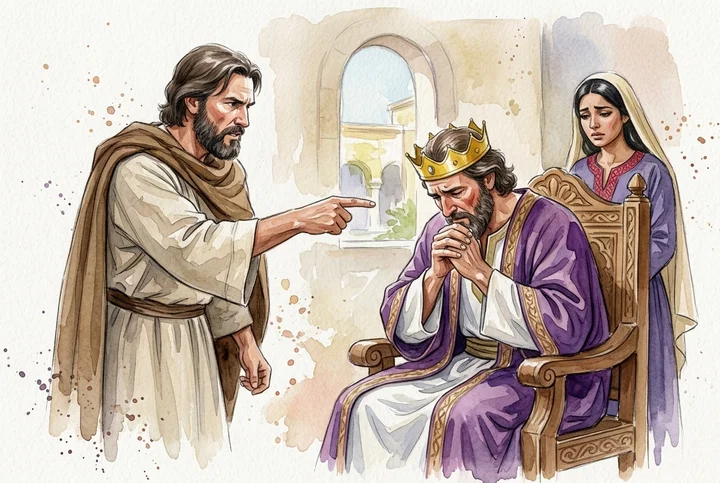
And the LORD sent Nathan unto David. And he came unto him, and said unto him, There were two men in one city; the one rich, and the other poor.
Translations
American King James Version, Webster Bible
And the LORD sent Nathan to David. And he came to him, and said to him, There were two men in one city; the one rich, and the other poor.
King James Version, Revised Version
And the LORD sent Nathan unto David. And he came unto him, and said unto him, There were two men in one city; the one rich, and the other poor.
And the Lord sent Nathan unto David. And he came unto him, and said unto him, There were two men in one city; the one rich, and the other poor.
And Jehovah sent Nathan unto David. And he came unto him, and said unto him, There were two men in one city; the one rich, and the other poor.
And Jehovah sendeth Nathan unto David, and he cometh unto him, and saith to him: 'Two men have been in one city; One rich and one poor;
And Jehovah sent Nathan to David. And he came to him, and said to him, There were two men in one city; the one rich, and the other poor.
So then Yahweh sent Nathan the prophet unto David,—who therefore came unto him and said to him—Two men, there were in a certain city, the one, rich, and, the other, poor.
Berean Standard Bible, Majority Standard Bible
Then the LORD sent Nathan to David, and when he arrived, he said, “ There were two men in a certain city, one rich and the other poor.
The LORD sent Nathan to David. He came to him, and said to him, “ There were two men in one city: the one rich, and the other poor.
And the Lord sent Nathan to David. And Nathan came to him and said, There were two men in the same town: one a man of great wealth, and the other a poor man.
Then the Lord sent Nathan vnto Dauid, who came to him, and sayd vnto him, There were two men in one citie, the one riche, and the other poore.
Douay-Rheims (Challoner revision)
And the Lord sent Nathan to David: and when he was come to him, he said to him: There were two men in one city, the one rich, and the other poor.
Pictures

Cross-references
- 2 Samuel 12:7
And Nathan said to David, Thou art the man. Thus saith the LORD God of Israel, I anointed thee king over Israel, and I delivered thee out of the hand of Saul;
Nathan applies the parable directly to David: “Thou art the man.”
- 2 Samuel 11
And it came to pass, after the year was expired, at the time when kings go forth to battle, that David sent Joab, and his servants with him, and all Israel; and they destroyed the children of Ammon, and besieged Rabbah. But David tarried still at Jerusalem.
Recounts David’s sin and plot against Uriah, which Nathan was sent to reprove.
- Psalms 51
Have mercy upon me, O God, according to thy lovingkindness: according unto the multitude of thy tender mercies blot out my transgressions.
David confesses his sin and seeks mercy and cleansing after Nathan’s rebuke.
- 2 Samuel 12:13
And David said unto Nathan, I have sinned against the LORD. And Nathan said unto David, The LORD also hath put away thy sin; thou shalt not die.
David confesses his sin, and the Lord forgives him.
- 2 Samuel 12:5-6
And David’s anger was greatly kindled against the man; and he said to Nathan, As the LORD liveth, the man that hath done this thing shall surely die:
David’s verdict on Nathan’s parable condemns himself.
- Luke 7:41-43
There was a certain creditor which had two debtors: the one owed five hundred pence, and the other fifty.
Jesus uses a parable to lead Simon to judge the case himself, as Nathan does with David.
- 2 Samuel 12:9-12
Wherefore hast thou despised the commandment of the LORD, to do evil in his sight? thou hast killed Uriah the Hittite with the sword, and hast taken his wife to be thy wife, and hast slain him with the sword of the children of Ammon.
Nathan declares consequences for David’s sin.
- 2 Samuel 11:27
And when the mourning was past, David sent and fetched her to his house, and she became his wife, and bare him a son. But the thing that David had done displeased the LORD.
David’s actions displeased the Lord.
- Psalms 32
Blessed is he whose transgression is forgiven, whose sin is covered.
David’s psalm recounts his sin, confession, and forgiveness.
- 2 Samuel 7:2
That the king said unto Nathan the prophet, See now, I dwell in an house of cedar, but the ark of God dwelleth within curtains.
rebuke proves Nathan there was true prophet
- 2 Samuel 12:14
Howbeit, because by this deed thou hast given great occasion to the enemies of the LORD to blaspheme, the child also that is born unto thee shall surely die.
Nathan charges David with giving the LORD’s enemies occasion to blaspheme.
Commentary
Each commentary is drawn from primary sources: the writings of Ellen G. White and Adventist pioneers and periodicals. Each commentary is separate. Its own words are not a quotation; follow the references to read the source passages.
Ellen G. White
21 sources
The Lord sent Nathan to David after David had arranged Uriah's death and felt no remorse, to confront him with a story of a rich man and a poor man that appealed to him as guardian of his people's rights.PP 719.4–720.1PP 720.5–721.2DA 566.4–5 Nathan veiled a severe rebuke in that parable so David would unknowingly pass sentence on himself, and only then brought it home directly with the charge that he was the guilty man.Lt 19a, 1875, par. 18–24ST Aug 12, 1875PP 720.5–721.2Lt 57, 1897, par. 13–16DA 566.4–5 The sending shows a just God who does not sanction or excuse transgression even in a ruling king, but lays the sin before him in its truly abominable character without glossing it over.1SP 378.1–379.1SG4 86.2–87.1SG4 88.2–89.1Lt 74, 1886, par. 621MR 379.5–6 Awakened as from a dream, David did not excuse himself like Saul but humbly acknowledged his sin and entreated forgiveness, and because of that repentance God forgave him and spared his life yet still punished him with evils rising from his own house.1SP 378.1–379.1SG4 86.2–87.1EDFCP 16.1SG4 88.2–89.1 The verse therefore charges those entrusted as watchmen to reprove sin in sharp, resolute words even in rulers, for a king is to be obeyed only as he follows Christ and it becomes sin to obey a command contrary to God's law.PP 719.2–3Lt 48, 1887, par. 23–24
Context of Nathan's Sending
The sending comes after arrangements had been made through Joab for the death of Uriah the Hittite and after the receipt of a carefully worded battle report that hid the guilt of both commander and king.PP 719.4–720.1 There was no remorse, but the death was treated as the common chance of war, with word sent back that Joab should not be displeased but should make the battle stronger against the city and overthrow it.PP 719.4–720.1
At this time David had departed from God and yielded himself to the wicked one, becoming for the time the agent of Satan while still holding the position and authority given him to be exercised only in harmony with divine law.PP 719.2–3 Heretofore his record had been to execute judgment and justice to all his people, and his integrity had won the confidence and fealty of the nation, but he now used God-given authority to claim an obedience that would imperil the soul of him who yielded it by commanding what was contrary to God's law.PP 719.2–3 Joab, whose allegiance had been given to the king rather than to God, transgressed God's law because the king had commanded it.PP 719.2–3 When a ruler commands what is contrary to God's law it becomes sin to obey, for though the powers that be are ordained of God they are not to be obeyed contrary to God's law, and leaders are to be followed only as they follow Christ.PP 719.2–3
David had become blinded to his departure, excusing his own sinful course until his ways seemed passable, with one wrong step preparing the way for another.1SP 378.1–379.1 That departure included turning from the wise arrangement by taking many wives like the idolatrous kings around him, and later turning from God's Word and its doctrines sullied his previously fair reputation, while he had been immovable when he kept God's Word before him.1SP 378.1–379.121MR 169.1 The verse opens the parable about two men in one city, the one rich and the other poor.PP 720.5–721.2DA 566.4–5 It is an appeal to David as the divinely appointed guardian of his people's rights, setting forth a story of wrong and oppression that demands redress.PP 720.5–721.2DA 566.4–5
The parable continues with the rich man taking the poor man's one ewe lamb.Lt 57, 1897, par. 13–1621MR 144.2 The taking is covetousness, which is idolatry, and it applies to taking resources entrusted for another's need, as when money raised for the Southern field was diverted and the consequences left to others.21MR 144.2
Nathan's Parable Method
The sending itself shows a just and impartial God who would not sanction or excuse David's heinous crime in the case of Uriah and Bath-sheba, because he had transgressed the commandment of the Lord.1SP 378.1–379.1SG4 86.2–87.1Lt 74, 1886, par. 6 For that reason Nathan was sent with reproof and heavy denunciation that set the offense before David in living colors and in its truly abominable colors.1SP 378.1–379.1SG4 88.2–89.11SP 380.2–381.2 God sends such reproof even to a ruling king through His appointed messenger, and Nathan came as God's servant and prophet to confront David.Lt 48, 1887, par. 23–2421MR 379.5–6PK 75 He came after David had stolen Uriah's wife thinking only of his own pleasure, and he laid the charge of sin heavily upon him without glossing over the matter at all.Lt 74, 1886, par. 6 He left him without excuse, because his course was sin and only sin.Lt 74, 1886, par. 6
That terrible rebuke in its severity was the kind that could have cost the reprover his life when addressed to a king.PP 720.5–721.2 Nathan therefore veiled it in a story used as a figure and illustration of David's own case.Lt 19a, 1875, par. 18–24PP 720.5–721.2DA 566.4–5 He delivered it unflinchingly, yet with heaven-born wisdom meant to engage the king's sympathies and arouse his conscience.PP 720.5–721.2 He did not use sensational songs or humorous anecdotes or appeal to feeling.Lt 19a, 1875, par. 18–24
By the story Nathan led David to pass sentence upon himself and thereby to condemn himself.Lt 19a, 1875, par. 18–24ST Aug 12, 18754MR 185.1–186.2 David condemned the rich man without recognizing that the judgment applied to himself, being blind to his own guilt concerning Uriah.Lt 57, 1897, par. 13–164MR 185.1–186.2 Only after David had pronounced that judgment did Nathan directly identify him as the guilty man.Lt 19a, 1875, par. 18–24ST Aug 12, 18754MR 185.1–186.2 That direct application brought the reproof home so that David saw his sin as God saw it, like a mirror that convicted him.Lt 57, 1897, par. 13–16
The reproof also laid before the sinner all the favors and mercies God had bestowed that had been abused and misapplied, so that guilt flashed upon the conscience.Lt 48, 1887, par. 23–24 Yet heart repentance that will not maintain and vindicate sin comes only when the reproof from God is brought home directly to the individual.Lt 48, 1887, par. 23–24
Repentance Forgiveness and Warning
Nathan's coming woke David as from a dream to feel his sin, and unlike Saul he did not excuse or palliate it but with remorse and sincere grief bowed and humbly acknowledged all with which he was charged.1SP 378.1–379.1SG4 88.2–89.11SP 380.2–381.2 He did not rebel against God for the stern correction nor hate the prophet for it, but accepted the faithful reproof rather than silencing him.EDFCP 16.1SG4 88.2–89.11SP 380.2–381.2 In this he did not show the spirit of an unconverted man or of the rulers of the surrounding nations, who would have taken the life of the faithful reprover.1SP 380.2–381.2 Though holding a lofty throne and unlimited power, he bore the reproof and accepted the counsel meekly.5T 683.11SP 380.2–381.2 He humbled himself before God in dust and ashes and openly entreated forgiveness before the great men and even the servants of his kingdom.1SP 380.2–381.2 He composed a penitential psalm to instruct after generations in whom is trust and hope for pardon.1SP 380.2–381.2
His humble acknowledgment is evidence that he still feared and trembled at the word of the Lord.SG4 88.2–89.11SP 380.2–381.2 What marked his character was humility and sincere contrition, not sinlessness, for he trusted God's mercy and accepted God's decision as just and merciful.EDFCP 16.1 Through God's dealings with him he learned wisdom, for Nathan's faithful portrayal of his true state made him aware of his sins and helped him put them away.5T 683.14T 14.3–15.1 This work produced true heart conviction leading him to repent before God whose law he had transgressed and to rely for pardon on the efficacy of the blood of Christ, in contrast to surface conversions produced by excitement.Lt 19a, 1875, par. 18–244MR 185.1–186.2 The parable served as a mirror that convicted him and led him to lasting repentance, making him see his sin as God saw it.Lt 57, 1897, par. 13–16
Sinners likewise must recognize the seriousness of their sin before they can truly repent and be converted.ST Aug 12, 1875 Without that conviction they would continue in sin and be ruined, and people mistake harmful conduct for doing good when they fail to see their own character truly.Lt 57, 1897, par. 13–16 Because of that repentance and humble confession God declared through Nathan that He would forgive the sin, avert part of the threatened calamity, and spare David's life.1SP 378.1–379.1 Yet God did not excuse the sin or avert all its consequences, and David must still be punished with judgments and evils rising up against him from his own house, including for plurality of wives.1SP 378.1–379.1SG4 86.2–87.1 By giving great occasion to the enemies of the Lord to blaspheme, David furnished an occasion still used from his day to the present by skeptics to assail Christianity, ridicule the Bible, and falsely assert that God justified David's polygamy and his sin with Uriah and Bath-sheba.1SP 378.1–379.1
The rebuke proves David was called a man after God's own heart only when pure and walking in God's counsel, not when he stained his virtuous character by crime.1SP 378.1–379.1 It proves God justifies no one in transgressing His commandments but surely punishes the guilty however righteous and favored they once were in purity of heart.1SP 378.1–379.1 For when the righteous turn from righteousness to do evil their past righteousness will not save them from the wrath of a just and holy God.1SP 378.1–379.1 Those placed in responsible positions as God's watchmen and heralds must faithfully discharge that God-given responsibility and reprove sin in keen, sharp, resolute words given by God and not their own, even when contrary to their nature, and not connive at it like Eli.Lt 48, 1887, par. 23–24 Or God will hold them accountable for the sins that exist and the evils resulting from them.Lt 48, 1887, par. 23–24 True friends are those who tell faults, while those who make light of sins grievous to God and encourage bold resistance under reproof are agents of the devil.Lt 48, 1887, par. 23–24 The reproof lays before the sinner all the favors and mercies God has bestowed that have been abused and misapplied, so that guilt flashes on the conscience, but heart repentance that will not maintain and vindicate sin comes only when it is brought home directly to the individual.Lt 48, 1887, par. 23–24
Sources
Pioneers and periodicals
45 sources
The Lord sent the prophet Nathan to David after his adultery with Bathsheba and his plot to have Uriah killed, with a special message condemning that great wickedness.ST Nov 11, 1880ST Apr 29, 1908RH Oct 12, 1869RH Jul 1, 1902 Nathan wisely began not with direct accusation but with the story of the rich man who took the poor man's only ewe lamb, holding David's attention until his anger condemned the man and he unwittingly pronounced sentence on himself when told, Thou art the man.ST Mar 11, 1889ST Nov 11, 1880ST Jan 28, 1889ST Aug 19, 1880RH Apr 3, 1879 That pointed rebuke awakened David's blinded conscience to the depth of his guilt, and he humbly confessed, repented and prayed for mercy, cleansing and a clean heart in Psalm 51:10.ST Apr 29, 1913ST Apr 29, 1908RH Oct 12, 1869ST Sep 10, 1896ST Jul 29, 1889 When he confessed with sorrow the Lord put away his sin so that he should not die for it, and being forgiven he afterward prospered and praised forgiveness in Psalm 32, yet bitter retribution in sorrows and crimes within his family followed him the rest of his life.ST Mar 11, 1889ST Mar 31, 1881RH Apr 26, 1870RH Sep 14, 1869RH Oct 12, 1869 The open condemnation and severe punishment of even a king shows the Bible does not hide or excuse sin, making David's repentance an Old Testament example of conversion and hope for sinners who turn back to righteousness.RH Oct 12, 1869ST Jul 29, 1889ST Aug 19, 1886RH Mar 19, 1861ST Mar 11, 1913
Historical Setting in David's Sin
The verse opens the Lord's warning and reproof to David after his great grievous sin in the matter of Uriah.ST Apr 29, 1908RH Jul 1, 1902ST Jul 17, 1884 That sin involved adultery with Bathsheba and the plot to have Uriah killed, whose full account is given in 2 Samuel 11-12. Nathan came as the Lord's prophet to reprove David for his sin against God, showing that David had been a great sinner who deserved punishment.ST Apr 29, 1908RH Jul 1, 1902 The reproof led to David's conviction of sin and humility of heart, and is the setting for his confession and prayer in Psalm 51.ST Apr 29, 1908ST Jul 17, 1884
The sending of Nathan expresses God's abhorrence of David's actions and terrible denunciation of his great wickedness, for God did not approve those crimes.ST Nov 11, 1880RH Oct 12, 1869RH Mar 19, 1861 It was a special message of condemnation for wickedness by which David gave great occasion to the enemies of the Lord to blaspheme.RH Oct 12, 1869RH Mar 19, 1861 The parable about a rich man who took and killed the poor man's only ewe lamb opens that rebuke and was meant to make David see the gravity of his sin involving Uriah's wife.ST Nov 11, 1880RH Mar 19, 1861 David's crime was openly condemned, not covered up or excused in any way, but placed on record in Scripture and punished severely.RH Oct 12, 1869RH Mar 19, 1861 The whole subsequent history of David shows how completely that prophetic denunciation was accomplished in the judgments that came upon him, while David himself placed on record for all future time a most humble confession of his great transgression.RH Oct 12, 1869
Nathan's Prophetic Mission and Courage
The Lord sent Nathan to David as prophet and prophetic counselor and instrument to deliver a message of reproof, beginning with a story of a rich man and a poor man.RH Sep 7, 1869RH Jun 15, 1911ST Oct 10, 1911ST Aug 2, 1910 His plain rebuke marks him as a true prophet.ST Jul 3, 1884 David recognized the ministry and accepted the rebuke.RH Sep 7, 1869RH Sep 13, 1906
As a recognized holy man he could confront the king directly and denounce his actions with impunity, speaking truths that even a powerful minister would not dare to raise.ST Nov 5, 1885 Such a warning was likely to be heard and heeded, though a bold critic could sometimes be made to disappear.ST Nov 5, 1885 He thus stands as an example of a courageous reprover who speaks against wrongdoing even to a ruler, confronting David through a parable.ST Nov 5, 1885RH Apr 23, 1872
The reproof after the terrible crime was wisely and carefully directed and given with wisdom and severity.RH Dec 22, 1868ST Aug 26, 1875 Its aim was not only to rebuke David but to save him from ruin and lead him to genuine repentance.RH Dec 22, 1868ST Aug 26, 1875 Through the parable of the rich man and the poor man the confrontation led David to accept correction and become a more spiritual channel for God's word.RH Sep 13, 1906
Parable's Design and Self-Condemnation
The verse opens the parable the Lord commanded to be spoken to David, concerning two men in one city, the one rich and the other poor, in which the rich man took and killed the poor man's only ewe lamb.ST Mar 11, 1889ST Nov 11, 1880RH Jul 27, 1869 It is a vivid and meaningful figure and a pointed personal rebuke, meant to bring the baseness of David's conduct home to his conscience and to make him see the gravity of his sin involving Uriah's wife.ST Nov 11, 1880ST Jan 28, 1889RH Apr 3, 1879 Its plainness marks it as true prophetic rebuke, expressing abhorrence of crimes that were not approved.ST Nov 11, 1880ST Jul 3, 1884
Nathan begins not with direct accusation but with a story, holding David's attention without letting him realize at first that it concerns his own sin.ST Aug 19, 1880ST Aug 19, 1880 This indirect approach draws out attention and judgment before guilt is recognized, using a vivid figure to lead David to pronounce the judgment he deserved.ST Aug 19, 1880RH Apr 3, 1879ST Aug 19, 1880 Only after David has judged does the direct word, Thou art the man, bring conviction home and let truth reach the heart.ST Aug 19, 1880ST Aug 19, 1880
David's anger was greatly kindled against the man in the story who had wronged his neighbor, and he declared that man should surely die, thereby unwittingly pronouncing sentence against himself.ST Mar 11, 1889RH Jul 27, 1869 The story functions as a figure of his own wrongdoing, leading him to judge the rich man and condemn wrongdoing before facing his own guilt and before Nathan declares, Thou art the man.ST Aug 12, 1875ST Mar 11, 1889RH Apr 1, 1873 In this it warns that people may pass judgment on themselves when judging others.RH Apr 1, 1873 The same method appears in Jesus' use of a parable to expose His adversaries and to bring Simon to face his conscience, leading hearers to recognize the right judgment before it is applied to themselves.ST Oct 11, 1899ST Jun 9, 1881
Repentance Forgiveness and Lasting Judgment
Sin had blinded David until Nathan's visit and coming brought his great sin to mind, and the pointed rebuke showed him his guilt and awakened his conscience to the depth of it.ST Apr 29, 1913ST Apr 29, 1908RH Jul 27, 1869RH Jan 15, 1861RH Mar 27, 1913 That awakening led to heartfelt repentance, and David responded with humility of heart, proving devotion by humbling himself, renouncing sin and turning back to righteousness.ST Apr 29, 1913ST Apr 29, 1908RH Jul 27, 1869RH Mar 27, 1913
He believed the word, confessed his sin to God and openly published it to the world, and humbly repented with a repentance commendable in quality and with loyalty in submitting when he recognized he had done wrong.RH Sep 14, 1869ST Sep 10, 1896ST Feb 20, 1879ST Apr 17, 1907 In that repentance he prayed for mercy, for his transgressions to be blotted out, to be washed thoroughly and cleansed from sin, for God to hide His face from his sins, to create in him a clean heart and renew a right spirit within him in Psalm 51:10, to not cast him away nor take the Holy Spirit from him, and to restore the joy of salvation and uphold him.ST Sep 10, 1896ST Jul 29, 1889 He himself placed on record for all future time a most humble confession of his great transgression.RH Oct 12, 1869
When with sorrow he confessed and expressed sorrow for it, Nathan told him the Lord had put away his sin and he should not die, so that having repented he was forgiven and afterward prospered.ST Mar 11, 1889RH Sep 14, 1869 That forgiveness is what he praises in Psalm 32 even while bearing punishment in the death of Bathsheba's child.ST Sep 10, 1896 Yet he was spared immediate death only, for the words mean only that his own sentence would not then be carried out and that he should not die for that sin, with no reference to total exemption from either the first or the second death.ST Mar 11, 1889RH Jul 27, 1869
Though his repentance was deep and genuine, bitter and lasting, and he did not afterward repeat his sin against the marriage law, the sending of Nathan introduces retribution that continued through the rest of his life.ST Mar 31, 1881RH Feb 6, 1879RH Jul 27, 1869 That retribution lay chiefly in sorrows and crimes within his family, and in trouble and anguish upon him, showing that wrongdoing brings consequences in kind.ST Mar 31, 1881RH Apr 26, 1870RH Jul 27, 1869 The whole subsequent history shows how completely the prophetic denunciation and terrible denunciation for his great wickedness was accomplished in the judgments that came upon him.RH Oct 12, 1869
The account stands as proof that the Bible does not hide, cover up, excuse, gloss over, or praise David at the expense of truth even though he was king of Israel and an instrument of God.RH Oct 12, 1869RH Mar 19, 1861ST Mar 11, 1913ST His crime was openly condemned by a special message of condemnation and severely punished, revealing him as accountable to God by the same moral standard as every other person.RH Mar 19, 1861ST Mar 11, 1913ST
Scriptural Links and Practical Lessons
The sending of Nathan to David stands as the setting for David's confession and prayer in Psalm 51 and for his praise of forgiveness in Psalm 32, for the warning over his great sin led him to confess his sin to God and publish it openly, to be forgiven while still bearing punishment in the death of Bathsheba's child, and to pray for God to create in him a clean heart and renew a right spirit within him in Psalm 51:10.ST Sep 10, 1896ST Jul 17, 1884 Remembrance of the yearly Day of Atonement with its symbols of pardoning mercy may have kept him from despair, giving him hope and leading him to seek mercy and the blotting out of his transgressions.RH Jan 15, 1861 The reproof for the crimes connected with Uriah's murder brought conviction of sin, and the account of David bowed beneath sorrow and disgrace in Uriah's case teaches that as soon as sin is hated and loathed Christ sends the Comforter within to give comfort.ST Jul 17, 1884ST Apr 10, 1893
David's being brought to repentance for the sins of 2 Samuel 11 and 12 is conversion, and an Old Testament example of conversion.ST Jul 29, 1889ST Aug 19, 1886 After that rebuke he prayed for mercy, for his transgressions to be blotted out, to be washed thoroughly and cleansed from sin, for God to hide His face from his sins, to create in him a clean heart and renew a right spirit within him, to not cast him away nor take the Holy Spirit from him, and to restore the joy of salvation and uphold him.ST Jul 29, 1889 By a story about a rich man and a poor man used as a figure of his own wrongdoing, David was led to pass sentence on himself before hearing Thou art the man, and this bringing to repentance shows that sinners likewise must recognize the seriousness of their sin before they can truly repent and be converted.ST Aug 12, 1875
The confrontation with great sin that awakened conscience to the depth of guilt offers hope to sinners who repent, for the reproof brought David to repentance and God forgave him.RH Mar 27, 1913ST May 6, 1897 Devotion to God was proved by humbling himself, renouncing sin, and turning back to righteousness.RH Mar 27, 1913 Leading another to condemn wrongdoing through a story before revealing his own guilt warns that people may pass judgment on themselves when judging others.RH Apr 1, 1873
The parable of the two men is a model for confronting those who have much while others have little, as in urging strong conferences to send laborers elsewhere while a weaker conference needs them.RH Mar 13, 1879 It likewise makes the messenger an example of a courageous reprover who speaks against wrongdoing even to a ruler.RH Apr 23, 1872
Sources