Romans 7:6
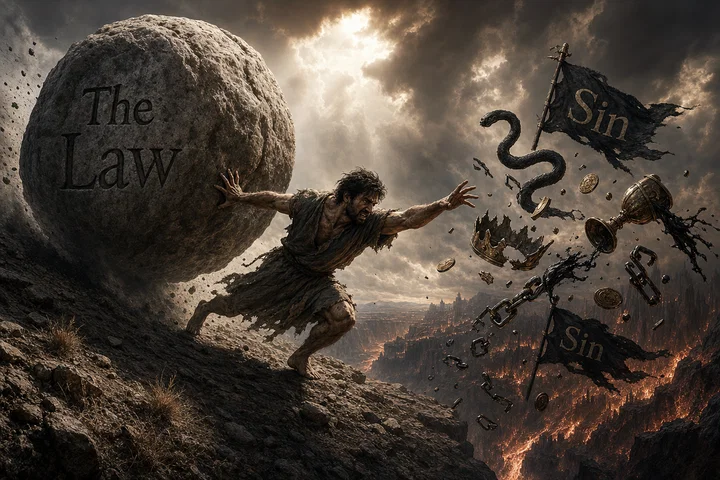
But now we are delivered from the law, that being dead wherein we were held; that we should serve in newness of spirit, and not in the oldness of the letter.
Translations
American King James Version, King James Version, KJV Cambridge Paragraph Bible
But now we are delivered from the law, that being dead wherein we were held; that we should serve in newness of spirit, and not in the oldness of the letter.
But now we are delivered from the law, that being dead by which we were held; that we should serve in newness of spirit, and not in the oldness of the letter.
But now we have been discharged from the law, having died to that wherein we were holden; so that we serve in newness of the spirit, and not in oldness of the letter.
But now we have been discharged from the law, having died to that wherein we were held; so that we serve in newness of the spirit, and not in oldness of the letter.
and now we have ceased from the law, that being dead in which we were held, so that we may serve in newness of spirit, and not in oldness of letter.
but now we are clear from the law, having died in that in which we were held, so that we should serve in newness of spirit, and not in oldness of letter.
But, now, we have received full release from the law, by dying [in that] wherein we used to be held fast, so that we should be doing service—in newness of spirit and not in obsoleteness of letter.
Berean Standard Bible, Majority Standard Bible
But now, having died to what bound us, we have been released from the law, so that we serve in the new way of the Spirit, and not in the old way of the written code.
But now we have been discharged from the law, having died to that in which we were held; so that we serve in newness of the spirit, and not in oldness of the letter.
But now we are free from the law, having been made dead to that which had power over us; so that we are servants in the new way of the spirit, not in the old way of the letter.
But now we are deliuered from the Lawe, he being dead in whom we were holden, that we should serue in newnesse of Spirite, and not in the oldnesse of the letter.
Douay-Rheims (Challoner revision)
But now we are loosed from the law of death, wherein we were detained; so that we should serve in newness of spirit, and not in the oldness of the letter.
Pictures
Cross-references 20 of 119
- Romans 6:6-7
Knowing this, that our old man is crucified with him, that the body of sin might be destroyed, that henceforth we should not serve sin.
The old self is crucified with Christ, freeing believers from sin.
- Romans 8:4
That the righteousness of the law might be fulfilled in us, who walk not after the flesh, but after the Spirit.
The law’s righteousness is fulfilled in those who walk by the Spirit.
- Romans 6:14
For sin shall not have dominion over you: for ye are not under the law, but under grace.
Believers are no longer under the law but under grace, and serve in newness of spirit.
- Romans 7:12
Wherefore the law is holy, and the commandment holy, and just, and good.
The law is called holy, just, and good, while sin causes death.
- Romans 8:7
Because the carnal mind is enmity against God: for it is not subject to the law of God, neither indeed can be.
The carnal mind is not subject to God’s law.
- Romans 7:14
For we know that the law is spiritual: but I am carnal, sold under sin.
Calls the law spiritual, explaining why its service must be spiritual.
- Romans 6:2
God forbid. How shall we, that are dead to sin, live any longer therein?
Being dead to the law is compared with being dead to sin and no longer living in it.
- Galatians 2:19-20
For I through the law am dead to the law, that I might live unto God.
Dying to the law through Christ leads to living with Christ and to God.
- Romans 6:4
Therefore we are buried with him by baptism into death: that like as Christ was raised up from the dead by the glory of the Father, even so we also should walk in newness of life.
Burial with Christ in baptism leads to walking in newness of life.
- 2 Corinthians 3:6-11
Who also hath made us able ministers of the new testament; not of the letter, but of the spirit: for the letter killeth, but the spirit giveth life.
Contrasts the old letter’s fading ministry of death with the Spirit’s life-giving ministry.
- Romans 8:1-2
There is therefore now no condemnation to them which are in Christ Jesus, who walk not after the flesh, but after the Spirit.
Newness of spirit leads to freedom from sin and death and no condemnation in Christ.
- Romans 3:31
Do we then make void the law through faith? God forbid: yea, we establish the law.
Faith establishes the law, in connection with serving in the Spirit.
- Ephesians 4:22-24
That ye put off concerning the former conversation the old man, which is corrupt according to the deceitful lusts;
Putting off the old self and putting on the new describes conversion.
- Romans 7:22
For I delight in the law of God after the inward man:
The inward person delights in God’s law despite conflict with sin.
- Colossians 3:9-10
Lie not one to another, seeing that ye have put off the old man with his deeds;
Putting off the old self and putting on the renewed new self describe the change.
- Galatians 3:24-25
Wherefore the law was our schoolmaster to bring us unto Christ, that we might be justified by faith.
The law leads sinners to Christ for justification by faith, after which they are no longer under it.
- Galatians 5:17-18
For the flesh lusteth against the Spirit, and the Spirit against the flesh: and these are contrary the one to the other: so that ye cannot do the things that ye would.
The flesh opposes the Spirit, but those led by the Spirit are not under the law.
- Hebrews 8:10
For this is the covenant that I will make with the house of Israel after those days, saith the Lord; I will put my laws into their mind, and write them in their hearts: and I will be to them a God, and they shall be to me a people:
God writes his law in the heart, enabling service in newness of spirit.
- Matthew 5:17
Think not that I am come to destroy the law, or the prophets: I am not come to destroy, but to fulfil.
Christ fulfills the law rather than abolishing it, while Romans describes believers as dead to the law.
- Colossians 2:14
Blotting out the handwriting of ordinances that was against us, which was contrary to us, and took it out of the way, nailing it to his cross;
The handwriting of ordinances is blotted out and nailed to Christ’s cross.
Commentary
Each commentary is drawn from primary sources: the writings of Ellen G. White and Adventist pioneers and periodicals. Each commentary is separate. Its own words are not a quotation; follow the references to read the source passages.
Ellen G. White
2 sources
Being delivered from the law means being released through Christ from the law's hold in the former sinful condition.Ms 21, 1896, par. 1–5 The purpose of that release is to serve God in a new spiritual life rather than by the old letter, not merely obeying its written form.Ms 21, 1896, par. 1–5Ms 16, 1897, par. 13–15 This new service comes through union with Christ in his death and resurrection so that believers bring forth fruit to God, with grace through faith ending sin in the heart and making the service possible.Ms 21, 1896, par. 1–5
The law reveals sin and condemns the transgressor, but it cannot remove guilt or grant pardon, and it is sin rather than the law that brings death.Ms 16, 1897, par. 13–15 The law itself is holy and good and acts as a schoolmaster that exposes the sinner's need to repent and look to Christ as the sin-bearing Saviour for the remedy.Ms 16, 1897, par. 13–15
Sources
Pioneers and periodicals
149 sources
Now we are set free from the law by having died to what once held us, so that we can serve in a new way of the Spirit and not in the old way of the letter.RH May 13, 1862RH Nov 25, 1858RH May 13, 1862RH Nov 25, 1858RH Nov 8, 1864 The law in view is God's moral law, the Ten Commandments, which remains holy and just and good and spiritual.RH Jul 2, 1861RH Feb 14, 1854RH Jun 9, 1853RH Jan 29, 1861 It is the believer who dies, not the law that dies, for the old man of sin and the carnal mind is crucified and buried with Christ, whose death meets the law's sentence against the sinner.ST Mar 11, 1880RH Nov 25, 1858RH Dec 9, 1858RH Dec 9, 1858RH Apr 16, 1861 In the marriage picture the sinner bound to that old husband of sin is loosed by his death to be joined to the risen Christ and bring forth fruit to God, while seeking Christ without dying to transgression is spiritual adultery.ST Mar 11, 1880RH Mar 19, 1872STST Apr 16, 1896ST Apr 15, 1875 This deliverance frees from the law's condemnation, curse and condemning power, yet leaves its duty binding, so the same law once written on stone without power to give life is now written on the heart to be kept in willing love by the Spirit, though some held instead that the whole moral law with the Sabbath is dead and abolished.RH Mar 12, 1872RH Jul 2, 1861ST Jan 14, 1897RH Oct 21, 1873RH Apr 19, 1864
Wording and Context
But now believers are freed, loosed, separated and released from the law because they have died to that by which they were held, rendered as having died to or having died in what held them.RH May 13, 1862RH Nov 25, 1858ST Aug 4, 1881 The release comes by the believers having died to what held them in bondage, and by having died with Christ in relation to it, not by the law itself having died or been abolished.RH May 13, 1862RH Nov 25, 1858ST Aug 4, 1881 The change described is the believer's death, not the death of the thing holding them.RH Nov 25, 1858ST Aug 4, 1881
The phrase about being dead refers to the believers, not to the law, with the plural wording meaning people who have died to sin and to that wherein they were held.RH Jul 21, 1868RH Apr 19, 1864RH Jun 24, 1875ST Oct 18, 1883 The Greek word behind that being dead is nominative plural, meaning we being dead to that wherein we were held, which fits the surrounding context of people dying to sin.RH Jul 21, 1868RH Apr 19, 1864ST Oct 18, 1883 Wherein we were held means the state of condemnation and inseparable union with the old man of sin, the body of sin and the carnal mind, not confinement in the law itself.RH Apr 19, 1864RH Jun 24, 1875 Sin brings condemnation under the law, and through faith the old life of transgression is put to death, changing the sinner's relation to the law and freeing from its condemnation while the law itself remains alive, unchanged, still binding, revealing sin and bringing death to the sinner.RH Jul 21, 1868RH Apr 19, 1864RH Jun 24, 1875ST Oct 18, 1883 Baptism represents this death to sin, so those still living in transgression have not undergone the change described, and rising from baptism is to begin a new obedient life rather than return to disobedience.RH Jul 21, 1868RH Apr 19, 1864
The verse belongs to the logical presentation of justification by faith and the gospel's power over sinful people, showing a sinner's passage from sin through conviction to becoming a new creature in Christ and teaching how the law deals with the sinner.ST Jun 24, 1886ST Oct 29, 1912ST Nov 21, 1911ST Jul 28, 1909 It belongs to the doctrinal argument that people are saved, justified and kept by faith and not by human works, proving all are under sin irrespective of nationality and that justification comes apart from ritualism or human organization.ST Nov 21, 1911ST Jul 28, 1909 The argument gathers force with every chapter toward the climax that there is no condemnation to those in Christ Jesus, culminating in the account of God's power and deeper Christian experience in Romans 8 where those who walk in Christ have peace.ST Oct 29, 1912ST Nov 21, 1911ST Jul 28, 1909 Only those who transgress the law are under its condemnation.ST Nov 21, 1911
The epistle was written to the believers in Rome, the largest city of the world, by Paul the apostle to the Gentiles.ST Oct 14, 1908 It stands first in order among his epistles though not first in time because of its doctrinal importance.ST Oct 14, 1908 It was written about 57 A.D. from Corinth, following the closing years of Paul's work recorded at the close of Acts.ST Oct 14, 1908 The first eight chapters are doctrinal and close with a triumphant shout of victory, while the later chapters set forth experiences appropriate to Christians and close with a long list of greetings to friends and kinsmen.ST Oct 14, 1908
The chapter portrays one personified under conviction of sin by the law, whose enlightened conscience and will side with the law though it condemns him, who would cast off sin and do good but without receiving Christ by faith is continually brought into bondage to the law of sin in the members.RH Jan 26, 1860ST May 30, 1906RH Sep 10, 1872 It is the anguish of knowing God's law is offended and feeling impending doom, the exposure of the inability of the flesh to do good where repeated failure teaches that no good thing dwells in the flesh, and a life of continually doing what one disapproves.RH Sep 10, 1872ST Apr 22, 1903ST Sep 16, 1886 That conviction prepares the person for conversion and comfort in Christ, leading to giving up self-reliance and letting Christ take possession.ST May 30, 1906ST Sep 16, 1886 In that moment deliverance through Jesus Christ is seen, and by laying hold on the hope set before him deliverance is realized, breaking out into no condemnation and freedom from the law of sin and death, followed by peace through believing in Jesus.RH Jan 26, 1860ST Sep 16, 1886 So the account relates only to the experience of a carnal person under the law and does not set the final standard for Christian experience, since Christians need not remain in that defeated condition but may live in victory over sin through God's help, consistent with full sanctification and salvation from all sin in this life.RH Jan 26, 1860RH Sep 10, 1872ST Feb 27, 1879 The law in this setting declares bondage and is the word of tribulation, standing opposite the gospel which shows redemption and is the tidings of peace.RH Apr 30, 1867
Law Paul Means
The law in Romans 7:6 is God's moral law, the Ten Commandments, the Decalogue written on stone and quoted elsewhere as in Romans 13:9 and spoken of in Romans 6:14.RH Jul 2, 1861RH Jan 29, 1861RH Jun 24, 1862ST Dec 25, 1893 It is identified as that moral law by the command against coveting in verse 7 and by the command against adultery in the context, and it says nothing about the law of Moses as proving that moral law dead or abolished.RH Jul 2, 1861RH Apr 19, 1864RH Jan 29, 1861RH Jun 24, 1862 That law holds a person in bondage while living in sin, exposes sin and brings recognition of its power, convicts as it convicted Paul of covetousness, makes sin appear exceeding sinful, and still occupies the same place in conversion in showing men they are sinners.RH Jan 29, 1861 Through faith in Christ believers obtain strength to keep it, being dead to sin releases them from that bondage so the law no longer has dominion over them, and the release language does not mean this law has ceased to be binding.RH Jun 24, 1862
That same law is holy, just, good, spiritual and perfect, delighted in by Paul with a real delight and not a pretense under an abolished code, and its condemnation comes because it has been transgressed through sin entering by transgression.RH Feb 14, 1854RH Jun 9, 1853RH Feb 1851RH Mar 5, 1857RH Mar 10, 1859 Release from its hold is therefore distinguished from any defect in the law itself, since the law from which Christians are released remains holy and the illustration does not say the law has ceased to be binding.RH Jun 9, 1853RH Mar 5, 1857RH Mar 5, 1857 Paul's testimony of keeping the commandments and serving God's law belongs with this, showing the verse does not teach abolition and supporting that the moral law remains binding as the means by which sin is known.RH Dec 1850RH Mar 10, 1859 The law from which the person dies by faith is thus the same law praised as holy, just, good and spiritual, with pardon raising to new life rather than continuance in sin.RH Jun 9, 1853
The release has also been understood as release not from the moral law but from the sacrificial and offering laws, the Mosaic rites and ceremonies, ordinances and types and shadows that held under the gospel dispensation and ended at the cross, distinguished from the holy, just, good and spiritual commandments spoken by God as opposed to those given through Moses.RH Dec 1850RH Oct 19, 1916RH Feb 17, 1852RH Jan 20, 1853RH Jun 17, 1862 In that distinction believers are separated so as to serve in newness of Spirit rather than by the old letter, the ceremonial enmity and middle wall of partition being brought to an end while the Ten Commandments including the seventh-day Sabbath remain.RH Dec 1850RH Jan 20, 1853RH Jun 17, 1862 Set beside this is the opposite reading that the moral law itself, the whole code of the Ten Commandments together, is dead, fulfilled and abrogated with feast days, giving place to the law of faith, the law of the spirit of life in Christ Jesus, the perfect law of liberty and the new moral law of the New Testament.RH Apr 19, 1864RH Mar 1, 1864RH Jan 16, 1866RH Mar 22, 1864RH Jan 31, 1854 On that reading believers become dead to the law by the body of Christ, are married to Christ raised from the dead to bring forth fruit unto God instead of fruit unto death worked when motions of sins by the law worked in the members, have nothing more to do with the law, serve in newness of spirit not oldness of letter as old law of works, and the Sabbath is dead and no longer binding with laboring six days ended and none to judge over observance.RH Apr 19, 1864RH Mar 1, 1864RH Mar 25, 1873RH Mar 22, 1864RH Jan 31, 1854
That abolition reading is rejected as false assertion, false reasoning and disguised deception, since the illustration does not prove the law dead or freedom from it.RH Jun 24, 1862RH Mar 5, 1857RH Nov 26, 1857RH Mar 8, 1864RH Apr 30, 1872 Treating Moses and the law as the church's first husband now dead with Christ as lawful husband, so that continuing obligation would be eighteen hundred years of adultery, and treating the ten commandments as the marriage law dead so the church may join Christ only by making the Creator the dead first husband, would otherwise make the new union adulterous.RH Jun 24, 1862RH Apr 20, 1869 The law described as spiritual, good and a delight is not a carnal law not good and a yoke of bondage, and God's commandments including the fourth remain in force alongside faith in Jesus rather than being abolished as decalogue.RH Nov 26, 1857RH Mar 8, 1864RH Apr 30, 1872 Deliverance is from the law as a covenant of works and old ministration of the letter, man's fleshly promise to obey in his own strength that genders bondage, probably meaning deliverance from the curse and from its original character as given to Adam as a covenant of works or of life, not from the Decalogue and moral law as a rule of obedience.RH Nov 1850RH Jan 1851ST Apr 11, 1900ST Mar 1, 1905RH Jan 1851 The first covenant points out duty but leaves inability and fruit unto death, while the new covenant points to the same holy law and supplies strength through grace and faith in Jesus with cleansing of past transgression, so believers serve in newness of Spirit and bear fruit unto God; in himself man is impotent, not subject to God's law and unable to be, powerless to cleanse himself or work God's righteousness, and every effort to save himself or help God by human devising belongs to the Sinaitic covenant and must be died to.RH Jan 1851ST Apr 11, 1900ST Mar 1, 1905RH Jan 1851 The moral law remains in perpetual obligation as long as God is Supreme Ruler and humans are moral subjects bound to love Him supremely and neighbor as self, for to annul that rule would rescind supreme love, sunder the tie uniting God and moral beings by God's own act, and change what is unchangeable.RH Nov 1850
Death That Frees
It is the believer who dies, not the law that dies or is abolished, for release comes by having died to what held in bondage through dying with Christ in relation to that bondage.RH Nov 25, 1858RH May 13, 1862RH Nov 8, 1864RH Nov 8, 1864RH Mar 24, 1874 That death is the sinner's death through the body of Christ, as verse 4 also shows, by which the person becomes dead to the law at conversion and is freed from its condemning hold while the law remains in force.RH Nov 25, 1858RH Nov 8, 1864RH Mar 24, 1874RH Apr 14, 1863 As the marriage law permits a widow to marry again while itself continuing, so the law no longer holds as a sinner the one whose old sinful condition has died, but permits union with Christ.RH Mar 24, 1874RH Mar 24, 1874
What dies is sin itself, the old man, the body of sin, the carnal mind and nature, the flesh and the former union with sin in which sinners were held under condemnation.RH Dec 9, 1858RH Dec 9, 1858RH Dec 9, 1858ST Dec 12, 1892RH Jun 24, 1862 While sin rules the sinner is held under the law and its condemnation, but when the old man is crucified with Christ sin loses dominion and no longer rules.RH Dec 9, 1858RH Dec 9, 1858RH Dec 9, 1858 Dying to sin and sin dying within mean the same thing, wrought when the carnal mind that held in transgression dies and is subjugated to God's will, so that enmity is gone and the new man can belong to Christ.RH Dec 9, 1858ST Dec 12, 1892RH Jun 24, 1862 Then the same moral law that condemned becomes the rule of obedience, kept with delight in newness of spiritual life rather than in oldness of letter.RH Dec 9, 1858
That dead husband, master and lord is further defined as another law, the law in the members warring against God's law and bringing into captivity to the law of sin and to the law of death.RH Jan 31, 1854ST Aug 29, 1895 Its motions worked in the members to bring forth fruit unto death, for the law working through carnality works sin and death, which is serving in oldness of the letter.ST Aug 29, 1895ST Sep 25, 1901ST Sep 25, 1901 The ten commandments themselves remain holy, just, good and spiritual, proved by Thou shalt not covet, and never harmed apart from sin, though sin which is transgression of them slew when covetousness was exposed.RH Jan 31, 1854 When that carnal nature wherein the sinner was held is dead, the same binding law that bound under the first husband now binds legitimately to Christ the second husband to restrain self and constrain the life in love.ST Aug 29, 1895ST Sep 25, 1901ST Sep 25, 1901
The death comes by the body of Christ: the old self is crucified and buried with him, his blood satisfies justice, the law's sentence and penal demand of death is met in him, and through faith the sinner is counted dead and raised to new life.ST Mar 11, 1880RH Apr 16, 1861ST Jan 14, 1897RH Oct 21, 1873RH Nov 22, 1853 The law has dominion so long as a man lives, holding transgressors under condemnation and demanding the life of the transgressor, until they die with Christ and their sins are borne away with no condemnation remaining.RH Nov 22, 1853 This is the death to sin described in Romans 6, where the body of sin must be destroyed before union with Christ, for joining him while still living in transgression would be spiritual adultery.ST Mar 11, 1880ST Jan 14, 1897 It is manifested in being baptized into his death, buried with him and raised to walk in newness of life, pardoned and redeemed from the curse through atonement so the law's grasp is relaxed because sin's claim is answered.RH Oct 21, 1873RH Nov 22, 1853
The living law itself exposes sin, slays the carnal nature, convicts of covetousness, and converts the soul, thereby bringing the old self to death and preparing the sinner to seek justification.RH May 13, 1862RH Jan 29, 1861RH Feb 17, 1859RH Jun 19, 1856 It remains the instrument that brings recognition of sin's power and of death to sin, serving conviction while the gospel provides remedy for past transgression and grace enables holiness.RH May 13, 1862RH Feb 17, 1859RH Jun 19, 1856 In this work the law means the precepts of the moral law, not the ceremonial ordinances nailed to the cross, and this death is the necessary preparation for baptism which portrays burial after death.RH Jan 29, 1861RH Jun 19, 1856
The law remains in force as God's immutable rule of life; after the old life dies it no longer holds the person as a sinner and permits union with Christ.RH Nov 25, 1858RH Nov 8, 1864RH Mar 24, 1874 It exposes sin and forbids union with Christ while one remains joined to sin, but once the old man is crucified with Christ and the person dies to sin, it no longer condemns as a sinner and leaves free to serve Christ rather than sin.RH Mar 24, 1874RH Mar 24, 1874 Freedom from it therefore does not mean freedom to sin.RH Nov 25, 1858
This freedom is not license to sin, for if a person yields to sin again the former master revives and the same living law condemns again.RH Jan 31, 1854RH Jul 2, 1861RH Oct 21, 1873RH Apr 21, 1851RH Nov 25, 1852 To be under the law is to be under its condemnation as a sinner held by it, as a thief is held by the law of the state, and to be delivered is to have renounced sin, stopped transgressing, and received pardon so condemnation no longer holds.RH Jul 2, 1861RH Oct 24, 1854 Pardon does not kill the law or give permission to break the commandments, but sin brings condemnation again, and the law continues to expose sin and approve righteous life.RH Jul 2, 1861RH Oct 21, 1873RH Apr 21, 1851RH Nov 25, 1852 Serving in newness of spirit therefore means living a changed life in God's service rather than continuing in the old life of sin and transgression.RH Oct 24, 1854RH Apr 21, 1851
Marriage to Christ
In the marriage picture the woman is the sinner, the law of marriage is the moral law of the Ten Commandments written on stone, the first husband is that to which the sinner was bound before conversion, namely the old man, the body of sin and the carnal mind, and the second husband is Christ who was raised from the dead.RH Mar 19, 1872RH Apr 19, 1864RH Jun 24, 1862RH Dec 14, 1869 The four parties must all have their counterpart, so what dies to set the sinner free is not the moral law but that alone represented by the first husband, and after conversion the sinner is at liberty to be married to Christ and to serve in newness of spirit.RH Mar 19, 1872RH Apr 19, 1864 The release comes because believers themselves have died to what held them, not because the law has died, the Greek form being nominative plural meaning we being dead to that wherein we were held.RH Apr 19, 1864RH Jun 24, 1862RH Dec 14, 1869 That wherein they were held is the state of condemnation and inseparable union with the old man of sin, not confinement in the law itself, and when the sinner is converted the old man is crucified, destroyed and put off, the sinner being slain by the law and made dead to sin, then buried with Christ by baptism to rise to walk in newness of life while the moral law remains distinct, unchanged, still binding, holy and just and good and delighted in after the inward man, giving no relaxation of its claims.RH Apr 19, 1864RH Dec 14, 1869 Freedom from the former bond does not mean freedom from temptation, for the lusts of the mortal body remain, but the renewed heart and the Spirit give power to resist so that sin no longer reigns.ST Nov 4, 1889
Made dead to the law by the body of Christ in order to be married to another, even to Him who was raised from the dead, believers lawfully bring forth fruit unto God, in contrast to when in the flesh the motions of sins which were by the law wrought in the members to bring forth fruit unto death.STST Apr 16, 1896ST Apr 16, 1896 Because sin and the sinner are joined as one flesh the sinner must die with sin to be separated from it, and this death takes place in Christ who died and lives again, sharing His life so that the body of sin is destroyed, sin remains dead, and the believer is raised with Him and made righteous by Christ's life given and lived within in obedience to the law, which makes possible what was formerly impossible since sin cannot dwell with Him.ST Apr 23, 1896ST Apr 16, 1896 Through the atoning blood justice is satisfied, the old man is crucified, and believers become dead to sin and freed from its dominion, no more serving sin and no more transgressing the law but living with the risen One.ST Apr 23, 1896ST Apr 16, 1896 Serving in newness of spirit and not in oldness of the letter is obeying in spirit the same law of love that was ordained unto life, the royal law to love neighbor as self, as children of obedience with Christ formed within, bringing every thought and word into subjection to His will, making the body a temple for God, presenting it a living sacrifice and yielding its members as instruments of righteousness instead of letting sin reign.
That death to sin is ceasing to transgress the law, for as long as a person transgresses he lives in sin and has not died to it, and to seek marriage to Christ while still living in transgression without death to sin would be spiritual adultery.ST Mar 11, 1880ST Apr 15, 1875RH Nov 22, 1853 The old self must be crucified and the body of sin destroyed before union with Christ, for the law holds a person as long as he lives, as shown by marriage where a woman who marries another while her first husband lives is guilty of adultery.ST Mar 11, 1880ST Apr 15, 1875 Burial by baptism must follow that death in the order of Christ's death and burial, and union with Christ is the consummation of this new marriage; without prior death it is a burial alive rather than burial in the likeness of His death.ST Apr 15, 1875RH Nov 22, 1853 Dying to the law means being convicted by the commandment, condemned as a transgressor under the law, then buried with Christ by baptism into death and raised to walk in newness of life, led by the Spirit instead of formal self-righteous profession, with no condemnation, the righteousness of the law fulfilled, the enmity and carnal mind slain, and the whole person brought into subjection to God's law.RH Nov 22, 1853
The same binding law governs both unions: while the carnal nature lives the law binds the sinner under the law to that first husband and holds dominion over it, working through carnality unto sin and death, which is serving in oldness of the letter with fruit unto death.ST Aug 29, 1895ST Apr 16, 1896 The law itself slays the carnal nature and converts the soul, making the sinner free from sin and death, so that when that wherein he was held is dead union with Christ becomes legitimate and the same law now binds him to Christ to restrain self, witness the new union, and constrain the life in love to live for God and bring forth fruit unto God.ST Aug 29, 1895ST Sep 23, 1913ST Apr 16, 1896 The new service is free, willing obedience given to Christ because His life has become theirs by resurrection power, so their obedience is His loyalty and faithfulness in them giving all the service the law requires, in contrast to the old service when, joined to sin as flesh, they were subject to sin in all things and found service irksome once drawn to God yet bound and unable until sin no longer restrained them.ST Apr 16, 1896 Sin is thus portrayed as a person and first husband whose yoke has become galling, for seeing Christ and being drawn by His love reveals union with a monster dragging toward death and makes the sinner long to escape.ST Apr 23, 1896 This deliverance does not mean the law is sin, for by the law sin is known, as shown by Thou shalt not covet.ST Apr 16, 1896RH Aug 21, 1855
Freedom from Condemnation
Believers are set free from the law as a condemning power, from its curse, penalty and dominion that held the sinner liable to death, because pardon has been granted and the claim of sin has been answered through the atoning death of Christ.RH Mar 12, 1872RH Jul 2, 1861RH Oct 21, 1873ST Aug 30, 1877 To be under the law is to be under its condemnation as a transgressor held by it, as a thief is held by the law of the state and its penalty, and to be delivered is to have renounced sin, ceased transgression and received pardon so that its condemnation no longer holds.RH Jul 2, 1861RH Oct 21, 1873RH Nov 25, 1852ST Jun 17, 1886RH Feb 28, 1854 What dies to effect this release is not the law itself, which does not change and is not abolished, but the sinner’s old self and former bond to sin, the old man crucified with Christ so that the law’s sentence has been carried out in Him and its grasp is relaxed.ST Jan 14, 1897RH Oct 21, 1873ST Aug 30, 1877ST Jun 17, 1886 This freedom is no license to sin again, for if the pardoned person yields to sin again the former mastery revives and the same living law condemns again.RH Mar 12, 1872RH Jul 2, 1861RH Nov 25, 1852
That deliverance from condemnation does not release from the duty to obey, for the law remains the teacher of God’s will, the witness to righteousness, and the binding standard and rule of conduct.RH Mar 12, 1872RH Mar 19, 1872RH Mar 19, 1872RH Aug 21, 1855RH Mar 12, 1872 The converted delight to follow it and keep the moral precepts, including the commandments against killing and stealing and the ten commandments written on stone, which remain of universal obligation.RH Mar 19, 1872RH Aug 21, 1855RH Mar 12, 1872 The marriage illustration requires this distinction, for the law must be distinguished from the person or condition that dies, so that what dies to set the sinner free is not the moral law but that alone represented by the first husband.RH Mar 19, 1872RH Mar 19, 1872RH Mar 19, 1872 For the Christian the law no longer decides condemnation, yet he is still bound to obey it, and grace pardons and saves from sin and its punishment rather than permitting violation of its moral precepts.RH Mar 12, 1872RH Mar 12, 1872
Pardon for past sin is joined with grace for future obedience, giving both forgiveness and ability to obey thereafter from the heart rather than by the outward letter alone.RH Mar 12, 1872ST Jan 14, 1897RH Jul 21, 1868ST Sep 24, 1902RH Mar 25, 1873 The carnal mind is taken away and a heart of love is given that loves the law and delights in obedience, so that the same spiritual law is put in the heart and written in the mind to insure obedience and to bring worship in spirit and in truth.RH Jul 21, 1868ST Sep 24, 1902ST Sep 2, 1886RH Mar 25, 1873 The new life in Christ is free from condemnation because it walks in harmony with the law and fulfills its righteousness through the Spirit, serving in spirit and truth rather than in merely outward observance.ST Jan 14, 1897ST Sep 24, 1902ST Sep 2, 1886 The law cannot justify, but it exposes sin and brings the sinner to Christ, then continues to keep believers close to Christ and prepare them for fuller spiritual life, the law and Christ continually directing to one another.ST Sep 24, 1902ST Sep 2, 1886 Forgiveness provides remission of sins that are past on condition of future obedience to the moral law, never connected with transgression or continuance in sin.RH Mar 25, 1873
The believer stands in a new relation, no longer under the law as a condemned transgressor held like a prisoner but under grace, which is the favor of God, with the law unable to touch him to decide his doom while still identifying sin.RH Jan 31, 1854RH Jul 2, 1861RH Feb 1851RH May 2, 1865RH Feb 28, 1854 As the woman is bound while her husband lives and is free to marry another when he dies while the marriage law itself remains holy, just, good and spiritual, so the ten commandments remain, proved by Thou shalt not covet, but no longer condemn those whose old husband, master and lord is dead.RH Jan 31, 1854 That dead husband is another law, the law in the members warring against the law of God and bringing into captivity to the law of sin and to death, to which the law justly bound all transgressors unto death.RH Jan 31, 1854 Through the atoning blood justice is satisfied, the old man is crucified, and believers become dead and buried with Christ to sin and are married to Him who is raised from the dead to bring forth fruit unto God.RH Jan 31, 1854RH Feb 1851 Release from bondage to the law’s power over the sinner does not end obedience to God’s law, for believers no longer seek to satisfy it in place of Christ but serve in newness of spirit in obedience to Christ, and the law still holds its claim against those who transgress it.RH Feb 1851RH May 2, 1865RH Feb 28, 1854
The law continues to expose sin and to approve the converted person’s righteous life, identifying both sin and righteousness while service in newness of Spirit enables its requirements to be fulfilled through Christ.RH Oct 21, 1873RH Nov 25, 1852RH Feb 28, 1854 Its old ministration of the letter convicted sinners, left them bound by guilt, and brought condemnation, whereas the Spirit’s ministration brings pardon, grace, freedom and righteousness.RH Nov 25, 1852RH Feb 28, 1854 In one limited reading the passage concerns Jews who were under the law, whether become Christians or remaining unconverted, belonging to Paul’s discussion of the Jews’ relation to the law and describing neither conversion nor Christian service in general but Paul’s perversion or struggle while committing his first sin.RH May 6, 1873 Deliverance also frees from slavish service to human traditions and from trying to gain salvation by law-keeping, for the added burdensome ceremonies could not make obedience spiritual, service without the Spirit was service of the flesh and sin, and the traditions made void the law they were meant to protect.ST Dec 5, 1892
Newness of Spirit
Serving in newness of spirit is obeying from a changed heart of love, with Christ formed within, rather than merely keeping the outward letter, for the Spirit quickens and gives life to fulfill the precepts in love.RH Mar 12, 1872ST Jan 14, 1897ST Aug 30, 1877RH Jul 21, 1868 Release from the former hold does not abolish the commandments but changes the believer's relation to them, the old self being crucified and the sinner dying to transgression to receive new life, so that the law is now obeyed from the heart and the carnal mind is taken away to delight in obedience.ST Jan 14, 1897ST Aug 30, 1877RH Dec 1850RH Jul 21, 1868 The law itself is not dead, and the new life is free from its condemnation because it walks in harmony with the law and fulfills its righteousness through the Spirit in spirit and truth.ST Jan 14, 1897
Under the old covenant only the letter was written on tables of stone, which could receive nothing more, and that service had no quickening or life-giving power but convinced of sin, left people unable to obey, and brought condemnation and fruit unto death.RH Jan 1851RH Jul 25, 1854RH Jan 1851 Under the new covenant the same holy law is written in fleshly tables of the heart by the Spirit of the living God, and the Spirit quickens and gives life so that believers are enabled to fulfill the precepts in love and bear fruit unto God and the Spirit's fruit.RH Jan 1851RH Jul 25, 1854RH Jan 1851 The blood of Christ cleanses from past transgression and purges the conscience from dead works to serve the living God, supplying grace and strength through faith in Jesus with forgiveness for past sins and power for future obedience, while the letter's ministration brought condemnation and the Spirit's ministration brings righteousness fulfilled through Christ.RH Mar 25, 1873RH Jul 25, 1854 To serve in newness of spirit is to have God's spiritual law put in the heart and written in the mind and to worship in Spirit and in truth, in contrast to the carnally minded whose mind is enmity and insubordination to the law.RH Mar 25, 1873
Letter and spirit here describe inward, living worship versus outward, formal, dead worship, not old and new covenants or different administrations of the law.RH May 9, 1871 In the opposite explanation held by others, letter means the old dispensation because its requirements and prohibitions were written out, while spirit means the new dispensation because it gives general principles with as little express legislation as possible by which Christians judge whether actions are approved.RH May 20, 1873
Letter and spirit uphold each other, for outward observance alone is insufficient yet the spirit of a command cannot be kept while violating its letter, including the commands against killing and to keep the Sabbath holy.RH Oct 28, 1873RH Feb 28, 1854 The letter alone can be kept without its spirit, but the spirit cannot be kept without its letter, so spiritual service does not abolish the moral law and does not permit breaking its written commands.RH Feb 28, 1854 Breaking the law outwardly also breaks it inwardly, and formal observance can still violate the law when driven by selfishness or tradition, as when Sabbath rest was strictly enforced for animals while the Sabbath as a merciful institution and day for the Creator's nobler work was disregarded.RH Oct 28, 1873ST Apr 5, 1883 True worship follows what God requires from the heart, with each interpreting the other, while worship shaped by one's own desires, claimed spiritual intent used to evade requirements, or spirituality used to enforce tradition is false worship and unacceptable.RH Oct 28, 1873ST Apr 2, 1896ST Apr 5, 1883 Newness of spirit is not worship of the affections only left to the choice and will of the worshiper, and legal injunctions and restrictions do not destroy freedom and pure spiritual worship, for true freedom is the choice between what God requires and what the human heart suggests, and to offer what the heart devises and call it spiritual freedom is license and no-lawism.ST Apr 5, 1883ST Jun 12, 1884
Freedom from condemnation does not exempt from righteous service but changes its manner, making service more abundant and obedience purer and more exalted, no longer a constrained bargain or mercenary effort but a willing offering of love and loyalty from a heart freed from condemnation.STST Sep 16, 1913ST May 20, 1880 This new obedience is essential and necessary to having a part in the gospel of Jesus Christ.STST Sep 16, 1913 Christ pays the sinner's debt and brings the sinner into a life of obedience in newness of spirit, the law remaining binding and fulfilled by Christ in the gospel, so that those united with him are trained to obey and in heaven will fulfill the law of love perfectly.ST Apr 1, 1886ST Jan 14, 1897 Deliverance enables service as free people rather than as slaves, for because the law is spiritual and alive only spiritual service truly keeps it, and the Spirit gives its living reality so that its righteousness can be fulfilled in those who submit to it, since a person acting from a carnal nature can only reproduce that nature.ST Jan 14, 1897ST Jan 14, 1897
Because the law is spiritual in contrast to sin and enmity, and the flesh serves the law of sin, only keeping the commandments by the Spirit is genuine obedience.RH Apr 29, 1873ST Apr 30, 1896ST Jan 14, 1897 The flesh itself is not changed at conversion but keeps its perversity, yet when the Spirit of Christ dwells in a person he is no longer in its power, and deliverance is freedom from the power of that flesh so as to serve in newness of spirit.ST Apr 16, 1896ST Apr 30, 1896 Christ proved this possible by coming in the same sinful flesh yet remaining without sin because He was always led by the Spirit.ST Apr 30, 1896 To serve in newness and not in oldness is to live with Him risen, crucified with Christ so that the body of sin is destroyed and sin remains dead, then made righteous by His life given and His present obedience lived within in obedience to the law, which makes possible what was formerly impossible because sin cannot dwell with Him, no more serving sin and no more transgressing the law.ST Apr 16, 1896ST Apr 30, 1896
Having Christ within takes away fear of bondage to the sin forbidden by the law, gives delight in the law, and gives faith that Christ in the believer will keep His own law, as the consequence of reckoning oneself dead to sin and becoming dead by His body.ST May 13, 1903ST Apr 15, 1897 Serving in newness requires Christ's life within received through conversion and regeneration, for trying to live as He lived without that life repeats the defeat of Romans 7, and those truly regenerated endeavor to live as the Master lived all the time, not for two weeks by mere human resolve to keep a new ideal.ST Jan 27, 1909ST Apr 15, 1897 This newness brings fresh experience in the enduring paths of righteousness without replacing or discarding eternal truth, holding His life of life and love conditionally through faith.RH Mar 24, 1903ST Apr 15, 1897
Conversion and Christian Life
Conversion follows a fixed order in which the law first slays the sinner by exposing transgression, then repentance with contrite turning to God brings death to sin and to the old life held under condemnation, and then the believer puts on Christ to walk in newness of life and serve in newness of spirit rather than continuing in transgression.RH Nov 22, 1853RH Jun 19, 1856RH Feb 12, 1857RH May 19, 1859 That death is dying with Christ by His body, freed from curse with sins borne away and no condemnation remaining, because the law holds dominion only so long as the transgressor lives.RH Nov 22, 1853 Conviction unto death to sin is the necessary preparation that must precede burial, and being slain prepares for seeking justification for past sins without abolishing the law.RH Jun 19, 1856RH May 19, 1859
Baptism portrays burial after that death has already taken place and must follow it, representing death to sin into Christ's death and rising to a changed, obedient new life rather than returning to disobedience.RH Jul 21, 1868RH Nov 22, 1853RH Oct 24, 1854 Those slain by the law with evidence they are dead are fittingly buried, since baptism is obedient action following death and not before it.RH Jun 24, 1858 A prior ceremony performed contrary to Scripture does not satisfy this order and purpose or remove need for authorized baptism.RH Apr 2, 1857 Those still living in transgression have not undergone the change described, for release is from condemnation through a changed relation while the law itself remains unchanged.RH Jul 21, 1868RH Oct 24, 1854
The crucified believer no longer yields bodily members to sin but presents the body as a living sacrifice and temple, yielding members as instruments of righteousness to bring forth fruit unto God in holiness.RH Jan 31, 1854STRH Sep 25, 1860 Having died to what held them when in the flesh, where sinful passions worked in the members to bring forth fruit unto death, believers are joined to the risen Christ to bring forth fruit unto God.STRH Dec 14, 1869 This deliverance comes through pardon and grace by faith, giving strength to keep the law previously disobeyed, and freedom never permits renewed yielding to sin lest the former master revive and the same living law condemn again.RH Jan 31, 1854RH Mar 11, 1873
Victory over the flesh is possible so that believers need not remain captive to doing what they disapprove, for freedom through the Spirit breaks sin's former mastery.RH Nov 1, 1864RH Sep 10, 1872 Conversion destroys and buries that controlling power yet leaves lusts of the mortal body, so freedom does not mean freedom from temptation but power of the renewed heart and Spirit to resist so sin no longer reigns.ST Nov 4, 1889 Deliverance puts the person under dominion of the Spirit with divine power to rule the flesh, keep the body under and bring it into subjection, reversing the former condition where flesh ruled and the person was under.RH Sep 18, 1900 That dying is continual, crucifying the flesh with its affections and lusts, bruising the body and forcing it into bondage in the good fight of faith, including ceasing reliance on works of the flesh for justification.RH Sep 18, 1900ST Sep 12, 1895
The law acts as schoolmaster that cannot justify but exposes sin and leads the penitent to Christ, then keeps believers close to Christ and prepares them for fuller spiritual life.ST Sep 2, 1886ST Sep 5, 1895 Allowed its legitimate course, conviction ends in freedom in Christ with the righteousness of the law appearing in life and character, since God sent His Son in likeness of sinful flesh so the design of the law could be wrought out through humanity and divinity combined.ST May 14, 1894 This meeting is fullest at Calvary, where law and grace are both revealed and sight of death for sin brings sorrow for sin and love for the Savior.RH Mar 17, 1863 The law's operation is therefore not only penal but binds to the Savior, proving mercy belongs to its very nature.ST May 14, 1894ST Oct 3, 1895
The whole law is brought over into this dispensation and remains binding, so every particular commandment remains as if individually reaffirmed, including the Sabbath of the fourth commandment.RH May 3, 1864 Claims that discharge from the law ends seventh-day obligation are rejected, contrasting service compelled by law with faithfulness prompted by love.ST Oct 21, 1897RH Mar 8, 1864 Freedom in the spirit does not permit disregard of the written command; as a restraining hold feels like bondage only to one wanting to sin, love makes obedience glad and the law no longer feels like bondage to a willing soul doing good.ST Nov 20, 1893
In a contrary use held by others, the law is said to have spent all its force on Christ as Substitute, so that when He died believers died and when He rose they rose, freeing them from obligation to the letter including laboring six days.ST Feb 17, 1904 In that same use, release from bondage of the letter through the spirit fulfilled in Christ is expressed in doing good every day without allowing others to judge over Sabbath observance.ST Nov 20, 1893
Delaying turning to Christ leaves a person under increasing guilt and increasingly unwilling to turn, so salvation should be accepted now and not postponed.RH Aug 12, 1875 The verse belongs with full holiness teaching alongside Matthew 5-7, Romans 6, 8, 12, Galatians 5-6, Ephesians 4-6 and like chapters, showing holiness in conduct toward God and Christ and in consistency between actions and profession before men.RH Nov 24, 1859
Sources