Galatians 3:24
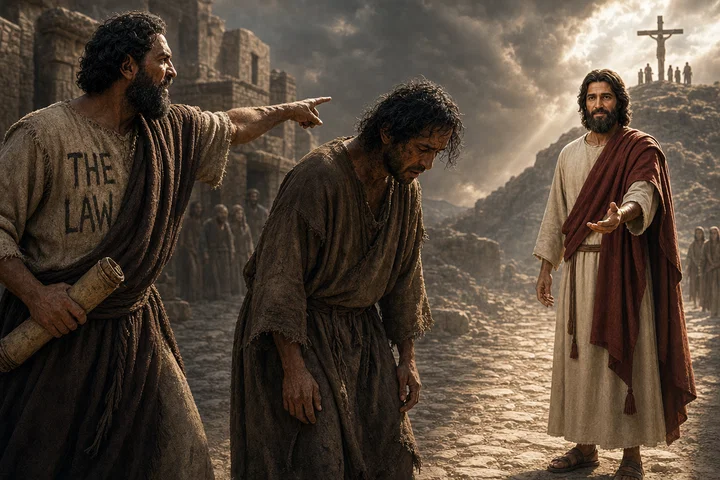
Wherefore the law was our schoolmaster to bring us unto Christ, that we might be justified by faith.
Translations
Why the law was our schoolmaster to bring us to Christ, that we might be justified by faith.
King James Version, KJV Cambridge Paragraph Bible
Wherefore the law was our schoolmaster to bring us unto Christ, that we might be justified by faith.
Wherefore the law was our school-master to bring us to Christ, that we might be justified by faith.
So that the law hath been our tutor to bring us unto Christ, that we might be justified by faith.
So that the law is become our tutor to bring us unto Christ, that we might be justified by faith.
so that the law became our child-conductor — to Christ, that by faith we may be declared righteous,
So that the law has been our tutor up to Christ, that we might be justified on the principle of faith.
So that, the law, hath proved, our tutor, training us, for Christ, in order that, by faith, we might be declared righteous;
Berean Standard Bible, Majority Standard Bible
So the law became our guardian to lead us to Christ, that we might be justified by faith.
So that the law has become our tutor to bring us to Christ, that we might be justified by faith.
So the law has been a servant to take us to Christ, so that we might have righteousness by faith.
Wherefore the Lawe was our scholemaster to bring vs to Christ, that we might be made righteous by faith.
Douay-Rheims (Challoner revision)
Wherefore the law was our pedagogue in Christ, that we might be justified by faith.
Pictures
Cross-references 20 of 121
- Romans 3:20
Therefore by the deeds of the law there shall no flesh be justified in his sight: for by the law is the knowledge of sin.
The law’s condemnation shows the sinner his need of a Saviour.
- Romans 7:7
What shall we say then? Is the law sin? God forbid. Nay, I had not known sin, but by the law: for I had not known lust, except the law had said, Thou shalt not covet.
The law makes sin known, showing the need to come to Christ.
- Romans 3:31
Do we then make void the law through faith? God forbid: yea, we establish the law.
Faith in Christ establishes the law rather than making it void.
- Galatians 3:19
Wherefore then serveth the law? It was added because of transgressions, till the seed should come to whom the promise was made; and it was ordained by angels in the hand of a mediator.
The law was added because of transgressions until the promised Seed came.
- Romans 10:4
For Christ is the end of the law for righteousness to every one that believeth.
Christ is the law’s goal for righteousness to believers.
- Romans 5:20
Moreover the law entered, that the offence might abound. But where sin abounded, grace did much more abound:
The law makes sin abound, while grace abounds through Christ.
- Romans 6:14-15
For sin shall not have dominion over you: for ye are not under the law, but under grace.
Believers are under grace, not law, and this freedom does not license sin.
- Romans 8:1-4
There is therefore now no condemnation to them which are in Christ Jesus, who walk not after the flesh, but after the Spirit.
Those in Christ are free from condemnation as the Spirit fulfills the law’s righteousness.
- Hebrews 10:1
For the law having a shadow of good things to come, and not the very image of the things, can never with those sacrifices which they offered year by year continually make the comers thereunto perfect.
The ceremonial law foreshadowed Christ and his work.
- Matthew 5:17
Think not that I am come to destroy the law, or the prophets: I am not come to destroy, but to fulfil.
Christ fulfills the law without destroying it.
- Galatians 3:13
Christ hath redeemed us from the curse of the law, being made a curse for us: for it is written, Cursed is every one that hangeth on a tree:
Christ bears the law’s curse to redeem us.
- Exodus 20:1-17
And God spake all these words, saying,
The Ten Commandments are the law that exposes sin and leads to Christ.
- Romans 3:19
Now we know that what things soever the law saith, it saith to them who are under the law: that every mouth may be stopped, and all the world may become guilty before God.
The law exposes the whole world’s guilt before God.
- Romans 4:13-16
For the promise, that he should be the heir of the world, was not to Abraham, or to his seed, through the law, but through the righteousness of faith.
Abraham’s promised inheritance came through faith, not through the law.
- Colossians 2:14
Blotting out the handwriting of ordinances that was against us, which was contrary to us, and took it out of the way, nailing it to his cross;
The ordinances were blotted out and taken out of the way at Christ’s death.
- Romans 7:12
Wherefore the law is holy, and the commandment holy, and just, and good.
The law is holy, just, and good, and exposes sin.
- Psalms 19:7
The law of the LORD is perfect, converting the soul: the testimony of the LORD is sure, making wise the simple.
The perfect law converts the soul and leads to Christ.
- 2 Corinthians 3:7-11
But if the ministration of death, written and engraven in stones, was glorious, so that the children of Israel could not stedfastly behold the face of Moses for the glory of his countenance; which glory was to be done away:
The law’s condemning ministry is contrasted with the more glorious ministry of righteousness.
- Galatians 5:1
Stand fast therefore in the liberty wherewith Christ hath made us free, and be not entangled again with the yoke of bondage.
Freedom in Christ contrasts with the law’s yoke of bondage.
- Galatians 3:16
Now to Abraham and his seed were the promises made. He saith not, And to seeds, as of many; but as of one, And to thy seed, which is Christ.
Identifies Christ as the promised Seed to whom the promise was made.
Commentary part 1 of 2
Each commentary is drawn from primary sources: the writings of Ellen G. White and Adventist pioneers and periodicals. Each commentary is separate. Its own words are not a quotation; follow the references to read the source passages.
Ellen G. White
20 sources
The law was the schoolmaster to bring sinners to Christ so they might be justified by faith, especially the moral law revealing sin and making them feel their need of pardon and peace through repentance toward God and faith toward Jesus Christ.1MR 130.1Lt 96, 1896, par. 3DA 308.1Lt 17, 1895, par. 17–19 That schoolmaster is both the moral code of the Ten Commandments and the ceremonial law, with the whole sacrificial system founded on Christ and its shed blood pointing from Abel onward to His blood to be shed for the world.1MR 131.5Ms 87, 1900, par. 21MR 131.4Ms 87, 1900, par. 1 The law does this work by exposing sin and guilt and condemning the transgressor, yet it cannot remove guilt, pardon, or make righteous, so it drives the convicted sinner beyond itself to Christ the sin-bearing Saviour and His imparted righteousness.Ms 50, 1900, par. 5Ms 16, 1897, par. 13–15Ms 138, 1899, par. 9–12Ms 16, 1897, par. 11–12 The passage in Galatians 3:19-25 gives plain light about this law that is to be accepted and investigated from the Scriptures by each person for himself, and its truth is meant to sanctify those who hold it and bring forth fruit after Christ's order.9MR 216.4–217.3Lt 7, 1888, par. 108MR 312.2
Law as Schoolmaster
Galatians 3:24 speaks especially of the moral law as the schoolmaster that reveals sin and awakens sinners to feel their need of Christ and to flee to Him for pardon and peace through repentance toward God and faith toward Jesus Christ, that they might be justified by faith.1MR 130.1Lt 96, 1896, par. 3 The sacrificial ceremony is also the schoolmaster bringing sinful people to consider Christ, with its work beginning at the beginning with Cain and Abel in the school of obedience where salvation by the blood of Jesus was taught through offerings pointing to Christ.1MR 131.5Ms 87, 1900, par. 2 God prepared the whole sacrificial system with Christ as the foundation of the whole system and of the whole Jewish economy, and the shedding of blood in sacrifice symbolized the blood of Christ to be shed for the world, while Cain's refusal to accept God's plan to be saved by Christ's blood led to Abel's death.1MR 131.5
The offerings beginning with the sacrifice associated with Abel symbolized Christ's blood shed for the world, with Christ as the foundation of the Jewish economy.Ms 87, 1900, par. 2 The schoolmaster that brings sinners to Christ is both the ceremonial law and the moral code of the Ten Commandments.1MR 131.4Ms 87, 1900, par. 1 The ceremonial law was given by Christ and, though no longer to be observed, remains glorious and worthy of its divine Originator, and Paul set it before the Jews to show its true position and value, its place in the plan of redemption, and its relation to the work of Christ.PP 367.2
Its sanctuary service typified grand truths to be revealed through successive generations: the cloud of incense ascending with Israel's prayers shows His righteousness that alone makes the sinner's prayer acceptable, the bleeding victim testified of a Redeemer to come, and the visible token of divine presence shone from the holy of holies, and through these types faith was kept alive through ages of darkness and apostasy until the advent of the promised Messiah.PP 367.2 Christ was the originator of the Jewish system of sacrifices, and His death fulfilled the typical law.ST Dec 19, 1878 The moral law exposed sin in Saul's experience: in its light he saw himself as a sinner though he had thought he kept it, and the law thus led him to repent and trust Jesus as Saviour.ST Dec 19, 1878
Leading Sinners to Christ
God's requirements act as a moral mirror, revealing a person's defects and leading that person to Christ as the sin-pardoning Saviour, and in this way the law serves as schoolmaster to bring people to Christ.Lt 17, 1895, par. 17–19 It brings people to Christ by exposing their sin and their need of a Saviour, as the Holy Spirit applies its principles to the heart and Christ's life makes those principles plain, thereby revealing the need for His cleansing blood and justifying righteousness so that they may be justified by faith.DA 308.1 It exposes sin by condemning the transgressor, yet it cannot pardon or make the sinner righteous, and its condemning work drives people to Christ, who died for sin and imparts His righteousness so they may be presented to the Father in His righteous character.Ms 50, 1900, par. 5
The law acts as schoolmaster by revealing sin and the sinner's guilt, but it cannot remove guilt or pardon the transgressor; it points the sinner beyond repentance to Christ the sin-bearing Saviour and to justification by faith.Ms 16, 1897, par. 13–15Ms 16, 1897, par. 11–12 It is holy, just, and good, and by exposing sin it makes sin unmistakable and exceedingly sinful, while warning and instructing people in the way back to God and showing sinners their guilt and need to return to loyalty to God.Ms 16, 1897, par. 13–15Ms 16, 1897, par. 11–12 It cannot remove guilt or pardon, but points the sinner to Christ the remedy and to justification by faith.Ms 16, 1897, par. 13–15Ms 16, 1897, par. 11–12
When obeyed in practical life the law exposes sin and leads people to recognize Christ as sin's only remedy, for the law itself is holy, just, and good, but sin uses the commandment to reveal how sinful sin is and to bring the sinner to a sense of need.Ms 138, 1899, par. 9–12 Self-righteousness resists this purpose, while the repentant sinner finds deliverance through Jesus Christ and learns willing obedience and the Saviour's meekness and lowliness.Ms 138, 1899, par. 9–12 The law of God points the sinner to Christ as his only hope, for after sinning man became part of the fallen order and before entering heaven must be purified and sanctified by exchanging his sins for Christ's righteousness rather than trusting human will, and in this way God guards His majesty against the idea that human will is the great power.Ms 41, 1910, par. 2 It directs people to Christ, the only hope of salvation and the one who can give life, and the gospel is revealed throughout the Bible, including in Old Testament prophecies and in acts of turning people from sin and bringing forgiveness that pointed to the coming Saviour.Ms 69, 1912, par. 40–45 Christ died because the Father's law could not be altered to excuse humanity's fallen condition.Ms 69, 1912, par. 40–45
Studying the Passage Rightly
The larger passage of Galatians 3:19-25 gives plain light about the law that is to be accepted, and fear of having to accept what it teaches about the law leads to turning away from that light.8MR 312.2 The verse itself holds truth that remains unchanged and will bear investigation and criticism without falling.9MR 216.4–217.3 Its meaning is to be investigated from the Scriptures by each person for himself, with meekness and fear, without making any man an authority.9MR 216.4–217.3
The verse belongs to the disputed question about the law in Galatians on which many took a wrong position before fully understanding it.9MR 331.3 The church sustained a loss when people failed to cherish the Spirit of Christ in that controversy.9MR 331.3 Differences over the verse are not vital questions compared with the vital question of being a Christian with a Christian spirit that is true, open, and frank with one another.9MR 216.4–217.3
Its truth is meant to sanctify those who hold it and to bring forth fruit after Christ's order, not fruit bitter as gall.9MR 216.4–217.3 When that truth does not produce fruits like Christ's but instead bitter results, it has not been rightly lived out.9MR 216.4–217.3Lt 7, 1888, par. 10
Sources
Pioneers and periodicals
198 sources
The law was a guardian and jailer that held sinners shut up under sin and condemnation to escort and drive them to Christ.ST Mar 1, 1899RH Apr 24, 1900ST Sep 2, 1886ST Sep 11, 1884
It does this work by exposing guilt and helplessness, showing God's holiness and man's inability to free himself, so that need of a Saviour is felt and refuge is sought in Christ.ST Oct 3, 1906RH Apr 24, 1900ST Mar 27, 1901RH Jan 10, 1916ST May 10, 1910
It cannot itself justify, pardon, give life or make righteous, but convicts and then points to where righteousness is received.ST Oct 24, 1900RH Mar 7, 1907ST Jul 25, 1911ST Sep 20, 1899RH Aug 27, 1857
That righteousness is received by faith in Christ, who bore the penalty and fulfilled the law's obedience, so that God pardons and treats the guilty as just through His imputed righteousness.ST Mar 4, 1897ST Mar 20, 1901
To be no longer under the schoolmaster is to be released from condemnation, curse and dominion of sin under grace, not to be released from obligation to obey, for faith establishes the law.RH Sep 15, 1863RH May 6, 1858ST Aug 23, 1877RH Jul 14, 1868RH Oct 16, 1855
The schoolmaster is the moral law of the Ten Commandments that gives knowledge of sin, and as ceremonial law of sacrifices and shadows it foreshadowed Christ's work until He came.RH Mar 21, 1865RH Sep 15, 1863RH Apr 26, 1864RH Apr 24, 1900
Words and Setting
The term rendered schoolmaster means paidagogos, a child's guardian, guide and attendant, traditionally a slave who led a boy to and from school, kept charge of him, corrected him and even beat him if he tried to escape, with teaching only incidental to custody.RH Apr 24, 1900ST Sep 11, 1884ST Mar 20, 1901RH Apr 28, 1874ST Mar 20, 1901 It is not a teacher who explains saving work or who can pardon, but a guardian and disciplinarian who watches, exposes and corrects sin and conducts to another who teaches.RH Apr 24, 1900ST Mar 20, 1901 Like that attendant who escorted a child to instruction and barred every other path, it drives toward release by leaving no other way out of condemnation for those who seek liberty.ST Sep 11, 1884 In that office it guides by teaching right from wrong and showing need of help, yet neither its moral nor its ceremonial form can supply the justification the sinner needs.RH Apr 24, 1900ST Mar 20, 1901
The same office pictures a taskmaster, jailer or prison warden who keeps the guilty under custody and restraint, pressing without rest until penalty is paid or pardon received.ST Mar 1, 1899ST Feb 22, 1899ST Sep 7, 1915 One held so may seem to walk freely yet is still not free, shut up under guilt with every escape closed except one.ST Oct 31, 1900ST Mar 1, 1899ST Feb 22, 1899 Scripture so shuts all up as in a prison house, holding the soul under ward, reminding emphatically of bondage and leaving no hope in self or power to keep the righteousness demanded unto life.ST Oct 31, 1900ST Sep 7, 1915ST Dec 19, 1900 This confinement is not without hope, because it points toward the Door of Safety where righteousness is fulfilled and freedom from sin makes believers sons of God.ST Oct 31, 1900ST Mar 1, 1899ST Dec 19, 1900
Wherefore marks consequence and cause from the preceding argument, meaning for which cause and in consequence of which.RH Apr 17, 1900 The law is not against the promises of God but aids in attaining them, and since all promises are in Christ it aids in attaining Christ.RH Apr 17, 1900 To be kept under the law and shut up unto the faith to be revealed means to be shut up and brought to faith, and since faith is always Christ as author and finisher and substance of all faith, to be brought to Christ.RH Apr 17, 1900
The words to bring us are supplied and are not in the original, and to point to Christ expresses the sense more clearly than mere distant indication.RH Apr 29, 1862 The sense is to escort, drive and shut up unto Christ rather than merely to point Him out from afar.ST Sep 2, 1886ST Sep 11, 1884 The moral law so brings the convicted sinner by exposing sin and leaving no rest or hope of justification through itself, so that flight is necessary.ST Sep 2, 1886ST Sep 11, 1884 The transition from old covenant to new began with John's preaching and ended with Christ's preaching, explaining how the law and prophets prophesied until John while the law served as schoolmaster unto Christ.
The past tense was describes what the law was before faith came, continuing in custody and leading until faith was revealed, after which believers are no longer under the schoolmaster.ST Feb 22, 1899ST Mar 20, 1901 For the Galatians it describes what the law was to them before they believed, including Paul himself in our, whose experience of the Decalogue showing sinful condition and need issued in victory through faith.ST Mar 20, 1901 One position holds the past tense marks the rites and ceremonies of the law dispensation giving way when the gospel dispensation came, so that if it said is it would point to a different meaning while the Ten Commandments remain binding to keep faith alive in justification.RH Oct 8, 1857 Another position holds schoolmaster and coming of faith describe an era change rather than merely individual experience, with the old dispensation having faith and some knowledge and prophecy of Christ but not full understanding, until fullness of time brought a flood of light like the sun at the time of reformation rightly called the coming of faith.
To be under the schoolmaster is the same as to be under the law, and to be under the law means to be under sin, under its dominion, shut up under sin and under condemnation and sentence of death for transgression.ST Sep 16, 1913ST Sep 16, 1886RH Apr 17, 1900 The Spirit uses the law to convict and shut up under condemnation, not to leave to die but to leave Jesus Christ as the only way out for declaring righteous by trust.RH Apr 17, 1900 After faith comes believers are no longer under that guide, which means no longer under condemnation but under grace, free from dominion of sin and led by the Spirit as sons of God, having attained Christ Himself who is the end, object, aim and purpose of the law for righteousness to everyone that believes.ST Sep 16, 1913RH Apr 17, 1900
Justification means to treat as just, pardon and absolve the guilty, and in its scriptural sense also to make the justified a doer of the law whose violation had made that person a sinner.ST Mar 20, 1901 It comes by the imputed righteousness of God in Christ wrought out in obedience to the law through the Spirit, the righteousness of the law worked out in Jesus Christ and placed upon the believer, which sinful man could not get from the law.ST Mar 4, 1897 The law that was accuser then becomes a blessed witness of acceptance, witnessing that the righteousness gotten through Christ's obedience is in harmony with the law He obeyed and which it remains duty to obey.ST Mar 4, 1897 After justification by faith the law no longer finds the person unrighteous but approves conduct as righteous and in harmony with its perfect purpose.ST Mar 4, 1897
The verse belongs to a chapter and epistle whose central message is salvation received by faith and not achieved by human effort.ST Feb 22, 1899ST Nov 21, 1911 Abraham believed God and was counted righteous, and through faith people of every nation receive the promised blessing and the Spirit.ST Feb 22, 1899 The faithful of earlier ages were reconciled by faith in Christ as believers are now, and those who belong to Christ share Abraham's faith and are his children, heirs according to the promise with Christ as the Seed through whom the promise comes.ST Apr 23, 1912ST Jul 2, 1885RH Jul 2, 1901 The Spirit's work for the world in convincing of righteousness by revealing Christ, in whom perfect righteousness and deliverance are found, stands in this same connection.ST Nov 21, 1895
Which Law Is Meant
The schoolmaster is the moral law, the Ten Commandments, the living Decalogue that says Thou shalt not covet and by which is the knowledge of sin.RH Sep 15, 1863RH Apr 24, 1900RH Apr 24, 1900ST Sep 2, 1886ST Aug 5, 1897 It reveals sin, holds all guilty under sin and condemnation, and leaves only Jesus Christ as escape to justification by faith.RH Sep 15, 1863RH Apr 24, 1900RH Apr 24, 1900ST Sep 2, 1886 It guides sinners to Christ by giving knowledge of sin and convincing of wrong by the rule of right, since no one comes to Christ to any purpose without that instruction, and being no longer under that guide means release from condemnation incurred by sin, not abolition of the law or release from obligation to obey it.RH Sep 15, 1863RH Apr 24, 1900ST Aug 5, 1897 It is perpetual because doers of it will live, because its curse held all including Gentiles until Christ redeemed transgressors from it, and because its curse stood between the sinner and the blessing of Abraham, which is the blessing of the gospel.RH Sep 15, 1863ST Sep 2, 1886ST Aug 5, 1897 It is a guardian and disciplinarian that watches, corrects, conducts and drives rather than merely pointing out from a distance, in the sense of the Greek pedagog who accompanied the young to the teacher, and its work of pointing out sin continues as long as probation lasts until the Seed comes to take the inheritance at the second coming.RH Apr 24, 1900RH Apr 24, 1900ST Sep 2, 1886ST Aug 5, 1897
The schoolmaster is the ceremonial law of sacrifices, offerings, priests, altar, temple and circumcision, added because of transgression till the Seed should come.RH Mar 21, 1865RH Apr 17, 1866ST May 27, 1875RH Apr 29, 1862RH Mar 14, 1854 Its types and shadows foreshadowed Christ's sacrifice and priestly work, with every offering and ceremony teaching about Christ as the great offering to come and fastening the mind upon the great remedy, and it kept faith alive where its rites expressed faith in Christ already held.RH Mar 21, 1865RH Apr 26, 1864RH Apr 17, 1866ST May 27, 1875RH Apr 29, 1862 It ended when faith came and Christ died, when its sacrifices ceased and Christ himself acts as great High Priest above, pointing beyond His earthly work to His ministration in the heavenly sanctuary.RH Mar 21, 1865RH Apr 26, 1864ST May 27, 1875RH Apr 29, 1862RH Mar 14, 1854 It is distinct from the moral law written on stone which remains, for the Ten Commandments convict of sin because sin is breaking the moral law but point to no remedy and in no sense lead by themselves, while the ceremonial schoolmaster was added because the moral law was transgressed to teach the way to Christ that men might be justified by faith.RH Mar 21, 1865RH Apr 26, 1864RH Apr 17, 1866ST May 27, 1875RH Apr 29, 1862 Being no longer under a schoolmaster in this sense means no longer being under that system of types and shadows pointing forward to a coming Saviour, but living under the dispensation in which the sacrifice and priesthood proved in Hebrews are fulfilled, which does not release from obligation to refrain from having other gods, making graven images, taking God's name in vain, breaking the Sabbath, and violating duties to fellow men.RH Mar 21, 1865RH Apr 26, 1864RH Mar 14, 1854
The schoolmaster is the law-system or dispensation as a whole, not the Ten Commandments or the ceremonial law separately, for these laws were constituent parts of that system which was added.RH Oct 8, 1857RH Oct 8, 1857RH Oct 8, 1857 It is especially its types and shadows and old Jewish law order, now dead and past, which led people to Christ and gave way to the gospel dispensation when faith in Jesus was revealed.RH Oct 8, 1857RH Oct 8, 1857RH Jan 15, 1867RH Jul 5, 1864RH Jun 28, 1864 The past-tense wording matters in distinguishing this temporary role, as an adult is free from the schoolmaster who governed his childhood, and divines commonly applied this freedom to ceremonial and civil law while holding the moral law in force, brought nearer and written on the heart under the new covenant.RH Oct 8, 1857RH Oct 8, 1857RH Jan 15, 1867 Following that old dead schoolmaster instead of the living Jesus is blindness and error, yet keeping the Sabbath God instituted, blessed and sanctified for man is adhering to the word and testimony of the Father and the Son.RH Jul 5, 1864RH Jun 28, 1864
The schoolmaster includes both moral and ceremonial law, not the ceremonial alone.ST Mar 27, 1901ST Mar 27, 1901ST Apr 8, 1886ST Jun 23, 1914 God designed both to bring people of every nation and age to Christ, the only source of justification, the moral revealing sin in its true character and the ceremonial showing the promised Saviour's coming and the nature of His work.ST Mar 27, 1901ST Mar 27, 1901ST Apr 8, 1886 The ceremonial forms served as unfulfilled prophecy for worshipers before Christ and as fulfilled prophecy that still gives light and instruction afterward, and although those forms are no longer used in worship the ceremonial law remains part of the means God provided to bring sinners to Christ through the Spirit's life and power.ST Mar 27, 1901ST Mar 27, 1901 The sacrificial law taught that Christ alone could provide pardon because He took the sinner's place under the death penalty and did not offer pardon through works of law, and it also taught that His pardon and justification require obedience to God's law, which Israel misunderstood when it trusted ritual observances to restore righteousness and the moral law to preserve it.ST Mar 27, 1901ST Apr 8, 1886ST Jun 23, 1914 The ceremonial part reached its limit when Christ fulfilled it at His first advent, but the moral law remained in force and its work of revealing sin continues while transgression exists until the second advent or the end of probation, when in the sinless world its principles fixed in every heart will no longer need teaching in form suited to imperfection.ST Mar 27, 1901ST Mar 27, 1901
The schoolmaster is the law of Moses written in a book for Israel's observance, distinguished from the law of God written on stone which is the Ten Commandments.RH Aug 5, 1851ST Jan 3, 1878 The law done away regulated the typical system, pointed forward to the cross, and was a shadow of good things to come whose body is Christ.RH Aug 5, 1851ST Jan 3, 1878 The Ten Commandments were not the covenant itself, for the old covenant was an agreement by the people to keep them.RH Aug 5, 1851ST Jan 3, 1878
The schoolmaster is the Mosaic law as a whole, including judicial laws, types, symbols and positive institutions such as the Sabbath.RH May 6, 1873RH Oct 29, 1872RH Dec 20, 1853RH May 6, 1852 It put moral duties into concrete, positive commands so people could recognize obligations they might not see when those duties rested only on general moral principles, without creating new moral principles, and its role as a school in which Israel was prepared for the gospel lasted until Christ came.RH May 6, 1873RH Oct 29, 1872ST Aug 14, 1884 Only its moral principles remained afterward, while the gospel governs by general principles and restores moral obligations to their moral basis, and the Levitical law so helped prepare people to understand the Messiah and His future kingdom by gradually unfolding salvation to reason and heart.RH May 6, 1873RH Oct 29, 1872ST Aug 14, 1884 The judicial laws and types and symbols gave place to the good things that came through Christ, which does not mean the Ten Commandments including the Sabbath commandment were abolished or changed, for the Sabbath's inclusion among legal ceremonies does not cancel its authority from creation.RH Dec 20, 1853RH May 6, 1852 The schoolmaster and tradition had added ceremonial features to the Sabbath, and when those ceremonies passed away the seventh-day Sabbath remained in its original importance and could be kept without being subject to ordinances.RH Dec 20, 1853RH May 6, 1852
Those who so use the verse call the Ten Commandments the old dead schoolmaster, a yoke of bondage and curse abolished at the cross and replaced by a new law of Christ identical except for transferring the Sabbath to another day.RH Jul 12, 1864RH Jul 12, 1864RH Aug 15, 1865RH May 17, 1864 The reply charges inconsistency in exalting the New Testament law as exactly identical except the Sabbath obligation transferred to another day, as the law of faith, the law of liberty, the Spirit that gives life, and more glorious, while denouncing the original Decalogue as the letter that kills and the old law of works.RH Jul 12, 1864RH May 17, 1864 It asks what commands make up the replacement and treats the Ten Commandments as still defining sin, noting that people cannot leave a law they have never kept and that following Christ does not require leaving the law in that sense.RH Mar 4, 1862RH May 17, 1864 In that opposed use the schoolmaster is made to represent visions of women instead of the visions of John and to give support to taking away sins on the head of a live goat instead of beholding the Lamb of God which takes away the sin of the world, while those who keep themselves shut up unto the faith but never come to it run into error.RH Jul 12, 1864RH Jul 12, 1864 The same language speaks of the ten commandments given to be obeyed without exception with every command obligatory in every case.RH Mar 4, 1862RH Aug 15, 1865
The schoolmaster is the whole law of God that condemns.RH Jul 25, 1854RH Feb 1851RH Mar 17, 1863 Only a law now in existence can condemn, stop every mouth and reveal guilt and lost ruin, so its work proves it has not been abolished, relaxed or reduced to precepts Christ quoted.RH Jul 25, 1854RH Feb 1851 It shows God's just claims, exposes transgression, drives the sinner to flee to Jesus and His atoning death for full free pardon, and concerns redemption from that law's curse where liberty is freedom from sin.RH Jul 25, 1854RH Feb 1851RH Mar 17, 1863 The Ten Commandments placed in the ark still show sin and demand real atonement by Christ's blood, while the blood of beasts offered before the ark could not take away sin but only shadowed forth Christ, and the law remains beneath mercy in the heavenly temple with the Eden Sabbath continuing to Paradise restored.RH Feb 1851RH Mar 17, 1863 Those under sin are under the law condemned and those pardoned are under grace, yet faith does not make void the law but establishes it, so the justified are by no means free to violate any precept without being convinced as transgressors, and the faith it produces works by love which keeps God's commandments and fulfills the law.RH Feb 1851RH Mar 17, 1863
How the Schoolmaster Leads
The law leads to Christ by exposing transgression, guilt, condemnation and utter inability to render the obedience it requires or to free oneself from its penalty, making sin appear exceedingly sinful and setting heaven's purity and God's holiness in contrast so the sinner sees lost ruin, recognizes need of a Saviour, and flees to Christ for refuge, pardon and justification by faith.ST Oct 3, 1906RH Apr 24, 1900ST Mar 27, 1901ST Apr 24, 1901 It was given because of transgression after transgression had obscured the inward standard, so that past offenses are seen to make one a sinner and the depth of sin is made plain, while it offers no justification in itself but directs to pardon through faith in Christ's blood.ST Oct 3, 1906RH Apr 24, 1900ST Mar 27, 1901RH Sep 30, 1852 The forgiven are no longer under its condemnation, Christ's righteousness covering unrighteousness so they stand complete in Him, are turned from sin to God, made doers of the law, and establish rather than abolish its claims, with this condemning and leading work continuing as long as sinful people live until the promised Seed comes.ST Oct 3, 1906ST Mar 27, 1901ST Apr 24, 1901
It leads further by confining all under sin as in a prison house under penal force and ward, pressing without rest, awakening to the condition of bondage to the rudiments of the world without Christ and without hope, and refusing release until penalty is paid or pardon received.ST Mar 1, 1899ST Sep 5, 1895ST Mar 8, 1899ST Sep 7, 1915 As guardian, disciplinarian and jailer it shuts off every other escape from guilt except faith in Christ, leaving Jesus Christ as the only way out, the only Door of Safety and avenue of escape, so the sinner with no hope in himself and no power to keep unto life the righteousness demanded is driven to Christ where the law's righteousness is fulfilled in believers.ST Mar 1, 1899ST Mar 8, 1899ST Sep 7, 1915 When faith comes and the sinner trusts in Christ, deliverance from that imprisoned condition follows, freedom from bondage is given, and believers become children of God no longer under the guide, which is no longer under condemnation.ST Mar 1, 1899ST Sep 5, 1895
Like a mirror it holds sins and plague spots of character before the sinner, revealing defects, sin and danger and convincing of need for pardon, exposing what is wrong but unable to make clean or save.ST Oct 7, 1880RH May 11, 1916RH Jan 12, 1905ST Feb 13, 1912 Terror of its penalty compels seeking Christ as the only way of escape, restraining and rebuking and directing the penitent to Christ as the object of the law for righteousness, who pays the penalty and offers the Spirit to lead away from sin and condemnation into truth.ST Oct 7, 1880RH May 11, 1916ST Feb 13, 1912 After pardon through faith the Holy Spirit makes a new creature free from penalty, a free child of God redeemed from the curse, who outwardly puts on Christ in baptism and delights to do God's will from love rather than fear, yet grace does not free to break the law and without the law there would be no standard by which to know sin.ST Oct 7, 1880RH May 11, 1916RH Jan 12, 1905
Through the law the Spirit convicts of sin, applying its principles to the heart, exposing specific sins, humbling and making conscious of guilt, so the sinner turns from self-reliance to believe in Christ and be justified by faith.ST May 10, 1910RH Dec 10, 1872RH Aug 28, 1860ST Apr 17, 1901 The law was given at Sinai to make known the holiness of God's character so that by contrast men see their own sinfulness, and this work continues still as its principles are made plain in the life of Christ and the light of Christ reveals need of His cleansing blood and justifying righteousness.ST May 10, 1910RH Dec 10, 1872 Its aim is righteousness, obedience and life and Christ's righteousness, and mercy and grace work through it and not apart from it, Jesus imparting the obedience and life it aims at, while those led by the Spirit are sanctified, cleansed and no longer under its condemnation.ST May 14, 1894ST Apr 17, 1901
In this convicting work the law acts as a severe schoolmaster that destroys trust in one's own strength, exposes spiritual death and guilt, strips away false confidence and every other plea, and drives rather than draws by love, locking sinners in hopelessness apart from Jesus as in an iron cage with no escape but faith.RH Jan 10, 1916ST Jun 12, 1884ST Aug 21, 1879RH Aug 28, 1860 This painful driving is itself driven by love to lead to dependence on Christ and to cry to be saved by grace, teaching that Christ is the only refuge and righteousness and constraining to fly to Him.RH Jan 10, 1916ST Jun 12, 1884ST Aug 21, 1879RH Aug 28, 1860 Therefore its terrors must be preached to awaken sleeping sinners and make way for Christ crucified, standing in all its terror as just and holy because men will never accept grace until they tremble before it, like a sharp needle going first so the long thread of gospel consolation can follow to bring to justification by faith.RH Jan 10, 1916RH Feb 17, 1863ST Jul 31, 1901
Law and gospel do opposite but joined work with the same aim of righteousness and life and no antagonism between them, the law humbling, casting down, wounding and convincing of misery by showing sin, while the gospel comforts, raises up, heals and convinces of mercy by revealing grace and Christ.ST Apr 23, 1894ST Sep 7, 1915RH Oct 3, 1854RH Jul 28, 1863 The law awakens conscience and responsibility and sets a high aim, while the gospel enables reaching that aim, so grace would be ineffective without the law and the law serves as monitor, disciplinarian, right arm of the gospel and perfect converter of the soul.ST Apr 23, 1894ST Sep 7, 1915ST May 8, 1884 So the Bible first wounds and condemns by showing one to be a sinner, then heals and acquits by leading to the Saviour, serving as guide of youth and staff of age with comfort through life and hope in death, and its converting power includes mercy and is not merely condemnation.ST Apr 23, 1894RH Jul 28, 1863
The law leads also by revealing the perfect life, character, authority and standard of its Author, showing heaven's purity, the way back into harmony with God, and that He is merciful to those inclined to obey, requiring forgiveness of the repentant and promising mercy to those who love and keep the commandments.ST Sep 5, 1895ST Feb 8, 1905ST Nov 5, 1896ST Mar 27, 1901 Salvation is found not in the law apart from its Author but in its principles carried out by Him, Christ the Creator who spoke it at Sinai, in whom its principles are perfectly carried out and whose perfect life revealed in men alone meets its requirements.ST Jul 15, 1908ST Nov 5, 1896ST Mar 27, 1901ST Jul 16, 1896 Its holiness reveals Christ's character and directs to the Redeemer whose blood is shed for sin, Christ being its object and fullness for righteousness, and those who find Him go on to show His righteousness in life, receiving as God's free gift in receiving Jesus the very thing the law demands but cannot bestow.ST Sep 5, 1895ST Feb 8, 1905ST Jul 16, 1896 When the penitent yields to its claims it leads to Christ for both pardon and power to live according to its righteousness, freeing from sin's dominion toward the Redeemer's perfect life, and believers return to the same law which then witnesses that the righteousness received by faith is the very righteousness it demands but cannot impart, transforming into God's image as His love dwells within.ST Sep 5, 1895ST Jul 16, 1896
It brings each sinner to Christ in his own time, as from dead Judaism and from heathenism, and still brings truly converted sinners today, its tutoring applying to believers in every age before and after Christ whether He was prefigured or had come.ST Sep 24, 1902ST Jul 12, 1899ST Sep 4, 1901RH Sep 18, 1900RH Sep 18, 1900 Old Testament believers also saw Christ through prophecy and types though less fully, were saved by faith in Him, cleansed by His blood and given life by His Spirit, while the gospel prefigured before Christ and fulfilled in Him gave the law its true interpretation.ST Jan 27, 1890RH Sep 18, 1900RH Sep 18, 1900 The law is sent home emphatically to the individual to produce conviction and drive to seek freedom, then the sinner accepts Christ's long-extended invitation, is justified by faith, manifests faith through gospel ordinances, lives righteously by faith, and through forgiving love has the law written in the heart into harmony with it.ST Sep 24, 1902ST Jan 27, 1890ST Sep 4, 1901 Without that light in Christ the law becomes a burden of precepts and ceremonies leaving sinners in self-righteousness, but through the Spirit Christ's word and blood make its spiritual meaning clear, write it on the heart, and exchange the heavy yoke for one that is light and gives rest.RH Sep 18, 1900RH Sep 18, 1900
Yet it does not bring those who do not want relief, for like the ancient attendant who escorted the child and beat him if he tried to escape, it drives toward Christ by leaving no other way out but does not bar His way when sinners seek liberty, and when faith comes the trusting person is free from condemnation to walk in newness of life under grace.ST Sep 11, 1884 Its bringing work is voided when people cover its influence with human traditions, turn ordinances and traditions of their own devising into works of righteousness, set their own works above its wisdom, or disobey it, cutting themselves off from recognizing and receiving Christ.ST Sep 11, 1884ST Nov 13, 1884ST Oct 1, 1902 So Israel, meant to be led to Christ, turned away from the schoolmaster and did not recognize the promised Messiah when He came.ST Nov 13, 1884ST Oct 1, 1902
Sources