Zechariah 3:1
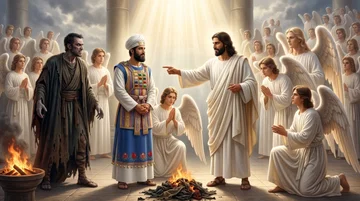
And he shewed me Joshua the high priest standing before the angel of the LORD, and Satan standing at his right hand to resist him.
Translations
American King James Version, Webster Bible
And he showed me Joshua the high priest standing before the angel of the LORD, and Satan standing at his right hand to resist him.
And he shewed me Joshua the high priest standing before the angel of the LORD, and Satan standing at his right hand to resist him.
And he shewed me Joshua the high priest standing before the angel of the Lord, and Satan standing at his right hand to resist him.
And he shewed me Joshua the high priest standing before the angel of the LORD, and Satan standing at his right hand to be his adversary.
And he showed me Joshua the high priest standing before the angel of Jehovah, and Satan standing at his right hand to be his adversary.
And he sheweth me Joshua the high priest standing before the messenger of Jehovah, and the Adversary standing at his right hand, to be an adversary to him.
And he shewed me Joshua the high priest standing before the Angel of Jehovah, and Satan standing at his right hand to resist him.
And he shewed me, Joshua the high priest, standing before the messenger of Yahweh,—and, the Accuser, standing at his right hand, to accuse him.
Berean Standard Bible, Majority Standard Bible
Then the angel showed me Joshua the high priest standing before the angel of the LORD, with Satan standing at his right hand to accuse him.
He showed me Joshua the high priest standing before the LORD’s angel, and Satan standing at his right hand to be his adversary.
And he let me see Joshua, the high priest, in his place before the angel of the Lord, and the Satan at his right hand ready to take up a cause against him.
And he shewed mee Iehoshua the hie Priest, standing before the Angel of the Lord, and Satan stoode at his right hand to resist him.
Douay-Rheims (Challoner revision)
And the Lord shewed me Jesus the high priest standing before the angel of the Lord: and Satan stood on his right hand to be his adversary.
Pictures

Cross-references 20 of 32
- Revelation 12:10
And I heard a loud voice saying in heaven, Now is come salvation, and strength, and the kingdom of our God, and the power of his Christ: for the accuser of our brethren is cast down, which accused them before our God day and night.
Satan is the accuser of God’s people, accusing them before God.
- Jude 1:9
Yet Michael the archangel, when contending with the devil he disputed about the body of Moses, durst not bring against him a railing accusation, but said, The Lord rebuke thee.
Both show Satan opposing God’s work and being answered with the Lord’s rebuke.
- Romans 8:34
Who is he that condemneth? It is Christ that died, yea rather, that is risen again, who is even at the right hand of God, who also maketh intercession for us.
Christ intercedes for his people against Satan’s accusation.
- Job 1:6-12
Now there was a day when the sons of God came to present themselves before the LORD, and Satan came also among them.
Satan appears before God as an adversary, accusing God’s servant.
- Zechariah 3:7
Thus saith the LORD of hosts; If thou wilt walk in my ways, and if thou wilt keep my charge, then thou shalt also judge my house, and shalt also keep my courts, and I will give thee places to walk among these that stand by.
Joshua’s priestly service is promised conditionally after his pardon and opposition.
- 2 Corinthians 11:14
And no marvel; for Satan himself is transformed into an angel of light.
Satan may disguise himself as an angel of light rather than appear as an open enemy.
- Hebrews 4:14
Seeing then that we have a great high priest, that is passed into the heavens, Jesus the Son of God, let us hold fast our profession.
Jesus is the great High Priest, foreshadowed by Joshua.
- Zechariah 3:8-9
Hear now, O Joshua the high priest, thou, and thy fellows that sit before thee: for they are men wondered at: for, behold, I will bring forth my servant the BRANCH.
The coming Branch is linked with the removal of iniquity.
- 1 Peter 5:8
Be sober, be vigilant; because your adversary the devil, as a roaring lion, walketh about, seeking whom he may devour:
Both depict Satan as an active adversary seeking to oppose and harm.
- Ephesians 6:12
For we wrestle not against flesh and blood, but against principalities, against powers, against the rulers of the darkness of this world, against spiritual wickedness in high places.
Both describe opposition from Satan and spiritual powers.
- Job 1:9-11
Then Satan answered the LORD, and said, Doth Job fear God for nought?
Satan accuses both Job and Joshua before God.
- Haggai 1:1
In the second year of Darius the king, in the sixth month, in the first day of the month, came the word of the LORD by Haggai the prophet unto Zerubbabel the son of Shealtiel, governor of Judah, and to Joshua the son of Josedech, the high priest, saying,
Identifies Joshua as high priest during the rebuilding.
- Job 2:1-5
Again there was a day when the sons of God came to present themselves before the LORD, and Satan came also among them to present himself before the LORD.
Both depict Satan standing before God to accuse and challenge a servant.
- Luke 22:31-32
And the Lord said, Simon, Simon, behold, Satan hath desired to have you, that he may sift you as wheat:
Satan seeks to sift a believer, while Christ intercedes to preserve his faith.
- Hebrews 4:15-16
For we have not an high priest which can not be touched with the feeling of our infirmities; but was in all points tempted like as we are, yet without sin.
Christ the high priest sympathizes with the tempted and gives mercy and help.
- Luke 10:18
And he said unto them, I beheld Satan as lightning fall from heaven.
Jesus describes Satan falling from heaven.
- 1 John 2:1
My little children, these things write I unto you, that ye sin not. And if any man sin, we have an advocate with the Father, Jesus Christ the righteous:
Christ intercedes for sinners before God as their Advocate.
- Zechariah 3:9
For behold the stone that I have laid before Joshua; upon one stone shall be seven eyes: behold, I will engrave the graving thereof, saith the LORD of hosts, and I will remove the iniquity of that land in one day.
Continues the vision’s reference to Jesus by name.
- Hebrews 7:25
Wherefore he is able also to save them to the uttermost that come unto God by him, seeing he ever liveth to make intercession for them.
Christ intercedes as High Priest against Satan’s accusations.
- Leviticus 16:15-16
Then shall he kill the goat of the sin offering, that is for the people, and bring his blood within the vail, and do with that blood as he did with the blood of the bullock, and sprinkle it upon the mercy seat, and before the mercy seat:
Joshua’s representative ministry is compared with the high priest’s work for Israel on the day of atonement.
Commentary
Each commentary is drawn from primary sources: the writings of Ellen G. White and Adventist pioneers and periodicals. Each commentary is separate. Its own words are not a quotation; follow the references to read the source passages.
Ellen G. White
106 sources
The vision shows the high priest standing before the Lord's angel while Satan stands at his right hand to oppose, resist and accuse him in a controversy in the heavenly court.STB 60.4–61.1COL 166.3–4RH Jan 2, 1908 Joshua there stands for God's people, the church and Jerusalem, and for every repentant sinner confessing guilt and relying on mercy, especially the faithful who remain loyal to God's law.COL 166.3–4RH Nov 19, 1908Ms 125, 1901, par. 37–43Lt 173, 1903, par. 8–14Ms 96, 1902, par. 36–37 Satan acts as the day-and-night adversary, pointing to their sins and filthy garments, claiming them as his prey by their transgressions, and seeking to make them despair and lose hold on heaven.COL 166.3–4FE 274.2–275.1RH Jan 2, 1908Ms 65, 1909, par. 2–6Ms 27, 1894, par. 33–36 Christ stands as High Priest, Mediator and Advocate, rebuking Satan, taking away iniquity and clothing the forgiven with His own righteousness, since no one can answer the accuser by personal merit.RH Nov 19, 1908Ms 125, 1901, par. 37–43Ms 29, 1900, par. 21–237MR 202.2–203.3ST Aug 28, 1901 The scene belongs to the closing time of trial and investigative judgment, when the remnant, conscious of unworthiness, will plead with broken heart and unfaltering faith while Satan urges his accusations to the uttermost.RH Nov 19, 1908RH Jan 9, 19085T 472.2–473.1RH Jan 9, 1908GC88 618.2–3
Vision and Historical Setting
The vision presents Joshua the high priest standing before the angel of the Lord while Satan stands at his right hand to resist, oppose and accuse him, picturing a controversy carried on in the heavenly court.STB 60.4–61.1COL 166.3–4RH Jan 2, 1908Ms 95, 1903, par. 6–7Ms 87, 1906, par. 5 Joshua pleads for blessing and mercy for an afflicted people and for the fulfillment of God's promises to them, while Satan as adversary seeks to block their restoration and keep help from reaching them.COL 166.3–4RH Jan 2, 1908PK 583.2 Satan points to their sins, faults and failures to make their case appear hopeless, claiming them as his prey and demanding that they be handed over to him and denied restoration to favor.COL 166.3–4RH Jan 2, 1908PK 583.2
These symbolic visions were given when the returned Jews faced uncertainty about whether they could continue rebuilding, to sustain and encourage those advancing God's work by revealing His compassion and love.RH Dec 26, 1907 The showing of Joshua before the angel with Satan opposing him was a personal encouragement to Joshua and a testimony of encouragement for all God's people.RH Jan 16, 1908 The setting is Jerusalem about to be rebuilt, with a repentant people turning to obedience while God comes to relieve their affliction rather than leave them in distress.RH Aug 20, 1901 This vision of Joshua and the Angel comes immediately before the message regarding the work of Zerubbabel.PK 593.1–594.1
The setting concerns Israel after disobedience, captivity in Babylon, repentance, and the return of a remnant to its land.RH Jan 2, 1908 Joshua pleads for mercy and the fulfillment of God's promises for His afflicted people, while Satan resists their restoration, points to their sins, claims them for destruction, and seeks to destroy the returned remnant through the heathen nations after having tempted them into sin.PK 583.25T 467.3RH Jan 2, 1908 The angel before whom Joshua stands is the Saviour Jesus Christ in actual ministry for His people, corresponding to Joshua's ministry for Israel on the day of atonement.Ms 124, 1901, par. 18–1917MR 242.1–2 He continues that ministry as Advocate for repentant believers, so that as Joshua pleaded, the true who plead for pardon and deliverance in final distress plead through Him with broken heart when menaced and betrayed, with God's mercy as their only hope.Ms 124, 1901, par. 18–19PK 588.1
Figures Represented in Vision
Joshua the high priest stands before the angel as a picture of God's people, Israel, the church and Jerusalem standing before their Redeemer to plead for blessing in great affliction.COL 166.3–4ST Aug 28, 1901Lt 51, 1886, par. 19–21Ms 98, 1893, par. 3–6 He represents God's people today, who like him stand before Christ clothed in unrighteousness while Satan resists Christ's work for them and claims them because of their sins.RH Nov 19, 1908Lt 51, 1886, par. 19–21Ms 98, 1893, par. 3–64MR 249.3–250.1 Satan uses their guilt to assert a right over them, yet those who have confessed with contrition and put away sin receive pardon through Jesus.21MR 384.1–385.1Lt 51, 1886, par. 19–214MR 249.3–250.1 The conflict is over their rescue, for Satan resists Christ's plan to redeem them and give them power against him, accusing them before God.Ms 98, 1893, par. 3–64MR 249.3–250.1 The company shown are those who improved probation by confession with contrition of soul, who vex their souls over abounding corruption and sigh and cry over abominations without being mixed in them, having washed their robes of character white in the blood of the Lamb.21MR 384.1–385.14MR 249.3–250.1
He especially represents the people who keep God's commandments and honor God by loyalty to His holy law amid widespread lawlessness and hostility to the law.Ms 125, 1901, par. 37–43Ms 96, 1902, par. 36–37Ms 125, 1901, par. 25–28 Those faithful ones face Satan's opposition and accusation, as he invokes even their past sins to claim power over them and resist Christ their High Priest and defender.Ms 125, 1901, par. 37–43Ms 96, 1902, par. 36–37 The vision shows the conflict sharpening as the world grows hostile to God's standard and Satan works through those who reject it, until God vindicates His name by magnifying His law as holy, just, good and unchangeable.Ms 125, 1901, par. 25–28
He represents the church in its sacred and official office, and ministers set over congregations in their official work of preaching the Word.Lt 208, 1906, par. 34–36Lt 68, 1900, par. 4–720MR 188.5–189.1 Satan's standing at his right hand to resist him means Satan now takes the same position toward every church and toward ministers of the gospel, to resist them in the ministry of the Word and to resist the Lord's working in their behalf.Lt 68, 1900, par. 4–720MR 188.5–189.1 He seeks to hinder the work God is about to do for His people through the coming Messiah, the Branch, and to keep them in distress after they dishonored God by yielding to temptation and disobeying His commandments.Lt 68, 1900, par. 4–720MR 189.2–3 The priest and people are on trial as a brand plucked from the fire, called to repent and obey, and the Lord comes to their relief in answer to intercession and in pity toward them.Lt 68, 1900, par. 4–720MR 188.5–189.120MR 189.2–3 The filthy garments belong to ministers and congregations, who must humble themselves, pray and repent so sins may be pardoned through Christ's atoning sacrifice, while the rebuilding and measuring of Jerusalem signify comfort and strength for God's afflicted people.Lt 208, 1906, par. 34–3620MR 189.4–6Lt 68, 1900, par. 8–10
He represents the individual sinner for whom Christ mediates to bring to repentance.FE 274.2–275.1Ms 27, 1894, par. 33–36CE 159.2 This includes those whose religious lives have been faulty and who have been overcome by temptation, bearing imperfections and sins symbolized by filthy garments.Lt 173, 1903, par. 8–14Ms 27, 1894, par. 33–36PK 583.3 Satan claims such a person as his because the person chose him as ruler, portrays the tempted as undeserving of care and mercy, and seeks their destruction.FE 274.2–275.1Lt 173, 1903, par. 8–14Ms 27, 1894, par. 33–36CE 159.2 Yet those who confess guilt, call upon Christ, and rely in faith on God's promises and the mercy of the Redeemer are not forsaken, for Christ as Advocate and Restorer, stronger than Satan, answers the claims, helps and protects them, and rescues those who trust Him as personal Saviour.Lt 173, 1903, par. 8–14Ms 27, 1894, par. 33–36PK 583.3CE 159.2 Joshua cannot defend himself or Israel and claims no faultlessness, but as representative bears their sins, confesses guilt, and points to repentance and humility.Lt 360, 1906, par. 2–7PK 583.3 The figure called Satan may have been a person possessed by Satan's spirit speaking Satan's words to shame those who have sincerely repented, while those continuing in wrongdoing taunt the repentant.Lt 360, 1906, par. 2–7
He represents only those who have improved the hours of probation to confess sins with contrition and put them away, for whom Jesus has written pardon against their names.21MR 384.1–385.14MR 249.3–250.1 Satan points to their filthy garments and to sins not yet blotted out, which he himself tempted them to commit, and reviles them as sinners clad in filthy garments over whom he claims cruel power.21MR 384.1–385.14MR 249.3–250.1 The scene concerns people who have not joined surrounding corruption but grieve over it, not those who continue in sin without repentance and without seeking pardon.21MR 384.1–385.14MR 249.3–250.1 His filthy garments picture sin but do not fairly represent those who have repented, whose hope in defection is reconversion through repentance toward God and faith in Jesus Christ as righteousness and sanctification.Lt 65, 1894, par. 10–1317MR 241.2–4 Joshua was accounted in heaven as a justified sinner, and Christ hears the prayers of repentant believers and intercedes for them against Satan's obstruction, doubt and weakening of faith.Lt 65, 1894, par. 10–1317MR 241.2–4
Satan's Work as Accuser
Satan stands at the right hand of Joshua to resist him as adversary and accuser of God's people, opposing their restoration and resisting the Lord's merciful work for them, accusing them before God day and night as his special work.RH Jan 2, 190817MR 240.2–241.1Ms 124, 1901, par. 13–15GC 484.1 After he himself has led men into wrong positions he takes his place as their adversary to resist every effort made to save those bought by blood, and he persecutes those whom he has caused to sin.17MR 240.2–241.1Ms 124, 1901, par. 13–15 The same conflict recurs whenever one rescued from evil seeks mercy and enters God's family, because such salvation displays Christ's supremacy, and his accusations do not arise from concern about sin but exploit defective character and transgression of law to gain power and oppose rescue.17MR 240.2–241.1RH Jan 2, 1908
He points to sins, faults, failures and past mistakes, reviving them and holding up past unworthiness to make the case appear hopeless.COL 166.3–4Ms 65, 1909, par. 2–6Lt 136, 1910, par. 5–81MR 155.4 By this he seeks to make them lose confidence in God and their hold upon heaven, to make them believe they have separated themselves from God, to rob them of their rights, and to discourage through evil angels those striving for victory over sin.COL 166.3–4Ms 65, 1909, par. 2–6Lt 136, 1910, par. 5–81MR 155.4 He tries to frighten them with the thought that their case is hopeless and the stain of defilement will never be washed away, hoping so to destroy faith that they will yield to temptation and turn from allegiance to God.PK 588.2COL 167.1–168.14SP 436.1
He claims them as his property and prey because they chose him as ruler and because of rebellion and disobedience to God's law, using transgressions he himself tempted them to commit.FE 274.2–275.1Ms 27, 1894, par. 33–36STMW6 13.2Ms 70, 1902, par. 19–22PK 588.3 Having accurate knowledge of the sins he instigated, he urges them against the repentant even after pardon, portrays them as undeserving of care and mercy, and demands they be handed over for destruction.Ms 27, 1894, par. 33–36STMW6 13.2Ms 70, 1902, par. 19–22Ms 39, 1891, par. 24–25PK 588.3 He declares that by those sins they have forfeited divine protection and that he has right to destroy them, pronouncing them just as deserving as himself of exclusion from favor, challenging their claim to take his place and the place of angels who united with him, and arguing that justice requires sentence against them since God cannot in justice banish him and his angels yet reward those guilty of the same sins.PK 588.3
He points to their filthy garments, which are defective characters, selfishness, and laboring in human strength and spirit and way and will, with weakness and folly, sins of ingratitude, unlikeness to Christ by which they have dishonored their Redeemer, selfishness, malice and hatred of one another.4MR 249.3–250.1PK 588.2PK 588.321MR 449.4–450.34MR 302.4–304.1 He reviles them as sinners clad in filthy garments whose sins are not yet blotted out, exults over their guilt, presents their defects to characterize commandment-keeping people as defiled, and complains because he is prevented from destroying them as he is determined to do.Ms 52, 1901, par. 13–14ST Nov 13, 19014MR 249.3–250.14MR 302.4–304.1Lt 74, 1886, par. 6 As the mighty general of the forces of darkness he claims people on the basis of rebellion and disobedience, yet God does not abandon His people to temptation but rebukes Satan even though the church is still imperfect.Ms 29, 1900, par. 21–23ST Nov 13, 1901Ms 52, 1901, par. 15–17
He resists Christ's work, opposes Joshua's prayers and Christ's intent to show favor, and seeks to keep authority over souls he has brought under his control, claiming sinners belong under his control and that God should not give them power to resist him.7MR 202.2–203.3Ms 74, 1903, par. 16Ms 98, 1893, par. 3–6RH Oct 14, 1902Ms 95, 1894, par. 4–6 He stands between Christ and every repenting believing soul, stepping in between the soul and Christ to cast his hellish shadow, dampen faith, eclipse Christ's love and acceptance and pardon, and make the words of God of none effect.7MR 202.2–203.3Lt 65, 1894, par. 10–13 By reckoning every misdeed though they have repented and feel humbled and ashamed of sin they cannot remove or cancel themselves, he drives man to strive to prepare his own robe of righteousness instead of coming just as he is to believe in Christ as personal Saviour.7MR 202.2–203.3Lt 65, 1894, par. 10–13
He seeks to use heathen nations to destroy the remnant, as when he had tempted Israel into sin and then sought to prevent restoration after captivity through those nations.5T 467.3 He stirs people to persecute those who keep God's commandments and refuse to worship the papal institution, with hatred like that stirred against Christ when men demanded Barabbas be released and Jesus rejected, and he resists the Church and its ministry of the Word.RH Aug 20, 1901 He seeks to hinder those entrusted with giving the world its final message of mercy, and through his angels works to confuse judgment, feed falsehood to those who do not cherish truth, place obstacles before those God is leading, oppose people on every side, and paralyze every effort.STMW10 6.2–7.1Lt 208, 1906, par. 33Ms 99, 1897, par. 14 What took place in the courts of heaven is repeated on earth when the devil links himself in person with men who profess to believe the truth, linked arm in arm with them and personifying himself though they do not understand it, accusing them and keeping them from hearing aright.Ms 195, 1903, par. 35–41
The scene is acted out again when reproach is brought upon those who have repented and humbled themselves before God, while people who refuse to confess their own sins accuse and condemn the repentant as though they were guiltless.Lt 360, 1906, par. 2–7Lt 360, 1906, par. 8–11 Joshua represents those who have sinned but sincerely repented, whom Satan opposes and seeks to shame over sins they have repented of, and those who continue in wrongdoing may be prompted by Satan to taunt the repentant.Lt 360, 1906, par. 2–7Lt 360, 1906, par. 8–11 The figure called Satan may have been a person possessed by Satan's spirit and speaking words Satan supplied.Lt 360, 1906, par. 2–7
Christ's Work as Mediator
Christ stands before the Father as High Priest, Mediator, Advocate, Defender and Intercessor for His people, pleading for mercy and offering the merits of His own sacrifice on their behalf.RH Nov 19, 1908Ms 125, 1901, par. 37–43Ms 29, 1900, par. 21–23Ms 70, 1902, par. 19–22Lt 138, 1897, par. 20–23 He answers Satan's claims against the sinner whom Satan claims as his own because the sinner chose him as ruler, and being stronger than Satan He restores the sinner and brings him to repentance.Ms 125, 1901, par. 37–43Ms 29, 1900, par. 21–23Ms 70, 1902, par. 19–22CE 159.2 While Satan stands to resist and oppose that work, Christ intercedes for commandment-keeping people and for every willing follower, leading all who will be led upward step by step to where the clear light shines.RH Nov 19, 1908Ms 125, 1901, par. 37–43Ms 29, 1900, par. 21–23STA 115.1
He rebukes Satan and bids him depart, restraining his power to destroy and refusing to accept his accusations against those who confess their sins and trust in Christ's merits.7MR 202.2–203.3Lt 173, 1903, par. 8–14Lt 76, 1898, par. 6–8Lt 75, 1888, par. 2 He defends the sinner rather than cutting him off, and with the voice and attitude of a king He will not permit the destruction that Satan determines, demands and complains he is prevented from carrying out.Lt 76, 1898, par. 6–821MR 449.4–450.34MR 302.4–304.1Lt 47, 1891, par. 10–13 Though filthy garments give Satan grounds to demand their destruction, Christ holds back that destruction and leaves room for repentance.Lt 76, 1898, par. 6–821MR 449.4–450.34MR 302.4–304.1
He takes away iniquity, causes it to pass, writes pardon against the name, removes the sin-stained garments and clothes the forgiven with His own righteousness.ST Sep 16, 18897MR 202.2–203.3Ms 24, 1891, par. 33–3619MR 244.4–245.2 That clothing is the change of raiment and fair mitre brought forth as by a forgiving Father for the returning child, robes of honor and coronation robes for faithful obedient children, by which He justifies believers and delivers them from condemnation.7MR 202.2–203.3Ms 24, 1891, par. 33–3619MR 244.4–245.2ST Mar 30, 1915 As sin-bearer and substitute He takes their guilt upon Himself, letting His light and righteousness shine into the heart, so that the repentant believing sinner who cannot remove or cancel sin himself is accounted in heaven as a justified sinner.ST Sep 16, 1889Ms 124, 1901, par. 18–197MR 202.2–203.3ST Mar 30, 1915 Joshua's ministry for Israel on the day of atonement thus connects with Christ's continuing ministry for His people.Ms 124, 1901, par. 18–19
No one can answer Satan's charges by his own merits or remove his own defects and stain of sin, but must come to Christ with imperfections to have transgressions blotted out and receive His righteousness.Ms 20, 1885, par. 14–18RH Jan 2, 1908ST Mar 30, 1915 Hope lies in repentance toward God and faith in Jesus Christ, who is righteousness and sanctification, with confession, humility, obedience and mercy rather than worthiness, and those being purified by obedience see their need more clearly as they behold Christ's spotless character and rely on Him as righteousness, sanctification and redemption.Ms 124, 1901, par. 18–19Ms 20, 1885, par. 14–18RH Jan 9, 1908RH Jan 2, 1908 When they repent He forgives and does not leave them under the charge of their sins, and those who have confessed with contrition and put sins away receive pardon through Jesus.ST Aug 28, 1901Lt 51, 1886, par. 19–21RH Jan 9, 1908 In the closing time of trial they plead to Jesus their Advocate for pardon and deliverance, praying in living faith, welcoming Jesus, shutting out Satan, seeking clearer light and strength, and confessing and forsaking sin without delay rather than depending on own righteousness or purity.RH Jan 9, 1908RH Jan 2, 1908RH Nov 19, 1908
Joshua is accounted a justified sinner and a brand plucked from the burning, his life and opportunity for forgiveness preserved by God's patience and forbearance though not free from guilt.17MR 241.2–4Lt 76, 1898, par. 6–820MR 189.2–3 The priest and people on trial, imperfect and contaminated by sin after breaking God's law, must find hope in reconversion, repentance and obedience.17MR 241.2–4Lt 76, 1898, par. 6–820MR 189.2–3 To all who repent and believe the conditional promise is given that if they walk in God's ways and keep His charge they shall judge His house and keep His courts and have places to walk among the angels that stand by.7MR 202.2–203.320MR 189.2–3
The scene reveals how dear the church is to God, guarded with jealous care and not forsaken, and how greatly it offends Him when Satan and evil angels strive to rob His people of their rights and discourage those striving for victory.Lt 136, 1910, par. 5–8Ms 23, 1888, par. 101MR 155.4 In pity He comes to relieve His afflicted people in answer to intercession, resisting Satan's power to afflict and destroy them.Lt 136, 1910, par. 5–8Ms 23, 1888, par. 10 Seeing this heavenly reality by faith clears Satan's hellish shadow from the view of God and heaven, dampening faith no longer, and gives courage, hope, light, increased faith and evidence of acceptance to those who desire that clothing.Lt 138, 1897, par. 20–23STA 115.14MR 302.4–304.1 Against accusation stands an all-powerful Redeemer who came in humanity, lived righteousness, was tempted without sin, is touched with infirmity and is endowed with power to minister to all who accept Him and succor repentant ones convinced of sinfulness.Lt 136, 1910, par. 5–8
Even in conflict Christ uses no railing accusation, retaliation, defiance or harshness, but says The Lord rebuke thee.RH Oct 14, 1902STMW7 59.2–3Ms 95, 1894, par. 4–6Lt 35, 1895, par. 4–7 His refusal to answer Satan so is written for present benefit and concerns present readers, to be studied as the pattern for meeting opposition and Satan's working with meekness and without retaliation.RH Oct 14, 1902STMW7 59.2–3Ms 95, 1894, par. 4–6Lt 35, 1895, par. 4–7 Joshua likewise cannot defend himself or Israel and claims no faultlessness or innocence, but as representative bears sins symbolized by filthy garments, confesses guilt, points to repentance and humility, and relies in faith on God's promises and the mercy of the compassionate Redeemer who forgives sin and defends His people.PK 583.35T 468.1–469.1
Prophecy of Final Trial
The standing of Joshua before the angel while Satan resists is a picture of God's people today in the closing time of trial, the closing events of the day of atonement, and the heavenly investigative judgment where Satan accuses and Christ pleads for them before the Father.RH Nov 19, 1908RH Jan 9, 19085T 472.2–473.1RH Jan 9, 1908GC 484.1 Like Joshua clothed in unrighteousness, they stand before Christ while Satan stands to resist His merciful work for them.RH Nov 19, 1908RH Jan 9, 1908 They plead to Jesus their Advocate for pardon and deliverance, with hope resting in God's mercy and not in their own worthiness.RH Jan 9, 19085T 472.2–473.1RH Jan 9, 1908
In their final distress the true and remnant church will plead with broken heart and unfaltering faith when menaced, denounced, proscribed, and betrayed by parents and brethren and kinsfolks and friends even unto death.5T 472.2–473.1RH Jan 9, 1908PK 588.1 Fully conscious of the sinfulness of their lives and of their weakness and unworthiness, and ready to despair, they will make God's mercy their only hope and prayer their only defense.5T 472.2–473.1RH Jan 9, 1908PK 588.1 As they review the past their hopes sink because in their whole lives they can see little good.4SP 436.1 Satan endeavors to terrify them with the thought that their cases are hopeless and the stain of their defilement will never be washed away, hoping so to destroy their faith that they will yield to his temptations and turn from allegiance to God.5T 472.2–473.1GC88 618.2–34SP 436.1
As he accused Jacob, so in the time of trouble he will urge his accusations against the little company who keep the commandments of God.GC88 618.2–3 He numbers the world as his subjects, sees holy angels guarding them and infers their sins have been pardoned, but he does not know that their cases have been decided in the sanctuary above.GC88 618.2–3 Having accurate knowledge of the sins he tempted them to commit, he presents these before God in the most exaggerated light, representing them as just as deserving as himself of exclusion from the favor of God.GC88 618.2–3 He declares that the Lord cannot in justice forgive their sins and yet destroy him and his angels, claims them as his prey, and demands that they be given into his hands to destroy.5T 472.2–473.1GC88 618.2–3 The Lord permits him to try them to the uttermost, so that their confidence in God and their faith and firmness are severely tested, while Satan seeks to make them despair, abandon loyalty to God, and accept the mark of the beast.5T 472.2–473.1GC88 618.2–34SP 436.1
The chapter stands alongside the visions of the marked faithful in Ezekiel 9 and Revelation 7, concerning overcomers registered in heaven, as warning of solemn events soon to take place and of the need for every soul to prepare.Lt 49, 1893, par. 4–5Lt 47, 1893, par. 34 It gives a faint description of the reality of the near end, when Satan is drilling his army to develop strong parties ready against the great battle of the last great conflict.Ms 134, 1908, par. 9–10 What it pictures shall become a living reality, met by opposition from men in high places supposing themselves wise who block the way, so that the King's highway must be cleared.Ms 134, 1908, par. 9–10 Its chapters are to be understood and received as a call to advance work for people hungering and thirsting for righteousness, helping those God is leading to understand the truth to move forward and upward despite Satan's angels working to confuse judgment and place obstacles before them.Lt 5, 1897, par. 11–13STMW10 6.2–7.1 It pictures God's faithful remaining loyal to His holy law amid widespread lawlessness and hostility to the law, while God ultimately vindicates His name by magnifying His law as holy, just, good, and unchangeable, a meaning that will be fully understood when the lost see clearly the deception they chose.Ms 37, 1900, par. 10Ms 125, 1901, par. 25–28
Practical Warning and Comfort
To point at a brother's polluted garments and condemn him for mistakes and sins is to take Satan's place at Joshua's right hand, joining the accuser who demands power over God's people because of their sins.Lt 109, 1895, par. 11–12RCOC 100.1–2RH Mar 17, 1903Ms 143, 1902, par. 21–24 Christ pleads the case of every tempted soul against that accusation, claiming the criticized as His own by creation and redemption and as graven upon His hands, so they need not become discouraged when others condemn them.Lt 109, 1895, par. 11–12RCOC 100.1–2RH Mar 17, 1903 At the Berrien Springs meeting the same resistance was acted out when people defended themselves and condemned others instead of attending to their own faults.STB 60.4–61.1 To accuse others is to put oneself in the accuser's role rather than examining self and seeking God's help, whereas God's people are to rely on Christ's intercession and seek victory through prayer.STB 60.4–61.1Ms 74, 1904, par. 12–14
When mortals who are themselves liable to temptation pronounce upon one humbled in the dust, decide by their own feeling how much sorrow and feeling must be shown to merit pardon, speak strong condemning words, and hold the fallen off at arm's length with cold Pharisaism, they act Satan's part as adversary of souls.16MR 338.1–2Lt 16, 1887, par. 7–14Lt 16a, 1887, par. 2 Such dealing leaves the erring to become the sport of Satan's temptations and under his control, and destroys courage and hope of being set right.Lt 16, 1887, par. 7–14Lt 16a, 1887, par. 2 Because souls cost the price of the Redeemer's blood, sin is to be plainly rebuked and then the erring are to be labored for in faith with tender sympathy and compassion, taken in arms of faith and borne to the cross of Christ and brought into contact with the sin-pardoning Saviour.16MR 338.1–2Lt 16, 1887, par. 7–14Lt 16a, 1887, par. 2 The work is to continue with melting love and spiritual power to restore them and help them gather strength to overcome until restored to active service, erring if at all on the side of mercy rather than condemnation and harsh dealing.Lt 16, 1887, par. 7–14Lt 16a, 1887, par. 2
Those who claim to be the remnant must not take the reproofs and corrections God gave to show sin and turn them into material for denouncing, accusing, condemning, and hurling thunderbolts to tear down, discourage, and destroy the church militant.Ms 23, 1911, par. 21MR 356.2–357.3 To misstate sacred things is to stand on Satan's accusing side, clothing the church with filthy garments and casting reproach upon Christ's kingdom, and to falsely accuse God's servants while claiming to be led by the Holy Spirit is to do Satan's work under the guise of heavenly purity.Ms 23, 1911, par. 21MR 356.2–357.3Lt 98a, 1897, par. 26–31 Instead they must be wide awake and work together with God to seek and restore the erring among them and those who are ready to die.1MR 356.2–357.3 Joshua in filthy garments represents ministers over congregations and the congregations themselves under opposition to their appointed work, and they are to humble themselves, pray, and repent so sins may be pardoned through Christ's atoning sacrifice.Lt 208, 1906, par. 34–36Lt 208, 1906, par. 31–32 The church must not depend on its own righteousness, which would give Satan ground to accuse it as unworthy of favor, but must pray in living faith, welcome Jesus into the heart, shut out Satan, seek clearer light and strength in Christ's righteousness, and confess and forsake sin without delay.Lt 208, 1906, par. 34–36Lt 208, 1906, par. 31–32RH Nov 19, 1908
The scene is written for present benefit and concerns present readers, given as personal encouragement to Joshua and as testimony of encouragement for all God's people.STMW7 59.2–3Lt 35, 1895, par. 4–7RH Jan 16, 1908 It is therefore to be studied to learn how Satan works, and to follow Christ's meekness by answering opposition with The Lord rebuke thee, avoiding railing accusation, retaliation, and defiance.STMW7 59.2–3Lt 35, 1895, par. 4–7
Sources
Pioneers and periodicals
65 sources
The vision shows Joshua the high priest standing before the Lord with Satan at his right hand as an adversary to oppose and accuse him and block his work of restoration.RH Jan 2, 1908RH Feb 21, 1907ST Apr 23, 1902 What happens to Joshua stands for what happens to Israel and to all of God's people, who are burdened with sin and shortcomings.RH Nov 19, 1908ST Aug 28, 1901ST May 13, 1903 The Angel before whom he stands is Michael, Christ the Advocate and great High Priest, who rebukes Satan and shields the sinner though the charges are true.ST Mar 8, 1899ST May 13, 1903ST Oct 22, 1896 For everyone who truly repents and believes, Christ commands the filthy garments of unrighteousness to be taken away and clothes him with His own righteousness, given by faith and not earned by works.ST Sep 16, 1889ST Mar 8, 1899ST May 4, 1904ST Sep 22, 1890ST Apr 9, 1902 That cleansing belongs especially to the remnant in the closing time of trial in the antitypical day of atonement, when Satan accuses them to discourage them yet they are pardoned, sealed, and honored as kings and priests to God.RH Jan 9, 1908RH Jan 9, 1908ST Nov 5, 1885RH Aug 3, 1905ST Oct 8, 1902
Vision Words and Setting
The wording for standing to resist him comes from a verbal form of the word rendered as Satan, carrying the sense of acting as an adversary to oppose. RH Oct 28, 1902RH Jul 21, 1853ST Apr 9, 1902 The margin gives the reading to oppose him, and the Greek rendering uses the same word as Paul's term for opposeth. RH Oct 28, 1902RH Jul 21, 1853ST Apr 9, 1902
The vision was given when the returned Jews faced uncertainty about whether they could continue rebuilding, in the days of Darius king of Persia. RH Dec 26, 1907ST Aug 16, 1905 It belongs to a series of symbolic visions meant to sustain and encourage those advancing the work by revealing compassion and love. RH Dec 26, 1907 It was a personal encouragement to Joshua and a testimony of encouragement for all God's people. RH Dec 26, 1907RH Jan 16, 1908
The setting is Israel after disobedience, captivity in Babylon, repentance, and the return of a remnant to their land to restore worship and rebuild the temple and Jerusalem at Jerusalem. RH Jan 2, 1908RH Aug 20, 1901RH Feb 21, 1907ST Oct 8, 1902 Joshua pleads for God to fulfill His promises and show mercy to relieve His afflicted people. RH Jan 2, 1908RH Aug 20, 1901 The people are repentant and turning to obedience as Jerusalem is to be rebuilt. RH Jan 2, 1908RH Aug 20, 1901
Satan is shown as an actual personal being and not merely a symbol or personified evil, who enters heaven and stands in the presence of the Lord before the angel of the Lord. ST Nov 5, 1896ST Jun 11, 1902ST Dec 23, 1908RH Dec 31, 1901 He had access to heavenly assemblies of the representatives of other worlds, where he challenged God's justice and wisdom and accused His servants on earth. ST Nov 5, 1896ST Jul 6, 1915ST Jun 11, 1902 Those who accuse fellow sinners act the same part as Satan and are his mouthpiece. ST Nov 5, 1896
Joshua stands in vision before the judgment seat of Jehovah, clothed and compassed with the infirmities that beset mortal nature. ST Aug 16, 1910ST Oct 7, 1930 What happens to the priest represents what happens to the people, so the charge against him is a charge against Israel. ST Aug 16, 1910 The vision therefore depicts God's dealings with all His children before the judgment seat. ST Aug 16, 1910ST Oct 7, 1930
Persons the Vision Portrays
Joshua was the literal high priest of his nation and the chief human representative of God's cause and work on earth at the time of its restoration.ST Jan 9, 1893ST Apr 23, 1902 In the vision he stands before the angel of the Lord while Satan stands at his right hand as enemy and accuser to oppose him.ST Jan 9, 1893ST Apr 23, 1902 What happens to the priest represents what happens to the people, for Joshua represents Israel in sin, the people burdened by sin and shortcomings, and all God's people, including God's people today.RH Nov 19, 1908ST Aug 28, 1901ST May 13, 1903ST Oct 8, 1902ST Feb 27, 1901 Like Joshua they stand before Christ while clothed in unrighteousness, with Satan standing to resist Christ's work as he did in Joshua's case, while Christ intercedes for His people before the Father.RH Nov 19, 1908ST Feb 27, 1901
Joshua seeking acceptance and relief pictures God's people seeking to serve God while Satan accuses and opposes them and tries to bring reproach upon them.ST Aug 28, 1901ST May 13, 1903ST Feb 27, 1901 Satan's position at the right hand is his work of accusing those trying to serve and honor God, trying to bring them into disrepute and present them in a questionable light as clothed with filthy garments.ST Aug 28, 1901RH Apr 30, 1901 The people are painfully aware that the accusations are true as they stand before a holy God and holy angels.ST Oct 8, 1902 Those who stand by include both the hosts of the enemy doing this accusing work and the hosts of heaven, ten thousand times ten thousand angels, who watch over and guard the tempted people of God, uplifting and strengthening them, so that believing ones are not overcome by the powers of darkness but walk among those who stand by and stand before God in the sight of the holy angels.RH Apr 30, 1901
Joshua's filthy garments symbolize Israel's sins and the unrighteousness and self-righteousness in which sinners stand.ST May 4, 1904ST Oct 22, 1896 They teach that human righteousness is like filthy rags and that people must recognize their sin.ST Oct 22, 1896RH Jan 16, 1900 The Angel of the Lord before whom Joshua stands is Michael, identified as Christ, the Advocate and Great High Priest.ST Mar 8, 1899ST May 13, 1903ST Oct 22, 1896ST Feb 27, 1901 Joshua represents one who is sorry for his sins and tired of his filthy garments, while Satan is the accuser who points to the filthy garments with nothing but censure and fault-finding and seeks to bring further calamity and evil upon the sinner.ST Mar 8, 1899ST May 30, 1911 The Angel takes up the case without price out of love, intervening for rescue, rebuking Satan, causing iniquity to pass away, and clothing the repentant sinner with a change of raiment.ST Mar 8, 1899ST Mar 13, 1893
Michael rebukes Satan in the Father's name because the sins of the people rest upon Joshua as their representative.ST Oct 22, 1896ST May 30, 1911 In this God shows His care for His people by rebuking the enemy, forgives them by blotting out sin, and by angelic power keeps those He forgives, giving assurance of the same divine power to keep through a Great High Priest.ST Mar 13, 1893 The name Joshua in Hebrew is the same as Jesus in Greek.ST Aug 16, 1905ST May 25, 1904 Joshua is a type of Christ the great High Priest, and Joshua standing before the angel of the Lord to intercede for the people represents Christ as high priest and intercessor, whose cause Satan resists by accusing the people whose cause He pleads.ST Aug 16, 1905ST May 25, 1904ST Apr 26, 1883
Satan's Accusation and Opposition
Satan stands at Joshua's right hand, the place of opportunity and help, to resist and oppose him before God.RH Jan 2, 1908RH Feb 21, 1907ST Apr 23, 1902 He acts there as accuser and adversary of God's people, seeking to block their restoration by pointing to their sins.RH Jan 2, 1908RH Feb 21, 1907ST Apr 23, 1902 His aim is to hinder the high priest's appointed work and to keep the people in their iniquities, resisting the restoration from its beginning including the work in Jerusalem.RH Feb 21, 1907ST Apr 23, 1902
He argues that forgiveness cannot be granted for such sins and claims that Israel has no hope of acceptance and relief.ST May 13, 1903ST Oct 22, 1896 When the people sin he claims them as his subjects and claims the church as his own, wanting them to remain in distress rather than receive God's favor.RH Aug 20, 1901ST Oct 8, 1902 The people are repentant and turning to obedience as Jerusalem is to be rebuilt, yet he works through surrounding nations to hinder and destroy them, though God looks on them with mercy and shields them from his designs.RH Aug 20, 1901ST Oct 8, 1902
He tempts people to sin and then accuses them, exploiting their defects when temptation overcomes them.ST Nov 13, 1901RH Jan 2, 1908ST May 13, 1903 He thereby presents them as spiritually defiled and holds them up as examples of what God's commandment-keeping people are like.ST Nov 13, 1901 His accusations do not arise from concern about their sins or their transgression of God's law, but to gain power over them and to oppose Christ's work of rescue.RH Jan 2, 1908 The same conflict occurs whenever one is rescued from evil and seeks God's mercy, because such salvation displays Christ's supremacy, which Satan resists.RH Jan 2, 1908
He stands to oppose Joshua and to resist his prayers, and to resist Christ when Christ is about to show favor.RH Oct 14, 1902RH Nov 21, 1907 This is his attitude and work toward every soul drawn toward Christ, opposing acceptance and relief.RH Oct 14, 1902RH Nov 21, 1907 His opposition extends to the Church and its ministry of the Word, stirring people to persecute those who keep God's commandments and refuse to worship the papal institution.RH Aug 20, 1901 His hatred toward them is like the hatred stirred against Christ when men demanded that Barabbas be released and Jesus rejected.RH Aug 20, 1901
He is the accuser of the brethren who accuses them before God day and night, entering heaven to oppose God's faithful servants on earth before the Lord.ST Jun 11, 1902ST Oct 15, 1894 While carrying on that continual heavenly work he also labors on earth to prevent the coming of the promised Seed and to destroy Christ and the church.ST Oct 15, 1894 Those who accuse fellow sinners act the same part as Satan and are his mouthpiece.ST Nov 5, 1896 That accusing role is taken up whenever God's people condemn their brethren and point to their sins, even while Christ pleads for every tempted soul.RH Mar 17, 1903ST Nov 5, 1896
Christ's Rebuke and Cleansing
The Lord rebukes Satan on the ground of His choice of Jerusalem and the rescue of Joshua as a brand plucked from the fire.ST May 13, 1903ST Oct 8, 1902 Though the accusations are true and the people stand painfully aware of their sin before a holy God and holy angels, God provides a mighty Deliverer who can save them.ST May 13, 1903ST Oct 8, 1902 He looks on them with mercy and shields them, showing His care by rebuking the enemy, forgiving them by blotting out sin, and by angelic power keeping those He forgives, with assurance of the same divine keeping power in the Great High Priest.ST May 13, 1903ST Mar 13, 1893
In that conflict Christ does not use a railing accusation or retaliate against Satan, but leaves judgment and the vindication of right to God.RH Oct 14, 1902ST Oct 22, 1896 This matches Michael's confrontation with the devil over the body of Moses, when Satan was vanquished by the name of the Lord with the words The Lord rebuke thee.RH Oct 14, 1902ST Jan 11, 1905 The voice of the Archangel triumphing over Satan's resistance illustrates the power by which Christ will call God's sleepers from death.ST Apr 9, 1902
The cleansing of Joshua introduces what Christ does for everyone who truly repents and believes.ST Sep 16, 1889ST Mar 8, 1899 Satan as accuser points to the filthy garments with nothing but censure and fault-finding and seeks to bring further calamity upon the sinner, claiming forgiveness cannot be granted, while Joshua represents one who is sorry for his sins and tired of his filthy garments.ST Mar 8, 1899ST May 13, 1903ST Oct 22, 1896 The Angel as Advocate, Jesus Christ, takes up the case without price out of love to intervene for rescue, rebukes Satan, commands the filthy garments symbolizing sin to be taken away, declares iniquity passed away, and clothes the repentant sinner with a change of raiment and a fair miter, which is Christ's righteousness, replacing clean garments for defilement and removing guilt.ST Sep 16, 1889ST Mar 8, 1899ST Apr 9, 1902ST Aug 2, 1899 Forgiveness and cleansing are given by God, not achieved by the sinner's own effort.ST Aug 2, 1899
God gives righteousness for the remission of sins not through the sinner's good works but by imparting Christ's righteousness to take the place of sin, received by faith.ST Sep 22, 1890ST Aug 2, 1899ST Oct 8, 1902 Like the prodigal's return, the penitent in filthy garments and the filthy rags of self-righteousness, helpless with no good dwelling in the flesh and facing the truth of the accuser's charges, is promptly recognized as a son and cordially received without being made to earn place as a servant, made a brand plucked from the burning, given the fair miter, with the accuser put to shame and silence and the forgiven person walking reverently with God.ST May 4, 1904ST Sep 22, 1890ST Oct 8, 1902 Removal of unrighteousness in the high priest's change of garments comes before the Spirit's baptism and priestly service.RH Jul 30, 1901
Christ as Mediator and Advocate intercedes before the Father to overcome accusation and resist Satan's blocking of restoration, pleading His own merits and His blood with power for tempted souls, backsliders, rebels, and those who have sinned against great light and love.RH Jan 2, 1908RH Nov 19, 1908RH Jan 2, 1908ST Apr 15, 1897 Sinners cannot answer Satan's charges by their own merits, but as they are purified by obedience and look at Christ's spotless character they see their need more clearly and rely on Him as righteousness, sanctification, and redemption.RH Jan 2, 1908ST Mar 30, 1915 Through His merits God justifies those who believe in Jesus, takes their guilt upon Himself, and delivers them from condemnation.ST Mar 30, 1915ST Apr 15, 1897ST Jan 18, 1883 In connection with the high priest and atonement even Satan is compelled to acknowledge that the atonement is complete and undeniable, and in the day-of-atonement picture the typical accuser is rebuked when the people's sins are placed on the scapegoat and it is sent away, removing sin from their presence.RH Feb 19, 1867ST Dec 12, 1916
Prophecy for Restoration and End
The vision had a local application to the literal high priest laboring in rebuilding the temple in the days of Darius king of Persia, while referring in a more extensive and important manner to the work of the Lord Jesus.ST Aug 16, 1905 It is an incident in the great controversy between Christ and Satan, with Satan standing at the right hand to resist Jesus the High Priest standing before the angel of the Lord, for the name Joshua in Hebrew is the same as Jesus in Greek.ST Aug 16, 1905 He humbled Himself to take human nature and submit to human surroundings, was granted a change of raiment from common garments to priestly robes with the fair miter upon His head as the present High Priest, and will soon have another change of raiment when He puts off priestly attire and comes in glory as King of kings.ST Aug 16, 1905
The prophecies of Zechariah that encouraged the restoration of Jerusalem and the building of the temple present that restoration movement as a type of the final reformation.ST Dec 15, 1909 In that typical sense the scene applies to God's people as they face the time of trouble, giving them encouragement.ST Nov 5, 1885 It applies to God's people in the closing time of trial, when Satan accuses them while they plead to Jesus their Advocate for pardon and deliverance, with hope in God's mercy and not their own worthiness.RH Jan 9, 1908
The scene applies to the remnant church in its final time of trial, when Satan points to believers' sins, weakness, and unworthiness and claims they deserve to lose God's favor and protection, and like Joshua they plead before the angel for pardon and deliverance through Jesus their Advocate.RH Jan 9, 1908 It applies especially to the remnant living in the antitypical day of atonement when Jesus blots out sin, when like Joshua each sinner stands before a holy God in the filthy rags of self-righteousness, recognizes that no good dwells in the flesh and that he is helpless, and faces the truth of the accuser's charges.ST Oct 8, 1902 God then makes the sinner a brand plucked from the burning, takes away his iniquity, clothes him with a change of raiment, and gives him the fair miter, which by faith the sinner receives as deliverance from sin, so that the accuser is put to shame and silence and the forgiven person walks reverently with God.ST Oct 8, 1902
In its closing-time application the remnant faces their sins, the judgment, and eternity during the final hours of the great day of atonement, while Satan uses his accusations to discourage them.ST Oct 8, 1902 They realize that the Judge is about to decide every case and that Jesus will soon cease pleading for the guilty, so their cases appear hopeless.ST Oct 8, 1902 The vision is applied to the 144,000, whom Satan stands to accuse and seek to destroy while holy angels move unseen to place the seal of the living God upon them.RH Aug 3, 1905 Despite Satan's accusations they are pardoned and accepted, honored with a fair miter, and appointed as kings and priests to God.RH Aug 3, 1905
The Hebrew word translated to resist is a verbal form of the word rendered Satan, and the Greek translation uses the same word as Paul's term for opposeth.RH Oct 28, 1902 That wording is used to explain that the man of sin acts the part of Satan by exalting himself above God.RH Oct 28, 1902ST Apr 9, 1902ST Apr 9, 1902 This adversarial opposition identifies the papacy as Satan's earthly plan and direct representative to take the place belonging to the Son of God.RH Oct 28, 1902ST Apr 9, 1902ST Apr 9, 1902
Assurance and Life Application
God rejects the accuser's claim against His people: though they may have faults and failings, when they repent He forgives them and does not leave them under the charge of their sins.ST Aug 28, 1901 Even while fallen powers labor through accusation to annoy and pervert God's subjects and denounce their defilement, God Himself rebukes the adversary and shows mercy to the accused, for He will not break a bruised reed nor quench the smoking wisp of flax.ST Oct 7, 1930
Seeing this sinful condition before the Lord should lead to humility and searching of heart, not to confidence in personal purity.RH Jan 2, 1908 No one can answer Satan's charges by personal merits, for Christ alone can plead effectively on the strength of His own merits and silence the accuser.RH Jan 2, 1908ST Oct 8, 1902 Those being purified by obedience to the truth see their need more clearly as they look at Christ's spotless character, and rely on Him as righteousness and sanctification and redemption.RH Jan 2, 1908 By faith the helpless sinner in self-righteousness receives deliverance as a brand plucked from the burning, with iniquity taken away and a change of raiment given, so that the accuser is put to shame and silence and the forgiven walks reverently with God.ST Oct 8, 1902
The scene calls for prayer in living faith, welcoming Jesus into the heart, shutting out Satan, seeking clearer light and strength in Christ's righteousness, and confessing and forsaking sin without delay.RH Nov 19, 1908 It stands as encouragement to persevere in prayer despite opposition when Satan resists those who seek God's help and cleansing.RH Nov 19, 1908ST Dec 4, 1901
Those who are criticized for their faults should not become discouraged, for they belong to Christ by creation and redemption and He claims them even while others condemn them.RH Mar 17, 1903 Being alone with Jesus is a sweet and holy refuge from Satan's charges, a place where the heart can unfold itself and tell its hidden tale to infinite love and tenderness and compassion. Believing ones are not overcome by the powers of darkness but are watched over and guarded, uplifted and strengthened, by ten thousand times ten thousand angels, so that they walk among those who stand by and stand before God in the sight of the holy angels.RH Apr 30, 1901
Joined to Michael's refusal to bring a railing accusation over the body of Moses, the verse teaches Christ's meekness and lowliness of heart, in that even heaven's majesty guards every word lest He stir up the spirit of Satan and the fallen angels.RH Apr 13, 1911 Discourses are therefore to be weeded of everything savoring of retaliation and defiance and of drives against churches and individuals, especially condemnation of those ignorant of the truth.RH Apr 13, 1911 This guarding of speech keeps hearts and doors from closing and Satan from taking possession of minds, in view of the coming time of trouble such as never was.RH Apr 13, 1911
Sources