Though the matter was repeatedly urged upon their attention, our brethren took no action in regard to it until 1861. Up to this time my husband had been the legal proprietor of the publishing house, and sole manager of the work. He enjoyed the confidence of the active friends of the cause, who trusted to his care the means which they donated from time to time, as the growing cause demanded, to build up the publishing enterprise. But although the statement was frequently repeated, through the Review, that the publishing house was virtually the property of the church, yet as he was the only legal manager, our enemies took advantage of the situation, and under the cry of speculation did all in their power to injure him, and to retard the progress of the cause. Under these circumstances he introduced the matter of organization, which resulted in the incorporation of the Seventh-day Adventist Publishing Association, according to the laws of Michigan, in the spring of 1861.
PARENTAL CARES
Although the cares that came upon us in connection with the publishing work and other branches of the cause involved much perplexity, the greatest sacrifice which I was called to make in connection with the work was to leave my children frequently to the care of others.
Henry had been from us five years, and Edson had received but little of our care. For years at Rochester our family had been very large, and our home like a hotel, and we from that home much of the time. I had felt the deepest anxiety that my children should be brought up free from evil habits, and I was often grieved as I thought of the contrast between my situation and that of others who would not take burdens and cares, who could ever be with their children, to counsel and instruct them, and who spent their time almost exclusively in their own families. And I have inquired: Does God require so much of us, and leave others without burdens? Is this equality? Are we to be thus hurried on from one care to another, one part of the work to another, and have but little time to bring up our children?
LOSS OF CHILDREN
In 1860 death stepped over our threshold, and broke the youngest branch of our family tree. Little Herbert, born Sept. 20, 1860, died December 14 of the same year. When that tender branch was broken, how our hearts did bleed none may know but those who have followed their little ones of promise to the grave.
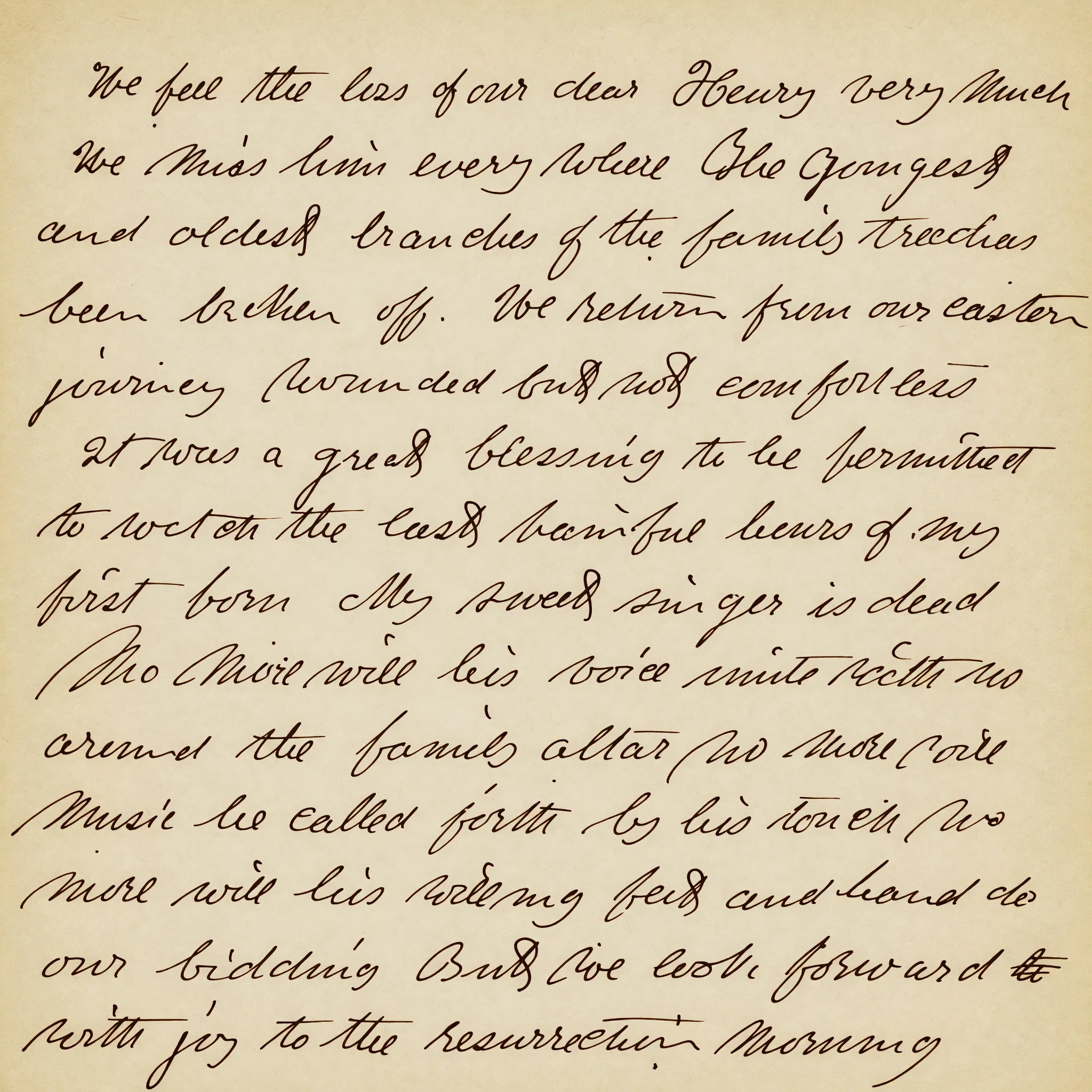
But oh, when our noble Henry died, at the age of166sixteen,—when our sweet singer was borne to the grave, and we no more heard his early song,—ours was a lonely home. Both parents and the two remaining sons felt the blow most keenly. But God comforted us in our bereavements, and with faith and courage we pressed forward in the work He had given us, in bright hope of meeting our children who had been torn from us by death, in that world where sickness and death will never come.
Facsimile (slightly reduced) of portion of a page written by Mrs. White shortly after the death of her first-born, Henry N. White, Dec. 8, 1863.
XXVI
BATTLING AGAINST DISEASE
[HISTORICAL NOTE.—“Our people are generally waking up to the subject of health,” wrote Elder James White in an editorial in the Review, Dec. 13, 1864, “and they should have publications on the subject to meet their present wants, at prices within reach of the poorest.” He announced the early issuance of a series of pamphlets, under the general title, “Health: or How to Live.”
The strong conviction of Elder and Mrs. White, that the reforms to be outlined in these pamphlets were of great importance, is thus expressed in a note in the Review, Jan. 24, 1865, calling attention to the publication of the first of the series:
“We wish to call the attention of the brethren everywhere to these works, prepared with especial care, on the important subject of a reform in our manners of life, which is greatly needed, and as we view it, will surely be accomplished in whatever people find themselves at last prepared for translation.”
During the first five months of 1865 this series was completed. These health pamphlets, six in number, contained articles from Mrs. White on “Disease and Its Causes,” and on allied subjects; and many extracts from the writings of various physicians and others interested in health reform principles. Hygienic recipes were included, also hints on the use of water as a remedial agency. The harmful effects of alcohol, tobacco, tea and coffee, spices, and other stimulants and narcotics, were further emphasized.
The winter of 1864-65 was a time of stress and trial. While uniting with his wife in the preparation168of matter on health and temperance for publication, Elder White found it necessary to labor untiringly in behalf of Sabbath keepers who were being drafted for service in the army. This work was attended with perplexity and anxiety, and drew heavily on his sympathies, besides overtaxing his physical strength. The administrative cares in the session of the General Conference held in May, 1865, added to his weariness.
Worn with the labors of writing and publishing, and of looking after many interests connected with the general work, Elder White and his wife were nevertheless given no rest. Immediately after the Conference session, they were called to Wisconsin and Iowa, where they endured many hardships. Soon after their return to Michigan, he was stricken with partial paralysis. An account of this affliction, and of the impetus it indirectly brought to the health reform movement a few months later, is given by Mrs. White in the Review, Feb. 20 and 27, 1866, a portion of which forms the text of this chapter.]
THE SICKNESS OF ELDER JAMES WHITE
One morning, as we were taking our usual walk before breakfast, we stepped into Brother Lunt’s garden, and while my husband attempted to open an ear of corn, I heard a strange noise. Looking up, I saw his face flushed, and his right arm hanging helpless at his side. His attempt to raise his right arm was ineffectual—the muscles refused to obey his will.
I helped him into the house, but he could not speak to me until in the house he indistinctly uttered the words, “Pray, pray.” We dropped on our knees and cried to God, who had ever been to us a present169help in time of trouble. My husband soon uttered words of praise and gratitude to God, because he could use his arm. His hand was partially restored, but not fully.
My husband and myself felt the need of drawing near to God. And as by confession and prayer we drew near to God, we had the blessed assurance that He drew near to us. Precious, exceedingly precious, were these seasons of communion with God.
The first five weeks of our affliction we spent at our own home. For wise purposes our heavenly Father did not see fit to raise my husband to immediate health in answer to our earnest prayers, although He seemed preciously near to comfort and sustain us by His Holy Spirit.
SOJOURN AT DANSVILLE, N. Y.
We had confidence in the use of water as one of God’s appointed remedies, but no confidence in drugs. But my own vital energies were too much exhausted for me to attempt to use hydropathic remedies in my husband’s case; and we felt that it might be duty to take him to Dansville, N. Y., where he could rest, and where we could have the care of those well skilled as hydropathic physicians. We dared not follow our own judgment, but asked counsel of God, and after prayerful consideration of the matter, decided to go. My husband endured the journey well.
We remained in Dansville about three months. We obtained rooms a short distance from the institution, and were both able to walk out and be in the open air much of the time. Every day, excepting Sabbath and first day, we took treatment.
Some may have thought that when we went to Dansville and placed ourselves under the care of170physicians, we had given up our faith that God would raise my husband to health in answer to prayer. But not so. While we did not feel like despising the means that God had placed in our reach for the recovery of health, we felt that God was above all, and that He who had provided remedial agencies would have us use them to assist abused Nature to recover her exhausted energies. We believed that God would bless the efforts we were making in the direction of health.
SEASONS OF PRAYER AND BLESSING
Three times a day we had special seasons of prayer for the Lord to restore my husband to health, and for His special grace to sustain us in our affliction. These seasons of prayer were very precious to us. Our hearts were often filled with unspeakable gratitude that in our affliction we had a heavenly Father in whom we could trust without fear.
Dec. 4, 1865, my husband passed a restless night of suffering. I prayed by his bedside as usual, but the Lord was not pleased to send relief. My husband was troubled in mind. He thought that he might go down into the grave. He stated that death had no terrors for him.
I felt intensely over the matter. I did not believe for a moment that my husband would die. But how was he to be inspired with faith? I prayed God to guide me, and not suffer me to take one wrong step; but to give me wisdom to choose the right course. The more earnestly I prayed, the stronger was my conviction that I must take my husband among his brethren, even if we should again return to Dansville.
In the morning Dr. Lay called, and I told him that unless there should be a decided improvement in the case of my husband in two or three weeks, at most,171I should take him home. He answered: “You cannot take him home. He is not able to endure such a journey.” I answered: “I shall go. I shall take my husband by faith, relying upon God, and shall make Rochester my first point, tarry there a few days, and then go on to Detroit, and if necessary, tarry there a few days to rest, and then go on to Battle Creek.”
This was the first intimation my husband had of my intentions. He said not a word. That evening we packed our trunks, and the next morning were on our way. My husband rode comfortably.
During the three weeks that we were in Rochester, much of the time was spent in prayer. My husband proposed sending to Maine for Elder J. N. Andrews, to Olcott for Brother and Sister Lindsay, and to Roosevelt, requesting those who had faith in God, and felt it their duty, to come and pray for him. These friends came in answer to his call, and for ten days we had special and earnest seasons of prayer. All who engaged in these seasons of prayer were greatly blessed. We were often so refreshed with heavenly showers of grace that we could say, “My cup runneth over.” We could weep and praise God for His rich salvation.
Those who came from Roosevelt were soon obliged to return to their homes. Brother Andrews and Brother and Sister Lindsay remained. We continued our earnest supplications to heaven. It seemed to be a struggle with the powers of darkness. Sometimes the trembling faith of my husband would grasp the promises of God, and sweet and precious was the victory then enjoyed.
Christmas evening, as we were humbling ourselves before God and earnestly pleading for deliverance,172the light of heaven seemed to shine upon us, and I was wrapped in a vision of God’s glory. It seemed that I was borne quickly from earth to heaven, where all was health, beauty, and glory. Strains of music fell upon my ear, melodious, perfect, and entrancing. I was permitted to enjoy this scene a while before my attention was called to this dark world. Then my attention was called to things taking place upon this earth. I had an encouraging view of the case of my husband.
Circumstances did not seem to favor our starting for Battle Creek, but my mind seemed fixed that we must go.
We were prospered on our journey. On the arrival of the train at Battle Creek, we were met by several of our faithful brethren, who received us gladly. My husband rested well through the night. The next Sabbath, although feeble, he walked to the meetinghouse, and spoke for about three quarters of an hour. We also attended the communion season in the evening. The Lord strengthened him as he walked out by faith.
The long sickness of my husband was a heavy blow, not only to myself and my children, but to the cause of God. The churches were deprived both of my husband’s labors and of my own. Satan triumphed as he saw the work of truth thus hindered; but, thank God! he was not permitted to destroy us. After being cut off from all active labor for fifteen months, we ventured out once more together to work among the churches.
XXVII
CONFLICTS AND VICTORY
Having become fully satisfied that my husband would not recover from his protracted sickness while remaining inactive, and that the time had fully come for me to go forth and bear my testimony to the people, I decided to make a tour in northern Michigan, with my husband in his extremely feeble condition, in the severest cold of winter. It required no small degree of moral courage and faith in God to bring my mind to the decision to risk so much; but I knew that I had a work to do, and it seemed to me that Satan was determined to keep me from it. To remain longer from the field seemed to me worse than death, and should we move out, we could but perish. So, on the 19th of December, 1866, we left Battle Creek in a snowstorm for Wright, Mich.
My husband stood the journey of ninety miles much better than I feared, and seemed quite as well when we reached the home of Brother E. H. Root as when we left Battle Creek. We were kindly received by this dear family, and as tenderly cared for as Christian parents can care for invalid children.
LABORS AT WRIGHT, MICH.
Here commenced our first effective labors since my husband’s sickness. Here he began to labor as in former years, though in much weakness. He would speak thirty or forty minutes in the forenoon of the Sabbath and on first day, while I would occupy the rest of the time, and then speak in the afternoon of each day, about an hour and a half each time. We were listened to with the greatest attention. I saw174that my husband was growing stronger, clearer in mind, and more connected in his discourses. And when on one occasion he spoke one hour with clearness and power, with the burden of the work upon him as before his sickness, my feelings of gratitude were beyond expression.
My labors at Wright were very wearing. I had much care of my husband by day, and sometimes in the night. I gave him baths, and took him out to ride, and twice a day, cold, stormy, or pleasant, walked out with him. I used the pen while he dictated his reports for the Review, and also wrote many letters, in addition to personal testimonies, and most of “Testimony for the Church,” No. 11.
AT GREENVILLE, MICH.
Jan. 29, 1867, we left Wright, and rode to Greenville, a distance of forty miles. It was a severely cold day, and we were glad to find a shelter from the cold and storm at Brother A. W. Maynard’s. This dear family welcomed us to their hearts and to their home. We remained in this vicinity six weeks, laboring with the churches at Greenville and Orleans, and making Brother Maynard’s hospitable home our headquarters.
The Lord gave me freedom in speaking to the people. In every effort made I realized His sustaining power. And as I became fully convinced that I had a testimony for the people, which I could bear to them in connection with the labors of my husband, my faith was strengthened that he would yet be raised to health to labor with acceptance in the cause and work of God. As he ventured, trusting in God, regardless of his feebleness, he gained in strength, and improved with every effort.
VISIT TO BATTLE CREEK — MARCH, 1867
It was decided that we should return to Battle Creek, and there remain while the roads were in a muddy, broken-up condition, and that I should there complete Testimony No. 12. My husband was very anxious to see his brethren at Battle Creek, and speak to them, and rejoice with them in the work which God was doing for him.
In a few days we found ourselves again at Battle Creek, after an absence of about three months. On the Sabbath, March 16, my husband spoke with clearness and power, and I also bore my testimony with usual freedom.
I came home to Battle Creek like a weary child, who needed comforting words and encouragement. But on our return we met reports having no foundation in truth. We were humbled into the very dust, and distressed beyond expression.
In this state of things we started to fill an appointment at Monterey. On the journey I tried to explain to myself why it was that our brethren did not understand in regard to our work. I had felt quite sure that when we should meet them, they would know what spirit we were of, and that the Spirit of God in them would answer to the same in us, His humble servants, and there would be union of feeling and sentiment. Instead of this, we were distrusted and suspiciously watched, which was a cause of the greatest perplexity I ever experienced.
LAYING HOLD ON GOD
As I was thus thinking, a portion of the vision given me at Rochester, N. Y., Dec. 25, 1865, came like176a flash of lightning to my mind, and I immediately related it to my husband:
I was shown a cluster of trees, standing near together, forming a circle. Running up over these trees was a vine which covered them at the top, and rested upon them, forming an arbor. Soon I saw the trees swaying to and fro, as though moved by a powerful wind. One branch after another of the vine was shaken from its support, until the vine was shaken loose from the trees, except a few tendrils which were left clinging to the lower branches. A person then came up and severed the remaining clinging tendrils of the vine, and it lay prostrated upon the earth.
Many passed and looked pityingly upon it, and I waited anxiously for a friendly hand to raise it; but no help was offered. I inquired why no hand raised the vine. Presently I saw an angel come to the apparently deserted vine. He spread out his arms and placed them beneath the vine, and raised it so that it stood upright, saying: “Stand toward heaven, and let thy tendrils entwine about God. Thou art shaken from human support. Thou canst stand, in the strength of God, and flourish without it. Lean upon God alone, and thou shalt never lean in vain, or be shaken therefrom.”
As I saw the neglected vine cared for, I felt inexpressible relief, amounting to joy. I turned to the angel and inquired what these things meant. Said he: “Thou art this vine. All this thou wilt experience, and then, when these things occur, thou shalt fully understand the figure of the vine. God will be to thee a present help in time of trouble.”
From this time I was settled as to my duty, and177never more free in bearing my testimony to the people. After we returned from Monterey to Battle Creek, I felt it my duty to move forward in the strength of God, and free myself from the suspicions and reports circulated to our injury. I bore my testimony, and related things which had been shown me in the past history of some present, warning them of their dangers and reproving their wrong course of action. I stated that I had been placed in most disagreeable positions. When families and individuals were brought before me in vision, it was frequently the case that what was shown me in relation to them was of a private nature, reproving secret sins. I have labored with some for months in regard to wrongs of which others knew nothing. As my brethren see these persons sad, and hear them express doubts in regard to their acceptance with God, also feelings of despondency, they have cast censure upon me, as though I was to blame for their being in trial.
Those who thus censured me were entirely ignorant of what they were talking about. I protested against persons’ sitting as inquisitors upon my course of action. It has been the disagreeable work assigned me to reprove private sins. Were I, in order to prevent suspicions and jealousy, to give a full explanation of my course, and make public that which should be kept private, I should sin against God and wrong the individuals. I have to keep private reproofs of private wrongs to myself, locked in my own breast. Let others judge as they may, I will never betray the confidence reposed in me by the erring and repentant, or reveal to others that which should only be brought before the ones that are guilty. I told those assembled that they must take their hands off, and leave me free to act in the fear of God.
AMONG THE CHURCHES IN NEW ENGLAND
Refreshed in spirit over the good result of our labor with the Battle Creek church, which closed in October, 1867, we cheerfully joined Elder J. N. Andrews on a journey to Maine. On the way we held a meeting at Roosevelt, N. Y., October 26 and 27. This meeting was one of hard labor, in which pointed testimonies were given. Confessions were made, followed by a general turning to the Lord on the part of backsliders and sinners.
IN MAINE
Our labors in Maine commenced with the conference at Norridgewock, the first of November. The meeting was large. As usual, my husband and myself bore a plain and pointed testimony in favor of truth and proper church discipline, and against the different forms of error, confusion, fanaticism, and disorder naturally growing out of a want of such discipline. This testimony was especially applicable to the condition of things in Maine. Disorderly spirits who professed to observe the Sabbath, were in rebellion, and labored to diffuse the disaffection through the conference.
In consequence of this spirit of rebellion, our work in Maine required seven weeks of the most trying, laborious, and disagreeable toil. But as we left that State, we were comforted with the fact that all had confessed their rebellion, and that a few had been led to seek the Lord and embrace the truth.
Perhaps I cannot better give an idea of our labors up to the time of the Vermont meeting than by copying179a portion of a letter which I wrote to our son at Battle Creek, Dec. 27, 1867:
“My dear Son Edson:
“After our meeting closed at Topsham, Maine, we had an appointment at Westbrook, Maine, to meet the brethren from Portland and vicinity. We made our home with the kind family of Brother Martin. I was not able to sit up during the afternoon; but being urged to attend the meeting in the evening, I went to the schoolhouse, feeling that I had not strength to stand and address the people.
The house was filled with deeply interested listeners. Brother Andrews opened the meeting, and spoke a short time; your father followed with remarks. I then arose, and had spoken but a few words when I felt my strength renewed; all my feebleness seemed to leave me, and I spoke about one hour with perfect freedom. I felt inexpressible gratitude for this help from God at the very time when I so much needed it.
“On Wednesday evening I spoke with freedom nearly two hours. To have my strength so unexpectedly renewed, when I had felt completely exhausted before these two meetings, has been a source of great encouragement to me.
REVIVAL SERVICES AT WASHINGTON, N. H.
“Our journey to Washington, N. H., was tedious. We found shelter at last at the good home of Brother C. K. Farnsworth. They did all they could for our comfort, and everything was arranged so that we could rest as much as possible.
Sabbath your father spoke in the forenoon, and after an intermission of about twenty minutes I spoke, bearing a testimony of reproof for several. The180meeting for the evening was appointed at Brother Farnsworth’s. The next morning we attended meetings again in the meetinghouse. We were trying to bring those who professed the truth to see their state of dreadful darkness and backsliding before God, and to make humble confessions.
“Again we held an evening meeting at Brother Farnsworth’s. The Lord helped Brother Andrews that night, as he dwelt upon the subject of suffering for Christ’s sake. The case of Moses was mentioned, who ‘refused to be called the son of Pharaoh’s daughter; choosing rather to suffer affliction with the people of God, than to enjoy the pleasures of sin for a season; esteeming the reproach of Christ greater riches than the treasures in Egypt: for he had respect unto the recompense of the reward.’ Heb. 11:24-26.
“Meeting commenced Monday at 10 A. M. Again the condition of the church was dwelt upon. With the most earnest entreaties we pleaded with them to be converted to God, and face right about. The Lord aided us in the work. Our morning meeting closed at three or four in the afternoon. All these hours we had been engaged, first one of us, then another, earnestly laboring for the unconverted youth.
“Tuesday evening I spoke an hour with great freedom. Brother Andrews talked in an earnest, touching manner. The Spirit of the Lord was in the meeting. Angels of God seemed drawing very near, driving back the evil angels. Minister and people wept like children. We felt that we had gained ground, and that the powers of darkness had given back. Our meeting closed well.
“We appointed still another meeting for the next day, commencing at 10 A. M. I spoke about an hour181upon the humiliation and glorification of Christ. Then we commenced our labors for the youth. Parents had come to the meeting, bringing their children with them to receive the blessing. We pleaded earnestly with the children, until thirteen arose and expressed a desire to be Christians. One young man, about twenty years old, walked forty miles to see us and hear the truth. He had never professed religion, but took his stand on the Lord’s side before he left.
“This was one of the very best of meetings. We parted with all with many tears, feeling the blessing of Heaven resting upon us.”
IN VERMONT AND NEW YORK
The meeting at West Enosburgh, Vt., was one of deep interest. It seemed good to meet again with, and speak to, our old, tried friends in this State. A great and good work was done in a short time. These friends were generally poor, and toiling for the comforts of life where one dollar is earned with more labor than two in the West, yet they were liberal with us. In no State have the brethren been truer to the cause than in old Vermont.
Our next meeting was at Adams Center, N. Y. It was a large gathering. There were several persons in and around this place whose cases had been shown me, for whom I felt the deepest interest. They were men of moral worth. Some were in positions of life which made the cross of the present truth heavy to bear, or at least they thought so. Others, who had reached the middle age of life, had been brought up from childhood to keep the Sabbath, but had not borne the cross of Christ. These were in a position where it seemed hard to move them. They needed to be shaken from relying on their good works, and to be brought182to feel their lost condition without Christ. We could not give up these souls, and labored with our might to help them. They were at last moved, and I have since been made glad to hear from some of them, and good news respecting all of them.
God is converting strong men of wealth, and bringing them into the ranks. If they would prosper in the Christian life, grow in grace, and at last reap a rich reward, they will have to use of their abundance to advance the cause of truth.
RETURN TO MICHIGAN
After leaving Adams Center, we stayed for a few days at Rochester, and from that place came to Battle Creek, where we remained over Sabbath and first day. Thence we returned to our home in Greenville, where we spent the next Sabbath and first day with the brethren who assembled from different places.
Meetinghouse at Washington, N. H.
XXIX
RECLAIMING THE LOST
After we had reached our home, we felt most sensibly the wearing labors of our Eastern tour. Many were urging me by letter to write what I had related to them of what the Lord had shown me concerning them. And there were many others to whom I had not spoken, whose cases were important and urgent. In my weary condition the task of so much writing seemed more than I could endure, and I called in question my duty to write so much, to so many persons, some of them very unworthy. It seemed to me that there was certainly a mistake in this matter somewhere.
AN ENCOURAGING DREAM
One night I dreamed that a person brought to me a web of white cloth, and bade me cut it into garments for persons of all sizes and all descriptions of character and circumstances in life. I was told to cut them out and hang them up all ready to be made when called for. I had the impression that many for whom I was required to cut garments were unworthy. I inquired if that was the last piece of cloth I should have to cut, and was told that it was not; that as soon as I had finished this one, there were others for me to take hold of.
I felt discouraged at the amount of work before me, and stated that I had been engaged in cutting garments for others for more than twenty years, and my labors had not been appreciated, neither did I see that my work had accomplished much good. I spoke to the person who brought the cloth to me, of one woman in particular, for whom he had told me to184cut a garment. I stated that she would not prize the garment, and that it would be a loss of time and material to present it to her. She was very poor, of inferior intellect, and untidy in her habits, and would soon soil it.
The person replied: “Cut out the garments; that is your duty. The loss is not yours, but mine. God sees not as man sees. He lays out the work that He would have done, and you do not know which will prosper, this or that. It will be found that many such poor souls will go into the kingdom, while others, who are favored with all the blessings of life, having good intellects and pleasant surroundings, giving them all the advantages of improvement, will be left out. It will be seen that these poor souls have lived up to the feeble light which they had, and have improved by the limited means within their reach, and lived much more acceptably than some others who have enjoyed full light, and ample means for improvement.”
I then held up my hands, calloused as they were with long use of the shears, and stated that I could but shrink at the thought of pursuing this kind of labor.
The person again repeated: “Cut out the garments. Your release has not yet come.”
With feelings of great weariness I arose to engage in the work. Before me lay new, polished shears, which I commenced using. At once my feelings of weariness and discouragement left me, the shears seemed to cut with hardly an effort on my part, and I cut out garment after garment with comparative ease.
VISITING CHURCHES IN MICHIGAN
With the encouragement which this dream gave me, I at once decided to accompany my husband and185Brother Andrews to Gratiot, Saginaw, and Tuscola counties, and trust in the Lord to give me strength to labor. So, on the 7th of February, we left home, and rode fifty-five miles to our appointment at Alma. Here I labored as usual, with a good degree of freedom and strength. The friends in Gratiot County seemed interested to hear.
At Tittabawassee we found a large house of worship recently built by our people, well filled with Sabbath keepers. The brethren seemed ready for our testimony, and we enjoyed freedom. The next day fifteen were baptized.
At Vassar we held our meetings Sabbath and first day at the union schoolhouse. This was a free place in which to speak, and we saw good fruit of our labors. First day afternoon about thirty backsliders, and children who had made no profession, came forward for prayers.
CARING FOR THE SICK
We returned home from this tour just before a great fall of rain which carried off the snow. This storm prevented the next Sabbath meeting, and I immediately commenced to prepare matter for Testimony No. 14. We also had the privilege of caring for our dear Brother Seneca King, whom we brought to our home with a terrible injury upon the head and face. We took him to our house to die, for we could not think it possible for one with the skull so terribly broken in to recover. But with the blessing of God upon a very gentle use of water, a very spare diet till the danger of fever was past, and well ventilated rooms day and night, in three weeks he was able to return to his home and attend to his farming interests. He did not take one grain of medicine from first to last.186Although he was considerably reduced by loss of blood from his wounds and by spare diet, yet when he could take a more liberal amount of food he came up rapidly.
REVIVAL MEETINGS AT GREENVILLE
About this time we commenced labor for our brethren and friends near Greenville. As is the case in many places, our brethren needed help. There were some who kept the Sabbath, yet did not belong to the church, and also some who had given up the Sabbath. We felt disposed to help these poor souls, but the past course and present position of leading members of the church in relation to these persons, made it almost impossible for us to approach them.
In laboring with the erring, some of our brethren had been too rigid, too cutting in remarks. And when some were disposed to reject their counsel, and separate from them, they would say, “Well, if they want to go off, let them go.” While such a lack of the compassion and long-suffering and tenderness of Jesus was manifested by His professed followers, these poor, erring, inexperienced souls, buffeted by Satan, were certain to make shipwreck of faith. However great may be the wrongs and sins of the erring, our brethren must learn to manifest not only the tenderness of the Great Shepherd, but also His undying care and love for the poor, straying sheep. Our ministers toil and lecture week after week, and rejoice that a few souls embrace the truth; and yet brethren of a prompt, decided turn of mind may, in five minutes, destroy their work by indulging the feelings which prompt words like these: “Well, if they want to leave us, let them go.”
We found that we could do nothing for the scattered sheep near us until we had first corrected the wrongs in many of the members of the church. They had let these poor souls wander. They felt no burden for them. I wrote out pointed testimonies not only for those who had erred greatly and were out of the church, but for those members in the church who had erred greatly in not going in search of the lost sheep.
THE LOST SHEEP
The Lord is giving the erring, the weak and trembling, and even those who have apostatized from the truth, a special call to come fully into the fold. But many have not learned that they have a special duty to go and search for these lost sheep.
The Pharisees murmured because Jesus received publicans and common sinners, and ate with them. In their self-righteousness they despised these poor sinners who gladly heard the words of Jesus. To rebuke this spirit in the scribes and Pharisees, and leave an impressive lesson for all, the Lord gave the parable of the lost sheep. Notice in particular the following points:
The ninety and nine sheep are left, and diligent search is made for the one that is lost. The entire effort is made for the unfortunate sheep. So should the effort of the church be directed in behalf of those members who are straying from the fold of Christ. And have they wandered far away? do not wait till they return before you try to help them, but go in search of them.
When the lost sheep was found, it was borne home with joy, and much rejoicing followed. This illustrates the blessed, joyful work of laboring for the188erring. The church that engages successfully in this work, is a happy church. That man or that woman whose soul is drawn out in compassion and love for the erring, and who labors to bring them to the fold of the Great Shepherd, is engaged in a blessed work. And, oh, what a soul-enrapturing thought, that when one sinner is thus reclaimed, there is more joy in heaven than over ninety and nine just persons! Selfish, exclusive, exacting souls who seem to fear to help those in error, as though they would become polluted by so doing, do not taste of the sweets of this missionary work; they do not feel that blessedness which fills all heaven with rejoicing upon the rescue of one who has gone astray.
That church or those persons who shut themselves away from bearing burdens for others, who shut themselves up to themselves, will soon suffer spiritual feebleness. It is labor that keeps the strong man strong. And spiritual labor, toil, and burden bearing, is what will give strength to the church of Christ.