From the time the property came into full possession of the Australasian Union Conference, to the time of the opening of the school, there was much to be done. Land must be cleared, a swamp drained, an orchard planted, and buildings erected. For the accomplishment of this, a number of students were gathered,—sturdy young men who were glad to work six hours a day, and receive their board, and instruction in two studies. The school opened March 6, 1895, and continued thirty weeks.
For the accommodation of the twenty young men who entered into this work, an old hotel was rented in Cooranbong, and several tents were pitched beside this building. In April, Brother Metcalfe Hare, who had been chosen as treasurer and business manager of the school enterprise, moved his family to Cooranbong, and, desiring to be close to the work, pitched his tents near the sawmill and the site set358apart for school buildings. For nearly two years the tent, covered with a galvanized iron roof, served as his habitation.
Many parents wishing to send their children to the school, thought it ought to be located near one of the large cities where many Seventh-day Adventists were living. They believed that thirty or forty acres of land not far from Sydney or Melbourne would be much better than a large tract of wild land near Newcastle. Others were opposed to the place because they thought the land was so poor that little would be gained in its cultivation. Mrs. White had a more encouraging view of the value of the land; and when the liberal gift of $5,000 by the friends from Africa made it possible to pay for the tract, she wrote: “I felt my heart bound with gratitude, when I knew that in the providence of God the land was in our possession; and I longed to shout the high praises of God for so favorable a situation.”
In July, 1895, Mrs. White determined to manifest her interest in the school enterprise and her confidence in the Avondale estate, by purchasing a piece of the land, and making Cooranbong her home. She selected sixty-six acres, and in a few weeks had a portion of her family living in tents on the tract, which she named “Sunnyside.” The erection of an eight-roomed cottage was begun; and as soon as a clearing could be made, land was plowed, and fruit trees were planted. Of this experience she wrote:
“When the foundation of the house was laid, preparations were made for the raising of fruit and vegetables. The Lord had shown me that the poverty which existed about Cooranbong need not be; for with industry the soil could be cultivated, and made to yield its treasure for the service of man.”
Mrs. White’s unbounded enthusiasm regarding the improvement of the Avondale estate, did much to cheer and encourage others. She was particularly insistent that no time be lost by the school men in the planting of an orchard; and she greatly rejoiced when in October one thousand choice fruit trees were planted on a favorable piece of land occupied a year before by a thick forest of eucalyptus trees.
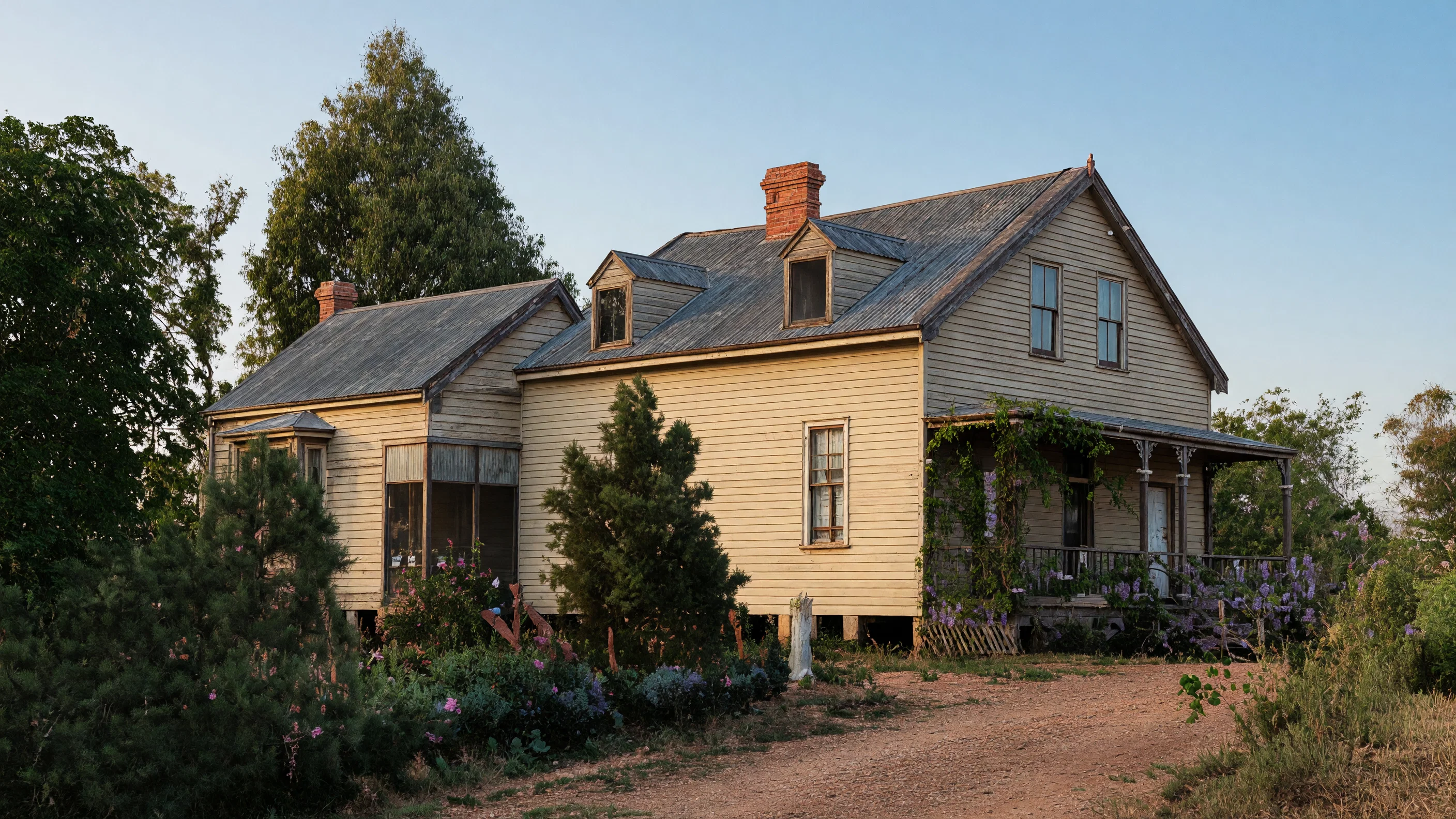
A view of “Sunnyside,” the Australian home of Mrs. White at Cooranbong, New South Wales, 1895-1900.
After the close of the industrial school in November, several months passed without material progress being made. The people felt very keenly the financial depression under which the colonies were still staggering. Criticism regarding the effort to build up a school in such a wild, out-of-the-way place, grew more and more general. Then came the unfavorable termination of a lawsuit into which the school had been dragged by the hasty action of its solicitor,360which cost two thousand dollars, besides causing serious delay in the work.
What could be done? The work seemed to be at a standstill, with little prospect of more favorable conditions. The loss of two thousand dollars would have been very discouraging at any time, but at such a time as this it was most disheartening.
A BEAUTIFUL DREAM
In this crisis, when the faith of many was being sorely tried, Mrs. White had a dream which brought to her and to others the sweet assurance that God had not forsaken them. In relating this experience, she wrote:
“On the night of July 9, 1896, I had a beautiful dream. My husband, James White, was by my side. We were upon our little farm in the woods in Cooranbong, consulting in regard to the prospect of the future returns of the labor put forth.
“My husband said to me, ‘What are you doing in reference to a school building?’
“We can do nothing,” I said, “unless we have means, and I know not where means are coming from. We have no school building. Everything seems to be at a standstill. But I am not going to encourage unbelief. I will work in faith. I have been tempted to tell you a discouraging chapter in our experience; but I will talk faith. If we look at things which are seen, we shall be discouraged. We have to break the soil at a venture, plow in hope, in faith. We would see a measure of prosperity ahead, if all would work intelligently, and with earnest endeavor put in the seed. The present appearance is not flattering, but all the light that I can obtain is that now is the361sowing time. The working of the grounds is our lesson book; for in exactly the way we treat the fields with the hope of future returns, so we must sow this missionary soil with the seeds of truth.”
“We went the whole length of the grounds we were cultivating. We then returned, conversing as we walked along; and I saw that the vines we had passed were bearing fruit. Said my husband, ‘The fruit is ready to be gathered.’
“As I came to another path, I exclaimed: ‘Look, look at the beautiful berries. We need not wait until to-morrow for them.’ As I gathered the fruit, I said: ‘I thought these plants were inferior, and hardly worth the trouble of putting into the ground. I never looked for such an abundant yield.’
“My husband said: ‘Ellen, do you remember when we first entered the field in Michigan, and traveled in a wagon to the different localities to meet with the humble companies who were observing the Sabbath,—how forbidding the prospect was? In the heat of summer our sleeping-room was often the kitchen, where the cooking had been done through the day, and we could not sleep. Do you remember how, in one instance, we lost our way, and when we could find no water, you fainted? With a borrowed ax we cut our way through the forest until we came to a log shanty, where we were given some bread and milk and a lodging for the night. We prayed and sang with the family, and in the morning left them one of our pamphlets.”
“We were greatly troubled over this circumstance. Our guide knew the way, and that we should get lost was something we could not understand. Years afterward, at a camp meeting, we were introduced to several persons who told us their story. That visit362made, as we thought, by mistake, that book we left, was seed sown. Twenty in all were converted by what we supposed was a mistake. This was the work of the Lord, that light might be given to those who desired to know the truth.”
“My husband continued: ‘Ellen, you are on missionary ground. You are to sow in hope and faith, and you will not be disappointed. One soul is worth more than all that was paid for this land, and already you have sheaves to bring to the Master. The work commenced in other new fields,—in Rochester, N. Y., in Michigan, in Oakland, in San Francisco, and in the European fields,—was quite as unpromising as the work in this field. But the work you do in faith and hope will bring you into fellowship with Christ and His faithful servants. It must be carried on in simplicity and faith and hope, and eternal results will be the reward of your labors.’”
HELP FROM FRIENDS IN AFRICA
In April, 1896, Mrs. White had written to the Wessels brothers, of Cape Town, asking them to lend her $5,000 at a low rate of interest, that she might lend it to the school board to help and encourage in the beginning of the necessary buildings. In one of her letters to these friends in South Africa, she wrote:
“We must build a school here, where students may be educated to form characters for eternal life, and where they may receive such an education in the Scriptures that they will go out from the school to educate others. This is the Lord’s work; and when we know that we are doing the very work He has specified, we must have faith to believe that He will open the way. . . . The King’s business requires haste.363The youth in this country are expecting a school, and we do not want them to wait longer.
“Would you know how you can best please your Saviour? It is by putting your money to the exchangers, to be used in the Lord’s service and to advance His work. By doing this, you make the very best outlay of the means God has entrusted to you. I have consecrated all I possess to the Lord, and have expended means in various lines, helping to sustain camp meetings, and building meetinghouses in those places where people have accepted the truth. I find many openings where I can help to save perishing souls. . . .”
“It pays us to labor for those for whom Christ has died. Our strength and resources can be expended in no better way. If, by the help of the Spirit of God, we can build a structure which will last through the eternal ages, what a work we have done! Coöperating with God in this work, we can think of Christ’s words, so full of assurance, ‘I say unto you, that likewise joy shall be in heaven over one sinner that repenteth, more than over ninety and nine just persons, which need no repentance.’ God cares for the human souls to whom He gave His only-begotten Son, and we must see all men through the eyes of divine compassion.”
Not long after the dream about the ripening fruit, letters came from Africa, stating that Mrs. A. E. Wessels would lend to Sister White the money she had asked for. Joyfully this news was communicated to the school board, and immediately the cutting and sawing of timber for the buildings was hastened along.
Oct. 5, 1896, at 5:30 P. M., a group of about thirty-five gathered on the school campus, and Mrs. White364laid the first brick of the foundation of Bethel Hall, which was to be the young ladies’ dormitory. She then briefly related her experience, as follows:
“Often during this time of financial straits, I awakened in the night sorely distressed over the situation. To what source could we look for help? I earnestly prayed that the Lord would open the way for us to build, and that although there seemed no prospect of securing means, He would send the needed help. One night I fell asleep, and dreamed that I was weeping and praying before the Lord. A hand touched me on the shoulder, and a voice said: ‘I have means in many families in Africa that is being bound up in worldly enterprises. Send to the Wessels brothers. Tell them the Lord has need of money. It will do them good to help to advance My work here with their entrusted means. Tell them to lay up treasure for themselves in heaven, where moth will not corrupt, and where thieves do not break through nor steal; for where their treasure is, there will their heart be also.’”
PUTTING UP THE FIRST BUILDINGS
For four months the sawmill and the carpenters made very good progress. The ladies’ dormitory was nearly completed, and the foundation pillars for the Dining Hall were being laid. According to the architect’s plans, this was to be a one-story structure, eighty by twenty-six feet in size, for the accommodation of dining- and serving-rooms, pantry, kitchen, and store-rooms. But the school board, fearing that a third building could not be erected soon, planned to add a second story, one end of which, left unfinished, could be used for a time as a chapel, while the remaining365portion could be made to accommodate a dozen boys with sleeping quarters.
When the work on this building was about two thirds done, the treasurer reported that the funds were exhausted, and that the work must move slowly. But the time was nearing when the school was to be opened, and the friends of the enterprise felt that unpreparedness to care properly for those who should come would be disastrous. “The school must open on the date advertised,” Mrs. White insisted, when told of the difficulties surrounding the school board. To this the builders replied, “It is impossible; it cannot be done.”
There remained one resource,— the united and unselfish coöperation of all in a supreme effort to bring about that which seemed so utterly impossible. Mrs. White determined to appeal direct to the people. “We appointed a meeting for Sunday morning at six o’clock, and called the church together,” she afterward wrote of the experiences of the weeks that followed. “We laid the situation before the brethren and sisters, and called for donated labor. Thirty men and women offered themselves for work; and although it was hard for them to spare the time, a strong company continued at work day after day, till the buildings were completed, cleaned, and furnished, ready to be used at the day set for the opening of the school.”
At the time appointed, April 28, 1897, the school was opened, with Elder and Mrs. S. N. Haskell and Prof. and Mrs. H. C. Lacey as teachers. On the first day, there were only ten students. When the word went abroad that the school had actually opened and begun work, others came; and a month later, when Prof. and Mrs. C. B. Hughes came to join the teaching force, there were nearly thirty students in attendance.366As the term advanced, and the character of the instruction given was told in the churches, others made great efforts to join them, and before the close of the term there were sixty students in all. About forty of these were accommodated in the school home.
ANOTHER TEST OF FAITH
As the school term advanced, and families gathered in so that their children might have its advantages, the Sabbath congregations became much too large for the temporary chapel above the dining-hall, in which seats had been provided for one hundred. In former years the Sabbath meetings had been held, first, in the dining-room of the Healey Hotel; and later on, in the dark, uncomfortable loft of the sawmill. The little chapel was a much better meeting-hall than the mill loft; but now it was too small. There was much discussion as to what could be done; and finally the brethren determined to erect a neat and commodious church, sufficiently large for the needs of all.
Referring to this experience while speaking in the church during the week of prayer held in June, 1898, Mrs. White said:
“When the time came for this meetinghouse to be built, there was another test of faith and loyalty. We had a council to consider what should be done. The way seemed hedged about with difficulties. Some said, ‘Inclose a small building, and when money shall come in, enlarge; for we cannot possibly complete at this time such a house as we desire.’ Others said, ‘Wait till we have money with which to build a commodious house.’ This we thought to do. But the word of the Lord came to me in the night season, ‘Arise, and build without delay.’
“We then decided that we would take hold of the work, and walk out by faith to make a beginning. The very next night there came from South Africa a draft for two hundred pounds, . . . to help us in building the meetinghouse. Our faith had been tested, we had decided to begin the work, and now the Lord put into our hands this large gift with which to begin. With this encouragement the work began in earnest. The school board gave the land and one hundred pounds, two hundred pounds was received from the Union Conference, and the members of the church gave what they could. Friends outside of the church helped; and the builders gave a part of their time, which was as good as money. Thus the work was completed, and we have this beautiful house, capable of seating four hundred people.”
Meanwhile the school prospered, and a goodly number of young men and young women were prepared to enter the service of the Master. At the Queensland camp meeting, held in Brisbane Oct. 14–24, 1898, Mrs. White reviewed this most encouraging feature of the development of the school, as follows:
“During the first year, . . . with an attendance of sixty students, there were about thirty who were over sixteen years of age; and from this number, ten were employed during the vacation in various branches of our religious work. During the second year, there were one hundred in attendance; and from among fifty who were over sixteen years of age, definite work was found for thirty-two during the vacation. Twenty-five of these were employed by the conferences and societies in religious work.”
AIMS AND OBJECTS
It was primarily for the purpose of giving the students a practical fitting up for service in many lines of Christian endeavor, that the managers of the Avondale School had been planning all through the years. Clearly and forcefully Mrs. White emphasized, over and over again, the work before the school, and the great advantages accruing to students and teachers through daily contact with the practical affairs of everyday life. In September, 1898, she wrote:
“We need more teachers and more talent to educate the students in various lines, that many persons may go from this place willing and able to carry to others the knowledge which they have received. Orphan boys and girls are to find a home here. Buildings should be erected for a hospital, and boats should be provided to accommodate the school. A competent farm manager should be employed, also wise, energetic men to act as superintendents of the several industrial enterprises, men who will use their undivided talents in teaching the students how to work.
Many young people will come to school who desire a training in industrial lines. The industrial instruction should include the keeping of accounts, carpentry, and everything that is comprehended in farming. Preparation should also be made for teaching blacksmithing, painting, shoemaking, cooking, baking, laundering, mending, typewriting, and printing.369Every power at our command is to be brought into this training work, that students may go out equipped for the duties of practical life. . . .
MISSIONARY LABOR THE HIGHEST TRAINING
“The Lord will surely bless all who seek to bless others. The school is to be so conducted that teachers and students will be continually gaining in power through the faithful use of the talents given them. By putting to a practical use that which they have learned, they will constantly increase in wisdom and knowledge. We are to learn from the Book of books the principles upon which we are to live and labor. By consecrating all our God-given abilities to Him who has the first right to them, we may make precious advances in everything that is worthy of our attention. . . .
“Our schools must be conducted under the supervision of God. There is a work to be done for young men and women that is not yet accomplished. There are much larger numbers of young people who need to have the advantages of our training schools. They need the manual training course, that will teach them how to lead an active, energetic life. All kinds of labor must be connected with our schools. Under wise, judicious, God-fearing directors, the students are to be taught. Every branch of the work is to be conducted in the most thorough and systematic ways that long experience and wisdom can enable us to plan and execute.
“Let the teachers wake up to the importance of this subject, and teach agriculture and other industries that it is essential for the students to understand. Seek in every department of labor to reach the very best results. Let the science of the word of God be brought into the work, that the students may understand correct principles, and may reach the highest possible standard. Exert your God-given abilities, and bring all your energies into the development of the Lord’s farm. Study and labor, that the best results and the greatest returns may come from the seed-sowing, that there may be an abundant supply of food, both temporal and spiritual, for the increased number of students that shall be gathered in to be trained as Christian workers.”
FIELDS WHITE UNTO THE HARVEST
As the workers in the Australasian colonies and in the islands of the Pacific kept advancing into new territory, there came to them a deepening conviction that every effort possible must be put forth to train many laborers for the harvest.
“All about us,” declared Mrs. White on one occasion in 1898, while attending a wonderfully inspiring camp meeting in the newly formed Queensland Conference, “are fields white unto the harvest; and we all feel an intense desire that these fields shall be entered, and that the standard of truth shall be raised in every city and village.
“As we study the vastness of the work, and the urgency of entering these fields without delay, we see that hundreds of workers are needed where there are now but two or three, and that we must lose no371time in building up those institutions where workers are to be educated and trained.”
And as the Australasian Union Conference Committee studied anew, in the light of the opening providences of God, their duty to occupy new territory, they “recognized the school, the sanitarium, and the food factory as three agencies working in harmony for the education and training of home and foreign missionaries, who should go forth prepared to minister to the physical, mental, and moral needs of their fellow men.” In her report to the readers of the Review of this advance step on the part of her brethren in Australia, Mrs. White wrote: “We all feel that the work is urgent. There is no part that can wait. All must advance without delay.”
At times through the years of toil spent in raising up a strong constituency in Australasia, and in establishing centers where the youth might be trained as workers for God, Mrs. White and her associates caught glimpses of what the future had in store for that portion of the broad harvest field. The pioneers in that field,—Elders Haskell, Corliss, Israel, Daniells, and others,—had early recognized the possibility of raising up workers there who should be able to enter the surrounding islands of Polynesia, Melanesia, and Micronesia. But late in the nineties, when the various branches of the cause of present truth,—publishing, educational, and medical,—were becoming well established, and many youth were being raised up as workers, the brethren in charge of the Australasian Union Conference saw more and still more clearly the opportunities for service with which they were surrounded.
These possibilities of the future were outlined at length by Mrs. White in communications addressed to the leaders of the cause of God who were assembling in General Conference early in 1899. “Our brethren have not discerned that in helping us,” she wrote to them concerning the value of maintaining strong training centers for workers in Australasia, “they would be helping themselves. That which is given to start the work here, will result in strengthening the work in other places. As your gifts free us from continual embarrassment, our labors can be extended; there will be an ingathering of souls, churches will be established, and there will be increasing financial strength. We shall have a sufficiency not only to carry on the work here, but to impart to other fields. Nothing is gained by withholding the very means that would enable us to work to advantage, extending the knowledge of God and the triumphs of truth in regions beyond.”
A TRAINING GROUND FOR MISSION FIELDS
In behalf of the brethren and sisters in Australasia who were eager to share the burdens of missionary endeavor in the regions beyond, Elder A. G. Daniells, at that time the president of the Australasian Union Conference, reported to the 1899 General Conference the rapid developments taking place, and the strong faith of all in their ability to unite with their fellow workers in America and Europe in carrying the third angel’s message into missionary territory.
“We in Australasia,” he wrote, “have been slow to grasp the meaning of God’s providence in keeping His servant, Sister White, in this country. When373she came, we all thought she was making us only a brief visit. She thought so. But the Lord knew better. He placed her in this land, and does not cause the cloud to lift and move elsewhere.
“Ever since she came, God has been instructing her regarding the work here. He has pointed out the mistakes in our methods of labor. He has caused another mould to be placed upon the work throughout the entire field. He has constantly admonished to ‘go forward,’ to break forth on every side. All the time He is directing us to enlarge our work. He has given His servant a great burden regarding the educational work. The struggle it has taken to carry out what God has plainly revealed should be done, has been terrible. Satan has contested every inch of the ground; but God has given us many victories. He has planted the Avondale School, and we have the plainest evidences that He will be glorified by it. He has given minute instructions regarding its location, object, and management. Now He is telling us that if we will walk in the light He has given, Avondale will become the training ground for many missionary fields. The hand of God is in all these things. We are endeavoring to arouse our people to understand the situation, and do all in their power to sustain the work. They are responding nobly; but our visible resources are small for the great work we are urged to do. . . .
“We have an army of intelligent young men and women, anxious to fit themselves for the work of God. We believe that in a short time we shall be able to furnish a large number of valuable workers for various mission fields under the British flag. The374Lord is revealing this to us through the Spirit of prophecy, and He will bring it to pass.”
In a talk on the Avondale School and its work, given Sabbath afternoon, July 22, 1899, before the Australasian Union Conference session of that year, Mrs. White emphasized at considerable length the missionary character of the work to be done there. She said:
“God designs that this place shall be a center, an object lesson. Our school is not to pattern after any school that has been established in America, or after any school that has been established in this country. We are looking to the Sun of Righteousness, trying to catch every beam of light that we can. . . .
“From this center we are to send forth missionaries. Here they are to be educated and trained, and sent to the islands of the sea and other countries. The Lord wants us to be preparing for missionary work. . . .
“There is a great and grand work to be done. Some who are here may feel that they must go to China or other places to proclaim the message. These should first place themselves in the position of learners, and thus be tested and tried.”
And this ideal—the training of many Christian workers for the needy mission fields lying beyond—was continually held before the supporters of the Avondale School, and is the ideal that has characterized the work there in the years that have followed, as indicated by the very name the school now bears, “The Australasian Missionary College.”
“We have moved out by faith and have made large advancement,” Mrs. White wrote at the close of 1899,375“because we saw what needed to be done, and we dared not hesitate. But we have not done the half of that which should be done. We are not yet on vantage ground. There is a great work before us. All about us are souls longing for light and truth; and how are they to be reached? . . .
“My brethren and sisters in Australasia, there is in every city and every suburb a work to be done in presenting the last message of mercy to a fallen world. And while we are trying to work these destitute fields, the cry comes from far-off lands, ‘Come over and help us.’ These are not so easily reached, and perhaps not so ready for the harvest, as the fields within our sight, but they must not be neglected. We want to push the triumphs of the cross. Our watchword is to be, ‘Onward, ever onward!’ Our burden for the ‘regions beyond’ can never be laid down until the whole earth shall be lightened with the glory of the Lord.
“But what can we do? We sit down and consider, we pray, and plan how to begin the work in the places all around us. Where are the faithful missionaries who will carry it forward? and how shall they be sustained?
“Above all, how shall missionaries be trained? How shall workers be prepared to enter the opening fields? Here is now our greatest burden. Therefore our special anxiety is for our school in Avondale. We must here provide suitable facilities for educating workers in different lines. We see young men possessing qualifications that, if they can be rightly educated, will enable them to become laborers together with God. We must give them the opportunity. Some are placing students in our school, and are assisting them in defraying their expenses,376that they may become workers in some part of the Lord’s vineyard. Much more should be done in this line, and special efforts should be made in behalf of those whom our workers shall send from the islands to be trained as missionaries.
“In the future, more than in the past, our school must be an active missionary agency, as the Lord has specified. . . . Workers we must have, and in twenty-fold greater numbers, to supply the need in both the home and the foreign field. Therefore, the Avondale School must not be restricted in its facilities.”
AFTER MANY YEARS
From 1901 to 1909 Prof. C. W. Irwin acted as principal of the Avondale School; and in his report to the General Conference of 1909 he bore witness of the fulfillment of that which had been said would come to pass on the Avondale estate, as follows:
“As time has gone on, and we have had an opportunity to watch the work develop, we can say most assuredly, from our experience, that God led in the selection of this place. Everything that has been said about the location of the school in this place, has been fulfilled,—everything.”
Professor Irwin declared further: “The brethren, in counsel with Sister White, had made such broad and liberal plans for the school, that through my eight years’ connection with it I have never yet needed to change a single plan they had laid down. God guided in the establishment of the work there; and all we have endeavored to do during these eight years, has simply been to develop more fully the plans377already made. I believe the working out of this has proved that God’s instruction was true.
“It would necessarily follow that in starting a school of that kind, in a field where the constituency was small, and where the people had been passing through serious difficulty financially, there would be a large indebtedness of about $23,000 on the school. It was about this time that the plan of selling the book ‘Christ’s Object Lessons’ was launched, and our brethren in that country took hold of this work with an earnest purpose to carry out the instruction regarding it. As a result of their efforts, up to the present time, something over $20,000 has been received from the sale of ‘Christ’s Object Lessons’ for the school. The indebtedness being $23,000 when we started, practically all the original indebtedness has been liquidated by the sale of ‘Christ’s Object Lessons.’ . . .
“At the beginning of the ‘Object Lessons’ campaign, the present worth of the Avondale School was about $23,000. The present worth of the school today [1909] is about $67,000. Adding $20,000, the amount that has been received, to the $23,000 present worth, makes $43,000. Subtract this from $67,000, the present worth, and you will notice that the school has made, during the past eight years, about $24,000. This proves that industrial schools can be made to pay.
“When we began our work at this school, eight years ago, the students were earning about $2,000 a year in the industrial work; that is, they were working sufficient to receive a credit of $2,000 a year. That work has steadily grown from that day to this, until, when our last statement was drawn, Sept. 30,3781908, it was shown that the students, during the preceding year, had earned $20,000 on their education.” . . . Since the inauguration of the ‘Christ’s Object Lessons’ work, we have never called for a penny of donations from the field. We believe that when the Lord says that an industrial school can be conducted successfully, financially as well as otherwise, the only thing for us to do is to take hold and prove that what He has said is true.
“I am aware, however, that financial figures are not necessarily the best sign of success in a school. It was said at that time, also, that this school was to prepare missionaries to go out into various fields; and, as you know, we in Australia have a large missionary field, representing many millions of people, . . . between sixty-five and seventy millions. Most of these are natives, who must be reached by this present truth. Five years ago we did not have more than two or three from the Avondale School in these mission fields, but to-day nearly thirty from our school are engaged in active labor in these fields.”
During the 1913 General Conference, Elder J. E. Fulton reported concerning the Avondale School: “Each year, this institution supplies new recruits for our field. Many who in former years were students in this school are now doing successful work both in home and foreign fields.”
LII
THROUGH THE SOUTH TO THE CONFERENCE OF 1901
“Our efforts in missionary lines must become far more extensive,” wrote Mrs. White shortly before her return to America in 1900. “A more decided work than has been done must be done prior to the second appearing of our Lord Jesus Christ. God’s people are not to cease their labors until they shall encircle the world.”
“Let the gospel message ring through our churches, summoning them to universal action. Let the members of the church have increased faith, gaining zeal from their unseen, heavenly allies, from a knowledge of their exhaustless resources, from the greatness of the enterprise in which they are engaged, and from the power of their Leader. Those who place themselves under God’s control, to be led and guided by Him, will catch the steady tread of the events ordained by Him to take place. Inspired with the Spirit of Him who gave His life for the life of the world, they will no longer stand still in impotency, pointing to what they cannot do. Putting on the armor of heaven, they will go forth to the warfare, willing to do and dare for God, knowing that His omnipotence will supply their need.”
CENTERS OF INFLUENCE AND OF TRAINING
With the rapid development of missionary operations in many lands during the nineties, there had arisen perplexing administrative problems regarding the distribution of workers and of means. Some advocated one policy, some another. There were those380who urged the immediate occupation of the strongholds of heathenism by large forces of workers, while others held to the policy of carrying on a vigorous campaign in unoccupied regions of the home land, as, for example, the Southern States of America, and in those countries where the efforts of the workers were rewarded with encouraging and substantial results. These advocated that difficult heathen lands be entered only as the providence of God might plainly open the way.
For several years Mrs. White had been writing concerning the advantages to be gained by establishing centers of influence and of training in England and in some of the Continental countries of Europe, and in such fields as Australasia, where the prospects were good for raising up and educating many workers to enter the less favored regions beyond. She had also been counseling the brethren to carry forward an aggressive campaign in the Southern States, and had often pleaded that this portion of the field be dealt with liberally.
“It is the very essence of all right faith,” she wrote, “to do the right thing at the right time. God is the great Master Worker, and by His providence He prepares the way for His work to be accomplished. He provides opportunities, opens up lines of influence and channels of working. If His people are watching the indications of His providence, and stand ready to coöperate with Him, they will see a great work accomplished. Their efforts, rightly directed, will produce a hundredfold greater results than can be accomplished with the same means and facilities in another channel where God is not so manifestly working. . . .
“Certain countries have advantages that mark them as centers of education and influence. In the English-speaking nations and the Protestant nations of Europe it is comparatively easy to find access to the people, and there are many advantages for establishing institutions and carrying forward our work. In some other lands, such as India and China, the workers must go through a long course of education before the people can understand them, or they the people. And at every step there are great difficulties to be encountered in the work. In America, Australia, England, and some other European countries, many of these impediments do not exist.”