For over two years prior to the accident that hastened her death, Mrs. White was freer from suffering and from common ailments than during any other like period in her lifetime. Once her strength failed decidedly, but soon she rallied, and was again able to get about with comparative ease. Her attendant usually took her out driving every pleasant day, and this afforded restful change. She was ordinarily able to go from her upper room to her carriage unaided. But her frame was becoming more and more bowed with the weight of years, and her friends could not hope for long continuance of life.
In the spring of 1914, Mrs. White had the pleasure of meeting once more her son, Elder James Edson White, who spent some weeks in her home. Not long after his return, his mother suffered great weakness from a complication of difficulties, and as the result, largely gave up reading. In the months that followed, she often had others read to her.
The cessation of her ordinary activities, however, did not lead to diminished interest in the progress of the cause of God throughout the world. The pages of the Review and Herald and of other denominational papers were as precious to her as ever, and she continued to enjoy letters from old-time friends, and often recounted with animation the experiences of former days.
In the course of a conversation held Dec. 2, 1914, she referred to an incident that occurred many years before. A certain brother had expressed discouragement over the prospect of the extended and difficult441work that would need to be done before the world could be prepared for the second advent of Christ. Another brother, one of large faith, turned to him, his face white with strong emotion, and said: “My brother, do you permit such a prospect to bring discouragement? Do you not know that God would have us press the battle to the gate? Do you not know He would have us labor on, and on, and on, knowing that victory lies ahead?”
It was early in December, 1914, also, that she testified to hearing voices in the night season, crying out: “Advance! Advance! Advance! Press the battle to the gate!”
While eager to continue her work, and especially desirous of speaking again in public, Mrs. White knew that her strength was gradually failing, and that she must not presume on her waning energies. This was a real trial to her, yet she felt resigned to the Lord’s will. Hear her praying around the family altar at set of sun, Sabbath, Dec. 26, 1914, following petitions by Elder E. W. Farnsworth and others:
“Thou wilt answer our petitions; and we ask Thee, Lord, for Christ’s sake, if it is Thy will, to give me strength and grace to continue; or, I am perfectly willing to leave my work at any time that Thou seest best. O Lord, I greatly desire to do some things, Thou knowest, and would be willing to do them if Thou wilt give me strength; but we will make no complaint; because Thou hast spared my life so much longer than many anticipated and than I have anticipated myself. . . . Give us light; give us joy; give us the great grace that Thou hast in store for the needy. We ask it in the name of Jesus Christ of Nazareth.”
Feebler and still feebler grew the physical frame; but the spirit was courageous ever. In conversation with Dr. David Paulson on Jan. 25, 1915, Mrs. White said: “The Lord has been my helper, the Lord has been my God, and I have not a doubt. If I could not realize that He has been my guide and my stay, do tell me what I could trust in. Why, I have just as firm a trust in God that He will stand my feet on Mount Zion, as that I live and breathe; and I am going to keep that trust till I die.”
When, on the 27th of January, 1915, her son, W. C. White, returned home after a four months’ absence in the East and the South, she was apparently as strong as when he had left. She was still enjoying a good degree of comfort, healthwise, and was able to be about. Some two weeks later, only the day before she was stricken, she spent a little time walking in the yard with him, and conversing on the general interests of the cause of God.
It was on Sabbath day, Feb. 13, 1915, that Mrs. White met with the accident that confined her to her couch thereafter and hastened her death. As she was entering her study from the hallway, about noon, she apparently tripped, and fell. Her niece, Miss May Walling, who for a time had been acting as her nurse, was close by in the hallway, and hastened to her assistance. As efforts to help her to her feet proved unavailing, Miss Walling raised her into a chair, drew the chair through the hallway into the bedroom, and finally got her onto the bed, and summoned a physician from the St. Helena Sanitarium.
A preliminary examination by Dr. G. E. Klingerman was followed by a more thorough examination by means of the X-ray, and this revealed unmistakably an intracapsular fracture of the left femur. It443was of course impossible to determine when the break in the bone had taken place,—whether before the fall, thus causing Mrs. White to drop to the floor, or as the result of the fall.
The restlessness of the next few days and nights was accompanied with very little pain. In fact, from the very first, the Lord mercifully spared His aged servant the severe pain that ordinarily comes with such injuries. The usual symptoms of shock, also, were absent. The respiration, the temperature, and the circulation were nearly normal. Dr. Klingerman, and Dr. B. F. Jones, his associate, did all that medical science could suggest to make their patient comfortable; but at her advanced age they could hold out but little prospect of ultimate recovery.
All through the weeks and months of her last sickness, Mrs. White was buoyed up by the same faith and hope and trust that had characterized her life experience in the days of her vigor. Her personal testimony was uniformly cheerful and her courage strong. She felt that her times were in the hand of God, and that His presence was with her continually. Not long after she was rendered helpless by the accident, she testified of her Saviour, “Jesus is my blessed Redeemer, and I love Him with my whole being.” And again: “I see light in His light. I have joy in His joy, and peace in His peace. I see mercy in His mercy, and love in His love.” To Miss Sara McEnterfer, for many years her secretary, she said, “If only I can see my Saviour face to face, I shall be fully satisfied.”
In an interview with another she said: “My courage is grounded in my Saviour. My work is nearly ended. Looking over the past, I do not feel the least mite of despondency or discouragement. I feel so444grateful that the Lord has withheld me from despair and discouragement, and that I can still hold the banner. I know Him whom I love, and in whom my soul trusteth.”
Referring to the prospect of death, she declared: “I feel, the sooner the better; all the time that is how I feel—the sooner the better. I have not a discouraging thought, nor sadness. . . . I have nothing to complain of. Let the Lord take His way and do His work with me, so that I am refined and purified; and that is all I desire. I know my work is done; it is of no use to say anything else. I shall rejoice, when my time comes, that I am permitted to lie down to rest in peace. I have no desire that my life shall be prolonged.”
Following a prayer by the one who was making these notes of her conversation, she prayed:
“Heavenly Father, I come to Thee, weak, like a broken reed, yet by the Holy Spirit’s vindication of righteousness and truth that shall prevail. I thank Thee, Lord, I thank Thee, and I will not draw away from anything that Thou wouldst give me to bear. Let Thy light, let Thy joy and grace, be upon me in my last hours, that I may glorify Thee, is my great desire; and this is all that I shall ask of Thee. Amen.”
This humble, trustful prayer by one who long had been a chosen vessel in the Master’s service, was fully answered. Hers was the comfort that causes a child of the great Father of light and love to fear no evil, even while passing through the valley of the shadow of death. One Sabbath day, only a few short weeks before she breathed her last, she said to her son:
“I am very weak. I am sure that this is my last sickness. I am not worried at the thought of dying.445I feel comforted all the time, that the Lord is near me. I am not anxious. The preciousness of the Saviour has been so plain to me. He has been a friend. He has kept me in sickness and in health.
“I do not worry about the work I have done. I have done the best I could. I do not think that I shall be lingering long. I do not expect much suffering. I am thankful that we have the comforts of life in time of sickness. Do not worry. I go only a little before the others.”
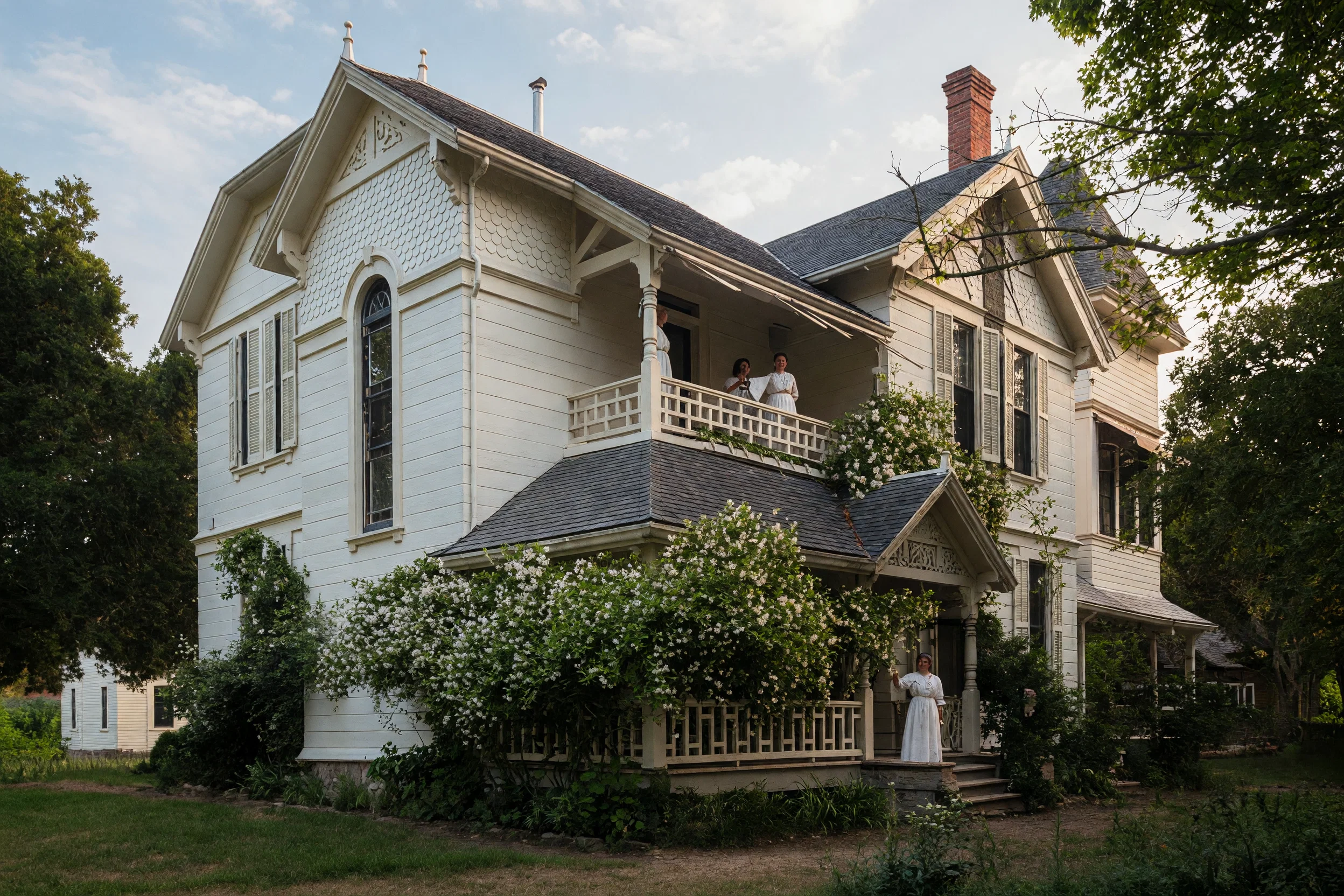
The comfortable office room on the second story of Mrs. White’s home was the most favorable place for patient and nurses, and here it was that she lay the most of the time, surrounded by the familiar objects of the more active life to which she had so long been accustomed. The room was light and airy. In one corner a large bay window flooded a portion of the chamber with sunshine. Here stood her old writing chair. This was transformed into a reclining chair, into which she was lifted nearly every day after the first week or two of illness had passed by. The view from this sunny corner was pleasing and varied, and she greatly enjoyed the changing beauties of springtime and early summer.
Close beside her chair, on a table, were kept several of the books she had written. These she would often handle and look over, seeming to delight in having them near. Like an affectionate mother with her children, so was she with these books during her last sickness. Several times, when visited, she was found holding two or three of them in her lap. “I appreciate these books as I never did before,” she at one time remarked. “They are truth, and they are righteousness, and they are an everlasting testimony that God is true.” She rejoiced in the thought that when she446could no longer speak to the people, her books would speak for her.
At times when her strength permitted, she was taken in a wheel chair to a sunny veranda on the upper floor. From this little balcony, embowered with beautiful climbing roses, the panorama of orchard and vineyard, of mountains and valleys, afforded continual pleasure.
Again and again, during the earlier weeks of her illness, her voice was lifted in song. The words oftenest chosen were:
“We have heard from the bright, the holy land,
We have heard, and our hearts are glad;
For we were a lonely pilgrim band,
And weary, and worn, and sad.
They tell us the pilgrims have a dwelling there—
No longer are homeless ones;
And we know that the goodly land is fair,
Where life’s pure river runs.
“We’ll be there, we’ll be there, in a little while,
We’ll join the pure and the blest;
We’ll have the palm, the robe, the crown,
And forever be at rest.”
About a fortnight after her accident, she was told of the missionary and bookmen’s convention in session at Mountain View, where plans were being laid for an increased circulation of denominational publications. This reference to the bookmen led her to express once more the pleasure she had had two years before in greeting many of them personally in her own home. “I am very glad,” she added, “for all they are doing for the circulation of our books. The publishing branch of our cause has much to do with our power. I do desire that it shall accomplish all that the Lord designs it should. If our bookmen do their part faithfully, I know, from the light God has given447me, that the knowledge of present truth will be doubled and trebled. This is why I have been in so much of a hurry to get my books out, so that they could be placed in the hands of the people and read. And in the foreign languages the Lord designs that the circulation of our books shall be greatly increased. Thus we shall be placing the cause of present truth on vantage ground. But let us remember, in all our endeavors we must seek daily power and individual Christian experience. Only as we keep in close touch with the Source of our strength shall we be enabled to advance rapidly and along even lines.”
MRS. WHITE'S "ELMSHAVEN," HOME
Many were the visitors — old acquaintances and others — who came to greet Mrs. White during the last few months of her life. Sometimes she was unable to recognize old associates in labor; at other times she knew those who came. Whenever possible, she would converse with them. She never ceased to take delight in testifying of God’s goodness and tender mercy. For months prior to her illness, she frequently quoted the scripture, They overcame “by the blood of the Lamb, and by the word of their testimony”; and she felt strengthened every time she bore witness to the love of God and to His watchful care.
One Sabbath afternoon, when the family of her son, W. C. White, spent some time with her, she was specially blessed, and spoke many words of counsel to her grandchildren. “The Lord is very good to us,” she declared; “and if we follow on to know the Lord, we shall know that His going forth is prepared as the morning. If there is any question in your minds in regard to what is right, look to the Lord Jesus, and He will guide you. We should bring every plan to the Lord, to see if He approves it. . . . Remember that the Lord will carry us through. I am guarding448every moment, so that nothing may come between me and the Lord. I hope there will not. God grant that we may all prove faithful. There will be a glorious meeting soon. I am glad that you have come to see me. May the Lord bless you. Amen.”
Not alone for her granddaughters and grandsons, but for all the youth throughout the denomination, her heart went out in loving solicitude. At times she talked with her nurses and with her office helpers concerning the need of making wise selections of matter for the youth to read.
“We should advise the young,” she urged, “to take hold of such reading matter as recommends itself for the upbuilding of Christian character. The most essential points of our faith should be stamped upon the memory of the young. They have had a glimpse of these truths, but not such an acquaintance as would lead them to look upon their study with favor. Our youth should read that which will have a healthful, sanctifying effect upon the mind. This they need in order to be able to discern what is true religion. There is much good reading that is not sanctifying.
“Now is our time and opportunity to labor for the young people. Tell them that we are now in a perilous crisis, and we want to know how to discern true godliness. Our young people need to be helped, uplifted, and encouraged, but in the right manner, not, perhaps, as they would desire it, but in a way that will help them to have sanctified minds. They need good, sanctifying religion more than anything else.
“I do not expect to live long. My work is nearly done. Tell our young people that I want my words to encourage them in that manner of life that will be most attractive to the heavenly intelligences.”
The end came on Friday, July 16, 1915, at 3:40 P. M., in the sunny upper chamber of her “Elmshaven” home where she had spent so much of her time during the last happy, fruitful years of her busy life. She fell asleep in Jesus as quietly and peacefully as a weary child goes to rest. Surrounding her bedside were her son, Elder W. C. White, and his wife; her granddaughter, Mrs. Mabel White Workman; her long-time and faithful secretary, Miss Sara McEnterfer; her niece and devoted nurse, Miss May Walling; another of her untiring bedside nurses, Mrs. Carrie Hungerford; her housekeeper, Miss Tessie Woodbury; her old-time companion and helper, Mrs. Mary Chinnock Thorp; and a few friends and helpers who had spent many years in and about her home and in her office.
For several days prior to her death, she had been unconscious much of the time, and toward the end she seemed to have lost the faculty of speech and that of hearing. The last words she spoke to her son were, “I know in whom I have believed.”
“God is love.” “He giveth His beloved sleep.” To them the long night of waiting until the morning of the resurrection is but a moment; and even to those who remain the time of waiting will not be long, for Jesus is coming soon to gather His loved ones home. As our beloved sister herself declared to those about her one Sabbath day during her sickness, “We shall all be home very soon now.”
LIX
THE “ELMSHAVEN” FUNERAL SERVICE
At five o’clock on the afternoon of Sunday, July 18, 1915, at “Elmshaven,”
“A little spot hallowed by grace,
Out of the world’s wide wilderness,” there assembled nearly five hundred friends and neighbors to pay their last tribute of respect to the memory of Mrs. Ellen G. White, and to comfort by their presence and sympathy those who had been called to suffer the loss of one they had loved dearly.
The service was held on the lawn in front of Mrs. White’s quiet country home, which had long been to her a haven of rest,—a veritable “refuge,” as she often styled it when returning from public labors. At one end of the lawn had been erected a canopy for the officiating ministers; while chairs and benches conveniently placed beneath the wide-spreading elms, with sofas and rockers for the aged and the infirm, gave seats for all who came.
The familiar strains of the hymn, “It is well with my soul,” sung by a double quartette from the Pacific Union College and the St. Helena Sanitarium, marked the opening of the service. Elder R. W. Munson, in his prayer, petitioned that all might profit by the example of the devoted and godly life of the one now sleeping, and that special help and strength might be found by many through reading her published writings. “Grant especially,” he prayed, “to bless those writings which she has sent forth to the four corners of the earth, that the world may hear the message in the many languages into which her books have been451translated. We thank Thee for those in China, in Korea, in Japan, in India, in Africa, and in the islands of the seas, who have been helped to a saving knowledge of truth by reading the writings of Thy servant. Bless also, we beseech Thee, those who have gone forth into these countries to carry the truth for this time. . . . O God, hasten the proclamation of this message to all the inhabitants of earth, that this generation may hear it and heed it, and the way be prepared for the coming of our blessed Saviour.”
Elder J. N. Loughborough, venerable with many years of Christian service, yet wonderfully sustained by God as a living witness of manifold providences in the rise and progress of the advent movement, was the first speaker. He bore a loving tribute to the life work of the one with whom he had so often labored in close association since the year 1852. His discourse, largely reminiscent, served the purpose of a biographical sketch, though it was far more than a mere sketch, revealing, as it did, the special workings of the Holy Spirit in connection with her labors. He emphasized anew the fact that her published works tend to the purest morality, lead to Christ and to the Bible, and bring rest and comfort to weary and sorrowing hearts.
Elder Starr, the next speaker, referred to some personal phases of Mrs. White’s life. “I have never heard any other person,” he said, “speak of love for452Jesus, as I have heard her speak. Many times have I heard her exclaim, ‘I love Him, I love Him, I LOVE Him!’ Her entire life was devoted to winning others to love Him and serve Him with all the heart. . . .
“I regarded her as one of the strongest characters I ever met. I can compare her life only to the sturdy oak that meets the wind and bears its severest pressure, or to the mountain that laughs at the storm. . . . Her faith in God was invincible. Under trials that might have swept away the faith of many, she maintained firm confidence, and triumphed.”
“In bidding her good-by two weeks ago to-day,” Elder Starr continued, “I said, ‘We are glad to find you so bright this morning.’ Sister White replied, ‘I am glad you find me thus, and I wish to tell you it is bright inside.’ And then she added, ‘I have not had many mournful days, have I?’ ‘No, Sister White,’ I said, ‘not in all your life, because you have risen above them.’ ‘Yes,’ she responded, ‘my heavenly Father has planned it all for me, and He knows when it will end, and I am determined not to murmur.’
“Then I said to her, ‘I can only repeat to you, Sister White, what you wrote us in one of your last letters. You said: “The shadows are lengthening, and we are nearing home. We shall soon be at home, and then we will talk it all over together in the kingdom of God.”’ She replied, ‘Yes; it seems almost too good to be true, but it is true.’”
“Passed away from earth forever,
Free from all its cares and fears,
She again will join us never,
While we tread this vale of tears,” the first lines of the second hymn, affected deeply many in the listening congregation. Years ago these lines453were penned by one of Mrs. White’s associates in the Master’s service, the late Elder Uriah Smith. Sad are the partings of this life;
“But a glorious day is nearing,
Earth’s long-wished-for jubilee,
When creation’s King, appearing,
Shall proclaim His people free;
When, upborne on Love’s bright pinion,
They shall shout from land and sea,
‘Death, where is thy dark dominion!
Grave, where is thy victory!’”
Elder E. W. Farnsworth, who had charge of the service, spoke as follows:
“It seems, brethren and friends, almost impossible for any one to think of preaching a sermon, a memorial sermon, commemorative of one whose life and labors have been a constant living sermon for nearly fourscore years. Seventy-eight years ago this summer, Sister White gave her heart to God; and during all those years, there has scarcely been any cessation or interruption in most ardent and earnest labor for the Master, and her life and what it represents in literature is the greatest eulogy that could possibly be pronounced on her funeral occasion.
“I have wondered what Sister White herself would say if she were here alive, and one of us were in her place. I am certain of some things that she would say. I think she would read, for the benefit of her friends and relatives and neighbors and others who are congregated here, this passage:
“For the grace of God that bringeth salvation hath appeared to all men”—and I venture to say that no living person in this generation has ever held up more insistently the grace of God for the salvation of men than has she—‘teaching us that, denying ungodliness454and worldly lusts, we should live soberly, righteously, and godly, in this present world.’
“She would speak to her neighbors and friends along that line, but she would not stop there. This afternoon she would add, ‘Looking for that blessed hope, and the glorious appearing of the great God and our Saviour Jesus Christ.’ She would emphasize that. She would press it home upon all our hearts and all our minds. Not only that, in a general way; but she would emphasize the fact, the great truth, that that blessed hope is soon to be consummated. She would lift our hearts and our minds up to that blessed hope which was her hope, and her joy, and her inspiration. I should like to echo that voice here this afternoon, brethren and friends and neighbors. I am sure that is the message she would give. But she is at rest.
“Somehow I am impressed that there is a present fulfillment of that passage in the fifteenth chapter of 1 Corinthians, where it says, ‘The sting of death is sin.’ Let me read it to you. It is this: ‘For if the dead rise not, then is not Christ raised: and if Christ be not raised, your faith is vain; ye are yet in your sins. Then they also which are fallen asleep in Christ are perished.’ And she would read further: ‘Then shall be brought to pass the saying that is written, Death is swallowed up in victory. O death, where is thy sting? O grave, where is thy victory?’
“The thought I have in mind is this,—that there is a certain sense in which the sting is taken out of death here and now, brethren. [Hearty amens.] Our natural affections, the love of our hearts, will force the tears from our eyes, and we cannot help it; but back of it all, brethren, there is the consolation that sin has gone from this one, and hence the sting455of sin has been extracted, and death cannot hold such a person a great while. [Many amens.]
“We read in one place of Jesus that it was not possible that He should be holden of death. Why? — Because there was no sin there. Where righteousness reigns and sin is gone, death has lost its grip. The subject may sleep in the grave for a little, but death cannot hold him there very long. The day of deliverance draws near. Soon the trumpet will sound, and, thank the Lord, we shall see Sister White again.
“I say to the family and friends, I am a mourner with you to-day; but there is something about a righteous life in Christ which robs death of its terrors, and the grave of all its woe. Jesus has been there, and we may safely walk the path which Jesus trod. So, brethren, let us look up. Let us look beyond this present vale of tears and sorrow to a brighter and an eternal hope and life, for Jesus’ sake, amen.”
With the singing of one of the hymns best loved by Mrs. White, “We shall meet beyond the river,” and the pronouncement of a benediction by Elder S. T. Hare, the service closed.
LX
THE MEMORIAL SERVICE AT RICHMOND
By special request of the officers of the Pacific Union Conference and of the California Conference of Seventh-day Adventists, a memorial service was held at Richmond, Cal., the day following the funeral of Mrs. White at “Elmshaven.”
It was not difficult to arrange for such a service, as the annual camp meeting of the California Conference was in progress at Richmond, and this city is on the main line of railway travel from the Pacific coast to the East, where the body was to be taken for interment in the family burial plot. Accordingly, announcements were sent out to the larger churches close by, and on the morning of July 19 fully a thousand friends from the cities surrounding San Francisco Bay and from more distant points, assembled at the Richmond encampment.
Elder E. E. Andross, president of the Pacific Union Conference, was in charge, assisted by Elder E. W. Farnsworth, vice president of the Union; Elder J. N. Loughborough, an honored pioneer of the advent movement; and Elder A. O. Tait, editor of the Signs of the Times.
The opening hymn, “Sweet be thy rest,” and the Scripture reading by Elder E. W. Farnsworth (1 Cor. 15:12-20, 35-38, 42-45; 2 Cor. 4:6-18; 5:1-10), prepared the minds of the congregation to enter into the spirit of Elder Loughborough’s invocation, in the course of which he acknowledged that “while afflictions come upon us,457and while workers in this cause may lay down the armor because of lack of physical strength,” yet God’s purpose will be accomplished. When the Saviour was laid away, it was thought by His disciples that His work on earth was at an end; but His death on the cross was in reality the very life of the cause He had advocated.
A carefully prepared biographical sketch, written by Elder M. C. Wilcox, of the Pacific Press Publishing Association, was read by an associate, Elder A. O. Tait, because of Elder Wilcox’s absence in the East. In the introductory paragraphs the principle was set forth that “God makes much of individuals. All the great movements, awakenings, and crises of the centuries have centered around individuals, so that the story of the lives of these persons must include the history of God’s work in the world, or the history of the crises or movements.” Citing the biographies of Noah, of Abraham and other Hebrew worthies, of Wycliffe and Luther and the Wesleys, the writer continued:
“And in the advent movement, the giving to the world of the last message of reform, there are two persons whose biographies must include the beginning and the establishment of the movement and its worldwide growth. Nay, more, God’s hand through them will affect it to the end. I refer to Elder James White and his beloved wife, Mrs. Ellen G. White.”
In this review of Mrs. White’s life history, as read at Richmond, her labors on the Pacific coast were outlined thus:
“The work in California had been inaugurated by Elders J. N. Loughborough and D. T. Bourdeau in the summer of 1868. In the autumn of 1872 Elder and458Mrs. White visited San Francisco, Santa Rosa, Woodland, Healdsburg, and Petaluma. Here her messages were received by earnest souls, and her labors were greatly appreciated.
“In February, 1873, Brother and Sister White went to Michigan, returning to California in December of that year to take up new and greater burdens and start new enterprises. In 1874 they assisted in two tent meetings held in Oakland. Here Mrs. White spoke with telling effect on the temperance question, in a local option campaign.”
“It was at this time that publishing work was begun in Oakland, the first issue of the Signs of the Times being dated June 4, 1874. In 1875 the Pacific Press Publishing Company was organized, with capital stock first at $28,000. This corporation is now continued in the Pacific Press Publishing Association, with a present worth of nearly $250,000, and a yearly output of half a million dollars in religious and educational literature.
“God revealed to Mrs. White that a great work would be done upon the Pacific coast and in the cities around the bay. This began to materialize very early; for church buildings were erected in Oakland and San Francisco in 1875 and 1876. In helping to build these churches, Mr. and Mrs. White sold all they had in the East.”
“Mrs. White was intimately connected with the starting of the college at Healdsburg, from which laborers have gone forth to all parts of the world. That school is now continued in Pacific Union College, near St. Helena, which has also received her hearty support.
Having borne a great burden in the building up of the Battle Creek Sanitarium, Elder and Mrs. White took special pleasure in encouraging a like work in459California, which resulted in the development of the St. Helena Sanitarium — started as the Rural Health Retreat. A lifelong physical sufferer, Mrs. White’s sympathies have ever been drawn out to the afflicted. In connection with three other medical missionary enterprises in California,— at Paradise Valley, near San Diego; at Glendale, near Los Angeles; and at Loma Linda,— Mrs. White has borne heroic burdens and rendered great assistance. This is especially true of the College of Medical Evangelists at Loma Linda.
“In 1878 she visited Oregon. Here she attended Oregon’s first camp meeting, at Salem. . . .
“Her life was a life of sacrifice. In poverty, in ill health, in sickness herself and with family ill, laboring with her hands in connection with her husband, economizing to barest necessities of existence, ministering to others hope and cheer under greatest discouragement herself, she more than measured the span of her days in arduous self-denial and self-forgetfulness for others’ sake. She has given away many times over what would have kept her in ease. Her appeals to others have been to do, do, do, for God and humanity; but in this she has been greatly blessed of God. Coming down to death’s door many times, life despaired of by friends, given up to die again and again by physicians, she has been repeatedly and miraculously restored to health.
“Mrs. White ceased her work here as she began — poor in this world’s goods. Her income from her books — no inconsiderable sum — has been used freely in giving assistance to needy enterprises and needy people. Her heart has always been sympathetic, and her own hands have often ministered to the sick and suffering. . . .”
“The life of Mrs. White lives after her. Enemies she has made by her straightforward teaching and reproof. She has been maligned and slandered. Those who know her best, can best judge her life. She was human, subject to all the infirmities and weaknesses of the race; but she found in Christ a precious Saviour and Helper. He called her to do a most unpopular work, and she responded. He has used her mightily. She has truly been a mother in Israel.
“Our blessed Lord voiced the calmest judgment of the human heart when He said that a tree is known by its fruits. In the light of this, the life of our sister, and its blessed influence upon all whose lives it has touched, are a witness of her character and work. She ‘being dead yet speaketh.’”
For the discourse that followed the reading of the biographical sketch, Elder E. E. Andross chose as his text the words: “Blessed are the dead which die in the Lord from henceforth: Yea, saith the Spirit, that they may rest from their labors; and their works do follow them.”
“Of no one,” the speaker declared, “can it be said more truly than of our dear sister, that this scripture is fulfilled; still, under circumstances such as these, our hearts cry out for the glorious morning of the resurrection. We want to know that death is to be destroyed, that the sleepers are to awake. However blessed the life that has gone out, we want to know that the loved one will rise again to glorious immortality. And the Lord has not left us to mourn as those who have no hope. ‘I will ransom them from the power of the grave,’ the prophet writes; ‘I will redeem them from death: O death, I will be thy plagues; O grave, I will be thy destruction.’ Blessed words! . . .
“Again, I read the words of the prophet Isaiah, as recorded in the twenty-sixth chapter: ‘Thy dead men shall live, together with My dead body shall they arise. Awake and sing, ye that dwell in dust: for thy dew is as the dew of herbs, and the earth shall cast out the dead.’ Death is eventually to be destroyed, and the sleepers are to awake. . . .
“So to-day, my dear brethren, and especially those who mourn most deeply upon this occasion,—members of the family,—I say to you, We are not to sorrow as those who have no hope. Our sister, after seventy years and more of earnest, faithful toil for the Master, has now lain down to rest in the last sleep; but soon she is to rise again. ‘The Lord Himself shall descend from heaven with a shout, with the voice of the Archangel, and with the trump of God.’ She will hear His voice, and come forth. . . . O, let us, like our beloved sister, ‘follow the Lamb whithersoever He goeth.’ And when, in a little while, our labors are ended, like the great apostle we may say, We have fought a good fight, we have finished the course, we have kept the faith.”
With the singing of a hymn, and with dismissal by Elder E. W. Farnsworth, the Richmond memorial service closed.
THE FUNERAL SERVICES AT BATTLE CREEK
On Sabbath day, July 24, 1915, Mrs. White was laid to rest by the side of her husband, the late Elder James White, in the Oak Hill Cemetery, Battle Creek, Mich., there to await the summons of the Life-giver.