The Youth’s Instructor, Vol. 65, No. 24.

Speeding Up the Store

The Youth’s Instructor

Jun 12, 1917

Review and Herald Publishing Assn. · Takoma Park Station, Washington, D. C. · Jun 12, 1917

Speeding Up the Store

In the first year of their fight to get a toe hold in the mercantile life of the Illinois town where their country store is located, the Patrick boys did a total business of only a little more than a thousand dollars a month. Their trade for the year past touched the eighty thousand point—and that in a town of only two thousand inhabitants.
There is nothing unusual about the town or the country surrounding it; nothing particularly advantageous about the location of the store. Most young men, finding themselves with a store on their hands in such a little town, would have considered the case impossible. But the Patrick boys believed that the proper kind of enthusiasm put into any proposition, anywhere, would produce success. They started first with the clerks in the store.
Regular meetings of the force were instituted right away; and at one of the first of them the senior partner said: “Now, boys, I want each one of you to go through the stock and make a list of any articles that seem to you to be moving too slowly.”
Before he had gone through half of the lists that resulted, and heard the comments of the clerks upon them, young Patrick realized that he had “started something.” While some of the suggestions offered as to the movement of slow goods did not wholly meet his own judgment, he decided that it was better worth while to let a clerk make a mistake than to take a chance of chilling his initiative. So he said to his helpers:
“I’m going to give each of you a good, square chance to back up his judgment and put his plan over, just as if he owned the whole store. Each of you has his own customers and his own circle of friends. Beginning two weeks from today, we are going to have a series of week-end special sales; and the first will be Jim’s sale, and will be so advertised. He is to select the articles to be used as leaders, and fix the prices at which they will be sold. He will write the advertising, and will personally arrange the window and counter displays.
“But there is one thing that we must clearly understand at the start: this is no narrow-gage contest between clerks for a personal popularity medal. Naturally, every one of you will hustle to get out all his friends when his own week is on; but the coöperation that each of you gives to the other fellow when the other fellow is having his week is going to count for just as much and perhaps a little more, in the eyes of my brother and myself, as will a big record for his own week. Now, go to it on that understanding.”
(Concluded on page twelve)
(Concluded from page two)
Jim picked as his leader about the most hopeless article that he could find in the store. The season for putting up homemade preserves had been under way long enough, at that time, to demonstrate very clearly that, owing to the increased price of sugar, the housewives of the community were holding off in the matter of putting up fruit. A month before, based on the expectations of a normal demand, the store had bought a quantity of the best quality of can rubbers, and there was every indication that about two thirds of them would still be in stock when the home-canning season was closed.
Owing to the unusual quantity involved in the purchase, these can rubbers had been bought very closely. Jim decided that a cut in price which would simply absorb the extra margin secured by good buying would prove a sufficient attraction to make the goods move. Of course, there were other leaders for Jim’s week; but he put the emphasis on can rubbers.
The sale opened Thursday, because the local paper appeared that day. Jim worked nearly all Wednesday night arranging his display. In the preceding issue of the paper he had had one preliminary advertisement, and he had passed the word along to all his personal friends that he was anxious to make his week the success of the store.
The procession of customers that crowded the store from Thursday noon until Saturday night demonstrated two things very conclusively: first, that Jim was a popular young man in the community; second, that the success of his sale was altogether too big to be accounted for on the score of personal popularity alone, and that most of it must be accredited to the soundness of his judgment in selecting his leaders and fixing their prices, and to the effectiveness of the merchandising methods that he brought into play.
When the door of the store was closed late that Saturday night, they had sold eighty gross of can rubbers. The sale had brought a number of new customers into the store, and the volume of business done was of almost record-breaking proportions. Jim didn’t forget to thank the other clerks for the loyalty with which they had coöperated. Tom had the next turn, and Jim worked just as hard to make Tom’s week a success as he had to score hard when his own name was heading the advertising.
In the course of this experiment, which spread over about six or seven weeks, some of the clerks discovered that their judgment on certain articles and the prices at which they could be moved was decidedly faulty. On the whole, however, the plan of giving each clerk a week in which to show how far and fast he could go in the rôle of running the store was a decided success. Not only did it speed up sales, but it distinctly increased the teamwork spirit of the force.—Every Week.

Wartime News Digest: Politics, Prohibition, and Relief Efforts

A Sinn Feiner, Joseph McGuiness, has been elected to the House of Commons. He is now serving a three-year sentence in the Lewes prison, having been convicted in connection with the Dublin rebellion of last year.
Mrs. Belva Lockwood, the first woman lawyer to be permitted to practice before the Supreme Court of the United States, and twice a United States Presidential nominee, died on May 19, at the age of eighty-six.
The skin of the troublesome shark is to be used by the United States for shoe leather. Florida fishermen will ship large skins of different species to tanners all over the country for use in experiments in making shark leather.
Princess Mary, daughter of King George, it is reported, is with her own hands digging up a garden at Windsor Castle. She will raise potatoes and other vegetables for the now frugal royal table. A call for 60,000 women to work on the land is made by England.
Every American citizen is requested by the country's temperance leaders to telegraph to President Wilson immediately, assuring him that “this nation wants immediate national prohibition as a war measure in behalf of the conservation of our food supply and our manhood supply,” and urging him to request Congress to enact legislation to that effect.
Marshal Joffre received when in Boston, from the children of New England, a gift of $175,000, to be used in caring for the orphan children of France. The New York Committee of the Fatherless Children of France also gave him a large sum of money. Many persons also agreed to care for a certain number of orphans, the number varying from one to four hundred. The secretary of the committee, Miss Leland, has agreed to provide for forty-seven of these soldiers’ children.
Mrs. Charlotte Kellogg’s book, “Women of Belgium Turning Tragedy to Triumph,” is being sold by Funk and Wagnalls, New York City. The book sells for $1.10, and all the profits go to feeding hungry Belgians. Mrs. Kellogg is the only American woman member of the Commission of Relief in Belgium. Her husband had charge of Belgian Relief at the Brussels headquarters of the Commission. The author has given to the world, therefore, a most intimate view of women’s work, and courage, and sacrifice, made necessary by the desolations of war.
“The annual waste bill of the United States stands at $7,000,000. The garbage of New York alone for a year would make a pile as tall as the Woolworth building. That it is called garbage is only because it is put in the slop can, economists say. The French could make a meal out of the customary leavings of the American family. Carelessness in packing and shipping is also responsible for some 20,000,000 pounds annually of condemned food. During the week of the food riots in New York, 600,000 pounds of fruit and 475,000 pounds of other foodstuffs were thrown into the sea.”

The Geographer of the Heavens

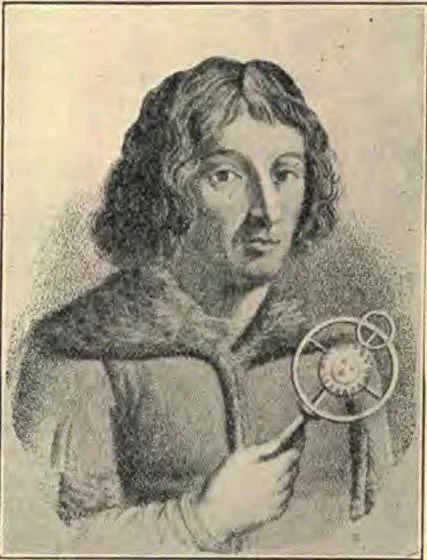
NOT only in music, art, and literature has Poland produced great men. One of her scientists ranks with Galileo and Newton. It is rarely given to one man to alter the entire view of the world for all mankind, to make the race face in a new direction. But this honor belongs to Nicolaus Copernicus. Before he announced his discoveries, every one held to the Ptolemaic theory that the earth was the center of the universe. It was a tremendously complex and cumbrous system, and made man consider himself more highly than he ought.
NICOLAUS COPERNICUS
NICOLAUS COPERNICUS
The age was one of discovery. While the young student of astronomy was poring over his books in Cracow, Columbus and the other venturesome Spanish, Portuguese, and Dutch navigators were spanning the oceans and continents of the earth. It was Copernicus who began to shake the faith of mankind in the old-established doctrine that “the sun do move.” He elaborated his thesis to a system, and man, for the first time, began to realize that he was not, as he had fondly believed, the center around which the universe revolved, but merely “a speck of cosmic dust.” The Copernican method, more than the mere discovery, made man more humble and modest. The old way of propounding a theory and making the facts fit it, received its deathblow from the labors of the Polish astronomer. He began the modern method of searching for a theory that would fit the facts. This had an almost incalculable influence on the thought of the world. Man no longer believed that the universe was created solely for his benefit. The world came out of its scholastic, college-boy stage and learned to regard itself with the sense of humility that comes to every young man when he goes out among his fellows and realizes that he knows so little. Man had found himself, and modern progress became possible.
It is a tribute to Poland as well as to the man himself that Prussia should have claimed Copernicus as one of her sons. It is true that Thorn (Torun), where he was born (Feb. 19, 1473) and where he lived for many years, is now Prussian, that is, German, but it was incorporated into the kingdom of Prussia at the second partition of Poland, in 1793, two hundred and fifty years after the death of Copernicus. Besides, why did the astronomer write “Polonus” after his name in the matriculation book of the University of Bologna, if he was a German? To say that Copernicus was a German is about as reasonable as to claim that Jesus Christ was a Turk because Jerusalem and Bethlehem are now within the Turkish Empire.
It was the ambition of his mother that he should be a preacher, like her own brother, the eloquent bishop. The father, however, opposed the idea, intending to make his son a man of business. The parental disagreement resulted, while the young Nicolaus was a student at the University of Cracow, in his Latinizing his name, and turning to medicine as a profession. Upon receiving license to practice, however, he at once discarded medicine for his absorbing delight, mathematics. At twenty-one he was teaching mathematics in the university. He soon began to show his grasp of the higher conceptions by improving some of the methods of trigonometry. At this period of his life he also invented a quadrant with which to measure the height of trees, steeples, or mountains. His fame spread abroad, and he was invited to lecture at Bologna. There he met the famous astronomer, Novara. The Italian scientist believed and taught the old Ptolemaic theory of astronomy. Copernicus watched the heavens with him, but soon decided that mathematics, not theology, was the basis of the movements in the heavens.
From Bologna he went to Padua and thence to Rome, all the while slowly elaborating and expounding this theory of stellar and planetary movement. But the old theory was part of the teaching of the church, and Copernicus was a good Catholic. He soon perceived that alchemy, astrology, even orthodoxy itself, were being arraigned at the bar of intellect by his ideas. This was heresy. But, he asked, is it sinful to attempt to understand God’s works?—“No. To know the mighty works of God; to comprehend his wisdom and majesty and power; to appreciate, in degree, the wonderful working of his laws, surely all this must be a pleasing and acceptable mode of worship to the Most High, to whom ignorance cannot be more grateful than knowledge.”
Yet Copernicus loved the church, and, in his fear lest he interfere with the work of the clergy, he ceased lecturing. Then, with the benediction of the Pope, he himself took to preaching. Afterward he practiced medicine gratis for the poor. He instructed the people in the science of sanitation. He devised a system of sewerage and utilized the belfry of his church as a water tower, all to aid his fellow townsmen and to convince them that he wished them well. He helped King Zygmunt, of Poland, to establish a scientific, honest system of coinage, and then wrote a book on the coining of money, which is valuable even today.
Year by year he worked at his great problem of the earth, the sun, and the stars. In the upper floor of the barn, back of the old dilapidated farmhouse where he lived for forty years, he cut holes in the roof, and also in the sides of the building, through which he watched the movements of the stars. He lived in practical isolation and exile. The [Catholic] church had forbidden him to speak in public except upon themes that the Fathers in their wisdom had authorized. No one dared invite him to speak, none could read his writings, or hold converse with him except on strictly church matters. But he cared not.
“The stars do me honor,” he said. “I am forbidden to converse with great men, but God has ordered for me a procession of the stars.” Ostracism and exile gave him the opportunity he needed for digesting all that had been written on astronomy, and for testing, very laboriously with his rude instruments, every one of the hypotheses of his brain.
And so the years passed. The vigorous, aggressive man had become old, feeble, bowed, and almost blind from constantly watching the stars and from writing at night. At last his great book, “The Revolution of the Heavenly Bodies,” written in Latin, was completed. It had been nearly forty years in the making. For twenty-seven of these, as he himself tells us, not a single day or night passed without his having added something to it. What should he do with these pages of truth that he had written five times?
The censor at Rome, he knew, would not permit the book to be published. Did it not contradict and refute all that the priests had taught of astronomy? To bring it out in his own town without ecclesiastical authority would be equally dangerous. So the great soul sent the manuscript, with a bag of gold to pay the cost of publication, to Nuremberg, a free city, of free science, free art, and free speech. But he was still full of tender reverence for the church. So he wrote a preface, dedicating the volume to “His Holiness Pope Paul.”
Months passed, months of weary waiting. Would they burn the book? The old man, stricken with fever, was within a few days of his death, when a messenger arrived from Nuremberg. It was May 23, 1543. He brought a printed copy of the book. With the sight of the blessed volume before him, the great soul passed.
In the old Jagiellonian Library of Cracow, one summer day, in the year of grace 1900, the attendant pointed out a small brass instrument, of globe, rings, and circles, curiously worked with astronomical symbols long since out of date. It was the original planisphere of the great cosmographer. Outside, in the picturesque stone courtyard, the floral tributes of its dedication still unfaded, stood the bronze statue of Nicolaus Copernicus, holding in his hand a facsimile of this brass instrument. The sun seemed to have special interest in this man as its rays lovingly fell on him. He had reestablished its supremacy in the universe.—“Poland, the Knight Among Nations.”

John Eliot, Puritan Apostle to the Indians (1604-90)

Probably the heart of the American child is never so deeply stirred by song or story as when listening to the ever-fascinating Indian legends. The stoic, unflinching courage of the Indian in danger; the supple, agile body, which can surprise even animals by stealth; the promise, once given, that is kept till death; the wonderful physical strength and endurance, which enables him to do the most marvelous feats in the most indifferent way; and his firm, unfailing friendship to the few whom he knows to be his friends,—these are all traits of our Indian heroes that delight the minds of young people, and attract and stimulate to courageous deeds many an older head.
It is true that years lend enchantment to the tales of prowess performed by the first Americans, and those who lived with them did not always find them heroic or agreeable. However, there was one brave and good man in the early history of the New England colonies whose heart went out in love and sympathy to these dark-skinned Americans, good or bad, as he found them. His name was John Eliot, and he is known today as “The Apostle to the Indians.”

Eliot and the Indians

Our Pilgrim Fathers had been in this country for twenty-four years before they turned their attention seriously to the conversion of the Indians. When, in 1646, the court of Massachusetts Colony passed an act for the encouragement of attempts to win the natives to Christianity, John Eliot set himself to the task with his whole heart. He was a scholarly man, who had been educated in Cambridge, England, and who had successfully pursued the occupation of a teacher before coming to the colonies. When twenty-seven years of age, he came to Boston, and was immediately appointed as teacher, or elder, of the Roxbury church.
His interest in the Indians dates from his arrival in America. He set himself at once to learn the language of the natives, and this was no easy task. It was a difficult tongue, with harsh pronunciation and long words, that made communication a slow process. For instance, the word for “question” is Kummoogkodonattoottummootiteaongannunnonash.
But Eliot was not dismayed. He asked the Lord to help him, and in a few months could speak the language intelligently. After further study, he set himself to write a grammar, which took some time, and is a curious combination of alphabets, syllables, short nature words, Scripture texts, etc. When he had finished it, he wrote at the end, “Prayer and pains, through faith in Jesus Christ, will do anything.” Surely we can be stimulated to exertion by his noble example!

The Condition of the Indians

But these were only the beginnings of his difficulties. When he entered upon definite evangelical work in 1646, he encountered plenty more of them. Let us consider briefly the state in which he found the Indians. Dr. Mather says:
“Know, then, that these doleful creatures are the veriest ruins of mankind. They live in a country where we now have all the conveniences of life; but as for them, their housing is nothing but a few mats tied about poles fastened into the earth, where a good fire is their bed clothes in the coldest season; their clothing is but the skin of a beast; their diet has not a greater dainty than a spoonful of parched meal with a spoonful of water, which will strengthen them to travel for a day together.”
As a rule, the men were indolent, allowing the squaws to do the work, which consisted chiefly of packing and unpacking household goods, pitching and taking down the wigwams, and caring for the animals. Their time was regulated entirely by the moon and seasons. In some way, they had acquired enough knowledge of the stars to recognize one constellation by the same name that Europeans term it,—the Bear, their name for it being Pawkunnawaw. They had few traditions, and could neither read nor write. Their religion consisted simply of a belief in the Great Spirit, who permeated the objects about them, and who expressed his pleasure and displeasure by good or bad circumstances in the lives of his red children. They worshiped no idols save the trees and other objects of nature. Of money they had none. They bought and sold with shells, or wampum. The “mints” seem to have been located on Block Island and Long Island, because the sea washed up an abundance of this particular kind of shell in those places. The men of the New England tribes followed the usual custom of painting their faces and bodies with gaudy colors. They were all good dancers, active hunters, and bloody fighters.
In case of sickness, the sick person was placed in a little stone hut, and a fire built all around it. When the patient was perspiring freely, they would take him out quickly, and plunge him into a neighboring brook.
These were the people to whom John Eliot dedicated his life. As soon as his purpose was fixed, he started to work, beginning, in accord with the Saviour’s command, at home.

The Praying Towns

At Nonantum, a short distance from Roxbury, several Indian families had congregated. With a few friends, Eliot visited them, gathered them all in the largest wigwam, that one of Waban, and gave them a discourse in the native tongue for one and a quarter hours, on the ten commandments and the love of Christ. When he had finished, he questioned them, and was surprised and glad to know that they understood and believed so much.
Of course, he visited them again, the second time paying special attention to the children after his sermon. He found that they, too, remembered what they had heard in the lesson before, and he helped them to memorize some scriptures. After a few lectures, the Indians began to be much more gentle in spirit. They confessed their sins to one another, and many were found alone in secret prayer.
Soon they asked for permission to stay near Roxbury, that they might learn more of God and civilized ways. The General Court granted them the hill on which they were camped, and Nonantum, which means “rejoicing,” became their permanent home. They made themselves civil laws, and enforced them, borrowing many little tricks of cultivation and industry from the white settlers, and endeavoring to keep their village as neat and clean as possible. And John Eliot, who lifted his hands each night above their bowed heads, thanked God for what the love of Christ had wrought.
But this earnest missionary realized that native ministry is the most efficient. He called his work only “the Daybreaking, if not the Sunrising, of the gospel among the Indians.” And so he set himself to training those who had already entered the fold of Christ, to be workers for their fellows. He had not long to wait; for the Indians near Concord heard of his preaching, and of the Christ whom the other tribe was now serving, and they sent for a teacher to come to them. Eliot sent a discreet young man from the Nonantum camp, who preached to them, and then in consultation with their sachems, drew up a set of laws in which all the ten commandments were well represented in a practical way. These Indians also requested to be “made into a town,” and the second praying city, as these camps were called, was established.
In the lifetime of Eliot, fourteen of these praying cities were established, each with its code of laws, its industrial prosperity, its morning and evening worship, and its consecrated, earnest leaders who sought in every way to make it a Christian community. All the Indians who were yielding obedience to the gospel in these fourteen communities number eleven hundred. Surely the heart of the old apostle must have rejoiced to see such a rich reward for his labor!
It had not been attained without continual suffering. Once a fortnight he made a missionary journey into all parts of the surrounding country, preaching the gospel and teaching the Indians. Many times he traveled over dangerous paths and through dreary wildernesses, being cruelly treated by the Indians, who were not all friendly. On one occasion he wrote: “I was not dry day or night, from the third day of the week to the sixth; at night pulled off my boots, wrung the water out of my stockings, and on with them again, and so I continued; yet God helped.”
The powwows and the sachems hated him; for he branded the former as deceivers, and took away loyal subjects from the latter. They combined to do everything in their power to annoy him and check his influence. But he declared to all that the angel of God was his leader, and that he had no fear of all of them together, and in many instances, he was powerfully protected. Their very plans were turned to the glory of God.
John Eliot held in his mind a high ideal of the Christian church, and was loath to admit any for membership who were not truly and wholly the Lord’s. His Indian converts continually begged him that they might be admitted to church fellowship; so, after much prayer, it was decided to call a general meeting at Natick, on the thirteenth of October, 1652, just six years after his work began. A company of ministers and friends were present to judge of the fitness of the candidates for admittance to church communion. Fifteen were baptized at this time, and the first Indian church was formed, in 1660, at Natick. Eliot was made very happy by their clear, earnest confessions of faith, but with characteristic humility, he gave all the glory to God and his associates.

His Translations

The next great burden of John Eliot’s heart was to give these souls so dear to him the Scriptures in their own tongue. But what a problem it was! They could neither read nor write, and with the poor equipment of those early colonial days, it was no easy task to teach them. He took the matter to the Lord in prayer, and soon we find him writing:
“It hath pleased God this winter much to enlarge the ability of him whose help I use in translating the Scriptures. Besides, it hath pleased God to stir up the hearts of many of them to learn to read and write, wherein they do much profit with little help, for they are very ingenious. And whereas I had thought that we must have an Englishman to be their schoolmaster, I now hope that God will raise up some of themselves, and enable them unto that work. With my care to teach them well the sound of letters and spelling, I trust we shall have sundry of them who will write every man for himself so much of the Bible as God shall enable me to translate.”
He had not thought it possible that all the Bible could be translated in his day; but before his death, he had the privilege of reading not only the entire Bible, but also various primers, catechisms, and favorite devotional works in the Indian tongue. One of his personal students, Monequessun, was made a schoolmaster at Natick; and in a short time, many of his students were admitted into the college, where they showed themselves in no way inferior to their white brothers.
During all this work for the Indians, Eliot maintained his position as elder of the Roxbury church, neglecting in no way any of his duties toward them. He visited the poor and fatherless, cared for the sick, and fed the hungry souls with living bread. All his flock loved him dearly. One biographer says of him that as he grew older “he grew still more heavenly, more savory, more divine.”
Much against the wishes of his congregation, he insisted that a new minister be called to his place, as he felt no longer capable of bearing the physical strain his duties imposed upon him. It is a tribute to his position in the hearts of the people, that they continued his salary until his death, although a younger man filled his chair. He still loved to be with the Lord, and nearly every service found him an eager listener in his pew.
In his late years, he became interested in the Negro slaves, but his plans for the betterment of their condition bore no fruit, for the Lord called him away. He was eighty-six years of age when death came to him. Surely his heroic life, so full of physical, mental, and spiritual activity, is a great lesson to us who are looking for the soon coming of the Lord.
RACHEL SALISBURY.

The Way to Win

A KING had at the edge of his domain a small rebellious province that he wished to bring into harmony with his policies. The people of the province were brave, hardy, and industrious, as well as clever and skilful. He felt that they would be a valuable part of his kingdom. So he sent one of his great generals to conciliate the people.
The general appeared before the town meeting to make a speech. “People of the province,” he said, “you are very different from us. You have a different ancestry. Your forefathers were men of violence, evil men. You ought to recognize that we are better than you, and cease your strife. You belong to a different church, but ours is the right church, and you are but heretics. You must come into our church, and do as we do. You do not wear garments like ours, but you ought to. You hold your town meeting on Wednesdays, whereas the proper time to hold it is on Thursdays, as we do. You wear your hair cut short, but you should have it trimmed as we do ours. You do not think our king ought to reign, for you favor a different branch of the family, but our king belongs to the only right branch. Now I want you to get rid of these differences. You are a part of our kingdom, and you must conform yourselves, and live at peace.”
As you can imagine, the hardy little province was so swept with anger that the general had to leave secretly at night to avoid danger. He went back to the king, and told him that the province was in a hopeless state of rebellion, and the differences could never be settled.
“Let me go,” said the king’s old tutor, a gentle, white-haired philosopher.
The king let him go, though he expected no results from the visit.
The old philosopher attended the town meeting, and he, too, made a speech. “Brothers,” he said, “I have come to show you in how many things we are alike, so alike that there cannot be division between us. We are sprung from the same tribe. When your brave and splendid forefathers settled here, their brothers went on, and settled farther south. So we must still be brethren. We call our churches by different names, but do we not all seek one Master, even Christ? Come and help us to make our church more useful, and let us help you. And our king is from the royal family that springs half from your tribe. He belongs to you as much as to us of the south. Come and claim him. Our kingdom needs you. We need your strength, and wisdom, and daring, and fine traditions.”
So the old philosopher went on. He talked not of differences, but of likenesses. He saw all the good within their institutions, manners, and laws, and he pointed it out, and urged them to bring their contribution to the aid of all the kingdom. He did not ask them to come in as inferior and conquered people, but as a part of the great nation.
And the philosopher won the people. He carried back their allegiance to the king, and thereafter they were an important and peaceful part of the kingdom.
The philosopher knew the secret of winning men. It is a secret that all people need to know. The lawyer, the doctor, the salesman, the minister, the missionary, the editor, the business man, the inventor, the clerk—they all need to be able to win other people. There is no business in life that will not be bettered if we know this secret. It simply consists in starting with the likenesses, and ignoring the differences, in pointing out the excellences of the other person’s position before we try to move him to ours. It does not involve deceit in any way. It needs only a sympathetic heart. The great theologian, Munger, tells us that the best missionary is not the one who hates idolatry most, but the one who is most ready to recognize the good that may lurk within it. So if we are sympathetic and broad-minded, we can see the other fellow’s viewpoint, and see the good things about it.
Even boys need to begin to practice the art of winning. If you never can get another fellow over to your side, there is something wrong with you, and your future success in life is seriously threatened. Don’t approach a fellow, roughshod, and demand that he come over to your side. Find out first how you agree with him, and lead him by the likenesses in your opinions.
It is a secret worth knowing, an art worth cultivating.—J. L. West, in the Boy’s World.

The Bible

Study it carefully, Think of it prayerfully, Deep in thy heart let its pure precepts dwell; Slight not its history, Ponder its mystery, None can e’er prize it too fondly or well.
Accept the glad tidings, The warning and chidings, Found in this volume of heavenly lore: With faith that’s unfailing And love all prevailing, Trust in its promise of life evermore.
With fervent devotion And thankful emotion, Hear the blest welcome, respond to its call; Life’s purest oblation, The heart’s adoration, Give to the Saviour, who died for us all.
May this message of love From the Tribune above, To all nations and kindreds be given; Till the ransomed shall raise Joyous anthems of praise, Hallelujah! on earth and in heaven.
— Anonymous.

Love as the Light of Life

“LOVE is the light in which we see and live. Hates are malarial mists in which we blindly grope and miserably die.”
Continue reading: THE RETURN OF JESUS