The Youth’s Instructor, Vol. 65, No. 24.

Speeding Up the Store
Earlier text: Speeding Up the Store

THE RETURN OF JESUS

Donald Hears the Great Advent Message
CARLYLE B. HAYNES
Each night the crowds increased at the tent on the baseball lot. Those who had been there told others, and these still others, and thus the entire city was reached by the things which Brother Harris preached. On Wednesday night nearly a thousand persons sat before the preacher when he began his sermon on “The Return of Jesus.” You may be sure that Donald Hunter was in his usual place on the front row of seats.
That night Elder Harris had a number of pictures thrown on the screen. He told of the last public address which Jesus delivered to the Jews before his crucifixion, when he pronounced the woes on the scribes and Pharisees, which is recorded in the twenty-third chapter of Matthew. He described how Jesus left the courts of the great temple after this address, and went out to the Mount of Olives, just outside the city, from the slopes of which he could see the beautiful buildings of the temple. He showed pictures of the temple and of the mount, and then said:
“While Jesus was sitting on the slope of Mt. Olivet, overlooking the buildings of the temple, ‘the disciples came unto him privately’ (Matt. 24:3), and asked him two questions. Just before this Jesus had said to them, ‘Verily I say unto you, There shall not be left here one stone upon another, that shall not be thrown down.’ Matt. 24:2.
“The two questions which the disciples asked were these: ‘Tell us, when shall these things be? and what shall be the sign of thy coming, and of the end of the world?’
“The first of these questions referred to the destruction, which he had foretold, of Jerusalem and the temple. The second referred to the end of the world and the second coming of Christ.
“Jesus at once answered these questions, beginning with the first. He gave the indications, one by one, of the approaching destruction of the city and the temple, and finally gave them the sign by which they were to know when to leave the city to escape its destruction. When they should see Jerusalem encompassed by armies (Luke 21:20), they were to flee into the mountains. The Christians, following this instruction, were saved when this event took place.
“Then Jesus began his answer to the second question, ‘What shall be the sign of thy coming, and of the end of the world?’ He spoke first of a period of ‘great tribulation.’ Matt. 24:21, 22.
“This sign was fulfilled in that great period of persecution against God’s people, which, according to the prophecy of Dan. 7:25, was to continue for ‘a time and times and the dividing of time,’ or twelve hundred and sixty years.
“This period of persecution began with the supremacy of the Roman Church in 538 A. D., and continued just twelve hundred and sixty years, until 1798. In this year the Pope was taken prisoner by General Berthier of France, and sent away into exile, where he died. This ended the period of papal persecution.
“The ‘days’ of persecution, then, reached to 1798. But the Saviour said these days should be shortened (Matt. 24:22); that is, the persecution itself would be brought to an end before the days ran out, or before 1798. And, true to the Master’s word, before 1798 came, the effects of the Protestant Reformation began to be felt, and persecution had practically stopped by 1775.
“Here, then, is a period of about twenty-three years, between 1775 and 1798, during which the persecution of Christians had been brought to an end. In this period, between these two dates, Christ now locates the next sign of his second coming. He said: ‘Immediately after the tribulation of those days shall the sun be darkened, and the moon shall not give her light.’ Matt. 24:29.
“Notice that Jesus does not say that this sign will take place after the days, but after ‘the tribulation of those days.’ There is a difference between the days of tribulation, which reached to 1798, and the tribulation itself, which ended in 1775. The disciple Mark, in recording this same instruction of the Master, makes the exact time of this sign a little clearer. He says: ‘In those days, after that tribulation, the sun shall be darkened, and the moon shall not give her light.’ Mark 13:24.
“Thus the occurrence of this sign, a remarkable darkening of the sun, a dark day, is limited to a period of about twenty-three years, between 1775 and 1798. And in that very period this prediction was exactly fulfilled. It took place on May 19, 1780. About ten o’clock on the morning of that day a darkness began to shut out the light of the sun. The chickens went to roost as if it were night, and the cows came in from the pastures. This sign took place at the very time set for it, and was a fulfilment of Matt. 24:29.
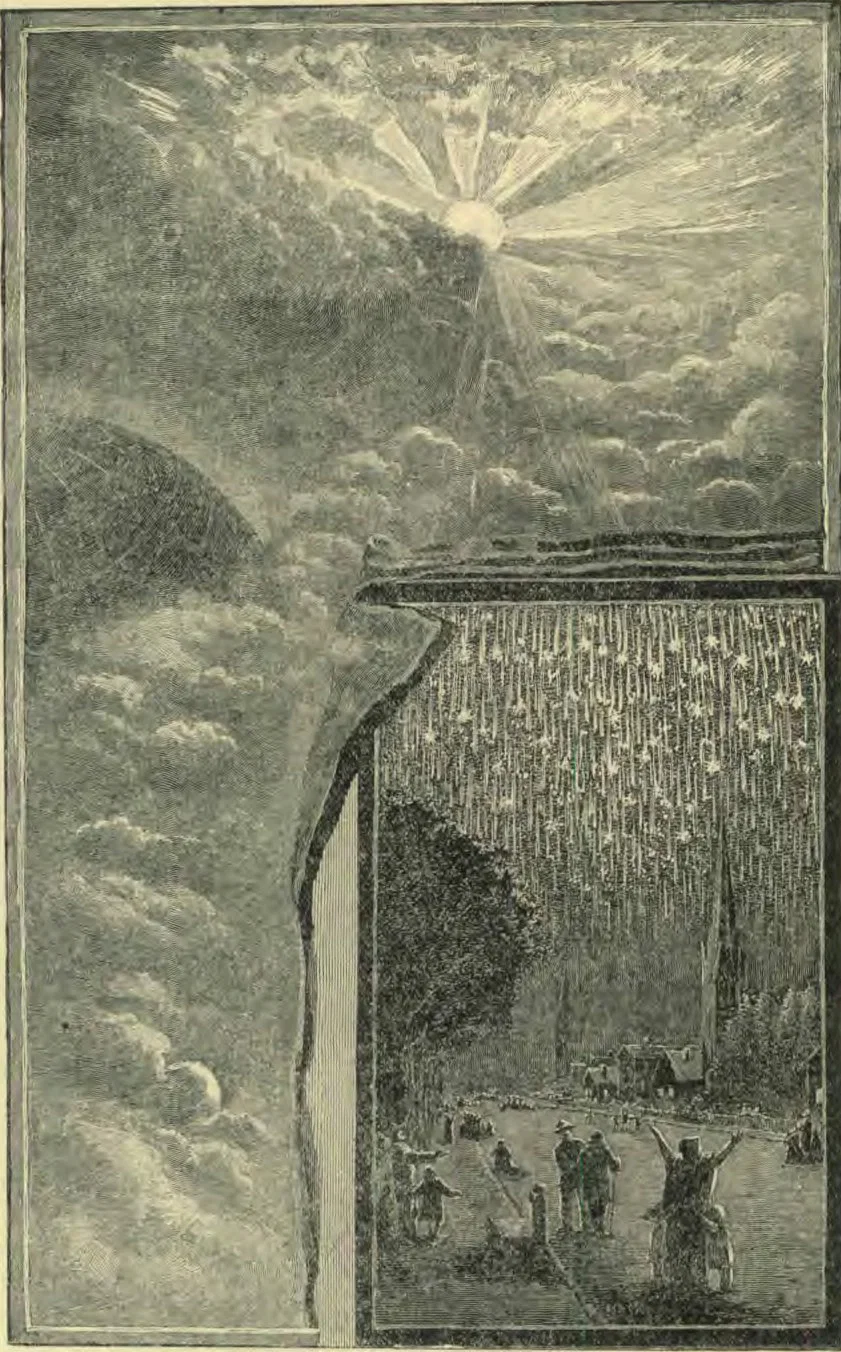
“After the sign of the dark day there was to be another. Christ speaks of it as follows: ‘And the stars shall fall from heaven.’ Matt. 24:29. This sign was fulfilled in the wonderful meteoric shower of the morning of Nov. 13, 1833. On that day the most wonderful falling of stars that the world has ever witnessed took place, and fulfilled this verse. One writer who saw this star shower says: ‘The awful grandeur of the display on the night of the thirteenth of November, 1833, which made the stoutest heart stand in awe, and the most defiant infidel quake with fear, is never to be compared with the most brilliant fireworks. Those who witnessed the meteoric shower named saw the greatest display that man ever will see until the day that Peter speaks of, when the heavens, being on fire, shall be dissolved, and the elements shall melt with fervent heat.’
“It may be,” said Brother Harris, “that there are some in this audience tonight who remember seeing this wonderful sign of the Lord’s coming. I want to stop long enough to say that if there are, we should like you to rise.”
Every head was turned as Deacon Sewell and his wife rose to their feet, and Donald saw another old man, with hands shaking with palsy, rise to his feet on the other side of the tent. Deacon Sewell said, “Yes, my brother, I remember well that night. The sight was so awe-inspiring that I can never forget it. And all of us felt at that time that this wonderful display of God’s power was sent as a sign of the approaching end of the world.”
“You see, my friends,” said the minister as the three elderly people sat down, “that I am not following cunningly devised fables in making known to you the coming of Christ. Here are those of your own number who saw one of the very greatest signs of his coming.
“Thus, as at the first coming of Christ God hung out a star as a sign of his coming, so before his second coming he has hung these signs in the heavens, that all may be convinced that his coming is near at hand.
“The next event in this line of prophecy is the actual coming of Christ himself. This is made plain in the next verses of the chapter. Matt. 24: 30, 31.
THE FALLING OF THE STARS ON NOVEMBER 13, 1833
“Then Jesus said: ‘When ye shall see all these things, know that it is near, even at the doors. Verily I say unto you, This generation shall not pass, till all these things be fulfilled.’ Matt. 24: 33, 34.
“Verse 34 locates the coming of Christ in a certain generation. And this certain generation is definitely located in the preceding verse as the generation which ‘shall see all these things,’ that is, the tribulation, the dark day, and the falling of the stars. It does not necessarily mean to see them literally, certainly not all of them, for there is no one now living who saw the period of persecution, and it is doubtful if there are any who saw the dark day. The generation meant is the one that shall see these things as signs of the coming of Christ.
“This passage clearly teaches that when the people of this earth hear a great message of the coming of the Lord, a message which will set before them these signs as signs of the coming of Christ, the generation hearing that message will not pass away until the Saviour comes. Just as it was the generation which heard the preaching of John and of Christ and his disciples, and which rejected that message, upon which the destruction of Jerusalem came as a punishment for that rejection, so in these last days it will be the generation which hears the message of the coming of Christ with all its allied truths, and rejects that message, upon which the destruction of the last days will come.
“That message of the Lord’s coming, containing the signs referred to, is even now being preached in all the world. This generation, the present generation, is the one which is hearing the message of the coming of Christ. This audience has heard that message tonight.
“This brings us face to face with the most solemn truth of all our lives. And that truth is this: The present generation is the one which is destined to see the coming of Christ.”
As Brother Harris, reaching far out from the platform, said these words with solemn impressiveness, Donald heard the voice of Deacon Sewell exclaiming with a thrill of real rejoicing, “The Lord be praised!” As Donald caught a glimpse of the old man’s face, he saw two great tears run down his cheeks upon his beard, and his eyes shining with the light of heaven. There wasn’t any doubt that Deacon Sewell was glad to hear the message which was brought to him that night.
“And,” the speaker said in conclusion, “there is no mistake here. Just as surely as the great period of tribulation of the church came to pass, just as surely as this period was followed by the sign of the dark day in 1780, just as surely as this in turn was followed by the falling of the stars in 1833, just so surely will the coming of Christ take place in the present generation. This is the clear teaching of the Bible, and the Scripture cannot be broken. How important it is, then, that all who are here tonight make at once that preparation of heart and life which is necessary in order to meet the Lord in peace.”
Before dismissing the congregation, Brother Harris called attention to a large pile of small books called “The Return of Jesus,” and urged those who desired more information on this subject to purchase a copy. After the meeting many crowded forward to get a book, and Donald’s father gave him twenty-five cents with which to buy one. By the time he reached the bookstand all the books which had been brought out had been purchased, about one hundred and fifty; but another supply was brought from the small tent, and Donald received his copy, and that night read some of it with great interest.

The Prodigal's Return

(Texts for June 17-23)
“O God, according to thy grace, be merciful to me; In thine abounding love blot out all iniquity. O wash me wholly from my guilt and make me clean within; For my transgressions I confess, I ever see my sin. From out thy presence cast me not, thy face no more to see; Thy Holy Spirit and his grace, take not away from me. Restore me thy salvation’s joy, my willing heart uphold; Then sinners shall be turned to thee, when I thy ways unfold.”
9. It is not hard to pray with David, “Hide thy face from my sins, and blot out all mine iniquities;” but those who join in this prayer should also join in submitting themselves to whatever affliction or discipline God may send to do the cleansing.
10. The psalmist desired a new heart, and he felt that nothing less than the almighty power of God which brought a beautiful, well-ordered earth out of chaos could make a new heart of the black ruin within. And it does require the same power. If our desire for pardon, young friend, does not have in it a longing to live the life—the new life—that tries to please God in all things, our repentance is not genuine, but needeth “to be repented of.”
And we need to join the psalmist in praying for “a constant spirit.” Without it we cannot keep a cleansed heart clean; but if we will endeavor to keep our sins forgiven, God’s Spirit will abide in our hearts and keep them clean, strong, and steadfast.
11. Perhaps David was thinking of the sad fate of his predecessor, Saul—thinking how “the Spirit of the Lord departed” from him; and so he prayed with special emphasis, “Take not thy Holy Spirit from me.” When a man grieves away the Holy Spirit, he enters a gloom so dense that no ray of light can penetrate it; his case is hopeless. No wonder David prayed as he did; no wonder Paul admonishes us not to grieve the Holy Spirit.
12. David had tasted the “joy of thy salvation.” It had been to him like dew to the budding flower. It was the only genuine joy—the only joy that could shine over every cloud of earthly sorrow. His sin had robbed him of it, and he felt that he could not live or serve God without it.
And notice, he prays for “a willing spirit.” Are we praying for this? Are we praying for a spirit that delights to obey? that is eager to serve? “To serve God because we must is not service. To serve God because we had rather do his will than anything else is the service which delights him and blesses us.”
13. And now comes the result of true penitence. David knew his life, if consecrated fully to God, would draw others to the Master. The life of the true Christian is a magnet drawing others to Christ; it is a channel through which the almighty arm can reach down to save others.
On the other hand, a man that had passed through David’s experience and received the blessings for which he prayed could not remain silent, but would be ever trying to persuade others to “taste and see that the Lord is good.” What you tell others of your own experience will have more influence with them than any amount of highly polished eloquence and elaborate reasoning.
14. Again his sin emerges like a black rock in a bright sparkling lake; but this does not mean that David doubted God’s forgiveness. “It marks the abiding sense of sinfulness, which must ever accompany abiding gratitude for pardon and abiding holiness of heart.”
15. Sin had closed his mouth and paralyzed his tongue. His lips were sealed. He could not praise God. If sin abides in our hearts, our words of praise mock us and fall back dead. There is no power in words when the life contradicts them. David knew as well as Emerson that if the life and words do not correspond, then “what you are talks so loud that I cannot hear what you say.” When the heart is free from sin, the lips will be opened in praise to God.
16. It is not things that God wants. He wants you; he wants me; he wants our lives, that he may make them lives worth our while to live.
17. Then comes an ever-blessed assurance written in immortal words: “A broken and a contrite heart, O God, thou wilt not despise.” These words “derive still deeper beauty and pathos when it is observed that they are spoken after confession has been answered to his consciousness by pardon, and longing for purity by at least some bestowal of it. The ‘joy of thy salvation,’ for which he had prayed had begun to flow into his heart. The ‘bones’ which had been ‘crushed’ are beginning to reknit, and thrills of gladness to steal through his frame; but still he feels that with all these happy experiences contrite consciousness of his sin must mingle. It does not rob his joy of one rapture, but it keeps it from becoming careless. He walks safely who walks humbly. The more sure a man is that God has put away the iniquity of his sin, the more should he remember it; for the remembrance will vivify gratitude and bind close to Him without whom there can be no steadfastness of spirit nor purity of life. The clean heart must continue contrite, if it is not to cease to be clean.”
MEDITATION.—Sin is a double failure. It causes me to fail God; and it fails me—it fails to give me what the tempter promises it will. This psalm reminds me of that fact, and as I study the verses, my heart overflows with gratitude for my heavenly Father. He forgives my sins; he never disappoints me; he never fails me. This psalm helps me to understand how I must enter into his presence to receive the pardon I need, the happiness I seek, and the power I must have to live for him and to serve my fellow men.
SPECIAL PRAYER.—Father, I thank thee for all thou art willing to do for me; and this morning I pray thee that thou wilt “create in me a clean heart.” Take away this heart of mine that is so full of selfish ambitions; that forgets others and stoops to self-pity; that loves not thee and thy work, but longs for the things of this world. Take it away, and give me a heart in which thou canst abide. And now, O Father, help me to let thee grant my request.
M. E.

Animals of the Bible

Few animals were more despised and detested in Bible times than the dog. Sometimes he was found in the field caring for the sheep, but more often in packs on the city streets. Each company of dogs had a leader and a limited district, beyond which no dog dared to go. They were savage and half-starved, and fought continually over scraps which were thrown to them. They ate dead animals of all kinds, even human bodies; this accounts for the awful fate of Jezebel and Ahab. If a dog was treated kindly, he at once became a friend, and would accompany his new master along the streets at night, and defend him from other dogs which were always snapping at people’s heels, especially strangers’.
But when a dog came to the edge of his district, he would stop and lie down, unless especially coaxed to go farther. To go on might mean that he would come back with an ear chewed off, an eye put out, or more scars on his lank sides.
The story is told of a man who lived in the trunk of an old palm tree which had a low fence around it. Gaunt, half-starved dogs clustered around constantly to get pieces of food he occasionally threw to them. No doubt Lazarus was in just such company as this when he lay at the rich man’s gate.
The wolves spoken of in the Bible as “the wolf of evening” were like the dogs, only more fierce. They cautiously prowled at a distance from the sheepfold, and made it necessary for the shepherd to be very alert at night to defend his flock from their ravenous attacks.
The foxes lay concealed during the day in solitary places or holes in some old ruins, but at night many would come forth and attack the sheep.
The sheep and the goats were herded together; usually, however, the goats chose the slope of a hill, while the sheep grazed in the valleys. At noon, when they came to be watered, the stone was rolled from the mouth of the well, and the sheep lined up on one side and the goats on the other. They were also separated when driven into the fold at evening. The wool of the sheep was used for clothing, and the flesh for food. The skins of the goats were made into bottles and sacks. When Joseph’s brothers went into Egypt to buy corn, they took this kind of sacks.
The ass of Bible times was not stupid and awkward, but was a clever animal, even superior to the horse in intelligence. He could baffle a boy trying to ride him, where a horse would fail. When kindly treated, he was very affectionate. The ass was ridden by kings, and other persons on important journeys. Christ rode an ass when going up to Jerusalem as King, and many of the prophets traveled in the same way.
The ass is saddled and driven today much as in olden times, a thick cloth being thrown over his back, a straw saddle with a high pommel placed thereon, and then a bright-colored cloth spread over that. On the bridle are jingling bits of brass and small belts. The driver goes behind and directs the animal. One may cry out, “Bess” or “Piacco,” but the driver says, “Let the bridle hang loose,” and then, as one writer says, “you dodge your head under a camel load of blankets, brush your leg against a wheel of an oxcart, strike a fat Turk plump in the back; you miraculously escape upsetting a fruit stand; and at last you reach some quiet street with the sensation of a man who had stormed a battery.”
The ass carries bundles of sticks, and also turns the water wheel. In this work he is blindfolded and tied to the horizontal bar of the water mill, and so reined that he walks around in a circle. The boy driver may fix a whip to touch him every time he comes around, and then go away and lie down to sleep while the poor blindfolded animal works. Each time an ass runs away, as asses are prone to do, the neighbor who finds him clips a piece from his ear, and then returns him to his master.
Some of the smaller animals of the Bible were as interesting as the larger, and Solomon, the great wise man, did not overlook them. He noticed that the ant laid up her food in summer to be ready for winter. Some have said that the ants are only flesh eaters, and that Solomon saw the white pupæ and thought they were grains of corn. One man, who has observed ants for twelve years, tells us that they not only store away grain for food, but that they even plant and grow it. They bite the germ from all but the seed grain to prevent its sprouting in their damp cellars. The “ant seed-rice” is planted around the hill and kept free from weeds.
Sometimes mother says, “Johnnie, go and hoe the weeds out of the cabbages.” But John is lazy and wants to lie on his back under a shade tree. Remember that the Bible says, “Go to the ant, thou sluggard; consider her ways, and be wise.” C. L. Ross.

How the Telephone Was Invented

Alexander Graham Bell’s father was famous for his system of “visible speech,” by which he was trying to teach deaf-mutes to talk. Bell inherited this interest. When he was twenty-one he learned that an electromagnet could vibrate a tuning fork, and he began to experiment with an electrical telegraph. So he set out on his search for the telephone.
Just at this time he was threatened with tuberculosis, and came to America, where he made a name for himself teaching deaf-mutes. He was so successful that for a time he laid aside his experiments with telegraphy and telephony. Two wealthy men, however, realizing his abilities as an inventor, supported his experiments. One of them, Sanders, had a deaf-mute son. Bell was to tutor him at their Salem home, and to conduct his experiments in their basement. The other, Hubbard, a lawyer, had a deaf-mute daughter. Bell fell in love with her, and four years later married her.
While he was working on the musical telegraph and telephone, he was trying to help a mute talk by making sound vibrations visible to the eye. “If I can make a deaf-mute talk, I can make iron talk,” said he.
Just at this time when his two friends had begun to insist that he stop experimenting with telephony and confine himself to musical telegraphy, he met Prof. Joseph Henry, who had aided Morse, and who now urged him to work on.
“But,” replied Bell, “I have not the electrical knowledge that is necessary.”
“Get it,” replied Henry.
Bell got it. He hired Thomas Watson as an assistant. His two old friends provided funds for his continued experiments with musical telegraphy, and at odd moments he worked on telephony. In 1875, at the end of three years of dreary drudgery, he had completed a new instrument. When sounds were at last transmitted, Bell was wild with enthusiasm. If his instrument could reproduce sounds, it could reproduce words and sentences. His two friends were finally convinced that he was on the road to a greater invention than musical telegraphy, and financed him until 1876, when he spoke into the instrument in the workroom and was understood by Watson in the basement.
On his twenty-ninth birthday he received a patent described as “the most valuable single patent ever issued.” It was so entirely new that he did not know how to describe his invention to the patent officials; and although it was far from being a telegraph, he called it “an improvement on the telegraph.”
“Had I known more about electricity and less about sound,” he said, “I should never have invented the telephone. — Every Week.

The Wise Mother Bird

THE following story, illustrative of the fact that work left to others to perform is not likely to be done until we ourselves set about the doing of it, is old, having found a place in readers a generation ago; but it is none the less pertinent. I was delighted with its lesson when I first read it. The story runs something like this:
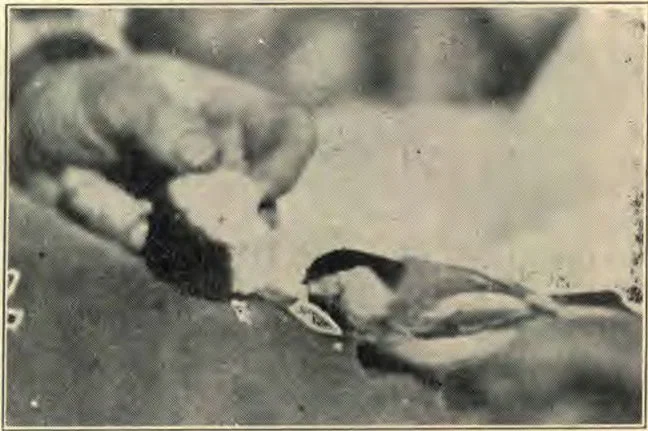
Photo by Forrest A. Snell
E. E. Pratt, of Brampton, Michigan, sharing his lunch
with a chickadee
Photo by Forrest A. Snell E. E. Pratt, of Brampton, Michigan, sharing his lunch with a chickadee
During the warm spring days a little mother bird built a cozy nest in a farmer’s wheat field. After a few weeks the beautiful nest was filled with five little birds.
Every day the wheat grew taller; the heads came on, and finally were heavy with ripened grain.
One day while the mother bird was away gathering food for her young, the little birds in the nest heard a rustle in the grain. Soon they saw the farmer who owned the field come walking near the nest. He stopped a moment and said to himself, “I think I shall go over to Neighbor Brown’s and tell him to come and cut my wheat tomorrow.”
Upon returning to the nest, the mother bird found the little birds in a state of great excitement. “O mamma,” they cried, “the farmer said he will have his neighbor cut the grain tomorrow. Then our nest will be spoiled! O, what shall we do?”
“Never mind,” said the mother bird, “there is no need to worry. If Mr. Jones said he would have his neighbor do it, we may stay another day.”
The next day when the mother bird was gone, again the farmer visited the field. That night when she returned to the nest all the little birds cried aloud, “O mother, the farmer was here again, and says that since Mr. Brown would not cut his grain he is going to get Mr. Smith, his other neighbor, to cut it tomorrow. What shall we do now?”
“Never mind,” said the mother bird, “we may stay yet another day.”
On the third day as she returned to the nest, the little birds were again wild with excitement. “Mr. Jones says that he is coming himself in the morning to cut the wheat.”
“Then we must move and with no delay,” said the mother bird, “for when a man says he will do a thing himself, then it will be done.”
EDMUND C. JAEGER.

David’s Sling

LONG before the time of David, the sling was used as an instrument of warfare. It was made of a piece of sinew or fiber, broadened in the middle where the piece was bent. A smooth stone was placed in the sling, and the soldier slung it once or twice around his head, and then let go of one string, thus sending the stone with great force. The sling was used by the Assyrians and Egyptians as well as by the Hebrews in taking or defending a city. The children of Benjamin, however, were especially noted for the dexterity with which they used the sling.
David lived in the fields when a boy, and cared for his father’s flock. The ravines were full of wild beasts, and he had many exciting experiences delivering his sheep from the lions, wolves, and bears. At a certain time it became necessary for him to visit his brothers in the army, to find out how they fared. On arriving at the camp of the Israelites, David found the entire army of King Saul cowering in fear, unable to put to flight or slay the giant Goliath, who was defying God’s chosen people. David, on learning of this serious condition, offered to slay the Philistine warrior.
Saul offered David his armor and helmet; but David would not take them because he had not “proved them.” Instead, he took five smooth stones from the brook, and put them in his shepherd’s bag. His shepherd’s sling was in his hand, and with this simple weapon, David went forth in the name of the Lord, and slew the Philistine.
In this simple little story of David and the sling, is a lesson for all of us. It is a good thing to learn well how to do the simple, everyday duties of life; then when the important moments come, make use of what we have, and not try some new thing that we have not proved.
PANSY E. PALMER.

Jack’s Prayer

A NEIGHBOR of mine who lives one block from the street car track, had warned his only son not to venture alone near the car line. Bidding the little five-year-old boy good-by one morning, the father, one of Duluth’s prominent business men, walked to the car line, and noticing the little fellow following on behind, crossed the street, and dropped into a store. As the venturesome little fellow made his way to the car line, the father telephoned his wife to punish the boy as soon as he reached home. Then with a smile, and a kindly wave of his hand good-by, he motioned the child to go back home, as he hastily stepped into the car for down town.
The punishment was faithfully administered by the firm but tender-hearted mother. Little Jack not only asked forgiveness of both his parents for his disobedience, but that evening, before going to bed, he earnestly prayed, “Jesus, I am sorry that I disobeyed papa and mamma, and if ever again you see me going down to that street car line, please stop my legs.”
Would that all the bigger boys and girls were as earnest and sincere as Jack.
STEMPLE WHITE.

Word from Nova Scotia

A YOUNG American Red Cross lieutenant, while on his way to France, writes:
“Yarmouth, Nova Scotia, is a fine little town, a quaint old place, like South Lancaster. Everything is quiet, very quiet. I have been here only about two hours, and really people snub one until he makes it plain that he is going to wear the uniform. Then all changes. There are women in the post office, and little tiny fellows nine and ten years of age are tending stores and running errands, and all in uniform. It seems like a dream. The United States flag is flying under the English, here.”
Suppose that God’s people were so zealous in spreading the last message that their children would have to stay at home or in the store and do the work while their parents were out doing real missionary work!
LOUIS GLANVILLE STEVENS.

What the Bible Is to Me

THE Bible is to me the solution to all the problems and mysteries of life—the convincing answer to every question. It is the rock upon which I can center all faith and belief without any liability of incurring failure or loss.
The Bible is the one source of a living hope—the one star among the flashing meteors of time, which never dims nor sets. The Bible yields healing for the broken and contrite heart; it affords balm for the wounded, troubled spirit. In overwhelming trials, in bitter disappointments, it is my supporting rod and staff.
When friends deny, betray, the Bible is the friend that changeth not. In times of pleasure, prosperity, and success, it is my shield and buckler, my strong tower.
The Bible enables me to render good for evil; to treat with courtesy and kindness those who treat me with insult and contempt. It makes the law of love a reality in the life. The Bible leads me to seek my best good, and that of my fellow men, for time and eternity. It is the anchor which moors our frail bark to the eternal shore, and when safely transported yonder, we shall tell in immortal language what the Bible has been to us. P. S.
THE Bible is to the other blessings which the Lord gives me, as the sunshine is to the day. E. O.
O HOLY Bible, sacred Book! What dost thou mean to me? In sorrow and sickness, my solace; in distress and trouble my guide; in joy and triumph, my comrade; thou Voice of God to me! But transcending far all other worth is thy message of hope to me,—that blessed hope of Christ's coming, without which, life were hopeless indeed. O what would I be without thee, thou Book of all books to me! W. S. T.
THE Bible is my never-failing friend. From it I receive much comfort. I. V. B.
Continue reading: An Audience of Monkeys