CHINA as an empire is as distinct in its territorial isolation as it is unique in its civilization, social structure, and national life; the former fact, indeed, is to a great degree the direct cause of the latter.
A Chinese Fisherman.
Cut off from communication with the outer world by the almost impassable Himalayan System in the route thru India, it is likewise sheltered on the western border by the high plateaus, arid steppes, and mountain ranges of the still but partly explored regions of Central Asia, while Mongolian desert and Siberian snows keep sentinel over her northern frontier.
Thus, hedged about on all sides, what wonder that in those days when navigation was confined to sailing, she learned to stay home and be content with the things she had, or could herself produce; or that as time went on she became so self-contained as to regard with superiority or indifference the visitors who in these later years have knocked at her doors.
The origin of the name China is not surely known, but certain it is, it never originated with the people themselves, since no trace of a corresponding term is found in the Chinese language. The Malays and Arabians, early traders between the Mediterranean and Canton, knew it as China, and introduced that name into Europe before 1500 A. D.
In the days of Isaiah it was known to the Hebrews as Sinim. The Persian name Cathay is unknown to the people whom it is used to designate, as is also the Roman name Seres, which is probably derived from the Chinese word sz (silk.) The term Celestial Kingdom, now so frequently heard, is probably derived from the Chinese Tien Chau, that is, the Heavenly Dynasty, and applies to the kingdom over which the dynasty appointed by heaven rules; but “Celestials,” as applied to its people, is of purely Western origin.
The Chinese designate their land by many names, as, Beneath the Sky, meaning all the earth under heaven; The Four Seas, all the territory bounded by the seas; while another, Middle Kingdom, is an outgrowth of the popular idea that China is really the great empire of the earth to which all outlying countries are inferior and tributary states. Presents from other sovereigns were accordingly styled “tributes.” While this notion has been largely dispelled by commercial and political intercourse in later years, it is still possible to obtain maps of the world with China occupying not only the middle, but monopolizing nearly the whole of the map, while other countries are represented as small islands or single cities around its borders.
Often the people have chosen to call themselves after a favorite dynasty of rulers. Hence in the north we hear the term Hanjin, that is, Men of Han, while in the south the Tong dynasty is popular and the people call themselves Tong yan, Men of Tong, and their language Tong wa or speech of Tong.
A Chinese Workman.
The present Manchu dynasty has styled itself the Great Pure Dynasty, but O, people have rejected the corresponding appellation—Men of Purity.
The term “Flowery Kingdom” is also in use among the Chinese as a fitting designation for the kingdom which they consider to be among the most polished and civilized of all nations; an idea not easily confuted in the light of the history of China’s contemporaries.
The Extent of the Empire.
A glance at the map of China in its relations to parallels and meridians affords convincing evidence that altho but little known to the outside world, the Chinese Empire comprises no mean territory, for the possessions of the present ruling dynasty from the Amur on the border of Asiatic Siberia, sweep south in one vast extent to the Himalaya Mountains at the border of India and ancient Burma, while from the Pacific Ocean on the east she reaches westward to embrace the table lands, high plateaus, and mountain ranges of Central Asia, thus forming one of the most extensive dominions ever swayed by a single power. It may be stated on good authority that neither Egypt, Greece, nor Rome in their widest extent ever equaled the area of even China Proper.
In 1840, the longest line ever drawn upon its possessions from north to south represented a distance of 3,350 miles, and its greatest breadth was estimated at 2,200 miles, inclosing an area of 5,300,000 square miles. Since that time the cession of Hong Kong to the English has been followed by large partitions to Russia on the north, with Korea and Formosa to Japan, and slices to other European powers, reducing her territory13by more than one-half million square miles.
The Chinese themselves designate their vast domains under three principal heads rather by the different form of government in each than by any geographical arrangement; namely, China Proper, Manchuria, and the Colonial Possessions.
China Proper is divided into eighteen provinces, each ruled by its own governor appointed by the supreme government at Peking. (These, beginning at the northeast and named in order of an outer circle, are Chili, Shausi, Sheusi, on the north; Kangsu, Szechuan, Kweichau, and Yunnan on the west; Guangxi and Quangtung on the south; Fuken, Chi Kiang, Kiangsu, and Shantung on the east; with Anwhei, Homan, Hupei, Hunan, and Kiangsi in the center. The large island of Hainan lies to the southeast, surrounded by the waters of the South China Sea.) These provinces are not to be considered mere slips of territory, like the countries of England or the principalities of Germany, since they aggregate an area of 1,500,000 square miles, which, if divided equally, would give to each province an average of territory equal in extent to that of the whole of Great Britain, while in parts the density of population borders onto that of England.
Manchuria.
Manchuria, on the north, embraces three provinces but sparsely settled, and previous to the recent war between Russia and Japan, but little traversed by Europeans. Its location beyond the Great Wall marks it at once as Tartar and foreign. It is the home of the present ruling dynasty of China, and as such, has attained to an importance in the government little less than one of the provinces.
The people are nomadic in disposition and have done but little to develop the resources of their country. In late years the sturdy Cossacks have pushed across the Russian steppes and settled in large numbers along the frontiers, "while the coast districts are now mostly occupied and cultivated by emigrants from the northern provinces of China Proper, who are pushing the Manchus back toward the Amur River, or compelling them to leave their hunting and take to farming if they wish to stay where they were born. The conquerors are being civilized and developed by their subjects, . . . and becoming more comfortable as they learn to be industrious."
In physical features, Manchuria is described as hilly rather than mountainous. The valleys are well watered, but the streams are of but small utility for commercial purposes.
The rivers and coasts abound in fish of good varieties, while the pearl fisheries are sufficiently remunerative to attract many fishermen. The abounding forests shelter many fur-bearing animals. The hills are covered with valuable forests waiting the development of facilities for transportation. Grains of the temperate zone, as maize, wheat, millet, pulse, barley, and buckwheat, are among the principal crops grown. Ginseng and rhubarb are collected, oil and whisky are largely manufactured. Of late, the cultivation of opium has been greatly extended.
The development of Manchuria's resources has attracted many Japanese merchants and traders who have become the sharp competitors of the Russians. And who shall say that the motive of Japan in becoming the champion of China in the late Russo-Japanese conflict, which brought Manchuria into such sudden prominence, was entirely disinterested and humanitarian?
Mukden, the capital of Shing King province is described as follows: "The streets are wide, clean, and the main business avenues lined with large, well-built shops, their counters, windows, and other arrangements indicating a great trade. . . . Everywhere marks of prosperity and security indicate an enterprising population." It was the seat of the old Manchu, and "the emperors have done everything in their power to enlarge and beautify it." The town of Hing King, otherwise called Yenden, some sixty miles east of Mukden is noted for being the family residence of the Manchu monarchs, and the burial-place of their ancestors. The guards about the imperial tombs comprise most of its present inhabitants.
Perhaps nowhere in China have missionary efforts been rewarded with larger results than in the regions of Manchuria.
COMMUNION.
By Helen M. M. Phelps
LORD, with Thee we drink the wine of sorrow,
Lord, with Thee we break the bread of
life;—
Thy word, the strength with which to meet
the morrow,
Thy peace the oil upon the waves of strife.
HELEN M. M. PHELPS.
OUR WORK AND WORKERS.
By Editor
At Rock Falls, Ill., three have begun keeping the Sabbath.
Two recent additions are reported to the New Hope, Ind., church by Brother U. S. Anderson.
EIGHT dollars' worth of papers in one day is the good record of Brother A. J. Olsen and company in Milwaukee recently.
SIXTEEN Union College students were baptized during the school year. The work of that institution is progressing, especially along spiritual lines.
JANUARY 20, the company of believers at Riverside, Cal., dedicated a church building, Brother G. W. Reaser delivering the dedicatory sermon. The church is free from debt.
If you have not seen the January number of Life and Health, send for a free sample, or better yet, send fifty cents for a yearly subscription. This journal will be a valuable help in any home, and should be read and studied by all. Address, Life and Health, Takoma Park Station, Washington, D. C.
SISTER BESSIE L. HANKINS writes from China that in one place where they thought no seed had been sown, one little tract had dropped, and it has already resulted in the conversion of between twenty and thirty.
THE report of the State canvassing agent of Missouri for 1906 contains the following totals: No. canvassers, 50; No. hours put in, 10,333; No. orders taken, 4,204; value, $14,043.25; rate per hour, $1.36.
A CANVASSER in Iowa recently found an old couple keeping the commandments of God and the faith of Jesus because of reading "Great Controversy." It is estimated that fully one-third of our ranks were taught the truth by our good books and papers.
THE thirty-sixth annual session of the California Conference was held in San Jose, January 25 to 29. Forty-three churches were represented and nine new churches were received. The gain in membership during the year was shown to be three hundred forty-three. Elder W. T. Knox was chosen president; E. A. Chapman, secretary and treasurer.
THE February number of the Life Boat is filled with its usual encouraging matter, messages of cheer to the fallen, instruction in temperance, healthful living, and Christianity. The April number is to be a special prisoner's number. Send for sample copy. Address, Life Boat, Hinsdale, Ill. The publishers would send it free, but they will use five cents to good advantage.
THE German students of Union College are carrying on an active campaign among the German-speaking people of Lincoln, Neb. Eleven Sabbath-schools, with an attendance of over one hundred, have been organized, two students going to a school each Sabbath. About 425 numbers of the Hausfreund have been sold, the interest being followed up with tract work.
"SHALL NOT GOD AVENGE HIS OWN?"
By Ella Cornish
I BEAR each day a heavy cross,
And for my toil I gain but loss,
All I have cherished here is flown,
But "shall not God avenge His own?"
And when I think the goal is near,
Within a wilderness so drear
I tread a thorny path alone,
But "shall not God avenge His own?"
The enemy doth press me sore,
But to his power I'll not give o'er;
For Jesus is my Lord alone,
And "shall not God avenge His own?"
I journey on with cheerful song;
For in His strength I still am strong.
Why should my heart make bitter moan;
For "shall not God avenge His own?"
Asylum, Neb. ELLA CORNISH.
OUR LITTLE FRIEND.
By Editor
You will be interested in a letter from our artist in which he outlines the plan for the "Easy Drawing Lessons" he is writing for the children:
“I am writing to tell you that I have already made a good start on the drawing lessons.
“I think I will call them ‘Easy Drawing Lessons,’ and the series will contain about twenty lessons.
“The first four or five lessons will be on the early artists, or how drawing was first done, fully illustrated and put in a simple and interesting way for the children. This will create an interest first, and show the children that drawing is not simply for past time, but is a part of every nation’s history. I will show how that nearly everything we use, and articles that are made, have to be first drawn before they can be reproduced.
“Then if you will find out thru your ‘Talks with Little Friends’ department what the children would like to know how to draw, I can then instruct them along the lines in which they are most interested.
“PEDRO LEMOS.”
Does Our Little Friend, the best children’s paper published, visit your home? Every number this year will be filled with interest and educational value to the little folks.
Its 52 visits cost just 50 cents.
Address,
Our Little Friend, Mountain View, Cal.
ANNUAL MEETING NOTICE.
THE tenth annual meeting of the California Medical Missionary and Benevolent Association, for the purpose of electing four or more members of the Board of Directors, and transacting any other business that may properly come before the meeting, will be held at Sanitarium, Napa County, California, on Wednesday, March 13, 1907, at 12 o'clock M.
L. M. Bowen, President,
E. E. Parlin, Secretary.
ANNUAL MEETING NOTICE.
THE fifth annual meeting of the Sanitarium Food Company, for the purpose of electing directors, and transacting any other business that may properly come before the meeting, will be held at Sanitarium, Napa Co., Cal., on Thursday, March 14, at 12 o'clock M.
L. M. Bowen, President,
E. E. Parlin, Secretary.
OUR LONDON LETTER
By M. Ellsworth Olsen
AN EVENTFUL YEAR.
THE year 1906 has been an eventful one in British politics. Not only did the people send three hundred new men to Parliament, but they have followed its doings thruout the legislative year with unwonted interest. On the whole, this interest has been justified. The House of Commons has been the scene of active, earnest work, and some legislation of importance has been entered on the statute books. Most notable, perhaps, has been the prominence given to labor interests. The Trade Disputes Bill is in many ways the most remarkable and important of the measures that passed into law. Its essential feature is the provision that no action shall be brought against a trade-union to recover damages inflicted by a member of the union. It further abolishes the law of conspiracy as regards trades-unions, leaving these organizations free to do as unions all that an individual may do, without being held responsible as unions. The bill not only permits, but directly sanctions "peaceful" picketing and persuasion.
It may seem strange that the House of Lords, which is by no means noted for its popular sympathies, should pass such a radical measure as this and yet refuse its sanction to an attenuated Education Bill. The reason is not altogether obvious; but most likely the lords were largely influenced by the Conservative Party in the House of Commons, under the leadership of Balfour, which decided to admit the one bill (in order to win the favor of the Labor Party) and reject the other. Labor unions are bound to grow more powerful as a result of the immunities conferred by this bill, which is so radical as to be distasteful even to prominent members of the Government.
RESULTS OF REJECTION OF THE EDUCATION BILL.
In order to understand the situation created by the rejection of the Education Bill, it will be necessary to recapitulate a little. Readers of the SIGNS will remember that leading clergymen of the various Nonconformist bodies were prominent in the late election. The education situation was then very critical, arrests continually being made of men who preferred imprisonment to paying the rate. Nonconformists felt at the time that they were suffering persecution for conscience' sake, and a new government afforded about the only means of getting relief. They accordingly entered into the fight with great earnestness and enthusiasm, and the ensuing enormous Liberal majority was owing not a little to these strenuous efforts based on religious convictions. Naturally the Government which came into power under such circumstances would feel some obligation to the people to which it owed so much. An Education Bill was accordingly put forward as the chief Government measure for its first legislative year. It was a complicated affair, but by no means lacking in moderation; had it been less insistent on popular control and the abolishing of religious tests for the teachers, it would not have met the minds of the Nonconformists. As it was, the Church party, which is influential in the House of Lords, took a strong stand against the bill, and the opposition in the House of Commons did likewise. Religious feeling ran high; it was felt to be a case of Church against Chapel. The bill of 1902 had favored the Church; now a bill was to be passed penalizing the Church and making Nonconformist ideas to prevail in the country. An American would solve the problem by confining the public schools to secular teaching; but to this neither Liberals nor Conservatives will agree in this country.
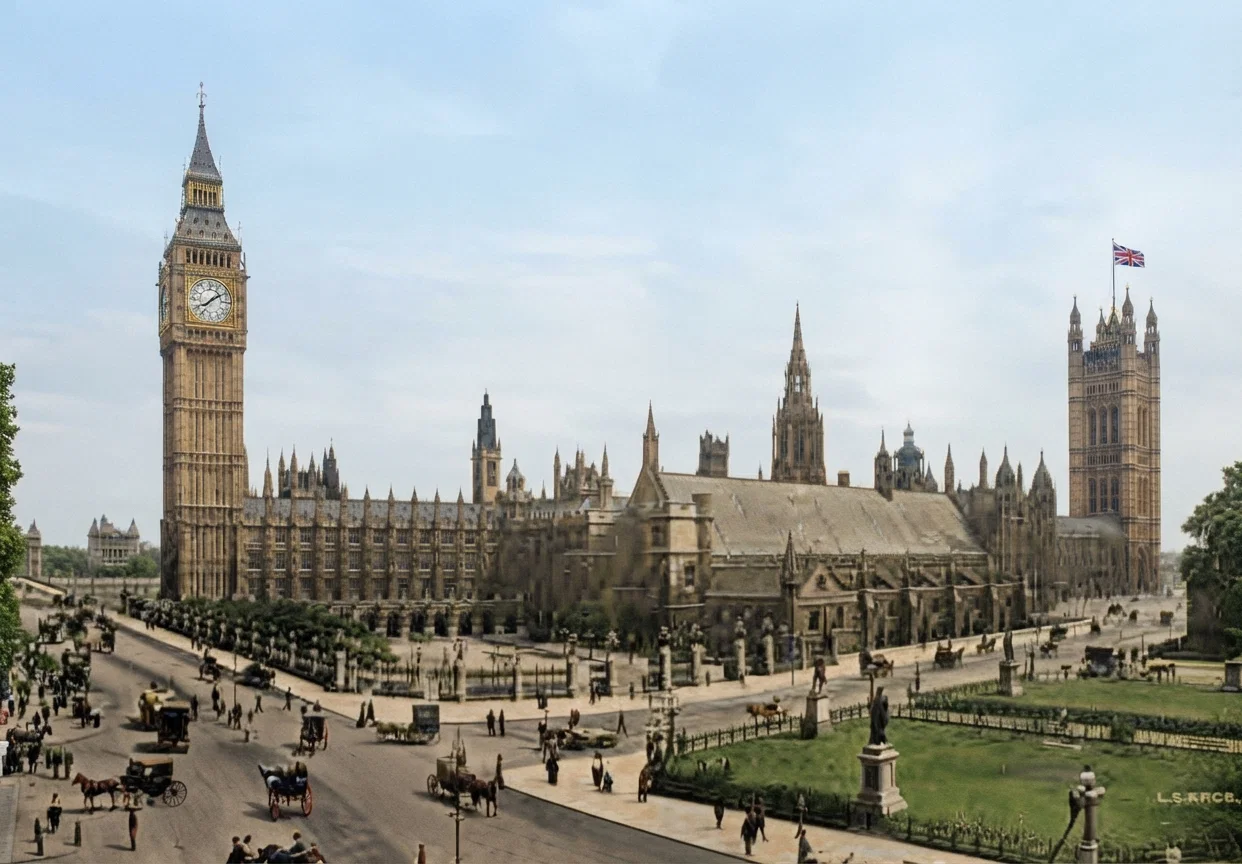
British Parliament Building.
We must remember that in England the Church and the Government are linked by many ties, and the majority of the people still think that an educational system which did not include definite religious instruction of some kind would be unsatisfactory. The Government Bill, while it was intended to redress the grievances of the Nonconformists, also aimed to give justice to the Anglicans and the Roman Catholics; but both these indignantly rejected it.
That which gave some show of color to the attitude of the Church was the fact that it owns practically all the so-called voluntary schools, concerning the taking over of which by popularly constituted bodies the bill had much to say. It is always a delicate matter in such transfers of property to fix upon terms which shall be just and liberal; but to the disinterested on-looker the Government terms certainly seemed reasonable. The clash came in reality over the nature of the teaching to be given the children in these schools. Should they be taught that the Church of England is the only true church, and Nonconformists are schismatics, or should they be taught the Bible on a broad Protestant basis, such as would be acceptable to Wesleyans, Congregationalists, and Nonconformists in general? The Church wanted the first and would not tolerate the second.
THE HOUSE OF LORDS.
Naturally Liberal sentiment is strong against the House of Lords; but Sir Henry Campbell-Bannerman, the Prime Minister, is a cautious man who knows to the full the force of that dogged Conservative sentiment which lies at the heart of British politics. It is not at all likely, therefore, that any extreme measures will be undertaken. Possibly the education problem, which everybody, including even the Archbishop, is thoroly tired of, may be solved by skilful administration. Certainly both parties to the controversy are dissatisfied with the present situation, and would be inclined to make some concessions. The House of Lords will probably survive this and a good many more episodes of the kind before its integrity is seriously threatened. As long as the country insists on giving the children religious education in the public schools, it can not but be extremely difficult for the representatives of Church and Chapel to agree as to the nature of that instruction; and, of course, a strictly secular education is hardly in line with the idea of a State-supported church such as the present establishment.
WOMAN SUFFRAGE.
The disturbances raised by certain agitators for woman suffrage known as "suffragettes," form a painful commentary on the times. That women of intelligence and respectability could seriously hope to gain access to the polls by deliberately making a nuisance of themselves at Westminster, and acting in such a way that it becomes necessary for policemen to carry them out bodily like so many maniacs, seems almost beyond belief. A love of notoriety probably had something to do with it. Needless to say, the cause of woman suffrage has gained nothing by such ridiculous methods of propaganda.
THE SUNDAY QUESTION.
An appeal for the better observance of Sunday was issued at the beginning of 1907, signed by the Archbishop of Canterbury, the Archbishop of Westminster (Roman Catholic), and the President of the National Council of the Evangelical Free Churches. After pointing out the importance of the weekly day of rest from the point of view of man's physical needs, it proceeds to the religious phase in these words: "Under the sacred sanction which attaches to the Lord's day, it is intended that all should have opportunity, in the worship of Almighty God, to escape15from the grip of ordinary cares and occupations into regions of higher thought and nobler aspiration." The newspapers mostly commend the document. They all want "better Sunday observance," but they seem to have rather hazy ideas of what that may mean. Thus one leading daily says that Sunday morning without doubt should be given to church going; but Sunday afternoon should be spent in harmless recreation. To this end the art galleries, museums, and libraries ought to be thrown open to the public so that people may have opportunity to go to some place besides the public house (saloon). The present Lord Mayor of London is President of the National Sunday League, organized to promote Sunday excursions, concerts, the opening of picture galleries, and similar places of public resort, and he has a good body of public opinion behind him. A large, new theater recently opened in North London, within a stone's throw of the place where these lines are being penned, has been hired for Sunday-night concerts under the supervision of this League, and is attracting large crowds. Everything considered, there is no immediate likelihood of Great Britain materially improving the status of Sunday as a day of rest and religious worship. The Puritan element, which exerts a good deal of influence in certain quarters of the United States, is here largely wanting.
The year has, on the whole, been a remarkably prosperous one for England, and the winter thus far has seen less real suffering than any that has occurred for some time. The foreign relations of the country are excellent, and the Government holds the confidence of the people both at home and abroad. The Prime Minister is acknowledged even by the party in opposition to have filled his position with ability. M. ELLSWORTH OLSEN. London, Eng., January, 1907.
A DESTRUCTIVE PRACTISE.
There is probably nothing which is taking the manhood out of the young men more rapidly than cigaret smoking. It is declared that opium enters into the manufacture of cigarets, so that it creates not simply an appetite for itself, but a voracious and ever-unsatisfied appetite. One smokes all the time, or is inclined to. A report from St. Louis recently stated that one merchant was driven from business by insipient paresis as a result of smoking from 100 to 150 cigarets a day. "Cigarets," he said, "did it all. I want to
smoke night and day. I go all to pieces when I haven't a cigaret in my mouth." Yet notwithstanding such warnings as this, the thousands continue to use them, so stupefied by the poison that they can not appreciate the merciful warning and admonitions.
A SECULAR PAPER ON SUNDAY.
FROM an editorial in the Birmingham (Ala.) "Ledger" of February 2 we take the following excerpt. After referring to two measures which the Legislature had passed, it refers to a Sunday bill before that body, and thus states its convictions concerning Sunday.
Now comes the question of whether the business of the roads will be stopped on Sunday. That would be bad for the State. The argument that Sunday is the Sabbath established by God, when He rested on the seventh day, will not hold. He "blessed the seventh day and hallowed it." He did not bless the first day of the week, nor did He hallow it. Again, on Sinai He said, "The seventh day is the Sabbath of the Lord thy God. In it thou shalt not do any work." He did not say that of the first day of the week, nor is there a word in the Bible to justify any change from the seventh day to the first day of the week. Not one single divine word to justify the change. So there is no sin in failing to keep Sunday as the Sabbath.
The change was made in the early days of the Christian church, but so far as we know it was not by divine command.
We Christians keep Sunday as the Sabbath, but we are not all the people of the world. We have established it as a day of rest and it is observed. We do not have any divine order or sanction for the change. The Bible has been searched many times, but there is no word about it. The only passage that can be found that even bears on the point is one that says, "On the first day of the week let every one of you lay by him in store as God has prospered him." That is taken to mean a recognized change to the first day, but it is not so stated. That is the moral status of the Sunday law.
PROHIBITION SENTIMENT.
THE Associated Prohibition Press Legislative Correspondence to date shows that an aggregate of over 250 bills relating to the liquor traffic have been introduced in thirty-five different state legislatures since January 1.
Up to Jan. 1, 1907, there were in the United States, three states under full state prohibition law, and six other states rapidly approaching state prohibition thru "county-option," while the people of more than thirty states and territories had no effective legal weapon whereby to abolish the liquor business within their borders.
In less than forty days since January 1, these conditions have developed:
State prohibition, constitutionally established in Maine, Kansas, and North Dakota, referred to as "dead" or "dying" by hostile press and license politicians, and bitterly assailed by all the influence and power which the liquor interests could bring to bear, has, on the contrary, proved extraordinarily alive.
"Resubmission," altho widely advertised in the newspapers, it is now openly conceded has failed to elicit any popular response in either Maine or Kansas, and has been shelved as an issue in both states, while legislation strengthening prohibition enforcement is scheduled for passage in all three legislatures.
EARTHQUAKES AN EARTH DISEASE.
THE following note, taken from the Christian Advocate, of New York, issue of January 24, gives some points on earthquakes that merit consideration:
"Professor Angelo Heilprin, of Philadelphia, whose standing is of the first-class, affirms that geologists are mistaken in the supposition that the more intense earthquakes have no connection with volcanic activities. He maintains that instability yet marks the history of the planet. He denies that any regions of the earth's surface may be considered as exempt from earthquakes.
"He directs attention to the fact that in the early part of 1902 there was a fearful earthquake in Guatemala (on April 18), and shortly afterward volcanic eruptions in various parts of Central America, culminating in the cataclysms of the Soufrière of Saint Vincent, on May 7, and of Mount Pelée, on Martinique, on May 8. The distance between the extreme points of disturbance, Martinique and Guatemala, is 2,000 miles.
"He says that when Lisbon fell in 1755, on that very day the volcano of Gotlugia in Iceland, 1,800 miles north, had a fearful paroxysm; and that when—almost exactly, if not precisely—San Francisco was destroyed, a remarkable volcanic eruption took place in the Alaskan group of islands, in which Bogoslov Island No. 3, a steaming volcano, was upthrown from the sea bottom.
"One thing is certain, the phrase terra firma is being discredited, and the radical disputes of scientists should be moderate in tone and manner rather than, as frequently, arrogant and savage."
A FRENCH CATHOLIC CHURCH.
A despatch from Paris, January 15, states that a movement is inaugurated to organize a National French Catholic Church. Thus organized, they would accept the Church-and-State separation law enacted by the French Parliament. The leader of this is M. Des Houx, who will publish an appeal to the French Catholics to throw off the yoke of Rome. The nucleus of the new organization will be the cultural associations authorized by law. Archbishop Valatte, head of the strong Catholic movement of Texas, will ordain clergy and bishops elected by the Parisians. The movement will probably not be as extensive as its promoters think. Catholicism is too strong for France to expect a great break.
SUNDAY IN EUROPE.
The Laws in Many Places Already Rigid, Are Being Enforced.
SIXTEEN years ago Switzerland gave all railway employees fifty-two weekly rest days, seventeen on Sunday, and has gradually extended this privilege to nearly all employees and stopped all Sunday freight and excursion trains.
Eight years ago Belgium stopped nine-tenths of its Sunday freight trains.
Recently Holland stopped ninety-nine per cent. and gave most employees one or two free Sundays a month.
Germany has made great progress in recent years in giving employees Sunday rest, especially in stores and factories. Recently 1,600 commercial houses in Frankfort demanded stricter Sunday closing. Many Sunday freights have been stopped, and nearly all in Alsace and Bavaria.
The Minister of Public Works in Prussia guarantees railway employees two rest days a month, generally on Sunday.
In Austria no despatch or delivery of freight is allowed on Sunday.
In Hungary all in factories have Sundays free, if practicable, but must have one whole or two half Sundays free each month.
In Norway, saloons are closed more tightly Sunday than anywhere else.
There and in Sweden, employees have one free Sunday in three, and factories are closed entirely. In Sweden no Sunday theaters or dancing are allowed, and no Monday lessons are given for Sunday study.
Canada's new law greatly reduces Sunday freight, and gives all employees on trains and in most factories one rest day in the next six, when necessity compels Sunday work.
France's Sunday law gives nearly all employees a weekly rest day, part or all on Sunday. Paris hotels now give all waiters and clerks weekly rest days. The railway officials met and arranged to grant weekly rest days to all employees very soon.—Catholic Mirror.
Tidal Wave Devastates Simalu
A DESPATCH FROM THE HAGUE dated January 22, declares that the tidal wave which devastated some of the Dutch East Indies, announced January 11, practically engulfed the Island of Simalu, and not only that, but that Simalu has almost entirely disappeared, and that probably fifteen hundred persons lost their lives. These islands are situated off the northwest coast of Sumatra.
Japanese Immigration to the United States
JAPANESE laborers will be plentiful in the United States if the present rate of immigration continues. On January 24 the steamer Korea landed 438 coolies who came by way of Honolulu. Several hundred more are reported to be on the way.
The Church and Political Power
By Macaulay
"The whole history of the Christian religion shows that she is in far greater danger of being corrupted by the alliance of power than of being crushed by its opposition.—Macaulay."
Primero Mine Explosion
TWENTY Italian miners lost their lives in an explosion of a mine at Primero, Colo., on the morning of January 23. The mine was badly wrecked and few bodies have been recovered.
Render Unto Caesar
By Jesus Christ
"Render unto Cæsar the things that are Cæsar's; and unto God the things that are God's"—Jesus Christ.
University Appropriations and Hague Conference
By Editor
The University of California is feeling justifiably grieved, it seems to us, that more was not appropriated by a Legislature which is appropriating to so many things; $250,000 was asked for a new library, but nothing was granted; $250,000 was asked for an agricultural building; this was cut down to $150,000. Wisconsin gives to its State university this year $822,000, yet the university in that State asks for $190,000 more. The University of Illinois asks the State for the next two years $1,622,500 for running expenses, and for special purposes $536,000 more. The University of Missouri is asking for $1,710,600 for the coming year. It would seem that as much good as the University of California is doing the agricultural people of this State, its requests in this respect should have been granted.
The coming Hague peace conference will probably convene June 15, tho it is not definitely settled. The "piece de resistance" of the program is said to be the question of disarmament and the limitation of armaments.