Your ShelfYour Projects

Signs of the Times, Vol. 33, No. 9.

Contained in this Issue
Earlier text: CHINA

CALIFORNIA SUNDAY AMENDMENT.

THE proposed amendment to the constitution of California naming the first day of the week as a rest day and giving the various county and municipal governments power to make laws to enforce it, has received hard treatment at the hands of the Assembly Committee. We stated last week in brief what was done at the hearing. Since that hearing the Committee have taken the bill into consideration again, and as one paper reports it, "Grove L. Johnson's Sunday amendment came out of Committee to-day shorn of all religious symptoms. It has been amended so that it merely provides one day of rest each week." It stands now as follows:
"Amending Article XX of the Constitution, by adding a new section thereto, to be known as Section 21, relating to a day of rest.
"The Legislature of the State of California, at its thirty-seventh session, commencing January 7, 1907, two-thirds of all the members elected to each of the two houses of said Legislature voting in favor thereof, hereby propose that Article XX of the Constitution of the State of California be amended by adding thereto a new section, to be known as Section 21, to read as follows:
"SECTION 21.—The necessity of encouraging and fostering the observance of one day in seven as a day of rest, is hereby recognized as essential to the welfare of the State; and to that end, it is hereby provided it shall be unlawful for any person, firm, or corporation, to require or compel, any employee to labor or perform services, for more than six consecutive days in any one week; and the Legislature shall provide penalties for the violation of this provision, and for the proper enforcement of the same."
IT WILL BE SEEN THAT NO DAY whatever is set apart, simply that employers should grant to their employees one day of rest in the week. It is very similar to a law which was passed Feb. 27, 1893, and may be found in the California Penal Code, page 722. As above presented it means little. What the Assembly will do with it we do not know. If it should pass the Assembly in this form, of course it will go to the Senate, and may, in order not wholly to offend the advocates of the measure, be passed in the form it comes from the Assembly.
IN A WAY THAT IS ALL that some of the advocates of the Sunday amendment ask for. They made a great plea for the poor laboring man; altho the union labor forces number thousands in this State, and have many able speakers, none of them have appeared to champion the bill. In fact, some of them are directly opposed to it. Yet if the advocates of that measure were honest in their appeal for the thousands who, they contend, have to work because there is no law guarding them in their rights against employers, they certainly ought to be satisfied with this bill in that respect, inasmuch as they contend that the measure they are pleading for is in no way religious.
WHETHER THEY BELIEVE THAT OR NOT, certainly no one else can believe it. They are still pleading for the religious measure. It is the religious day which they want sanctified by civil law, and they will never rest satisfied with a dozen measures of this kind, if it does not recognize the religious day, the first day of the week. This Amendment, if carried and adopted by the people, will be used as a basis for religious legislation. It ought to die; for apart from that it means nothing.
FULL REPORTS FROM THE HEARING did not reach us in time to publish in this week's paper, but we will have more upon the subject next week. There are some very interesting things to be published concerning that hearing, and we are sure that our readers will be glad to get them. The amended bill or substitute is made a special order for February 18, which we have not yet reached at this writing. We will report to our readers next week as to what is done with it.

Adventism

Adventism.—A friend sends us the Gospel Trumpet of January 3, containing an article on "Adventism," and requests us to answer it, but as we read the article the question comes, Of what use? It is a conglomerate mixture of truth and error and half truth, which is the worst kind of error. Uriah Smith is quoted as authority concerning the condition of things in 1844, and his testimony utterly perverted. Where he speaks of only a branch of the Advent movement, it is quoted as tho it applied to the whole movement. Nor did William Miller, as the writer states, acknowledge that the whole thing was a mistake, nor has the "seventh-day faction" been from time to time torn to pieces by discord, divisions, and confusion. It has always been true, in the very days of the apostles and of Christ Himself, that some disciples go back and "walk no more" with the body. No movements have been started in connection with God's work but what that has been true, and that is all that has been true in connection with the Seventh-day Adventists. There have been those who have withdrawn themselves, and who have fought the movement and its work; but the harder they have fought, the stronger the movement has developed, and greater success and blessing have ever attended the movement after they left. As stated by one of old, "They went out from us, but they were not of us; for if they had been of us, they would no doubt have continued with us." The animus of the whole article is shown in the writer's enmity to the Sabbath. That Sabbath is a part of God's holy law, and was kept by Christ Himself and His apostles. The only reason the Bible gives that men do not love it, is that the "carnal mind is enmity against God."
A Cure of Opium.—In parts of Malaysia a plant has been discovered which relieves the terrible pains which invariably accompany an attempt to leave off using opium. It is called chong hing. The leaves are simply boiled and the resulting tea is taken as a medicine. Many have tried it with complete success, and the Christian missionaries and many Chinese are making the medicine in large quantities for free distribution among the sufferers, who throng by the hundreds to the places where it is made. The government sales of opium fell off $30,000 in the month of November, 1906, as a result of the use of the new plant. Another result is that the natives are coming to look upon the missionaries with much more favor, as they are mainly instrumental in supplying the medicine.
Thomas A. Edison announces that he has perfected a storage battery which is half the weight and has twice the power of the common battery. One charging of the battery will carry an automobile one hundred miles, and the matter of running such a machine will be much simplified. The inventor has spent seven years perfecting the new battery.
A Princely Gift.—John D. Rockefeller's latest gift to the cause of education is in the shape of income-bearing securities valued at about $32,000,000. None of this will go to State institutions, but certain colleges will be selected for donations and endowments, forming a chain across the continent, those making the best use of the help to be favored.
"To the law and to the testimony; if they speak not according to this word, it is because there is no light in them." With regard to the matter contained in this paper, we always desire the reader to search the Scriptures, as did the Bereans, to see whether those things are so.

Approaching the Scriptures Humbly

The Scriptures of truth are God's spiritual food, of which we may freely eat and grow. But when we approach this table, let us come humbly, taking the lowest seat; then He that hath invited us will say, "Friend, go up higher."

Earthquake Shocks Continue in Kingston

Earthquake shocks continue in Kingston. One, February 11, was sharp, but did no damage. On the same date a shock was felt about sixty-five miles west of Richmond, Va. In Kingston, more than four thousand people are still camped in the public parks.

The Pope’s Appreciation of America

The pope acknowledges his appreciation of America's sympathy and interest in the Holy See in the French conflict, and has decided to express his appreciation thru some visiting prelate to the American episcopate, clergy and people. An encyclical issued in the regular way to the American episcopate would, he fears, prove detrimental, because it might create a bad impression on other countries.

The Larchmont Disaster

Long Island Sound was the scene of a terrible tragedy of the sea, February 12, when the schooner Knowlton crashed into the steamer Larchmont, both sinking at once. Of the two hundred passengers and crews only about twenty were saved, many of the passengers of the Larchmont meeting death in their berths. A freezing gale was blowing, and all the bodies which washed ashore, and many brought in in boats, were incased in ice. No one is able to give the exact cause of the disaster.

Power Comes thru Life

Power Comes thru Life.—He who would have additional power must have additional life. Christ is the only One who ever walked the earth, having complete and perfect power over sin, and the result of sin—death. His power was by virtue of the life, or Spirit, of God within Him. If we would have such power, we must have His life; and Jesus died that we might have the "power of the endless life" which is in Him. "I am come," He declares, "that they might have life, and that they might have it more abundantly."
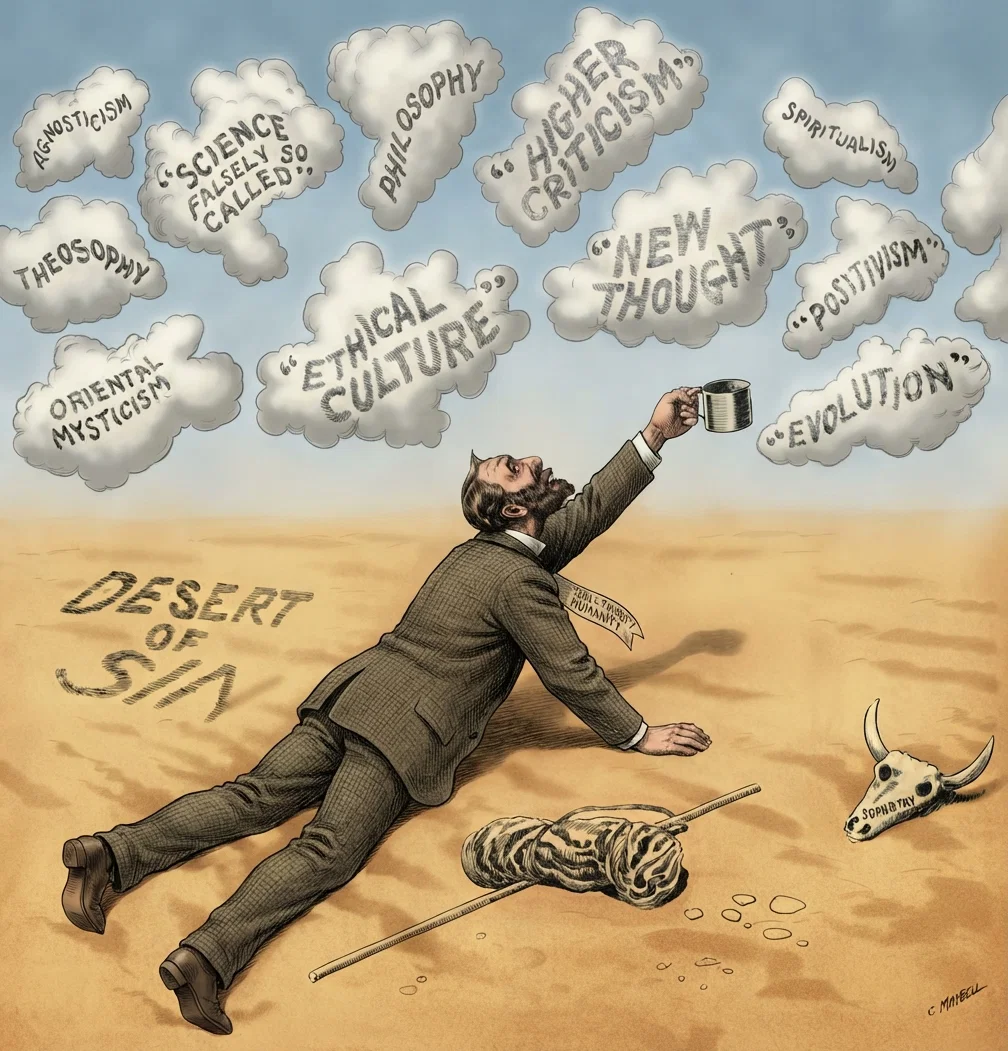
“CLOUDS WITHOUT WATER.” JUDE 12.

You have reached the end of this edition.

Signs of the Times · Feb 27, 1907