“SWEETNESS of temper is a precious heritage. It gives beauty to everything. It keeps its windows open toward the spice country, and fills the home with perpetual delight. The fortunate possessor of a sunny soul is God’s evangel in a dark world. He is a living gospel which no one will ever repudiate, and the blessedness of which all men will appreciate. The body will grow old and the smooth brow will be furrowed, but a happy disposition is an aureole to the gray crown of age. Blessed is he whose life looks out upon the land of Beulah and whose soul is responsive to the outlying vision.”
Process of Distillation
By F. D. C.
From Petal to Perfume
MOST of the world's extracts and essences come from Europe, our own total production probably not exceeding one twelfth that of one little town in France. Grasse, in southern France, is the center of the perfume industry. It is a city of lovely flowers, and during the larger part of the year the air is heavy with fragrance. Nice and Cannes, neighboring cities of Grasse, are her rivals in giving the sweets of the flowers to the world.
Not all our perfumes come from flowers. Leaves, wood, bark, gum, seeds, buds, and fruits of various plants yield perfume. Some plants produce more than one distinct perfume. The orange yields three.— fruit, flower, and wood each producing a different odor. Even some animals, as the civet cat, musk deer, whale, and beaver, yield some of the most important perfumes.
The animal perfumes are very strong and persistent. A grain of musk will distinctly scent millions of cubic feet of air without any appreciable loss of weight, and its scent is not only more penetrating but more persistent than any other known substance. The animal perfumes serve chiefly to hold the vegetable odors in solution. The most valued musk comes from China, though some is imported from Russia. Artificial musk is now manufactured as a coal-tar product.
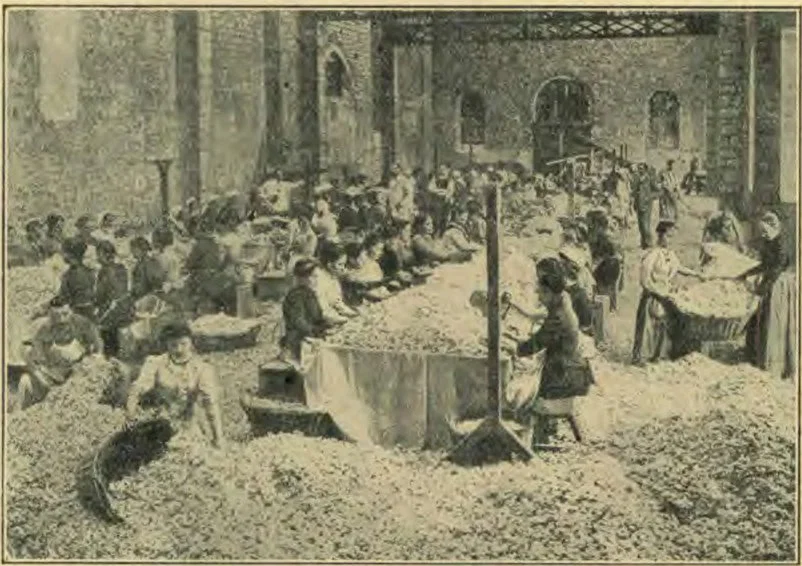
SEPARATING THE PETALS FROM THE PISTILS OF ROSES
Castor, or castoreum, is the name of a perfume taken from the beaver, while ambergris is that from the sperm whale. Ambergris is a solid, fatty substance of a dull-gray color found in the abdomen of the whale. As much as one hundred pounds of ambergris has been taken from one animal. It is usually found floating on the surface of the ocean, or cast upon the shore in regions frequented by whales, sometimes in masses of from sixty to two hundred and twenty-five pounds in weight. Ambergris was once used in medicine, but now its use is confined almost wholly to perfumes and flavoring materials.
Process of Distillation
There are four processes of extraction of the perfume from the flower,— distillation, enfleurage, maceration, and expression. By the first process the flower petals, buds, or seeds yielding sweet odors are put into a still with water, and the mixture distilled, or boiled, the fragrant oil or principle passing out through the steam. It is then carried to a receiver containing water. Here it rises to the top, and can be poured out or siphoned off. The water retains a certain portion of the essential oil. It is used over and over again, or sold as rose water, jasmine water, etc.
Process of Enfleurage
The process of enfleurage requires a wooden frame two to three inches deep having a glass bottom. The glass is covered with a layer of refined lard or beef suet, about one fourth of an inch thick. On this is placed a layer of flower petals or buds. The frames are placed one above the other and left from ten to seventy hours, according to the species of flower used. After this layer of flower petals is removed, the grease is scratched up and a new layer of the same kind of flower is sprinkled on the fresh surface. This is repeated until the grease has absorbed a large quantity of perfume. The grease, or pomade, is then scraped off and sold to perfume manufacturers, who melt it or treat it with alcohol or rectified spirit of wine for a month at summer heat. Essences of tuberose, rose, orange, and violet are obtained in this way. Much of the perfume extracted in Grasse is treated in New York and other large cities.
Sometimes a piece of wire netting is used in place of glass for the wooden frames, and on this is laid a piece of felt saturated with pure olive oil. The flower petals are sprinkled upon this greasy felt and left for many hours.
Process of Maceration
Orange and rose petals are usually treated by the process of maceration. In this the flower leaves are thrown into large iron kettles of melted lard surrounded by boiling water, and left for from twelve to twenty-four hours. The petals are then strained out and fresh ones put in. This process is repeated until the lard, or pomade, is highly perfumed.
Process of Expression
Expression, or squeezing, is suitable only in cases where the plant is abundantly supplied with essential oils, as in lemons, citrons, oranges, and limes. In such cases the rind is pared off, and the parings placed in a canvas bag and squeezed in a screw or hydraulic press. The oils so obtained are then separated from the water with which they are mixed, by a tap funnel and filtered.
Thus we see that perfumes are obtained by boiling, the odors passing off with the steam; by allowing the odors to be absorbed by cold or hot grease; or by pressure.
Sensitiveness of Essences
One writer, in speaking of the sanitary care acquired in the perfume industry, says: “One’s first impression on stepping inside the cool, airy buildings is astonishment at the cleanliness of everything. The whole place is quite as spotless, and perhaps even more so, than a food factory. It is explained that all kinds of essences are extremely sensitive. Anything that would cause the slightest smell must not be tolerated. All the workers are expected to observe the9strict rules of the factory in this respect; instant dismissal would follow the smoking of a cigarette.”
Quantity of Flowers Used
We can hardly comprehend the quantity of flower petals demanded by this industry. It is said that forty-five pounds of rose petals, and a rose petal is not very heavy, are required for one three-hundred-and-fiftieth of a pound of attar of roses. The total weight of flowers gathered annually at Grasse alone is estimated to be ten or twelve billion pounds. The factory flowers at Grasse are always heaped with flower petals, for it is estimated that 3,300,000 pounds of roses, 4,500,000 pounds of orange flowers, 700,000 to 900,000 pounds of violets, 1,320,000 pounds of tuberoses, together with thousands of pounds of other varieties, are used annually by the Grassois.
The work of the perfume industry is wholesome as well as pleasant, for it is claimed that two thirds of the people of Grasse live to be seventy years of age. But this simple folk have competitors in their work. Before the war, German scientists, by blending and combining chemicals, were manufacturing in large quantities perfumes that almost perfectly simulated the products coming from the factories at Grasse. We shall hope, for the sentiment connected with the beauty and sweetness of the natural product if for no other reason, that the real product will never be displaced by the artificial. F. D. C.
What to Do in a Thunderstorm
If you are out of doors in a very severe electrical storm, it is well to observe the following rules for your own protection:
1. Keep away from wire fences. They may carry a dangerous electrical charge long distances. Cattle in pastures are frequently killed from the neglect of farmers to ground the wire of the fence.
2. Keep away from hedges, ponds, and streams.
3. Keep away from isolated trees. Oak trees are frequently struck; beech are seldom struck. It is safe in a dense forest.
4. Keep away from herds of cattle and crowds of people.
5. Do not hold an umbrella over you.
6. It is safer to sit or lie down in an open field than to stand.
7. Drivers should dismount and not stay close to their horses.
8. Do not work with any large metal tool or implement.
If you are indoors:
1. Keep away from the stove and chimney. The hot gases from the chimney may conduct the lightning to and down the chimney.
2. Do not take a position between two bodies of metal, as the stove and the water pipe, for example. An exception to being near metals is the case of an iron bed. One of the safest places is on a mattress in an iron bed, provided you do not touch the metal. The metal surrounding you makes a safe cage which will prevent the lightning from reaching a person inside.
3. Do not stand on a wet floor nor draw water from the well or faucet.
4. Do not stand directly under a chandelier, near a radiator, nor on a register.
5. Do not use the telephone.— Electrical Experimenter.
Our First Locomotive
By J. Alvin Renniger
The first locomotive to turn a wheel on American soil was one of English manufacture, and the engine was called the “Stonebridge Lion.” It was taken on its first trip by Horatio Allen, who did much in those early days to make the railroad a reality. The experiment was conducted at Honesdale, New York. Mr. Allen thus describes the event:
FIRST ENGLISH RAILWAY TRAIN
“It was in the year 1829, on August 8, on the banks of the Lackawaxen, at the commencement of the railroad connecting the canal of the Delaware and Hudson Canal Company with the coal mines, and he who addresses you was the only person on that locomotive. The circumstances which led to my being alone on the engine were these:
“The impression was very general that the iron monster would break down the road, or that it would leave the track at the curve and plunge into the creek. My reply to such apprehensions was that it was too late to consider the probability of such occurrences; that there was no other course but to have a trial made of the strange animal which had been brought there at great expense; but that it was not necessary that more than one should be involved in its fate; that I should like the first ride alone, and that the time would come when I should look back to the incident with great interest.
“As I placed my hand on the throttle-valve handle I was undecided whether I should move slowly or with a fair degree of speed, but holding that the road would prove safe, and preferring, if we did go down, to go handsomely and without any evidence of timidity, I started with considerable velocity, passed the curves over the creek safely, and was soon out of hearing of the cheers of the vast assemblage present. At the end of two or three miles I reversed the valve and returned without accident to the place of starting, having made the first locomotive trip on the Western Hemisphere.”
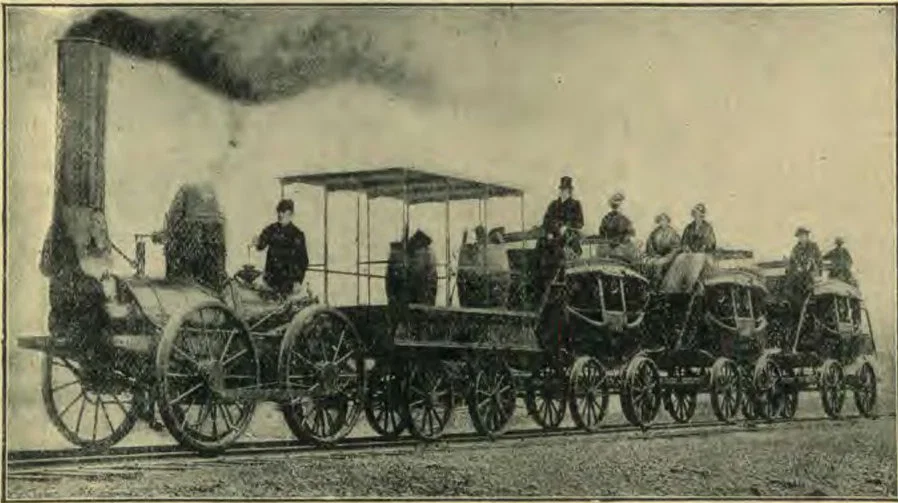
THE DE WITT CLINTON ENGINE AND TRAIN
The first railway train in New York. The omnibus was the only conception of a car in those days. The passengers on this train were very much annoyed by the sparks from the engine setting fire to their clothes.
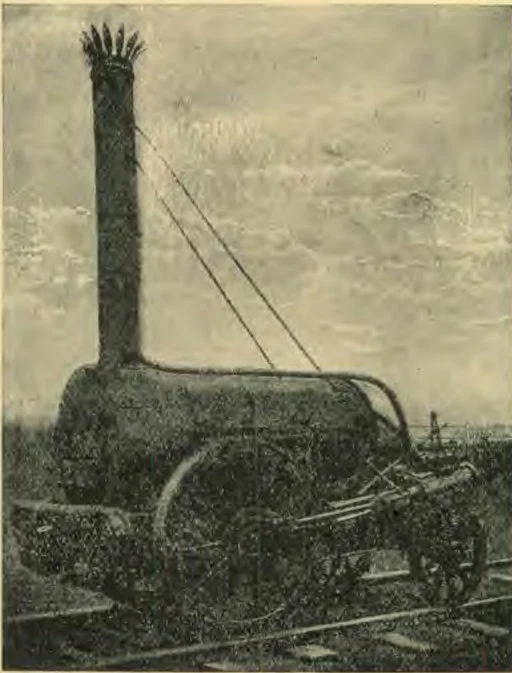
THE “ROCKET”
First locomotive in practical use, and which
Mr. Entwistle operated.
The first locomotive built in this country was constructed by C. L. Miller, of Charleston. It had a vertical boiler and was regarded as “a fearful and wonderful contrivance.” After several tests had been made, this locomotive was able to make sixteen to twenty-one miles an hour, carrying forty or fifty passengers in four or five coaches, and could make thirty-five miles without cars. Some time later the Negro fireman on this engine, not liking the noise of the escaping steam from the safety valve, fastened it shut. The explosion killed the Negro, and the engineer was severely injured. This accident put a temporary damper on experimental activities in this direction, but necessity stimulated the development of our present system of railroads, which serves the industrial interests of the country so efficiently.
J. ALVIN RENNIGER.
The Story of Mary
By Lulu White Butler
MARY’S face shone as she settled back in her seat at the young people’s convention. What a privilege it was to be a Seventh-day Adventist young person! How wonderful to have a part in the Missionary Volunteer movement! Her new Morning Watch Calendar was in her hand; surely no morning during the coming year should find her without it. They were discussing the Reading Courses now: What a splendid plan! Three or four of the best books in the world chosen each year by those who know how to choose books, and recommended to the young people. Of course she would take a set; she wished she had them to begin at once.
The Standard of Attainment! Why, yes, she longed to know her Bible well, and people were often asking her how old our church is, and who first found out that Saturday instead of Sunday is the Sabbath, and such questions. Yes, she would try for Attainment membership; she would study hard.
The first Morning Watch verse was familiar, and a few moments sufficed to learn it by heart. Why not learn them all? It seemed so easy, and three hundred and sixty-five verses in a year would be a wonderful asset. For one whole week Mary committed the scriptures, and proudly recited them at worship on Sabbath evening. The next morning she overslept, and had time only to read the verse. That week she committed two texts, hoping to make up the others later. Extra school work crowded in, and soon she came to hurry through a prayer, snatch a moment for the scripture or omit it altogether, in place of the sweet communion with God which she had formerly enjoyed.
When the Reading Course books arrived, Mary started “Advance Guard of Missions” at once. No effort of the will was required to finish that book; she could hardly let it alone. How Mary longed to make the most of her opportunities, and perhaps become a worker. “Steps to Christ” went a little slower. It was beautiful, and Mary felt stronger whenever she read it, but it did not compel her attention, and several months passed before she had finished it. It was some time before she found a convenient season to begin “History of the Waldenses.” Her school work was pressing, and when she had leisure it was so much easier to spend it with a magazine or in chatting with a friend. She admired the Waldenses, she coveted their sterling strength of character, but the record of their sufferings was not exactly comforting reading. How much pleasanter it is to dwell upon the sunny side of Christian service than to rejoice in the battle and the conflict! Finally Mary discovered that the book had been neglected so long that she had lost the thread of the narrative, and it seemed too great an effort to go back and pick it up.
During the early part of the year every Sabbath afternoon saw Mary with Bible in hand, carefully studying the Standard of Attainment texts. Her soul thrilled as she saw the message from various angles, each subject interlocked and interwoven with every other, and Christ the center of the whole. Confidence entered her heart as she felt herself becoming able to give an answer for her hope, and she decided that very soon she would be prepared to meet the people in some active missionary work. But one Sabbath afternoon she attended a special meeting, another she visited a sick friend, and by the third she found she had forgotten a number of the texts, and her interest waned. It was so easy to while away the Sabbath in resting, walking, or visiting.
Mary did not always go to prayer band now, and her voice was often silent in testimony meeting. She seemed to have nothing to say. Nor could she be persuaded to go out with tracts, for she felt quite out of touch with missionary effort.11
“What is the matter with Mary?” said the good old church elder to himself. “A few months ago her testimonies were an inspiration, and I thought she was planning to enter the work. Now she seems silent and uninterested. I must find out the trouble.” So he called on the young girl, and with true Christian tact began to seek the reason for Mary’s indifference.
“I suppose you will soon be ready for the Standard of Attainment examination. I remember how enthusiastically you started on your study. And don’t you think ‘History of the Waldenses’ an inspiring book? How little we have ever been called upon to suffer for the Lord! How about the Morning Watch? Did you think the psalms so rich as they are proving to be?”
Poor Mary! With a heart full of shame she saw her mistake. She had run well for a time, but something had hindered her. What had it been? No sudden change had come over her, only a gradual loss of interest. And she had not had the moral force, the will power, to rise above this inertia and press through to the end. Now she knew that she lacked spiritual backbone, and that unless this element could be added to her character she would sooner or later fall out by the way in her march to the heavenly city.
Kind and encouraging were the words that the old elder spoke to Mary, and after confessing her weakness to the Lord, she started anew to finish what she had begun. Over her study table you may now see the little motto, “Let us not be weary in well-doing.”
LULU WHITE BUTLER.
A Warning
WHEN Johnnie was a youngster, he went each day to school;
And there he studied grammar, and learned it all by rule.
He could give you definitions by the dozen and the score,
Knew how to analyze and parse, and oh, a great deal more!
Now Johnnie on examination day stood ninety-five per cent,
But he never seemed to comprehend that grammar rules were meant
For use at any other time; and so he paid small heed
As to whether in his daily speech his nouns and verbs agreed:
He often used two negatives, and I might also mention
That to case forms and to tenses he gave simply no attention.
Now his folks held the opinion that Johnnie was precocious;
The neighbors said, “He may be bright, but his language is atrocious.”
Well, Johnnie went to high school, when he’d finished the eighth grade,
And there he studied rhetoric, and how speeches fine are made;
Of paragraph and sentence structure constantly he read;
Yes, many a splendid principle was tucked into his head.
And Johnnie studied German and Latin grammar, too,
He could inflect a Latin noun or verb just as he ought to do.
Of no avail was all of this—I say it with a pang—
When it came to speaking English, Johnnie had recourse to slang.
“Why, it don’t make no difference, for all the fellows do it,”
Said he, when people told him that some day he would rue it.
Now his parents were so proud of him they could not help but show it;
The neighbors said, “He’s quite advanced, but dear! you’d never know it.”
In due time John was graduated, and then he went to college,
And there he entered broader and still broader fields of knowledge;
He read the famous classics, and he dipped into the sciences,
In laboratory learned to use all sorts of strange appliances;
At last he took psychology, and then he learned directly
That the habit he had long since formed of speaking incorrectly,
Might, in childhood or in early youth, have easily been broken;
Great difficulty now he’d find since he had long thus spoken.
Well, that troubled him a little, but still John did not see
For precision in one’s English any great necessity.
Now his folks thought John would make a mark,—he surely was a wonder;
But other people smiled and said, “He’d likely make a blunder!”
The hour came when John desired to enter a profession,
And put to use the knowledge he had now in his possession.
But he could not be a minister, a lawyer, or a teacher,
For in each of these vocations correct English was a feature
Of great, of prime importance; and this was even more true
Of editors and lecturers, and politicians, too.
He had no taste for medicine, nor was it in his line
To engage in business ventures on a large scale; so, in fine,
There was little John could do, and suddenly he knew it.
His long abuse of English,—very bitterly did he rue it!
His parents said that John’s poor health all their bright hopes had blasted;
“Oh, education,” others said, “on him was simply wasted!”
— Anonymous.
For the Finding-Out Club
Some of the First Things in the Bible
NAME the first man; the first woman:
Who was the first deceiver?
Who told the first lie?
Where in the Bible is the first prophecy concerning Christ?
Name the first babe born into this world.
Who was the first babe to be spoken of as a “babe”?
Who was the first adopted babe?
Give the first death recorded in the Bible.
What is the first record of one to die a natural death?
Who was the first murderer?
Where in the Bible is the first mention of drunkenness?
Who was the first woman accused—though falsely—of drunkenness?
When and by whom was the first temperance society organized?
When did God first give animal food to man?
What was the first thing Noah did upon coming out of the ark?
Where is the first law for capital punishment?
Where is the first mention of thorns?
Name the first city of the Bible. By whom was it built?
Give the first mention of musical instruments.
Who was the father of the musicians, or father of the fine arts?
Who was the father of the nomads and of commerce?
Who was the first worker in metals, or the father of the useful arts?
Who, according to the Bible record, wore the first bridal veil?
Who was the first person mentioned in the Bible that committed suicide?
Where is the first recorded instance of the purchase of land?
Who erected the first monument to the memory of the dead?
Where is the first mention of a library?
Where was the first wall built of water?
Who were the first women to demand their rights? Mrs. W. H. Claggett.
Correction to Answer to Question 6, in “Instructor” of July 3
THE recognized official motto of the United States is E Pluribus Unum, meaning “One out of many,” and not, “In God we trust,” as given in the INSTRUCTOR of July 31, though the latter is used on many of our coins, and is often thought of as our national motto. For this reason those who gave this answer were credited with a perfect answer.
A Prophecy 2300 Years Long
By Carlyle B. Haynes
Second Talk on Daniel Eight
CARLYLE B. HAYNES
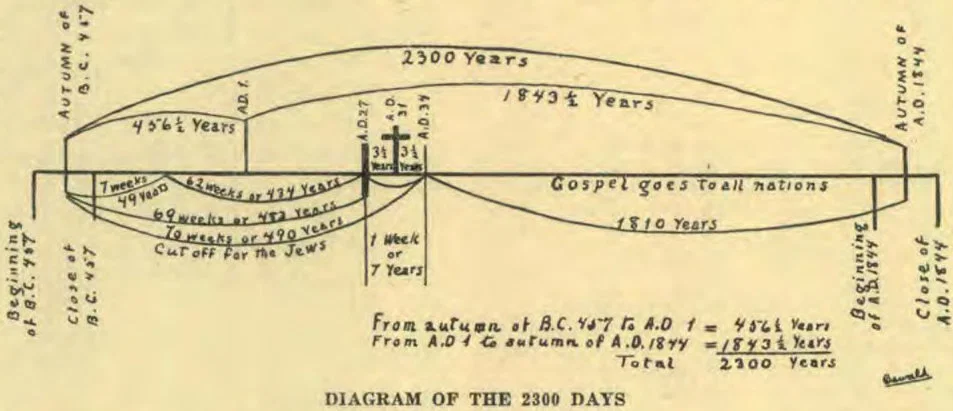
DIAGRAM OF THE 2300 DAYS
When Donald Hunter came into the big tent on the baseball lot on Monday night, he saw the same charts on the platform that Brother Harris had used the night before, and he remembered the preacher had said that on Monday night he would continue the explanation of the wonderful prophecy of the eighth chapter of Daniel. He was very eager to understand the rest of this prophecy.
Elder Harris first reviewed briefly the talk of the preceding night. He pointed to the charts, and said that, as previously stated, the ram was a symbol of Medo-Persia, the goat a symbol of Greece, and the little horn of Rome. After reading Dan. 8:13, 14, he said:
“Whenever time is found in connection with symbolic prophecy, the time itself is symbolic. In prophecies of this kind we are given a divine rule of reckoning. This rule is in Eze. 4:6, and reads, ‘I have appointed thee each day for a year.’ “Hence every day mentioned in this prophecy represents a year. Therefore, a certain work, called the cleansing of the sanctuary, is to be done at the end of a long period of twenty-three hundred years.”
The minister read Dan. 8:15, 16, where the angel Gabriel was commanded to make Daniel understand the vision, and then continued:
“In response to this command, Gabriel immediately begins to instruct Daniel in the meaning of the vision. He explains the ram, the goat, and the little horn in verses 20-25, and then refers to the twenty-three hundred years. Verse 26. This chapter closes with the statement that the vision was not understood.
“Plainly it was the prophecy of the 2300 days which Daniel did not understand, for the angel had very carefully explained the symbols of the ram, the goat, and the horn. Since Daniel did not understand the vision, it is clear that the commission to make him understand had not yet been fulfilled, and hence we shall certainly expect Gabriel to return and carry out this unfulfilled duty.
“In the ninth chapter we find Daniel, by study and prayer, seeking for light and information. In response to Daniel’s prayer, Gabriel returns to make him understand the 2300 days. The angel now says, ‘Therefore understand the matter, and consider the vision.’ Dan. 9:20-23.
“In obedience to this command, Daniel considers the vision. He sees again the ram, the goat, and the horn, and recalls the explanation which had been given of them. But there is a part of the vision he does not understand, the 2300 days, at the end of which the sanctuary is to be cleansed. As he recalls this part of the vision, Gabriel begins right there to explain it, saying:
“‘Seventy weeks [of this 2300-day period] are determined [or cut off] upon thy people and upon thy holy city, to finish the transgression, and to make an end of sins, and to make reconciliation for iniquity, and to bring in everlasting righteousness, and to seal up the vision and prophecy, and to anoint the Most Holy.’ Dan. 9:24.
“This divides the 2300-day period into two parts, 70 weeks or 490 days, and the remainder, which would be 1810 days. As these days stand for years, we now have two periods, one of 490 years, the other of 1810 years, or 2300 years in all.
“The next verse gives the starting point of the entire period, and at the same time divides the first period of 490 years into three smaller periods. Read verse 25.
“Here we have the starting point of the 2300 years, and of the 490 years as well. It is to begin with some decree, or commandment, to restore and rebuild Jerusalem. From the time that decree is given it will be just 2300 years to the time when the sanctuary begins to be cleansed.
“The first period of 490 years is divided into three smaller periods: of seven weeks, or 49 years; of 62 weeks, or 434 years; and of one week, or seven years. The city of Jerusalem was to be rebuilt during the 49 years, the Messiah was to appear at the end of the 434 years, and the full end of the 490 years given to the Jewish people was to be reached at the end of the third period of one year. After this there would still remain the 1810 years of the full period of 2300, and at the end of this last period, the record says, ‘then shall the sanctuary be cleansed.’
“Now before we can find the end of any of these periods we must obtain the date when the whole period of 2300 years begins. And this, in the words of the angel, is at ‘the going forth of the commandment to restore and build Jerusalem.’ And this date is given,13with the very commandment, or decree, itself, in the seventh chapter of Ezra. The date given in the margin, 457 B. C., is the date which begins the 2300-year prophecy.
“With this date we have found a starting point. Forty-nine years from 457 B. C. brings us to the complete rebuilding of Jerusalem; 483 years, or ‘seven weeks, and threescore and two weeks,’ from 457 B. C., reaches to the appearance of the Messiah; 490 years from 457 B. C., reaches to the end of the time given to the Jewish people; and 2300 years from 457 B. C., reaches to the time of the cleansing of the sanctuary.”
By close attention Donald, though he was only a boy, found that he could understand the prophecy, but he made up his mind he would study it all over very carefully by again reading the book, “Thoughts on Daniel,” which his father had bought for him the previous night. Brother Harris continued:
“Four hundred and eighty-three years after 457 B. C., the Messiah was to appear to his people, the Jews. To what would this bring us? This period, 483 years, would reach from the first day of 457 B. C., to the last day of 26 A. D. Thus:
First day of 457 B. C. 483 Last day of 26 A. D.
“Now it is plain that if the decree did not go forth on the first day of 457 B. C., but some time later, that the 483 years would reach over into the year 27 A. D. The decree did take effect in the autumn of 457 B. C., and we are, therefore, brought over to the autumn of A. D. 27 as the ending point of the 483 years.
“Thus the prophecy points directly to the year 27 A. D. as the year for the appearance of the Messiah to his people. But was not Christ born before this year? — Yes, but notice carefully the wording of the prophecy, ‘Unto the Messiah the Prince.’ What is the meaning of the word ‘Messiah’? It is the same in the Hebrew language as ‘Christ’ is in the Greek. ‘Messiah’ means ‘the anointed One;’ and ‘Christ’ means ‘the anointed One.’ Hence we must locate the date of the anointing of Jesus of Nazareth.
“Jesus was anointed at his baptism. This we see by reading Matt. 3:13-17, and the date of this anointing is 27 A. D.
“Immediately after his baptism, Jesus was in the wilderness of temptation for forty days. We read that then ‘Jesus came into Galilee, preaching the gospel of the kingdom of God, and saying, The time is fulfilled, and the kingdom of God is at hand: repent ye, and believe the gospel.’ Mark 1:14, 15.
“Note the significance of this expression of Christ’s, ‘The time is fulfilled.’ At this point the 69 weeks, or 483 years, of the prophecy of Daniel ended. At this point the Messiah, the anointed One, was to appear to his people. And at this very point the Messiah did appear, being anointed at his baptism, and then coming and preaching, ‘The time is fulfilled.’ He called their attention to the very prophecy we are now studying, the very prophecy which proves his Messiahship.
“Continuing our study, we find there is one more week of the seventy which were given to the Jewish people. Sixty-nine weeks have brought us to 27 A. D. There is now another week of years, and adding this to 27 A. D., we are thus brought to the year 34 A. D., as the ending point of the seventy weeks, or 490 years.
“Now in the middle of this last week something takes place which is especially noted in the prophecy. ‘And he shall confirm the covenant with many for one week: and in the midst of the week he shall cause the sacrifice and the oblation to cease.’ Dan. 9:27.
“In the ‘midst’ of the final week of the seventy ‘the sacrifice and the oblation’ were to cease. This sacrificial system was all typical of Christ, the great Sacrifice, and when Christ died on the cross, during this week, type met antitype, and the typical system thus closed. This was shown by the veil of the temple being rent in twain at the time of the death of Christ. Matt. 27:51. However, during the entire week, from 27 to 34 A. D., the covenant was to be confirmed with the Jewish people.
“The full period of seventy weeks, or 490 years, given to the Jews expired in 34 A. D. At this point we find the prophecy being fulfilled by the official rejection of the gospel of Christ by the ruling body of the nation, the Sanhedrin, in their persecution of the disciples and the martyrdom of Stephen, and from this time onward the apostles turned to the Gentiles. At this time, too, the great apostle to the Gentiles, Paul, was converted.
“We have now completed our consideration of the first division of the 2300 years, that period given to the Jewish people, which was 490 years long. We have found this ending in the year 34 A. D. To this must now be added the 1810 years of the 2300 which still remain. And when this is added to 34 A. D., we are thus brought to 1844 A. D., as the grand terminal point of the entire period of the 2300-year prophecy. And the accuracy of this date cannot be successfully challenged, for it is based upon the central facts of the gospel of Christ, his baptism, ministry, and crucifixion.
“According to the prophecy, then, the sanctuary would be cleansed in 1844. With these facts clearly before us we are prepared to pass on to a consideration of what the sanctuary is, and what is meant by its cleansing.”
Donald found himself so interested in this prophecy that it was very hard to wait until the next night to hear it further explained. The following day he read it all over again in “Thoughts on Daniel,” and thus was much better prepared to understand what the speaker said the next evening.