Is There But One Law, or Are There Two?
The Proof Offered
A Series of Striking Contrasts
III
THE doctrine of the abolition of the law of Ten Commandments is in direct opposition to both the spirit and the letter of the whole gospel of Christ. But in this connection, it is urged that there are passages of Scripture which very plainly teach that some law has been abolished by Christ. And this is true.
It is claimed, moreover, that there is but one system of law revealed in the Bible, and therefore these verses which speak of a law's being done away must have reference to the Ten Commandments.
Two Laws in the Bible
THIS claim is a great mistake, and it arises from a failure to discern the difference between the moral and the ceremonial law of God. A failure to comprehend the difference between these two systems of law leads to the attempt to blend them by making the verses of the Bible which speak of the abolition of the ceremonial law refer to the moral law of Ten Commandments.
The verses used to show that the law has been abolished are the following:
"Having abolished in His flesh the enmity, even the law of commandments contained in ordinances; for to make in Himself of twain one new man, so making peace." Eph. 2: 15.
"Blotting out the handwriting of ordinances that was against us, which was contrary to us, and took it out of the way, nailing it to His cross; and having spoiled principalities and powers, He made a show of them openly, triumphing over them in it. Let no man therefore judge you in meat, or in drink, or in respect of an holy day, or of the new moon, or of the Sabbath days: which are a shadow of things to come; but the body is of Christ." Col. 2: 14-17.
"One man esteemeth one day above another: another esteemeth every day alike. Let every man be fully persuaded in his own mind." Rom. 14: 5.
"For the priesthood being changed, there is made of necessity a change also of the law." Heb. 7: 12.
Christ Changed a Law
IT is true that by the death of Christ, a law has been changed and abolished; but it was not the moral law of Ten Commandments, nor any part thereof. This will be made clear from a close study of the subject of the two laws.
There are many religious teachers who deny that there are two laws in the Bible. This is a mistake which a little study will correct.
"Moreover Thou leddest them in the day by a cloudy pillar; and in the night by a pillar of fire, to give them light in the way wherein they should go. Thou camest down also upon Mount Sinai, and spakest with them from heaven, and gavest them right judgments, and true laws, good statutes and commandments; and madest known unto them Thy holy Sabbath, and commandedst them precepts, statutes, and laws, by the hand of Moses Thy servant." Neh. 9: 12-14.
In this passage, it is declared that the Lord Himself came down upon Mount Sinai, and gave them "true laws," and that He also commanded them "precepts, statutes, and laws, by the hand of Moses." Here, then, are two systems of law; one that God did not inspire a man to speak or write, but which He both spoke and wrote Himself, and another which was given to Moses by inspiration, and which Moses spoke and wrote.
This distinction between the two systems of law is made clearer in the following passage: "Neither will I make the feet of Israel move any more out of the land which I gave their fathers; only if they will observe to do according to all that I have commanded them, and according to all the law that My servant Moses commanded them." 2 Kings 21: 8.
There can be no question that two laws are mentioned in this verse, for the distinction between them is made broad and clear. One, God says, is that which "I have commanded them," and the other is that which "My servant Moses commanded them." If this distinction were always kept in mind by the student of the Bible, the confusion that exists on the subject of the two laws could not prevail.
Two Distinct Systems
THERE is one law that deals only with moral duties. Exodus 20. The other law is wholly ceremonial. Heb. 9: 10.
The moral law is contained in the Ten Commandments. This law was spoken by the Lord Himself. Deut. 4: 12, 13. The ceremonial law related to the rites and ceremonies of the sacrificial system given to the Jews, and this was spoken by Moses. 2 Kings 21: 8.
The moral law of Ten Commandments was written by God. Ex. 31: 18. The ceremonial law, relating to the priesthood, the sacrifices, and the offerings, was written by Moses. Deut. 31: 9, 24.
The moral law was engraved by God upon stone. Deut. 4: 13. The ceremonial law was written by Moses in a book. Deut. 31: 24.
The moral law, on stone, was placed in the ark. Deut. 10: 5. The ceremonial law, in a book, was placed by the side of the ark. Deut. 31: 24-26.
There was a law which was "right," "true," and "good." Neh. 9: 13. There was another law, which was "not good." Ezek. 20: 25. These two could not possibly be the same.
There was a law "which if a man do, he shall even live in" it. Ezek. 20: 11. There was another law, whereby a man should "not live." Ezek. 20: 25.
One law was "perfect." Ps. 19: 7. The other "made nothing perfect." Heb. 7: 19.
The Two Differentiated
ONE law Christ did not come to destroy. Matt. 5: 17. The other He abolished. Eph. 2: 15.
The moral law will endure while heaven and earth stand. Matt. 5: 18. The other has been taken out of the way by Christ. Col. 2: 14.
Of the one law, Christ said that whoever should break one of its least precepts should be condemned. Matt. 5: 19. Of the other law, the apostles gave no commandment that Christians should keep it. Acts 15: 24.
One law is "the law of liberty." James 2: 12. The other was a "yoke of bondage." Gal. 5: 1. Two things so entirely opposite cannot be the same thing.
One law Paul took "delight" in. Rom. 7: 22. The other was an unbearable yoke. Acts 15: 10.
One law is established by faith in Christ. Rom. 3: 31. The other was abolished by the cross of Christ. Eph. 2: 15. There must be two laws; for could one law be abolished and not abolished at the same time?
One law is "holy, and just, and good." Rom. 7: 12. Another is "the enmity," "that was against us, which was contrary to us." Eph. 2: 15; Col. 2: 14.
Other Striking Contrasts
THE moral law contains "the whole duty of man." Eccl. 12: 13. The other "stood only in meats and drinks, and divers washings, and carnal ordinances." Heb. 9: 10.
The moral law was by nature written in the hearts of the gentiles. Rom. 2: 14. The other became a wall of partition between Jews and gentiles. Eph. 2: 14, 15.
One was "the royal law." James 2: 8. The other was "the law of Moses." Acts 15: 5.
The moral law Jesus came to make honorable and to magnify. Isa. 42: 21. The other He disannulled. Heb. 7: 18.
The moral law is that by which the world will be judged. James 2: 12. The other will judge no man. Col. 2: 16.
Thus it is clearly seen that the Bible teaches two laws, one of which is to endure forever, the other being temporary, and meant to continue only until the sacrificial system should be done away by the great sacrifice on Calvary. Christ's death did not abolish the Ten Commandment law, a part of which is the Sabbath; but it did abolish the ceremonial law, which governed the sacrificial system.
Second Law Dependent on First
THE sacrificial system was established as "a shadow of things to come," and it pointed forward to Christ and His sacrifice. It was made necessary by sin, and was brought into existence to provide a typical remedy for sin. It was governed by a law, the law of the priesthood; and this law was changed when the priesthood was changed.
Let it be remembered that sin, which gave rise to the sacrificial system, "is the trans8gression of the law." 1 John 3: 4. Then before sin a law existed, the violation and transgression of which was and is sin. A priesthood was established to "offer both gifts and sacrifices for sins." Heb. 5: 1. This priesthood was established because the law of God had been broken, and to provide a remedy, in type, for the transgressions of the law. Sin was before the priesthood, and law was before sin.
The offering of "gifts and sacrifices" was done "according to the law." Heb. 8: 3, 4. That is, there was a law to govern the sacrificial system, the system that provided a remedy for the transgression of a preceding law. Then it can be put this way: Priesthood before the law which governed the priesthood; sin before priesthood; and law before sin. Now the question is, Can the law which governed the priesthood and regulated the offerings for sin be the same law which existed before sin, and to transgress which is sin? — Most assuredly not.
Which Law Reveals Sin?
BUT can it be determined which law it is that reveals sin, and to transgress which is sin? — Very easily. "What shall we say then? Is the law sin? God forbid. Nay, I had not known sin, but by the law: for I had not known lust, except the law had said, Thou shalt not covet." Rom. 7: 7.
The law, then, which is the standard of righteousness, and reveals sin, and to transgress which is sin, is the law that says, "Thou shalt not covet." This is the Ten Commandment law, the law which declares the seventh day to be the Sabbath of the Lord.
The Ten Commandment law was not abolished by Christ. The sacrificial law, the law of the priesthood, the ceremonial law, was the one which the death of Christ brought to an end. Therefore the Ten Commandments still exist, are still in force; and every Christian is under obligation to God to observe every one of them faithfully by the power of the commandment-keeping life of the Saviour, which is given freely to all who will accept it.
“What Hath God Wrought!”
“The Isles Shall Wait For His Law”
MANY times this Biblical expression of wonderment comes to the mind of one reviewing the growth of the cause of God in the Philippines. The natural foes of this purifying message, which are inherent in every individual, are just as numerous and powerful here as in the sons of Adam anywhere. It could almost be said that they prevail to a greater degree here, on account of age-long custom making sin second nature in an already weak island race.
Yet the tendency of the depraved heart for sinful indulgence, and the soul-consuming demand of the carnal mind for participation in that which Scripture describes truthfully as “the enemy of God,” does not succeed in competing successfully against the higher claims of the “blessed hope.”
That narcotic drug, nicotine, has its captives here more than almost anywhere else. All the men, with few exceptions, and many women, are held in its tenacious meshes. Still, God’s drawing love proves its conqueror. Christ’s blood, in which there is so much power, compels this enemy of purity and holiness to retreat. The 235 baptisms of last year represent almost that many struggles and victories over tobacco.
Then looking at temporal things, one is impressed that this finishing work of the everlasting gospel is not to be restricted, even though opposition from without takes on vigorous action.
In the suburban section of Manila, a year ago, stood a native house on a large lot. To-day it sinks into comparative oblivion, and there has arisen a small printing plant, which is a center of consecrated activity; and beside this stands a neat home for its manager. Truly, the King’s business requires haste; and it is making haste, too, as was testified by a scene I witnessed a week ago, of the formation of a country church of 104 new members, the result of one tent effort.
Not overlooking John 15:5, we must admit that there is a sacred partnership in this developing movement, which makes the above report possible. Without the loyal financial support of devoted Christians abroad, and liberal conferences releasing valuable workers, this would not have been accomplished. Responsibility for success or failure rests more or less on each member of Christ’s body, and not altogether on the missionary. Let each of us prove true to our trust, and share in the approaching harvest, which now literally calls for reapers.
Neglected Duties and Excuses
"A NEGLECTED duty looks no better for being clothed in flimsy excuses."
THE FOUNDATION IS LOVE
CHRIST bore the Father's law upon His heart as He came to this world. With poetic expressiveness, the psalmist said of Him: "Sacrifice and offering Thou didst not desire; Mine ears hast Thou opened; burnt offering and sin offering hast Thou not required. Then said I, Lo, I come: in the volume of the book it is written of Me, I delight to do Thy will, O My God; yea, Thy law is within My heart." Ps. 40: 6-8.
In presenting to the world this divine law that was borne in the Master's heart, the Son of God said, "Therefore all things whatsoever ye would that men should do to you, do ye even so to them: for this is the law and the prophets." Matt. 7: 12. All will recognize that the first part of the foregoing utterance is the Golden Rule,—"All things whatsoever ye would that men should do to you, do ye even so to them;" but do we recognize that the Master tells us that this Golden Rule "is the law and the prophets"? In other words, His divine powers are called into action to express, in a single terse sentence, the great essence and summary of the teaching of both the law and the prophets.
Many have regarded this as a New Testament maxim, and have thought that expressions like the Golden Rule were not found in the Old Testament Scriptures; but whether men may be able to find such wonderful teachings in the law and the prophets of the Old Testament, the divine Teacher Himself had no difficulty in finding that the very heart of the law is, to do to others the things we would wish them to do to us.
THE LAW'S LIVING EXPRESSION
THE Jewish nation had this superior teaching through their prophets, and the law that was delivered to them; but they never met the high ideals of the Master in their practical life. It was Jesus alone who could give that truth in its fullness, not only as a teacher, but as one who lived all that He taught.
That was what clothed His words with such power. He not merely presented theories concerning the law of Jehovah, but He was the living expression, in actual deeds, in both heart and outward life, of the law that God had given to be such a choice blessing to mankind.
The all-pervading principle of the law of God is love. This is shown not only through the Golden Rule, which calls us to do to others what we would have them do to us, but the Master tells it more fully in His conversation with the Pharisees and the Sadducees. A lawyer of their number said to Him, "Master, which is the great commandment in the law?" "Jesus said unto him, Thou shalt love the Lord thy God with all thy heart, and with all thy soul, and with all thy mind. This is the first and great commandment. And the second is like unto it, Thou shalt love thy neighbor as thyself. On these two commandments hang all the law and the prophets." Matt. 22: 36-40.
All the law and the prophets, then, hang upon the great principle of love. We are to render supreme love to God, and we are to love our neighbor as ourselves. The law that expresses these broad and deep principles is the one that Jesus Christ bore to humanity upon His heart; and all of the law that He gave to us in this strong way is expressed in these commandments of love.
NO PROVISION FOR HATRED
THERE is no provision for hatred in the plan of salvation or in the character of the Master. Satan has misrepresented Him in all the ages. He even succeeded in getting the Lord's own professed representatives to crucify Him. In like manner, many doctors of divinity all through the ages, and even in the present time, greatly misrepresent the divine Christ. But there in His word stand these supreme principles of love to God and love to humanity.
In God's law, then, is found the true expression of the fatherhood of God and the brotherhood of man.
We find, also, that these wonderful principles of love were taught by the prophets of old, the same as was the Golden Rule. "Thou shalt not avenge, nor bear any grudge against the children of thy people, but thou shalt love thy neighbor as thyself: I am the Lord." Lev. 19: 18.
This teaching, then, which Christ presented when He was here upon earth in person, was only a continuation and a further expression of what He had given through the prophets and teachers of the old dispensation. He is "Jesus Christ, the same yesterday, and to-day, and forever." That lovely character remains always the same, and we can ever depend upon Him who bore to humanity the law of Jehovah in His warm heart of love.
THE AIM OF THE VATICAN
By P. T. M.
THE Jezebel of the Apocalypse and the papacy of the Middle Ages are, without controversy, one and the same power. To exalt herself into a place where she can first woo and wed and later lord it over the civil power, thus "reigning over the kings of the earth," has ever been the aim of the Vatican. It was her aim in the Dark Ages, and it is her plan and purpose to-day. And the present struggle in Europe is made by her to serve these unhappy designs in a manner that but few even suspect.
The present pope, Benedict XV, has toiled unremittingly to this end. On the first day of November,—the feast of All Saints,—1914, he issued his first encyclical letter, under the title "Ad Beatissimi." In this encyclical, he speaks of the deep distress which fills his soul because of the war, the "most mournful spectacle of which there is any record." Then he adds: "Certainly those days would seem to have come upon us of which Christ our Lord foretold: 'You shall hear of wars and rumors of wars—for nation shall rise against nation and kingdom against kingdom.'"
He next delivers himself of the significant words, "We implore those in whose hands are placed the fortunes of nations to hearken to our voice." From this it will be clear that the supreme pontiff is calling upon the rulers of the belligerent nations to listen to him and to let him be the peacemaker between them; but to ask them to do this is in principle and fact to ask them to restore the papacy to its ancient place of power and splendor, as the arbiter between all nations.10
"SOLE, LAST SUPREME JUDGE"
It is to ask the nations to recognize the so-called "vicar of Jesus Christ" as the mediator in the greatest of earthly matters. He is, in effect, restating the words of another famous pontiff: "I claim to be the supreme judge and director of the consciences of men—of the peasant that tills the field, and the prince that sits on the throne; of the household that lives in the shade of privacy, and the legislature that makes laws for kingdoms. I am the sole, last supreme judge of what is right and wrong." (Cited by W. E. Gladstone, "Rome and the Newest Fashions in Religion.")
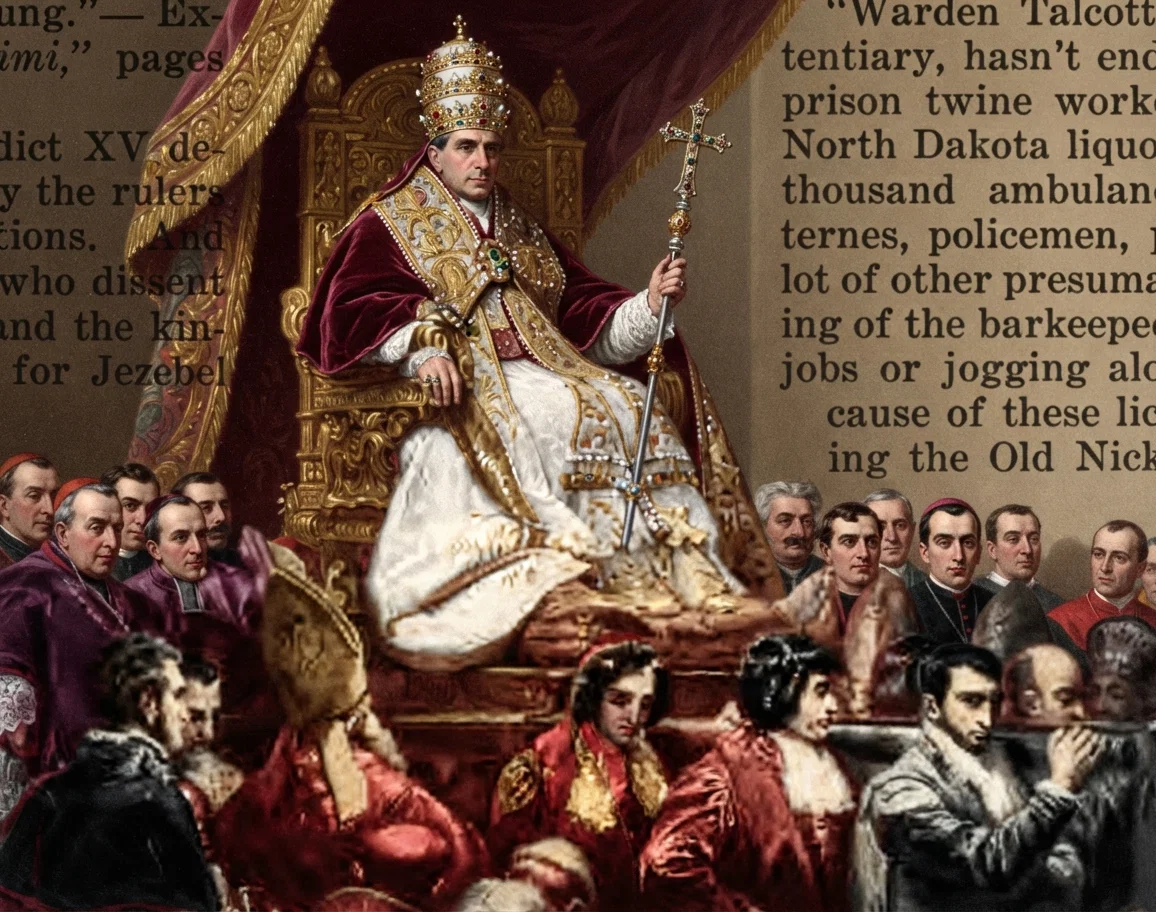
This assumption of the papacy is further emphasized in the words which are spoken at the coronation of a new pontiff at the time when the papal diadem is placed upon his head: "Take thou the tiara adorned with the triple crown, and know that thou art the father of princes and of kings, and art the governor of the world." (Coronation service of the pontiffs.)
And in the encyclical before cited, Benedict XV further states: "But it is not the sanguinary strife alone that distresses the nations and fills us with anxiety and care. There is another evil raging in the very inmost heart of human society, a source of dread to all who really think, inasmuch as it has already brought, and will bring, many misfortunes upon nations, and may rightly be considered to be the root cause of the present awful war.
FOUNDATION OF STATES SHAKING
"FOR ever since the precepts and practices of Christian wisdom ceased to be observed in the ruling states, it followed that, as they contained the peace and stability of institutions, the very foundations of states necessarily began to be shaken. . . . Let the princes and rulers of peoples remember this truth, and let them consider whether it is a prudent and safe idea for governments or for states to separate themselves from the holy religion of Jesus Christ, from which their authority receives such strength and support.
"Let them consider again and again, whether it is a measure of political wisdom to seek to divorce the teaching of the gospel and of the church from the ruling of a country and from the public education of the young."—Excerpts from the encyclical "Ad Beatissimi," pages 7, 8, 10.
Take thou the tiara adorned with the triple crown, and know that thou art the father of princes and of kings, and art the governor of the world.
From this, it is clear that Pope Benedict XV desires the restoration of papal teachings by the rulers and governments of the belligerent nations. And this can only mean persecution of those who dissent from the creed of the Church of Rome, and the kindling once more of the martyr's fagot; for Jezebel in the present day will just as surely stir up the kings of the earth to persecute the people of God, as did that other Jezebel in that early hour of history stir up Ahab to hunt to their death, with fire and sword, those who were true to the God of Israel.
JEZEBEL'S HEAVY HAND
BE it remembered that the word "Rome" signifies brute force; and if that church shall, as a result of the present war, be able to exalt herself once more into the place where she can control the temporal power, the flames of the Inquisition will again blaze up, as they did during the times of her ascendancy in the Middle Ages, and all who do not accept her teachings will feel the weight of Jezebel's heavy hand. Kings and governments will be incited to deeds of religious intolerance which they never would perpetrate of their own accord.
Because of the wrong conceptions of the divine attributes, ancient heathen nations believed that human sacrifices were necessary in order to please and to appease God. The Church of Rome unites the forms of paganism with those of Christianity, and over and over again she has resorted to practices no less cruel and revolting. The Scriptures teach that these atrocities will be again. Therefore all Christian men and women should seek the God of heaven with heart and soul, that they may be kept in this coming hour of mighty temptation and trial.
P. T. M.
TO OUR READERS
By Editor
All reasonable effort will be made to preserve accuracy of statement, and to verify all authorities quoted.
Scripture quotations, when not from the Authorized Version, are taken from the American Standard Revised, unless otherwise stated.
Persons receiving copies of this paper without ordering them are not indebted to this office. Such papers are paid for by others.
Manuscripts should be addressed to the editor. Address all business and make all money orders, etc., payable to the SIGNS OF THE TIMES, Mountain View, California.
SUBSCRIPTION RATES
By Editor
Three months ...............................$0.50
Six months ................................... .90
One year (50 numbers) ........................ 1.75
With "Questions and Answers" ................. 2.00
Two or more copies to one person, six months, each $0.60.
Two or more copies to separate addresses, six months, each $0.65.
Weekly and monthly SIGNS one year, $2.25.
Expiration: The wrapper bears date of the last issue due on your subscription. Unless renewed in advance, paper stops with the expiration date.
Change of address: Kindly give both old and new address.
JAMES COCHRAN, Circulation Manager.
RUINING THE "ROCK" INDUSTRY
By George B. Thompson
IN Collier's of July 29, 1916, the editor sets forth the blessed results that follow the suppression of the liquor traffic, as follows: "The county jail was the subject of an editorial printed on this page some weeks ago, when we noted that the Denver Highway Department now has to pay real money for the rocks it is using in road making, simply because there aren't convicts enough to serve on the rock pile. All that has happened since Colorado went dry; and it seems to us that if the rock-pile industry has been ruined, it is all the fault of the drys. But Denver isn't the only sufferer. Down in Wilkes County, Georgia, they've been having trouble finding enough convicts to work on the roads, and tried to borrow some from Richmond County. According to the Augusta Chronicle, however, Richmond was short herself. 'Prohibition, it seems, had begun to get in its work in Richmond as well as in Wilkes.'
"The Savannah Morning News comments on the same shortage in Chatham County, where 'prisoners in the county convict camps averaged about one hundred less than the previous month.' The Atlanta Georgian reports still another county — Fulton — that is having trouble because there aren't boozers enough being sentenced to jail terms. In Fulton County, some fifty or sixty deputy wardens, guards, and other officeholders seem to be doomed, or have already lost their jobs, and there are to be only five convict camps instead of eight.
THE SITUATION ALARMING
"THIS situation naturally alarms the Augusta Chronicle. 'What on earth are the counties of Georgia going to do about it — with prohibition depriving them of their convicts in this manner? The situation is becoming serious.' Indeed it is, and not only in Georgia. In other states, too, the convict-labor market is upset by these newfangled prohibiting measures. The Seattle (Washington) Post-Intelligencer reports that the dry laws have cut down the number of convicts sent to Walla Walla, and Superintendent Bowen is short-handed on his road work in Pine Cañon. He doesn't know what to do about it unless the state of Washington votes wet the next chance it has.
"Warden Talcott, of the North Dakota penitentiary, hasn't enough convicts left to run the prison twine works. He blames it all on the North Dakota liquor laws. Pretty soon several thousand ambulance chauffeurs, hospital internes, policemen, prison keepers, and a whole lot of other presumably good people, to say nothing of the barkeeper himself, will be losing their jobs or jogging along on half time simply because of these liquor laws that are just playing the Old Nick in these states of Georgia, North Dakota, and Washington."
It has been well said that the saloon is a licensed turnstile inevitably becoming a "criminal dump." When an officer of the law is searching for some outlaw who is a fugitive from justice, the first place he looks for him is in a saloon. Rum stands convicted at every just tribunal, as the greatest curse the world ever saw.
FEEDING THE MAW OF THE DRINK GOD
IT takes a hundred thousand boys and girls each year to supply the depleted ranks of the unhappy victims of the intoxicating cup; for we are informed that a hundred thousand besotted, ruined victims of rum fall into the grave annually, lost not only for this world, but for the world to come as well. This is a terrible toll required to feed the insatiate maw of the drink god.
Surely it is time for the manhood and womanhood of this great republic to throttle this destructive monster, which is preying upon society and upon the homes of our fair land. Let the convict ranks be depleted. It will cost the state less to put able-bodied men on a rock pile at good wages, than to support an institution that manufactures paupers and idiots, and fills our jails and penitentiaries with depraved victims of intemperance.
We speak of the horrors of war, and God knows there are horrors enough,— carnage and bloodshed and terrible mutilation. There are crippled men, empty coat sleeves, weeping, desolate widows, and hungry, homeless orphans, together with enormous debts and grinding taxation. Rum debauches more homes, makes more misery and anguish, more pauperism, crime, and murder, and more victims of self-destruction than war ever has. G. B. T.
“Prohibition depriving them of their convicts.”
Don't Hunt
By Adelaide Bee Evans
After
Trouble
"*No Man Sees His
Shadow Who
Faces the Sun.*"
By
Adelaide Bee Evans
"YOU'LL never strain your eyes by looking on the bright side of things, my dear," said Aunt Ann, in her gentle way, to one who had poured a long tale of worries into her ears; "and that is more than can be said for looking at the dark side. Tears dim the eyes, and roughen the eyelids, and set dark specks and light specks dancing in all sorts of fantastic figures before you, so you can't see even the plain, ordinary, everyday side of things straight. Big, dark clouds are often made of trifles that a cheery breath would blow clear out of sight, taken soon enough.
"I remember Susie Belknap," continued Aunt Ann, a far-away look in her eyes. "She went to work early, as the girls used to do in our town, in the big printing office that buzzed and throbbed through twelve or fifteen hours of the day during busy times. That was before the eight-hour day was the fashion. But the long hours didn't bother Susie; she was greatly taken with the wonderful privilege of being permitted to earn enough money to keep bread in her mouth and a roof over her head, and never thought of complaining at the long hours.
"But she didn't get through without trials. She was set to work at 'composition,' and a teasing boy was her instructor. A rare specimen of a lad he was, too; for he set an almost 'perfect proof.' Galley after galley came back with only one or two marks. Susie was his first pupil, and he took the notion to make her work perfect too. That was a dark time for Susie. Often she'd slip away to the wash room and wipe her eyes and bathe her face; and sometimes, in spite of all, the rebellious tears would fall dripping into the little boxes of metal letters.
Crying over Johnny's Scoldings
"By and by, the proofs improved. There were fewer mistakes, and the bright side of the work began to be apparent. But about that time, something else happened — Susie's eyelids smarted constantly, and little hard, white, scratching lumps began to appear on their edges. She had to stay at home, shade her eyes from the light, and have them treated many times daily. Out of that expensive and painful experience, Susie came to a resolve — she would not spoil her eyes crying over Johnny's scoldings for her mistakes, 'for her good,' as he sometimes teasingly explained.
"She began to see that it really was for her good, though perhaps not in just the way the boy intended, and that was a real glimmer of the bright side showing through. And when she, too, could set perfect proofs, the dark cloud was turned 'inside out,' as the old rime says, and nothing but the bright and shining lining showed."
"But I don't see —"
"Susie's a good deal like the rest of us," continued Aunt Ann, serenely; "had to have a little real trouble to keep her from making it for herself. She wouldn't even try to look at the bright side when there it was all the time, but she had her eyes so filled with tears she couldn't see it.
Magnifying the Molehills
"LOOKING on the dark side has a worse effect than that on the eyes, too; it warps and changes the whole nature when it becomes a habit. Troubles are magnified so that the molehill that might be easily flattened under our feet becomes a frowning, impassable mountain, often, as likely as not, standing right in our way to the heavenly city. The influence of gloom and foreboding and anxiety is spread to all in our circle; and our friends are depressed or rebellious, according to their temperament or disposition."
"But no one else —"
"Of course you have your troubles, child; but — look on the bright side. Don't stop looking; and often your mountains of difficulty, wrapped with black clouds, will vanish like a mirage of the desert. Even real heart sorrows are more easily borne by looking at the bright side, and trusting in your heavenly Father's love and care. Moreover, the people around you will gather strength and inspiration and courage from your cheerful, pleasant presence.
"Don't hunt after trouble, but look for success.
You'll find what you look for — don't look for distress.
If you see but your shadow, remember, I pray,
That the sun is still shining, but you're in the way.
Don't grumble, don't bluster, don't dream, and don't shirk;
Don't think of your worries, but think of your work.
The worries will vanish, the work will be done,
No man sees his shadow who faces the sun."