Signs of the Times, Vol. 43, No. 36.

America
Earlier text: What Law

Ideal Food Combinations

The Art of Body-Building Versus The Art of Self-Poisoning

By Lauretta Kress M. D.
MAN is composed of what he eats, and he should go about the work of body-building just as intelligently as he goes about the work of house-building. One who desires to put up a substantial building selects the very best materials. He also knows something of the quality of wood, brick, iron, etc., required. He puts thought and study into his work.
What the quality of the structure of the body shall be, is left with each individual to decide for himself. The one who subsists on inferior food, even if he is capable of digesting it without experiencing inconvenience, cannot expect to build up superior body tissues.
The carpenter cannot improve the quality of timber furnished him. All he can do is to hew and square it, and prepare it for the building. The body is similar. Man should select only the best body-building material, and he should be intelligent regarding the various elements, and the approximate quantity of each required. The digestive organs cannot convert an unclean thing into a clean. All they can do is to dissolve or prepare the elements, good or bad, furnished them for the body.

Worse than Clay

THE term "food" should not be applied to every substance that satisfies or arrests the appetite, although real food does both. Savages, in the absence of food, may satisfy their craving and arrest appetite by swallowing lumps of clay; but clay is not a food. More civilized man often satisfies his appetite by substances equally indigestible and even more harmful.
Food must contain elements identical with those of our bodies, or capable of transformation into those elements. It must not irritate and destroy the organs of digestion or elimination, and its nature must be such that it can be digested within a proper period.
Frequently we hear of men and women breaking down from physical or mental overwork; and when inquiry is made, we are surprised at the small amount of work they have actually done. Others who do double the work remain in health, are always cheerful and happy, and experience no mental or physical depression or fatigue. The fact is, most of these breakdowns are due to overworked stomachs and livers, clogged brains, and the like.
Men crowd into their stomachs pickles, mustard, pepper, and foods made indigestible by being saturated with grease. Again, foods that are quite wholesome in themselves are often washed into the stomach without proper mastication. The fermentation resulting from these indigestible masses in the alimentary canal produces alcohol and other poisons, which, carried by the blood to the brain, benumb the moral and mental sensibilities. This causes drowsiness, headache, physical debility, and other general depression.

Should Relish What We Eat

THE little energy derived from the food has to be used by the body in efforts to throw off these impurities. Consequently no energy is available for muscle or brain work. The will power is weakened, thought is confused, and mental or physical exhaustion results from the least exertion.
When food is introduced into the stomach, its mere presence, unknown to the subject, creates a flow of saliva and stomach juice; but in order to have a good quality of gastric juice and good digestion, it is necessary to relish and enjoy what is eaten. It is commonly observed that the mere sight, smell, or thought of food that is relished, causes a copious flow of saliva. A glimpse of the stomach under such circumstances would show the gastric juice trickling down its walls, and the whole digestive apparatus getting ready for reception and digestion of the expected food. Disappointment in obtaining the food desired and expected, may produce indigestion; for the kind of digestive juices secreted are especially adapted for the digestion of the food one has thought of, and these juices are not well adapted for the digestion of any other food. The juices thus formed possess many times the digestive power that is possessed by juices formed when food is eaten mechanically, without a special relish.

The Culinary Art and City Life

IN the past, much ignorance has existed regarding the wholesomeness and nutritive value of foods. The only thing consulted was the appetite. Our forefathers ate what they relished. Hard out-of-door work gave them a relish for simple foods even in small variety. The digestive fluids were always of a superior quality, and consequently indigestion was not common.
But when the land and out-of-door employment are exchanged for city life and the office, naturally the simple foods are no longer relished. Nature says, in language too plain to be misunderstood, "He that worketh little should eat little," and wisely removes the appetite for food. Delicacies, complicated dishes, and a variety of spicy and highly seasoned foods, are then invented to tempt the appetite, but result in indigestion and disease. The prevalence of disease during recent years, and the physical degeneracy that everywhere exists, have forced upon many the need of making reforms in their manner of living, and of studying the nutritive value, wholesomeness, and combination of foods.

Appetite of First Importance

WITH this increase in knowledge, we would naturally expect digestive troubles speedily to disappear. But many persons, after eating foods more wholesome and more carefully combined, have not realized therefrom all the benefit they desired or expected. The food, although easier of digestion, may really not be digested as readily, because the much needed appetite juice is absent. This has frequently led those who had made partial reforms along these lines, to abandon them, and return to former habits, with apparently good results.
All should be encouraged to make a study of foods, and to eat that which is wholesome; but it is unwise to ignore the need of stimulating the appetite, and eat foods that are not relished. Some eat even the most unwholesome foods, yet digest double the quantity they actually need. They eat that which appeals to the palate, and thus create a copious flow of appetite juice. Such a course is not to be recommended, although it results in an abundance of flesh; for it results also in general diseases, as gout, rheumatism, and fatty degeneration of the heart. It also wears out the digestive organs prematurely, and shortens life.

As to Infantile Paralysis

Interesting Facts as to Cause, Cure, and Prevention

By Daniel H. Kress, M. D.
No country has suffered more severely of infantile paralysis during the last few years than has the United States. Out of 8,000 cases reported between 1905 and 1909, 5,500 occurred in the United States. More than half of these were in Greater New York. In the year 1909, 569 deaths were reported in the registration area of the United States. During the present epidemic, already over 3,000 cases have been reported, and over 600 deaths in New York alone.
In the New York epidemic of 1907, over ninety per cent of the cases reported were children under six years of age; and ninety-nine per cent of the children affected during the present epidemic have been born since the former epidemic. There is only an occasional adult to be found with the disease. In an epidemic in Buffalo, New York, in 1912, no cases were reported among persons above the age of twenty-four, though they constituted nearly half the total population. Yet in an epidemic that occurred in Sweden in 1905, only forty per cent were in children under six years, and ten per cent of the cases were in adults. In the year 1910, in the Island of Nauru, out of 700 cases, the majority were adults.
No doubt there is a reason for the difference in epidemics, of which fuller knowledge of local conditions might furnish explanation. The mortality varies with age. The Massachusetts State Board of Health found the mortality to be as follows: In cases less than one year old, sixteen per cent; from one to ten years, four per cent; and over ten years, twenty per cent. During the present epidemic, the mortality has thus far been over twenty per cent. A sad thing about the record is that only seven per cent of those who survive make complete recovery, and the rest are left more or less maimed for life.
In every epidemic of infantile paralysis, there are cases of a mild type not recognized by friends nor diagnosed by physicians. Practically the only cases that are reported are those in which a certain amount of paralysis has taken place. The symptoms present in these mild cases are common to nearly all febrile diseases. In a few days, the patient makes an apparent recovery. Abortive cases of this kind do more to spread the disease than do those correctly diagnosed. When one child in a family develops paralysis, he may have been infected by another that had only a little digestive disturbance and fever for a few days. This emphasizes the importance, during an epidemic of this character, of parents' calling a physician when the first symptoms of the disease appear.
The degree of susceptibility of children to infantile paralysis is probably less than to scarlet fever, diphtheria, or measles. The mortality is not so great as is that in some diseases about which there is felt very little alarm,—for instance, summer diarrhea among children. During the epidemic, 600 deaths from this disease have been reported among children; but diarrhea diseases carried off a greater number in the same time.
Infantile paralysis is communicated in much the same manner as these diarrheal diseases. The germ, or virus, enters the body chiefly by way of the mouth, the nose, and the throat. The mouth smeared with food substances favoring germ growth becomes a base for their cultivation, and they may also multiply in the intestines. From this base, they may penetrate the mucous membrane, and finding access to the lymphatic channels, pass through to the spinal cord and the brain, their principal seat of operation. This is believed to be the most usual method of entry.

Method of Infection

AFTER infection, as in other germ diseases, there is a period of incubation. In this case, from two to fourteen days must elapse before symptoms of the disease appear. The virus is always present in the secretions of the nose and throat of those having the disease, and for fully six weeks after recovery. Hence it may be readily distributed by coughing, sneezing, or kissing, or through the handshake, eating out of the same spoon, or by ordinary contact.
As the disease principally attacks the young, the hands of the fond mother readily become contaminated. Then in preparing food or in actual contact with other members of the family, she may convey the germs from the sick to the well. Adults who have been exposed may harbor the germs in mouth and throat, even though no symptoms of disease develop. The domestic fly may carry infection from the sick to the healthy, either directly or through food infected by it.
The fact that the fly is tolerated by children more than by grown-ups may afford one explanation of why the disease is more prevalent among children. Children are also less careful in regard to what enters the mouth. Putting the fingers into the mouth or the nose, a practice common among children, is likely to introduce infection. Their playthings also are a medium by which germs are conveyed to the mouth from the dust of the floor.

Symptoms of the Disease

THE onset of the disease is usually sudden, but symptoms vary considerably. Generally there is fever, headache, a feeling of weakness, nausea, vomiting, and sometimes diarrhea. The child is likely to be irritable and drowsy. Localized pain in the back of the neck, sometimes extending down the spine, may be experienced. However, to make a diagnosis from these symptoms is difficult, and hence many cases are overlooked even by physicians. After the onset of paralysis, the diagnosis offers no difficulty. In the case of a little child that came under my observation some years ago, the temperature in the evening reached a little over 101 degrees Fahrenheit. Some digestive disturbance, restlessness, et cetera, were present.
As there were no other cases in the community at the time, I had no thought that the case was one of infantile paralysis. In the morning, the fever was down, but the little patient was unable to get out of bed, the lower extremities being paralyzed. It was then not difficult to determine the nature of the trouble; but had paralysis not developed, no one would have suspected the identity of the disease. In four weeks' time, the little girl made an almost complete recovery.

Treatment and Recovery

THE recovery depends upon the extent and location of the injury sustained by the spinal motor centers. If destruction is complete, the paralysis will be permanent, no matter how well the treatment may be adapted to the case. If the destruction involves the centers that control respiration or the heart action, death results.
During the acute stage, complete rest is required. There is danger in doing too much for the patient. To see little ones lying in bed, and do nothing for them, seems hard; but as a rule, it is best merely to keep them comfortable.
Treatment should be continued for months after the acute stage has passed. Progress in recovery is usually rapid during the first few weeks. After the fourth month, little further improvement may be expected in most of the cases; but there are exceptional cases which, under suitable treatment, continue to improve for months. Doubtless better results might have been obtained by careful treatment. Out of 754 cases in the 1907 epidemic in New York, only 53 made complete or almost complete recovery.
Money spent for patent medicines is worse than thrown away. Warm baths, fomentations to the spine, alternating hot and cold to the spine, massage to the limbs, and electricity will accomplish more than any other treatments. In fact, these are the only treatments of real value.

Thrives in the Darkness

LIKE other ger. diseases, infantile paralysis is a "pestilence that walketh in darkness." Sunlight is destructive to the virus. As a precautionary measure, it is well to admit sunlight and air freely into living rooms. Moldy, damp, sunless rooms were condemned by the law of Moses as unfit to live in, and such rooms are the most favorable places for the cultivation of germs.
Care should be taken to keep the hands always clean. Especially before eating should they be washed with soap and water. The dirt should be removed from under the nails with a brush and then with a towel. The hands come in touch with many objects during the day, such as door knobs, and hanging straps in street cars. By hand-shaking, infection is frequently carried from hand to hand. Kissing by lips touching lips should be avoided. The rubbing of noses, as practiced among the natives of New Zealand, may be less objectionable.
Great care should be taken to keep the mouth and the throat clean by the use of toothbrush and gargles after each meal. Remnants of food, especially animal products, such as meats, milk, and butter, which encourage the growth of germs of disease, should be removed after each meal, and again before retiring. Not only should the teeth be brushed, but the tongue and the roof of the mouth should be scrubbed. While little is as yet known by science of this disease, these things are effective to prevent its spread.

A Great Paper

NEXT WEEK

Here are titles of some articles:

THE GREAT AWAKENING IN PRINCETON

Why we fight Sunday laws and favor prohibition.

A THOUSAND YEARS IN PRISON

Satan will be actually bound for this length of time. Why? What will then be going on in heaven and earth?

THE GREAT BLUNDER

Science shows the fallacy of the evolutionary doctrine, as demonstrated in this article.

BUYING AND SELLING SALVATION

A deeply spiritual article, of which many will say, "That is good."

ECHOES OF THE DRAGON'S VOICE

A masterly opposition to Sunday laws, from a new viewpoint.

GOD'S LOVE FOR THE CHURCH OF JEZEBEL

Another of those Magan articles.

SUFFRAGETTES AND PERUNA

An interest-gripping temperance tale.

DO DRUGS CURE DISEASE?

The millions of dollars spent for them would indicate a big vote for the affirmative. But do they?

GRIPPED BY THE TEMPEST OF NATIONS

QUARRELSOME FOODS

GEMS FIT FOR A KING

THE ROCK OF THE ETERNAL AGES

To Train for Nurses

THE nurses' class for 1916-17 of the Loma Linda College of Medical Evangelists is still open for applicants. Instruction began August 13, but students may enter later. In this training school, the students have an unusual advantage in the way of the large medical faculty. During the course, there is opportunity for experience in the sanitarium as well as in the hospital.
Students should be at least nineteen years of age, and should have completed at least ten grades of school work. Application blanks and calendars, with full information, will be sent at once to any applying for the same.
Address Superintendent of Nurses, Loma Linda, California.

Dr. Godsmark's

HYGIENIC COOKING OIL

The shortening used by vegetarians. Shipped everywhere from Louisville, Ky.
Write for prices and descriptive circulars Address Dr. O. C. Godsmark, Chattanooga, Tenn.

"The Highest It Has Ever Been"

said the listing clerk for the Signs of the Times Magazine. A study of the records showed that the single subscription list has doubled in less than three years' time.

Why?

First, because people generally are stirred over world conditions as never before, and they are looking for a dependable explanation of them.
Second, because the Signs of the Times Magazine is supplying that very need. It not only chronicles the event or condition, but with the aid of Bible prophecy, gives the meaning as well.
Read this 48-page magazine from month to month. A yearly subscription will cost you but a dollar.
SIGNS OF THE TIMES MAGAZINE MOUNTAIN VIEW, CAL.

Now Ready

October Signs of the Times Magazine

Now Ready

CONTENTS

Dress and Demoralization Harvest of Evolution Where Did the Sabbath Come From? Lawlessness, Anarchy, Murder True Source of Infallibility Mount Sinai and the Second Coming of Christ Christ and His Atoning Sacrifice Solving the Great Problem of Missions

Read It

ARMAGEDDON

Do you wish to know what world-stirring event follows Turkey's evacuation of Europe? Read "Armageddon."
The world will never regain her political equilibrium. A time of trouble such as man has never before been called to face lies just before us. One and all ought to understand the prophecies which pertain to our time, the time of the end. Read "Armageddon." It provides a definite, clear-cut, and accurate explanation of them all.
128 pages and cover, well illustrated.

25 Cents

Is the postpaid price of a copy.
Special rates on quantities of ten or more.
Order of our representative in your state, or
Pacific Press Publishing Association
Mountain View, California

Avoiding Bad Habits

"No person was ever stung by hornets who kept away from where they were. It is so with bad habits."

The Sure Word of Prophecy

This is one of the clearest expositions of the book of Daniel in small compass ever published. For those who do not have the time to read such large works on this subject as "Daniel and the Revelation" (cloth, $3.00), "Heralds of the Morning" (cloth, $2.00), or "Coming King" (cloth, $1.50), this booklet will prove most interesting and helpful. The subject is treated under the following chapter headings:
Nebuchadnezzar's Dream. The World's History Outlined. Another Line of Prophecy. The Time Explained. Daniel's Last Vision. A Literal Prophecy. The Time of the End.
Contains 96 pages, and is illustrated by charts and diagrams.

PRICE, 10 CENTS

COMPANION PAMPHLETS — The Lord's Day. An Exposition of Matthew 24. The Saints' Inheritance. The Sure Word of Prophecy. The Spirit World. Christian Science. Prophetic Gift in the Church.
Eight of them, totaling about 800 pages. All neatly packed, in a box, for 80c.
Address your tract society, or PACIFIC PRESS PUBLISHING ASSN. MOUNTAIN VIEW, CAL.

Turkey Must Fall

It does not follow that Germany must lose to her enemies. But whichever way the fortunes of the great war turn, Turkey must fall. Bible prophecy tells us that "he shall come to his end, and none shall help him."

Strange Deeds

THE dispatches are continuously telling us of the atrocious cruelties that are perpetrated on the battle fields of Europe. And not only do the dispatches announce these things, but signed articles by leading men of the world from time to time describe the barbarous deeds that are committed by soldiers who, in this "enlightened twentieth century," are engaged in "civilized warfare."
These stories of cruelties and barbarities are told by each side against the other; and it is quite possible that if an impartial commission has an opportunity to investigate the situation calmly after the war is over, it will find, as did the commission that investigated the Balkan wars which immediately preceded this European war, that not only have savage cruelties been manifested, but the laws of decency and virtue have been most violently disregarded.
In the view that John had of the days when the Judgment was pending, he said "the nations were angry." The Revised Version says they were "wroth." The Twentieth Century translation says "the nations were enraged." Thus do we see that the prophetic forecast is most literally fulfilled. The ideas that men have had concerning our twentieth century civilization have been shattered to fragments. "The brotherhood of man" that would make us all so gently humane, has not been realized. God knows the future better than men can even know the present; and when God speaks of the conditions that will prevail, it is well for men to listen to the voice of omniscience.
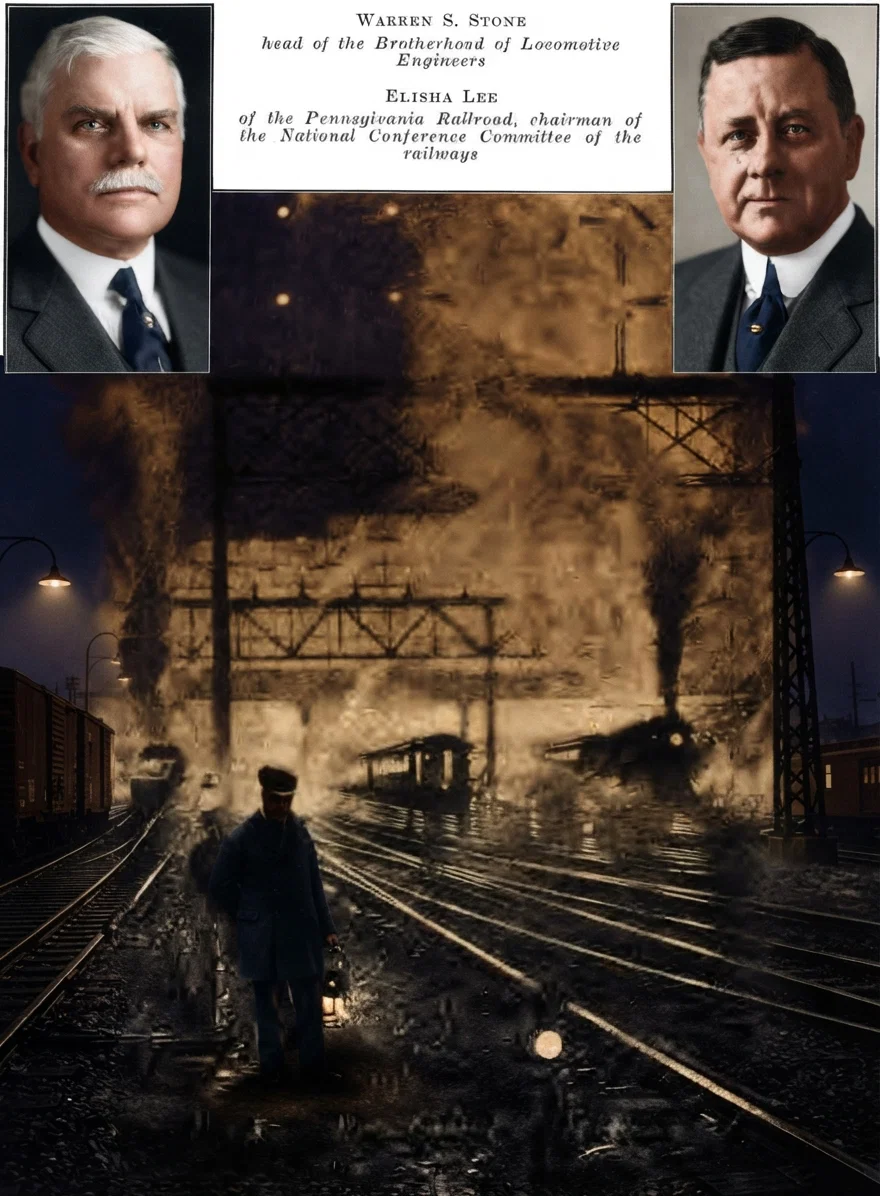
WARREN S. STONE head of the Brotherhood of Locomotive Engineers ELISHA LEE of the Pennsylvania Railroad, chairman of the National Conference Committee of the railways

The Strike and Its Portent

A STRIKE that promises to tie up all the railroads of this nation may be in operation by the time our readers get this paper, unless President Wilson and his advisers are successful in adjusting the differences between the officials of the great railway lines and their employees that are involved in the controversy.
The differences that lie at the foundation of this threatened strike have been in acute controversy for something like a year. There seems to be a determination on both sides that the industrial war shall be waged in order that the strength of each of the contending parties may be fully measured. This strike is only one of the things that appear on the surface to show the tremendous depth of the spirit of unrest that has taken almost complete control, not merely of this nation, but of the civilized world.
The late Charles Lenz, Ph. D., in his book "Cassock and Sword," spoke of the unrest particularly in this nation, and the struggle that is on between capitalism and labor. He affirms that the United States Constitution will be no guarantee of safety in case of an outbreak, but that the people will assert their authority, regardless of the constitution, and then he adds:

The Time Is Nigh

"If the signs on our political firmament do not belie us, the time is nigh when the people will exercise this authority."
The bitter class feeling is of long standing. Class hatreds have been generated; they are much more extensive than outwardly appears, and a struggle that bids fair to become so general as this railroad strike that is now under consideration may result in widespread revolution, violence, and anarchy that would be even worse in point of individuals killed and property destroyed than would result from actual war with another nation.
The conditions in society are becoming more and more tense and violent, and anything that has occurred in the past is not a proper precedent by which to judge the social combats of the immediate future. If the men who are at the head of this struggle between the railroads and their employees could get a clear vision of the possibilities that are just ahead of us, there would be found among them many pale faces and palpitating hearts.
We are in the rising tides of the great ocean of discontent and violence that God's word so clearly tells us to characterize the last days. We are in those times when there is to be violence in the land, as it was in the days of Noah, only this, in this time, will be far worse.

Deaf to Some Teachings

SOME one has asked, “What has become of the old-fashioned man who always had cotton stuffed in his ears?” We cannot answer the question; but if there ever was a time in the history of the world when one should be deaf to some of the teachings promulgated in the world, it is to-day. R.

War Inventories

THE United States government has practically completed "an industrial inventory" "in an attempt to mobilize America's resources for war." Chairman Howard E. Coffin, of the Committee on Industrial Preparedness, of the Naval Consulting Board of the United States, has had the work in hand. The campaign of study and investigation has been going on quite vigorously for the past three months. Every factory and other establishment throughout the United States, as well as the railroad, telegraph, and telephone systems, has been carefully and closely studied with reference to having every detail available for immediate use in case of war.
It may not seem to many that there has been any immediate danger of a sudden outbreak of war between the United States and any other country; yet when we stop to consider the matter, we find that there have been constant negotiations between this government and Germany, England, Mexico, and other nations, which might have resulted in war in case of the least slip of diplomacy. And it is more than probable that if the average citizen had understood everything the officials of the government have had thrust upon them from day to day, fathers and mothers would have spent many a sleepless night, fearing that their sons would be immediately called to the great slaughterhouse of modern warfare.
We hear many talks in favor of peace in these times; and would that it were possible for the importance and the rightfulness of peace to be proclaimed by thousands of voices and pens where there is only one at the present time. But regardless of the sentiments in favor of peace, the world is plunging furiously into the mad rush of war. A large part of the factories of the United States are operating at the highest point at the present time, preparing war materials for the fighting nations of Europe. There are immense revenues in these war preparations. Hundreds of millions of dollars have been made by a few men in this country, out of Europe's slaughter pen. Men in this age, which is not only maddened with war, but maddened with greed for gain, are intensely interested in continuing a work that brings them such large dividends.
It is indescribably awful that this should be the case, but nevertheless it is true. The apostle Paul has most clearly told us that the last days would be made perilous because men would be lovers of self and lovers of money. The prophets have forewarned us, in numerous passages, that the last days would be days of terrible slaughter and frightful war and carnage.
The theories of men have not been met by the facts in this time; but the divine predictions of the prophets have met their fulfillment most literally in the events that are passing. Wise men and women, with their open Bibles in their hands, should have no difficulty in ascertaining the meaning of what is occurring. We are in the midst of the thickening perils of the last days. The great climax of the coming of Christ cannot be delayed very long.

Sheer Love of Gold

THE love of money, the simple, sheer love of gold, is the root cause of the great industrial disturbances of the day. "They that will be rich fall into temptation and a snare, and into many foolish and hurtful lusts, which drown men in destruction and perdition. For the love of money is the root of all evil: which while some coveted after, they have erred from the faith, and pierced themselves through with many sorrows." 1 Tim. 6: 9, 10.
"The love of money is the root of all evil"—not money, but the "love of money." Through this love, men are drawn into "snares" and into "foolish and hurtful lusts" which "drown" them in "destruction and perdition."
The infinite God holds the evil forces in check in so far as it is possible for Him to do so without compromising His righteous and just character. Let us hope and pray that this storm of violence may for still a little longer period be kept from breaking upon our great nation.
But, on the other hand, let us not be blinded to the indisputable fact that forces are rapidly gathering, not only in this nation, but throughout the world, that will soon break into a storm of furious revolution which will be as much greater than anything that has appeared in the past as the wickedness of this time is more general and more pronounced throughout the world than anything that the history of the ages affords.
Said the inspired apostle, "This know also, that in the last days perilous times shall come." Those days are here, and the little calms that we may have from time to time must not be allowed to blind our eyes to the forces that are so rapidly gathering for action.
BY R. A. CALDWELL
BY R. A. CALDWELL

You have reached the end of this edition.

Signs of the Times · Sep 12, 1916