IN this third article of Mr. Bowen's excellent series, the story of Princeton's awakening is still further unfolded. In the first installment, Mr. Wilkinson's mix-up over the Jewishness of certain Christian things was presented. Last week, "That Memorable Thursday Evening" was the subject. The article this week needs no statement. In our next issue, the report of the crowded temperance rally will be given.
BISHOP LUDDINGTON had just seated himself in his study when a servant carefully opened the door, saying: "Pastor Bradley has called to see you. Shall I invite him in?"
"Certainly. Tell him I shall be glad to see him."
"Have a seat, Brother Bradley. Glad you called. How is everything over in your section?" the bishop inquired, as the minister entered.
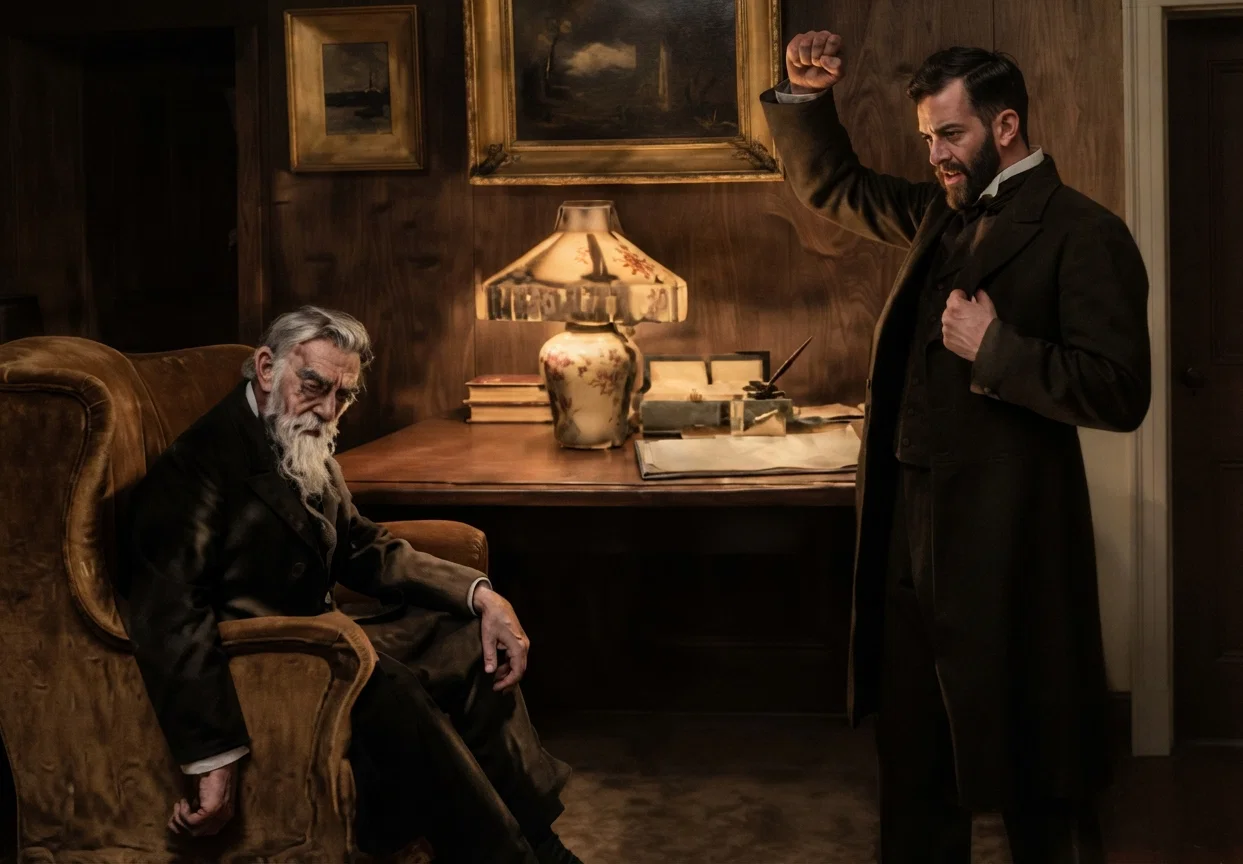
"Fairly well," he replied. "My attendance was splendid until about a week ago, when a certain lecturer opened meetings in the town hall. I must say I have been considerably perplexed since. My people have been asking all manner of questions, and I am about wild."
"What is the nature of the work to which you refer? Who is he that is stirring up things this way?" the bishop asked, having just returned from a long trip in other parts of the state.
"As nearly as I can learn, he is a Seventh-day Adventist missionary. He has traveled extensively, it seems. He dwelt upon world conditions, particularly the war, and conditions in the Orient. The people say that he brought some very strong arguments from the Bible to show that the end of the world is near at hand. Of course, the Sabbath question is always dragged in, whether these men lecture on it or not. Their very name brings up that old Jewish Sabbath. I have many questions to answer about it. I thought you might have something new to quiet these folks who are continually inquiring about that old outlawed Sabbath," replied Mr. Bradley, revealing that he had no sympathy for the agitation of the Sabbath question.
"Well, Brother Bradley, it is becoming a quite perplexing question. The trouble is, those seventh-day people have the Bible on their side, and they know how to use it. I have met them myself, and know pretty well the ground they cover. If we had one good strong text to show the change from Saturday to Sunday, we would be all right. But we have public sentiment; and when we get the legislators a little more in line, we shall be able to put up a different kind of argument."
"Yes; and we can rely on the Catholics to help us out when it comes to enforcing Sunday laws," Pastor Bradley broke in.
"Surely they will. Yet we can hardly join hands with them yet. It may come to that; but their awful record sounds bad, and is sure to come up whenever we are made to appear as taking common ground with them. Our best help now will be Congress. I think Congressman White will help get through our Sunday bill during this session. I had a talk with him just the other day. Anyway, we must keep at it until we win. We need not fear a stampede toward the old Jewish Sabbath. But it is annoying to have the subject of the Sabbath coming up all the time. You will have to do the best you can, Brother Bradley. Make the Sunday saloon appear hideous. Emphasize the love of God. Preach Christ, and avoid the Sabbath question as much as possible. We must keep in with public sentiment. That will be our strong fort. What! You are not going yet?"
"Yes, I must be off. I fear I have kept you too long already," said Mr. Bradley, as he rose to go.
When Jesus Blessed Sunday
A FEW days after, Tom Jones was returning to his office from a business errand on the other side of town, when Pastor Bradley, out of breath, came into the car. He soon was seated beside Tom; and after they had chatted on a variety of topics, Tom, in a low tone of voice, said:
"Mr. Bradley, tell me where I can find, in the New Testament, where Jesus blessed Sunday. I confess I've been hunting for a place, but so far have not been able to find it."
"Blessed Sunday? Why, don't you remember that place where He met with the disciples that first Sunday night after His resurrection, and breathed on them His blessing? Surely that is all anybody needs to know."
"But blessing His disciples and blessing Sunday are not just the same thing," Tom ventured.
"Surely if He had not wanted to honor Sunday, He would not have appeared to them on that day. Don't you see?"
But somehow it was not just clear to Tom.
"What I want is a text where Jesus blessed Sunday, as God blessed and sanctified the seventh day when that was made into the Sabbath for the Jews," Mr. Jones went on to say.
"I'd be glad to help you, but here's my corner now. I'll have to leave you. Good-by." And the minister left the car.
Nothing for a Man in Trouble
"MARY, I'm puzzled. It seems queer our minister has nothing for a man in trouble when it's purely a Bible question. On the car to-day, I asked Brother Bradley where that text was that told about Jesus' blessing Sunday. I have just looked up the one he spoke about, by hunting it out in the concordance. Let me read it to you: 'Then the same day at evening, being the first day of the week, when the doors were shut where the disciples were assembled for fear of the Jews, came Jesus and stood in the midst, and saith unto them, Peace be unto you. And when He had so said, He showed unto them His hands and His side. Then were the disciples glad, when they saw the Lord. Then said Jesus to them again, Peace be unto you: as My Father hath sent Me, even so send I you. And when He had said this, He breathed on them, and saith unto them, Receive ye the Holy Ghost.' Where is there anything in this text that shows that Jesus blessed Sunday?"
Mrs. Jones replied: "He blessed the disciples, and breathed on them, that they might receive the Holy Ghost; but nothing at all is said about blessing Sunday. God blessed the seventh day, and sanctified it; and Jesus said He was Lord of that Sabbath, for we read that out of our own Bibles the night Miss Burdick was here. Tom, Mrs. Lewis was over to-day, and had a whole bunch of questions to ask me. You565know Sammy, her oldest boy, was here the night Miss Burdick studied the Bible with us. He said nothing, but he must have had his ears open all right, for his mother says he has been talking ever since about things Miss Burdick said. He said she said that Jesus never blessed Sunday. Mrs. Lewis wanted to know if she might come over the next time Miss Burdick comes, and hear for herself what she says."
"What did you tell her?" asked Tom.
"I told her to be sure to come Thursday evening at eight o'clock, and have Ed come along, too."
Challenged the Liquor Men
"BUT those folks down at the hall have other things they are lecturing on. Mrs. Lewis was telling me to-day she had heard that a man from Washington is to lecture on temperance a week from Sunday. You know the state is to vote on prohibition soon. And Mrs. Lewis says that last fall, this same man answered the challenge of a liquor man, one of their champions, to debate with him, and that none of our men had cared to take the challenge. Mrs. Lewis's brother is a prohibitionist, and had heard that this same man is going to lecture here, and had told her all about it. She wants Ed to hear him, for she fears his country growing on him."
"I am convinced there is much for us to learn, Mary, and I am beginning already to see much more in the Bible than I ever thought could be in it. It is a wonderfully interesting Book. How glad I am we cut out those frivolous parties and eats, so we have more time at home to study and read!"
That Elusive Text
PROMPTLY at eight o'clock, Thursday evening, Miss Burdick met her appointment. The subject to be studied was the Sabbath in the New Testament. Three of the Lewis family and another neighbor were there ready for the study. A little time had to be spent in helping different ones find the texts, but Miss Burdick gracefully assisted each.
Every text in the New Testament mentioning the first day of the week was carefully studied. Nearly all of them referred to the resurrection day. Tom and Mrs. Lewis especially were alert to find the text about Jesus' blessing Sunday. Every word was scrutinized, and Miss Burdick was as interested as they in the search for the account of Jesus' changing the Sabbath of creation week to Sunday.
"Well, I declare," said Tom, when they were through, "I was never more astonished in my life. I thought we had plenty of New Testament texts for Sunday keeping, but here we can't find even one. And all the world, nearly, is keeping Sunday, as though every text in the Bible commanded it. What do you think about it, Mrs. Lewis?"
"I don't know. I am not ready to express my opinion yet," Mrs. Lewis replied, a bit curtly. "I was counting on that last 'Lord's day' text to help me out, for I knew it was in here somewhere, as my pastor, Dr. Clark, often refers to it in his prayer Sunday mornings. But there isn't much comfort in that when one comes to it after looking over all the other Sunday texts, especially as Miss Burdick has gone over them here to-night. But I'm sure my minister can get more out of these texts to favor Sunday than we see here to-night. I wish he had been here."
They again bowed in prayer; and as Miss Burdick asked God to let the blessed light of His word shine into these dear hearts, somehow they felt the same breath of the Holy Spirit's power touch their souls, that the hearts of the disciples must have felt in their upper room on the night after the resurrection.
“My people have been asking all manner of questions, and I am about wild.”
What
By Lucas A. Reed
Nation
Is to
Rule
the
World?
The
Coming Universal
Kingdom
By
Lucas A. Reed
As a result of the present war, what nation is to rule the world? This question may be in the minds of many. The answer can be very simply and easily given: No nation any longer can dominate the world. We know this by appealing to one prophecy of the Bible, that given in the second chapter of Daniel. According to this prophecy, there were to be but four universal empires during the reign of man upon the earth. The first of these was Babylon, the second Medo-Persia, the third Greece, and the fourth Rome. After Rome there was to come the divided Roman Empire, under the form of the many kingdoms of Europe; and the prophecy gives us the definite conclusion of earth's events by saying that "in the days of these kings shall the God of heaven set up a kingdom, which shall never be destroyed."
This is so clear and definite that there is no ground for demurring or speculating about the matter. We do not know just what the plans of Russia may be. It has plainly come out that she seeks for Constantinople and the straits as her necessary way into that place as a great nation which by right of existence belongs to her. How much further she may at heart desire or intend to go, we are largely left to presume.
The ambitions and intentions of Austria and Germany have been quite clearly stated, according to the report published in the London Times by one who calls himself "Observer." Of course, this report, coming as it does freely and frankly from a partisan on the side of the allies, may need to be taken with some degree of allowance; but events seem to indicate the truth of some of his assertions, as, for example, the following:
Unable to Repeat "Starving" Policy
"THE German people feel that with the crushing of Servia and the opening up of the route through Bulgaria to Constantinople and beyond, the first and most essential portion of this great scheme has been realized; and they do not for a moment believe that their mastery of the highway to the East can now be seriously challenged. Consequently they are confident that, as soon as the enemy shall have recognized defeat and left Germany at the head of an immense Zollverein stretching from Antwerp to the Persian Gulf, no power on earth and no British blockade will ever be able to repeat a policy of 'starving Germany out.' The symbol of this great achievement is the Balkanzug, the Balkan express, which runs twice a week from Antwerp to Constantinople. This German train has now replaced — the Germans believe forever — the former International Orient Express.
"It is not that the Germans have given up the idea of challenging British naval supremacy or of obtaining 'the freedom of the seas' for German sea-borne trade. The disputes between the partisans of 'central Europe' and those of 'world trade' have, in reality, little importance. The two aims are complementary to each other. The Germans mean to secure both. But, for the moment, it is the 'central European' and eastward tendency that predominates, because the only field which, for the moment, lies open to German enterprise is to be found in the East.
"Is it any wonder that, having secured, as they believe, the highway to the East, and with it, the power to throttle Russia on the Bosporus at their pleasure, the Germans should be confident? The best proof of their confidence lies in the efforts they are now making to organize, develop, and extend their inland waterways so as to make it possible for vessels of one thousand tons to pass from Antwerp, Hamburg, Bremen, or any other port on any large German river or canal, to the Black Sea by way of the Danube.
"This 'Danube question' is to-day the foremost question in Germany. Preparations are being made to link up, by a system of canals, not only the Rhine, Danube, and Elbe, but every important German waterway. In the past, this 'canal scheme' was chiefly Bavarian. Now it has become national and imperial. . . .
"One of the objects of the 'Danube scheme' is, to secure for Germany the control of both banks of the Danube, from source to mouth. Throughout Austria and Hungary, and along the Servo-Bulgarian shore, the control is assured. It is hoped to bring Roumania into the scheme by persuasion or force, and to compensate her by securing for her possession of the Russian shore of the lower Danube. Thus German control of the whole waterway would be complete, and would, together with the control of the railway route, link Germany indissolubly with the East."
We see, by this, that the ambitions of Germany and Russia diametrically oppose one another. Russia wishes to press toward the South and the East, conquering Turkey, and bringing everything into subserviency to her own commands. Germany has a similar ambition toward the East, but plans to make the Turk an ally, causing the people of the Orient to coöperate in a great alliance for trade and prosperity. It is plain enough to any one, that neither nation intends to stop, if unhindered, with this ambitious project; and so, after all, the conflict of interests and purposes in this present war seems to be really because of an ambition of each nation to be the dominating influence in world affairs. However, the recent successes of the Russians on the eastern front appear to be a mighty menace to the cherished plans of Germany.
The Coming Kingdom
BUT Europe — that is to say, the territory of the old Roman Empire — is to remain divided to the end. The scripture declares that "they shall not cleave one to another, even as iron is not mixed with clay." Dan. 2: 43. "The kingdom shall be partly strong, and partly broken. . . . And in the days of these kings shall the God of heaven set up a kingdom, which shall never be destroyed: and the kingdom shall not be left to other people, but it shall break in pieces and consume all these kingdoms, and it shall stand forever." Dan. 2: 42, 44.
There is yet to be one more grand, universal empire. That will be the kingdom of Christ, and it will be set up on the ruins of this world's kingdoms. It will be a kingdom of righteousness, one that shall never pass away.
Every world ambition that runs counter to these plain truths of the Bible is but an illusion, a dream. God's word can never fail. "The Scripture cannot be broken."
Judge Yourself First
"If you must form harsh judgments, form them of yourself, not of others, and, in general, begin by attending to your own deficiencies first. If every one would sweep up his own walk, we should have very clean streets."
CLARENCE SANTEE
By Clarence Santee
MOSES was a man of strong faith. Even when he was fleeing from Egypt for self-preservation, it could be said of him, "By faith he forsook Egypt, not fearing the wrath of the king: for he endured, as seeing Him who is invisible." Heb. 11: 27. This faith was implanted in him when he was a child at his mother's knee. Dear parent, your lessons of faith, taught in tender childhood, are not forgotten, though seemingly buried by worldly ambition. When the parting of the way has been reached, they will come to the surface, and the precious one will take a stand by your side, to endure the desert journey, and to rest with you, at the end of the way, in Canaan.
CLARENCE SANTEE
The Vandal Mountain in the Roman Sea
By Jean Vuilleumier
By
JEAN VUILLEUMIER
A Vivid Recital of Tragic Desolations A Horrible Tumult in the Night
SYNOPSIS.
This interest-gripping prophecy of the seven trumpets portrays the downfall of nations during the Christian era. The first article of the series, in our issue of August 29, gave a general view of this desolation as it began to unroll before the ancient prophet. The trumpets were shown to be the symbols of war, referring definitely to the mighty irruptions from the barbaric hordes that swept over the Roman Empire, dethroning her from the position of proud mistress of empires. The first trumpet symbolized the wars waged by the renowned Alaric and his victorious Goths. Hail, fire, and blood falling upon the earth is the prophetic description. Rome was pillaged, was humbled in the dust.
EDITOR.
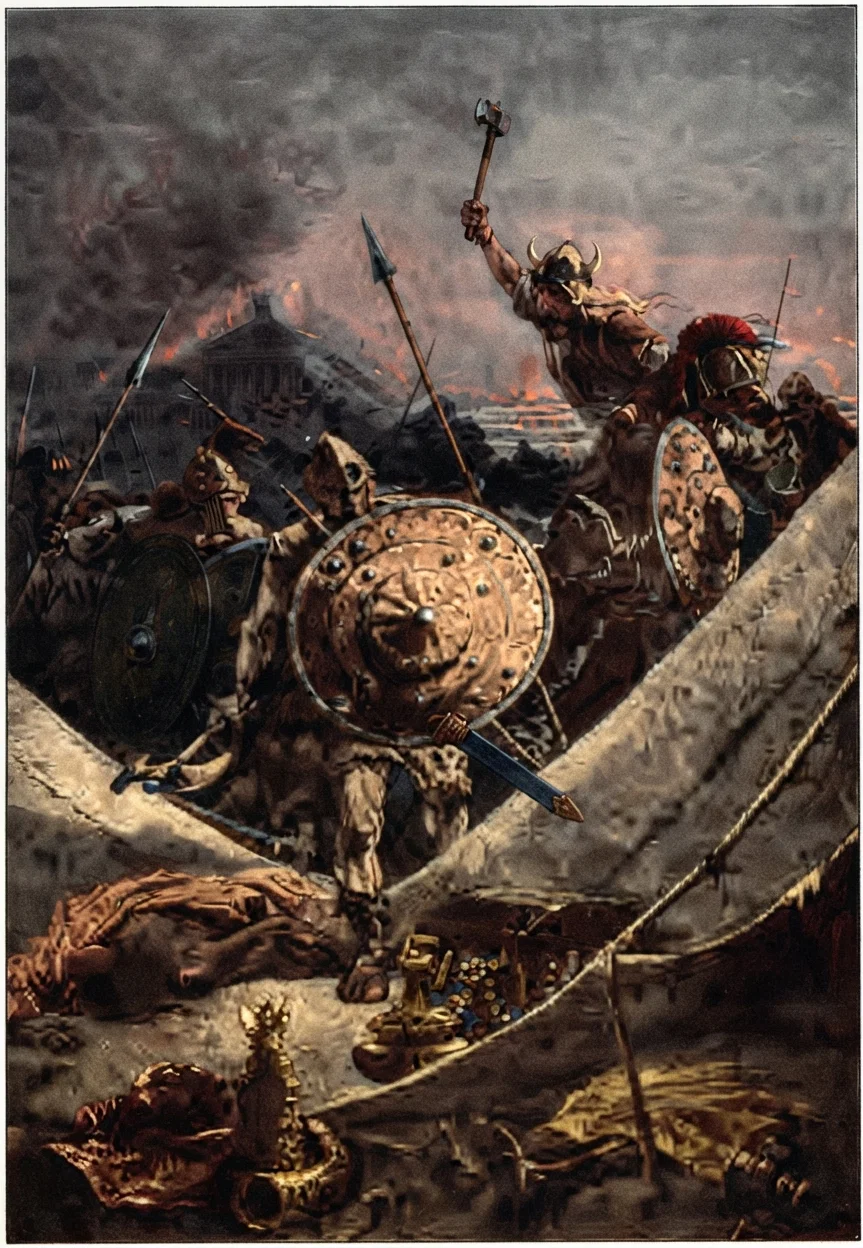
The eternal city opened her gates; and for fourteen days, it was plundered with a degree of rapacity which the Visigoths of Alaric had not approached.
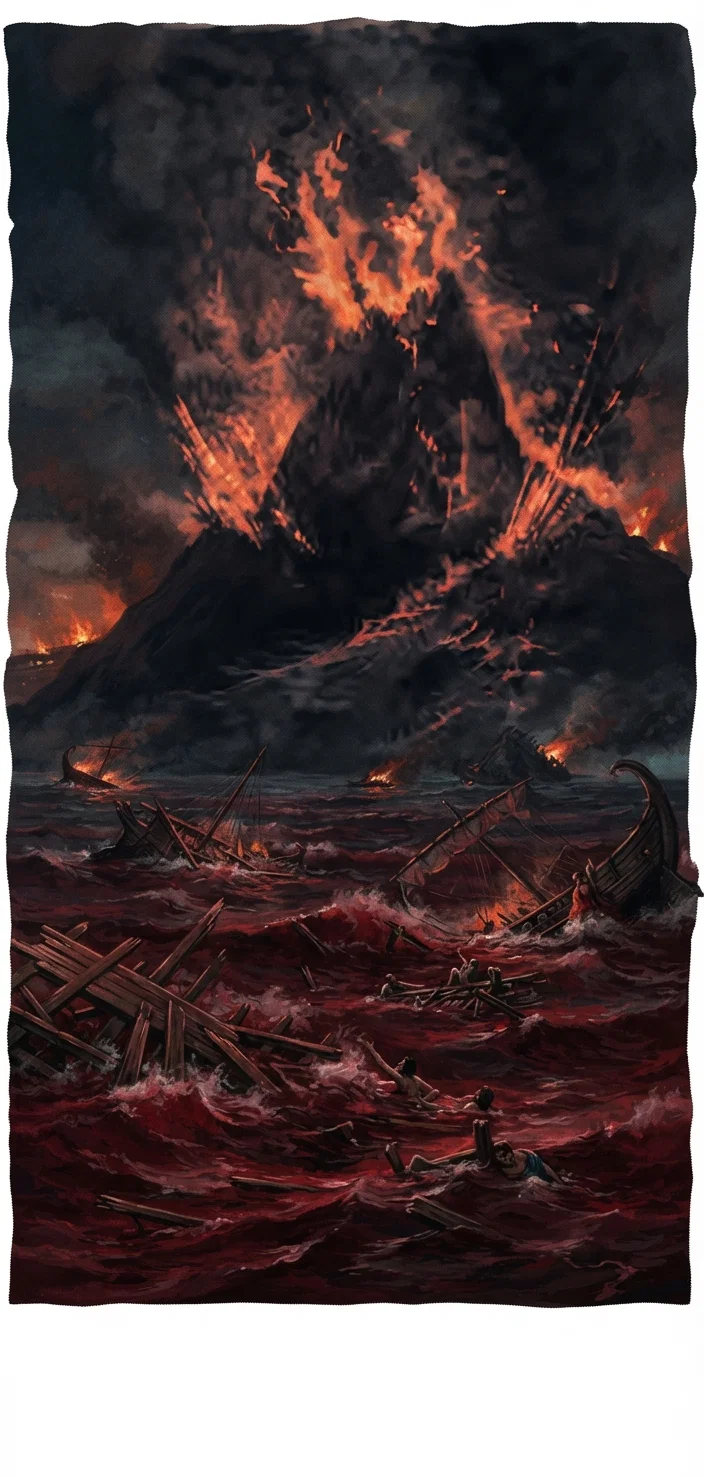
"AND the second angel sounded, and as it were a great mountain burning with fire was cast into the sea: and the third part of the sea became blood; and there died the third part of the creatures which were in the sea, even they that had life; and the third part of the ships was destroyed." Rev. 8: 8, 9.
This partially symbolic language describes the depredations of a great sea power. It was fulfilled to the very letter, although none of the barbarian tribes knew anything about naval warfare.
The Vandals had been in Spain twenty years, when, upon the invitation of Count Boniface, the Roman governor of the African provinces, the entire nation set sail for Algeria. This was in the year 429. They soon found an ally in the original inhabitants of the country, the Moors. Another ally was the Donatists, a sect that the Catholics had been unable to convince of their errors, and had therefore cruelly treated. Gibbon describes the persecution of the Donatists by the Catholics as follows:
"Three hundred bishops, with many thousands of the inferior clergy, were torn from their churches, stripped of their ecclesiastical possessions, banished to the islands. . . . Their numerous congregations, both in cities and in the country, were deprived of the rights of citizens and of the exercise of religious worship. . . . The distracted country was filled with tumult and bloodshed, . . . and the calendar of martyrs received on both sides a considerable augmentation. Under these circumstances, Genseric, a Christian, but an enemy of the orthodox communion, showed himself to the Donatists a powerful deliverer, from whom they might reasonably expect the repeal of the odious and oppressive edicts of the Roman emperors."
"The long and narrow tract of the African coast," says the same historian, "was filled with frequent monuments of Roman art and magnificence. . . . The country was extremely populous; . . . and the annual exportation, particularly of wheat, was so regular and plentiful that Africa deserved the name of the common granary of Rome and of mankind. Of a sudden, the seven fruitful provinces, from Tangier to Tripoli, were overwhelmed by the invasion of the Vandals. . . . Careless of the distinction of age or sex or rank, they employed every species of indignity or torture to force from the captives a discovery of their hidden wealth."
"This devastation," says Posidonius, an eyewitness, "embittered the last days of Saint Augustine. He saw the cities ruined, the country desolated, the inhabitants killed or put to flight, the churches deprived of priests, the virgins and monks scattered. . . . Those who fled into the woods, into caverns and rocks or strongholds, were seized and killed or starved to death. Out of such a large number of churches in Africa, only three remained whose cities were not ruined: Carthage, Hippo, and Cirtha.
"The Vandals tore up the vines and the fruit trees, especially the olive trees, so that the inhabitants, hidden in the mountains, could find no food. Public edifices which escaped the flames were razed. In some cities, there did not remain a single man."—Chateaubriand, "Etudes Historiques," pages 427-440.
Into the City of Sin
THE capital of the country, the famous city of Carthage, was only conquered in 439. This "Rome of the African world" "was rich in all the appliances of the highest civilization, in schools of art, in schools of rhetoric, in schools of philosophy." "Yet this was the city of which the great African, Augustine, had said, 'I came from my native town to Carthage, and everywhere around me roared the furnace of unholy love.'"
"Houses of ill fame swarming in each street and square, and haunted by men of the highest rank and what should be venerable age; chastity outside the ranks of the clergy a thing unknown and unbelieved, and by no means universal within that inclosure; the darker vices, the sins of Sodom and Gomorrah, practiced, avowed, gloried in,— such is the picture which the Gaulish presbyter (Salvian) draws of the capital of Africa.
"Into this city of sin marched the Vandal army, one might almost say, when one reads the history of their doings, the army of the Puritans. With all their cruelty and all their greed, they kept themselves unspotted by the licentiousness of the splendid city. They banished the men who were earning their living by ministering to the vilest lusts. They rooted out prostitution with a wise yet not a cruel hand. In short, Carthage, under the rule of the Vandals, was a city transformed, barbarous, but moral."—Hodgkins, "Italy and Her Invaders."
Upon entering the city, Genseric gave severe orders to check the covetousness of the soldiers; he forbade massacre and plunder; but it was to keep for himself all the wealth of the people. An edict was issued which enjoined all persons to deliver their gold, silver, jewels, and valuable furniture. He protected the houses of the people, but he destroyed the churches and the theaters, reserving a few churches after plundering them. Some of them were abandoned to the Arians, and some were converted into barracks for his soldiers.
Resolved to Create a Navy
BUT this dark storm which was desolating the Roman provinces of Africa was only a partial fulfillment of the second trumpet. It was now to take the aspect of a naval war, in exact fulfillment of the prophetic prediction.
"Genseric," says Gibbon, "had acquired a rich and fertile territory which stretched along the coast above ninety days' journey from Tangier to Tripoli; but their narrow limits were pressed and confined, on either side, by the sandy desert and the Mediterranean. The discovery and conquest of black nations that might dwell beneath the torrid zone could not tempt the rational ambition of Genseric; but he cast his eyes toward the sea; he resolved to create a naval power, and his bold resolution was executed with steady and active perseverance."7
The Vandal Mountain in the Roman Sea
(Continued from page 6)
"The woods of Mount Atlas afforded an inexhaustible nursery of timber; his new subjects were skilled in the arts of navigation and shipbuilding; he animated his daring Vandals to a mode of warfare which would render every maritime country accessible to their arms; the Moors and Africans were allured by the hope of plunder; and, after an interval of six centuries, the fleets that issued from the port of Carthage again claimed the empire of the Mediterranean."
Sicily, the pearl of the sea, was conquered, Palermo was sacked, and frequent descents were made on the coast of Lucania (lower Italy). The fleet of Genseric became the nightmare of the people living on the coasts of the sea. "Genseric seemed great," says Chateaubriand, "because he was treading on ruins. In one of his expeditions, everything was ready; he had himself embarked, not knowing whither he was going. 'Master,' said the pilot, 'toward what nation wilt thou direct the war?'—'Toward those,' said the old Vandal, 'against whom the wrath of God is kindled.'"
Ravaged Most Barbarously
ITALY was already cruelly conscious of the presence of the Vandals on the territory of the empire. The loss of the province of Africa was in itself a great calamity to all the peninsula. Africa being the granary of Italy, the free distribution of wheat to the people of Rome, Milan, Ravenna, and other cities, had led the people of the country to abandon agriculture almost altogether. Consequently the sudden stoppage of the annual tribute from the plains of Africa caused a cruel famine and a new reduction of the population.
Nor was this all. The empress Eudoxia, hard pressed by the usurper Maximus, called the king of the Vandals to her aid. Genseric was not long in accepting the invitation; and in 455, the terrible corsair landed his army at Ostia, Rome’s harbor. The eternal city opened her gates; and for fourteen days, it was plundered with a degree of rapacity which the Visigoths of Alaric had not approached. Genseric ordered the careful transportation of public and private treasures to his ships. The sacred instruments of Jewish worship, the golden table and the golden candlestick, which had been offered in spectacle to the Romans four centuries earlier by Titus, were transferred from Rome to Carthage by the barbarian chief. Sixty thousand captives, and the empress Eudoxia herself, with her two daughters, were placed in captivity. "A great mountain burning with fire" had been "cast into the sea; and the third part of the sea" had become "blood."
The emperor Majorion resolved to crush the power of the Vandals. Three years were devoted to the construction of a fleet of three hundred ships. This fleet took its position in the large bay of Cartagena, on the Spanish coast. But Genseric made a sudden and unexpected attack upon it, and sent the Roman ships to the bottom or captured them.
Made Horrible Havoc
THE emperor of the West now turned to the emperor of the East for help. A new fleet was equipped, at the cost of thirty million dollars. This fleet was composed of eleven hundred ships. Genseric asked for a five days’ truce; and then, the wind having become favorable, he took advantage of the night to send great barges, loaded with inflammable material, toward the Roman ships. Fire soon roared with violence through the imperial fleet; and in the midst of the tumult of this horrible night, the disciplined ships of Genseric made terrible havoc of what had been spared by the fire.
"And there died the third part of the creatures which were in the sea, even they that had life; and the third part of the ships was destroyed." With absolute exactness, the second trumpet was fulfilled.
After this terrible battle, Genseric became more than ever the "tyrant of the sea"; and "before he died in the fullness of glory," as says Gibbon, "he beheld the final extinction of the empire of the West."
The second trumpet was over. Five more trumpets were yet to be heard.