A Work That Is Sane and Scientific, and Is Winning Its Way
BY L. A. HANSEN
Secretary Medical Department, General and North American Division Conference
The movement carried forward by the people issuing this paper, is a unique one in the religious world, in its relation to physical reform and the presentation of health principles. Almost without exception, its membership of over one hundred thousand is composed of people who believe that the religious life comprehends a recognition of the laws of health, and conformity thereto.
Sixty Years of Success
More than sixty years ago, this denomination associated with its evangelical work the teaching of health as well as temperance principles. Several prominent hygienic reforms of to-day were taught and practiced by this people years before the general public gave them serious thought. Scientific research, experience, and demonstration of time have brought into popular favor things that were once presented by them amidst ridicule and prejudice. They have been prominent in their health work, and this phase of their activity to-day holds an important place as a medical missionary movement.
Other pages of this paper will speak of the progress of this religious movement in various phases, especially the evangelical. Let it be remembered that in general this includes the teaching of health principles, whether by press or by pulpit, and presenting the demands of the laws of health as moral requirements. We herewith give information as to the material development of the health movement of this people, presenting figures that give proof of a divine providence in connection with its growth.
A Broad Platform
Beginning with the teaching and practice of temperance in its broader application of covering all that is hurtful, the health question came to a recognition of dietetic reforms and the use of rational remedies of treatment in disease. A position quite comprehensive in its reach was taken in discarding intoxicants, narcotics, condiments, free use of flesh foods, and other hurtful articles or practices in diet. Careful thought and study were given to provide a well balanced, wholesome, and palatable dietary. Other measures of reform were adopted, dealing with dress, general hygiene, and healthful living. A decided position was taken against the use of poisonous drugs as curatives. Study was given to the subject of water as a remedial agent; and a system of therapeutics was evolved, to which were later added various measures constituting the basis of treatment as carried on now in many large sanitariums.
The Sanitarium Idea
This movement first made use of the word “sanitarium” as designating an institution for the care of the sick. Its first health institution was opened at Battle Creek, Michigan, in 1868. Another sanitarium, still in successful operation by the denomination, was established at St. Helena, California, in 1877. Others followed, until to-day about seventy sanitariums are operated, located in various parts of the world, representing a financial valuation of over four million dollars.
Fifty or more smaller health enterprises, such as treatment rooms and health institutes, are conducted. Dispensaries, in cities in the home field and in mission districts in the foreign field, are carried on. A number of physicians and nurses are also engaged in field work, either as appointed medical missionaries to various countries, or in private practice. About three thousand workers in all are engaged especially in distinctive health work.
About thirty training schools for nurses are conducted by the sanitariums. A denominational medical college, located at Loma Linda, California, has been duly incorporated for the education of missionary physicians and other medical evangelists.
Health Food Industry
The well established use of “health foods” had its origination with this movement; and ten food factories, located in various countries, are now in operation, supplying food products in keeping with the original idea. Food stores and agencies, together with vegetarian restaurants, aid in giving material evidence of the value of these dietetic principles.
Many health publications are now issued by the denomination, including tracts, pamphlets, and large bound books. One magazine, Health and Temperance, formerly Life and Health, published at Washington, D. C., has seen a circulation of 80,000 in a single month. Eight other magazines, printed in various languages and in various countries, are devoted exclusively to health questions, while about one hundred other periodicals devote more or less space in helping to carry forward the health-educational work the denomination is doing in behalf of right living.
Health Message in Big Movements
By David Paulson
Bright Lights Have Made Health Prominent in Religion
NEARLY all the great religious reformers were also health reformers. John Wesley, who stirred England as no other man ever did, wrote a health book, and taught health principles in season and out of season with the same mighty power with which he taught spiritual truth. Can any of us afford to do less to-day? The following are a few of the many practical health ideas that Wesley advocated:
Wesley's Health Principles
“Abstain from all mixed, all high-seasoned food. Use plain diet, easy of digestion; and this as sparingly as you can consistent with ease and strength. All pickled or smoked or salted food, and all high-seasoned, is unwholesome.”
What he said to the early Methodist preachers applies equally well to any preacher to-day: “Are you temperate in all things? Take one instance, of food—do you use only that kind and that degree which is best for both the body and soul? Do you see the necessity of this? Do you eat no flesh suppers? No late suppers? These naturally tend to destroy the best health. You may know if you do by a load in the stomach, by drowsiness or heaviness, and in a while, by weak or bad nerves.”
He was also an enthusiastic advocate of fresh air. “When the nerves perform their office languidly, good air is the first requisite. The patient should rise early, and as soon as the dew is off the ground, take a walk.”
At a time when the use of stimulants was almost universal, he gave this teaching: “Strong and more especially spirituous liquors are a certain though slow poison. Experience shows there is very seldom any danger in leaving them off all at once.”
Every one knows of the deplorable consequences that result from the stoppage of the city sewer, but some have not yet learned that stagnation of the human sewerage system is of equally serious consequences to human health and happiness.
John Wesley was a man who had such a compelling message to humanity that he could hold spell-bound outdoor audiences ranging from635five thousand to twenty thousand people. But he had such a full appreciation of the dangers arising from autointoxication that he gave his people this practical advice: “Costiveness cannot long consist with health. Therefore care should be taken to remove it at the beginning, and when it is removed, to prevent its return by soft, cool, open diet; or take daily, two hours before dinner, a small teacupful of stewed prunes, or live upon bread made of wheat flour with all the bran in it.”
Wesley did not recommend his followers to dispense with physicians, for he said: “In uncommon or complicated diseases, where life is in immediate danger, let every one apply, without delay, to a physician that fears God. From one who does not, be his fame ever so great, I should expect a curse, rather than a blessing.” How does it happen that so few are observing these principles to-day? Does it not indicate backsliding, and that the time is ripe for another John Wesley?
Sylvester Graham and His Message
Seventy-five years ago, Sylvester Graham, a Presbyterian clergyman, stirred not only that denomination, but the whole country, by his mighty proclamation of health truths. God must have seen that the gospel of health was important for that denomination, or He would not have raised up such a mighty man with such a mighty message. Graham anticipated by many years the conclusions of such modern investigators as Chittenden, Prof. Irving Fisher, and Horace Fletcher. He was interested in fundamental health truths instead of fads, and foundation principles never become out of date.
The Graham health movement swept over the entire country between the years of 1830 and 1840. He taught the people that distilled spirits, wine, beer, cider, tobacco, opium, coffee, tea, pepper, mustard, and every other kind of artificial stimulants and narcotics, should be totally abandoned, and that food should be taken in the natural and simple state, and plainly prepared, or cooked with no other seasoning than a very little salt, and eaten in moderate quantities, at regular periods, and well masticated, and that the bowels should be kept regular by unbolted wheat meal bread and fruit.
“Let the last meal of the day be simple and light, and at a good distance from bedtime. Never sleep on a full stomach.”
If that was orthodox Presbyterian doctrine seventy-five years ago, why is it not true to-day? Who will dare say that a similar message is not needed now?
A Bright Light at Oberlin
Two generations ago, God established Oberlin College for the Congregational Church. It was one of the most remarkable missionary training centers that the world has seen since the days of Luther. It was located in the heart of what was then the wilderness of Ohio. It was born in prayer. It was reared in adversity, as every divinely planted institution has been, and for years it proved to be a chosen instrument to forward both health and educational reform.
The founders of that institution stood firmly for great health and temperance ideals. They pledged themselves, by a solemn covenant, that in view of “the degeneracy of the church and the deplorable condition of our perishing world, we will, by industry, economy, and Christian self-denial, obtain as much as we can, above our necessary personal or family expenses, and faithfully appropriate the same for the spread of the gospel.”
“That we may have time and health for the Lord's service, we will eat only plain and wholesome food, renouncing all bad habits, and especially the smoking and chewing of tobacco, . . . and deny ourselves all strong and unnecessary drinks, even tea and coffee, as far as practicable, and everything expensive, that is simply calculated to gratify the palate.”
Our Sanitarium, Takoma Park, Washington, D.C.,
One of Thirty-Four Similar Institutions
Throughout the World
“That we may add to our time and health money for the service of the Lord, we will renounce all the world's expensive and unwholesome fashions of dress, particularly tight dressing and ornamental attire.”
The bread served on their tables was made from unbolted wheat flour. Good cream was preferred to butter. Flesh meat and fish in all forms were banished from their tables. Pastry was regarded as an abomination. Spices and fiery condiments were ruled out.
Young men and women whose hearts were aching for the divine touch, flocked to this wilderness educational headquarters as the people in ancient times came down to the river Jordan to listen to the teaching of John the Baptist. Thousands of students went out with their souls on fire with the gospel of Christ and saturated with reform truths, which they imparted to others wherever they went.
Like all reformers, they met with opposition; for remember, if you have no opposition, you are no reformer. The devil only lets us off easy when we let him off easy. When you hold aloft the standard of reform, you may be certain that “the enemy shall come in like a flood.” Isa. 59: 19.
No doubt God committed those vital health and temperance truths to the stewardship of these three great denominations, first of all because they needed them, and second because the world needed them as a part of their preparation to enable them to live through the perils of the last days, when sickness and suffering shall become almost universal.
A Personal Appeal
If you happen to be a member of one of these denominations, and are trampling underfoot some or all of these health reform truths, ask yourself why you are doing it. Remember the inspired words, “Keep that which is committed to thy trust.” 1 Tim. 6: 20.
If you are a member of some other church, or belong to no church at all, ask yourself if it is wisdom for you to continue to treat health reform principles as a joke, when you can read in your Bible, “If any man defile the temple of God, him shall God destroy.” 1 Cor. 3: 17. Let the Spirit of God burn into your heart the startling significance of the following words: “What? know ye not that your body is the temple of the Holy Ghost which is in you, which ye have of God, and ye are not your own? . . . Therefore glorify God in your body, and in your spirit, which are God's.” 1 Cor. 6: 19, 20.
You may say: “Nobody thinks that way these days. I never hear my minister talk from that verse.” What good will such an excuse do you when you are brought face to face with your Maker at the bar of God? He may say: “You lived in a land of Bibles. You knew that I raised up mighty health prophets to emphasize the importance of these truths. You were not dependent upon either your minister or public opinion.”
He “That Striveth for the Mastery”
The time has arrived when the words of Paul should come home to us with a new force, “Every man that striveth for the mastery is temperate [not in a few things but] in all things.” Paul did what many spiritual leaders fail to do. “I keep under my body, and bring it into subjection.” In other words, he did not eat what he liked, when he knew it was not best for him. He did not drink what his appetite craved, just because it had become a habit. He did not trust his bodily instincts, for he knew them to be more or less perverted. He determined to be a reformer, even if he had to subdue and discipline some of his tastes, bodily instincts, and passions. Why did he endure all this painful experience? Let him answer: “Lest that by any means, when I have preached to others, I myself should be a castaway.” 1 Cor. 9: 25, 27.
Why Are They Outcasts?
There is the real reason why a thousand men and women to-day are outcasts who a few years ago were active Christian workers. And there you have also the story of tens of thousands more who are on the same road, who will come up in the day of Judgment and say, Lord, Lord, have we not preached in Thy name, and in Thy name done many wonderful works? No one will deny that; but O, the crushing disappointment of that hour when the Master shall declare to such: “I never knew you”! I never had a chance to come in and save you from yourself—to make you another Elijah or John the Baptist, a free man both spiritually and physically. So “depart from Me, ye that work iniquity.” Matt. 7: 21, 23.
If you want to be saved then, you must give the Lord a chance to save you now. And remember that the God who wrote the Ten Commandments, is the same God who arranged the laws of life and health in your body; and it is just as great an insult to the Creator to despise one as it is to trample on the others. “Not every one that saith unto Me, Lord, Lord, shall enter into the kingdom of heaven; but he that doeth the will of My Father which is in heaven.”
Inca Indians
By E. E. Maxwell
From Lapland to Punta Arenas
An Island Family Their Tent in Background
Inca Indians
BY E. E. MAXWELL.
ABOUT half way down the western slope of the Peruvian Andes, hanging hammock-like between two of the massive spurs that jut out from the rugged Cordillera, is the beautiful terraced valley of Otao. Its Indian population, with the quaint dress and personal customs of other centuries, calls to mind the rule of the Incas, before the bloody hand of the “Conquerors” had spread death and destruction through the fairest parts of the great Inca Indian empire.
The effect of the advent of the European in Peru was the same as elsewhere in the new West. He offered the Indian his religion, and the Indian acquired his language, his vices, and his lust for gold. Awe-stricken by his military trappings and prowess, the Indian ceased to resist, and became the white man’s slave; and the progress of nearly four hundred years has served to ameliorate but slightly his condition.
We began gospel work in the valley of Otao a few years ago, and its effect has been surprising. A working-church has been organized, with all its departments. A temperance society, which includes in its membership the best elements of the population of the valley, was organized, and drunkenness is nearly abolished. A chapel, the first of its kind in the republic, built by evangelical Peruvians for evangelical Peruvians, is in process of erection. Offensive customs that since the conquest have bound the people to offensive religious-ethical practices, have been successfully resisted. Those who profited most by the performance of these onerous practices, have not yielded without a contest, and the courts have been called on a number of times to enforce the civil rights guaranteed by the constitution of the country. Not only have our own brethren profited by these decisions, sweeping as they were in many cases, but the whole Indian population of the country has gladly accepted the emancipation offered.
Peruvian Indians Waiting for the Light of the Gospel of the Coming Christ
Five millions more in this ancient empire of the “Children of the Sun” are stretching out their hands for help. Shall we answer the call?
Lima, Peru.
A Chinese Soldier's Conversion
By Eva Allum
BY MRS. EVA ALLUM
WANG was born in Honan, China, some twenty-nine years ago. When eighteen years of age, he became a soldier. During the revolution in China, in 1911, he served in the imperial army at Hankau, and took part in the fighting there. Later, together with many other soldiers, he began plundering and looting in the peace-abiding villages and smaller towns of Honan. He became such a notorious character that the officials had their men searching for him. He decided to leave for the far western province of Szechuan.
In order to reach this province, he engaged himself as a “swimmer” on a house boat leaving Ichang for Chungking. It happened — very providentially, no doubt — that Mr. Allum and Mr. Warren had engaged this very house boat for their first trip to Szechuan. On Sabbaths, they would assemble the crew of about twenty in a little meeting. At the close of the first meeting, Mr. Allum made an appeal to the men to give up their tobacco smoking and wine drinking. Wang responded by throwing his pipe overboard.
Noticing his willingness to work, and his kindly disposition toward one or two boys among the crew, Mr. Allum thought to use him as a water carrier and general helper after they found a suitable building here in Chungking. Of course, at this time they knew nothing of his former history. So he was employed as doorkeeper and water carrier.
Later, when I arrived in Chungking, we employed the boy as general help in our home. One day, on our return from a walk, we found that five dollars was missing from our cash box. All the evidence pointed to Wang, so we dismissed him. He repeatedly denied having stolen the money, and although dismissed in this humiliating manner, continued to come to the meetings. He always took part in the testimony meetings, in which he expressed his determination to serve God in spite of the obstacles he declared Satan was placing in his pathway.
After dismissing Wang, we hired another lad who had been in attendance at the meetings. Again we found that things were stolen; and upon thoroughly investigating, we learned that the second boy had stolen these. Finally he acknowledged the theft of the five dollars we had accused Wang of stealing. He admitted having stolen this money to cause Wang to lose his position, so that he might secure it.
Upon finding out the facts, we re-employed Wang. He continually praises God for vindicating him in this matter; and realizing that the Lord thus cared for him, his faith has been greatly strengthened. This seems to be a genuine case of conversion from heathenism to the gospel. When he first came in contact with the gospel, he could not read a character; but although very busy, he has now read the Gospel of John. As we see the result of the influence of the gospel upon the life of this heathen soldier, we are encouraged to bend every effort toward giving it to others who sit in darkness.
Chungking, Szechuan.
Dedication in Cook Islands
By G. L. Sterling
BY G. L. STERLING
The dedication of a church in the Cook Islands is an event of great importance, to which the whole island is wont to turn out. We therefore planned to accommodate as many as we could, and sent out written invitations to about fifty. This fifty included all the foreigners, native pastors, and chiefs on the island.637The house was filled, and many stood about the open doors and windows and sat about in the yard.
Our Mission at Punta Arenas, the Farthest Point South
The part which interested the foreigners most was the description given of the world-wide work done by the people represented by this Missions Number of the Signs. The chief magistrate of Aitutaki Island, who, with his wife and daughter, took luncheon with us, said that he had no idea Seventh-day Adventists were doing such a great work in the world.
Arorangi, Rarotonga.
An Uplifting Power Among the Indians
By F. A. Stahl
BY F. A. STAHL
We now have a church of over two hundred Indians here at Puno, Peru, and not one has backslidden.
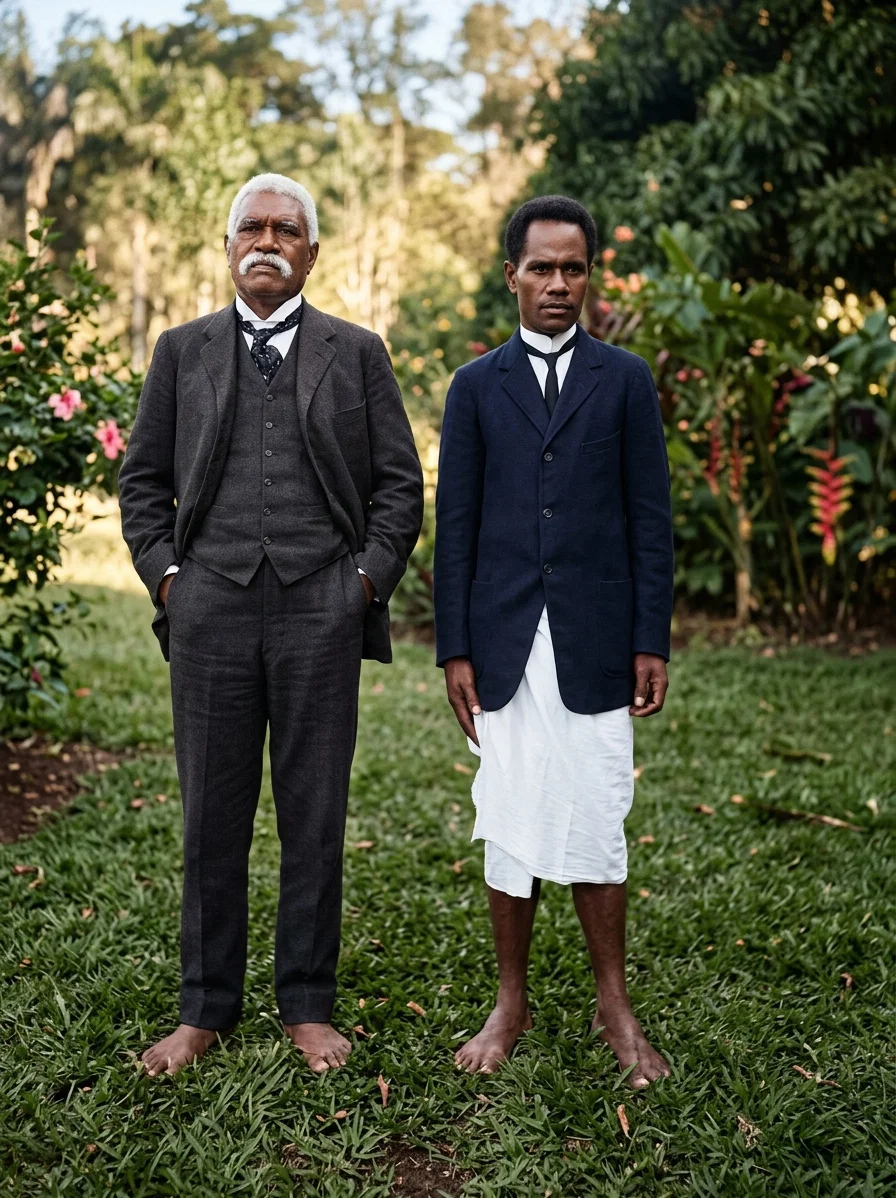
Rev. Ambrose, Left, a Fijian Chief Who Is Also One of Our Church Elders
Prominent people come to visit us, and I am having calls to visit the sick from villages where the people were very bitter at first. There are calls for us to establish missions in other places. Some have offered land and a house. They see that when the heart of the Indian has been touched by the grace of God, he is growing honest and clean, thus becoming useful to the community, instead of being worthless, if not an out-and-out menace.
The opening of our school here met with strong opposition. The enemies lied and threatened, but to no avail. God wanted it opened, and it is open. Now the very people who were in opposition are coming around to visit us, and they all say, “Espléndido”—splendid. This work is a wonder to them. The more they tried to hinder, the more it has grown. I believe the conviction has fastened on some of them that they have been fighting against God. Many feel sorry now.
One prominent man said recently: “We have to send Indians to the large cities to bring in our cargoes of rice, sugar, etc.; and by the time it arrives at our stores, we find that it is short weight many pounds. They take a little out of each sack, and we are helpless. We cannot teach them. O that we had such Indians as you people are surrounded with! Do come and teach the Indians here.”
This is now known far and near. The people used to think and say that we gave the Indians money to be good, but they know better now. We have taken great pains to explain to them how Jesus has come into the lives of these Indians, and that they are looking forward for their reward for faithfulness to the coming of the Saviour.
Puno, Peru.
Jens-Höklund, Coiffeur at the Farthest Point North
In Lapland, Our Northernmost Mission
By J. C. Raft
BY J. C. RAFT
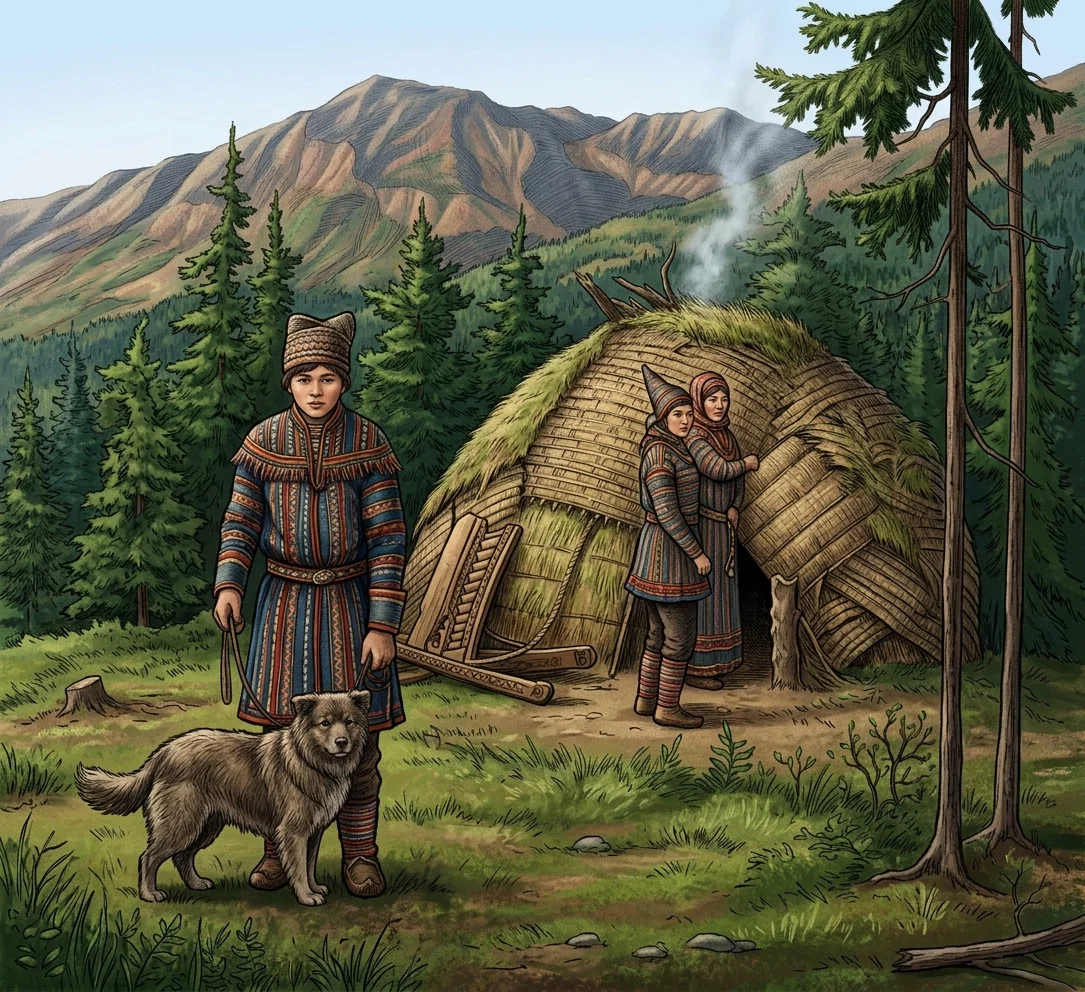
THE picture accompanying this article presents to our readers our young missionary in Lapland, Brother Jens Hokland, on a journey among the Lapps. He has now been among this people a little over one and one half years. When traveling in that land of the far North, he cannot get into a nice, comfortable compartment, in an up-to-date railway car, and speed through the country. Nor can he use horses and sleigh; for, first, there is not the slightest trace of a road to be found; and, next, the horses would sink almost out of sight in the deep snow which, in winter, covers the ground several feet deep, and stretches out as far as the eye can see, in every direction. He must either go on skis, or travel by pulka and reindeer.
Nor is it always pleasant to sojourn among the Laplanders, their habits and modes of living are so widely different from ours. They dwell in tents, and their food consists largely of meat and dishes prepared from the blood of the animals they kill.
Brother Hokland has been well received by the Laplanders. Already several families, also young people, are showing an interest in the gospel of Christ. He has just been out on a journey (the picture was taken on this trip), and he writes that the Lapps he visited were very kind and hospitable. He lived with them in their tents, and of this experience he says, among other things: “Although the fire in the tent burned lively, and I sat so close to it that I almost burned my feet and hands and face, still my back was very cold, in spite of the fact that I had on my overcoat.”
The lot of the Laplanders is hard, but his soul is just as precious in the sight of God as ours. Christ came to the world to save all who will receive His salvation, the Lapps not excepted.
Copenhagen.
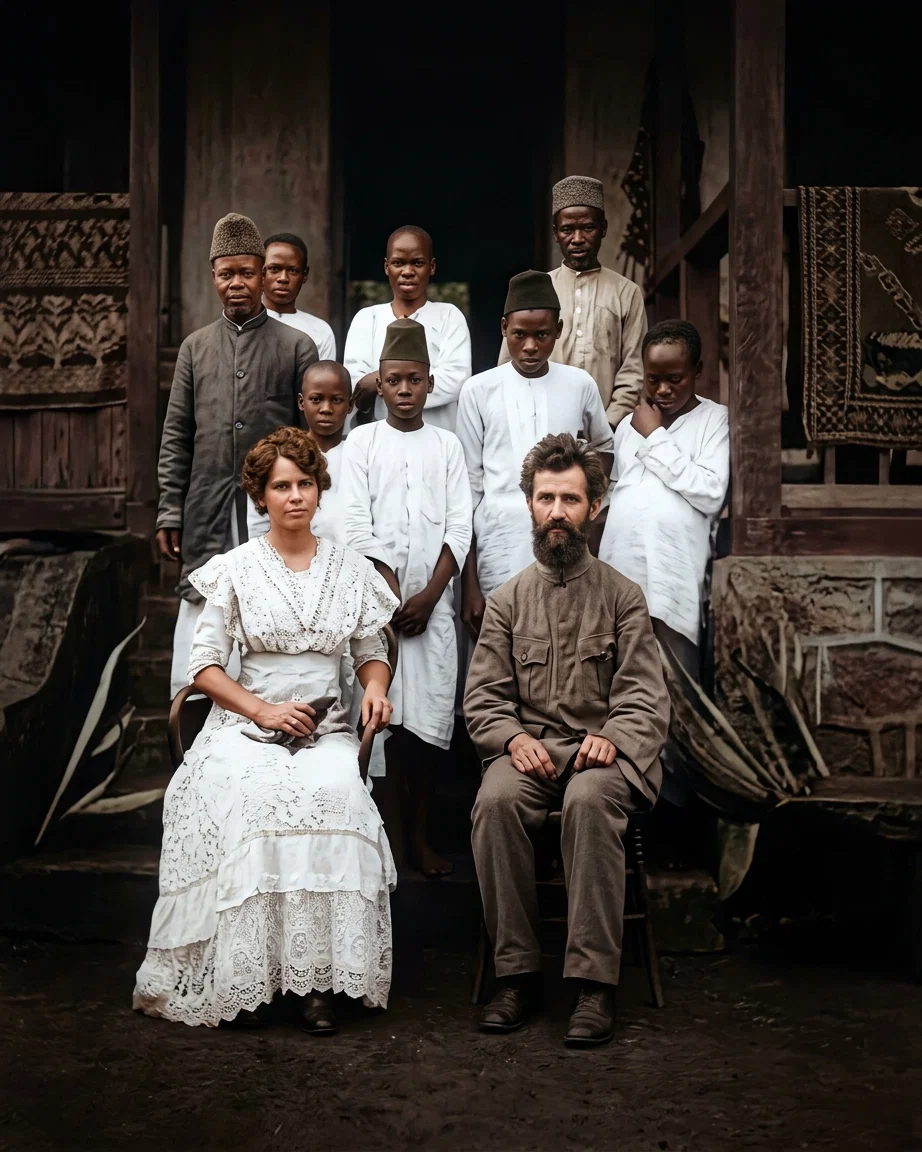
Workers at Vuasu Mission Station, German East Africa