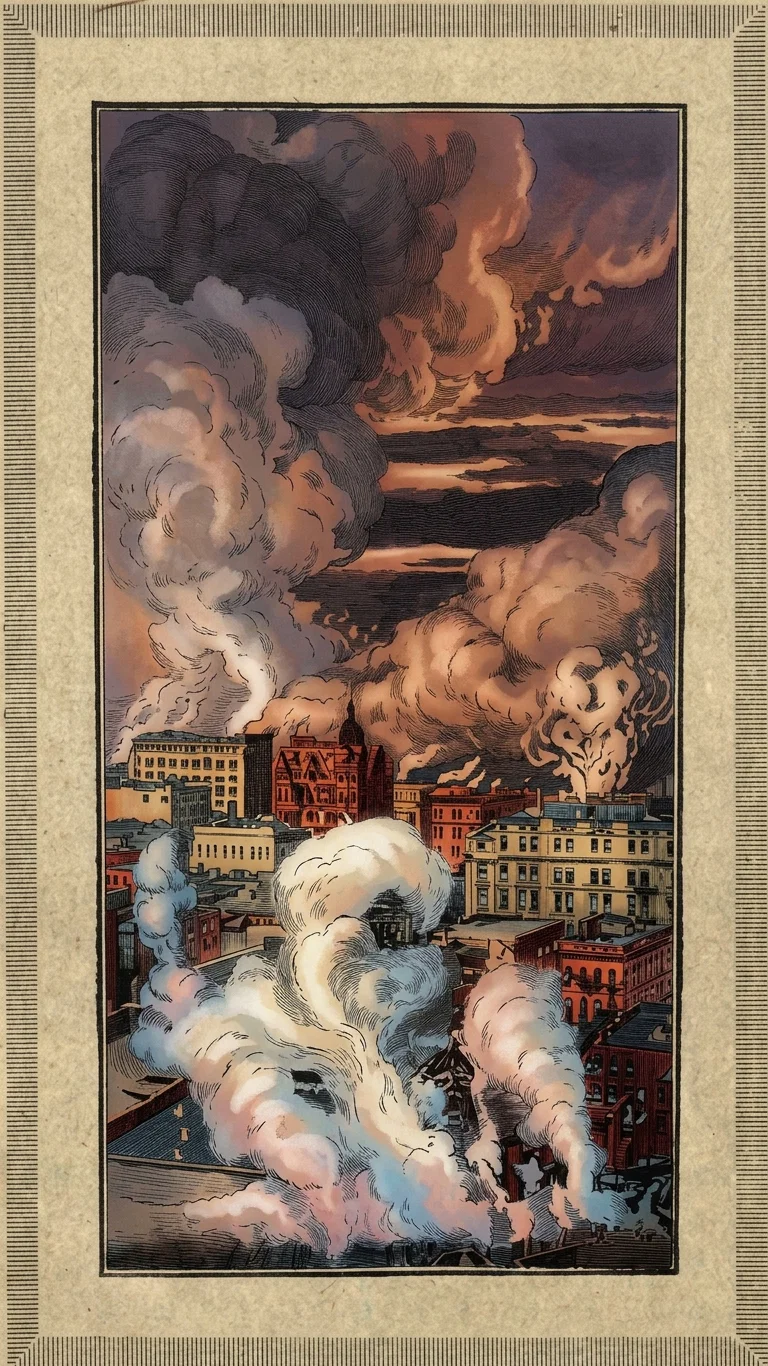
Will They Burn Eternally?—Does the Bible Teach Such a Doctrine?—Where the Wicked Are to Be Punished—When Death Is Finally Destroyed
By HAMPTON W. COTTRELL
In Holy Writ we read, “For the time is come that judgment must begin at the house of God: and if it first begin at us, what shall the end be of them that obey not the gospel of God?” 1 Peter 4: 17. The gospel of God, if believed in fact and obeyed, will save the penitent sinner from eternal death—the curse of God’s violated moral law.
We read “that God made man upright; but they have sought out many inventions.” Eccl. 7: 29, A. R. V. Our foreparents sought out a way to disobey God, that led them and their posterity to death. Disloyalty to God will keep the sinner in the way to eternal death. But faith in the gift of the Son of God, and loyalty to the requirements of His word, will lead one to eternal life: “for God so loved the world, that He gave His only-begotten Son, that whosoever believeth in Him should not perish, but have everlasting life.” John 3: 16.
Eternal Punishment
Popular theology has taught that the life of the wicked will never end, but that they will live eternally in torment. However, this view is not a Scriptural one. The Master said, “These [the wicked] shall go away into eternal punishment: but the righteous into eternal life.” Matt. 25: 46, A. R. V. Note that the difference between the two classes of men is that the righteous are faithful—full of faith—and law-abiding; while the wicked are sinful—full of sin, lawless. The punishment—the wages of lawlessness —is death, not torture in an endless hell; “for the wages of sin is death [eternal death]; but the gift of God [to the righteous] is eternal life through Jesus Christ our Lord.” Rom. 6: 23. Again we read, “Let the sinners be consumed out of the earth, and let the wicked be no more.” Ps. 104: 35.
As Though They Had Not Been
The prophet Obadiah, in defining the end of the wicked, said, “And they shall be as though they had not been.” Obadiah 16. If there never had been any unrepentant wicked people, there surely would be no eternal torture. “And they shall be as though they had not been.” Isaiah bears similar testimony: “Behold, the day of the Lord cometh, cruel both with wrath and fierce anger, to lay the land desolate; and He shall destroy the sinners thereof out of it.” Isa. 13: 9. Seeing the sinners are to be destroyed out of the earth in the day of the Lord, this fact will forever abolish the human theory of a second probation for sinners after the coming of Christ, and annul the doctrine of eternal torture in a lake of fire.
Malachi the prophet states that the day will come when the wicked “shall be stubble; and the day that cometh shall burn them up,” that there shall remain neither root nor branch—that they shall be reduced to ashes. There can be no eternal suffering with those who are reduced to the elements from which they were created. God desires that all men accept eternal life through Jesus37Christ; for we read that God so loved sinners that He gave Christ, that whosoever believes in Him—believes the word of God—should not die an eternal death, but should have eternal life. “And this is the record, that God hath given to us [repentant sinners] eternal life, and this life is in His Son.” But if men, by their words and personal conduct, choose death rather than life through Christ, God grants them their desire, and rather than torture them eternally, returns them to the elements from which He formed them.
In Fire That Can Not Be Quenched
It is elsewhere stated that the wicked will be burned in fire that can not be quenched. And men have based an argument upon this text, and drawn the unwarranted conclusion that they will live and suffer eternally. An illustration will make the text clear. If two buildings were on fire, and the flame in one were quenched, the house would remain; but if the fire in the other “could not be quenched,” the latter house would be consumed—reduced to ashes by unquenchable fire.
One Bible example of the results of unquenchable fire will satisfy those who are searching to know the truth of the future of the wicked. God told His ancient people who lived in Jerusalem that He would burn their city with unquenchable fire if they were not more faithful and loyal to Him. Said He, “Then will I kindle a fire in the gates thereof, and it shall devour the palaces of Jerusalem, and it shall not be quenched.” Jer. 17:27. “And he burnt the house of the Lord, and the king’s house, and all the houses of Jerusalem, and every great man’s house burnt He with fire.” 2 Kings 25:9. But Jerusalem is not burning now, although it was burned, as the impenitent wicked will be, with unquenchable fire.
Tormented Forever and Ever
Again, “The smoke of their torment ascendeth up forever and ever: and they have no rest day nor night, who worship the beast and his image, and whosoever receiveth the mark of his name.” Rev. 14:11. The psalmist adds, “But the wicked shall perish, and the enemies of the Lord shall be as the fat of lambs: they shall consume; into smoke shall they consume away.” Ps. 37:20. Thus we are assured that like fat, the wicked will be reduced to smoke, and it will ascend away forever.
It is written of the archdeceiver, and of certain classes of the wicked, symbolized by the beast and the false prophet, that they will be “cast into the lake of fire and brimstone, . . . and shall be tormented day and night forever and ever.” Rev. 20:10. The word “forever,” when applied to God and His people, is unlimited; but when applied to the incorrigible, sinful mortals, or to things pertaining to time, sin, and the instigator of sin, it is limited to the length of time endurance. An example or two will suffice in proof of the assertion. “David said, None ought to carry the ark of God but the Levites: for them hath the Lord chosen to carry the ark of God, and to minister unto Him forever.” 1 Chron. 15:2.
Again we read with reference to the Biblical use of the word “forever”: “If thou buy an Hebrew servant, six years he shall serve: and in the seventh he shall go out free. . . . And if the servant shall plainly say, I love my master, my wife, and my children; I will not go out free: then his master shall bring him unto the judges; . . . and his master shall bore his ear through with an awl; and he shall serve him forever.” Ex. 21:2-6. “Forever,” as used in this text, is limited to the period of time the slave shall live, and does not mean that he would be a bond servant throughout eternity, as every person who is candidly investigating for truth will be free to admit.
Eternal Fire
Sodom and Gomorrha, and other cities about them, were burned in eternal fire, and were an example of the final destruction of the wicked. In evidence we read, “Even as Sodom and Gomorrha, and the cities about them in like manner, . . . are set forth for an example [to the wicked], suffering the vengeance of eternal fire.” Jude 7. Associating with this another text, the conclusion as to the Scriptural meaning and use of the term “eternal fire” may be readily drawn by the reader himself. “And turning the cities of Sodom and Gomorrha into ashes condemned them with an overthrow, making them an ensample [example] unto those that after should live ungodly.” 2 Peter 2:6. Though burned in eternal fire, they are not burning now; but the Dead Sea is supposed to be where those cities once stood.
Destroyed from the Presence of the Lord
“And to you who are troubled rest with us, when the Lord Jesus shall be revealed from heaven with His mighty angels, in flaming fire taking vengeance on them that know not God, and that obey not the gospel of our Lord Jesus Christ: who shall be punished with everlasting destruction from the presence of the Lord; and from the glory of His power.” 2 Thess. 1:7-9. Note that their end is destruction—exterminated for eternity; and so complete is their annihilation, that they are destroyed “from the presence of the Lord, and from the glory of His power.”
The spiritual presence of the Lord is everywhere; and the wicked are to be where He is not. Where will they be? “Whither shall I go from Thy Spirit? or whither shall I flee from Thy presence? If I ascend up into heaven, Thou art there: if I make my bed in hell, behold, Thou art there. If I take the wings of the morning, and dwell in the uttermost parts of the sea; even there shall Thy hand lead me, and Thy right hand shall hold me. If I say, Surely the darkness shall cover me; even the night shall be light about me, Yea, the darkness hideth not from Thee; but the night shineth as the day: the darkness and the light are both alike to Thee.” Ps. 139:7-12.
Their destruction is also banishment from the glory of God. The poet says, “Everywhere His glory shineth.” The Bible says, “And one cried unto another, and said, Holy, holy, holy, is the Lord of hosts: the whole earth is full of His glory.” Isa. 6:3. Therefore the conclusion must be that in the final analysis the wicked will not exist.
Fire from Heaven Destroys Them
John, while on the Isle of Patmos, had a view of that last day, when sin shall be forever erased from the universe of God, and saw the vast host of the wicked, marshaled by earth’s greatest generals, coming “up on the breadth of the earth,” and compassing “the camp of the saints about, and the beloved city;” and then adds, “And fire came down from God out of heaven, and devoured them.” Rev. 20:9. But Peter, referring to the same day, the same event, and the same fire, says: “But the day of the Lord will come as a thief in the night; in the which the heavens shall pass away with a great noise, and the elements shall melt with fervent heat, the earth also and the works that are therein shall be burned up. . . . Looking for and hasting unto the coming of the day of God, wherein the heavens being on fire shall be dissolved, and the elements shall melt with fervent heat.” 2 Peter 3:10, 12.
The fire that John saw come down from heaven, Peter says, melted the elements and the earth, which locates the lake of fire—the place of the destruction of the wicked, and the erasure of sin. The lake is as broad as earth and sea. “And the devil that deceived them was cast into the lake of fire and brimstone, where the beast and the false prophet are, and shall be tormented day and night forever and ever.” Rev. 20:10. The earth is polluted with sin; and the purpose of the Lord is to melt it, and thus destroy every scar or stain that sin has made upon it. Thus the lake of fire will be the place of the wicked. And of this place the psalmist says, “For yet a little while, and the wicked shall not be: yea, thou shalt diligently consider his place, and it shall not be.” Ps. 37:10.
“Will Bring Thee to Ashes”
It is said of the devil, the beast, and the false prophet, that they are to be tormented in this fire forever and ever; but we have already cited decisions of the supreme Judge of the universe, that “forever,” when applied to things or beings of which He has determined the end, is limited to the time of their endurance. Satan’s eternal destruction is determined in the language, “Therefore will I bring forth a fire from the midst of thee, it shall devour thee, and I will bring thee to ashes upon the earth. . . . Thou shalt be a terror, and never shalt thou be any more.” Eze. 28:18, 19.38
The Second Death
“But the fearful, and unbelieving, and the abominable, and murderers, and whoremongers, and sorcerers, and idolaters, and all liars, shall have their part in the lake which burneth with fire and brimstone: which is the second death.” Rev. 21:8. It is elsewhere stated that Christ gave His life that “He might destroy him that had the power of death, that is, the devil.” Heb. 2:14. Also, “For this purpose the Son of God was manifested, that He might destroy the works of the devil.” Surely, every purpose that God had in the gift of His divine Son will be accomplished.
Isaiah speaks of the lake of devouring fire and everlasting burnings, and gives assurance that no harm can come to the righteous; but to the sinner it brings everlasting destruction. Isa. 33:14, 15. And after the destruction of sin, and the lake itself, then will come the new heavens and “new earth, wherein dwelleth righteousness.” 2 Peter 3:13 and Rev. 21:1.
“TELL THE TRUTH”
By T. E. Bowen
Perjury and Falsehood, and the Results—Should Not the Christian Church Be More Particular About the Truth?
By T. E. BOWEN
UNDER the above title, there appeared recently in the editorial department of one of the leading Protestant papers here in the East, the following sound counsel regarding the importance of every one's telling the truth:
“Newspaper readers have been frequently horrified, during recent weeks, by the news of fresh discoveries of perjury in the events leading to the retrial of two prominent murder cases. One can not read these accounts without being appalled at the ease with which some men and women will lie, even under oath. It makes the search for justice almost hopeless to have the way blocked by such a tangle of lies, contradictions, fresh confessions, and further lies.
“There is urgent need for some new kind of insistent exhortation to tell the truth. A child ought to be brought up to shrink from lying as he shrinks from death. There ought to be a horror at any sort of deception or evasion, or anything that will, even by silence itself, mislead another. New laws are, indeed, being made and enforced, compelling manufacturers and merchants to tell the truth in advertising their wares. New laws are needed to compel newspapers to tell the truth even in cases that could not be covered by suits for libel. It is the newspaper man's business, as well as the business man's obligation, to tell the truth, and a lie ought to make a man a criminal.
“It has been considered a deadly insult to be called a liar. It is a worse insult, an insult to one's self and to God, to be a liar. ‘Buy the truth, and sell it not,’ cling to it, live by it, think it, speak it, live it. Every lie is a step on the way of death. Lies make personal, social, business, political, judicial, ecclesiastical, national life unsound and unsafe. Let us build our lives, our homes, our churches, and our commonwealth, upon the truth.”
All truth-loving people should heartily say “Amen” to the above. A lie is a wicked thing. And if all would “buy the truth, and sell it not, cling to it, live by it, think it, speak it, live it,” what a wonderful reformation would be experienced! What joy would be brought into our homes, our neighborhoods, our churches—everywhere! In other words, it would be a call back to the keeping of God's commandments, one of which says, “Thou shalt not bear false witness against thy neighbor.”
A WEEKLY FALSEHOOD
Somehow, as we read these good words, we could not refrain from saying in thought, “Is it not a pity that these good people who exhort us in this noble manner to truthfulness in every particular should stop short of the truth?” To be plain and “tell the truth,” one of the stones in the foundation of nearly every Protestant church structure in the land is nothing more than a soft, crumbling sandbag handed down from the Dark Ages—a papal falsehood. Every week, from nearly every pulpit in Christendom, a lie is enacted, and palmed off for the truth, there being not one word or fiber of truth in it. And if “every lie is a step on the way of death,” what about this?
When God says, “The seventh day is the Sabbath of the Lord thy God,” what about all the religionists of the land rising up and contradicting Jehovah by saying, “The first day of the week, commonly called Sunday, is the Lord's day”? Because men say it, does this make it into the truth? And if it is not the truth of God's holy word, then, pray, what is it?
It takes only one rotten board in a ship to sink it. One broken rail is sufficient to wreck the most elegant of trains. Only one commandment set aside is needed to break God's holy law. One lie held to and taught for the truth—mark these words—is sufficient to drown in perdition the greatest church on earth. Why not face the truth, “cling to it, live by it,” and “speak it,” in the important matter of Sabbath keeping, as well as in all other fundamentals?
ALL LIARS DEBARRED
Making a lie, loving a lie, and living a lie—just one—knowingly, is sufficient to land one in the lake of fire. This is God's own word. Here it is: “And the city [New Jerusalem] hath no need of the sun, neither the moon, to shine upon it: for the glory of God did lighten it, and the lamp thereof is the Lamb. . . And there shall in no wise enter into it anything unclean, or he that maketh an abomination and a lie.” “Blessed are they that wash their robes, that they may have the right to come to the tree of life, and may enter in by the gates into the city. Without are the dogs, and the sorcerers, and the fornicators, and the murderers, and the idolaters, and every one that loveth and maketh a lie”—just one. Rev. 21:23, 27; 22:14, 15.
Jesus is the truth. He is also called the Word; and the Word is the truth. He says, in that Word, that the seventh day is the Sabbath. He made it, He kept it, and He has not changed it. He ought surely to know. He who still loves the truth, and purposes to “live it,” “cling to it,” and “tell it,” will of necessity be compelled to expel from his life, with all other falsities, the false sabbath. No other refuge but the truth of God's word will stand in the awful storm just ahead. Do not insult God by presenting to Him a day for a sabbath with which He has had nothing whatever to do in its making, especially when by doing so His own word is turned into a lie. “Yea, let God be found true, but every man a liar; as it is written, That Thou mightest be justified in Thy words, and mightest prevail when Thou comest into judgment.” Rom. 3:4. And further, “He that believeth not God hath made Him a liar.” 1 John 5:10.
In regard to Sabbath rest, Sabbath observance, along with all else that goes into the warp and woof of our character, truly “let us build our lives, our homes, our churches, and our commonwealth, upon the truth.”
Knowing God Personally
By G. W. Caviness
Are We Actually Acquainted with God? — How Some of the Patriarchs Learned to Know Him
By G. W. CAVINESS
The Holy Scriptures teach us that every one may and should know God for himself. There is an experience which each one must have individually before it can be said that he knows God. He may have been brought up in a Christian family, may have read and heard the Bible from childhood, he may also have had faithful instruction in the things of God by his godly parents, he may have attended the Sabbath school and church services regularly all his life, and may have a good understanding of sacred history, and still not know the Lord by personal experience.
When Samuel Learned to Know God
The case of the prophet Samuel gives us an illustration of this. This child was given to his godly mother in answer to her prayer, and she promised to lend him to the Lord all the days of his life. His mother, knowing that she would not have her child with her always, taught him faithfully in the things of God; and the boy was so well prepared for the service of the Lord, that when he left his pious mother to live in Jerusalem, he was safe from the contamination of the profligate sons of Eli, although they were priests in the temple. But when the Lord appeared that night and called Samuel, he went to Eli three times, supposing the aged high priest had called him; and the Bible says, “Now Samuel did not yet know the Lord, neither was the word of the Lord yet revealed unto him.” 1 Sam. 3:7.
It seems somewhat strange to say of a39child who had been brought up as Samuel had, that he knew not God; but such is the language of the inspired Word. He had had all the instruction and help a godly mother could give him; but now he was away from her, and must come into direct relation with God, and have an experience that neither his parents nor the church nor any human being could give him.
Jacob Met God and Became Personally Acquainted
The same was true with Jacob. He lived at home, and had the instructions of God-fearing parents; yet he did not learn to know God for himself, although he was deeply interested in religious matters, and coveted the spiritual blessings of the birthright. Doubtless he had heard from the lips of his grandfather Abraham of his wonderful experiences, so that from father, mother, and grandfather he had the best opportunity in the world to learn about God and His wondrous dealings with man; yet he did not know the Lord, and perhaps his very surroundings made it apparently unnecessary that he should have personal relation with the Lord.
But when he was compelled to flee from his home, and had to spend the night in a desert and dangerous place, and was no longer under the protection of his parents, he felt the need of the divine protection. He prayed earnestly to God—prayed as he never had prayed before, because he felt his need as he never had felt it before.
The Lord heard and answered his prayer, and that night showed him a wondrous vision, to let him know that his heavenly Father was a personal help in time of need. He saw a ladder whose foot was on the earth, and its top reached to heaven. He saw angels of God ascending and descending. He saw God above, and heard Him say: “I am the Lord God of Abraham thy father, and the God of Isaac: the land whereon thou liest, to thee will I give it, and to thy seed.”
God Was There, and He Knew It Not
That Jacob did not know God, or realize His presence, is evident from what he said the next morning. When he awoke, he said, “Surely the Lord is in this place; and I knew it not.” He made a solemn vow that if God would keep him in the way he was going, supplying him with the necessities of life, then God should be his God.
A true knowledge of God includes ever the idea of the presence and protection of God as promised in His word: “The angel of the Lord encampeth round about them that fear Him, and delivereth them.” What Jacob saw in his dream is not merely a fancy, but is a divine reality. The angels of the Lord, as in the days of old, ascend and descend, carrying messages between our Father in heaven and His children here on earth. They still give protection and help to the believing child of God.
Moses’ Secret of Endurance
Of Moses it is said that “he endured, as seeing Him who is invisible.” A true knowledge of God includes the ability to recognize the presence of heavenly beings though they may be invisible to human eyes. The experiences of the servants of God as recorded in the Bible are for our instruction and learning. They would be of very little use to us unless it were possible that we might have similar experiences.
Of what value is it to me to know that the angels of the Lord rescued Elisha from his enemies in a wondrous way? Of what advantage is it to me that an angel took the chains from Peter, opened the jail, and let him go free? Of what good is it to me to know that Paul and Silas were freed from the stocks at midnight by an earthquake, and thus permitted to preach the gospel to the jailer and his household?
The benefit to me from those experiences is received when I believe that God is able to do the same things to-day and for me; and when I see the hand of God directing me in my affairs, then I have learned the lesson these instances in the Holy Scriptures were designed to teach. When I have learned to see the things that are not seen, and am taught the lessons of God’s providence in my own case, then I may be said to know God, and be taught of Him. Then, indeed, is He my God, and I am His child. Then I know Him whom to know aright is life eternal.
The Seventh Day Sabbath
When God says, “The seventh day is the Sabbath of the Lord thy God,” what about all the religionists of the land rising up and contradicting Jehovah by saying, “The first day of the week, commonly called Sunday, is the Lord’s day”? Because men say it, does this make it into the truth? And if it is not the truth of God’s holy word, then, pray, what is it?
Be Not Afraid, Only Believe
By Clarence Santee
By CLARENCE SANTEE
A CONSTANT spirit under trial and “hope deferred” is one of the graces much needed, but too rarely seen.
One of the many lessons in which our Saviour instructed His disciples in regard to this spirit, is found in Luke 11:5-8: “And He said unto them, Which of you shall have a friend, and shall go unto him at midnight, and say unto him, Friend, lend me three loaves; for a friend of mine in his journey is come to me, and I have nothing to set before him? and he from within shall answer and say, Trouble me not: the door is now shut, and my children are with me in bed; I can not rise and give thee. I say unto you, Though he will not rise and give him, because he is his friend, yet because of his importunity he will rise and give him as many as he needeth.”
This incident is said to be common to Oriental life, even to this day.
In the lesson, three persons are prominent,—one who has all the loaves needed; one who is willing to impart, but has none to give; and one who, in the darkness, has come in his journey to this man’s house in need of bread.
The Lord has “bread enough and to spare.” We have none. In the darkness, He sends the wayfarer, in need of bread, to our door. Shall we give to him?
“A FRIEND OF MINE”
One of the characters in the parable, though he had no bread to give, had a willing heart. He desired to give. In coming to the one who had bread, he said the wayfarer was “a friend of mine.”
Unless you can truly say to God that it is your “friend” for whom you request, be sure you will not receive. There is little if any blessing in laboring or praying for those whom you do not love. The sentiment may not be that of human attachment, but it must be that broader love which makes no distinction. “Love your enemies.” Jesus called Judas His “friend.” Matt. 26:50. And He prayed for him as such. It is as well to ask little for another until you can ask as a friend indeed.
If God waits as you ask for the bread, it is because you are not ready to receive it. Keep asking. The earnest asking will prepare for better use of the gift when it is received. You may at times be tempted to say: It is of no use. “Why troublest thou the Master any further?” Mark 5:35. But remember, when “they laughed Him to scorn,” believing the girl to be past help, He kindly said to the parents: “Fear not: believe only.” “She is not dead, but sleepeth.”
The one for whom you have sought God to give the bread of life, may long have been indifferent, careless, dead as far as human help is concerned; but the hand that wakened the girl who was past sense or feeling, can yet touch the object of your importunity, and that one will awake. “Fear not: believe only.”
MAY NOT DISCERN THE LOAVES
The Master may not always give the loaves in the way that we look for them. Paul planned a triumphant journey to Rome. He wrote of his contemplated visit. He did visit Rome; but how different the entry from his anticipations! In the midst of criminals, chained and execrated, aged and in ill health, he entered Rome. He might have been tempted to say, I asked bread, but God has given me a stone. But no; and while he saw but little of the reasons why he should bear his testimony in bonds, yet in the persecution that followed, in which thousands were martyred, the example of Paul in those bonds, even until death, caused many to face death and bonds bravely. His testimony in bonds was a stronger witness than could have been borne had he gone as he desired.
God gave him the loaves for his friends. He saw it by faith, and was satisfied. 2 Tim. 4:6-8. “Ask, and it shall be given you.” Luke 11:9.
Trust God for the way. “Fear not: believe only.”
The Glorified Man
By William Covert
WHEN man was made, he was all glorious and perfect. No sin had cast a shadow on his form, nor had sorrow marred his countenance. He was perfect in beauty, and that perfection made him glad. But sin came, and with it sadness. Then death wrapped man up in the dark grave, and he was out of sight.
But the resurrection is coming soon, and then perfection will be regained. In the resurrection state, the infant will be developed, and the dwarf will reach normal size. Then the blind will see, and the lame will walk. The weak will be made strong. The deaf will hear, and the dumb will talk, and shout, and sing. No crutches will be needed, for he who once was lame will be supple as the bounding deer. Then no nerve can suffer, nor heart can ache. No worry will follow us into the land of life. Our resurrected and glorified bodies will be incorruptible. The redeemed will be as angels are, and can then pass to other worlds with speed like the electric flash.
What a manhood and womanhood the immortal state will behold! We want it. We must have it. In Christ we can not miss it.
WILLIAM COVERT.
The Robe of Righteousness and Ballroom Garb
“It is poor policy to sell one's robe of righteousness for a ballroom garb.”