[The following article is from a brother who was in the great 1844 movement, who passed through the great disappointment at that time, and who with undimmed faith is still looking for the fruition of his hope. He is now eighty-seven years of age in body, but his heart is young, and his hope bright. Ed. S. of T.]
This scripture doubtless has reference to the 69 weeks of Dan. 9:25, bringing us to the autumn of A. D. 27, this being the end of the first 483 years of the 2300 years of Dan. 8:14. At that time our Saviour was baptized and acknowledged to be “Messiah the Prince.” In the middle of the 70th week or 490th year of the 2300 years, He (Christ) was cut off or crucified (Dan. 9:26, 27), in the spring of A. D. 31, leaving 3½ years for His apostles to fulfil the remainder of the 70 weeks (Dan. 9:24). This brings us to the autumn of A. D. 34, the remaining 1810 years bring us to the autumn of 1844.
We then reached the climax, if I may so speak, of the world’s great prophetic era. Within the fifty years preceding, five of the prominent prophetic periods of the Bible had terminated. The 1290 years ending in 1798; the 1260 years beginning with the setting up of the Papacy in A. D. 538, had ended the same year, 1798, and marked the beginning of “the time of the end” (Dan. 11:35); the 391 years and 15 days of Revelation 9, had come to an end Aug. 11, 1840, marking the fall of the Ottoman Empire, as since that time it has existed only by the consent of the powers of Europe; the 1335 years ending in 1843. Blessing is pronounced upon those who wait and come to the end of the 1335 days. While this blessing may be the increase of knowledge, it will terminate in such a blessing as the disciples at Christ’s first advent were themselves permitted to enjoy. Dan. 12:12; Matt. 13:16, 17. And in 1844, the great period of the 2300 years ended, which marked the commencement of the work of cleansing the sanctuary.
The warning message to the world in the great advent message of 1840-44, had now swelled into a mighty cry. A movement such as the world had never before witnessed, had now reached the height of its power. The coming of the Lord was the burden of the proclamation. Sublimer times never engaged the attention of man. God raised up men in different parts of the world to herald this warning abroad. It went to every missionary station on the globe. An army of able and devoted men appeared, filled with love for souls and for the truth, who freely gave their time, talent, and strength to its vindication; treasures were poured out like water to spread the warning everywhere. God was in this movement, and all Christendom was shaken from center to circumference.
Truly the time had come when the first division of this three-fold warning which was to precede the coming of Christ was going forth, Rev. 14:6-12; also Rev. 10:6; for the time had come for the longest and last prophetic period to meet its termination; then came the grievous disappointment. A mistake had been made somewhere. And as it was asked of the baptism of John, “Was it from heaven or of men?” This question was settled at once by every one who truly and heartily accepted the Bible time message. The time was the test; it was the moving principle; and when I publicly arose and confessed it, such a blessing I never before experienced. It far exceeded my happy conversion. Such was the experience of thousands who accepted the time message; and we could say, Truly it was from heaven. As God set His seal of approval to the time, we saw that in that great and mighty movement we had fulfilled the parable of the ten virgins up to Matt. 25:10. Right here our faith had followed our Saviour into the most holy place, and at this very point the temple of God was opened in heaven and there was seen in His temple the ark of His testament. Rev. 11:19. Here also the third angel came out with his warning message. Here we saw the light upon the sanctuary in heaven. This was the sanctuary to be cleansed, promised in Dan. 8:14. There we saw the ark of His testament, and we made haste to keep His down-trodden Sabbath.
Now we see that when the time came for our Saviour’s first advent, God raised up John the Baptist to give the warning message, and also of His crucifixion and ascension to heaven; and when the time of His second coming was to take place God raised up men to warn the world of the judgment which was to precede Christ’s second coming, based on Rev. 14:6, 7, saying “the hour of His judgment is come.”
Fifty-one years ago I don’t think there were 100 Seventh-day Adventists in the world. Now there are probably 100,000 telling the people that we are passing through the time of judgment of the righteous and dead. See Dan. 7:9, 10. No other denomination on earth is preaching such a message. This is all made plain by the sanctuary subject. Now it is plain to be seen that this is the last threefold message to be given to the world before Christ comes, and this work has been going forward in the sanctuary above since the end of the prophetic period in 1844.
With those of the earliest generation, the work of examination in the judgment of God passes on down through all the records of time, closing with the living; then the sealing message of Revelation 7 will have performed its work, and all cases will have been decided. Everything will then be ready for the coming of our Lord and Saviour. While we see the great work which is going on in heaven, we also see a corresponding work is going on in the earth. And as many of God’s true servants who have gone down to the grave regarding the Sabbath, the seal of God’s law, will doubtless be raised as a part of those who will be translated; it is sure that the people who give this warning message will witness the glorious appearing of the dear Saviour.
And so I can say, as Brother William Miller said in an article in the Midnight Cry of September, 1844, “Glory, glory, glory! the Lord is soon coming! O church of God lift up thy voice like a trumpet, and sound an alarm which shall cause the inhabitants of earth to fear and tremble; ‘for the great day of the Lord is near, and hasteth greatly.’”
WASHINGTON MORSE.
Peterboro, Ont., Dec. 29, 1902.
DELIGHTS TO GIVE.
By Spurgeon
BOUNTEOUS is Jehovah in His nature; to give is His delight. His gifts are beyond measure precious, and are as freely given as the light of the sun. He gives grace to His elect because He wills it, to His redeemed because of His covenant, to the called because of His promise, to believers because they seek it, to sinners because they need it. He gives grace abundantly, seasonably, constantly, readily, sovereignly; doubly enhancing the value of the boon by the manner of its bestowal. Reader, how blessed it is, as the years roll around, and the leaves begin to fall, to enjoy such an unfading promise as this: “The Lord will give grace.”—Spurgeon.
THE PUNISHMENT OF THE “LOST.”
By MYSTIC
[The following article comes from a respected gentleman in the government service of Great Britain. He prefers that his name should not be given.]
THE ordinary belief of the religious world concerning the lost, is that they will suffer eternal pain; but when we examine closely the Scriptures, we find, as common sense might lead us to expect, that God will inflict no disproportionate punishment but “reward every man according to his deeds,” which, in our knowledge of things, would not be the case should everlasting pain be meted out for transgressions committed during a man’s lifetime; which is but “a vapor, that appeareth for a little time, and vanisheth away.”
Man, we are told in Holy Writ, has given him in this world, the choice of eternal life or eternal death; of living forever with Christ, or of perishing everlastingly. Our Lord says, “And these shall go away into everlasting punishment.” Matt. 25:46.
The punishment, therefore, is eternal, and universalism thus splits to pieces on our Saviour’s words.
What, then, is the punishment?
The Word of God seems to the writer to answer, Destruction! Note the following expressions of Holy Writ:—
“All the wicked will He destroy.”
“And shall consume . . . both soul and body.”
“Who shall be punished with everlasting destruction.”
“He hath utterly destroyed them.”
“None shall pass through it forever and ever.”
“He shall stretch out upon it the line of confusion, and the stones of emptiness.”
“It shall leave them neither root nor branch.”
“They shall go forth, and look upon the carcasses of the men that have transgressed against Me.”
“Were cast into the lake of fire; this is the second death.”
This is the lake of fire into which death and hades (R. V.) themselves are to be cast.
Other passages of the same effect could be quoted; the whole drift and trend of both the Old and New Testaments is in this direction, viz., that after the final judgment the wicked “will perish at the presence of God as wax melteth before the fire.”
Certainly if destruction means continual existence and to perish means to live forever, then all the above argument is altogether unsound. But the disadvantage of interpreting Scripture in such a manner is that words lose thereby their ordinary meaning without giving any clue to their real meaning; and this we know is not the character of the way of God. “The way-faring men tho fools shall not err therein.”
The awful mystery of the future destiny confronts us constantly. But let us take heart of grace. “He who reigns above,” “He who reigns below,” “He who reigns alone” will not inflict disproportionate punishment, and that is all we know in this state concerning the fate of the lost who dwell in hades.
There is another point to be considered in the matter arising out of the passage “The last enemy that shall be destroyed is death.” That sin should continue in the universe after the destruction of all other enemies of God seems not only unlikely, but contrary to all scripture.
MYSTIC.
THE BURNING OF THE REVIEW AND HERALD.
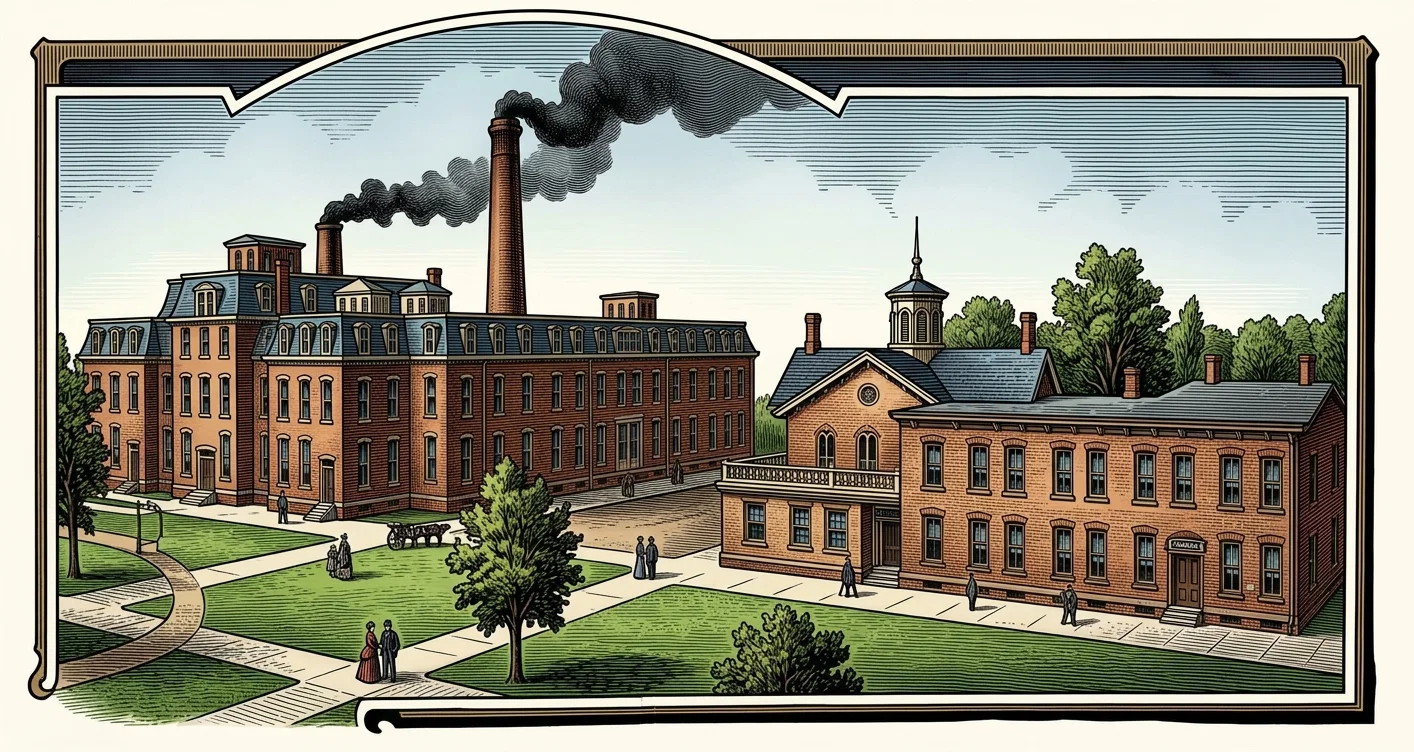
On this page we present two cuts, one a woodcut of both of the Review and Herald buildings, and the other a half-tone of the ruins after the fire. The loss was greater than at first reported. It will probably aggregate $400,000; insurance $100,000.
The cause of the holocaust of December 30 is unknown. The fire chief of the city and the electrician of the institution made a thorough inspection of the building the day of the fire, and pronounced everything satisfactory. But in a few hours the great printing plant was in ashes, some of those working in the building barely escaping with their lives.
The Review of January 6 came promptly to hand, the type being set at the offices of the Moon, the Journal and the Enquirer of that city; the press work was done at the Pilgrim office. All of the copy of the Youth’s Instructor for two numbers was burned, and therefore two numbers will be omitted; the S. S. lessons will be printed for those weeks in the Review. We are sure that the subscribers will willingly make this sacrifice.
Some Interesting Facts of History.
The first copy of the Advent Review and Sabbath Herald was issued in November, 1850, at Paris, Me. It was published monthly, more or less regularly, till April, 1857, when it was then issued as a semi-monthly. Aug. 5, 1851, Vol. II., No. 1, was printed at Saratoga Springs, N. Y. Under date of May 6, No. 1 of Vol. III. of the paper was printed at Rochester, N. Y. The same year in August the first number of the Youth’s Instructor appeared.
In 1855 the office was moved to Battle Creek, Mich., and established in a two-story wooden building. The first issue of the Review and Herald in Battle Creek bore date Dec. 4, 1855. It was first printed on a power steam press July 30, 1857. The Publishing Association was organized Oct. 1, 1860, and legally incorporated May 3, 1861. Since that it has been enlarged from time to time, and, its charter expiring, it was reincorporated in 1891 with a capital stock of $250,000.
The Review and Herald Office after the Fire.
Review and Herald Office before the fire. The large building on the left was burned. The composite building on the right remains.
At the time of the fire it was printing the following periodicals: Review and Herald (leading church-paper of the denomination); The Youth’s Instructor; Christlicher Hausfreund (German); Der Deutsche Arbeiter; Evangeliets Sendebud og Sandhedens Tidende (Danish-Norwegian); Sion’s Vaktare och Sanningens Harold (Swedish); besides many other publications, serial and otherwise.
What They Say.
From the Review of January 6, we take the following paragraphs, which give our readers an idea not only of the loss, but of the spirit actuating those upon whom the loss falls so heavily:—
A meeting of the employees was called the next morning at nine o’clock, at which the situation was considered, with particular reference to the effect of the calamity upon those who were dependent on their weekly wages for support. The assurance was given by the management that no one of the employees would be permitted to suffer for the necessaries of life, and plans were suggested by which it was believed employment could be furnished to all. Some will go out to scatter our publications, and some will be employed by the Sanitarium, and some may connect with our publishing houses elsewhere.
All face the situation calmly, courageously, hopefully, confident that victory will yet come out of seeming defeat, and the scripture will again be proved true, that “all things work together for good to them that love God.”
Other publishing houses of the city kindly offered assistance through the use of their facilities, and many telegrams of sympathy were received from firms with which the office has sustained business relations. It is too early at this date to attempt any statements with reference to the question of rebuilding.
The next day after the fire the directors of the Review and Herald Publishing Co. authorized the manager to order at once such an outfit of machinery and material as would make it possible to print the Review and the Youth’s Instructor. The large room in the West Building formerly occupied as a chapel will now be turned into a printing office, and this new machinery will be set up as soon as possible. We hope to print our own papers again in a short time.
The president of the General Conference, Pastor A. G. Daniells, who is also one of the directors of the Review and Herald Publishing Association, after recounting some of his thoughts of the great fire and its consequent losses, and his joy that the good old Review still lives, makes this plea, which we heartily second:—
It certainly seems that under the present conditions, the Review would become a dearer and more cherished friend to us all than it has ever been. This ought to be the case. In the present hour of difficulty the Board of Directors wish to make at least one earnest appeal to our people, and that is that they will rally around the Review and Herald. They feel that the loss of our building and machinery will not prove to be such a terrible thing if our brethren and sisters will become faithful readers of the Review. We do not see how they can read this paper from week to week without being inspired with new life and enthused with new courage. If this is done, the message for this time will hold its place in our hearts.
The directors desire to make an earnest appeal at this time to every lover of this truth to take the Review. Will not our union and State conferences, also our ministers and church officers, take this matter up, and see that every family in the country is supplied with the paper? Now is the time to rally around this old friend, and this is the way to show practical sympathy in the disaster that has come to us. Printing establishments and business firms have telegraphed us their sympathy, and have offered anything and everything at their command for our service. We appreciate this; but it can do us little good. The greatest help that can be rendered at this time can be given by all our people rallying around the Review.
There is much more which we would like to quote, but space and time forbid. May God especially bless those upon whom the burdens fall so heavily.
Question Corner
1307 F. A. A.—To learn about companies of Sabbath-keepers in Missouri, Arkansas, or Alberta, write to the following gentlemen for the fields named respectively: J. M. Rees, 14 West Fifth Street, Kansas City, Mo.; A. E. Field, Springdale, Ark.; J. W. Boynton, Ponoka, Alberta, N. W. Territory.
“The unclean spirit when he is gone out of the man passeth through waterless places, seeking rest, and finding none, he saith, I will turn back unto my house whence I came out. And when he is come, he findeth it swept and garnished [“empty,” also, Matt. 12:44]. Then goeth he, and taketh to him seven other spirits more evil than himself; and they enter in and dwell there; and the last state of that man becometh worse than the first.”
(1) The text implies demoniac possession, or the control of human beings by the demons, or angels of Satan. These demons, or evil angels or spirits, cut off by voluntary sin from God from whom they once received directly the current of life, are doomed to obtain it by secondary means through originally lower creatures. Many of them possess humanity. Many, doubtless, possess lower animals. (2) The spirit is cast out. God in mercy expels him to save the man, that the man may be free. The man asks for cleansing, and God cleanses, cleanses that the man may serve him. The house is left empty, swept, garnished. (3) The unclean spirit is cast out, that the spirit of God may come in. The man is released from the bondage of Satan, that he may freely serve God. But this must be voluntary also. The man refuses, thinks to do nothing and yet go free. The evil spirit goes forth seeking rest and nourishment but finds none, and he returns to his house,—the man who was cleansed,—and, finding the house empty, enters and again takes possession. He controls the man, and to make possession sure lets in others. Surely the last state of that man is worse than the first.
If Jesus Christ has cleansed us from one sin, set us free from one evil habit, it is that the good may take10its place; and if we refuse to use the strength to do the good that Christ would put in the place of evil, sooner or later the evil will return leading a troop of others worse than the original, and we will be doomed to a worse bondage than ever before. We can not remain neutral; it will avail naught to say, “We will do naught against Christ.” The Master declares: “He that is not with Me is against Me; and he that gathereth not with Me scattereth.” Luke 11:23. And then follows the above scripture. Surely the lesson is important. It is Christ or Satan.
1309.—Chinese and the Sabbath.
Which day of the week do the Chinese observe as the Sabbath?
The pagan Chinese observe no day as the Sabbath. There seems to be fairly good evidence that they once observed the seventh day. Of course Christian Chinese observe the day they have been taught to observe by their teachers. Some observe the first day, some the seventh. Many of the Tai Pings, so much maligned, were seventh-day observers.
1310.—Marriage and Divorce.
Would a Seventh-day Adventist minister marry a divorced man and woman whose wife and husband were living? If so, would they not be living in adultery according to Matt. 5:32? C. S. H.
(1) We do not know; we hope not unless the case was scripturally clear. (2) It would depend on the basis and ground of former divorces. Were the divorces mere separation with no Bible grounds? What is meant by divorced man and woman? Were these parties divorced because they violated the marriage vows, or because the former husband and wife did? It is impossible to answer categorically. There are, however, what everybody knows, too many loose, unconsidered, unscriptural marriages among professed Christians; and no Christian minister should perform the marriage ceremony.
ADOLESCENCE
By Mary Wood-Allen, M.D.
BY MARY WOOD-ALLEN, M.D.
II. Mental Significance.
EVERY observant parent knows that the physical changes are not the only accompaniments of adolescence. The child who has heretofore been amiable and docile perhaps now begins to manifest perversity and wilfulness. He is strangely restless, perhaps morose at times, at others irritable. The girl is peevish and petulant, the boy unamiable or even impudent. They have before this been confidential and communicative. Now they withdraw themselves and seem inclined to keep their own counsel.
They become opinionated and do not hesitate to express their ideas in the most egotistical way. They are hard to please, hard to govern, hard to live with in every way. The parents can not understand this. What should have changed this sweet, loving, little child into a youth so awkward, opinionated, fault-finding and perverse? The conditions at home have not changed. Everything is as pleasant as ever, and in truth everybody is making more effort than ever before to placate this strange, restless, unreasonable creature who seems to care little how much trouble he makes.
Just at this period of their children’s lives many mothers suffer greatly with the feeling that everything is going wrong, that their children do not love them any more, and they really lose their hold on these growing inmates of their homes simply because they fail to understand the mental significance of adolescence.
In his early life the child imitates. He learns through imitation. He accepts the ideas of those about him unquestioningly and follows the path marked out for him. But with the new gift of life-power which comes to him at puberty his own self awakens. He begins to realize that he is a unit, an integer, an individual. He realizes this only in a blind way. He does not comprehend that these new and strange feelings of rebellion are the strugglings of his individuality for expression. Those about him do not understand it either. They fail to see that these traits which seem so objectionable to them are in truth the struggle to attain that self-hood which will make him of real value to the world. (I Cor. 13:11). The individual who in maturity is only a childlike imitator of those about him has very little value to the world. If he is to amount to anything he must have a “mind of his own,” must be able to think for himself, to judge for himself, to act for himself. And this is what the adolescent is beginning to do. In himself he feels the awakening of his individuality. He is somebody. Not merely an appendage to parent or teacher; not merely an imitator of others; not merely a reservoir for the ideas of others. Their ideas may be good, but how does he know until he has thought for himself? So he discards your carefully studied beliefs, your “ancient received opinions,” not because of any newly discovered lack of faith in you, but because of a newly discovered faith in himself. It is a wonderful thing, this discovery of self. It should arouse our respect. Instead of snubbing the crude and dogmatically expressed ideas of the growing boy or girl (Eph. 6:4; Col. 3:21), we should see in them the dawning of individuality and rejoice. It is far better to think wrongly in the outset, than not to think at all. Crude and faulty ideas are more desirable than no ideas. If encouraged to go on thinking, the probabilities are that the husks of thought will fall off and the sound, ripe kernels be found to have matured within.
While not obliged to receive without contradiction every simple idea of youthful minds (Ps. 103:13) we can still show a courteous recognition of their efforts at thinking, and by polite queries lead them more quickly to see their errors than by sneers or snubs.
The boy who at home learns how to courteously discuss a subject, how to pay deference to his antagonist, how to differ politely, how to gracefully accept defeat, or how to generously acknowledge the justice of his opponent’s arguments has had a training the value of which can scarcely be measured.
And the father who accords to his son or daughter the right of an individual to think, has taken the surest way to maintain his influence over them.
The awakening of individuality in the adolescent mind is the secret of apparent withdrawal from the parental confidence which troubles mothers, more often than it does fathers.
The child has been so confidential, so free to bring to mother all little griefs and joys, why should he now seem to desire less of confidence and sympathy? Why does the girl consult her mother less about the details of her toilet, or why does the boy seem to shun the sweet hour of sympathetic intercourse?
In all probability it is simply the growing individuality, which makes the youth feel that he must now take charge of his own life. It is not that he trusts mother less, but he wants to be himself, to assert the ego. If the mother can understand this and sympathize with it she will feel less troubled, for she will know that this is only a turbulence that will eventuate in a clarifying of the mind and a strengthening of confidence. If she can only be wise enough to let go with the arbitrary hand of parental authority, and grasp with the friendly hand of sympathy, she will find the grasp is firmer and surer and grows stronger with the passing years.
The mental significance of adolescence then means the awakening of individuality, the coming into the possession of self. With this fact in mind we shall better understand the youth who is reaching out after a knowledge of his own powers and who needs our wise sympathy in his struggles to gain possession of God’s great gift of self-hood.
THE WEALTH OF OLD MAN JONES.
By William H. Hamby
[William H. Hamby, in S. S. Times.]
“THERE is one thing that I can’t understand,” said my friend with a questioning mind.
“What is that, Hanson?” I asked.
“About old man Jones, down there at the foot of the hill. If there are any Christians in this country, he is one. He has prayed twice a day for forty years, and proved his faith by his works. He has worked hard, and has been ambitious to lay up something for his family, yet he is exceedingly poor, has always been poor,—often his family lack the bare necessities of life. That little cabin with the rocky patch of ground around it is all he has to show for a life of drudgery. Yet the Bible says that all things work together for the good of those who love the Lord, and to him that asketh it shall be given. How do you explain it?”
“Let us go down and talk with him about it,” I replied.
The old man warmly welcomed us into his simple cabin, and set chairs for us by the open fireplace, for it was a frosty November day.
“I’m glad to see you, Will.” He always called11me Will. “I have been wanting to tell you about a letter I got two weeks ago from Dave. Dave has professed religion, and joined the church.” The old man’s eyes grew bright, but his voice shook a little. “I’ve been praying for that boy for many years, and I knew the Lord would save him.” The light on the face furrowed by care and toil and age was good to see. “I’m perfectly happy now,” he continued. “Mary married a good man, and they have a good home. Sam is preaching the Gospel, and now Dave has chosen that better part. The Lord is wondrous good to His servants, and I can say with David, ‘The Lord is my shepherd, I shall not want.’” And he repeated the whole Psalm.
“But haven’t you often needed things that you did not get?” inquired my friend.
“Oh, yes! certainly, there have been many times in our lives when we did not have all the worldly goods we wanted, but some way we pulled through,” replied the old man cheerfully. “Perhaps it was the result of bad management, perhaps it was best so, but that matters little. The Lord has made us so rich in everything else we do not mind a little poverty.”
As we climbed the hill my friend was silent. When we reached the summit we looked back at the little cabin at the foot.
“I understand now,” said my friend.
Meadville, Mo.
The Leader and Shepherd
THE EARLIEST RECORDED HYMN
From the Greek of Clement of Alexandria
CHRIST! of tender Lambs the Leader,
Shelter of each nestling bird,
Of our young the Guide and Pleader,
Let our song to Thee be heard;
While sweet praises each voice raises
To the everlasting Word.
Lead, O King, to life eternal,
In the footsteps Thou hast trod,
In the heavenly way supernal,
Strength of those who worship God;
Fount of mercy, virtue’s Author,
Lead us with Thy staff and rod.
For Thy lowly life of teaching,
Find Thou here Thy blest reward,
While the children, heavenward reaching,
Sing the praises of their Lord;
Children tender, their Defender
Praising in divine accord!
A YOUNG GIRL'S CHOICE.
I READ of a girl whose father had a great deal of money; he had earned it making and selling beer, giving her a lovely home with everything she could wish. She lived a gay life, going to parties and balls, till a day came when she saw this way of living was the way of sin, and she turned from it to follow Jesus. She could not go to these parties any more, and when her father asked her to go, she had to say, “I can not, for I am a Christian now.”
This made him angry and he said, “Well, you must go, that is all there is to it.”
“But, father,” she said, “it would be sin for me to do it.”
“Never mind about sin; I want you to go with me to-night. I will wait for you.”
“I must not go, father,” she cried. “Please do not ask me.”
“You can choose now to go with me or you can leave your home. Which will you do?” asked the angry father.
“Father, I will do anything you ask, if it is right to do, but this is sin, and I can not disobey God.”
Then he said, “You may have till morning to think over this, and if you can not give up being a Christian you will have to go away.”
When morning came he asked her what she would do. “I am willing to stay away from church if you wish, but I can not go where Jesus would not have me.”
“Then you may go,” he said. So the girl left sadly to get her things, and when she was ready to go away stopped to say good-by to her home.
Kneeling by the sofa she prayed God to guide. Then she sang: “Jesus I my cross have taken, all to leave and follow Thee.”
Her father in passing, heard her sing and pray. The Holy Spirit softened his heart. He went in and kissed her. “Forgive me,” he said. “You may stay and go to church as much as you like, and will you pray for me?”—Anon.
Leading Strings from the Home to the Saloon.
Many a man has been “driven to drink” by the unpleasant and unwholesome atmosphere in his home. Many a son and many a daughter have drifted to ruin because the home was full of criticism, cheap gossip, slackness, and everything else that was unhomelike.
Frequently the boy and his companions find it more congenial to play in the barn, or woodshed, than in his own home. The ever-sounding, “Don’t do this,” or, “Don’t do that,” creates a yearning in the child’s mind for the time when he will be free from the “home bondage.”
Fathers and mothers can do more for the cause of temperance by making home attractive than they can by smashing saloons or pouring liquor into the streets. When parents cease to take care of their children, the devil will be sure to take care of them; for he is interested in the youth. If you fail to make home attractive you will pay the penalty in a failure to save your boy or girl. The money which the average drunkard spends each year in the saloon would be amply sufficient to decorate his home and help make it a little heaven for the wife and mother, and the most attractive spot on earth for his children.
Take a Tourist Car
—A Santa Fe tourist car—if you would enjoy your trip across the continent.
The cars are so comfortable, the route so interesting, the people so pleasant, the excursion manager so accommodating, the porters so obliging, and the meals so good, that you simply can't help being satisfied.
Personally conducted east and west three times a week—Mondays, Thursdays and Saturdays—to Chicago, Kansas City, Los Angeles and San Francisco.
Folder giving full information furnished on request by any Santa Fe Agent.