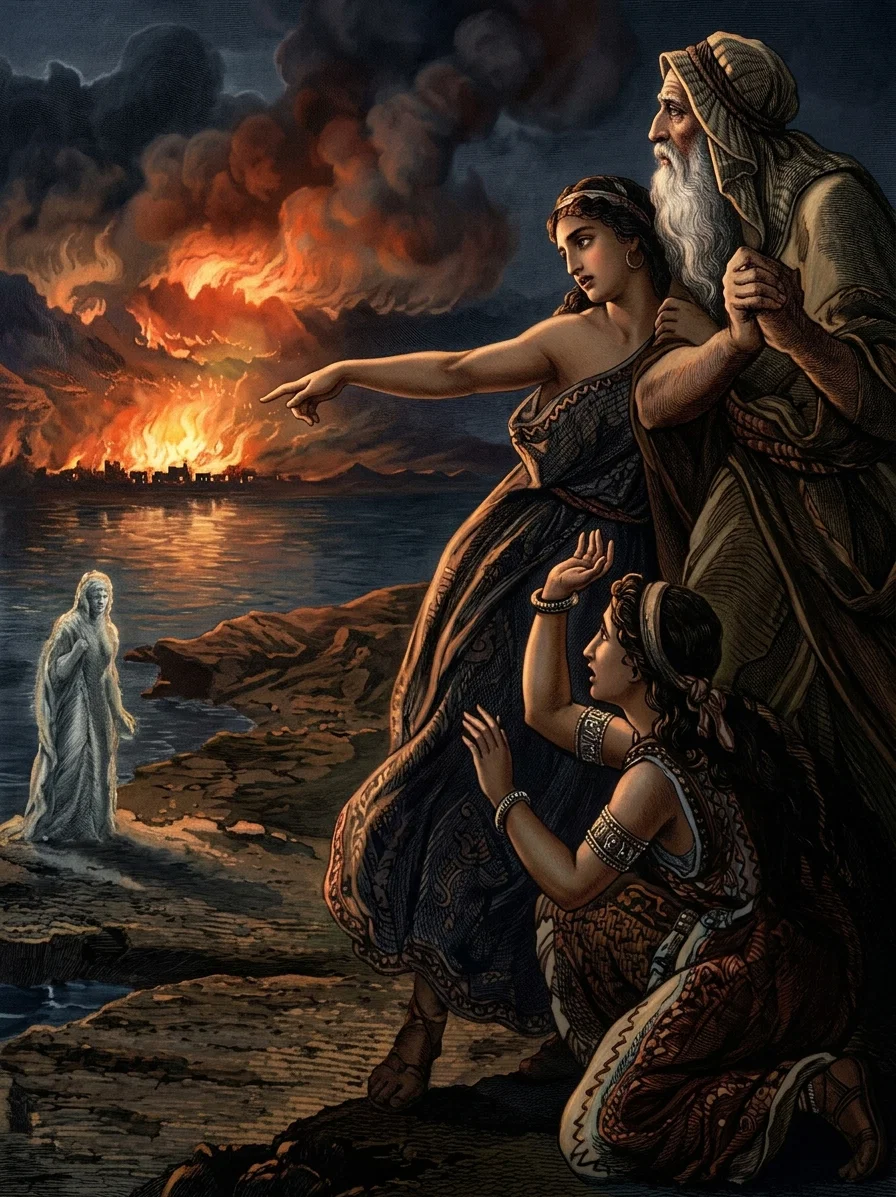
In Jordan’s lovely, blooming vale,
Where living waters never fail,
Where flowers shed their fragrance rare,
Stood Sodom’s city, grand and fair.
Her fields were dressed in harvests white,
And verdant hills did greet the sight;
Her plains were clothed in robes of sheen,
Of palm, the vine, the olive green.
Profusion reigned, till life did seem
To people but an idle dream.
Her wealth and leisure were the seeds
That ripened into fearful deeds.
But God in love sent beams of light
To pierce this gloom as dark as night.
But, sad indeed! the last, last ray
Was also spurned and turned away.
But now the fatal night draws nigh,
And clouds of vengeance fill the sky,
As o’er the city, doomed, they cast
Their heavy shadows, thick and fast.
While angels on their mission came
To rid the earth of Sodom’s name, Men’s hearts were filled with visions bright,
And dreamed of naught but false delight.
THE DESTRUCTION OF THE CITIES OF THE PLAIN.
The evening brought a lovely scene;
All nature smiled and looked serene.
The sun, more softly seemed to say,
“Adieu,” by its declining ray.
As twilight shared her fair estate,
Two strangers neared the city gate,
And, tho as pilgrims lone they came,
Their welcome was but scorn and shame.
How little did this people know
Their cup was filled to overflow,
When from these heavenly guests they turned,
And all persuasions madly spurned!
But ’mid the careless throng was one
By whom a kindly act was done.
’Twas righteous Lot, who day by day
Was vexed by Sodom’s sinful way.
The angels, by his strong request,
Went home with him that night to rest.
And there they opened to his view
What God had sent them there to do.
“We will,” they said, “this place o’erthrow,
Because the Lord she will not know; Because so great has waxed her cry.
Before the face of God, most high.”
And there was given the thrilling word
By which their very hearts were stirred.
“Arise and flee,” the angels said;
“To right or left turn not thy head;
In all the plain remain thou not,
Nor stop to gaze at earthly lot.”
So forth they went and entered Zoar,
As day did flood the valley o’er.
All o’er the plain the smiling morn
Seemed but to laugh all fears to scorn.
But soon the fearful tempest broke,
And as a furnace, great the smoke
From Siddim’s vale rose as a cloud:
So perished Sodom, fair and proud.
But O, to-day, this witness sounds
E’en to the earth’s remotest bounds!
For as it was in former time,
They heeded not the truth sublime,
But ate and drank and bought and sold,
And in their sins waxed very bold,
Until was closed sweet mercy’s gate,
Which left them to their fearful fate:
In this, our day, so shall it be
When we our blessed Lord shall see.
And now the angel’s warning voice
Bids us, in haste, make God our choice.
For, lo, we are in judgment’s hour,
And soon the work will close with power!
Let none by idly scoffing say,
“Our Lord his coming doth delay.”
For ere this generation’s passed
That glorious day will come at last!
CORA GLUNT.
Princeton, Ind.
WHY LATE TO CHURCH?
It is thus that a late writer voices the sentiment of many, and answers the question, “Why is it that so many people are habitually late to church?”
“I think that I can answer for a considerable number. It is because the introductory services are so long and tiresome. For this reason whenever I attend certain churches alone, I make it a point to be late. A few weeks ago I arrived at one of the leading churches of the city three-quarters of an hour behind time and found the preliminary exercises still in progress. They continued ten minutes longer, making in all fifty-five minutes before the minister announced his text. His hearers were already weary and could not more than half appreciate the excellent sermon that followed. On Sunday, December 27, I attended the same church, but as two members of my family were with me, I was punctual. Preludes, interludes, solos, duets, and anthems, which were added to the regular hymns, protracted the musical exercises almost beyond the limits of patience. During the last fifteen or twenty minutes the strain on the congregation told visibly. There were frequent glances at watches, and the significant looks which persons here and there in the congregation cast at each other when they saw that another number was to be given, showed how wearisome the fiasco had become. The sermon began at 11:35 o’clock, after the service had already been in progress an hour and five minutes. This is why one person at least is habitually late to church. I believe that many others are late for the same reason. The churches are loading themselves with expense in an effort to rival one another in musical attractions, whereas they only render their services less inviting to no small number of their attendants. But the worst result, as it seems to me, is that these supernumerary exercises are pushing the sermon from the foreground and placing the preacher at a great6 (502)disadvantage, allowing him less time and obliging him to address a tired, often satiated, and sometimes half disgusted audience.”
The above is true. The writer attended a popular church recently to listen to a noted speaker, but from forty to fifty minutes were spent in prelatory music, prayers, and readings, and when the sermon began, the people were tired. Some lovers of this sort of thing may not believe this, but let them test it this way: Let the opening be confined to two songs, short Scripture lesson, and prayer; let the sermon follow, and give the rest of the ceremonial program after the sermon. How many would stay to hear it?
Lost Time Is Lost Eternity
By Max Müller
How MANKIND defers from day to day the best it can do, and the most beautiful things it can enjoy, without thinking that every day may be the last one, and that lost time is lost eternity.—Max Müller.
Do the Duty Nearest You
By C. Kingsley
Do THE duty which lies nearest you. Every duty which is bidden to wait returns with seven fresh duties at its back.— C. Kingsley.
UNCOVERING SIN.
MARK GUY PEARCE tells the following story:
A member of the church once got drunk. He sought to go back to God and get his peace restored. He could not find the Saviour, so he sought again. His minister called upon him. The minister said, “You pray again.” They knelt down together. “O God, thou knowest thy servant in a7moment of unwatchfulness was overtaken by a sin!” “Nonsense!” said the minister, “tell the Lord you got drunk.” That was another matter; he could not bring that up. He began again: “O Lord, thou knowest thy servant in his weakness and frailty was overtaken by a besetment!” “Nonsense! tell the Lord you got drunk.” At last the poor fellow said, “O God, have mercy on me; I got drunk!” Then very speedily that man was at peace with God again.
“TO WHOM SHALL WE GO”—“THY WORD IS TRUTH.”
By W. N. G.
As there are true and false Christianity in the world, so there are true and false Protestantism. In either case the false predominates, both in number of adherents and in influence upon surroundings. Consequently true Christianity is misjudged in the world through the intrusion of the false, and true Protestantism is wofully depreciated, because much that passes for Protestantism is such only in name.
The fact thus briefly stated is conspicuously illustrated in a recent discussion between Rev. J. O’Keefe, a prominent priest of the Roman Catholic diocese of Baltimore, and several Protestant ministers of that city. The discussion grew out of a sermon by Mr. O’Keefe, in which he tartly arraigned Protestants as Sabbath-breakers. His argument was from the standpoint of the Bible, and his conclusion was irresistible that Protestants do not follow the Scriptures, which they claim to accept as their teacher, when they observe the first day of the week as the Sabbath.
But the learned prelate, while uttering a far-reaching truth, labors under a delusion which is also far-reaching in its influence and consequences, namely, that this departure from the Word of God in Sabbath observance is Protestantism. In fact, this implication is contradicted by his own practise as a Roman Catholic. Of course he is not to blame, from a Roman Catholic standpoint, for calling everything Protestant which assumes that name, any more than the avowed unbeliever is to blame for holding up as Christianity every inconsistent act of those who profess to be Christians. In either case, by ignoring the only available evidence, they place themselves beyond the means of knowing any better.
True Protestantism stands on the Word of God. The great Protestant Reformation was a revolt from the tyranny of church authority, with its awful consequences during the Dark Ages, to the liberty of Bible authority. “All Scripture is given by inspiration of God, and is profitable for doctrine, for reproof, for correction, for instruction in righteousness.” 2 Tim. 3:16. “The prophecy came not in old time [margin, ‘at any time’] by the will of man; but holy men of God spake as they were moved by the Holy Ghost.” 2 Peter 1:21. It was the Spirit of Christ that was in them when they testified. 1 Peter 1:10–12. These scriptures show us that all Scripture is an infallible guide, as it all originated with God. Col. 3:16 enjoins us to “let the Word of Christ dwell in you richly in all wisdom,” and 2 Cor. 3:17 tells us that “where the Spirit of the Lord is, there is liberty.” Then we repeat that true Protestantism is a revolt, or protest, against the assumption of church authority in doctrine, and an appeal to the Bible as the only rule of faith and doctrine. True Protestantism demands a “Thus saith the Lord” for all doctrine.
Then, when Mr. O’Keefe shows conclusively that the observance of the first day of the week as the Sabbath is a departure from the Bible—the Protestant’s teacher—we point him to the further inevitable conclusion that those who do so are not true Protestants at all. They are groping in the shadow of the delusion of church authority; for all the authority there is for the observance of the first day of the week as a religious institution is vested in that church from whose doctrine and practises and assumed authority Protestantism revolted; that church which Mr. O’Keefe and his coreligionists accept as their infallible teacher.
Professed Protestants who depart from the Word of God in observing the first day of the week instead of the seventh, make the same mistake that Mr. O’Keefe does,—they go to the Scriptures and make them say what they do not say, when it comes to a defense of their own doctrines. He says:—
I go with confidence to the scriptural record and find my teacher, the church instituted by Jesus Christ, with all the guarantees necessary for my protection from error.
But the “scriptural record” sets up Christ, and not the church, as teacher. The church is to be taught; how then can it be its own teacher? True, the church is to teach the world, but it is to teach just what Christ teaches it—no more, no less. Moses said to the children of Israel: “The Lord thy God will raise up unto thee a Prophet from the midst of thee, of thy brethren, like unto me; unto him ye shall hearken.” Deut. 18:15. And the Lord added: “And it shall come to pass, that whosoever will not hearken unto my words which he shall speak in my name, I will require it of him.” Verse 19. Again, on the mount of transfiguration (Luke 9), when Peter essayed a suggestion as to what they should do, a voice out of the cloud said, “This is my beloved Son, hear him.”
Later, when Jesus was about to leave his work on earth in the hands of his disciples, he gave this parting instruction: “All power is given unto me in heaven and in earth. Go ye therefore, and teach all nations, baptizing them in the name of the Father, and of the Son, and of the Holy Ghost; teaching them to observe all things whatsoever I have commanded you.” He did not instruct them to teach what the church should command, but all things that he had commanded them. He did not tell them to set up another teacher, and in their own fallible way proclaim it infallible. The Holy Spirit was to guide them into all truth; “for he shall not speak of himself; but,” says Christ, “whatsoever he shall hear, that shall he speak; and he will show you things to come.” John 16:13. But where is the Holy Spirit to get that which it will show? From the church?—No; for it is the church that he is to teach in Christ’s name. Chap. 14:26. Hear the Lord further: “He shall glorify me; for he shall receive of mine, and shall show it unto you. All things that the Father hath are mine.” Chap. 16:14, 15. But into what was the Holy Spirit to guide them?—Into all truth. What is truth?—Jesus said to the Father, “Thy Word is truth.” John 17:17. And Paul, an inspired apostle, enjoins the ministry, “by the coming of the Lord,” to “preach the Word.”
But, as is inevitable when men turn from the Scriptures to any other teacher, Mr. O’Keefe waxes inconsistent and self-stultifying. While he confined himself to showing what the Scriptures actually teach in regard to the Sabbath question, he was consistent all through; but the moment he undertakes to follow another teacher, he becomes illogical. For instance, he says:—
What guarantee is needed to make good the Word of Him who is the Creator and Redeemer of the world; who commands me to “hear the church” under the penalty of being ranked with the heathen and publican; who pledges himself to abide with her to the end of the world; who promised the Holy Ghost—the Spirit of truth—to come and teach her all truth and to “abide with her forever”?
Then he goes right on to show that some guarantee is needed to make good the Word of the Creator. Speaking of the apostles, he says:—
Their writings, however, the church has sacredly cherished and preserved as it were the living voices of the apostles themselves; and, more than this, she has placed the seal of her authority on them, declaring that they are of divine inspiration—impossible to be proven without her.
Thus he makes the guarantee of the church necessary to “make good the word of Him who is the Creator and Redeemer of the world.” The Word given by inspiration of the Holy Spirit, the teacher of the church, must be indorsed by the church, the one to be taught, before it is reliable. In other words, the teacher appointed of God must be limited by the pupil as to what it shall teach. The church, according to Mr. O’Keefe’s logic (and he is indorsed by the cardinal’s organ), is authorized by the Lord, contrary to the Scriptures, to set itself up as its own teacher. Hear him a little further. After stating, as above quoted, that the Creator promised the Holy Ghost to teach the church all truth forever, he says:—
The church, the only teacher instituted by Jesus Christ, and which he commands me to hear, requires me to worship God on Sunday, which precept I obey as the command of God himself.
Now there is no doubt that God requires worship on every day; but Mr. O’Keefe here refers to the observance of Sunday instead of the seventh day; for he is answering the question put by a Baptist minister, “Why in the world does he not keep Saturday?” This question was logically called out by Mr. O’Keefe’s masterly showing that, according to the Scriptures, which Protestants profess to follow as their teacher, the seventh day is the true Sabbath of the Lord. According to his argument, the Lord has set up two teachers directly antagonistic to each other. He admits that the Scriptures are the Word of God; thus he at least tacitly admits that the Scriptures are the truth; he admits that the Holy Spirit is promised to guide us into all truth; and he admits that the Scriptures give us authority for no other weekly Sabbath than the seventh day. But he, right in the face of this showing, says of the church that Christ “left no other teacher than her.” And it is this teacher which he claims to be commanded of Christ to hear in the matter of Sunday observance. Thus this church-led preacher sets up Christ as antagonistic to the Word of God. And the professed Protestant ministers who are combating his scriptural arguments are following his example when he departs from the Scriptures. “A house divided against itself can not stand.”
W. N. G.
Question Corner
“Enquire, and make search, and ask diligently.”
NOTE.—We wish those who ask questions to take particular notice: (1) Only such questions will be answered here as we believe to be of general interest and information. (2) We can not undertake to explain from four to a dozen scriptures, as in one sentence we are often requested to do. (3) Do not ask to “explain” a certain text or passage. State clearly the point in question. (4) Give full name and address, not for publication unless desired, but as evidence of good faith, and to give us the privilege of replying by letter if deemed best. (5) Unsigned communications of any kind find the quickest way to the waste-basket. (6) It is always well to inclose stamp. (7) “Foolish and unlearned questions avoid,” also those that minister to mere curiosity. (8) Study the Scriptures yourselves.
PLEASE explain Luke 14:23. Does this verse not justify compulsory Sunday observance, in fact, any kind of a law that will compel sinners to recognize the commandments of God? J. S. W.
No; no passage of Scripture contradicts the “choose” of Deut. 30:19, or the “whosoever will” of Rev. 22:17. The whole idea of Luke 14:12-24 is that of invitation. Compel them to come in is to urge them, to so forcibly set before them the invitation, in Christ’s way, that they will hear his servants, even as they did him. There is no law for Sunday in the Bible except that which provides for work which may be done on that day. God has a Sabbath which he has commanded, but he compels no one to observe it. His servants “persuade” and “beseech.” 2 Cor. 5:11, 19, 20. Men can compel men to outwardly recognize their laws, but never God’s laws. He only recognizes God’s laws who loves God. But human force can not compel love.
No. 617. Whither Is the World Tending?
IS IT the belief of the Seventh-day Adventists that the world is growing worse? If so, upon what is the belief founded? E. R.
In judging the moral condition of mankind, two things must be taken into account: (1) What God requires, and (2) the light he has given. Judged by what God requires, it has ever been true that the world, the unregenerate, have been at enmity with God’s law. Sin has assumed varied front and form in different ages of the world; but its essential nature has been the same. Apart from the Gospel and its restraining influence, we have a true picture of the world in Rom. 1:28-32. The second chapter of Romans shows that the unregenerate Jew was guilty of the same things, because possessed by the same nature. Therefore the world, as the world, in a general way may be spoken of as ever the same.8The apostasy is on the part of the church, and the weakening of her restraining influence over the world. High profession amounts to nothing; what God requires is corresponding works. No profession could be made higher than that of the Jewish Church, yet they crucified the Christ of God, whose blameless life and blessed teaching condemned their sins. In their place he ordained a church pure in character, wedded only to him, looking only to him and his Word for all her needs. Yet he foretold us himself, and by prophet and apostle, that that church would apostatize, unite in fornication with the world, and would, under a “form of godliness,” be guilty of the same sins he charges to the world, in Rom. 1:28-32. Compare with 2 Tim. 3:1-5. For other scriptures among many, see the following: Matt. 13:23; 24:11, 12, 37-39; Luke 17:26-30; 18:8; Acts 20:28-30; 2 Tim. 3:13; 4:3, 4; James 4:1-4; 2 Peter 3:1-5; Revelation, chapters 17, 18. These very things are seen in the churches to-day. Mark the love of the world and the love for God as required of him. Matt. 22:37-40. Mark the amount given for the pleasures of the world, and the comparatively little given for the salvation of souls. Mark the turning from the Word of God and the exaltation of science and tradition. Mark the turning from her husband, Christ, and the turning to the State, committing fornication with the world. In departing from God she has lost her power over the world. These are but a few of the reasons why we believe that the moral state of the world, as compared with the wonderful light shining out from the Word of God, is constantly retrograding.
No. 618. Angels and Spirits of the Dead.
Does Rev. 22:8, 9 teach (1) that angels and men are the same race of beings; (2) Are angels (as Spiritualists affirm) the spirits of departed friends? ENQUIRER AFTER TRUTH.
1. No. John knew that the angel was above him, and thought him worthy of worship. The angel answers, “See thou do it not; for I am thy fellow-servant, and [the fellow-servant] of thy brethren the prophets, and [the fellow-servant] of them which keep the sayings of this Book; worship God.” The Revised Version reads better: “I am a fellow-servant with thee and with thy brethren the prophets, and with them which keep the words of this book.” That is, they were both servants of the one God.
2. Angels are not the spirits of the dead, but are a distinct order of beings; for (a) they existed before man was made upon the earth (Job 38:4-7), for they then sang together; (b) they were doing service for God before man died (Gen. 3:24), cherubim are an order of angels; (c) they are ministering spirits higher than man in the order of creation (Heb. 1:14; Ps. 8:5). “The dead know not anything.” “Also their love, and their hatred, and their envy, is now perished.” Eccl. 9:5, 6.
No. 619. The Tithing and Debts.
(1) If one has gone in debt for schooling, should he pay tithes while earning money to pay that debt and resume school? (2) What is meant by, “Owe no man anything,” etc.? A TRUTH-SEEKER.
1. The tithe, or a tenth part, “is the Lord’s.” Lev. 27:30. Which tenth?—Evidently the first. We are in partnership with God. He gives us six-sevenths of the time for us to use as we deem best to his glory, and he reserves one-seventh to himself, to be observed as he commands. Ex. 20:8-11; Isa. 58:13. Of all the money and means that come to us he gives us nine-tenths to be used in our discretion to his glory; he reserves one-tenth as his own. All debts that we contract are to be paid from our portion, not from our Partner’s. Far better would it be to render to God his own and ask him for greater blessings. If we had a partner in a store, we would not take a part or all of his dividend to pay our debts, even tho it were in our hands. That would be embezzlement. “Will a man rob God?” Read Mal. 3:8-10.
2. “Owe no man anything” means, we have no doubt, just what it says. God would not have his servants bound even by earthly ties so that they will be fettered in spiritual work thereby. But if we are in debt, he will not forsake us. Let us labor to pay it. He who did not believe in the obligation would not pay a debt unless obliged by law or policy.
NEARING HOME.
By Wm. Penniman
“Home” is one of the sweetest of words. The poet John Howard Payne, who wrote the poem “Home, Sweet Home,” immortalized his name. The old words will ever be true that “home is home if it be ever so homely,” and “there is no place like home.”
A home is one’s dwelling-house, or, in short, a place where one has a right to dwell. We may also have a right to our eternal home (Rev. 22:14): “Blessed are they that do his commandments, that they may have right to the tree of life.” If we have a right to the tree of life, we have also a right “to enter in through the gates into the city,” where Christ has prepared for us (John 14:2) an eternal home.
When in Vermont, in 1894, I had the pleasure of listening to one of the most interesting testimonies in a meeting I ever heard. It was from a brother who had been a soldier in the Civil War. I can not tell it as he did, but will try to give the substance. He was very zealous, and his whole heart was in his testimony, and the chief subject was “nearing home.” He alluded to the time when his company (the Green Mountain boys) received their honorable discharge from service at the close of the war; to the time when they boarded the train that would carry them out of “Dixie’s Land,” to their homes in Vermont. He spoke of how they waved their hats and shouted, and how glad and thankful they were that they were on their way home. The train carried them on rapidly, and one landmark and city after another was passed, and soon they came in sight of the old Green Mountains. Then their hearts beat with more joyful emotions, and their happiness could not be compared with what it was when they started on their journey; and as they came nearer and nearer, and finally came in sight of the mountain peaks, hills, valleys, and their old homes, which they had not seen for years, O, how they then cheered and waved their hats as never before! Finally, when they stepped on the old hearthstones, and clasped in their arms wives, mothers, fathers, children, brothers, and sisters, their happiness, so far as sociability in this life is concerned, was complete, and they could then weep for joy.
But this happiness is not to be compared with what will be experienced if we are faithful and worthy of that beautiful home “beyond the river,” in those beautiful mansions in the heavenly city, whose streets are paved with gold. “Eye hath not seen, nor ear heard, neither have entered into the heart of man, the things which God hath prepared for them that love him.” 1 Cor. 2:9.
If so much happiness can be had here, what will it be to be there? Are we not nearing our home beyond this sin-cursed earth? As the soldiers passed one landmark after another, which was an outward sign that they were nearing home, so have we not passed nearly all the waymarks? Are we not now between the falling of the stars and the shaking of the powers of heaven, or gathering together of the heavens as a scroll? Matt. 24:2-9; Rev. 6:14. Is it not time for the saints to rejoice as never before, for their “redemption draweth nigh”? Death and the coming of Christ are near at the longest, and time is bearing us on with more than railroad speed to our distant destination. Therefore let us be faithful soldiers in the Lord’s army, and be worthy of an honorable discharge, and so be permitted to see our loved ones who are worthy of the kingdom, and be permitted to sit down with Abraham, Isaac, and Jacob (Matt. 8:11), and, greatest of all, to see God and the blessed Saviour, the Captain of our salvation, and enjoy his approving smile in that everlasting home forever.
Let us strive every day for that home, and thank God that we are nearing it.
Wm. Penniman.
Woodburn, Ill.
DWELLERS, OR SOJOURNERS?
By Cyrus Simmons
To A casual reader this interrogation seems unimportant. Let us see if the Lord makes a difference between those who dwell and those who sojourn on this earth. To Abraham God said: “Lift up now thine eyes, and look from the place where thou art northward, and southward, and eastward, and westward; for all the land which thou seest, to thee will I give it, and to thy seed forever.” Gen. 13:14, 15. Paul shows that God intended not only that Abraham should have as much of the promised land as his eye could measure, but that he should be “heir of the world.” Rom. 4:13. If the whole world was given to us, we would naturally think we had a right to dwell on it. How was it with Abraham? “By faith he sojourned in the land of promise, as in a strange country, dwelling in tabernacles with Isaac and Jacob, the heirs with him of the same promise.” Heb. 11:9. When Sarah, his wife, died, tho living at the same time in the land given by God, he did not own enough of it to bury his dead. He confessed: “I am a stranger and a sojourner with you: give me a possession of a burying-place with you, that I may bury my dead out of my sight.” Gen. 23:4.
Abraham and those who sprang from him, who were as multitudinous as the stars in the sky, and as innumerable as the sand which is by the seashore, “all died in faith, not having received the promises [altho they lived in the promised land], but having seen them afar off, and were persuaded of them, and embraced them, and confessed that they were strangers and pilgrims on the earth.” Heb. 11:13.
The world of which Abraham is the heir, and the land promised to him and his seed, must necessarily mean the new earth, since Abraham and those who sprang from him did not recognize this earth to be the fulfilment of the inheritable promises; but during their sojourn here they disclaimed to be dwellers when they confessed that they were strangers and pilgrims on the earth. Abraham “looked for a city which hath foundations, whose builder and maker is God.” Heb. 11:10. In fact, all his children now “desire a better country, that is, a heavenly.” Heb. 11:16.
Who are his children? By what means is one able to trace his lineage back to father Abraham?—“If ye be Christ’s, then are ye Abraham’s seed, and heirs according to the promise.” Gal. 3:29. To be Christ’s we have to be the children of God, we have to be righteous. It follows as an unanswerable conclusion that the righteous, or those who, through Christ, claim relationship with Abraham, will have to confess that they too are “strangers and pilgrims on the earth.” They too will be looking for the fulfilment of God’s promises; they will be looking for that “city which hath foundations, whose builder and maker is God;” and, for that very reason, “God is not ashamed to be called their God.” Why?—Because they take him at his word; they believe what he says.
We can see why the “children of light” will be waiting and watching for Christ to come again and receive them unto himself; that they may live in the mansions prepared for them in that very city for which they are looking. Believing in this glorious inheritance, “ye, brethren, are not in darkness, that that day [the day of the Lord] should overtake you as a thief.” 1 Thess. 5:4. On the contrary, it is the very day “the children of light” will be looking for; and so rejoiced will they be when it does come that they will exclaim, “Lo, this is our God; we have waited for him.” Isa. 25:9.
But to those who dwell upon the earth, who do not believe in God’s promises, who want to live here and are not endeavoring to live hereafter, the day of the Lord will come as a thief in the night: “For as a snare shall it come on all them that dwell on the face of the whole earth.” Luke 21:35. CYRUS SIMMONS.