The Woman’s Christian Temperance Union of California held a “Summer School of Methods” at Pacific Grove, from the 1st to the 7th of this present month. Prominent leaders of the Union from several States were in attendance, and took active part in the discussion of all important questions that came before the school. Mrs. Sturtevant Peet presided.
There was much interest manifested, and good practical work done, along the regular lines for which the organization came into existence; and in this grand and noble enterprise all Christian people can bid them a hearty Godspeed; but, stepping aside from their legitimate calling, they have taken up a side issue, which can not be indorsed by the followers of Christ, viz., the advancement of the popular “Christian Citizenship” idea, and in connection therewith the laying of plans and schemes to secure legal recognition of, and compulsory obedience to, the “American sabbath,” to which cause the sessions of the school for one day were almost wholly devoted.
This day’s services were introduced with a consecration meeting, led by Mary Bell Mallory, M.D., of Auburn, Cal., who said, “We want Christian Citizenship clubs everywhere, and we must elect the best general to be found in our ranks, to lead in the work, and then the best local talent must be secured in each community, to act as leaders in carrying out the plans of the commander-in-chief.” The members of the Union were appealed to, and instructed to get their ministers, Sunday-school superintendents and leaders of young people’s societies interested and enthused in this great work, and to seek in every way possible to “make men vote as they pray; for universally applied Christian Citizenship,”
Will Usher in the Millennium.
In answer to the question, “If women take up political work, will they not neglect religious work?” it was stated that “civil government is based on the Bible, and if men and women enter politics aright, we will have the millennium, for women have always taken religion wherever they have gone, and hence when they enter the political field, they will take religion into politics.” The audience were reminded that in two years there will be another State election in California, in view of which the W. C. T. U. workers should begin to agitate now, and impress their husbands with the importance of attending the primaries, “for we can if we will have all of the State officials elected at that time, pledged to give their support to Christian Citizenship, and we can likewise in four years secure the election of a president of the United States who is a champion of the same cause.”
The scheme of a man-made millennium may sound well, and is, no doubt, a pleasing thought for some to contemplate, but such doctrine is not the teaching of the Infallible Book. The Lord does not tell us to look for the Millennium, but instructs us to be ready for his coming, and also plainly tells us that the wheat and tares—righteous and wicked—are to grow together till that event. (See Matt. 13: 39–42.)
Christian Citizenship.
As Christians our citizenship is not in this world in its present sinful condition. We are in the world but not of the world. Our citizenship is in heaven, from whence we look for the Saviour, according to his promise. (See John 14: 1–3; Phil. 3: 20, 21, R. V.)
It is our duty to pray for rulers and those in authority, but we are not told to enter the “political field,” “attend the primaries,” and drag religion into politics, that we may elect government officials. Nor are we instructed to tarry at the polls, or in the legislative halls, until clothed with power to suppress evil; but rather to tarry at the throne of grace until endued with power from on high. When God’s people were held captive by Persia, a heathen nation, Daniel, the servant of the Most High, sought deliverance through the power of
“Prayer, which soars on high through Jesus to the Throne,
And moves the hand that moves the world, to bring salvation down.”
In answer to that petition, Michael, the Archangel, and Gabriel, who “stands in the presence of God,” were sent to move upon the heart of Cyrus, king of Persia; and thus were God’s people set free. Can not God fashion things according to his own will still, without his people putting their hands to the ark to steady it, and without their becoming contaminated by mixing with politics and politicians?
When Nebuchadnezzar, in the pride of his imagined power, once walked upon his palace, viewing the capital city of his realm, and in “great swelling words” said, “Is not this great Babylon, that I have built for the house of the kingdom by the might of my power, and for the honor of my majesty?”—
“Yet when his heart was hard, his spirit high,
God drave him from his kingly majesty,
Far from the brotherhood of fellow-men,
To seek for dwelling in the desert den.
“And bitter-biting frost, and dews of night,
Schooled him in sorrow till he knew the right,—
That God is ruler of the rulers still,
And setteth up the sovereign that he will.”
God upholds earthly governments, corrupt though they may be; for any system of government is better than a state of anarchy; and he does this that his Word, which is “quick and powerful,” may have “free course,” “to every nation, kindred, tongue, and people;” and the promise to the one who wields the “sword of the Spirit” is, “My Word . . . shall not return unto me void but it shall accomplish that which I please, and it shall prosper in the thing whereunto I send it.” The only legitimate use of that word is to employ it not to coerce, but to persuade. (See John 12: 47; 2 Cor. 5: 10, 11.)
Sabbath Observance.
In her address on the subject of “Sabbath Observance,” the speaker, Mrs. Christine Armstrong, said in substance: The liquor traffic, Sabbath desecration, and social evils, are three cords by which our nation is bound. We must have a “national sabbath-rest law.” The national government must break off its sin of breaking the fourth commandment; 14,000,000 people have already indorsed a petition addressed to the National Congress for a national sabbath law; 10,000,000 pages of literature have thus far been circulated to agitate the question of such a law; the prominent religious organizations are wheeling into line to accomplish this much-desired end, and the time will come when the nation will yield to our demands. Three million laborers are deprived of their rest day by a Christian nation, in open violation of the law of God. Such Sunday-breaking threatens us with the curse of God. I stand pledged to use my influence for sabbath legislation. Let us unite our hearts and our voices in this work, and receive the blessing of the Lord of the Sabbath.”
Let me, with proper respect and in all candor, ask, What is the necessity for a national sabbath law? Is not the law of God sufficient for all men in all ages and in all countries? Or has it become a “back number,” “dead,” “obsolete”? Has it ever been repealed? If so, where and when was the repeal made? Ought not the repeal to have been as clearly and prominently published as the enacting of the law? Can man by legislation make the law of God more forcible or binding. Did God make a law and pronounce it “perfect,” that would be insufficient to meet all emergencies that might arise? Is not the observance of the Sabbath purely a matter of conscience toward God? Then what the necessity of a Sabbath law upon the statute-books of the State or nation? Could a man-made law govern the conscience? We leave the reader to ponder and answer these queries to his own heart, and “to God, the Judge of all.”
Again, does the national government commit the sin of violating the Sabbath of the fourth commandment, by operating its mail system on the first day of the week, a day not mentioned in the fourth commandment, nor in any other command in the Book of Holy Writ? Will the blessing of the “Lord of the Sabbath” rest upon those who knowingly trample9underfoot the Sabbath of the fourth commandment, and clamor for governmental support for a rival Sabbath?
More next week.
G. W. REASER.
FINDING HER TITLE DEED.
She was pointed out to me by a friend in the inquiry room of the tabernacle, with the request that I would talk with her. Her friend informed me that she was a lady of considerable fortune, and the owner of a beautiful house in a distant city, whence she had come to attend the meetings, with the hope of getting good to her soul.
Approaching her a few moments afterward, I inquired of her in regard to her spiritual condition.
“I have been for several years trying my best to be a Christian,” she said, “and I am no nearer to it now than when I began.”
“That is strange,” said I, “when the promise of immediate salvation is so plain for all who will accept it. What have you been doing all these years in order to be a Christian?”
“I have been doing everything I could do. I have prayed, and striven to do right, and to break off every known sin, and to obey every known requirement of God’s Word.”
“And yet you are not at peace with God?” I asked.
“Far from it. On the contrary, I have had constant doubt and darkness and misery of mind, so that I have been tempted again and again to give up all further effort.”
“Have you ever accepted Christ as your personal Saviour, and intrusted the whole matter of your salvation to him?”
“I have tried to, but I haven’t been able to get any evidence that he has accepted me.”
“What evidence do you expect to have?” I asked.
“Why, I think I should feel entirely different if I were a Christian. I should be happy and peaceful in my heart. I should have that joy and delight in Christ which so many tell about. Instead of this I am unhappy, and only growing more so the more I try to be a Christian.”
I saw at once that she was making the common mistake of searching the testimony of feeling for evidence of her conversion, instead of taking the testimony of the Word; and so I sought to clear away her difficulty by a simple illustration.
It had happened that a day or two previous I had heard two gentlemen talking about a house, which one of them, having come into possession of by the foreclosure of a mortgage, was trying to sell to the other.
“I doubt if you really own the house,” said the one who was asked to buy.
The other replied, very confidently: “I was in doubt of it myself till yesterday; but I spent the whole day in looking up the record, and now I am as sure of my title as I am of my own existence.”
Recalling the simple instance, I used it to make plain the assurance of faith to my inquirer.
“Do you own the house in which you live?” I asked abruptly.
“I do, sir.”
“How do you know that you own it?”
“Because my husband bought it and paid for it, and before his death gave me a deed of it,” was her reply.
“If any one should dispute your ownership of the house, you would appeal to this deed for the proof of it, would you not?”
“Certainly,” she answered.
“But what if you were to say something like this: ‘I know I own this house, because I feel happy and contented every time I walk through its rooms. I have a homelike feeling in it which I have nowhere else. And so I am sure it is mine, because I feel that it is.’ Do you think that this would be a sufficient ground on which to fix your claim in law?”
“Certainly not,” she replied.
“But you do have a homelike, contented feeling in that house, which you do not enjoy anywhere else, I suppose? You have a sense of ownership and rightful possession which you could not have in any other house?”
“Of course I have.”
“And what gives you the feeling of ownership and contentment?”
“The knowledge that I own the house, I suppose.”
“And this knowledge rests on the written word of your husband, contained in the title deed, does it not?”
“Yes.”
“Very well. Now let us look at the matter of salvation. Christ Jesus came into the world to give us eternal life. Our sins had merited for us eternal death. But he atoned for those sins by his death. Blotting out the handwriting of ordinances that was against us, which was contrary to us, and took it out of the way, nailing it to his cross.” Col. 2:14. “And not only did he blot out the ‘handwriting that was against us,’ and so cancel our sins, but he caused a handwriting which was for us to be executed, called the New Testament. That Testament contains our title deed to the forgiveness which he has purchased for us, and the eternal life which he has freely given to us. The way to be assured that we have forgiveness and eternal life after we have believed is to consult our title deed, which is the New Testament, the Word of God.”
I then rehearsed to the lady the incident given above in regard to the sale of the house. I asked her whether the strong confidence of ownership which the man avowed after consulting the title deed was not reasonable; whether she had not the same confidence in regard to her own property, resting on the same evidence, to which she of course assented. I then added, “You say that you have tried to receive Christ as your Saviour, and that you are willing to accept him now?”
“With all my heart,” she answered with great emphasis.
“And if I can show you your title deed to eternal life, conditioned simply on such acceptance, and written by God’s own hand, ought it not to satisfy you?”
“I suppose so,” she replied.
Then, taking my Bible and turning to 1 John 5:11, 12, I slowly read that title deed to her:—
“AND THIS IS THE RECORD,—
*That God hath given to us eternal life, and
This life is in his Son.
He that hath the Son hath life; and
He that hath not the Son of God hath not life.*”
“Will you tell what this record is written for, as indicated in the verse following?” I asked. She read: “These things have I written unto you that believe on the name of the Son of God; that ye may know that ye have eternal life.”
“Do you believe on the Son of God?”
“I do.”
“Do you not accept Christ with all your heart as Saviour and Lord?”506
“I do.”
“What does the record say about you then?”
“He that hath the Son hath life.”
“Don’t you know that you have eternal life then?” She hesitated. “You believe the witness of men, as found in the title deed of your house, you say; which is the surer, that, or God’s Word?”
“If we receive the witness of men, the witness of God is greater,” she replied, reading the ninth verse, as I pointed it out.
“But what if we do not believe God’s record?”
—“He that believeth not God hath made him a liar; because he believeth not the record that God gave of his Son.”
With these questions and explanations I left my inquirer, having gained her promise that she would carefully read and ponder her title deed.
I saw her soon after, and found that the same change had taken place in her which came to the gentleman who had spent the day looking up his real-estate record. Doubt had given place to assurance. Knowledge had been gained from the written Word, and on that knowledge peace was now springing up. Being justified by faith, peace had come, and peace was fast growing into joy, so that erelong this much-troubled seeker was as firm as a rock in her confidence of her acceptance. It is a history often repeated. A simple soul searching day after day the confused record of its own feelings, and striving painfully to get comfort from the stammering testimony of its own consciousness, and only finding out at last the truth of the psalmist’s words, “The testimony of the Lord is sure, making wise the simple.”
Would that it did not take us so long to learn this lesson—that we must first accept God’s Word before we can expect the inward witness—that we must know in order to feel happy, instead of expecting to know because we feel happy. And the title deed has been executed in order that we may know: “These things have I written unto you that believe: . . . that ye may know that ye have eternal life.”—British Evangelist.
THE GRINDING OF THE POOR.
It is now said that the Sugar Trust has been swallowed by the Standard Oil octopus; but the following statistics of how the Sugar Trust operated, and how similar organizations operate, will be of interest, and will also show the fulfilment of various prophecies of God's Word which point out clearly the social and commercial operations and oppressions of the present day. The figures we get from the Thrice-a-Week World of May 31, 1897. The trust first came into existence in 1887 by a sort of union among fifteen companies, which were consolidated, to evade the anti-trust law, in 1891. The prominent men in it numbered six. Its profits in refining for eleven years aggregated $390,666,966, or an average of $35,515,178.75 a year. The president received a salary of $100,000 a year. His wealth is estimated at from $60,000,000 to $80,000,000. The treasurer receives a salary of $75,000 a year. His wealth is estimated at $30,000,000. The trust produces two and a quarter billion pounds of sugar a year. In a rise of a little over half a cent a pound yearly profits are increased $16,000,000. The trust employs 15,000 persons. Its average wages is only $12 per week. One investigator thus writes of the employees:—
“These men work hard in rooms the temperature of which is sometimes nearly 200 degrees, and they are paid but eight and one-third cents for an hour's work. They therefore have to work twelve hours a day in heated rooms to earn $1.00, and as the sugar refineries are operated on Sundays the same as any other day, many of the laborers work every day in the week that they may earn $7.00. Those of the laborers who are married are compelled to look to their wives to help support the family, which the women do in some cases by taking in washing.”
The trust was said to have paid to the last Cleveland campaign fund $500,000. And it is said to be equally liberal to both parties in the same campaign. In the year 1894 its profits on refining amounted to over $36,000,000. The same year it is said to have made in speculating in its own stocks by forcing them up and down, $158,471,000.
What is a country to do with a combination of such trusts, aggregating such enormous wealth, used for the purpose of corrupting public officials, especially when issues come up over which there are nearly equal parties in Congress?
“Ill fares the land, to hastening ills a prey,
When wealth accumulates and men decay.”
God has forewarned the world concerning these things in such scriptures as Isaiah 59; Amos 8; Habakkuk 2; James 5. He has told us in these prophecies that sometime the trampled worm will turn, and woe be to his oppressor. He has also told his people that their hope was in Christ's coming. “Be patient therefore, brethren, unto the coming of the Lord.” James 5:7.
Jews Who Have Accepted Christ.
In the Prophetic News Mrs. Baron writes that “among the Jews at Budapest a fresh sect has lately appeared, . . . which rejects the traditions, and regards the Old Testament only as of authority.” The Jews in general are said to be against the movement. Mrs. Baron also speaks of Rabbi Lichtenstein’s work for Christ. He has been feeble, but now is better. It will be remembered that Rabbi Lichtenstein is a Christian Sabbath-keeping Jew. The same journal tells us that “there are no less than two hundred and fifty clergymen in the Church of England alone who have been brought out of Judaism into Christianity. Further it has been computed that in Europe alone six hundred pulpits are filled by ministers who have left Judaism and have accepted the Gospel.” We look for many more under the last message.
Lack of Faith in the Young
Says a writer in the Nineteenth Century for October, 1895 (“The Religion of Undergraduates”): “With reluctance and sorrow it must be confessed that the majority of Oxford and Cambridge undergraduates are without, or profess to be without, any religious beliefs at all. There are, of course, many exceptions; exceptions, however, they remain; certainly the greater number are Gallios so far as the church is concerned.”
IF I KNEW.
If I knew the box where the smiles are kept,
No matter how large the key
Or strong the bolt, I would try so hard—
’Twould open, I know, for me.
Then over the land and the sea, broadcast
I’d scatter the smiles to play,
That the children’s faces might hold them fast
For many and many a day.
If I knew a box that was large enough
To hold all the frowns I meet,
I would like to gather them, every one,
From nursery, school, and street;
Then, folding and holding, I’d pack them in,
And, turning the monster key,
I’d hire a giant to drop the box
To the depths of the deep, deep sea.
—Boston Transcript
THE SAME MEASURE.
“ACCORDING to the measure of the rule which God hath distributed.”
There lived forty years ago in Berlin a shoemaker, who had a habit of speaking harshly of all his neighbors who did not think quite as he did about religion. The old pastor of the parish in which the shoemaker lived, heard of this, and felt that he must give him a lesson.
He did it this way: He sent for the shoemaker one morning, and, when he came in, said to him, “Master, take my measure for a pair of boots.”
“With pleasure, your reverence,” answered the shoemaker. “Please take off your boot.”
The clergyman did so, and the shoemaker measured his foot from toe to heel, and over the instep, noted all down in his pocketbook, and then prepared to leave the room.
But as he was putting up the measure, the pastor said to him, “Master, my son also requires a pair of boots.”
“I will make them with pleasure, your reverence. Can I take the young man’s measure?”
“It is not necessary,” said the pastor; “the lad is fourteen, but you can make my boots and his from the same last.”
“Your reverence, that will never do,” said the shoemaker, with a smile of surprise.
“I tell you, sir, to make my son’s on the same last.”
“No, your reverence, I can not do it.”
“It must be—on the same last.”
“But, your reverence, it is not possible, if the boots are to fit,” said the shoemaker, thinking to himself that the old pastor’s wits were leaving him.
“Ah, then, master shoemaker,” said the clergyman, “every pair of boots must be made on their own last, if they are to fit, and yet you think that God is to form all Christians according to your own last, of the same measure and growth in religion as yourself! That will not do either.”
The shoemaker was abashed. Then he said, “I thank your reverence for this sermon, and I will try to remember it, and to judge my neighbors less harshly in the future.”—Anonymous.
Alcoholic Insanity
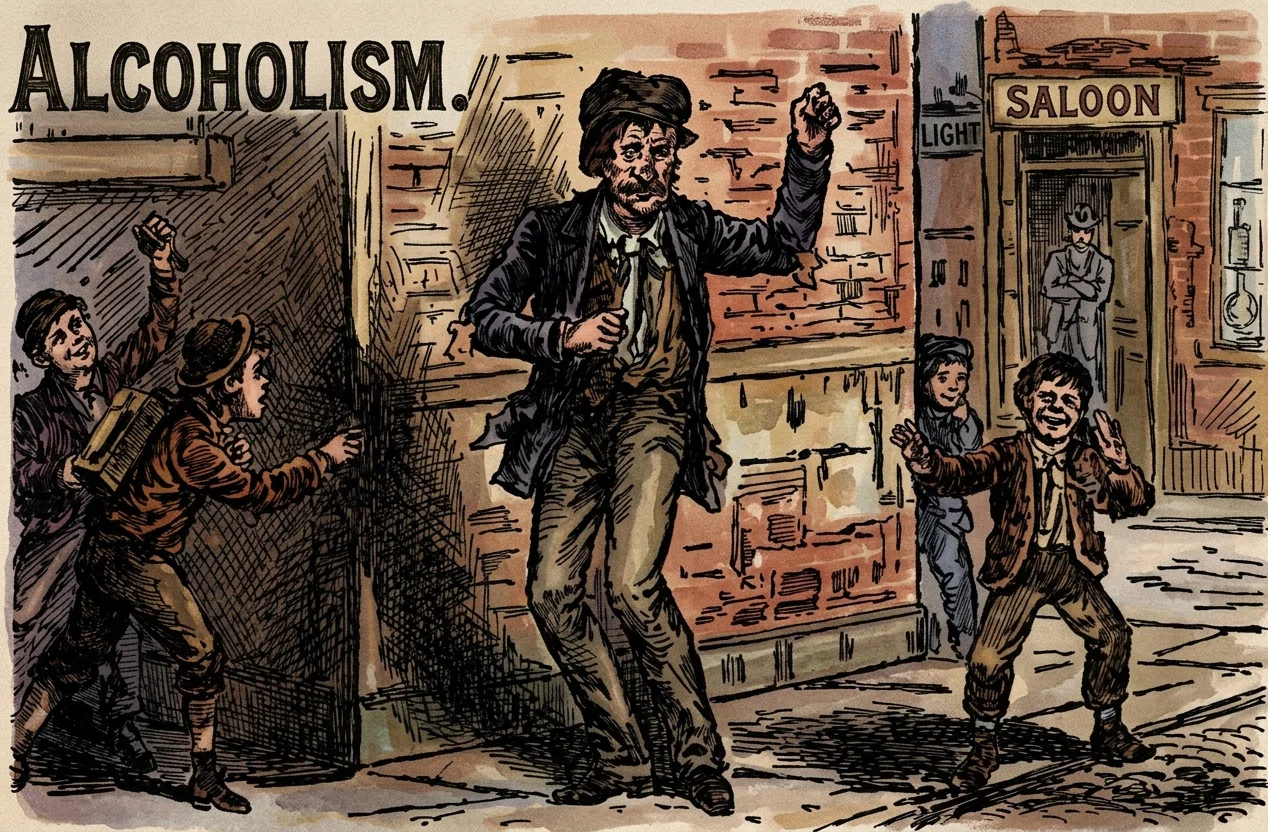
ALCOHOLISM
It is not necessary to tell the reader that the above picture is a representation of a drunkard. Such a man is recognized at once as a victim of alcoholism or inebriety, a vice-disease which is scarcely known outside of civilized countries, but which is recognized as a real malady, with symptoms as distinct and characteristic as those of smallpox or cholera.
We recognize the man who is afflicted with this disease by his trembling hand, his tottering gait, his bleared eyes, his haggard or bloated and repulsive visage, and his generally debased and besotted appearance. His muscles are soft, relaxed, feeble, and the subject of fatty degeneration. His stomach, liver, kidneys, heart, lungs, and other “internal arrangements,” are all degenerated and demoralized as the result of his long indulgence in the poison of the cup.
The effects of alcoholism are mental and moral as well as physical. As the physical tone is lowered, the mental tone goes down also. The will is gradually weakened, until the victim of the disease becomes wholly a prey to the wild caprices of his depraved appetite.
Alcoholic Insanity.
That inebriates are, of all classes of men, the most subject to diseases of the mind, is a fact which has been long established as a medical and scientific fact. The effect of alcohol is to produce a temporary insanity which does not differ essentially from the condition which constantly exists in the insane person. The different degrees of alcoholic intoxication exhibit in the most perfect manner all the different phases of real insanity. The man who “is fighting drunk” is the maniac. The man who is silly drunk or stupidly drunk, is the pathological analog of that stage of insanity known as dementia. A similar analogy exists between the other phases of insanity and intoxication. It is easy to see how the inebriate becomes insane. The frequent repetition of the temporary insanity of alcoholic intoxication after a time establishes the chronic condition, through impairment of the nutrition of the brain and its functions. The marvel is that a larger number of intemperate men do not become insane. It is highly probable that the forms of insanity produced by drink are far more common than is generally supposed, even by physicians. Many of these persons pass as cranks and eccentric individuals, and are not adjudged insane, simply because their insanity happens to assume some comparatively harmless form, altho they are always just upon the border line of complete mental derangement, and liable to develop the most dangerous forms of lunacy at any moment.
Hereditary Insanity.
Strange as it may appear, the worst injuries inflicted upon the mind by alcohol are not suffered by the intemperate man himself, but fall upon his children. We have in the hereditary effects of alcoholic intoxication the best possible illustration of the truth of the ancient proverb, “The fathers eat sour grapes and the children’s teeth are set on edge.” The statistics of insanity show beyond the possibility of controversy that the greatest number of recruits for our insane asylums come from the families of drunkards. The temporary physical condition resulting from the use of alcohol and causing temporary insanity in the parent, becomes a fixed and often hopeless condition in the child. Here is the undoubted source of a great share of the notable increase in the number of the insane which has of late attracted the serious attention of many eminent physicians and philanthropists.
The two greatest difficulties which stand in the way of the reformation of confirmed inebriates are the weakened will and the physical suffering which are occasioned by the withdrawal of the narcotic poison which has benumbed the nerves and which is capable of producing a delusive freedom from pain and a seductive comfort for which nothing else is a perfect substitute. Every confirmed drunkard ought to be regarded and treated as a diseased man, a man who is infirm in body and in mind. A cure of the drink habit can not be effected without a cure of the alcoholic disease first, as in all old drinkers the disease is the real foundation of the habit and the chief obstacle to the cure.
Let every young man who has not yet become a victim of the terrible soul-and-body-destroying disease, alcoholism, consider well before he exposes himself to the risk of becoming another on the list of so many thousands of victims whom it annually carries into poorhouses, prison-houses, madhouses, and then at last to that narrow house which bears the ignominious epitaph, “A Drunkard’s Grave.”
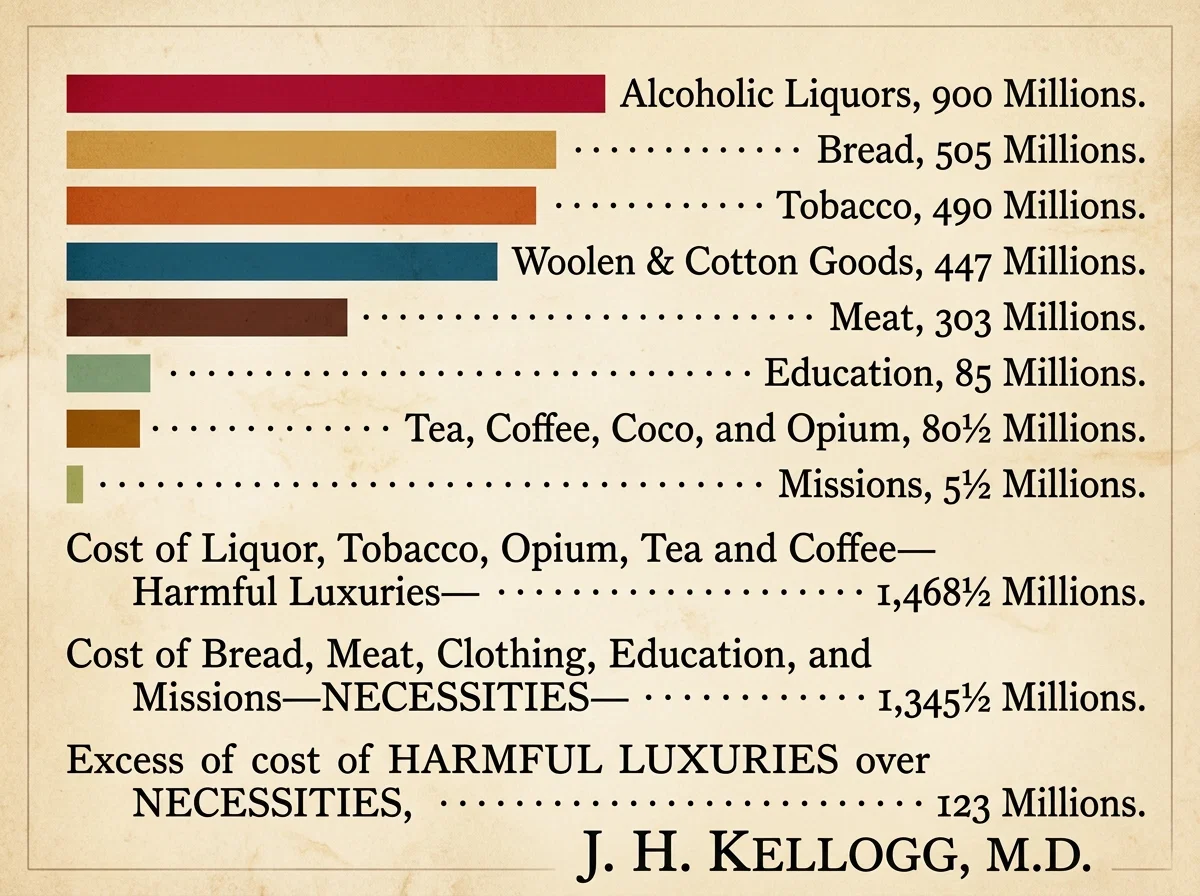
The following diagram and figures represent the amount expended annually for alcoholic drinks, tobacco, tea, coffee, and opium on the one hand, and the cost of bread, meat, clothing, education, and Christian missions on the other:—
Alcoholic Liquors, 900 Millions.
THE WORLD'S SUBMARINE CABLES.
The world's submarine cables now number more than 1,300, according to the recent presidential address to the London Institution of Electrical Engineers. They have an aggregate length of 162,000 nautical miles, over half of them being less than 5 miles long, while 8 of them exceed 2,000 miles. They represent a total expenditure of about $200,000,000, about 75 per cent of which is British capital. A fleet of 41 repair ships is maintained. The electrician can localize the breaks in a cable closer than the captain can sail his vessel, yet a break in one of the Anglo-American lines cost almost half a million dollars to mend, this being probably the most expensive repair record in the world. It is possible to transmit nearly 50 words of 5 letters each per minute on the Atlantic cables by an automatic transmitter.
The Meaning of a Welsh Name
“There is something in a name; for instance, the Welsh name, ‘Llanfairpwllgwyngyllgogerchwyrndrobwlltysiliogogogoch,’ when translated into English, means, ‘Mary’s church at the white hazel pool, near the whirling whirlpool of the sod house of the red cave.’”
The Value of Wise Counsel
“EVERY man, however wise, requires the advice of some sagacious friend in the affairs of life.”