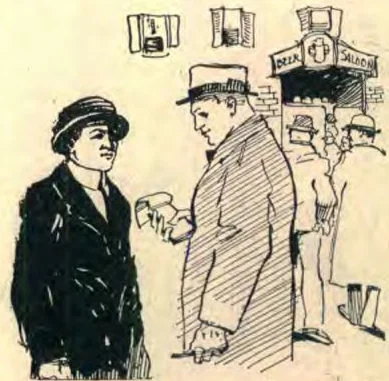
A STEP! a halt! a glad “Come in,
My friend, and drink; let us be men.”
With faltering step, though manly vim,
He takes the cup passed out to him—
Across the bar.
The first cup leads to sin and shame,
And casts a blot on his fair name;
Then comes arrest, and in the court
He eyes the judge with bad import,—
Athwart the bar.
The trial at end, the sentence passed,
He hears his fate with look aghast.
He bids his friends and all, “Good-by,”
For, says the judge, he is to lie
Behind the bar.
The curtain drops, the scene is changed;
Before the Judge of earth arraigned,
He sadly views his record past,
Which now confronts and holds him fast—
Before the bar.
No Sleeping on Guard
The prohibition cause is steadily gaining. Ten States have been added to the prohibition list the past year. There are now nineteen States wearing the white ribbon. Towns and counties by the scores have joined the ranks of the dry forces. Four out of every five square feet of the United States are dry. There is no State altogether wet. A bill is now pending in the Senate for prohibition in the Hawaiian Islands. Petersburg, Alaska, also has sent a petition to Congress, signed by every adult in the place, urging Congress to grant prohibition to Alaska. The temperance people are optimistic. The liquor dealers only are nervous and hesitating.
A West Philadelphia dealer recently consulted an acquaintance in the real estate business about the advisability of transferring his license from a side street location to a Market Street corner. The change would involve an increased investment. “Stay where you are,” counseled the real estate expert. “You would get a more prominent situation by moving; but that, in my judgment, is just what you should avoid. Better stay where you’re tolerated. If you try to get out on Market Street, you’ll only attract attention and stir up opposition. Public opinion is getting highly sensitive about the saloon business, and you’d run the chance of losing the place you’ve got.”
“I guess you’re right,” said the saloon keeper. “I put the proposition to one of the biggest men in the wholesale trade. ‘Don’t think of it,’ he said. ‘Don’t invest another dollar. And make all you can now, for inside of ten years we’ll all be out of business.’”
Notwithstanding these bright omens for the temperance cause this is a time of danger. Rev. Sam W. Small is sounding to the temperance forces the warning, “Beware of the torpedoes! Let none of us because of our success succumb to the spirit of a foolish optimism. The enemy is not dead, is not sleeping, is simply bewildered for the hour, and may be depended upon to ‘come back’ soon with new plans of campaign and redoubled energies. We must not be deceived by the seemingly smooth seas ahead of us. This is the age of submarines and aeronauts. We must look for the enemies below the calm and above the clouds. They move hidden often where least suspected, and our only safe policy is to keep the fight going, day and night.
“We know that such plausible propositions intended to distract the attention from the real issue are already hatching in political incubators. Everywhere the friends of national prohibition must be prompt to turn down every such proposition that Senators or Congressmen may offer. The time for any compromise with the open or secret friends of liquor is past. Henceforth our slogan is that of St. Paul, ‘This one thing I do.’” Stand foursquare and everlastingly for national prohibition and nothing less! Let us up and at the enemy! Don’t bring back our flag an inch; bring up the nation to the flag!
West Virginia and Prohibition
By Fred O. Blue
We are just finishing our first year of prohibition, and naturally the statistics that can be obtained in a longer period are unobtainable now, but we think we have made a respectable showing. From official reports from fifty-five municipalities in the State, we show a decrease in crime of about fifty per cent, and a decrease in drunkenness of practically seventy-five per cent. These figures are official, and show results of the last year of the saloon, and the first year of prohibition.
The largest brewery in West Virginia has been converted into a meat-packing establishment, which employs more men than it did when it was conducted as a brewery. Other breweries have been converted into cold-storage plants and ice factories, and some, of course, still remain unoccupied; but on the whole, the loss of money from loss in equipment on account of the State’s going dry is insignificant. In fact, conditions are very much better from every viewpoint.
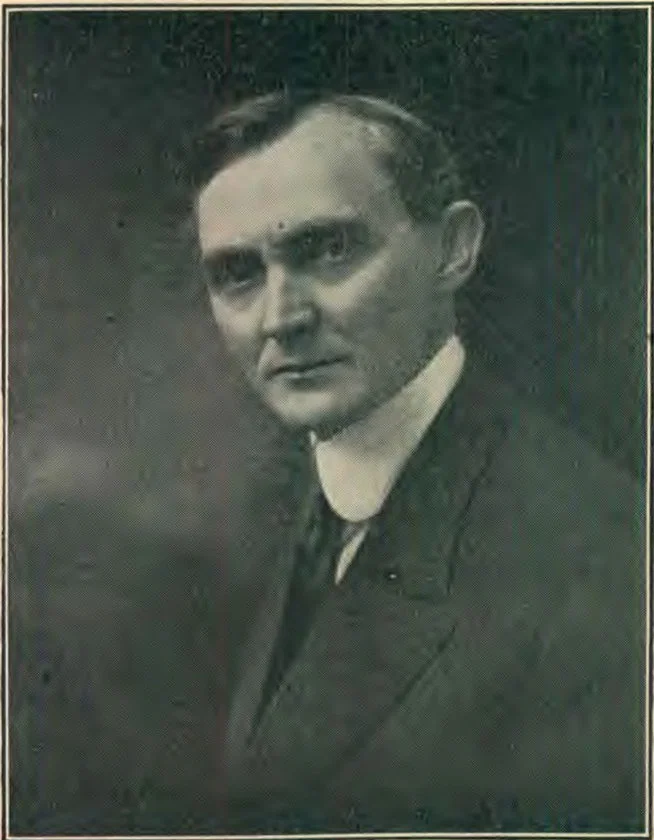
HON. FRED O. BLUE
Reports from the commissioner of labor and from the chief of the mine bureau of the State, show that the efficiency of those who work in the mine and factories of the State has been increased twenty-five per cent, and reports from mine and factory owners from all over the State indicate a wonderful improvement over old conditions.
FRED O. BLUE, Commissioner of Prohibition.
When a Town Goes Dry
By Forrest Crissey
Listen, men and women, we've got to have it dry. If it's wet, drink will sure get some of us. Mr. Voter, just put your hand on the one you would like to make a drunkard of. Not one of us? Then don't vote wet.
WHAT really happens when a town goes dry? Do the dire prophecies of a “dead town” actually come to pass? or do millennial conditions really materialize? There are thousands who are in honest doubt as to the answer, who want the plain facts of the case, and here they are:—
Our town is a snappy city of fifty-four thousand inhabitants. For years it was wet—very wet. Then came an almost unaccountable revulsion, and we had “high license, early closing, and a strictly regulated traffic,” and for two years we were perhaps the most strictly regulated wet town in the West. Apparently many of our solid citizens were convinced that the best “practical solution of the liquor question” had been found in high license, a small number of saloons, and a large number of handicaps strictly applied.
But two years ago the pendulum swung to the dry side of the clock, and it hit with a bang so loud that everybody could hear it.
So, you see, our town has had her wild, “wide-open” days; she has had her period of “drought tempered with mercy and enforced with indifference;” and right now she undoubtedly is the driest city of her size in the United States.
Now what did really happen when the town went dry—real bone dry?
Meat Market Operator Tells His Experience
Our town has a most remarkable meat market operator, and he has six markets in different parts of town. He gets the trade of the millionaire factory owner, of the cheapest laborer, and of all between them. I brought up the subject of the saloon with Jerry, the market man, because I happened to know that he had been strong for high license, and because nobody would ever accuse him of being narrow, bigoted, strait-laced, or anything of the sort.
“Would you put the town back on a wet basis, such as we had before, if you could, Jerry?” I asked.
“Never!” came the quick answer. “It’s a plain matter of business, mainly. My profits are fifty per cent greater today than when the town was wet. Not that the difference between saloons and no saloons has increased my trade fifty per cent, but there are families buying meat of me now regularly whose trade amounted to practically nothing when we had saloons. The money didn’t get home. Of course the man had some meat at the free lunch counter in the saloon, but the wife and the children tasted very little meat. Some people of this class are now good credit customers. Others pay cash.
“There is a remarkable difference in the collection end of our business. On the whole volume of our trade the losses in bad debts amounted to a large sum when our town was wet. When this town went dry, we began to collect the bad debts. Our percentage of credit loss on current business began to shrink soon after the saloons went, and now it is so small that it really amounts to very little.
“Then with the saloon wiped off the map, my help became more efficient in every way. I have one man working with me now who was with me through the high-license period. He drew good wages, but he was never thirteen cents ahead of the game—never! Part of the time he was so badly ‘soaked’ that he was almost useless. He had ‘tabs’ at the saloons, and those had to be paid first before his store accounts were settled; so he was always behind. When the town went dry, he took a few pay-day trips to the nearest town where booze is sold. But he soon dropped that; it was too much trouble. What has been the result? That man has more than thirteen hundred dollars in a savings account in the bank—saved in two dry years. He is a fair example of thousands in this city.
“What really pushed me over into the dry line, however, was watching my delivery men. I could tell as soon as one of them was initiated at the bar. His work would begin to fall off; he would require a lot of watching. You see booze makes any man more careless with your property and your money, less watchful and less dependable. My workers—from delivery boys up—are immensely more efficient than when they could run into saloons.
“I’m a lot more efficient myself, too. Perhaps you didn’t know that I drank at all. Very few of my acquaintances did know it. But generations of my ancestors have cultivated a taste for smoky Irish whisky, and it came easy to me. If any man had told me at the time that I was taking enough to hinder my efficiency, I should have resented the suggestion. My nips were very moderate. It took the contrast of no nips at all to show me that the stuff was having an effect on my ability to work and plan with a clear head. Nothing else would have convinced me. I know that it cuts down efficiency, no matter how well a man has his thirst under control.
“On the score of its effect on business, there isn’t a single justification for the saloon. I always thought there was until experience pounded a change of conviction into me, just as it has into hundreds of business men in this town. We all know better now.”
Lumber and Coal Merchant and Jeweler
I talked with our lumber and coal man, whose trade is mainly from families of the working class. He is a conservative man, always careful in his statements.17
“There is just this difference,” he declared: “Since the city went dry, we have been collecting accounts that were deadwood. They would have been utterly worthless had the city remained wet.” Reaching for his ledger, he pointed to an account, and continued: “There’s a case of a man. He couldn’t get credit for a bundle of laths when we had license. But when the town went dry, we saw that after a little he quit chasing out of the city for booze, and finally settled down to steady work and to taking care of his family. He came in and said he wanted to build on his lot. We told him he could have credit for all the material that he needed. Now he has bought several hundred dollars’ worth of stuff and paid promptly. That man is just a fair representative of a lot of others—perfectly good pay when the town is dry, and good for nothing when the town is wet.”
Near by, on the street car line, is a jewelry store catering to the working people. The jeweler who owns it said:—
“Certainly business is better than it was when we were wet, better in every way. It’s just like the difference between good times and bad times.”
Said the dry goods merchant four doors beyond: “He’s right. It’s the same with me. My business has increased threefold.”
Owns Store in a Dry and One in a Wet Town
A large clothing and shoe merchant in the center of the town had this to say: “Business under the best wet administration this town ever had was not to be compared with what it is now that it is dry. I’m collecting accounts right along that are outlawed; just as long as we had saloons, they were absolutely uncollectable.”
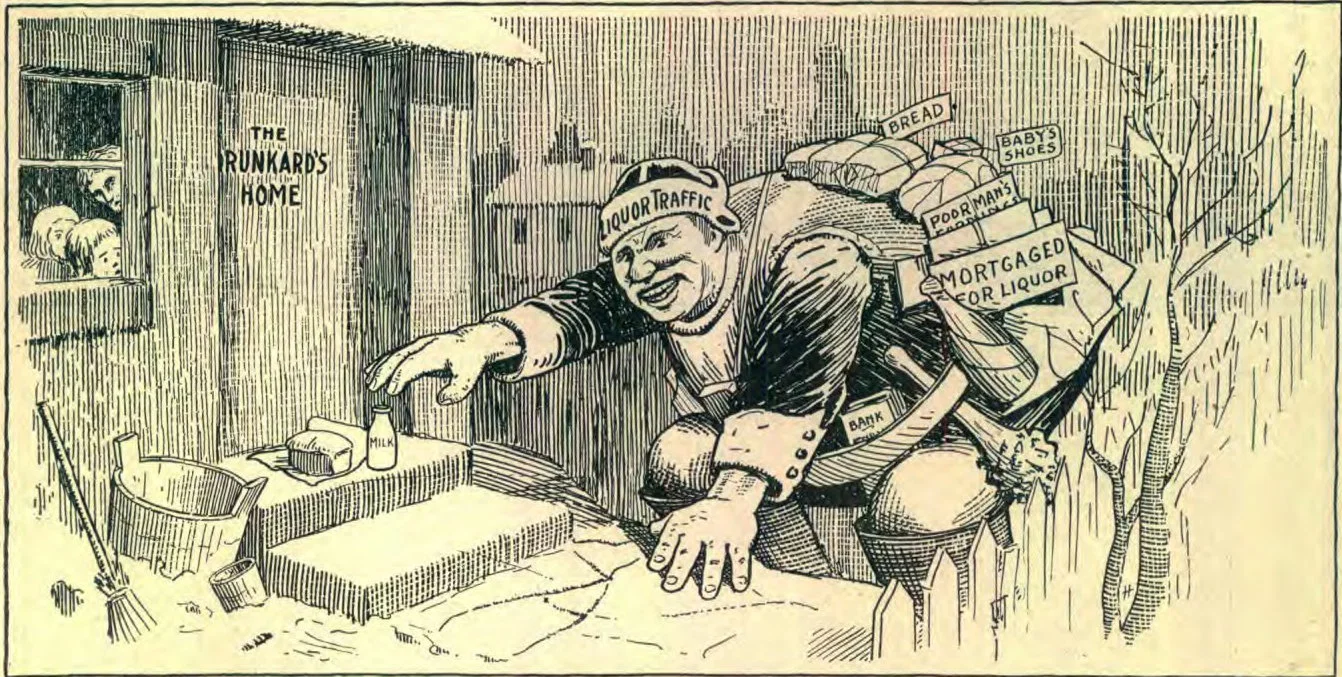
The liquor dealer in his “personal liberty” argument for the maintenance of the saloon claims that he has no other way of getting bread and milk for his wife and children; but have we a right to license a man to win bread and milk for his children by taking the bread and milk out of the mouths of another man's children?
“You hear a lot of talk to the effect that when a town goes dry, men who like their drink and are strong for personal liberty will go to some other town to spend their money, and the merchants there will get it. I happen to know how much truth there is in that theory, for the reason that, I own another store in the town that gets about all the trade that goes out of our town in order to get booze. I carry the same line of goods there as here; my store there is run by two young men who are uncommonly popular; rents are cheaper there than here, and so are some other expenses. I give close personal attention to the business there as I do here. If that doesn’t furnish a sound basis of wet and dry comparison, I don’t know where you will find one. My store in the town that gets our booze pilgrims—several hundred of them every pay night—is not only steadily dropping in profits, but also in volume of trade. The store here is as steadily going the other way. The facts shown me by my ledger and my cash book have forced me to the conviction that there was never a more childish theory palmed off on a credulous public than the theory that saloons help business. I’m ashamed whenever I remember that I once believed it myself.”
Real Estate Men Scared Stiff
Jones, the real estate man, laughed when I asked him if he had found a wet town better for real estate than a dry town.
“One of the business associations here,” he remarked, “took a straw vote, the other day, on the wet or dry question; out of the two hundred and ten men voting, how many do you think wanted to go back to a wet town? Just ten! When our town went dry and about fifty store locations were thrown on the market in one day, property owners and real estate men were scared stiff. It really looked as if property values were going to drop. But just as soon as dry conditions had a chance to demonstrate themselves, rentals and real estate values not only came back to where they were, but they became still better.
“Our town, as you know, has added thousands to its population under dry rule; and who is the best buyer of lot property—the man who is spending his money in the saloon or the man who is keeping sober? There is only one answer to that, as we real estate men know.
“And how about the factories? Dry territory looks mighty good to them—make no mistake on that score! Booze is one of the big troubles in factory management.”
Saloon Keepers Like the Dry Regime
I asked the chief of police to look over his list of former saloon keepers and give me an idea of their present occupations.
“Well,” he said, “there’s one man who is running a big farm—and there’s another. There’s a third one who is raising crops instead of selling booze. Here’s one who has gone back to work in one of the big factories. Four or five are in the restaurant business, and about the same number are running billiard halls or amusement places. There’s a live one who opened a candy store, and did so well that he began to make his own goods; now he runs a candy factory, and has several retail stores of his own as outlets for his product. He wouldn’t go back behind the bar if he could have the best location in our town.”
Before the last election the local saloon keepers of our18town met in a council of war. The saloon keeper who kept the best “place” in town and was looked upon as the “biggest man in the business” was asked to talk. He talked right out in meeting, and said:—
“If this town goes dry,—as it probably will,—you’ll put up an awful howl. But cheer up! You’ll be better off when you’re driven out of the business. I can count on the fingers of one hand all of you who are really making more than wages. The breweries are getting the money. You’ll not lose anything financially by being forced into other business. Most of you will gain by the change. Nearly every one of you is going downhill physically. Your saloons are a long way from being health resorts. You get about as much bad air in the course of a day as any set of men in this town. Then most of you take too much of your own medicine and too little exercise. But you’ll keep on just as long as you’re in the business, and you’ll stay in it until you are driven out. And I think the time has come.”
It did come, and the town and everybody in it are happy and satisfied.—Forrest Crissey, in Ladies’ Home Journal,
New Jersey’s Serpentine Railway
NEW JERSEY breweries and saloons, allowing one to each 100 feet, would line a highway extending from Jersey City to Atlantic City, via Paterson, Newark, Elizabeth, Trenton, and Camden—210 miles of degradation, debauchery, and death.
This monster devours annually over $57,000,000 of the earnings of New Jersey people, without a single benefit in exchange. Instead, it produces 65 per cent of the criminals and dependents, according to the report of the Commission on Crimes and Dependencies appointed by the governor; and to support these criminals and dependents, New Jersey people are taxed nearly $8,000,000 yearly.
Will you not help destroy this destroyer?
A One-Thousand-Dollar Prize
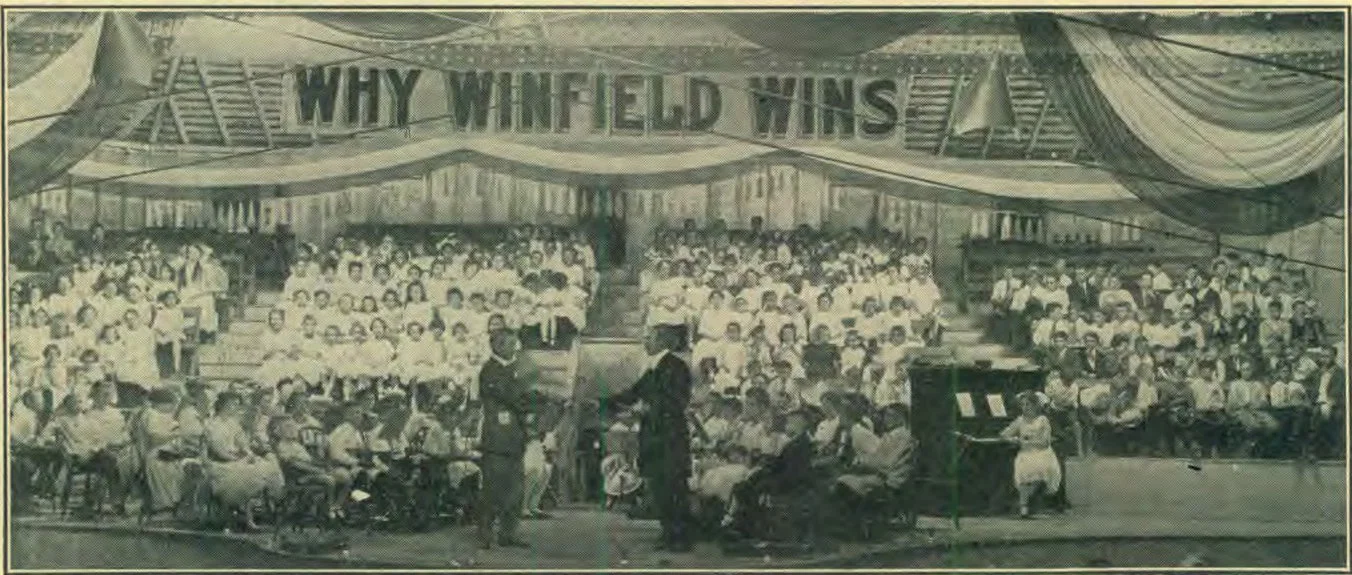
EX-GOVERNOR STUBBS of Kansas offered a prize of one thousand dollars to the best city of the second class in the State for the rearing of children. Dr. William McKeever was given the honor of handing, as shown in the accompanying picture, the one-thousand-dollar check to the chairman of the Child Welfare Committee of Winfield, Cowley County, a city of about seven thousand inhabitants.
Thirty-five years ago Winfield celebrated the State prohibition victory. The largest county majority vote for prohibition at that time was given by Cowley County. The pioneers of Winfield were sagacious men, recognizing their children as their best asset. Almost to a man they were of the belief that the saloons are childhood's greatest enemy; so before setting about in a large way to plan benefits for their children, they saw to the elimination of the liquor traffic, that they might run no risk of having their work undone by the influence of the saloon.
A quarter of a century ago courses were started in the public schools in vocal and in instrumental music. A generous farm was bought to make practical the teaching of agriculture. A free vacation school was instituted; manual training, sewing, and cooking were taught there. The children had play as well as work. They had a daily program, including all outdoor sports and the use of apparatus, and these were supplemented by the making of pictures, embroidering, and even the educational moving picture matinees. According to the Philadelphia North American, Winfield spent in 1913 for schools $6.45 per capita; while Philadelphia, with all its culture and its money, spent but $3.82 per capita. Surely Winfield made a wise investment when she chose to put her money into the education of her boys and girls rather than to spend it in booze shops.
Indiana’s Black Spot
INDIANA has a “city with its mayor, comptroller, superintendent of the police department, judge of the police court, sheriff of the county, and judge of the circuit court, all out of the city serving prison sentences for malfeasance in office, or for conspiring to destroy the purity of the ballot box.” And how did it happen? The judge of the court in which they with more than one hundred others stood, as defendants, said:—
The evidence in this case shows that this conspiracy had its inception in the saloons of Terre Haute. It was directed from them and consummated through them. I have the notion that the saloon will have to go. The American people will not tolerate it. They will arise in their might, and destroy it.
The saloon 'ought to die. It can be killed; and national, Constitutional prohibition will kill it.
Hon. Oliver W. Stewart makes the severe but incontrovertible statement that “it is no mere incident that almost every case of government corruption during the last half century has shown the saloon underneath it.” This being true, the American people must strike the saloon a deathblow, else corruption and anarchy will undermine the foundation of our civilization, for “only by stainless ballots shall we ever achieve a stainless flag.” “The saloon has sinned away its day of grace. The forces are forming on the battle field for the last struggle against it.” Be sure you enlist on the right side in this great world-wide conflict for sobriety.
Crime Record of New York City Compared With Kansas
NEW YORK CITY is proud of its record for a recent month. Not a murder was committed in the city; yet in prohibition Kansas twenty-eight counties have not had a criminal prosecution in a year.
Refuse the Evil; Choose the Good
PURITY is as essential to manhood as to womanhood. A manly boy is a pure boy. A manly man is a pure man. Purity means strength; impurity, weakness. The impure man is pliable. He cannot resist temptation. He cannot stand alone for the right. He must do as others do. His guiding star is, “They all do it.” Dr. Marden says this expression is “Satan’s other name,” and that “innumerable life tragedies have resulted from following the suggestion, ‘They all do it.’” The hero, the man of fame, whether in science, art, literature, or religion, has not been the man who did as others did. He wears his laurels because he did differently from other men. He turned aside from the crowd, and marked out his own path or trod the highway of life’s nobility. The boy, then, who fixes his eye upon the goal of a worthy manhood must learn to say No to the crowd. The ordinary man is prone to follow in forbidden paths; else our jails, penitentiaries, and saloons would not be full. The strong man stands alone. Boys, remember this. Leave the crowd to itself.
As the frost of a night may blight the sweetest flower, so may one impure word, picture, or visit to a questionable place spoil the purity of the soul. O that boys might know how precious is this gift of a pure heart! Then would they die rather than suffer it to be tarnished by evil. “Everything that is worth while, everything that we prize most, everything that elevates, costs us something. We must pay for it in effort, and it is prized in proportion to the struggles and sacrifices we make to obtain it. The youth who would keep himself unspotted from the world, especially the city youth, must stand on his guard against the snares and temptations that surround him. In order to be safe from moral contagion, he must, as far as possible, keep away from temptation, away from people, away from books and pictures, from faces, from everything which suggests a particle of impurity. The youth who keeps his mind absolutely pure has the whip hand over his passions.”
A saloon keeper placed at the entrance to his beer garden the sign “Look out! Paint!” His poor penmanship made the “p” appear to be a “t;” and so the sign seemed to read, “Look out! Taint!” As revised, this became a significant sign, one that Uncle Sam’s own hand should place at the entrance to every saloon in the land; for saloons are the places where men and boys lose their purity of soul. Then if you would heed the foregoing counsel, the saloon must be spurned.
Medical and physical science have placed warning signs over the saloon, and the church long ago recognized the sickening taint of the liquor traffic; but the crowd blindly pushes on, refusing to heed all warnings; and the thoughtless and weak among the youth follow in the wake of the crowd, and therefore human wrecks daily emerge from the saloons. You see them everywhere. The boy or man of moral courage will absolutely refuse to subject his soul and body to the awful taint of the saloon. He will say No to the first drink, for it is the beginning of sorrows. There are legitimate channels for the pent-up energy of the most robust and ardent youth. There is a world of play and work worth while, but all this is outside the saloon. Normal boys do not deliberately form habits or do things which will seriously cripple or absolutely defeat their ability to make their way in the world. They form such habits, and do such things ignorantly, or else they have the idea that they can yield now and then to a questionable course and still make good. Experience proves this to be a dangerous assumption. The wise will not act upon it.
A day laborer found a $650,000 necklace and turned it over to the police, though ignorant of its real value. Later he found in his pocket a detached pearl from the necklace. It was worth $25,000. He tried in several places to exchange this for a glass of beer. We pity his ignorance. But he was not more unwise than are the young men of today who for the first time accept the intoxicating cup: They are as ignorant of the full significance of their act as the laborer was of the value of his pearl; for in this first cup they barter away their all—health, talents, honor, business, property, position, friends, wife, and children. These all are sacrificed to this first drink. It is so far oftener than otherwise. How is it then that any one of ordinary intelligence can be found who will accept the proffered cup? It is only because of man’s mistaken estimate of his power when matched against that of him who holds the cup—the father of all evil. Young man, the enemy of all good is stronger than you. After failing to refuse the first glass, you will find it harder to resist the second, and still harder to resist the third.
The steps from the saloon always lead downward. A young man who recently died of alcoholism in Chicago, passed over this downward path, and left on record the following description of his experience:—
Six months ago I was earning $300 a month as a civil and general engineer. I had a wife and a little daughter and a comfortable home in Winnipeg, Canada. I did not drink. Then I was employed at the marine barracks at Washington, D. C. One night I took a drink. Since that night I have taken many drinks.
I lost my speed. Then I lost my job. Then I continued to drink, and soon I discovered that I couldn’t get another job. I felt I did not want another job as long as I could get something to drink. I lost my home. Then I came to Chicago.
I am going to die. I don’t care; but I want to say this before I go: “Let booze alone. It can’t be whipped. It’s too fast for me, and it’s too fast for you. For booze I gave everything that I had; and now that I haven’t anything left, booze will take me.”
More than one youth has learned to drink because he thought that all men drank, that he must drink to be a man. Nothing is farther from the right than this. The truest men do not drink. It is the common man who drinks, not the uncommon. If you wish to be enrolled among the wisest and best of earth, if you wish to preserve inviolate your purity of soul, you will always heed the counsel of the wisest of all men: “Wine is a mocker, strong drink is raging; and whosoever is deceived thereby is not wise.” “Touch not; taste not; handle not.”
Getting a Foreman
An employer who is a stanch abstainer advertised for a foreman for one of the departments of his works, and a number of men called at the factory. When the employer saw them outside, he said, genially, “Well, we might as well go and have a drink,” pointing to a saloon opposite. He suited the action to his words, and led the way across, the men following. When he reached the swing doors of the public house, he turned around and saw one man loitering behind the others, and called to him, “Aren’t you coming in?” “I’m a teetotaler, thanks,” was the response. “Well, you’re the man for me,” the employer promptly responded, and he then and there engaged him, while the rest were left to go their ways.
King Albert of Belgium: Water-Drinking Giant of Strength
“KING ALBERT of Belgium drinks nothing but water, and is a giant in strength. Between his two hands he can bend an inch-wide bar; he can take his fourteen-year-old boy with one hand and his ten-year-old daughter with the other and hold both out at arm’s length.”
A Self-Appointed Temperance Poster
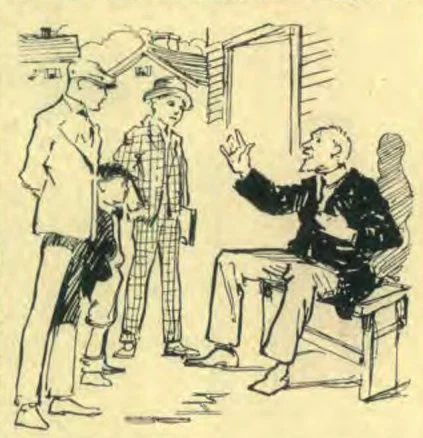
A citizen of Foster, Rhode Island, when alone and in a drunken stupor years ago, fell on the hearth of his home, with his head so close to the fire that the heat blinded both eyes and destroyed his features. The almshouse in time became his home, and in fair weather the wretched man begged to sit outside the door, on a bench in the sunshine, where he might feel the sun and air, and sound his words of warning to every passer-by. Day after day, for more than fourteen years, he exhorted to a temperate life all who would tarry to listen. He would say:—
“I don't know who you are, for I can see nothing. But, whoever you are, I want you to look at me and be warned to let rum alone. Look at me now. This is all the work of rum, and you see there is no chance for me ever to be any better. I shall nevermore see the sun or the faces of men. I must go to my grave as I am. And yet I might have been as happy as you, or as any one, if I had left rum alone.”