MELZAR, whom the prince of the eunuchs had placed over Daniel, Hananiah, Mishael, and Azariah, consented to the ten days’ food test which Daniel proposed. “And at the end of ten days their countenances appeared fairer and fatter in flesh than all the children which did eat the portion of the king’s meat. Thus Melzar took away the portion of their meat, and the wine that they should drink; and gave them pulse.” Dan. 1: 15, 16.
It seems that Melzar (margin, the steward) assumed a responsibility which Ashpenaz, the prince in charge, dare not assume; and as he was set over these four especially, there was opportunity for him to make the test without any one’s knowing that it was being done, excepting himself and his wards. The whole matter of the ten days’ test was between them alone. See verses 11–16. Of course after the test resulted so favorably, it would be safe to continue the vegetarian diet without endangering any one’s head. It is evident that all that was desired in that respect was physical health.
In the case of a person who has been sick and is rapidly recovering, ten days’ time will produce a marked improvement in appearance; but with healthy young men, such as these were (verse 4), there would not naturally be such a favorable change in so short a time, even with a change of diet. And, judging from their conscientiousness in the matter of temperate living, it is quite likely that what they called for was a customary provision. Their diet being confined to “pulse” does not necessarily mean a paucity of food; for pulse may include a variety in the line of leguminous vegetables (peas, beans, etc.) and grains of all kinds, such as wheat, barley, lentils, and millet. The Chaldean students were of the royal family, and of the higher class of the people (verse 3), and had probably been reared upon food somewhat similar to that served at the king’s table. Thus it would appear that in the cases of both the Chaldean and the Jewish young men in the king’s school there was no material change of food from that to which they had previously been accustomed.
Then we must look to some other cause than change or difference of diet for anything that appeared remarkable from so brief a food test. There must be some other reason why ten days would make such a noticeable change, or contrast not before remarked. Under the circumstances we must conclude that the direct cause was the providence of God. It has been shown before that the Lord was working in this matter for the welfare of Daniel and his companions (verse 9), and there is ample Scripture testimony to the fact that a proper control of the appetite is an important factor in the acceptable service of God. Our first parents failed through a gratification of appetite in the use of forbidden food, and our Saviour’s first great temptation in the wilderness was on the point where the first Adam was overcome. See Matt. 4: 2–4. “Whether therefore ye eat, or drink, or whatsoever ye do, do all to the glory of God.” 1 Cor. 10: 31.
So God honored and especially blessed the fixed purpose of his servants who, at the hazard of their lives, dared to honor him in their meat and drink. It is logically safe to conclude that were the professed people of God to-day as abstemious in their habits of living as he would have them, they could live much less expensively, have generally a much greater degree of health, have more means to invest in the cause of salvation, and be vastly nearer a condition in which the Lord could intrust them with an outpouring of his Holy Spirit.
But the providence of God in bringing Daniel and his three companions into the king’s school, and his watchcare over them, are shown in still another way: “As for these four children, God gave them knowledge and skill in all learning and wisdom; and Daniel had understanding in all visions and dreams.” Dan. 1: 17. Thus we see that God was the real teacher of his own children, altho unavoidable circumstances placed them in a heathen school. And so he is at all times and in every age, if they but place themselves in his hand. Men fail to discern that the purpose of God is being carried out continually even amid the most adverse appearances; they fail to realize that he is able to make the wrath of man to praise him (Ps. 76: 10), altho the fact has been demonstrated over and over again in the history of the world. They fail to comprehend this fact because the natural eye can not see to the end of an “eternal purpose.” That which seems to man to be overwhelming defeat often turns to glorious victory. While we might cite many instances in proof, the one that includes them all is the death and resurrection of Christ.
Where God teaches the willing, faithful student, there ever will be marked progress in the true wisdom—which is the knowledge of God—and in Christ-like life. This was true in the case of Daniel and his friends, as the record shows: “Now at the end of the days that the king had said he should bring them in, then the prince of the eunuchs brought them in before Nebuchadnezzar.” “And in all matters of wisdom and understanding, that the king inquired of them, he found them ten times better than all the magicians and astrologers that were in all his realm.” Verses 18, 20.
Here then was demonstrated God’s superior power to teach even the things that the king had most desired them to know. The king wanted them taught “the learning and the tongue of the Chaldeans,” in order that they might be able to stand in responsible places in the kingdom. He seemed to realize that a great responsibility rested upon him in the extension of his jurisdiction, and he wisely sought to educate men expressly to assist him in his6great work. And God indorsed the idea, for he so helped his own children in that school that they were ten times better qualified in the matters desired by the king than any others,—not merely better than their fellow-students, but better than all the “magicians and astrologers,” who were deemed the wise men of the kingdom. God wanted his servants to be “the head, and not the tail” in the matter of wisdom; and if the king would place them in official position, their God would see that they would be qualified to fill such positions to his honor and glory.
To this end—the honor and glory of God—Daniel was endowed with “understanding in all visions and dreams.” In other words, he was given the spirit of prophesy: “If there be a prophet among you, I the Lord will make myself known unto him in a vision, and will speak unto him in a dream.” Num. 12: 6. A part of God’s “eternal purpose” was to teach lessons to future generations, especially to those in the end of time (Dan. 12: 9), from the kingdom of Babylon and succeeding kingdoms; so he prepared his prophet, and placed him in the most available position, for this purpose. Altho the Lord interposed to give Daniel and his companions a physical appearance that would satisfy the man in charge of them, and gave them extraordinary wisdom in the line desired by the king to fit them for official duty in the kingdom, yet the primary mission of this servant was to set forth the power and glory of the God of heaven, and to make known the things pertaining to his everlasting kingdom. The first great lesson in this line will be considered in the next article.
GOD’S DESIGNS.
By W. H. B. Miller
WHEREVER design exists, discriminating thought has been exercised, and in proportion as the conception and its performance are more or less beautiful and perfect, the power of the mind that conceived, and the skill of the hands that executed, are manifested. Human designs never reach perfection, because the human mind is imperfect. Yet many wonderful devises and works have been accomplished, and we instinctively associate these achievements with a high standard of thought. We honor men who are able to perform such deeds, imperfect tho they may be; we extol their ability and magnify their power.
But, after all, these thoughtful persons have merely discovered a new combination of created objects or forces which were, in their creation, so designed that union might be thus beautifully effected; and the closer we look into this human invention the more defects we discover in the design. But, on the contrary, as we minutely examine the forces or materials which have been used, we are filled with admiration at their faultlessness and beauty. The most powerful microscope only reveals greater marvels of perfection.
While all men agree that the former imperfect achievement is the result of advanced thought, many claim to believe that the perfect workmanship of the latter is but the fortunate outcome of chance and evolution. The designs of nature, they say, have just happened so.
Let us seek a parallel. Suppose some one were to claim that a certain beautiful oil painting, representing sunshine and shadow, distance and foreground, pathos and life, was produced by promiscuously throwing a lot of different colors on the canvas, who would credit it? How many times would it be necessary to turn back and forth a mixed case of printers’ type before it would form itself into a beautiful poem?
How long must we mix together a parcel of wheels and springs and screws before they will happen to form themselves into a perfectly-regulated watch? But these are faulty parallels, because in each instance the materials are provided, and also a power to persistently change their positions till the desired results are obtained; while nature’s pictures and poems and mechanisms have sprung into beautiful and perfect existence from nothing, and this, too, it is claimed, without any controlling power.
God’s children see in nature the matchless designs of the great Creator. With infinite mind he stamps perfection on all his handiwork. With boundless wisdom all creation is designed for the good of his creatures, the glory of his name. “O, the depth of the riches both of the wisdom and knowledge of God! How unsearchable are his judgments, and his ways past finding out!”
“Lift up your eyes on high, and behold who hath created these things, that bringeth out their host by number.” Is this a result of chance? God “calleth them all by names by the greatness of his might.” Examine the mighty constellations and systems of the universe. Are these designs defective? On the contrary, the closest observation of our ablest scientists, with the most modern appliances at their command, reveals the fact that perfect order prevails throughout the whole of God’s universe. Indeed, so accurate are the movements of the great bodies, that for thousands of years in the future their precise location in the heavens can be positively stated, to a moment of time. One writer speaks of the universe as “God’s great timepiece.” All glory and honor and majesty to the great Creator who “stretcheth forth the heavens alone.” What human intelligence can criticise this great design?
Not less wonderful are the divine designs on earth. Man is the masterpiece. God’s glory is seen in him. He is the central figure of the great design “nature,” with which everything created has been made to beautifully harmonize. His eyes are formed to desire to behold things of beauty, and the earth has been clothed with lovely colors so harmoniously combined and contrasted that this created desire can be fully satisfied. His ears have been tuned to love harmonious sounds, and power to gratify this desire has been given to the voice. He loves to hear the songs of the birds, the sweet strains of musical instruments, the soft sounds of nature’s trees and streams. So throughout the entire design, we will find perfection. Health-giving fragrance has been added to the beauty of the flowers and trees. Food with life-sustaining properties has been bountifully provided, an unlimited diversity of flavor and odor having been added to create relish and enjoyment in partaking of the necessary nourishment.
Is this all chance, or do we again discern evidences that a mighty intelligence has been working? As we realize the great wisdom of God, surely we feel like exclaiming with David, “Such knowledge is too wonderful for me; it is high, I can not attain unto it.”
As we fix our eyes more intently on God’s great creation, we can discern design within design, perfection within perfection, beauty within beauty. An independent existence can not be discovered. Each atom forms a part of some great design. As we search we wonder more and more, and as we see God in his creations, we involuntarily love him, for we discern countless manifestations of his love and perfection and mercy at every step. Thus we become acquainted with him, and, knowing him, desire with all our hearts to worship him.
Again a God-given desire can be fully gratified; we can worship him. We are invited to enter “boldly” into the presence of the great Creator, for the way has been divinely prepared.
And now our eyes are dazzled with a resplendent glory, the marvelous “design of salvation!” W. H. B. MILLER.
Melbourne, Victoria.
STEPS TO CHRIST.
(Concluded.)
Consecration.
THE whole heart must be yielded to God or the change can never be wrought in us by which we are restored to his likeness. We are alienated from God by nature, and are held fast in the snare of Satan, taken captive by him at his will. But this demands an entire reformation, so we must yield ourselves completely to him. The warfare against self is the greatest battle ever fought. We are so well captured by Satan that it requires a struggle to yield to God; but the soul must submit to God before it may become holy.
God’s government is not founded upon unreasonable control, as Satan tells us. It only appeals to the conscience and intellect. God does not force the will of his creatures. He will not accept submission that is not intelligently and willingly given. God wishes his creatures to reach the highest blessing that his grace can bring us. It remains with us to choose whether we shall be set free from the bondage of sin and enjoy the liberties of the children of God.
In giving ourselves up to God, we must give up all things that would alienate us from him. We can not serve God and Satan. When we submit to God, we become holy, and are renewed into his likeness. We are taken out of Satan’s evil snare and placed in God’s holy communion. We become spotless, for when we submit, God blots out all sin.
Mammon is the idol of many. The love of wealth and desire of power keeps many from God. Others worship reputation and worldly honor. A selfish life of ease and freedom from responsibility, is the idol of others. If we are to become God’s children, we are to become wholly his. Some depend upon doing outwardly what Christians should do, but they do not realize Christ’s love, or their souls and hearts would be filled with it. Through the right exercise of the will, an entire change may be made in our life. We will have strength from above to hold us steadfast, and thus through constant submission, we will be enabled to live the new life.
Faith and Acceptance.
As the conscience is quickened, we perceive the guilt, the awful power of sin, and then we abhor it. We feel that sin has kept us from God. The more we struggle to become free, the more we realize our helplessness. Our hearts are unclean and our motives are impure.
It is peace that we need—that heavenly peace that can not be bought with money and can not be procured by wisdom. But God offers it as a gift. The Lord says, “Tho your sins be as scarlet, they shall be as white as snow; tho they be red like crimson, they shall be as wool.” When our sins are confessed and in heart put away, and we resolve to give ourselves up to God, and we ask him to wash away our sins and give us a new heart, he grants the request. But we are not to wait to feel that we are made whole, but say, “I believe it; it is so, not because I feel it, but because God promised it.” For it is God’s will to cleanse us from sin, to7make us his children, and to enable us to live a holy life. So we may ask for these and believe that we receive them, and thank God that we have received them.
Growing Up into Christ.
When the change is wrought in our minds, and sin is given up, we are born again. As Christ told Nicodemus, we “must be born again.” When we have changed our course, we must pray to be helped on by Christ. As a young plant must have water, pure air, and sunshine before it blooms, so must a new-born soul have the water of peace, pure surroundings, and the sunshine of love. As a Christian grows, a larger sphere in which to work is required. Then as the buds of love shoot forth, they open, and the blossoms of good works appear.
The Privilege of Prayer.
God speaks to us through nature and revelations, but we must pour out our thanks and desires in inferior language. When trials come to us, we have the privilege to speak to God through prayer and implore help to bear them. So we need not bear so many troubles, but cast them all on the dear Lord Jesus, and he’ll carry our burden for us. And when Satan tempts us to become his captives, we have this privilege to ask for strength. As Christ prayed in the Garden of Gethsemane in that hour of agony for strength, and submitted meekly to his Father’s will, so we may pray for strength in our distressing hour. Prayer is a large step to Jesus.
One step up the golden ladder;
One step nearer to God,
One step closer to heaven,
And the pathway we have trod.
One little song of joy,
Sung to a sorrowing soul;
One little song of peace,
And we're one step nearer the goal.
One little deed of kindness
Done with a heart full of love;
One little word of comfort,
And we're nearer to Heaven above
APOLOGIES.
THE most tedious utterances, because the most superfluous, and often the most hypocritical, to which the public has to listen, are apologies, whether in sermons or speeches.
Canon Fleming, an English author, says: "Apologies have been called the cant of the platform. They all spring from pride. In plain English they mean but this: ‘Let me beg of you not to take my present address as any criterion of my abilities. I assure you I am a much wiser and much cleverer man than you would suspect me to be, were you to judge of my talents by the speech I am about to deliver.’”—Christian Advocate.8
WATCHING FOR EVIL.
WE are told that when the Jews saw Christ in the synagogue on the Sabbath day, "they watched him that they might accuse him." Jeremiah tells us, "All my familiars watched for my halting." Jer. 20:10. When the viper had bitten Paul, the barbarians looked for him to swell and fall down dead suddenly; but they looked in vain, and changed their minds and said he was a god.
Many a time men have predicted and have expected the downfall of the servants of the Lord. They have accused them, condemned them, cast them out, and waited to see them sink in oblivion. They have rejoiced to be rid of their presence—like the people in that "great city, which spiritually is called Sodom and Egypt" (Rev. 11:8-10); they have rejoiced when the voices of the witnesses which accused them were silenced, and they have prided themselves upon the peace and quiet that they had when every protesting voice was hushed and when nothing but uniformity remained.
The ancient Romans said of certain ones, "They make a wilderness, and call it peace!" So when the silence of death broods, and only dumb dogs remain which can not speak, people boast of the "peace and quiet" they have, when they can have their own way, with nobody to object or complain. But great questions are not settled by majorities, by caucuses, or by snap judgments; and men in whose pulses beats the energy of everlasting life are not to be destroyed by rash speeches or ungodly acts. They live long after they are supposed to be dead; they stand when men have pronounced them fallen; they go forward when opposers try to stop them; and long after the men who have waited and watched for their halting are gone into oblivion, the men who have been condemned, rejected, and cast out, live to keep on the even tenor of their way and finish the work which God has given them to do.
It is hard to kill a man whom God has bidden to live; it is hard to cast down a man whom God is holding up; and those who watch for the halting of the servants of the Lord, and who expect the downfall of men whom God upholds, have yet much to learn of the ways in which God deals with the sons of men.
Let those who are despised, rejected, and cast out for Christ's sake, take courage and be strong. Their time of conflict and sorrow will soon be past; and that God who has been with them and helped them and loved them thus far, will not forget them nor forsake them if they will but trust in him. Above the storms of persecution shines the light of God's countenance, and beyond earth's conflicts and strife there spreads the everlasting peace which passeth understanding. We can await the Lord's appointment; we can trust in the Lord's providences; we can cast our cares and burdens and sorrows upon him; we can spread before the Lord everything that troubles and distresses us; and we may be sure that he will see and watch and overrule and care for those whom he has called to stand in the battle's front and to endure hardness as good soldiers.
Let us cast our care on him, and then when assailed by doubts and fears and dangers, we can say, "Thanks be to God, which giveth us the victory through our Lord Jesus Christ."—The Christian.
JOTTINGS FROM RUSSIA. NO. 1.
By H. P. H.
JUDGED by the course of events and the attitude of the other “great powers” of Europe, Russia occupies the first place among the nations of earth. After the leading nations of Europe, headed by England, had, during many tedious months, vainly attempted to bring the sultan to terms on account of the Armenian slaughters, Russia quietly took matters in hand, and, with one adroit sweep, “scooped” for herself decided benefits, leaving the other powers outside to look on and wonder. From that time it seems as tho the leading powers have made special efforts to court the favor of the czar.
The course of France in this direction is known to all. When the first step towards an alliance was taken, and the Russian marines visited France, the latter nation went nearly wild with enthusiasm; and when President Faure visited Russia, and the bare word alliance was uttered in a toast by the czar, the French, who had been waiting in breathless suspense to hear the word, burst forth again in uncontrollable ecstasy. Meanwhile England had made some advances towards greater friendship with Russia, and Germany has taken special pains to revive and cultivate the former good relations between the courts of St. Petersburg and Berlin. This general effort to court the favor of the czar is a confession of the estimate which these powers place upon Russia.
And the powers are not mistaken in their estimate. Russia is a great nation and possesses wonderful resources; and these resources are being rapidly developed. In general, marked improvement can be observed. Since my first visit to this country six years ago decided changes for the better have taken place. Russia is “coming up” fast. There are great possibilities before the nation. Russia is practically independent of the rest of the world. She possesses in resources everything that a nation needs. And when it is considered that she is just beginning to develop these resources, one involuntarily asks, What will the nation yet become if time permits their full development?
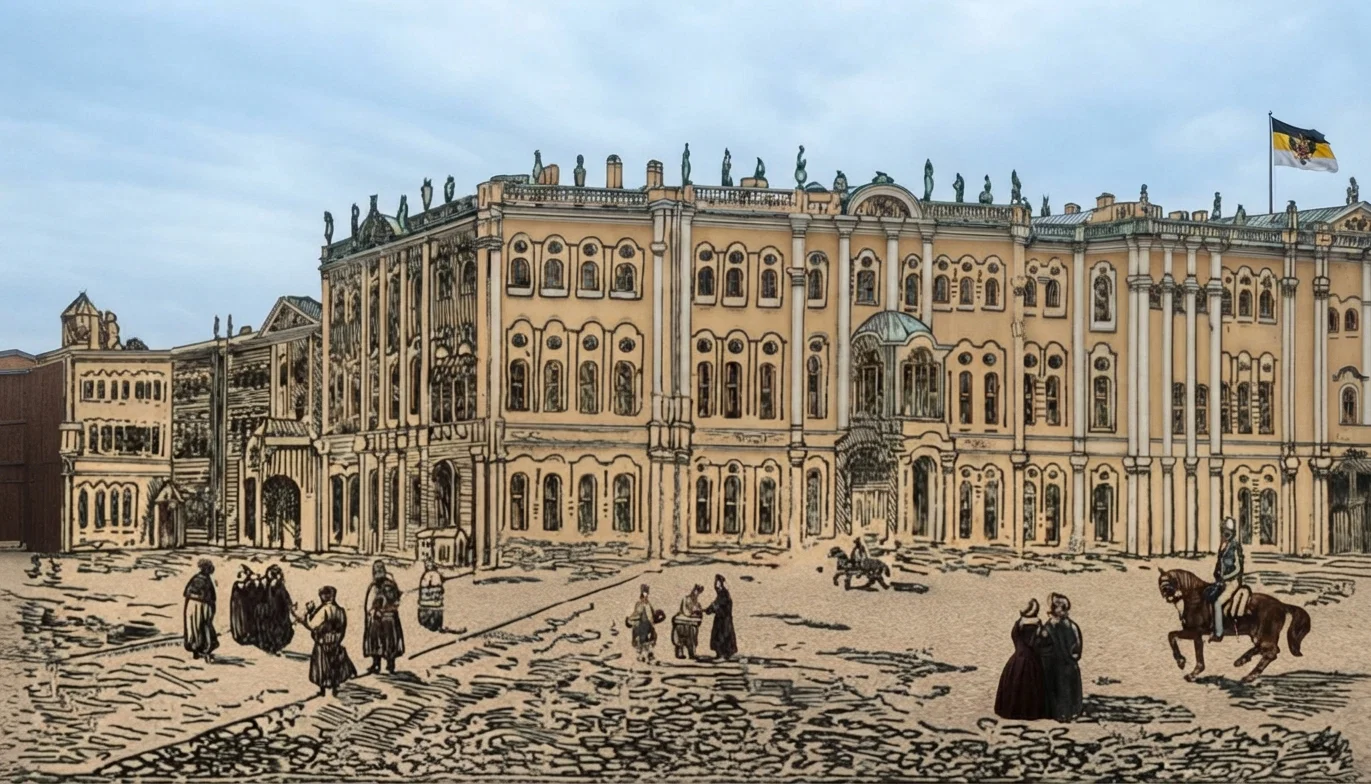
WINTER PALACE, RESIDENCE OF THE ROYAL FAMILY, ST. PETERSBURG.
It is also a fact worthy of note that the Russians were but recently emancipated from a sort of slavery, and the masses are just emerging from their former ignorance and inefficiency. It is hard to start great masses in the direction of improvement, but when once under way they advance with accelerating speed.
It is also a significant fact that the people are in a primitive state, and hence possess more physical vigor than the other nations of Europe. While these nations, having reached or already passed the summit of physical power, are becoming effeminate, and are on the down grade, the Russian is still in primitive vigor, and just beginning to ascend the mountain. While the other nations have reached their greatest power, Russia has but fairly begun to develop her resources, but even as she is to-day, the other powers have tacitly accorded her the first place.
Since the coronation of the present czar there seems to be a decided change in the direction of greater freedom. His grandfather had inaugurated quite liberal reforms, but when Alexander III. came to the throne, all was reversed in favor of the churchmen. When Nikolas II. ascended the throne, an all-absorbing question was whether he would follow the policy of his father or grandfather; and now it seems quite evident that he has adopted the more liberal policy of the latter. One of his latest proclamations is to the effect that non-orthodox students shall not as heretofore be compelled to attend religious service on national holidays; and another ukase specifies that in all public schools where there is a sufficient number of other confessions, the opening prayers shall be according to their liturgy. In civil matters also there is a decided tendency toward greater freedom. The Russian press expresses surprise at the great change that has of late taken place, but can not account for it. Unseen hands are evidently at work.
While Russia is attracting the attention of the political world, it is a field of special interest to the Christian. The student of prophecy both in the Old and New Testaments has long foreseen that Russia would play an important part in the closing scenes of this world’s history; to him the sudden coming up of Russia is an important sign of the times, and the rapidity with which the nation is developing indicates that affairs are now under pressure and will soon reach their culmination in the final solution of the Eastern Question. Under the generalship of the destroyer, the nations are being prepared for the closing struggle. The way seems quite fully prepared, and the nations are under such tension that there must soon be a break; and Russia now stands squarely on her feet ready to act a vigorous and leading part.
The Siberian railway is being pushed with great energy; when finished, this will greatly increase Russia’s power in the East, where she already has a dangerous influence. When it is considered that the drying up of the Euphrates to prepare the way of the kings of the East is one of the last events in this world’s history; and when we remember Russia’s relation to the Eastern Question, this haste in opening the way to the East and the sudden increase of Russia’s influence there, indicate that the momentous event is not far off. The Russian journals can not account for the sudden change that is coming over the nation; but in the light of the Word it is plain and full of meaning. While Russia is waking up politically and industrially there is also a religious awakening; while the enemy is preparing the nation for its important part in his work, the Lord is doing a great work for his people. Thus, to both the politician and Christian, Russia is of special interest just now, and is likely to be of still greater interest in the near future.
H. P. H.
In the Caucasus, Russia, Oct. 15, 1897.
Question Corner
By Editor
"Enquire, and make search, and ask diligently."
[From time to time we will reply under this head, if deemed advisable, to such candid inquiries as may be sent us. Correspondents wishing a reply to their questions must give their full name and address, not for publication unless they wish, but as an evidence of good faith on their part, and to give us opportunity to reply by letter if deemed best. It is always well to inclose stamp. Let the questions be short and pointed, and such as may be answered in limited space. The questions will be numbered continuously.]
PLEASE explain 1 Cor. 3:15: "If any man's work shall be burned, he shall suffer loss; but he himself shall be saved; yet so as by fire."
The text shows that it is possible for one to do work which will not stand the test, yet himself be saved, yet so as by fire. He may convert men who will not endure. He may raise up churches which apostatize. He may preach false doctrine. For instance, there are honest men of faith to-day who are teaching that Sunday is the Christian Sabbath; their whole life and all their energies are put into that work. They are attempting to build that work upon the Rock Christ Jesus, and believe they are doing work for him. But, while sincere in heart, they are deficient in knowledge. Their work is not scriptural. In the fires of the last day it will be seen to be wood, hay, and stubble, because not of God; but as long as those who have thus wrought have not sinned against light, they will themselves be saved. See Matt. 5:19, 20. What the true child of God should long for is not alone to build on Christ, but to build on him gold, silver, and precious stones.
PLEASE explain 1 Cor. 1:21: "For after that in the wisdom of God the world by wisdom knew not God, it pleased God by the foolishness of preaching to save them that believe."
There is wisdom and wisdom. The wisdom of the world is but the wisdom of fallen man, and is foolishness with God. In fact, by following its own wisdom the world lost the knowledge of God. The things of God they counted foolishness, because they knew not the wisdom or power of God's Word. So preaching, the proclaiming of that Word, was counted foolishness by the world. But by that very means which the world accounts foolishness, namely, the preaching of God's Word, or of Christ, will the Lord save those who believe. The true preaching of that Word is the preaching of the power of God, and the believer will receive and know it as such. See verses 23, 24; 1 Thess. 2:13.
No. 666. Things Temporal and Eternal.
"For the things which are seen are temporal; but the things which are not seen are eternal." 2 Cor. 4:18. The spirit of man is not seen, is it therefore eternal? Please answer through your columns.
The text is not designed to give a distinctive characteristic of things temporal or eternal. It simply declares that the eternal things of God can not be seen by mortal sight; "for we walk by faith, not by sight." 1 Cor. 5:7. The fact that we can not see anything is no evidence that that thing is eternal. We can not see the thoughts of mortal men; but on the day they die their "thoughts perish." Ps. 146:4. There are worlds of living creatures around us, millions of which die every moment, which mortal eyes can not see. The fact that we can not see man's spirit is therefore no proof of its eternity. But what is man's spirit?—It is man's life, given him of God, and when he dies, that life returns to God, not as a separate being, not as a conscious entity; but in the way it came from God, as life. The eternal things are of more "enduring substance" than the temporal and earthly, and immortal eyes will feast upon their beauty and glory.
No. 667. Source of Light.
IN answer to question No. 653 asked in the SIGNS, "What was the light which God created before the sun and moon were made?" we say, could there have been any other light than from that Spirit of God, which is going to light up the new heaven and earth, where there will be no need of the sun or the moon?
God is the source of all light; the Holy Spirit is the light and power of God in operation. And yet to the physical world as well as to the spiritual God has agencies, light-bearers, which have received and do receive light from him that they may shine it forth to all. The great light-bearers of the earth are the sun and the moon. The light-bearers of the new heavens and the new earth will also be the sun and the moon. "Moreover the light of the moon shall be as the light of the sun, and the light of the sun shall be sevenfold, as the light of seven days, in the day that the Lord bindeth up the breach of his people, and healeth the stroke of their wound." Isa. 30:26. It is in the holy city, in the immediate presence of God, where no sun will be needed. "And the city had no need of the sun, neither of the moon, to shine in it; for the glory of God did lighten it, and the Lamb is the light thereof." Rev. 21:23; 22:5; Isa. 60:19. While the sun will shine with undimmed brightness, yet in the effulgence of the brightness of God's glory, radiating from his personal presence, sun and moon will be eclipsed, even as now the light of the moon is lost in the light of the sun. The sun and moon will shine, but in that glorious city of Mount Zion, "the moon shall be confounded, and the sun ashamed, when the Lord of hosts shall reign in Mount Zion, and in Jerusalem, and before his ancients gloriously." Isa. 24:23.
Bible Readings.
By W. Leininger
"Seek ye out of the Book of the Lord, and read."—Isaiah.
"Whoso readeth, let him understand."—Jesus.
THE BOOK OF LIFE.
1. WHAT book of eternal import is named in Rev. 20:12?
"And I saw the dead, small and great, stand before God; and the books were opened; and another book was opened, which is the book of life."
2. Why is it of so much importance?
"And at that time shall Michael stand up, the great prince which standeth for the children of thy people; and there shall be a time of trouble, such as never was since there was a nation even to that same time; and at that time thy people shall be delivered, every one that shall be found written in the book." Dan. 12:1.
3. Did Moses have his name written in this book?
"Yet now, if thou wilt forgive their sin—; and if not, blot me, I pray thee, out of thy book which thou hast written." Ex. 32:32.
4. How only can we have our names enrolled there?
"I delight to do thy will, O my God; yea, thy law is within my heart." Ps. 40:8.
"If thou wilt enter into life, keep the commandments." Matt. 19:17, last clause.
5. When is the proper time to grasp this great power?
"For he saith, I have heard thee in a time accepted, and in the day of salvation have I succored thee; behold, now is the accepted time; behold, now is the day of salvation." 2 Cor. 6:2.
6. Will this exalted privilege ever be withdrawn?
"He that is unjust, let him be unjust still; and he which is filthy, let him be filthy still; and he that is righteous, let him be righteous still; and he that is holy, let him be holy still." Rev. 22:11.
7. How many can hope to have their names written in this book with the truly great?
"And the Spirit and the bride say, Come. And let him that heareth say, Come. And let him that is athirst come. And whosoever will, let him take the water of life freely." Rev. 22:17.
W. LEININGER.
Ione, Cal.
A Life of Employment
THE wise prove, and the foolish confess, by their conduct that a life of employment is the only life worth leading.—Paley.