Your ShelfYour Projects

Signs of the Times, Vol. 23, No. 46.

Editorial
Earlier text: The Liver

The Sunday School

International Series.
1897. LESSON XI.—SUNDAY, DECEMBER 12, 1897.

PAUL'S LAST WORDS.

NOTE.—This epistle to Timothy is supposed to have been written four or more years later than the Acts. It seems evident that the epistle was written during Paul's second imprisonment in Rome, while he was awaiting sentence and expecting death. These last words of the great apostle to the Gentiles thus become of added interest to us. They were written while the shadow of death was hanging over him, and yet self is forced into the background to give place for that instruction, encouragement, and exhortation for the followers of Christ which the apostle deemed of so great importance.
Lesson Scripture, 2 Tim. 4: 1-8, 16-18, R. V.
1 "I charge thee in the sight of God, and of Christ Jesus, who shall judge the quick and the dead, and by his appearing and 2 his kingdom; preach the Word; be instant in season, out of season; reprove, rebuke, exhort, with all long-suffering and 3 teaching. For the time will come when they will not endure the sound doctrine; but, having itching ears, will heap to them-4 selves teachers after their own lusts; and will turn away their 5 ears from the truth, and turn aside unto fables. But be thou sober in all things, suffer hardship, do the work of an evangel-6 ist, fulfil thy ministry. For I am already being offered, and 7 the time of my departure is come. I have fought the good 8 fight, I have finished the course, I have kept the faith; hence-forth there is laid up for me the crown of righteousness, which the Lord, the righteous judge, shall give to me at that day; and not only to me, but also to all them that have loved his appearing." 16 "At my first defense no one took my part, but all forsook me; 17 may it not be laid to their account. But the Lord stood by me, and strengthened me; that through me the message might be fully proclaimed, and that all the Gentiles might hear; and 18 was delivered out of the mouth of the lion. The Lord will deliver me from every evil work, and will save me unto his heavenly kingdom; to whom be the glory forever and ever. Amen."
Golden Text: "I have fought a good fight, I have finished my course, I have kept the faith." 2 Tim. 4:7.

SUGGESTIVE QUESTIONS.

(1) What charge does Paul give to Timothy? Verse 2. Note 1. (2) Before whom does he thus charge Timothy? Verse 1. (3) What important event does the apostle bring in, in connection with his charge to Timothy? Same verse. (4) Who will be included in that judgment? Same verse. (5) When will that event take place? Same verse, common version. Note 2. (6) What reason does Paul give for his exhortation to Timothy? Verse 3. (7) What will they do? Same verse. Note 3. (8) What will be their attitude toward the truth? Verse 4. (9) Toward that which is not truth? Same verse. (10) At such a time what should the minister of God do? Verse 5. (11) Why does Paul give these special charges to Timothy? Verse 6. (12) What does he say of his work? Verse 7. (13) In view of this what reward did he expect? Verse 8. Note 4. (14) At whose hands would he receive this reward? Same verse. (15) Who else is numbered among those who will receive the crown of righteousness? Same verse. Note 5. (16) What discouraging part of his experience does the apostle mention? Verse 16. (17) What is his prayer concerning them? Same verse. (18) But in what fact could he take comfort and courage? Verse 17. (19) What was the purpose of Paul's testimony? Same verse. Note 6. (20) In what trust did Paul rest? Verse 18. Note the similarity between this verse and the latter portion of the Lord's prayer.

NOTES.

1. Preach the Word.—It is not the latest sensation that is to be preached, or preached about, nor the latest fad, nor the politics of the day, nor the wonderful achievements of those whom the world calls great; but it is the Word, the unchangeable Word, the same yesterday, to-day, and forever. This admonition is not for Timothy alone, but for all the followers of Christ, especially to those who have been called to the work which Timothy was set to do. The "in season" and "out of season" take in every moment of the Christian's life.
2. At his appearing.—The common version is evidently the better rendering, both from the original words and from the sense of the text, and is in perfect accord with other portions of God's Word touching upon the judgment work. All cases will have been decided at the time of his appearing "in the clouds of heaven," but the judgment work will be carried out in fact by the separation of the righteous and the wicked, both the living and the dead. The righteous dead will be raised incorruptible at Christ's appearing, and, together with the righteous living, will be caught up together to meet the Lord in the air. See 1 Thess. 4:16, 17; 1 Cor. 15:51-53; Rev. 20:4-6.
3. Having itching ears.—The "time" referred to in this verse had already begun in the apostle's day; and out of it came the great apostasy. It is true in Protestantism to-day. In how many churches at the present time stands out the unvarnished fact that "sound doctrine" is not endured, and that they have employed the teacher who can preach the most pleasing things to tickle the "itching ears" of the congregation. The philosophy of the ancients, the traditions of the church, the progress of mankind, learned dissertations and essays on evolution, in many a pulpit take the place of the sound doctrine which the apostle recommends—and the "people love to have it so." This prophecy of the apostle has met its fulfilment.
4. A crown of righteousness.—Not "the crown awarded to righteousness," as one has said; but this is the crown of Christ's righteousness, which he bestows upon those who overcome through the blood of the Lamb. "Not having mine own righteousness, . . . but the righteousness which is of God by faith." Phil. 3:9. The crowning event in the experience of the Christian is when, character perfected, the diadem of righteousness is placed upon his brow at Christ's coming. Better than the perishable crowns of the ancients, or the crown of kings, is this crown of righteousness, the passport to the joys of the eternal world.
5. But also to all them that have loved his appearing.—He is not considered our friend whom we do not gladly welcome into our presence. Christ calls his followers friends. Those who truly are his friends will love the thought of his appearing. Do we dread to meet him? Do we wish that his coming would be postponed?—Then we are not his friends; and his coming, which will not be postponed, will find us unprepared to meet him. Those who love Christ will love his appearing.
6. That all the Gentiles might hear.—Even the opposition of Alexander the coppersmith was not without its good. It gave occasion for the proclamation of the truth. The Gentiles and others heard, and had an opportunity to turn to God if they would. If they would not, it stood as a witness against them. Paul's deliverance out of the mouth of the lion seemingly refers to his ultimate victory over those who withstood him in his defense of the Gospel.

PILGRIM'S PROGRESS

BY JOHN BUNYAN
A new, clear-type edition of convenient size. Neatly bound in cloth, cover design in colors, 240 pages, size 5x7½ inches.
Price, 50 Cents
Address . . .
PACIFIC PRESS PUB. CO., Oakland, Cal.
43 BOND ST., New York. 18 W. 5th ST., Kansas City, Mo.
BIBLE QUESTIONS AND ANSWERS CONCERNING MAN. By Alonzo T. Jones. Bible Students' Library, No. 76. Pacific Press Pub. Co., Oakland, Cal. 16 pp.; 2 cents.

Publications on the Sabbath

THE LORD'S DAY, THE TEST OF THE AGES

Presents in the briefest, simplest manner a part of the Bible evidence concerning both sides of the Sabbath question. The subject is treated in a new and interesting way. Fully illustrated with diagrams and original illustrations. 128 pages, paper covers, just out, price 15 cents.

ABIDING SABBATH AND LORD'S DAY

A pointed review of two of the best recent productions for the defense of the Sunday sabbath. The best arguments in support of Sunday are undoubtedly presented in this book. 173 pages, paper covers. Price 20 cents.

CHANGE OF THE SABBATH

A brief treatise answering the question so often asked, "Who Changed the Sabbath?" 218 pages, paper covers. Price 20 cents.

NATURE AND OBLIGATION OF THE SABBATH OF THE FOURTH COMMANDMENT

A candid and thoroughly scriptural treatise on this important question. 96 pages, paper covers. Price 10 cents.

THE SABBATH AND THE LAW

This work covers the Sabbath institution from Eden created to Eden restored, and its arguments are clear and forcible and convincing. 192 pages, paper covers. Price 20 cents.

THE HISTORY OF THE SABBATH

An exhaustive treatise on the Sabbath question, in which every passage in the Bible which has any connection with the Sabbath, either in the Old or New Testament, is examined at length. It is a veritable mine of information, both Biblical and Historical, on this subject. Three volumes, paper covers. Price $1.00 per set.
.. Send for Catalogue containing Price List of other .. Publications on this Subject.
Pacific Press Publishing Co. Oakland, Cal. Kansas City, Mo. N. Y. City, N. Y.
CHRIST AND THE SABBATH: Or Christ in the Old Testament and the Sabbath in the New, by Elder James White. Paper covers, fifty-six pages, sent post-paid for ten cents.
Address. PACIFIC PRESS, Oakland, Cal.

News and Notes

FOREIGN.

—It is reported that the government of Chile is arranging an alliance with Peru and Argentina for the purpose of dismembering Bolivia and dividing that country among the three.
—A large coach containing a wedding party of thirty persons was struck by an express train at a crossing in Russian Poland on November 11, and every member of the party was killed.
—A fierce wind from the sea has backed up the water in the river at St. Petersburg, Russia, and caused the flooding of the outlying districts to such an extent that 1,700 persons have been rendered homeless.
—The British Niger Company has sent a detachment of the Niger constabulary, with field guns and rapid-fire guns, to Arku, west Africa, to restore order and put an end to slave raiding and slave trading in that part of the country.
—The German gunboat Falke has grimly avenged the killing of Von Hagen, a German trader and acting governor of German New Guinea, having bombarded the town in which the murder took place, leaving no house standing.
—The plot to murder the president of the Brazilian republic has proven to be much more extensive than was at first surmised. One hundred prominent persons have been arrested as accomplices, and the investigation is still going on.
—A report from the Niger region, west Africa, states that Chief Samory has destroyed the town of Kong, capital of the kingdom of Kong, which is a French dependency. It is expected that the French will send a punitive expedition against this powerful chief.
—Count Cassini, the present Russian minister at Pekin, has been chosen to represent the Russian Government in the United States, in the place of M. de Kotzebue, who has recently resigned. Count Cassini is said to be the ablest diplomat in the Russian service.
—The czar of Russia has expressed to the bishop of Crete his intention to rebuild at his own expense the burned Christian quarter of Canea, and to enlarge the orthodox Greek Church at that place. He has also granted a large sum of money for the relief of the poor in Crete.
—A report from Kingston, Jamaica, states that the threatened rupture between Germany and Haiti has so far been amicably settled owing to the mediation of U. S. Minister W. F. Powell, tho it is still understood that Germany intends to make a naval demonstration in Haitian waters.
—A despatch from Shanghai says that serious tension exists between Japan and Russia, owing to the latter's efforts to control the Korean customs, and that some of the leading Japanese ministers are urging the adoption of strong measures even to the extent of war with Russia.
—On November 12 great damage was done by floods in Spain. In three provinces railway and telegraphic communication has been seriously interfered with, enormous numbers of cattle have perished, houses have collapsed, and so far fifteen corpses have been recovered from the débris.
—So far the threats of Austria have failed to secure from Turkey the reparation demanded for certain indignities to Austrian subjects in the city of Mersina. The Austrians propose to bombard this city if the Port remains obdurate, and to sever diplomatic relations with the sultan's government.
—The stand which Bulgaria has recently taken in urging her demands upon the sultan of Turkey has caused the Turks to mobilize 100,000 soldiers on the frontier of Bulgaria ready for any step that Bulgaria may take. In case of trouble between Turkey and Bulgaria, Servia, Macedonia, and Albania will also be involved.
—Oriental papers just received state that the bubonic plague has broken out in southern China, and that hundreds of the natives are dying. Twenty monks from a Catholic monastery are among the victims. It is feared that the plague will reach Canton, where the unsanitary conditions are such that its ravages would be terrible.
—The British officials in India have accepted the submission of the Maddakhsh, who are to surrender the property captured by them, and pay an indemnity of 10,000 rupees. Fighting is still going on between the British and other insurgent tribes. The followers of Islam in India are again calling for an Islamic uprising, declaring that the time is ripe for such a movement.
—Another plan is on foot for government by syndicate. A powerful English syndicate proposes to assume the Mexican public debt and bring into that country within twenty-five years one million colonists, the syndicate receiving in return for this, one-third of the revenues of the realm, and $100 for each colonist, with the stipulation also that all Mexican public lands shall be withdrawn from the market.
—The emperor of China and the Chinese Board of Revenue are now taking steps for establishing a gold standard in that country, and preventing the export of gold.
—The big British bark Cordillera, Captain Everett, from New South Wales, has been wrecked off the coast of Chile. Her entire crew, except the two mates and ship's carpenter, were drowned, and her valuable cargo is a complete loss.
—In the town of Biarritz, France, there is a community of silent nuns. They do not speak to one another, and only to the mother superior upon necessary business. Seven hours of the day they spend in prayer, and the rest in labor, and every Friday they eat their dinners kneeling.
—The Japanese war ship Fuso ran on a rock near Nagahama and sank on October 29. This ship was the first ironclad of the Japanese navy, being of 3,777 tons displacement. No casualties are reported, and it is believed that the vessel can be raised. The rock upon which she struck had been thrown up by the recent earthquake.
—The German Secretary of State, in an interview with the pope, is reported to have warmly complained against the sympathy of the Vatican with the Franco-Russian alliance. He declared in the name of Emperor William that if the Vatican persisted in such a policy, the German Government would retaliate on the Roman Catholics.
—Late oriental advices tell of a formidable insurrection in China just outside the great wall. The insurgents are the defeated Manchurian soldiers of the late war, and are mostly mounted and well armed, having fled from the Japanese with all their munitions of war. Viceroy Wong has sent 6,000 cavalry and a battery of horse artillery to subdue the rebels.
—An English scientist who has been visiting Hawaii recently, and studying her seismic characteristics, has published the statement that the group of islands will before long entirely disappear on account of seismic disturbances. It is well known that the Hawaiian Islands are of volcanic origin, and this scientist claims that islands so formed are liable to destruction at any moment.
—The government of Peru has won the fight against the Catholic clergy over the marriage question. The bone of contention was a proposed bill to legalize non-Catholic marriages and authorize the mayors of towns to perform the marriage ceremony. This measure was fought by the clericals from its inception, but was sanctioned by the Peruvian Congress on the very eve of adjournment.
—The proposal of the sultan to use the Greek war indemnity, or a portion thereof, in improving and increasing the Turkish navy, causes Russia to announce that if this is done, she will at once demand the unpaid arrears of the Russo-Turkish war indemnity, amounting to £1,300,000. Russia makes this move to prevent Turkey from becoming a more dangerous military power than she is at the present time.
—Spain has published a decree of amnesty for all Cuban rebels now imprisoned or exiled, and subjects of foreign countries are to be turned over to their consuls and sent out of the country. Sagasta has decided not to dismiss the present Spanish parliament until after the publication of President McKinley's message to Congress, when he will learn the attitude of the administration on the Cuban question.
—Dr. Sven Hedin, a Swedish explorer who has recently returned from a four years' sojourn in central Asia, reports having found a number of buried cities, of which the world has never before heard, and excavations on these ancient sites resulted in unearthing evidences of high culture, such as paintings and sculptures. A number of large lakes were also discovered which have never yet appeared upon the maps.
—The German squadron in Chinese waters has been ordered to the coast of Shan Tung to anchor in the vicinity of the scene of the recent murder of the German missionaries, and obtain immediate satisfaction for the outrage. The squadron arrived in the vicinity on November 17, the ships were arranged opposite the forts, and the ships' guns trained upon them. The German commander ordered the evacuation of the forts, and the order was complied with, the Germans taking possession and raising their own flag over the fortifications. It is feared that Germany may decide to retain possession of this part of the country. English and American war vessels have been ordered to the scene, and there is considerable excitement over the matter.
—The ousting of General Weyler from Cuba, and the more pacific régime of General Blanco, allows the details of many of the horrors of the Cuban war to come to view, showing that the reports previously published, in spite of the news censor, were not only true, but very mild. The worst possible conditions prevail throughout the island, especially in the camps of the concentrados, where disease and hunger are so rapidly ravaging their ranks that the cemeteries will not hold the dead, and they are dumped in the open fields, to be devoured by dogs and birds of prey. Spain has 33,000 sick soldiers in the island now, and a constant stream of sick and wounded is pouring into Madrid from Havana. General Blanco has ordered that sugar grinding be resumed, but the insurgents have decreed otherwise, and are burning plantations within twenty miles of Havana. Fighting is so fierce and close around this city that no supplies from the country are coming into town, and the inhabitants are depending upon the nearest ports of the United States for the necessaries of life.

DOMESTIC.

—The new battle-ship Iowa has had her final test, and has been recommended for the acceptance of the government by the examining board.
—President McKinley has issued a proclamation exempting from tonnage duties all Mexican vessels entering and leaving the ports of the United States.
—The germs of yellow fever are being rapidly destroyed by the colder weather now being experienced in the south, and but very few cases are now reported.
—Robert T. Lincoln, son of Abraham Lincoln, has been elected director of the Pullman Palace Car Company, the position left vacant by the death of Mr. Pullman.
—An epidemic of smallpox has broken out among the Ute Indians of New Mexico, and a quarantine has been established to keep the disease from spreading among the Apaches.
—The old prison at Tappan, N. Y., in which Major Andre was incarcerated before his execution, has been purchased by a wealthy citizen of that town, who will repair it and open it to the public.
—The general committee on missions of the Methodist Episcopal Church in session at Philadelphia, appropriated, on November 16, $1,129,914 for the maintenance of its missions throughout the world.
—Steps are being taken to qualify the government as a bidder for the Kansas Pacific Railroad in case the reorganization committee does not see fit to pay the full price of the government mortgage on the road.
—Professor Trowbridge, of Harvard College, has perfected a battery which produces thunder and lightning. The voltage required for this is over two thousand times as great as that required to drive a single trolley car.
—It is reported that the administration has made a poll of the members of the Senate to ascertain how that body stands on the proposition of Hawaiian annexation. According to the returns it seems that considerably more than two-thirds will vote for the ratification of the annexation treaty.
—On November 15 the Pennsylvania veterans of the civil war dedicated eight regimental and battery monuments in memory of their heroism upon the historic battle-fields of the rebellion. The ceremony took place on Orchard Knob, and the monuments were formally turned over to the national park commissioners.
—Gen. Nelson A. Miles has recommended an expenditure of nearly $16,000,000 upon the Atlantic and Pacific Coast defenses of the United States. Secretary Alger has approved the recommendation, and it will be placed in the hands of the committee on appropriations some days before the coming session of Congress.
—Two Indians and one half-breed were lynched by a mob at Williamsport, N. D., on November 13. The two Indians had confessed complicity in the murder of the Spicer family and had implicated the half-breed, tho the judge of the supreme court claims to have evidence that the latter was wholly innocent of any connection with the crime.
—A movement is now on foot to establish at Washington a national university on the lines suggested by President Washington. Representative American women have taken hold of the project and are soliciting funds with which to build the administration building, which it is expected to have in readiness for dedication on February 22, 1899.
—A company has been formed at Middletown, Connecticut, for the purpose of extracting gold from sea water. It is known that there is about one grain of gold in solution in each ton of sea water, but the cost of extracting it has hitherto been greater than the amount of gold obtained. The founder of this company claims to have succeeded by a new and novel process.
—Mr. Garrett, an American Protestant missionary in Peru, has passed the Peruvian school examinations, and is trying to establish a school at Cuzco, one of the most ancient Peruvian cities. His intentions have greatly excited the Catholic clergy, who will do all they can to prevent his opening a school there. Religious intolerance dies hard in these Catholic countries of the south.
—The English, Canadian, and American seal experts have come to an agreement in regard to the conditions of seal life in the Bering Sea. This agreement has been placed in the hands of the representatives of the three governments. The Canadians contend that action in regard to pelagic sealing should not be taken independently of other troublesome questions between the United States and Canada, especially alien labor, tariff, and reciprocity. It has been proposed that an international commission be established to deal with all these matters, and the Canadian commissioners will submit their propositions in writing from Ottawa.

More than 350 Fine Illustrations

Not alone a clearly printed, conveniently arranged Bible with handy, center-column references, but, in addition, a fund of useful and valuable information concerning Bible customs, manners, history, geography, weights, measures, etc., with side lights from recent explorations, with
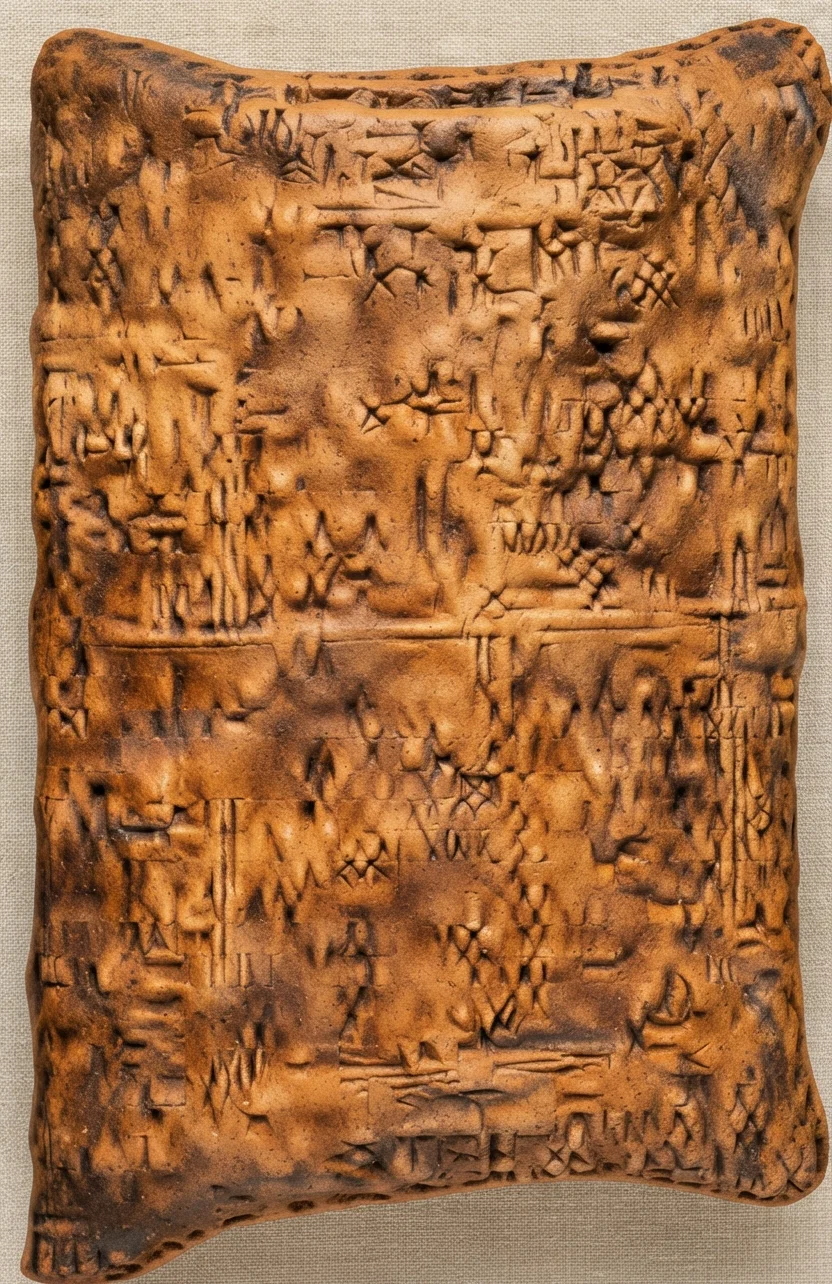
INSCRIBED BRICK FROM THE TEMPLE OF NIN-GIRSU AT LAGASH.

More than 350 Fine Illustrations

scattered through the helps, making really two volumes in one cover, of convenient size. The Bible has round corners, red-under-gold edges, minion type, and cover leather lined to edge (an important feature), divinity circuit. Size of page, 8x5½ inches.

Under One Alphabet - -

A new Concordance combined with a Subject Index and a Pronouncing Dictionary of Scripture

Proper Names Diacritically Marked

For their pronunciation, with meaning. In addition to the carefully compiled Concordance of passages in the common version, there are given over 10,000 REFERENCES TO THE REVISED VERSION. Thus for the first time Bible students may, at a glance, see all the principal changes of the Revised Version placed side by side with the passages according to the common or Authorized Version. Every change of proper names made by the revisers is given. Most of the important changes suggested by the American Revisers are also given, and thus an important additional explanation of the original text is furnished to all Bible readers.

Special Features of the Treasury.....

A LIFE OF JESUS, AND HARMONY OF THE GOSPELS PARABLES AND MIRACLES OF JESUS LIFE AND TRAVELS OF PAUL SACRED CHRONOLOGY HISTORY OF THE PATRIARCHS, ETC., ETC. Twelve Colored Maps with Index. In all

Over 650 Pages of Valuable Helps

to the Bible student. We have no hesitancy in saying with every one else that this is AN EXCEPTIONAL OFFER FOR THE MONEY.

JUST THINK OF IT!

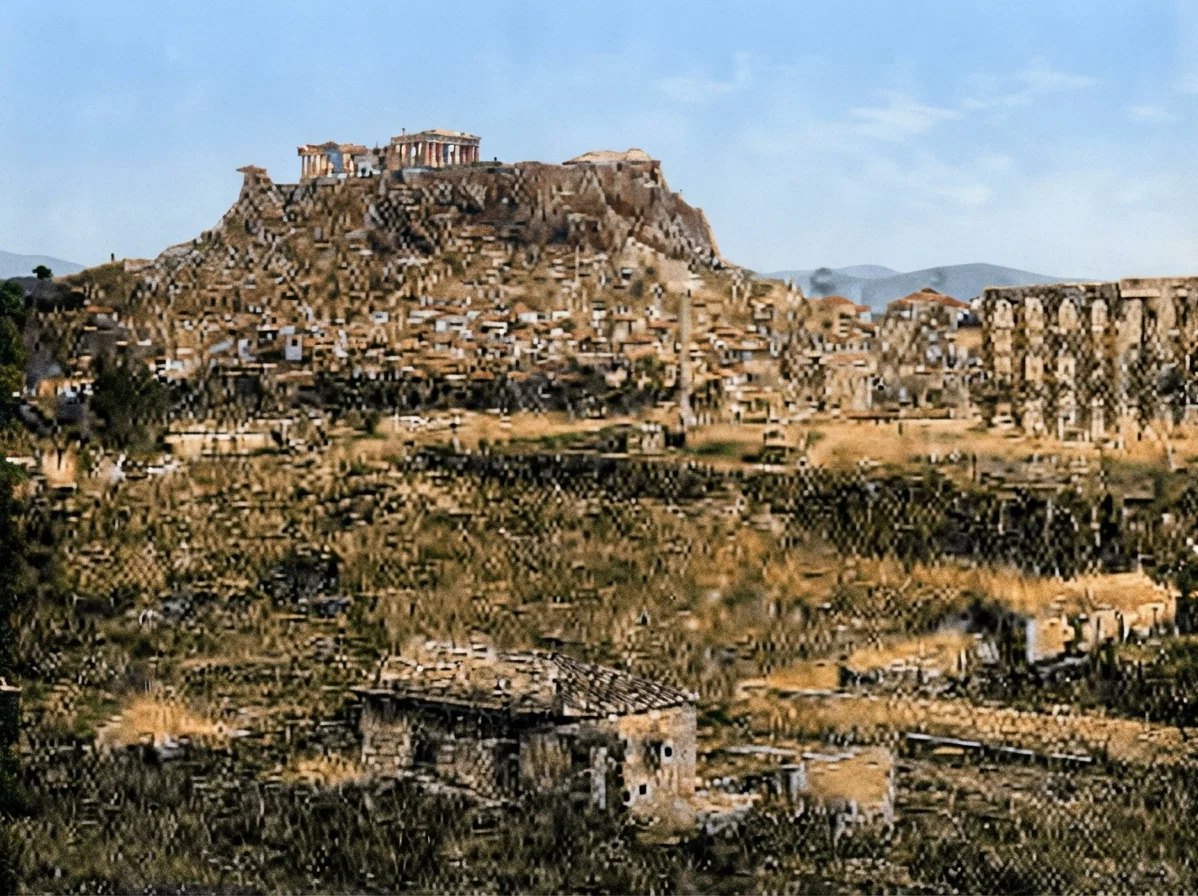
ATHENS.
(From a Photograph by BONFILS.)
ATHENS. (From a Photograph by BONFILS.)

THE TRAVELS OF ST. PAUL.

BY SIR CHARLES WILSON, K.C.B.
ANTIOCH, the metropolis of the Greek kings of Syria, and afterwards the residence of the Roman governors of the province of the same name, stood on the left bank of the Orontes, which a little lower down separates the range of Mount Amanus from the chain of Lebanon. Built partly on an island, partly on low ground, and partly on the rocky slopes of Mount Silpius, it was a city of singular beauty, adorned with magnificent temples, palaces, and colonnades. Its delightful climate, and the close proximity of the sanctuary of Apollo—with its fountains, its groves, and its licentious rites—attracted pleasure-seekers from all parts of the Roman Empire. But a large majority of its population was a worthless rabble of Greeks and Orientals, which passed its time in the theatres or in faction fights on the race-course. There was also a large Jewish colony dating from the time when, under the Seleucid monarchs, and especially during the reign of Antiochus Epiphanes, Antioch was closely connected with Jewish history. How far the Antiochian Jews had been able to resist the Greek influence to which they were exposed is uncertain; but many of the Greeks appear to have become "God-fearing proselytes," or "Proselytes of the Gate."
On the dispersion that followed the martyrdom of Stephen, certain Jews of Cyprus and Cyrene, who had been brought up in Greek lands, came to Antioch, and addressed both Jews and Greek proselytes in the synagogue. Their preaching was successful. A mixed body of Jews and Greek proselytes formed a primitive congregation, which gradually increased in numbers until it attracted the attention of the church in Jerusalem. In accordance with a former precedent (Acts 8, 14), Barnabas, "a good man, and full of the Holy Ghost and of faith," was sent by the church to encourage the new congregation. After exhorting them to "cleave unto the Lord," he went to Tarsus to seek for Saul, whose sponsor he had been before the apostles at Jerusalem, and whose special qualifications for work amongst the Gentiles he knew. They returned together (43 A.D.), and henceforth Antioch becomes the centre of progress and of historical interest in the church. Here the brethren were first called Christians, or "they that are connected with Christos"—a title that could not have originated with the Jews. Whether Christos were a god or a leader the Antiochians knew not, and popular fancy changed the name to Chrestos ("good, useful"), a term which occurs in the form Chrestians in inscriptions.
Agabus having foretold a dearth, the congregation sent Barnabas and Saul with relief to the brethren in Judea. The visit, probably that referred to in Gal. 2. 2 as due to a revelation, marks an important stage in the development of the church. The older apostles recognized the apostleship of Barnabas and Saul (Gal. 2. 9), and their special mission to "preach Him among the Gentiles." Saul was also able to confer privately

DON'T WAIT UNTIL TOO LATE

DO YOU WANT THE BIBLE DO YOUR FRIENDS WANT IT? ORDER THIS WEEK

A Splendid Bible for Three Dollars

A sixteen-page, weekly, illustrated paper for one year—800 pages —and this SPLENDID BIBLE for only
= $3.00 =
To Those Who Renew, Or to New Subscribers For the SIGNS One Year
Read the SPECIAL TERMS in the first column, next page, and secure a few subscribers at the regular rate, $1.00. The commission will help you get the Bible.
Add $2.00 for the Bible to the prices there given.

We Will Send the Bible Free

Post-paid, for Seven New Names and $7.00.
Solicit the subscriptions and make it free for yourself. The price of the SIGNS is $1.00 per year. The Bible will be sent to any of these subscribers for $2.00 extra.
The Bible and papers will be sent to different addresses if desired.
Your name on the cover for twenty-five cents extra.
We Want Agents. Write at Once for Special Terms.
Address, SIGNS OF THE TIMES Oakland, California
Continue reading: Choice gift books for the holidays