“WHY doesn’t Grace Martin hold up her hand?” said Mr. Mitchell to himself, when he called for a show of hands of all those who wished to enrol as Standard of Attainment members. In the few remarks that he had made, based upon these words: “Sanctify the Lord God in your hearts: and be ready always to give an answer to every man that asketh you a reason of the hope that is in you with meekness and fear,” he had certainly endeavored to emphasize the importance of systematic Bible study, and now he wondered if he, the leader of the Young People’s Society, had failed in his appeal to Grace; so at the close of the meeting he spoke with her, questioning her as to her reason for not enrolling as a Standard of Attainment member, to which she promptly replied: “Why, Mr. Mitchell, I wonder if you think that I have been a minister’s daughter these eighteen years for nothing? I have heard doctrine, doctrine, doctrine, until I am absolutely sure that should the occasion demand it, I could certainly give a ‘reason of the hope’ that is in me, and I think it is quite unnecessary to spend my time in going over those things that I have heard so long and so often.”
Mr. Mitchell felt that it was useless to argue the question with Grace, so left her with the suggestion that she “think it over.”
One morning, several months later, Grace was greatly surprised to receive a letter from her uncle living in the West, inviting her to visit him, and inclosing sufficient money for the trip, and a little extra for any needed additions to her wardrobe. Of course, she was delighted with the prospect of visiting her mother’s only brother and his wife, whom she had not seen since her mother’s death twelve years previously, and it was with a light heart that she made the necessary preparations, and set forth on her trip across the continent.
Upon arriving at the home of her relatives, she was received in a most gracious fashion, and as she anticipated the joys that awaited her, her heart fairly leaped within her. Desiring to make her visit as pleasant as possible, her relatives had planned a series of social functions to be given in her honor. The first of these was a reception, to which all their young friends were invited to meet Grace, and which was scheduled for the Friday evening following her arrival. When told of this, Grace very gently reminded them of the fact that she observed the seventh day of the week as the Sabbath, and that it would be impossible for her to take part in any social function on that evening. While the change somewhat upset the plans of her aunt and uncle, yet they were kind and considerate enough to change the date to another evening.
Well, after having once been introduced into this little world of society, where, because of her rare beauty and accomplishments, she was heartily received, many and trying were the temptations that came to Grace. Invitations to dances, card parties, and in fact to all such festivities as are common to those in the social whirl, came in quick succession, and so great was the pressure brought to bear upon her because of her refusal to accept them, that she longed for her godly father and her own simple little home, where she might be safe from the world’s temptations. Then, when the thought would come to her that possibly she was the one who, in God’s great plan, was to carry the truth into her uncle’s home, she would take courage and resolve more firmly than ever before to be a faithful representative of it.
It was the evening prior to Grace’s departure for home that she and her uncle sat together in the little room that was called his “den.” He was talking to her of her future, of his hopes for her, and of his willingness to expend any amount of money that these hopes might be realized. “But, Grace,” said he, “there is one thing absolutely necessary on your part, and that is that you give up these queer, fanatical views that you hold about religion—Saturday keeping, dancing, etc.”
“Uncle,” interrupted Grace, “I cannot do that and I will not. The Bible is my rule of life, and its precepts I must obey.”
“Well, perhaps you are right, Grace,” said her uncle, “but will you show me from the Bible just why you believe as you do—why you observe the seventh day instead of the first, as most of the world does?”
“Yes, indeed, uncle, I shall be only too glad to do so,” answered Grace, as she hurried to her room to get her Bible. Meanwhile, her aunt had joined her husband. When Grace returned with her Bible, she turned and read to them the fourth commandment, which her aunt refused to accept as proof of seventh-day observance, saying that the law of the ten commandments was abolished at the crucifixion of Christ. “Now,” thought Grace, “how am I to meet that argument? O if I can only prove that they kept the seventh-day Sabbath in New Testament times, why that will settle it! But where are the texts? I’ll find them in the concordance, that’s what I’ll do.” Then Grace remembered that she did not have a concordance in her Bible, neither was there one in her uncle’s library. What was she to do? For several minutes she fumbled nervously through her Bible, but was unable to place her hand upon any definite text bearing on the subject. Finally, she was forced to acknowledge her defeat, at the same time insisting, however, that the proof was in the Bible if she could only find it, and fled to her room abashed and humiliated.
The first Sabbath after Grace’s return home, Mr. Mitchell announced in the young people’s meeting that the time had come for the enrolment of new members in the Standard of Attainment, and when the call was made, Grace Martin was the first to respond. That was four years ago, and from that day to this she has faithfully striven to “be ready always to give an answer to every man that asketh” her a reason of her hope.
GRAYDE BROOKE.
The Story of Our English Bible
By Arthur Gibbs
It was in Northumbria, at the beginning of the seventh century, that the first portions of the Bible were rendered in the Anglo-Saxon tongue, by an ignorant farmer named Cædmon. This man had a genius for translating into verse, in the form of a paraphrase, the stories of the Old Testament, which the monks read from the Latin Vulgate. His work is among the early beginnings of English literature. Another writer of this same time was Aldhelm, later bishop of Sherborne, who translated the Psalms and helped to put the Gospels into Anglo-Saxon.
These were the earliest parts of the Bible in English. But the best-known work of this period was the translation of the Gospel of John by the venerable scholar Bede, who died in 735. There is a beautiful story told of how he finished this work on his deathbed, because, as he said, “I do not want my boys [his monks] to read a lie, or to work to no purpose after I am gone.”
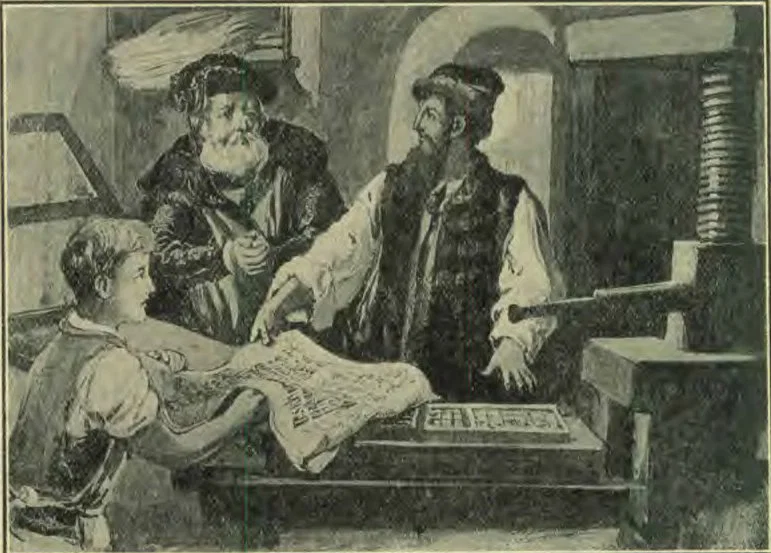
Gutenberg Printing the First Bible
On the morning of his last day there was only one chapter left untranslated. He was very near death, when his faithful scribe said, “Dear master, there is one chapter yet to do.” “Take thy pen and write quickly,” said Bede. All day he wrote, being interrupted many times to say farewell to the friends who came in. Just as night was coming on, his scribe leaned over and whispered, “Master, there is just one sentence more.” And he said, “Write quickly.” The monk wrote on, and then said, “See, dear master, it is done now.” “Yes, you speak truly; it is finished now.” Then they laid him on the pavement of his cell, at his request, and he died praising God, whom he had so faithfully served. His translation was destroyed some years later when the Danes devastated the towns of Northumbria.
Besides these early translations, Alfred the Great is known to have had the Psalms and parts of the Old Testament put into Anglo-Saxon, and distributed in his kingdom. After this we have to skip to the beginning of the thirteenth century, when a monk by the name of Orm made a metrical version of parts of the Gospels, and the Acts, for use in church services. This is known as the “Ormulum.” It was not a translation, but a paraphrase, with explanatory notes. These early attempts are but steps toward the light that was to break forth in the fourteenth century under John Wycliffe.
Wycliffe was a great scholar and a teacher at Oxford. He was a reformer who spoke out boldly against the abuses and corruptions of the clergy of his time. He laid great stress on the Scriptures as the basis of religious life, and he saw that the English people needed to have the Bible in their own tongue. He was nearly fifty years old when he began his work of translating the Bible from Latin into language which the simplest English peasant might understand. As rector of Lutterworth, a center of learning, he had all the help he needed, and his influence with the upper classes was a protection against his enemies who wished to stop the work. As soon as it was completed, he organized a band of lay preachers, called Lollards, who went about the country preaching and distributing the Scriptures. They became so numerous that it was reported that of every two men one was a Lollard.
Two years after he had completed his work, Wycliffe died from a stroke of paralysis caused by continuous study and heavy work. His Bibles were sold for about one hundred and fifty dollars, and Foxe reports that at that time it was common for a load of hay to be given for the loan of a New Testament for one day.
But in 1414 a law was passed saying that “all persons found reading the Scriptures in their mother tongue should forfeit land, cattle, life, and goods from their heirs forever.” The Book continued to hold its place, however, until the next century, when Tyndale’s version appeared.
Tyndale lived in an age of enlightenment, when the shackles of the Dark Ages were swept aside, and men began to think and act for themselves. The first complete Bible was printed by Gutenberg, from movable types, in 1455.
William Tyndale was born in 1484, and became, as Foxe says, “singularly addicted to the study of the Scriptures.” He was a Greek and Hebrew scholar, and was well fitted to translate the Bible from the original tongues. While in college, he got into an argument with a churchman, to whom he said, “If God spare my life, I will, ere many years, cause a boy that driveth the plow to know more of the Scriptures than thou dost.” This he started to do, but found his way hedged with difficulties. After a long search for funds, and a place free from monks and politicians, he located at Cologne, where he got his New Testament printed.
The first edition of three thousand copies was just off the press when his enemies came, and he was barely able to escape by boat up the Rhine, with his printed sheets. At Worms he found a friend and printer in Cochleus, who helped him to get out two editions of three thousand copies, and ship them to England concealed in packages of merchandise. The people of England were very eager to get the Testaments at almost any price. A rush was made for them by both bishops and people, the bishops that they might burn them, and the people that they might read. Whole editions were bought up by the bishops and burned. Of eighteen thousand copies printed we have only a fragment of thirty-six pages in existence today.
Tyndale had to move from place to place to keep out of the hands of his enemies. He dared not return to England, and finally he was caught and burned at the stake, his last words being, “Lord, open the king of England’s eyes.” His prayer was answered, and his work forms the basis of the Authorized Version as we have it today.9
Although King Henry VIII had opposed the work of Tyndale, he realized that the demands of the English people for the Bible could not be silenced. Before Tyndale’s death, he appointed Miles Coverdale to make a translation based on the German and Latin. Coverdale was not a scholar like Tyndale, but he was a quiet, shrewd editor, who had the favor of the king, and was thus able to get all the help he needed from other scholars. His was the first complete Bible in English. It was called the Great Bible, and was gladly received, being “sent forth with the king’s most gracious license.”
England now had the open Bible, only twelve years after Tyndale’s Testaments were publicly burned. This version held its place until the time of Queen Mary, when many Protestants had to flee to Geneva. While there, a scholar named William Whittingham, with others, began a version of the whole Bible. This was completed in 1560. Eight years later there was given to the world the so-called Bishops’ Bible, since not less than eight of these dignitaries took part in the revision. This translation was designed to be an improvement over the Great Bible, “and in this way to challenge the ever-growing popularity of the Calvinistic Genevan Bible.”
Bible study was further stimulated when James the First came to the throne in 1603. He had a natural liking for its study, and soon appointed fifty-four learned men to work on a translation that would suit the needs of all his people, and would be the best rendering in English of the original. This was the Authorized Version, sometimes called the King James Version, which was completed in 1611. The translators worked in groups at different places, on the different books of the Bible, and whenever a book was completed it was sent to each of the other groups for suggestions and revisions. There were Anglicans, Puritans, and laymen among those chosen, and they were permitted to call in outside help when it was thought desirable. The work was so arranged that each man read and passed on the work of every other man in the company. The result was that this translation has stood the test of time, and has been the bulwark of Christianity in the English-speaking world for more than three hundred years. This is but a brief sketch of how we got our Bible. The full story with its many interesting items reveals God’s guiding hand, and is a great source of help and inspiration to his children. ARTHUR GIBBS.
JOHN HOTTEL
By John Hottel
ALL that Christ was to the first disciples his Word should be to his children today. Christ has the same interest in us that he had in Peter, James, and John, for he said, “Neither pray I for these alone, but for them also which shall believe on me through their word.” Then, if the Word of God is dwelling in the heart, Christ will be able to work both “to will and to do of his good pleasure.” We shall work as he worked, we shall manifest the same spirit. And thus loving him and abiding in his Word, we shall “grow up into him in all things, which is the head, even Christ.”
JOHN HOTTEL
JOHN HOTTEL
By John Hottel
The boy Ernest, in Hawthorne’s “The Great Stone Face,” was changed to the likeness of his ideal because he meditated on it and beheld it day after day. In our Christian life we are changed to the likeness of Christ only as we behold his life, read his Word, and meditate on its beauty and truth day after day.
WOMAN, behold this man; discern
In him thy son, the one I love;
The one who dearer is by far
Than any who have followed me.
And think of him as one who loved
Me most, and followed me when all
The world refused and mocked their Lord.
Give him thy love; and in return,
With tenderest care he'll guard thy years
When I am gone. I trust him, and
I charge thee trust him. Live in peace,
For I will come again.
Beloved, behold the one I give
To thee. Thy mother let her be;
I charge thee care for her and take
Her to thy home, and bid her know
That though I die, I live again.
Go preach my gospel. Teach all men,
And show to them the plan whereby,
Redeemed from sin, they may be saved;
And tell them of my love, and how
I came from heaven to die for man.
Tell them to watch, and wait, and pray;
And I will come again.
Go teach all men this gospel true.
Through all the trying days to come
Let thy first thought, thy tenderest care,
Be for my mother. Lo! I die.
Live thou in hope and peace. Watch, then,
And pray, and ever faithful be;
For lo! I come again.
S. R. DICKERSON
How David Defied the King
By Maude Spencer
A SHORT distance from Bethlehem is the Cave of Adullam. It is in the mountainous district, high up on the side of a cliff, and is difficult of access. A narrow path leads upward five hundred feet to the single opening of the great cave. At a certain point of this path, it would be possible for a single man to withstand an army. He need only stand behind a jutting rock and push the men over the cliff as fast as they come in single file along the narrow path. At the present time there are many robbers and cave dwellers living in security among these rocks.
The cave itself is very large, and is divided into passageways, chambers, and crevasses. The rocky walls are niched. The record says that “David and his men remained in the sides of the cave.” The labyrinth of passages makes it possible for two persons to be very close together without being seen, and a stranger could wander about for many days without finding the main opening.
At the time Saul was king over Israel, and was seeking to take David’s life, David with six hundred men dwelt in this cave. It was here that Saul followed him, and becoming tired of his fruitless search in the gloomy maze, lay down to sleep in one of these niches in the wall. David, urged on by his men, who thought that now was the supreme moment for vengeance on the hated king, approached Saul as he slept; but because he was the anointed of the Lord, David only cut off a piece of the hem of his garment, instead of taking his life.
Saul, unconscious of the danger through which he had passed, rose and left the cave. David followed him out into the sunlight, and called to him, and showed him the piece that he had cut from his robe. The two men were so near each other on the path that they could easily talk together; yet Saul, with his “three thousand chosen men out of all Israel,” had not been able to capture the fugitive prince.
MAUDE SPENCER.
Whatever We Love, We Become
“WHATE’ER thou lovest, man, that too become thou must—God, if thou lovest God; dust, if thou lovest dust.”
Margaret’s Morning Watch
By Jessie Ruth Evans
JESSIE RUTH EVANS
THE steady gleam of the electric light in her face wakened Kathryn Marsh a full half hour before the rising bell sounded; and on this particular morning the arousal was not a welcome one. It was cold and bleak outside, and only the first faint light of the rising sun could be seen through the window.
“Oh, why,” grumbled Kathryn to herself, as she snuggled more closely under the warm blankets of the bed, “does Margaret persist in getting up at this unearthly hour? I should think she would know I couldn’t sleep with the full glare of that light in my face. I don’t see what good she gets from her Morning Watch, as she calls it, anyway. The other girls don’t do it regularly, the way she does. She might much better get the extra rest, for she surely does work hard during the day.”
At the close of these reflections, Kathryn raised her head a little, and peeped out of her warm, comfortable “nest” to see for certain if her beloved Margaret was as usual studying the Bible.
Well, she was. “I might have known it, and saved myself even that much effort,” thought the irritated girl. “She hasn’t failed in her half-hour morning’s devotion this entire year.”
All these musings were unusual for Kathryn. Occasionally she herself made use of the extra half hour before the rising bell, spending it perhaps on an unprepared lesson, beginning a letter, or thinking up some new plan for pushing the school activities, in which she invariably had a part.
But on this particular morning the world seemed awry, and Kathryn’s usually contented mind could only ask over and over, “Why does she do it?” The more Kathryn thought of it, the more absurd it seemed. Finally she could stand her irritation no longer, and the words would come: “Margaret, what good do you think reading those texts will ever do you? Don’t you know that your teachers won’t give you any credit for it? And it surely doesn’t help you to have your lessons any better; for I don’t do it, and I have mine as well as you. And it won’t help you keep the library any better; those silent books aren’t going to know whether you have read your Bible or not. And you never tell the girls that you do it; so you don’t get any extra praise from them. I’m the only one that knows, and I don’t see why you won’t spend the time resting. You aren’t any too strong, and you know how much work you are carrying.”
“Well, honey, that’s quite a speech from you, and quite a strong one,” answered Margaret. “I hadn’t realized that my little roommate was trying to analyze the whys and wherefores of my morning reading.”
Margaret McDowell was some years older than Kathryn, and as quietly forceful in her personality as Kathryn was in her exuberant impulsiveness. Neither of these girls—so opposite and yet in some ways so alike—was a nonentity in the school. Margaret’s place in the college was like that of a broad, calm, deep-flowing river, to be fully understood and appreciated only when one had sounded its depths. The strength of her life, like the undercurrent of the river, was her spirituality. Her roommate and closest friend, Kathryn Marsh, was like the waterfall of a mountain stream—turbulent, impulsive, always ready to catch and hold the sunshine of life, and never failing to make her personality felt when she once set her hand to a task. There was a lack in Kathryn’s forcefulness, however, that Margaret possessed,—she never looked higher than human help for her guidance and inspiration.
“But I would just as soon tell you, Kathryn, why I read my Bible each morning,” continued Margaret. “It isn’t because I have always loved to, or in fact have always read it; but one of life’s many experiences brought me the realization that—well, perhaps I had better begin at the beginning, and tell you all the story, if you truly want to know why I spend this morning period in studying the Bible and in silent prayer. I remember, too, that you asked me the other day why I called this period my Morning Watch, but I thought then you were only joking, so I didn’t take time to explain. Shall I tell you about it now, or at another time?”
“Oh, tell me now. And please don’t think I was cross or impertinent when I said you should not get up for your Bible study,” said Kathryn, penitently.
“Of course I didn’t think you were cross, dear; I know you too well for that,” replied Margaret.
“It was this way,” said Margaret, drawing her chair nearer to the bed, where she could better see Kathryn’s face. “I was an orphan, as you know, and was reared by an aunt, who lavished on me every luxury, and provided for me every necessity that she would have given her own children if she had had any, and much more than my own parents could have afforded for me. Not only did Aunt Katrina give me material things, but she also gave me love and training, seeking by every means in her power to train me to be a womanly woman. In return, I gave her the deepest affection of which a young, untried girl is capable. All the love which I should have felt for both father and mother, had they lived, I bestowed on this beloved aunt; and as time went on, the bond between us became almost indissoluble.
“In only one thing was I knowingly unwilling to comply with my aunt’s desires,—I never made a profession of religion. Aunt Katrina, for all her worldly possessions, was not deflected from her source of simple Christian faith. She loved her belief, and it was her fondest desire that I should profess Christ and join her church. But this it seemed I could not do. My nature seemed to lack the qualities essential to a Christian character. I was not emotional. I felt11no consciousness of sin, and naturally I could see no need of a Saviour. The world looked bright to me; I had no grievances, no heartaches. And when the small troubles of my girlish life came to me, I knew that I always had Aunt Katrina to fly to. She had never failed me, and I could appreciate no reason for the need of another comforter and refuge,—one that was not human. To me, my life seemed perfect as it was. Every waking moment was filled; I had study, recreation, and all the wholesome pleasure I could ask.
“Of course Aunt Katrina told me of the Bible, she told me of Christ and his sacrifice, she told me of the strength and support that faith in him would mean; and she urged me to read the Bible and to pray. While I did not refuse, the time never seemed to come. Life was full and complete without the Bible; and I thought—when I thought about it at all—that Aunt Katrina was good enough for us both; so what was the use?”
“There was one thing I always wondered at in my aunt, and that was that she was always the same,—sweet, calm, and well poised, no matter what test she might be subjected to during the day. One evening when she and I were visiting together, I asked her why she never became irritated, as other persons do, and never spoke unkindly to any one.
“‘I deserve no credit for my patience, dear,’ she said. ‘It is my Morning Watch with the Lord that prepares me for just such events, and gives me strength to meet and overcome a temptation to hurt others or to speak unkindly.’”
“‘Your Morning Watch, auntie! But what is that? I have never heard it mentioned before.’”
“‘Margaret,’ she said, gravely, ‘that is a period each morning that I spend with my Lord, before beginning the day’s duties and meeting my fellow men. I read the Bible, and in selecting my texts, I am guided usually by a little booklet prepared especially for the morning reading of the Bible. It is called “The Morning Watch,” and for each day of the week it has texts which have been selected by some one who has a well-planned design in mind. However they are grouped, they are so arranged as to be a special help to those who are trying to follow Jesus and live as he lived on the earth. It is the plan that these texts shall be read, meditated upon, and memorized; then, too, some time is to be spent in prayer. And it has been proved over and over, not only in my case, but in the lives of many others, that those who will thus take “a moment in the morning” to talk with Jesus, and to lay up his word in their hearts, will be fortified to meet the temptations and trials of the day as he would have his children meet them. It is during this Morning Watch with my Saviour, when I think only of learning what he wants me to learn, of receiving his messages to me, recorded in his Book, that I gain strength for the day. My Lord and I have the first watch of the day together, as the Jews in ancient times used to put it.’”
“I thanked Aunt Katrina for her explanation, but it did not drop with that. Those few brief words, together with her daily example as a proof of the help this Morning Watch must be, made a deeper and more lasting impression on my mind than any sermon could have made.
“Not long after this I was sent away to college, and though at first I missed home and Aunt Katrina, I soon adapted myself to the new environment. The college life was inspiring, full, and complete, and I loved it. It was not long before I was an active participant in all the college activities; everything seemed lovely, and sorrow was as yet unknown to me.
“Each summer for two years I went back to Aunt Katrina, never accepting the invitations offered by the girls for spending the long vacation with them. The summer months of freedom seemed only too short when spent with Aunt Katrina in our pleasant home; and while I was thoughtless, with the careless gayety of youth, I wasn’t so selfish as not to realize that my company meant much to my aunt. So we whiled away the time in our usual pleasant ways.
“And always Aunt Katrina took some occasion to talk with me of the ‘higher things,’ as she called them, before I returned to college in the fall. She would ask me if I still had no inclination for spiritual things; and always my answer was a thoughtless ‘No.’ I knew my conversion would mean much to Aunt Katrina; as she put it, her ‘cup would be full to running over’ if I could only see my way clear to accept Christ. But I couldn’t.”
“The morning I left for college, in my junior year, Aunt Katrina tucked a small new Bible in my trunk, and said, ‘Margaret, try to find time to read this a little each day for my sake.’”
“But I didn’t. Caught up into the whirl of school life, the days seemed too full for Bible reading, so I let it go. The only time I could have had to read it quietly was before the morning rising bell, anyway, and I thought that would be only foolishness, so why do it?”
“All went on as serenely and joyfully as ever, until the middle of the last semester of that year. Then one day, I was summoned home by telegram because of my aunt’s serious illness. That was my first taste of anxiety or sorrow. When I arrived in my home town, there was no one to bid me welcome; and a sense of desolation came over me that deepened when I reached home, and there was no beloved aunt to welcome me,—only a quiet nurse and a serious doctor.
“For one week, doctors and nurses fought death with all their human strength, and I stood by, helpless, knowing that my best loved friend was almost beyond human aid, and faintly trying to think what might be brought to her help that was not human. I felt that there was something that must save, but what it was I did not know.”
“At the end of the week, on Friday evening, when it seemed to me that I could bear the strain no longer, the doctor told me that my aunt might live through the night, and that if she did, there would be a chance for her recovery.
“The fighting spirit of the McDowells rose in me. I had no human soul—that is, no one who was near to me—to sympathize with me or give me courage; but I resolved to stay by Aunt Katrina all night, physician’s orders or not, and to help her, if humanly possible, to win the fight for life. I only vaguely knew the meaning of sickness, let alone that of death, and my heart almost failed me with fear, but love made me brave enough to put away self.
“I took my place by Aunt Katrina’s bed, out of the way of the nurses, but where I could watch her. She had not recognized me since my arrival, and it seemed to me that if she must die, it surely could not be without first speaking to me. So I began my vigil. All night long I watched. And during those long hours my mind went over all the things Aunt Katrina had done for me during these years. Her life had been a perfect example, and I had done so little for her. Incident after incident passed before my mind,—12all her unselfishness, her loving thoughtfulness, her Christlike life. And then came the thought, How helpless I am to save her at this time! My sorrow seemed almost too heavy to endure, and my usual comforter was as helpless as a child, apparently never to be herself again.
“Over and over the thought of my utter uselessness came to me, and with it the question, Why can’t I do something? I knew that everything in the medical line was being done that was possible, so I could expect no new help from that quarter. Suddenly came the thought, ‘What would she do for me, if she were in my place?’ And back came the answer, quick as a flash, ‘Pray, and seek comfort from the Bible.’”
“When this inspiration came to me, it was nearing dawn, and the doctors were counseling together, and gravely shaking their heads. The end seemed near. But I resolved to give Aunt Katrina’s Comforter a chance to prove his power, so I slipped into the next room, quietly closed the door, took Aunt Katrina’s Bible from the table, and found her Morning Watch text for that day. It was Psalm 20:6, and read, ‘Now know I that the Lord saveth his anointed; he will hear him from his holy heaven with the saving strength of his right hand.’ After I read that verse, and realized what strength and power God had, I knelt down before him and prayed. I told him that if he would spare Aunt Katrina’s life, I would serve him, and try to become one of his anointed; that I would read and study the Bible, and would keep my Morning Watch with him each day. I meant each word I said; it was no idle promise that I made that sad morning. I had just come to understand that human flesh is weak, and that one must put his trust in a higher power than is found in this world, or he will be swept away.”
“After that first Morning Watch with the Lord, I went back to Aunt Katrina. But before I arose from my knees, I knew that God must in some way answer my petition; for I felt such a flood of comfort fill my heart. When I entered the room, the doctors smiled, and instantly I knew there was at least some hope.”
“Aunt Katrina recovered; but I have never forgotten my first Morning Watch with God, nor the promise I made him then. My conversion came while I was on my knees before the Lord that morning, and I have tried never to miss spending at least a few minutes before the beginning of the busy day, reading the Bible and speaking to him in prayer. Those few minutes with the Saviour give me strength for the entire day, and fortify my soul against temptation. I have his Word to comfort me in the time of affliction. And I know now, Kathryn, from experience that his word is ‘a lamp unto my feet, and a light unto my path.’ That is why I keep my ‘Morning Watch.’”
As Margaret ceased speaking, Kathryn raised tear-filled eyes to hers. “Oh, Margaret,” she said, “I want to keep the Morning Watch too. I don’t want to wait until such an experience drives me to it for comfort; but right now, while I’m happy, I want to begin. Do you think it would be all right for me to do so? You know, Margaret, that I have never made a profession of religion.”
“Yes, dear,” replied Margaret, happily, “it surely would be all right for you to enlist with those who keep the Morning Watch. I have wanted all winter to ask you to join me in this period, but I feared it might harm instead of help you if I did. Shall we begin today? We still have five minutes before the rising bell.”