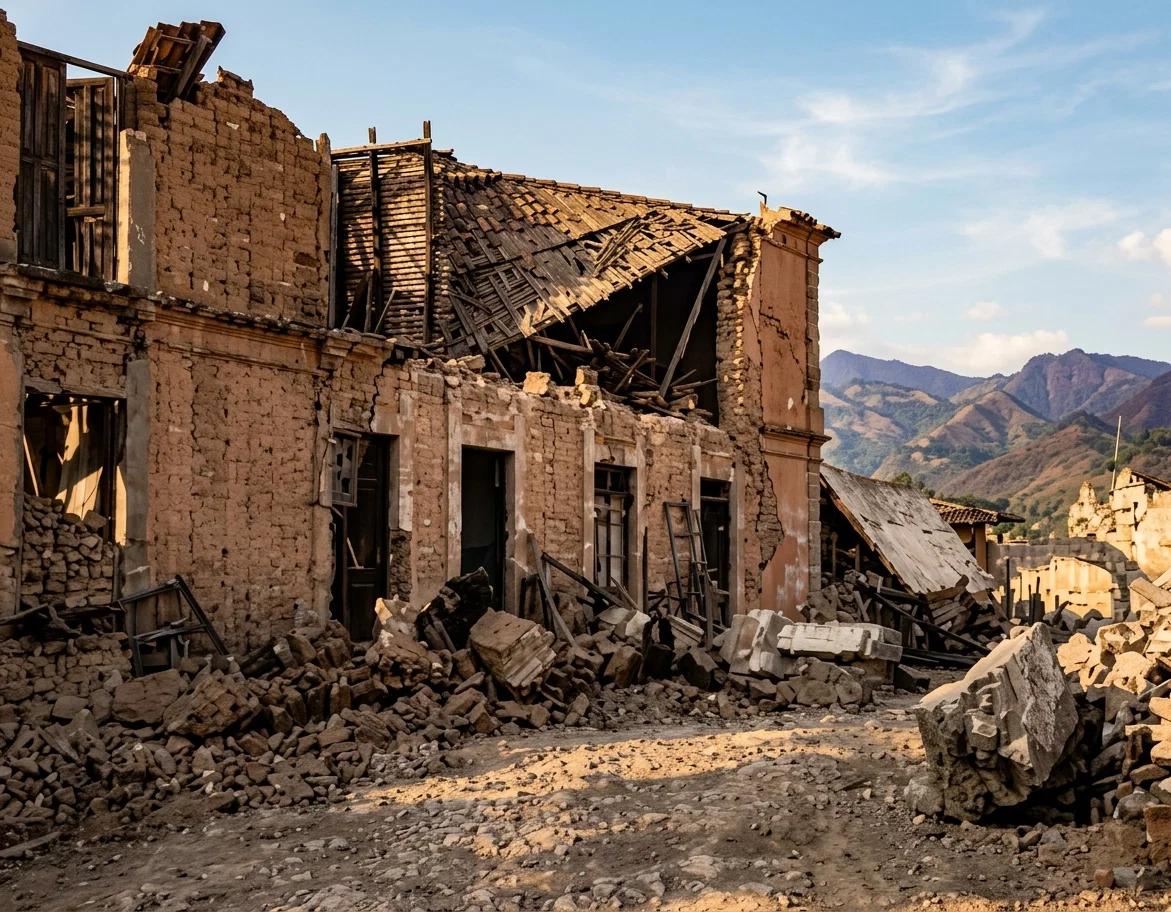
House of Citizen in Motazan Street, Quezaltenango. (Courtesy of Scientific American.)
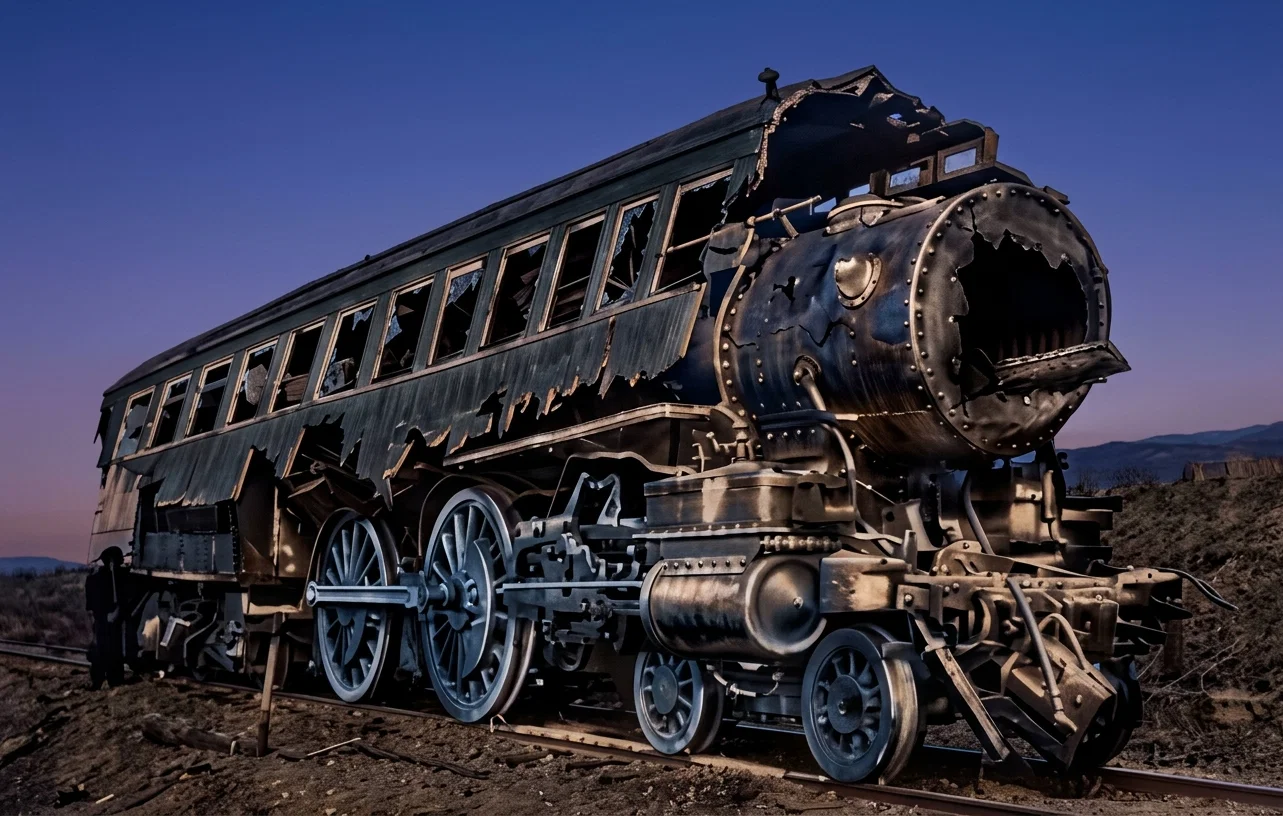
From a photograph of a train wreck on the Southern Pacific near Byron, Cal., the night of December 20. See note on last page.
EARTHQUAKES AND VOLCANIC DISTURBANCES FOR 1902.
From the New York Times, supplemented by other authentic accounts, we give a bare chronicle of the numerous volcanic disturbances and earthquakes—seismological phenomena, the scientists would call it—for 1902, or down to December 22. There is no year on record like it. The Scientific American remarks, in presenting a list less complete than this:
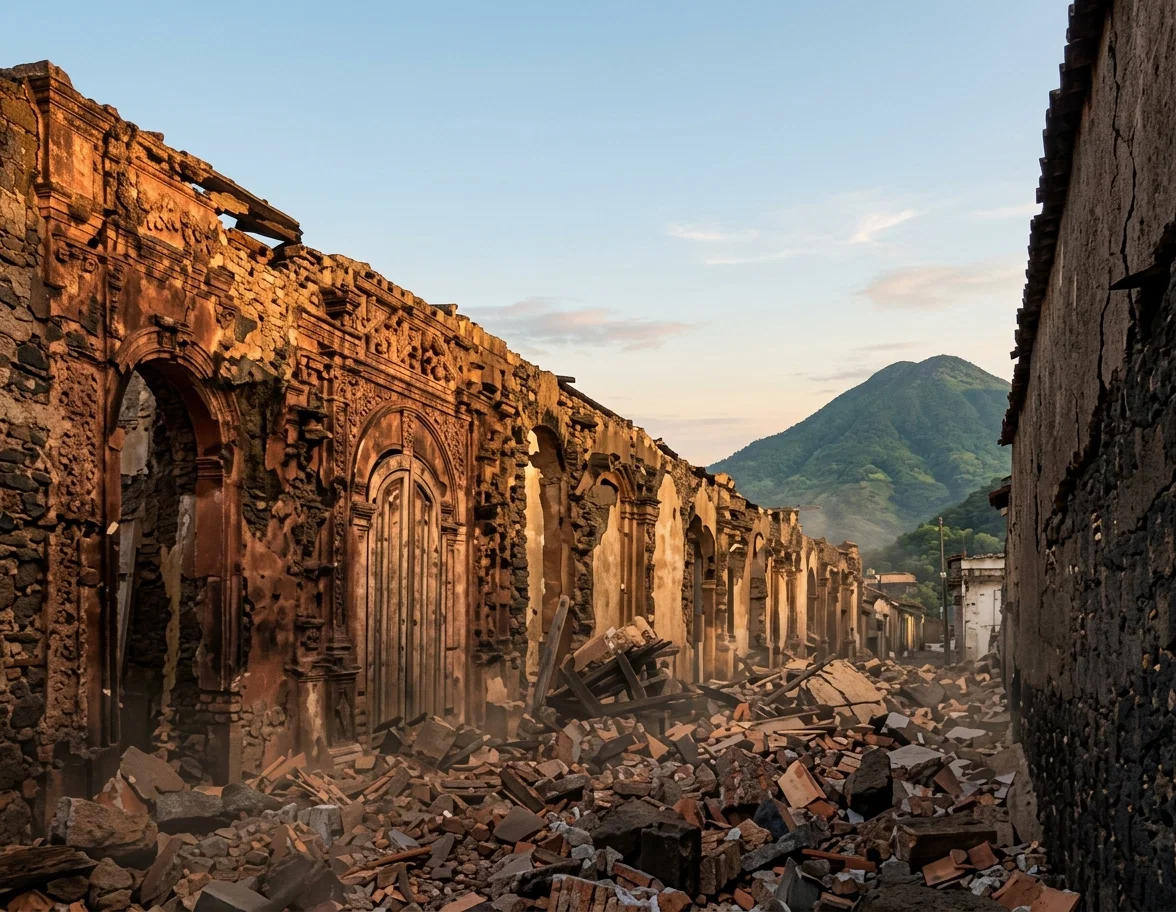
Earthquake Ruins of Arena Where Bull-Fights Were Held, Quezaltenango, Guatemala. (Courtesy of Scientific American.)
“The list shows an almost continuous series of earthquakes, eruptions, tidal waves, and lesser strange phenomena.” It will be seen that the eruptions which destroyed St. Pierre are only a small part of the whole.
January 16—Earthquake at Chilpancingo, Mexico, threw down the government buildings and many other houses.
January 17—Another severe shock threw down many of the buildings left standing. Many lives lost.
February 12—Destructive earthquake in Transcaucasia, destroying the city of Chemakha. Mountains were lifted up, and from large fissures torrents of pure naphtha poured forth. Four thousand persons perished.
April 10—News received of volcanic activity at Unalaska, Aleutian Islands.
April 18—Earthquake in Guatemala, Mexico, Amatitlan, San Juan, San Marcos, Escuintla and Santa Lucia, killing 1,000 persons, injuring 3,000 others, and rendering 50,000 homeless.
April 19, 20—Terrible earthquakes in Guatemala, causing great damage in Quezaltenango and Amatitlan, and killing several hundred of their inhabitants; also destroying $2,000,000 worth of property in southeastern Mexico.
April 30—A severe earthquake shock at Lautoka in the South Pacific.
May 3—Mount Redoubt, in Alaska, erupts.
May 7—First eruption of St. Vincent.
May 8—First eruption of Mont Pelée, destroying St. Pierre and its 30,000 people.
May 12—Mount Colima, near Guadalajara, Mexico, becomes active.
May 13—Severe earthquake felt at St. Thomas, Danish West Indies.
May 15—Mount Soconusco, State of Mexico, becomes active, causing many casualties and a few fatalities in Aquespala, Laverga, and Comitan.
May 18—Earthquakes in the southern part of Portugal.
May 18—Second eruption of St. Vincent.
May 20—Tidal wave destroys a portion of the village of La Carbet, Island of Martinique.
May 20—Basse Pointe, Martinique, inundated by mud.
May 21—Earthquake experienced at St. Augustine, Fla.
May 23—Earthquake and volcanic activity in mountains west of Lake Managua, Nicaragua.
May 24—Mount Pelée resumes and continues with great force for several days.
May 28—Earth tremor registered at Bayonne, N. J., and at Chattanooga, Tenn.
May 30—Another eruption of La Soufrière, accompanied by a severe earthquake.
May 31—Sulphurous exhalations from Mount Trabochetto, between Nice and Genoa, Italy.
June 1—An eruption of Kilauea, Hawaii, accompanied by a rain of ashes, a phenomenon not witnessed there before.
June 2—Announcement of eruption of Mount Blackburn, in southeastern Alaska.
June 3-6—Violent disturbances of Kilauea, Hawaii.
June 4—The Gusygran, a mud volcano near the village of Kobe, in Caucasia, erupts, killing several persons.
June 4—Landslide, Mount Grigna, near Lake Lecco, Switzerland, kills two noted scientists.
June 6—Another violent eruption of Mont Pelée.
June 8—News received of the eruption of Tacana, in Guatemala, accompanied by violent earthquakes which razed many buildings in several towns. One thousand persons killed.
June 9—Columns of steam rise from Mt. Ranier in Washington.
June 14—Discovery of slight elevation of localities in Pennsylvania.
June 14—Still another violent eruption of Mont Pelée.
June 14—Mount Fauno, Oregon, began smoking and sending out steam, and hot springs in the vicinity increased many degrees in heat.
June 15—Strong earthquake shocks in Sicily.
June 19—Mass of slime ejected from Pelée, practically destroying the town of Basse Pointe.
June 20—Disastrous earthquake shocks in Tyrol.
June 21—Volcano Pichincha, in the Province of Manabi, in Ecuador, becomes active.
June 22—Violent earthquake shock at Cassano al Jonio, in the Department of Calabria, in Italy.
June 24—News received at San Francisco of the eruption of the volcano of Kilauea, Hawaii.
July 1—Earthquake shocks in Salonica, European Turkey, causing heavy loss of life and great damage to property. On the same day, also, earthquake shocks were felt simultaneously in twenty towns in Asia Minor, causing the collapse of many houses.
July 7—Large boulders and gases ejected from Tulsa, a small volcano in the Indian Territory.
July 7—Guevesne and Zelisova, in European Turkey, partially destroyed by an earthquake.
July 8—Volcanoes of Miravallis and Ricond de Vieja, in Costa Rica, reported to be in active eruption.
July 9—Severe earthquake shock at Bunder Abbas, Persia, doing much damage.
July 9—Three severe earthquake shocks at St. Vincent, West Indies.
July 10, 11, 12—Loud detonations from Soufrière volcano.
July 11—Fresh eruption from Mont Pelée.
July 12—Violent earthquake shock in Caracas, damaging towns of Guarenas, Guatire, Valencia, and La Guayra.
July 17—Other severe earthquakes at Kingston, St. Vincent, West Indies.
July 27—Destructive earthquake shocks in California, doing much damage to property in Los Alamos, San Maria, and Santa Barbara. Simultaneously a series of severe shocks was felt in Nebraska, the Dakotas, and western Iowa, and did damage to property.
August 13-15, Japan—Eruption in small island of Torishima; the inhabitants, 150 in number, disappeared, together with houses.
August 17—An earthquake on Alaskan coast filled Taylor Bay with huge icebergs shaken down from Brady Glacier.
August 17—Earthquake in the Transcaucasus started an avalanche down a mountain valley, destroying twenty villages and nearly 700 lives.
August 22-September 3—Continuous earthquakes at Kashgar, Astyn, and Aksuksiche, Turkestan, demolishing several towns and destroying 520 lives.
August 25, Italy—Mount Alto in eruption.
August 27, Philippines—Earthquake in the Island of Mindanao; sixty natives killed.
August 30, Venezuela—Earthquake shock at Carupano at 9 A.M.; disturbance accompanied by noise which was heard along the whole shore of the Caribbean Sea.
August 30, Martinique—Mont Pelée in violent eruption; said to have killed 2,000 people.
September 1, Martinique—Mont Pelée again active, the eruption surpassing in force that of May 8.
September 1—New volcano breaks out in Peru, continuing active for several weeks.
September 6, Italy—Vesuvius spouts flames.
September 8, France—Earthquake shocks at Pau.
September 8, India—Severe earthquake in Bengal.
September 9, St. Vincent—Contour of island changed by eruption of La Soufrière.
September 9, Sicily—Stromboli in full eruption.
September 16, Mexico—Water spouted from a lake frightens Indians and whites.
September 17, Philippines—Macon, Taal, and Balusan volcanoes unusually active.
September 20—Very severe earthquakes in different parts of Australia, damaging many buildings.
September 22, St. Vincent—Violent eruption of La Soufrière; cable repair ship “Newington” working five miles from shore forced to steam away at full speed, effecting a narrow escape.
September 23, Jamaica—Sharp and violent earthquake shock felt throughout the island.
September 23, Ecuador—Severe earthquake shock felt at Quito followed by violent storm.
September 23—Seventy earthquakes were counted in one day at Salina Cruz, Mexico, followed by a tidal wave which destroyed much property.
October 15, 16, 17—La Soufrière, St. Vincent, again in violent eruption, and crops buried in burning sand.
November 1—Severe shocks in the island of Savaii, Samoa, shaking down stone structures, while fire issued from a number of mountain peaks.
November 6—Severe earthquake shock at Guarda, Portugal, accompanied by loss of life and destruction of property.10
November 15-December 15—Ten earthquakes in the vicinity of Los Alamos, Calif.
November 17—Southern Utah shaken by an earthquake, and shocks continued daily for nearly a month.
November 26—An unusually severe outburst of the volcano on the Island of St. Vincent, causing the inhabitants of Georgetown and Chateau Belaire to evacuate these towns.
December 12—Six earthquakes in Santa Barbara and San Luis Obispo Counties, Calif.
December 16—The old mud volcanoes of Mendocino County, Calif., renewed activity, and began belching mud and lava. A section a mile square is now covered with these craters, where a few years ago only a half dozen existed.
December 18—Two violent earthquake shocks occurred at San Jose, Costa Rica, followed by others of less severity.
December 22—An earthquake at Andijan, Russian Turkestan, destroying 16,000 homes and killing 4,000 persons.
December 27—Earthquake at Hain Chiang, China; 600 lives reported lost.
DISEASE AND DISASTER.
In a November issue the St. Paul Globe made the following comment on the deaths in 1902:—
Few people realize how frightful have been the ravages of 1902 by disease and disaster. Only a little more than ten months of the twelve are gone, and yet close to a million persons have been swept across the Styx by epidemics, floods, and volcanoes.
Early in May a series of eruptions in Martinique and neighboring islands in the Caribbean Sea snuffed out countless thousands of lives.
Somewhat later the Yellow River of China overflowed its banks, and tens of thousands of Celestials were drowned like rats in a trap.
Not in forty years has there been such an epidemic of cholera as for the past six months has been raging like a prairie fire in Egypt, Japan, China, and the Philippines. Official reports show that the disease has been no respecter of persons, but has raged with equal virulence in the slums of Canton and Shanghai and among those of royal blood in Peking. Neither did the pestilence break out in one town and spread to another. It appears to have broken out almost in the same hour in Manchuria, Shen-si, and half a dozen other provinces, and is now frightfully fatal in almost every section of China. The busiest men in Japan have been the undertakers, and how dreadful has been the mortality from the disease in the Philippine Archipelago is shown by the reports made to this government by American officials stationed there. Tho statistics have been kept imperfectly,—in some sections not at all,—the loss by the disease has easily been six hundred thousand people since the opening of the year.
And now comes the news that an epidemic of measles is sweeping over western Europe, and has already crossed Behring Sea into Alaska. Thousands have already died, particularly in Kamchatka, and the living are so worn out with caring for the sick that they are in most cases themselves fit subjects for the hospital.
The lack of fuel in the eastern part of this country and the extreme cold will be responsible for many more deaths. Extensive famine is prevalent in Finland, and many, doubtless, have perished from volcanic eruption in Guatemala, besides the deaths from train wreck and other accidents. The old earth is waxed old under the curse, and its people die.
WANTED, 50,000 FREIGHT CARS.
News telegrams from one point and another emphasize the fact that the country's most remarkable famine of these days is not in things to eat or to burn, tho it is contributory to local shortages in both fuel and food. This is a famine in freight cars and locomotives. Its effects reach across the whole country, tho they bring the hardest experiences to the west and southwest.
Freight cars have increased in number in the last eight years from 1,228,781 to nearly 1,500,000. The increase in carrying capacity is much greater than these figures show, for while the cars of 1894 would rarely take over 20,000 pounds, and never over 30,000, those of 1901 run as high as 100,000 pounds, and among the cars in use to-day those carrying at least 60,000 to 80,000 pounds are the prevailing number. In 1894 there were 36,304 locomotives; now there are about 40,000, and from machines seldom weighing over sixty tons we have come to engines rarely falling below 135 tons. Some monsters weigh 200 tons.
But mileage and tonnage in the freight business have more than kept pace with carriage capacity. In 1894 the cars shifted 674,714,474 tons of goods and produce. In 1901 the tonnage was 1,084,066,451. The estimate for 1902 is 1,100,000,000 tons. Traffic at the moment calls for 50,000 more cars than are available, and the demand is increasing.
Our national railway system is a giant. But even a giant must lose stride for a bit when prosperity moves in seven-league foot-gear.—Twice-a-week World.
SUFFERING FROM WANT OF FUEL.
The Springfield (Mass.) Republican of December 12 tells us that on December 9 the thermometer registered 20° below zero at Boston; Norfolk, Conn., 23 below; Ogdensburg, N. Y., 22 below; Saratoga, 30 below, with the average for the 24 hours of 20 below; one place in Franklin Co., N. Y., reported 38 below. Many of the towns could get no coal. The same paper tells the condition in Springfield, which may be regarded as typical of other towns. It says:—
The situation in this city and in all the cities of the State and this section of the country in respect of fuel is entirely unprecedented. The like of it has never been known in the history of the country, whether within the period of the use of coal as a domestic fuel or back of that when all dependence was upon wood. Probably two-thirds of the people of this town, in the midst of about as severe weather as a New England winter ever brings, are being driven to the most desperate expedients to keep their houses warm, and often to keep only one or two rooms in the house tolerable. Some of them have a little hard coal which must be used sparingly. Others are relying upon wood; others upon charcoal, soft coal, even engine sparks and boards. Gas heaters and oil heaters come into anxious requisition, shade trees and fruit trees have been sacrificed, and oil-soaked bricks are resorted to.
Meantime hard coal dribbles into town occasionally, a few car-loads at a time, which are but a drop in the bucket of demand, and the price is a famine price. All the while the hope is held out that the situation will speedily mend. The suffering already is considerable, and the cost of abating it even to a moderate degree is not small. Hard coal at $12 a ton is probably the cheapest of all the fuels offered, but it is next to impossible to get any. Wood, at $8.00 a cord or thereabouts, involves a cost to the householder of a dollar a day or more to keep the cellar furnace properly going in such weather as this. Soft coal at $8.00 a ton is about as expensive, and far less satisfactory, requiring constant attention to effect a heat-producing combustion. No house chimney has a strong enough draught to make the burning of soft coal easy or satisfactory.
We have had several decidedly cool, frosty mornings in Oakland, of late, which tingled the ears and nose and fingers, and made furs and overcoats comfortable; and we pay $8.00 a cord for wood inferior to the maple of the east, if we burn wood, and $9.00 to $11 a ton for soft coal, a steady standard price all the time. But there is little suffering, and we sympathize with the people in the East, who are deprived of fuel simply because of man's stubborn selfishness.
Perplexities and Distress.
There is a strange mixture of peace and turmoil, poverty and luxury, anxiety and carelessness, distress, perplexity, and threatenings of war in the world at the present time. With the exception of the Venezuelan trouble, the nations are outwardly at peace, but inwardly full of fears both from within and from without. While millions are seemingly care-free, disaster and calamity are rampant in the earth, and the nations are bickering and struggling for every possible advantage almost to the verge of hostilities. Storms are threshing the earth in the fury of their power on both sides of the Atlantic and Pacific. The following are some of the striking things that have come to our attention within the past few days: The destruction of a whole town in Russian Turkestan, in which over 4,000 persons lost their lives and the homes of those who escaped death were ruined, while the earth in that vicinity continues to tremble, and the homeless people shiver and freeze in the zero weather; bloody fighting has occurred in Bostoff, Russia, between strikers and troops, in which 300 are reported to have been killed and 1,000 wounded, 2,000 women fighting with the strikers; 400,000 persons are reported starving in Finland as the result of the crop failure; there is widespread famine and destitution in European Russia and Siberia, and the government is spending several million dollars for relief; Anarchists have been at work with dynamite in Geneva, Switzerland; the rebellion in north China is reported spreading instead of decreasing, while the poor are suffering from the famine and from the depredations of the imperial soldiery as well as from the rebels; the government of Colombia is threatening war on Nicaragua; France is pressing Peru energetically for a settlement of a claim of long standing; the Venezuelan rebels are reported to be about to capture the capital, their present activity adding much to the present difficulty of the Castro government; Germany and England are protesting against America's commercial attitude in the Philippines; a rebellion is in progress in Morocco; the common people of Ireland are stirred over the large number of evictions; and in this land of peace and plenty many are suffering greatly from scarcity of fuel. It is not a peaceful or promising outlook.
The Venezuelan Imbroglio
To make legal their blockade of the coast of Venezuela, England and Germany have declared war against that country. The declaration of war was doubtless due also to the position taken by the United States in refusing to recognize what was termed a “peaceful blockade.” Little has transpired in an offensive way during the week, the capture and disabling of a Venezuelan ship by a German vessel being about the only warlike act outside of the blockading operations. The Secretary of State at Washington strongly urged that the nations concerned yield their differences to a court of arbitration. The powers finally accepted the suggestion, with certain conditions, and proposed that President Roosevelt act as arbitrator. The President, after deliberation, decided adversely, believing The Hague arbitration tribunal to be the proper body for that task. Britons generally are pleased with the prospect for a peaceful solution of the difficulty, but are disappointed that the President refuses to act as arbitrator. The one thing that seems to mar the prospect for a peaceful settlement is Germany’s insistence on the payment of $100,000 by Venezuela before the arbitration begins. There seems to be considerable feeling in England against the course of that government. It has been recognized on all hands that the present situation is a delicate one and might involve America; and some have declared that a war with this country would be a calamity second only to the breaking up of the empire. Germany has reiterated her purpose not to interfere with the “Monroe doctrine” as at present interpreted. German traders are now fearing a loss of influence and trade in Venezuela, believing that the present trouble will give Americans greater prestige in the commerce of Venezuela.
Child Insurance
The poisoning of two Pennsylvania children recently for the insurance which they carried, has led to much discussion and some official action in that State. The State insurance commissioner has made an investigation which shows that nearly 400,000 children under twelve years of age are on the books of a single insurance company in Pennsylvania. How many are carried by the other companies is not stated; but it is safe to say that this is but a part of the total number; and doubtless some of these are insured in more than one company. In the presence of the ever prevalent avarice of the times, it is undisputed that child insurance has placed before the very poor and the unscrupulous a very dangerous temptation, and one which we know has frequently been yielded to. With the questionable moral status of much of life-insurance business, it should not be difficult for the Christian to decide aright the question of child insurance, so far as his child is concerned. It is at best a lottery into which a certain sum is paid periodically for the chance of receiving back a larger sum in case the death of the child occurs. There are two uncertain quantities, the arrival of death and the ability and willingness of the company to keep its promises. Then there is on the part of the two classes named the desire to receive back what they have paid out with increase to cover the risk incurred. The whole matter is a trenchant and caustic comment on the morality of our times.
Church Federation
The question of Protestant church federation has received considerable momentum of late throughout the Australian continent. The Presbyterian Church of Australia has appointed a representative committee to confer with the Congregational representatives on the subject of such union, and has submitted a tentative basis for federation. Conferences have already begun between the committees of the two churches. There will be provision for the appointment of pastors, ministers of both denominations being eligible for service in the churches of either denomination. The churches will transfer members from one to the other, and the theological training schools of the two denominations will co-operate. The union of the two denominations there, tho not actually accomplished, is looked upon as certain, and will probably be followed by similar action between these denominations in other parts of the world. It adds strength also to the efforts put forth for church federation by the representatives of other denominations. There is a strong tide setting in that direction at the present time, and the day is not far distant when the larger Protestant denominations will be working under federation control. This confederacy movement is but one of the many that show these times to be the most vitally important in all earth’s history.
Influence of Reading
Two boys—samples of many more of the same sort—were arrested recently in this city for burglary. Their ages were thirteen and ten. They had a desire to live in big hotels and wear prison stripes because they had read about these things in dime novels, and of course they could not live high without money, and they could not wear prison stripes without crime. Hence the crimes to get money,—and prison stripes when they were caught. Said one of them: “We wanted to live in a fine hotel, and as we had to have money we thought we would just go out and get it. That was the way they did it in the stories.” One of the great curses of the day is the overwhelming tide of fiction from the religious and historical novels shading down to the nickel terribles. They all partake so much of general badness in character, influence, or leading, as to be generally condemnable. They present unreal views of life which their devotees take as real, and so unfit themselves by such education for life's obligations and responsibilities. Let parents guard the reading and associations of the children more than they would their food and drink.
Preparing for the Battle.
Prof. Carl E. Myers' electrical aerial torpedo, now on exhibition at Madison Square Garden, New York, is a dirigible airship, perfectly controlled by an electrician on the earth. It is thirty-five feet in length, and is designed for use in warfare. It may be sent a long distance, and when the desired position is reached, a torpedo is released to carry destruction wherever it may strike and explode. Fearful indeed will be the last great war. “Every battle of the warrior” will be indeed “with confused noise, and garments rolled in blood.”
ADOLESCENCE
By Mary Wood-Allen, M.D.
BY MARY WOOD-ALLEN, M.D.
I. Physical Significance.
The period of adolescence may be considered to be the years between fourteen and twenty-one, altho its beginning may be several years earlier than fourteen and its prolongation for some years after twenty-one. Puberty is the marked entrance into this land of adolescence, or youth, and its average age is fourteen.
Before this the individual is a child, and if natural in his development will not have the mental or physical characteristics of sex. In truth the normal child is of the neuter gender. The little boy and girl, if left to themselves, will play together with no recognition of difference. They will quarrel as readily with each other as will boys and boys or girls and girls. The boy will manifest no chivalry, the girl no coquetry. If children manifest these impulses it is because of some education in that direction. We are now speaking of children who are perfectly natural, who have not been trained not to do certain things because they are girls, or have not been excused for doing certain things because they are boys. We little realize how early in life we begin to put the burden of sex on the woman-child and teach the liberty of sex to the man-child.
We are now speaking of children who have grown up with no suggestions from elders or superiors which would tend to make them conscious of sex, and we find that the boy is no more gentle and considerate of his girl companions than of the boys with whom he plays and the girl no more shy or sentimental than he.
But as they approach the boundaries of that mysterious land of the “teens” there comes a change. Without in the least understanding why, the boy begins to feel embarrassed when with girls. A new timidity takes possession of him and at the same time a new pleasure in their companionship. He begins to desire to gain favor in the eyes of the very girls whom he has hitherto treated most cavalierly.
They seem new and wonderful creatures, and in an awkward and embarrassed way he endeavors to show some courtesy and gallantry.
The girl is also becoming self-conscious and shy. Her manner loses much of its crudeness, and it is seen that she is spontaneously changing from the hoyden to the lady.
If the adults who surround these youths are wise they will comprehend the gravity of all these signs and will conduct themselves accordingly; but alas, too many who should understand these portents fail to do so, and by their unwisdom precipitate natural development and thereby produce deplorable results, from which the young people suffer, and for which they are unjustly blamed.
In order to act with wisdom, parents should understand the physical, mental, and moral significance of adolescence; should realize that it is
A Crisis of Grave Import to Boy or Girl.
Most mothers do realize that this is to the girl a critical time, and they watch with much anxiety the physical unfolding of their daughters, guard their health, have patience with their moods and tempers, and overlook many perversities, with the feeling that “she will be better by and by.”
Few parents, however, realize that this crisis to the boy is equally grave, is marked by physical changes of equal importance, that the crisis is for him of even graver import, because the inner forces work with greater energy and the outer temptations come with stronger power.
What is the physical significance of adolescence? What is its influence upon the child? What are its peculiar dangers, and how can we guard against them? These are the queries with which the thoughtful parent will be oppressed as he sees his children entering upon this stage of development.
The physical significance means first the endowment of the child with new powers. He is receiving a wondrous gift. Up to this time of life the whole organism of the child has been occupied with his nutrition and growth. He has naturally lived in the domain of self, of egoism. Now he has reached the stage of development where he is to prepare for the domain of altruism. Hitherto he has been linked only to the present and the past. Now he is to become a possible link to the future. He has received his gift of life from those who have gone before. He is now to be endowed with the power of transmission of life, a wonderful and holy gift which should sanctify this young creature in our eyes and in his own. Think of this sacred period when the youth receives from the All-Father this gift of semi-creative power, the greatest power of God himself, and let us bow in silent awe before this miracle of transformation. (Gen. 1:27.)
The development of reproductive power in the individual means also the endowment with new life for himself. In the first years of this process the child takes on a wondrous physical growth. All the processes of life are quickened. Not only is there increase in height, but in fulness of outline and in breadth of figure. The voice deepens, the eye takes on a new lustre; in the boy the beard starts, and in both sexes the body changes to its distinctive masculine or feminine contour.
Physical Changes.
So rapid is the physical growth that often there is not vitality enough to keep pace with it and the child manifests an unwonted indolence of both mind and body. Sometimes the muscles grow faster than the bones, and awkwardness ensues; or the bones grow more rapidly and stretch the muscles, and there are so-called “growing pains.”
Along with these evidences of development new fluids are secreted and eliminated, and unless the boy or girl is wisely instructed a needless terror is experienced; a terror which sometimes leads to unwise conduct that may result in invalidism; or a curiosity which, seeking the bread of true knowledge, is given the serpent of sinful knowledge; and physical and moral destruction follows.
Each child should receive from parent or friend the instruction which will prepare him for adolescence, which will make clear its physical significance, so that he may escape the dangers which lie in wait for the unwary and ignorant, and have a comprehension of his true value to the race. Study 1 Cor. 3:16, 17; 6:19, 20; Prov. 1:8, 9; 2:10-22; 4:1-27; Ps. 24:3, 4; 2 Tim. 2:22.