SUCH an one is J. J. Loeb of Colorado who saved the town of Manitou, in Ute Pass Canyon, Colorado, August 5, 1902. Since the age of two years he has been paralyzed on one side. He makes his living by selling soap. He rode from Denver to Los Angeles recently on a freight train to meet the famous Austrian surgeon, Dr. Lorenz, but had to bear the disappointment of being told there was no help for him. The story of how he saved Manitou is as follows:—
He reached Cascade in the afternoon after a ride for miles through a severe thunder storm, mixing with hail as he neared the town. The hail stones were so large, he tells us, that nine of the frozen masses filled the bicycle cap he was wearing. At Cascade he borrowed a rain coat of a liveryman. The liveryman pointed up the valley where about a mile and a half away, a great wall of water forty feet high—it seemed eighty—was pouring down upon them. No need to be told by man, God's angel told him of Manitou, with its 2,000 people below, and the campers along the valley. He turned his good horse down the valley and started in his mad race with death,—death in the slippery, dangerous mountain road. Death riding the crest of the cloud-burst wave of destruction. The rest of the story we will take from his telling in the Examiner of December 21:—
The hailstones beat against my body, while I held my only good hand over my eyes to prevent being blinded, and for days afterwards there were black and blue marks all over my body where those hailstones struck me. Maybe I didn't long for the use of that paralyzed arm just then. I had to cling to the horse with my one good leg. How I did it I don't know, except that there are such things as miracles. Once, after my horse had slipped, I held the bridle in my teeth. When the hailstones had bruised my hand—the hand I was holding over my eyes—so that every stone cut it like a knife, I drew my hand down, from the pain of it, lowered my head to the horse's mane and rode it blind. Did you ever think a man sentimental when he said he loved his favorite horse? Picture that pony in that frightful storm, and you will not wonder when the next man praises a horse to you. Constancy in human beings furnishes few parallels.
I rode back to Cascade and told the operator at the little railroad station to wire at once, for God's sake, to Manitou that the life of every man, woman and child was in danger. Then I dashed on to the pass. That was the rough-and-tumble part of the ride, through that canyon. My horse stumbled with me and threw me into the creek that flows through the canyon, after I had ridden about a mile and a12half. The faithful animal stood still, trembling and whinnying, as much or more for my safety as for his own, I have no doubt, until I was safely on his back; then, without my having to put the spur to him again, he leaped forward and we were down the canyon like a streak.
I rode about 175 yards when I saw two women coming leisurely along the pass, near the creek. I pulled up quick, shouted to the women to get to the top of the mountain unless they wanted to be drowned. They did not heed me, and, as I learned later, they were both drowned. I saw a horse tied to a tree near a tent about four feet from the creek. Maybe I was beginning to appreciate that noble little beast I was riding then, for I got off and led the other horse to high ground before I continued on to Manitou. I reached Rainbow Falls safely and was turning into the road to Manitou when my horse stumbled again and slipped and down we went, more than 100 feet to the bottom. My leg was cut open—my only good leg—and I was squeezed between rocks, but I got back in the saddle and rode along the creek and into the town, shouting warnings to everybody.
That is all the story. Nobody in the town was drowned. About sixty were hurt by the big trees that were washed through the canyon. Property valued at $120,000 was washed away, and I saw a great wall of water push the ties out from under the rails of the track as easily as I could push a match into a ball of wet mud. It was the most horrible thing I ever saw. I was only four minutes ahead of the flood, and strange as it may seem I was worse scared after I got through it all than I was at any other time.
What did I get for it? Nothing but the title of the "Paul Revere of Colorado." Not even thanks.
How human it all is, the treatment of the man who saved them! How such instances feebly illustrate the offering, the sacrifice, of Jesus Christ; who to save mankind—you and me, reader—from the great on-rushing, overwhelming tide of sin, gave Himself. The town of Manitou ought to pension Mr. Loeb for life; but they forgot him with an empty name. But Jesus Christ met scoffing, abuse, maltreatment, death, from those He came to save! May this little story help us more vividly to recognize Him who yielded all, suffered all in our behalf and to render to Him His due—ourselves.
The Master's Touch
By Horatius Bonar
In the still air the music lies unheard;
In the rough marble beauty lies unseen;
To make the music and the beauty needs
The master's touch, the sculptor's chisel keen.
Great Master, touch us with Thy skilful hand;
Let not the music that is in us die.
Great Sculptor, hew and polish us; nor let,
Hidden and lost, Thy form within us lie.
Spare not the stroke! do with us as Thou wilt!
Let there be naught unfinished, broken, marred;
Complete Thy purpose that we may become
Thy perfect image, Thou our God and Lord.
—Horatius Bonar.
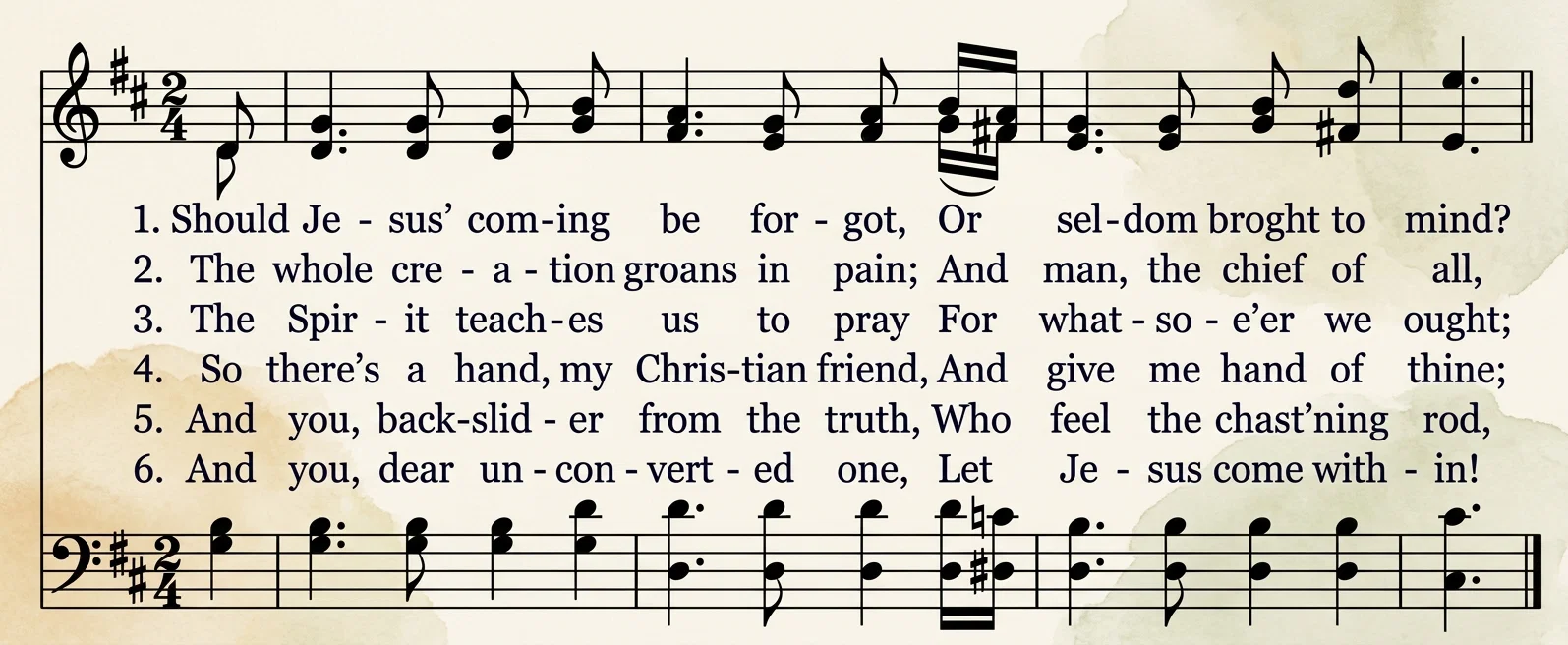
Should Jesus’ Coming Be Forgot?
By H. H. Fowler
H. H. FOWLER.
Moderato. SCOTCH AIR.
1. Should Jesus’ coming be forgot, Or seldom brought to mind?
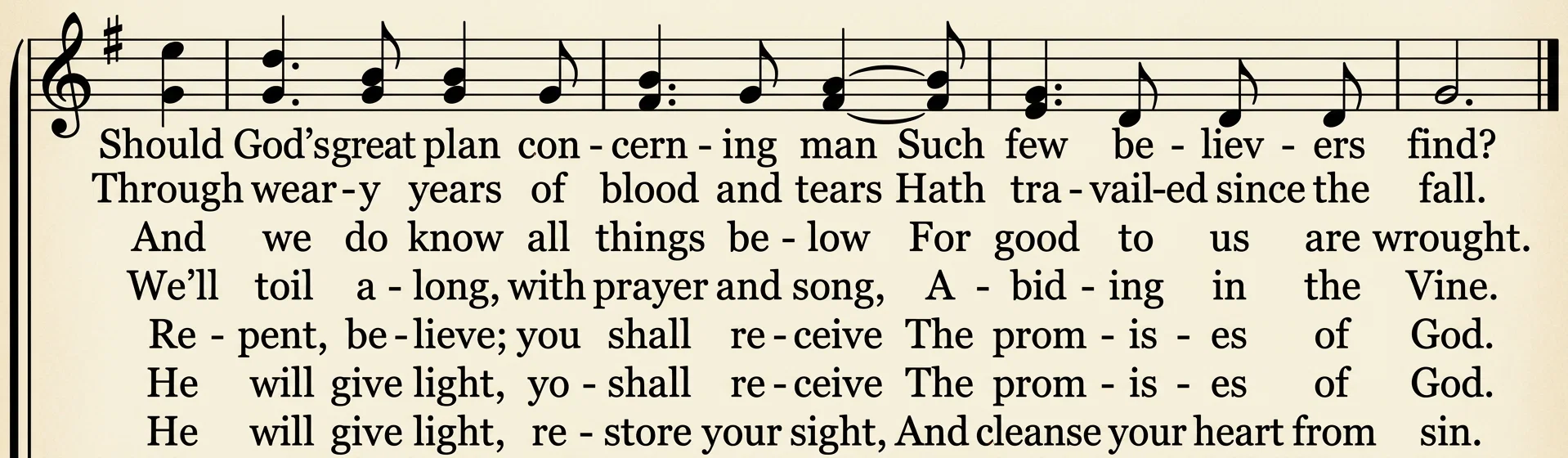
Should God’s great plan concerning man Such few believers find?
2. The whole creation groans in pain; And man, the chief of all,
Through weary years of blood and tears Hath travailed since the fall.
3. The Spirit teaches us to pray For whatsoever we ought;
And we do know all things below For good to us are wrought.
4. So there’s a hand, my Christian friend, And give me hand of thine;
We’ll toil along, with prayer and song, Abiding in the Vine.
5. And you, backslider from the truth, Who feel the chastening rod,
Repent, believe; you shall receive The promises of God.
6. And you, dear unconverted one, Let Jesus come within!
He will give light, restore your sight, And cleanse your heart from sin.
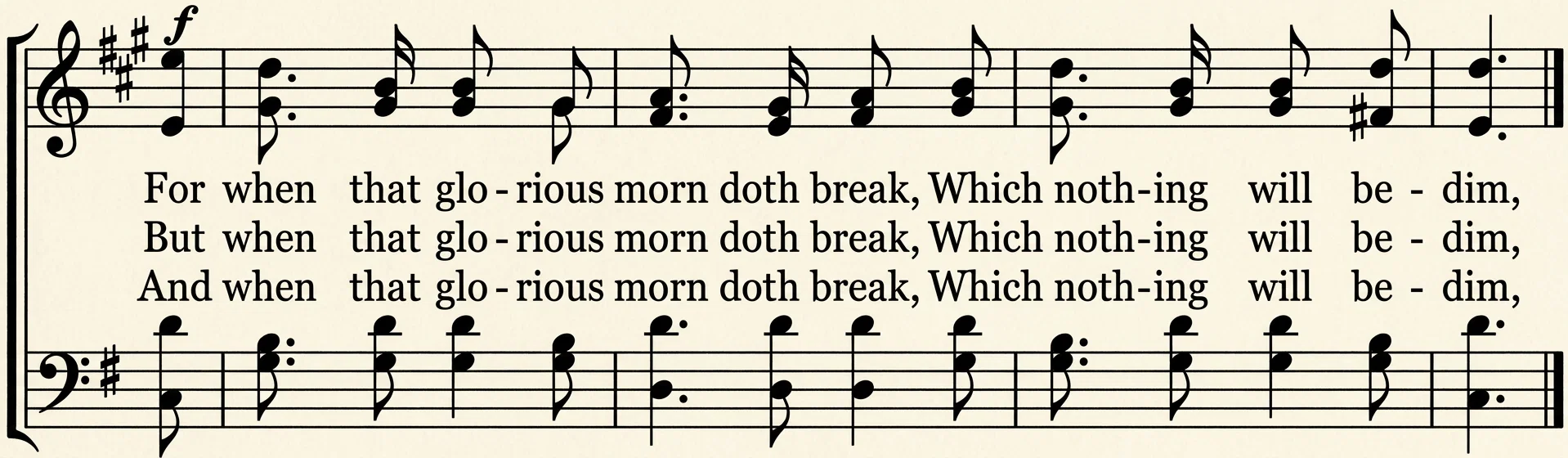
CHORUS.
For when that glorious morn doth break, Which nothing will bedim,
But when that glorious morn doth break, Which nothing will bedim,
And when that glorious morn doth break, Which nothing will bedim,
We shall, thro’ grace, behold His face; And then we’ll be like Him.
HOW JOB HELPED A CHINESE BOY
A Christian lady of Oakland, says the Congregationalist, furnishes the following, which is one of many illustrations that have come to me of the grace of God bestowed abundantly on Chinese believers for service in the kitchen:—
“Leu Yen worked in my family nine years, and tho he was always a good servant, there was a marked change in him after he became converted.
“He had naturally a quick temper, but was just as quick to acknowledge his fault.
“As I passed through the kitchen into the laundry on Tuesday forenoon, I could not but notice the happy, contented expression in Leu Yen’s face, tho I saw at a glance that the large clothes basket was full of tightly rolled garments to be ironed; and that meant a long, steady day’s work.
“‘How are you getting along, Yen?’ was my salutation; and the answer came readily and quick: ‘All right. Job helped me very much yesterday.’
“‘Job helped you! How was that?’ forgetting for a moment that our Sunday-school lessons at that time were in the book of Job.
“‘Yes, Job helped me!’ giving emphasis to his words.
“‘Yesterday I have big wash; very heavy quilt, too; and I work hard, hang some clothes on the line, fix ’em big quilt on the line, put stick under the line, hold him up; then wash more clothes, go out, find stick blow down, big quilt all dirt, go this way back again. Then I feel so mad, feel like I swear; then I think of Job, how he lose his money, his children, all his land, get sick, have sores all over. He never swear; he praise God. Then I praise God, bring quilt in house, wash him clean, and praise God all the time.’”
CAN SCIENCE RENEW LIFE?
By Edison Driver
“I have been reading in the paper about the new discoveries,” said neighbor Tom, as he seated himself on the nail keg. “An’ I see they are about to discover the elixir of life. Fer a fac’ sir, they’re so near it it makes your hair stand just to read it in the paper. Think o’ livin’ five hundred or a thousand years without dying, sir!”
“Yes, Tom,” replied the old gentleman from his place by the work-bench, “I ha’ thought about it ower and ower, an’ I tell ye I expec’ to see the day when a thousan’ years won’t be a minit out o’ life. But I don’t be givin’ thanks to science fer it tho, ner I won’t; fer I tell ye science can’t make life, never has made it an’ never will make it. Let me just remind ye that God took the tree o’ life out o’ this earth a long, long time ago, Tom. He didn’t want sinners livin’ here in misery forever, an’ he took that tree away. And now d’ ye think after all His trouble in settin’ the flamin’ swords there about it, an’ fencin’ it around to keep men away from it, d’ye think He’s goin’ to turn around an’ change His mind and let man discover it for himself. Not Him; an’ so these scientists that are so hot on the trail o’ life are about’s fur off ’s that ole Spaniard they call Ponthie de Leon wus when he wus seekin’ of the Fountain o’ Youth. With him it was always just ower the hill, or on the other side o’ the forest, or somewhere on the nex’ day’s march. The Indians kep’ a lyin’ to him, an’ he kep’ a goin’ an’ goin’ till he was played out, an’ his men buried him, a discouraged an’ disheartened man, in the great Mississippi. I tell ye it’ll be the same with all them what’s huntin’ life in the places where there’s none. Tom, the good Father has put the longing fer life into everybody, an’ man will never be happy, an’ his tears will never be wiped away, till he finds it; but the fac’ remains that science, nor modified electricity, nor none o’ them things will ever get it fer him. They can’t, fer God took it away, sayin’ that only through faith in Jesus Christ, and by obeying the will of the Almighty, can you get more life than what you ha’ got; an’ do you think, Tom, that He was foolin’ when He said it?”
“Why, no sir,” replied Tom. “I agree with you that He was not, sir. I never was a’ hand to take much stock in sech life-discoverin’ business—because if it wasn’t there, I sez to myself, how could you find it, sir!” EDISON DRIVER.
HOW AN EARTHQUAKE LOOKS.
Washington, Nov. 15.—Commander Seaton Schroeder, Naval Governor of Guam, has sent a detailed report of the earthquake of September 22. Only one person was killed—a child.
“The earthquake occurred at 11:24 A. M.,” says Commander Schroeder. “From the Government House terrace there could be seen clouds of dust rising suddenly as masonry houses fell. The earth opened here and there and water would spout and subside, leaving large, round pits. Innumerable fine cracks were everywhere. A dull, grinding roar preceded and accompanied the shaking. Sure-footed bulls were tripped up and fell to their knees. Buildings rocked, water tanks were tossed over and bells were rung by the vibration. Fissures one to two feet wide were made, those at Piti emitting strong sulphurous fumes.
“Masses were dislodged in the mountains, ploughing down the slopes. In the harbor of San Luis d’ Apra the collier Justin, anchored in 22 fathoms of water, was severely shaken. The disturbance of the white coral mud bottom of the harbor was so great as to give a milky appearance to the sea. Some of the shocks lasted half an hour.”—New York World.
Use What Talents You Possess
“Use what talents you possess. The woods would be very silent if no birds sang there but those which sing best.”
ARMENIA
Mirro Monsurea, whose parents were killed in the great Armenian Massacre.
Turkish Orphan Boys, as they appeared when they entered a Christian Orphanage.
It is a satisfaction to note that M. Delcassé, French Minister of Foreign Affairs, has promised a deputation of officials who are interested in saving the Armenians from massacre to send a French consular agent to the post in Turkey where the greatest danger threatens. One may wonder under what pretext the Turkish Government can kill the law-abiding subjects of that land, but here is one of the latest to be recorded: A rich Armenian of Sassun was taxed by the government to such an extent that his riches in grain and cattle and money melted entirely away. On the last summons he declared that he had nothing more that he could give, but that if the government would grant him time he would secure more money. That night the Kurdish officer, under the pay of the Turkish Government, sent a servant to shoot the Armenian, and it was quickly done. More than a hundred men from that locality are now in prison because they can not pay these cruel exactions. A recent letter from Armenia describes the method: “From five to ten thousand piasters are demanded of each little village. The collector arrives with a posse of soldiers, and these soldiers assemble all the men and women of the village, strip them naked, and deluge them with water from the wells till they faint, beating them with sticks, and by these brutal methods compel the poor people to give up their last cow or sheep, to save their lives.” If the Armenians resist, they are killed. If they try to defend themselves, the slaughter becomes general, and a massacre is started. It must not be forgotten that the Armenians are not allowed to possess any kind of weapons, not even a pocket knife, and that their murderers are literally armed to the teeth with knives and pistols. So long as the people can cling to the hills they can survive by hiding, but the endeavor is to force them down to the plains, where the soldiery can get at them. Once there only a large supply of money or the acceptance of the religion of the unspeakable Turk can save them. Is it any wonder that the harassed nation cries to the French and the English and the Americans at least to keep consuls in Armenia, that the world may know of its woes?—The Outlook
SHIMOON, A MARTYR'S WIFE.
By Mrs. C. H. Wheeler
[Mrs. C. H. Wheeler, in Helping Hand Series.]
Last week a lady—a real lady—rang my door bell. She could speak only the most broken English. I soon saw from her troubled face that she expected me to recognize her; but more than thirty years had passed away since, with her father, she came from the banks of the Tigris to our school in Harpoot, and I naturally could not recall her. But I needed only to be told that she was the daughter of Shemmas Hanna, of Cutterbul, Turkey, to open my arms and welcome her to my home. What a panorama passed before me as I gazed upon this sweet, refined woman, who as a girl of twelve came to our school in the earlier days of my missionary life. For her noble father determined to educate his daughter, even tho it brought reproach upon him; and he had to go three days' journey to put her in our school beyond the Tarsus Mountains.
The Turkish Orphans after a few months in a Christian Orphanage.
Garabed, Turkish Orphan, as he appeared in his winter suit when admitted to a Christian Orphanage.
During this first year she was ill with typhoid fever, and as we had no doctor then, I watched her through her long sickness. And now she had come all the way from New Jersey to thank me for my care so long ago.
After spending three years at Harpoot this dear girl returned to her home in Cutterbul, and was married to a young man in the village who was a member of Mr. Andrüs' theological class in Mardin, where with her husband she spent three more years in study, giving her six years of training for a pastor's wife.
When Mr. Abooshe finished his course in theology he was chosen as the pastor of the Cutterbul church that Shemmas Hanna, the father of Shimoon, had watched over with the greatest care; and the dear old father was happy as his grandchildren grew up about him. And here, honored by all, and loved by most, the dear old father died. But for Shimoon darker days were in store. For one evening in November, 1895, while the peaceful villagers were at their evening meal, the cruel Turks and Kurds14rushed into the village, and men, women, and children were slaughtered before their eyes. Shimoon and her husband gathered their children and in the darkness fled with others to the Syrian church, hoping for safety there. But Pastor Abooshe was shot in the church; and soon the awful cry went up, “The church is on fire!” (at the hand of some incendiary). There in her excitement Shimoon was separated from all her six children, for excitement had made her blind for the time being; and distracted and alone she found herself at last in a temporary hospital. Here she found her oldest married daughter dying from her wounds; she also heard that her oldest son had been saved by jumping into a well. But the dead body of her son of five was found murdered outside the village, and her daughter of seven was carried into the mountains by the Kurds, and never returned; while among the dead in Cutterbul and in the surrounding towns there were in all seventy-two persons who were related to her by birth or marriage. Is it any wonder that her hair has whitened too soon, and that the smile that still beautifies her face is full of sadness? And yet there are many such mourning mothers left alone with their orphan children. May God bless them and all who try to help them!
THE RELIGION OF THE ARMENIANS.
THE mission among the Armenians long conducted by the American board has borne fruit, not only in Turkey, where more than half of the total number of the Armenians reside, but also in this country. About thirteen thousand Armenians now live in America.
In the controversy concerning Christ’s twofold nature, the Armenian Christians refused to accept the decisions of the Council of Chalcedon (to which political trouble had prevented their sending representatives), and constituted themselves a separate church, called the Gregorian or Armenian. In the fifteenth century this church became split into majority non-Romanizing and minority Romanizing parties; since then most of the latter have accepted papal supremacy. This, or the United Armenian party, again split when, in 1870, the dogma of papal infallibility was promulgated, and affiliated with the Old Catholics. The orthodox Armenians reject the doctrine of purgatory, but believe in the intercession of saints. Some of their ritual peculiarities are: the threefold immersion at baptism; the union of baptism with confirmation; the dipping of the bread in the wine at the Holy Communion; finally, the administration of extreme unction to the priests alone, and that after and not before death.
The work of the American board in Turkey has always been aimed, not to antagonize this Christian church, but rather to lead its followers into a larger liberty. The Katholikos, or head of the church, to whom the Armenian patriarchs of Jerusalem and Constantinople are subordinate, resides near Erivan, in Russian Armenia—for sixteen centuries the ecclesiastical metropolis of the Armenian nation.—The Outlook.
THE AWAKENING IN CENTRAL TURKEY.
Much interest has been awakened by the reports which have reached us from time to time of marked and widespread religious awakening in the Central Turkey Mission. Marash, Hadjin, Adana, Tarsus, Oorfa, Kilis, Aleppo, and Aintab have all been sharers in the good work, and in several of these places the results show large and important gains to the churches. Latest intelligence from this field indicates that the influence of this revival is being strongly felt in a greatly increased interest in the home missionary work of the field. It is hoped that at the annual conference of the mission and native churches, which has just been held in Marash, some practical measures for the aid and better care of the feebler churches may have been devised and entered upon. There has also been among the Gregorians, in several places in this part of Turkey, a very decided deepening of interest in Bible study and in personal seeking for spiritual life in Christ. In Aintab, this has gone so far as to awaken the open and strenuous opposition of the conservative men of that community, and the Patriarch of Constantinople has issued a special edict, naming the “New Sect at Aintab,” characterizing their teachings and doings as irregular, subversive of Gregorian customs and destructive of the unity of the church, and commanding these innovators to cease from their mischievous work. As the evangelical party is numerous, and many of them well persuaded of the truth in which they have believed, the situation becomes one of deep interest, and seems likely to lead to important results. A later letter gives the gratifying intelligence that the authorities of the Gregorian church have granted permission to the evangelical party to continue their meetings, both for men and women, under certain regulations not difficult to comply with. Friends of the movement are much encouraged at this result.—Missionary Herald.