"Let the Revelation speak and tell what is truth. . . . Uplift Jesus as the center of all hope."
PATMOS
XI. The Seven Churches
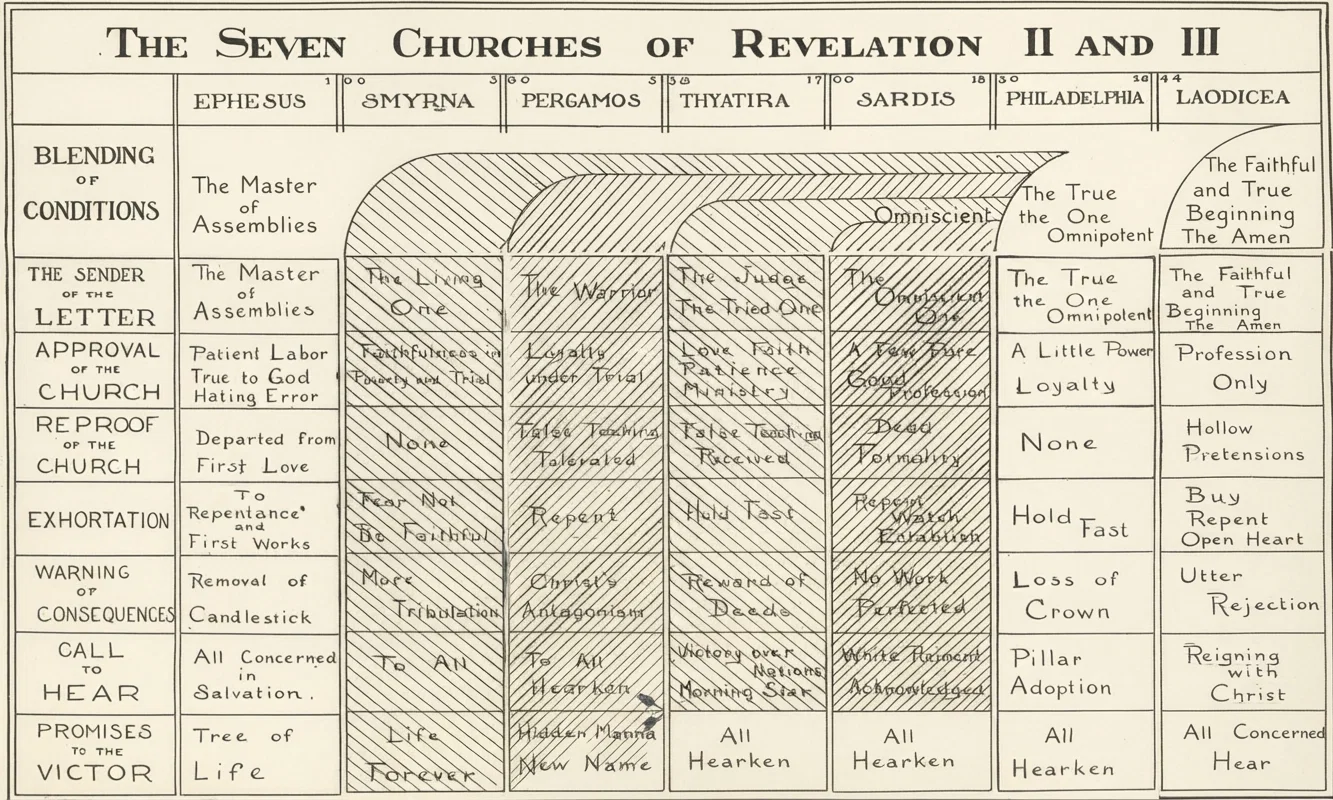
A Review
It seems to the writer of these studies that it would be well to take one large general view of this sevenfold letter of our blessed Lord to His called-out ones through the Christian dispensation, the church of the living God under various conditions. Those conditions have not always been the best, the most favorable, or morally or spiritually ideal. In nearly all cases reproof is needed, but always there is hope.
It is always well to remember that these letters do not recognize as the church — the called-out ones — of God great apostate bodies. They belong to Babylon or of "the synagog of Satan." God may have children in Babylon; in fact we know He will till nearly the close of Babylon's career; they partake more or less of Babylon, but they are not essentially of Babylon. Let us then in our review of this study, note the following:
1. These letters are one sevenfold message. Various things are emphasized, specially fitted to particular conditions, but of general application nevertheless. We must not, for instance, leave alone for Ephesus, the first condition, the reproof, "Thou hast left thy first love." To do
that would be to ignore the sevenfold repeated injunction, "He that hath an ear, let him hear what the Spirit saith unto the churches."
2. Note, too, that history repeats itself. The highly desirable condition of Ephesus is repeated in Philadelphia, only more favorable. The experience of the church under pagan persecutions — Smyrna — was deepened and intensified in the Thyatira condition under the persecutions of the Dark Ages. Both suffered; to overcomers in both are given fitting promises. Pergamum, living in an easier age of growing skepticism and superstition, finds its antitype in
greater Sardis, which repeats her history this side of the papal domination and the vigor and height of the Reformation. Laodicea stands out alone, unique, the replication of no other. This will appear more and more as we proceed.
3. All that the Master sees that is worthy in His people He approves. The labor, the purity, the hatred of evil, the patient endurance of the early church are commended. She could not bear false messengers. They could go on their way, she would not, could not persecute, but they must not teach their false doctrine in the church of Christ.
Smyrna, poverty-stricken, persecuted, crushed, slain, under pagan persecutions, is
commended for patient endurance and the riches which she possesses in Christ Jesus.
Pergamos, notwithstanding her tolerated false teachers, is loyal. Under great trials she had proved true, and the Master remembers it.
Thyatira passed through the long, dark wilderness of the Dark Ages. The Master was with her in the furnace heat. He regards her works and love and faith and patience and ministry for Him, and He tells her so.
In Sardis, exalted, making high profession, the Omnipresent One finds a few tried, noble souls. Their knowledge is not per-
fect, but their love for the Master is dominant, and through grace they are worthy to walk with Him.
Patience and loyalty in the exercise of the little strength are approved in Philadelphia.
There is no approval of Laodicea. The True Witness sees only great profession with no corresponding works. In every other condition there has been something to commend; in Laodicea, nothing.
4. How faithfully our Lord reproves! Ephesus had left her first love, her heart had grown cold. Smyrna had suffered enough, the first love was laid down in death; there is no reproof. Pergamum tolerated7false teaching which Ephesus hated, and Thyatira was even more deeply guilty. Sardis was dying because she had departed from correct principles, the law of her life. The church of brotherly love receives no reproof, unless it is gently suggested in the expression, "Thou hast a little strength." Laodicea is reproved for hollow pretensions, nauseating to Him who has borne with patience all the failures of His people in the past.
5. Note the injunctions, the exhortations: To Ephesus, Repent, return; to Smyrna, Fear not, be faithful; to Pergamum, Repent; to the faithful in Thyatira, Hold fast; to Sardis, Watch, stablish, repent; to Philadelphia, Hold fast; to Laodicea, Buy, be zealous in repenting. How we need them all!
6. The warnings are faithfully given and equally needed. To Ephesus there is danger of removal; to Smyrna comes greater tribulation for her faithfulness; to Pergamum the awful danger of Christ's antagonism; to Thyatira the sure reward of unfaithful deeds; to Sardis the awful message that she is found wanting; to Philadelphia the danger of loss of crown; to Laodicea utter rejection. "He that hath an ear, let him hear what the Spirit saith unto the churches."
The last three churches present three present-day conditions: (1) Great worldliness, dead while professing to live, having not the life of Christ, seen in the great popular churches; (2) Devoted, earnest seeking of God, manifested among a far smaller number who are looking for their Lord's coming; (3) Those who possess an outward knowledge of God's truth, who feel rich because of that knowledge, proud because of their superior morality, but do not know the sweetness of God's grace, the power of His redeeming love.
There is hope in neither Sardis nor in Laodicea. Out of these conditions must the victors come into that of Philadelphia — brotherly love. He pleads with the few names in Sardis. Upon the greater part of those in Sardis, Christ will come as a thief in swift judgment, but He will save some. He has no promise to Laodicea as a whole. "If any man hear My voice," — He pleads with the individual; but the individual who opens the heart's door and lets Christ in, who comes into that wonderful communion with his divine Lord, will by that very process come into the condition of brotherly love. They will constitute the remnant who keep the word of His patience, against whom He has no condemnation, who are ready for translation. Out of that condition of lukewarmness means a hard struggle, earnest zeal, severe conflict; but he who wins shall share Christ's kingdom eternally.
The Answer of the Text
[The answers to the questions are from the American Revised Version. Omitting questions, and disregarding sometimes the capital at the beginning and the period at the close of an answer, the text may be read continuously. In notes and comments both versions are used without designation.]
To the Overcomers
1. What is promised to him that overcomes the enticements to death and the lusts for forbidden fruit?
To him that overcometh, to him will I give to eat of the Tree of Life.
2. Entrance to what will that insure him?
Which is in the Paradise of God.
3. To those who in life place themselves upon God's altar of service, or die for His sake, what is promised?
He that overcometh shall not be hurt of the second death.
4. To those who reject the superstitions of the world, the salvation promised by men, nor trust in their substitutes or charms, what will God do?
To him that overcometh, to him will I give of the hidden manna, and I will give him a white stone, and upon the stone a new name written, which no one knoweth but he that receiveth it.
5. To him who overcomes with the very nations against him, with prevalent popular false teaching to drag him downward, meeting the severest persecution, faithful to the last, what is promised?
He that overcometh, and he that keepeth My works unto the end, to him will I give authority over the nations: and he shall rule them with a rod of iron, as the vessels of the potter are broken to shivers; as I also have received of My Father: and I will give him the morning star.
6. To those who are willing to stand alone or with the few for Christ's sake, who are willing to have reputations blasted and their names blotted out of the books of popular churches for His name, what is assured?
He that overcometh shall thus be arrayed in white garments; and I will in no wise blot his name out of the Book of Life, and I will confess his name before My Father, and before His angels.
7. What will those be made who have stood as pillars of God's truth here?
He that overcometh, I will make him a pillar in the temple of My God, and he shall go out thence no more.
8. To those who desire above all things the honor and glory of God's name what will be done?
And I will write upon him the name of My God, and the name of the city of My God, the New Jerusalem, which cometh down out of heaven from My God, and Mine own new name.
9. What is the glorious comprehensive climax of promises to all overcomers?
He that overcometh, I will give to him to sit down with Me in My throne, as I also overcame, and sat down with My Father in His throne.
Note and Comment
For extended notes on all the above, see the articles on the various churches preceding, this. The following are a few of the additional thoughts the studies have suggested.
1. Tree of Life. — No longer will a flaming sword of cherubim, or the withdrawal of the Garden of Eden, keep from humanity the Tree of Life. Through Christ the child of faith partakes of life now; then he shall have free access to the marvelous fruits continually. There are no walled cities or gardens in the kingdom of God.
2. The second death is the death from which there is no resurrection. Justice does not demand it; in mercy it would do no good. The second death is the compensation due to sin.
3. Which no one knoweth; Christ, of course, excepted. Every new name is spelled out of the letters composing Christ's name; all the excellencies of all the characters are but different phases of His. Every character prism but refracts some of the white light of Christ.
4. Power over the nations — with Christ. Christ has identified Himself with them in all their suffering; He identifies them with Himself in all His triumphs over sin. See Ps. 2:8, 9; 149:5-8; Rev. 12:5; 19:11-16. The Morning Star — Christ Jesus. Rev. 22:16.
5. Name indicates descent, relationship, character. Every true child of God is born from above. To him belongs the name of the Father, the Son, the eternal city of God, the capital of his future home. The overcomer is eternally labeled for what he is.
6. In My throne. — Note how this final promise includes all others, — the Tree of Life and Paradise; kept from the second death — immortality; the new name; power over the nations; a shining name in the Book of Life; a citizen of the kingdom, bearing the fourfold name of that citizenship forever.
Look on the Cross
By George E. Pooler
By George E. Pooler
LOOK on the cross! Where Jesus died,
For me He bled — was crucified!
They hung Him there — how could men dare,
When 'twas their sins that nailed Him there?
My shameless guilt He bore for me,
That I a ransomed soul might be.
Whene'er you feel your sin and loss,
Look on the cross! Look on the cross!
Look on the cross, where blood was spilt
By Him who bore another's guilt.
What love, that One with spotless name,
Should condescend to bear my shame!
O, may God grant me endless years,
To lave His feet with grateful tears.
Whene'er you sense your heart's foul dross,
Look on the cross! Look on the cross!
Aurora, Illinois.
Lessons in Liberty
By W. M. Healey
By W. M. Healey
III. Equality Before God
HE extent of Adam's dominion is given in Gen. 1:26: "And God said, Let Us make man in Our image, after Our likeness: and let them have dominion over the fish of the sea, and over the fowl of the air, and over the cattle, and over all the earth, and over every creeping thing that creepeth upon the earth."
It was the duty of Adam to obey and serve God; and upon this requirement rested the continuance of his kingdom over the earth and the living creatures on the earth.
No authority was given to Adam to compel others to worship God. Adam and Eve were not obliged to go together to sin. Each had the power of choice, and was held responsible for the use of that power. After sin Adam tried to shift the responsibility of his acts upon Eve, and she in turn blamed the serpent for what she had done; but God held each to account for their action toward Him.
"Who art thou that judgest another man's servant? to his own Master he standeth or falleth." Rom. 14:4. And that Master is not some other man, but Christ. "But be not ye called rabbi: for one is your Master, even Christ; and all ye are brethren." Matt. 23:8.
God never changes. "I am the Lord, I change not; therefore ye sons of Jacob are not consumed." Mal. 3:6. The same unchangeable character belongs to Christ—"Jesus Christ the same yesterday, and today, and forever." Heb. 13:8.
There has been no change in God or Christ, therefore there can be no change in Their kingdom. Christ came and died, not to establish a new kingdom, but to make it possible for man to be brought back into "the everlasting kingdom."
All nations stand alike before the Lord, all being of one blood. "And hath made of one blood all nations of men for to dwell on all the face of the earth, and hath determined the times before appointed, and the bounds of their habitation; that they should seek the Lord, if haply they might feel after Him, and find Him, tho He be not far from every one of us." Acts 17:26, 27.
Nationality or position does not give any advantage in the kingdom. "There is neither Jew nor Greek, there is neither bond nor free, there is neither male nor female: for ye are all one in Christ Jesus." Gal. 3:28.
Every one must be judged for his own deeds at the judgment-seat of Christ. "For we must all appear before the judgment-seat of Christ; that every one may receive the things done in his body, according to that he hath done, whether it be good or bad." 2 Cor. 5:10.
The kingdom is the Lord's. The power belongs to Him. We are all products of His creation, made of one blood, and all counted on an equality, each to render to Him his individual account; and from Him the faithful will receive their individual reward. Then by what power does one man or one set of men set themselves up to define another man's duty to God, and make rules and penalties to inflict upon him?
In any court of justice or board of arbitration there must be equal authority over all parties interested in the case, else there could be no assurance of justice. If there were no authority to compel both parties to abide by the decision, nothing could be depended upon.
If man could compel me to do something that God desired me to do, like the keeping of the Sabbath, what gain would there be in it to me? They have no authority to compel God to do anything for me in return.
If God had intended for man to rule over his fellow man in matters of worship, He certainly would have given that power to Adam, who was the first man, and free from sin. He certainly would not have passed him by, and then placed the power in the hand of sinful men.
Cain was the first man who tried to enforce his religion upon his fellow man. Abel worshiped God, and offered sacrifice to Him. Cain also went forth to worship, and offered sacrifice; and because Abel did not worship in his way, he slew him.
Cain was the prime minister for the new kingdom which was being established from the ruins of Adam's dominion. The same evils exist to-day, and the same spirit prompts the same work, tho many people may give their influence to it that do not know what they are doing.
John was zealous for his Lord; and when he saw that the Samaritans would not give Him entertainment, because He was going up to Jerusalem to worship, he asked if fire should be called down from heaven to destroy them, because of their difference in worship. Christ replied, "Ye know not what spirit ye are of."
Many to-day who are zealous for Sunday and other laws to enforce their religious views upon others, are like John, they know not the spirit that is prompting and urging forward all work of this kind.
—★★—
Our Bible Reading
What Christ's Coming Means to the Righteous
1. It means to the dead resurrection.
For the Lord Himself shall descend from heaven with a shout, with the voice of the Archangel, and with the trump of God: and the DEAD IN CHRIST SHALL RISE first. 1 Thess. 4: 16.
2. It means to the living a change to immortality with the righteous dead.
Behold, I show you a mystery; We shall not all sleep, but we shall all be changed, in a moment, in the twinkling of an eye, at the last trump: for the trumpet shall sound, and the DEAD SHALL BE RAISED INCORRUPTIBLE, and WE SHALL BE CHANGED. For this corruptible must put on incorruption, and this mortal must put on immortality. So when this corruptible shall have put on incorruption, and this mortal shall have put on immortality, then shall be brought to pass the saying that is written, Death is swallowed up in victory. 1 Cor. 15: 51-54.
3. It means to the righteous that they will be taken home to heaven.
Let not your heart be troubled: ye believe in God, believe also in Me. In MY FATHER'S HOUSE are many mansions: if it were not so, I would have told you. I go to prepare a place for you. And if I go and prepare a place for you, I will come again, and RECEIVE YOU UNTO MYSELF; that where I am, there ye may be also. John 14: 1-3.
4. It means to the righteous that they will enter on their eternal inheritance.
Then shall the King say unto them on His right hand, Come, ye blessed of My Father, INHERIT THE KINGDOM prepared for you from the foundation of the world. Matt. 25: 34.
5. It means to the righteous that they will inherit the everlasting kingdom of God.
And the kingdom and dominion, and the GREATNESS OF THE KINGDOM UNDER THE WHOLE HEAVEN, shall be given to the people of THE SAINTS OF THE MOST HIGH, whose kingdom is an everlasting kingdom, and all dominions shall serve and obey Him. Dan. 7: 27.
6. It is therefore to the child of God the blessed hope.
Looking for THAT BLESSED HOPE, and the glorious appearing of the great God and our Saviour Jesus Christ. Titus 2: 13.
Tests of Faith
By Delwin Rees Buckner
By Delwin Rees Buckner
Tho tempted sorely, I have never ceased
To feel that God doth try us as a test
Of faith. Upon the waves a sailing west
Sometimes I buffet winds a blowing east;
The troubled sea is often crossed and creased
With deep-cut hollows, many a lofty crest.
Yet fear I not, for God works for the best
Of all His creatures, man, and bird, and beast.
Let angry tempests in their fury growl.
My Saviour's strong, protecting hand is near,
And it will guide me through the ills that
come.
The raging winds do not for always howl;
And when they cease, His cov'ring hand will steer
My beaten bark into its harbor home.
Colon, Panama.
The Father's House
LET NOT YOUR HEART BE TROUBLED: YE BELIEVE IN GOD, BELIEVE ALSO IN ME. IN MY FATHER'S HOUSE ARE MANY MANSIONS: IF IT WERE NOT SO, I WOULD HAVE TOLD YOU. I GO TO PREPARE A PLACE FOR YOU. AND IF I GO AND PREPARE A PLACE FOR YOU, I WILL COME AGAIN, AND RECEIVE YOU UNTO MYSELF; THAT WHERE I AM, THERE YE MAY BE ALSO. John 14:1-3.
"The First Day or Nothing"
By Editor
A MAN, an Adventist, who claims to be a believer in Christ, a believer in our Lord's near coming, and who holds the Bible to be "the only divine standard of faith and practise," thus speaks in one of his published sermons in his own paper:
The Christian Sabbath.—We believe that the first day of the week, as the day set apart by the early church in commemoration of Christ's resurrection, should be observed as the Christian sabbath, and used as a day of religious rest and worship.
This article in our Declaration of Principles was specially needed because another body of people spoken of as "Adventists," lay peculiar stress on the assumed obligation of observing the seventh-day, Jewish Sabbath, and virtually unchristianize all who do not observe it. As against their claims, we stand with the overwhelming majority of all Christians in all ages—believing that the obligations of the Jewish Sabbath ceased at the resurrection of Christ, and that the first day of the week took its place as a day of rest and religious worship, tho not under its legal penalties. We deplore the growing desecration of the first day, and the increasing efforts of Jews, infidels, and Seventh-day Adventists to break down the remaining barriers which hedge about the world's only possible rest-day; clearly perceiving—what only those blinded by prejudice fail to see—that it is—
The First Day or Nothing
That day ceasing to be a day of rest, the toiler will have no sure protection against the greed of capital, and the Christian no quiet day for religious meditation and worship. We stand with all evangelical Christians in the forefront of the battle for the preservation of the Christian sabbath: shall we not be welcomed in this hour of conflict?
There are many things in this short extract,—all, however, that he says upon this phase of his "hope,"—but we wish to note just four points:
1. It is not taking the Bible as the STANDARD of faith and practise to depend upon the "early church;" pedo-baptists, trine immersionists, sprinklers, and pourers, sign-of-the-cross believers, and others can allege the same authority. When Jesus Christ died upon the cross, He sealed with His blood, confirmed forever, God's will in the new covenant, with His holy law of the ages unchanged in jot or tittle. Matt. 5: 17-20; 19: 17. He observed that law Himself in its fulness, and left us an example, that we should follow in His steps. John 15: 10; 1 Peter 1: 21, 22; 1 John 2: 6. He died to save from sin and sinning; and sin is the transgression of God's law. Matt. 1: 21; Titus 2: 14; 1 John 3: 4; Rom. 7: 7. Therefore He died to save us to obedience to that law, not by the change of the law, but by the change of the carnal mind to a mind which delights in God's law, in which God's law is established. Rom. 8: 3, 7; 1 John 5: 3; Rom. 3: 31. To hold otherwise makes Christ a "minister of sin," which God forbid.
Moreover, the very moment Christ died, God's covenant was sealed and confirmed forever. "Tho it be but a man's covenant, yet if it be confirmed, no man disannulleth, or addeth thereto." Gal. 3: 15. We find no first-day sabbath, no abolition of the Decalogue or the seventh-day Sabbath, in all the teaching of the prophets or Christ. In His teaching and life the law and the Sabbath were held holy and perfect. Therefore if anything were added to that covenant or law one minute this side of the cross by the whole apostolic college, it would be spurious and of no effect. But there is nothing. The apostolic church followed their Master; and it is not until later, in the times of backsliding and substitution, that the first-day sabbath creeps in. Sunday is not even called the sabbath for a thousand years after Christ, nor Lord's day till 200 years after. It is purely Catholic ground to plead the "early church." In the words of Dowling: "He who receives a single doctrine upon the mere authority of tradition, let him be called by what name he will, by so doing, steps down from the Protestant rock, passes over the line which separates Protestantism from popery, and can give no valid reason why he should not receive all the earlier doctrines and ceremonies of Romanism upon the same authority." Christ with one soul is a majority.
2. There can be no "DESECRATION" of a day which is not sacred. Man can not make a day sacred or holy; God has not so made it; how then can it be desecrated? This claim of desecration is also good Roman Catholic doctrine.
3. Seventh-day Adventists do hold to the Bible Sabbath, the only Sabbath given, taught, or observed by Christ, hence the only Christian Sabbath. Around that Sabbath God has erected the immutable ramparts of His holy law. Inclosing it is the hedge of His eternal truth; not altered with Him, for "forever, O Lord, Thy Word is settled in heaven;" but forgotten by His professed children. To restore that hedge, to build up that breach in the hearts and practise of His professed followers, Seventh-day Adventists are laboring, according to His prophecies. Isa. 56: 1-8; 58: 12, 13. And that is "the only possible rest-day," for it is the only day, as a day, in which God has placed His rest. Men may call it "Jewish;" His eternal law calls it "the Sabbath of Jehovah," and again the Spirit of Christ calls it "My holy day." To us it is a denial of God to say that He, the Creator of the heaven and the earth, is not able to care for His own, that man must needs furnish for God a purely human substitute, and support it by human enactments. It is well to remember the words of the Master, "Every plant, which My heavenly Father hath not planted, shall be rooted up." We do not condemn our brethren who keep the first day; but we would not be true to God did we not tell them that the day is spurious, that it has no foundation in God's Word or claim upon His loyal children, and plead with them to come with us and find the sweet rest of true Sabbath-keeping in Jesus Christ, Creator and Redeemer. God's own appointment and Christ's example are much better than "nothing."
4. Yes, indeed, this man and all whom he can influence will be welcomed by the men who are working for a Sunday law, for what they are pleased to call "the preservation of the Christian sabbath." It has ever been true that when God's professed church has with any sort of zeal substituted tradition for truth, the human for the divine, she has also endeavored to enforce the substitute with divers sorts of penalties, and always by civil law if possible. But this too is of the Papacy and not of Christ. Let our critic turn to the Bible and the Bible alone, and he will not be troubled. He can worship God tho all Babylon is bowing at the behests of men.
A Boomerang Argument
THE following is a sample argument of a man who tells us why he does not observe the Sabbath. After a deal of utter misrepresentation of those who do, and of the Bible, he gives this as one of his reasons; it is a fair sample of all:
Paul, who was an able minister of the Gospel of Christ, says that he had not shunned to declare all the counsel of God; that he kept back nothing that was profitable. But when does Paul preach seventh-day Sabbath-keeping?
When does Paul say this?—In Acts 20:27, 20. What else does he say?—Listen: "How I kept back nothing that was profitable unto you, but . . . have taught you publicly, and from house to house, testifying both to the Jews, and also to the Greeks, repentance toward God, and faith toward our Lord Jesus Christ." Verses 20, 21.
What is "repentance"?—Godly sorrow for sin, turning away from sin. See 2 Cor. 7:10. What is sin?—"Sin is the transgression of the law." 1 John 3:4. What law is here referred to?—The Decalogue, the law which declares, "Thou shalt not covet." "Nay, I had not known sin, but by the law: for I had not known lust, except the law had said, Thou shalt not covet." Rom. 7:7.
Again: Paul declared "all the counsel of God." Where is the counsel of God found? Where is that which "is profitable" found?—In the Holy Scriptures; for "all Scripture is given by inspiration of God, and is profitable for doctrine, for reproof, for correction, for instruction in righteousness: that the man of God may be perfect, thoroly furnished unto all good works." 2 Tim. 3:16, 17.
Doubtless all know that the Scriptures here referred to are the Old Testament Scriptures, "which are able to make thee wise unto salvation through faith which is in Christ Jesus." Verse 15.
Once more: Paul taught faith in Jesus Christ; what effect does faith have upon the law in the heart of the believer?—"Do we then make void the law through faith? God forbid; yea, we establish the law."
This writer says that he rests "in the finished work of Christ." It is well. Only the righteousness of God in Christ will avail; but the righteousness of Christ was wrought out in perfect obedience to all the Decalogue, including the fourth precept. Christ's perfect Sabbath-keeping must cover our Sabbath-breaking; but it will not if we continue in sin. Shall we make "Christ a minister of sin"? Or shall we let Him save us from sin and sinning? Let the writer of the above argument seek his reason for Sabbath-transgression in Rom. 8:7. He may there find help.
It Is What They All Say
ROMAN CATHOLICS are very candid in stating their work as to the law of God; they may well be, of course, for history bears them out in the fact. A week's services of a Paulist mission recently concluded in Knoxville, Tennessee. Certain questions were asked the Paulist Father Skinner, and this is the report of the Daily Journal and Tribune of that city of November 12:
Some very important questions for Protestants, have been answered by the mission fathers of the Catholic Church. Some of these questions were handed in by Protestants inquirers. The first question was this: "Protestants keep Sunday, the first day of the week, as a memorial of the resurrection of Christ, instead of the seventh-day Sabbath. Do they have any Scriptural authority for this practise?"
Answer—"No, friends; it is a fact that there is no Scriptural authority for keeping Sunday. God commanded His people under the old law to keep Saturday, which is the Lord's day. No, there is no Scriptural authority for this change. It was the church of Christ that made the change. The Protestants are not consistent with the Scriptures in this practise."
By "the church of Christ" is meant the Catholic Church.
A Prayer for Mercy
By Alexander Pope
Let not this weak, unknowing hand
Presume Thy bolts to throw,
And deal damnation 'round the land
On each I judge Thy foe.
—Pope.
Pledged to Good Citizenship
By Editor
AFTER an address by Mayor Gaynor to the class of 1910 of the College of the City of New York, the students took the following oath:
We will never bring disgrace to this our city by any act of dishonesty or cowardice, nor ever desert our suffering comrades in the ranks; that we will fight for the ideals and sacred things of the city, both alone and with many; that we will revere and obey the city's laws and do our best to incite to a like respect and reverence those who are prone to annul or set them at naught; that we will strive unceasingly to quicken the public's sense of public duty; that thus, in all these ways, we will transmit this city, not only not less, but greater, better, and more beautiful than it was transmitted to us.
From a worldly view-point that is noble; but it is what every Christian, every true man, ought to stand for without a pledge or an oath. The fact of the oath and the general comment upon it indicates a lowering of general standards in public life.