Your ShelfYour Projects

Signs of the Times, Vol. 38, No. 8.

Important Articles in This Number
Earlier text: Important Articles in This Number

The Closing Seals

WHAT a vision is presented before us in the first four seals, the breaking forth as it were upon the world of four great influences, powers, designed to bring men to God. The first of these is God's victorious Gospel Rider in the pure whiteness of righteousness, winning mighty victories by His truth and love in the hearts yielded to Him; the last three coming as a consequence of rejecting Him, and revealing to the world the awful sinfulness of sin, and its utterly hopeless condition without the Master. Therefore, in sympathy with suffering humanity and a groaning, travailing creation, comes the agonizing cry of God's mighty agencies, the four living creatures, to Christ the Lord to come, to come to His own—that cry four times repeated.
Yet the Master waits. He would that the world—rebellious, refractory, sin-loving humanity—might learn without the trial, the sorrow, the suffering. He loves humanity, all unlovely as it is, with an everlasting love. He demonstrated the wealth of that love by an eternal sacrifice and ignominious death, in which He forever identified Himself with the human race. But He can not be a minister of sin, can not condone sin, can not compromise with sin; He can not immortalize sin. Therefore He died that man might separate from sin. The only way it was possible for man to do that is to break willingly, gladly, voluntarily, with the demon, and arrange himself under Christ, the only Saviour from sin.
If man will not learn by faith the intrinsic evil and power of sin in every form, in whatever guise it may come, God must let him learn by the sad experiences of sin's outworking, not alone among its devotees, but against God—against His government, His children, His whole creation. And all this is represented in the opening of the first four seals. The results of each opening do not cease when the next is opened. The work of the white-horse rider does not cease when the red-horse rider goes forth; each and every one rides on to the end, to the time when the Lord Jesus shall come. There may be times when one or the other is not in evidence, but he is but making preparation for stronger effort.
In the meantime all creation through the living creatures—highest types, by the way, of earth's noblest creations, each in its field, the lion, the ox, the eagle, the man—cries to Him who was and who is and who is to come, to bring to fruition the ages-deferred hope. It will be noticed that the cry to come is not first uttered when the seal is broken. It has been uttered ever since sin entered; and therefore when the vision is opened to the prophet, each is represented as already saying, "Come," just as they had been ceaselessly saying, "Holy, holy, holy is the Lord God, the Almighty, who was and who is and who is to come."
Our study this week is of the closing seals.

The Answer of the Text

[The answers to the questions are from the American Revised Version. Omitting questions, and disregarding sometimes the capital at the beginning and the period at the close of an answer, the text may be read continuously. In notes and comments both versions are used without designation.]
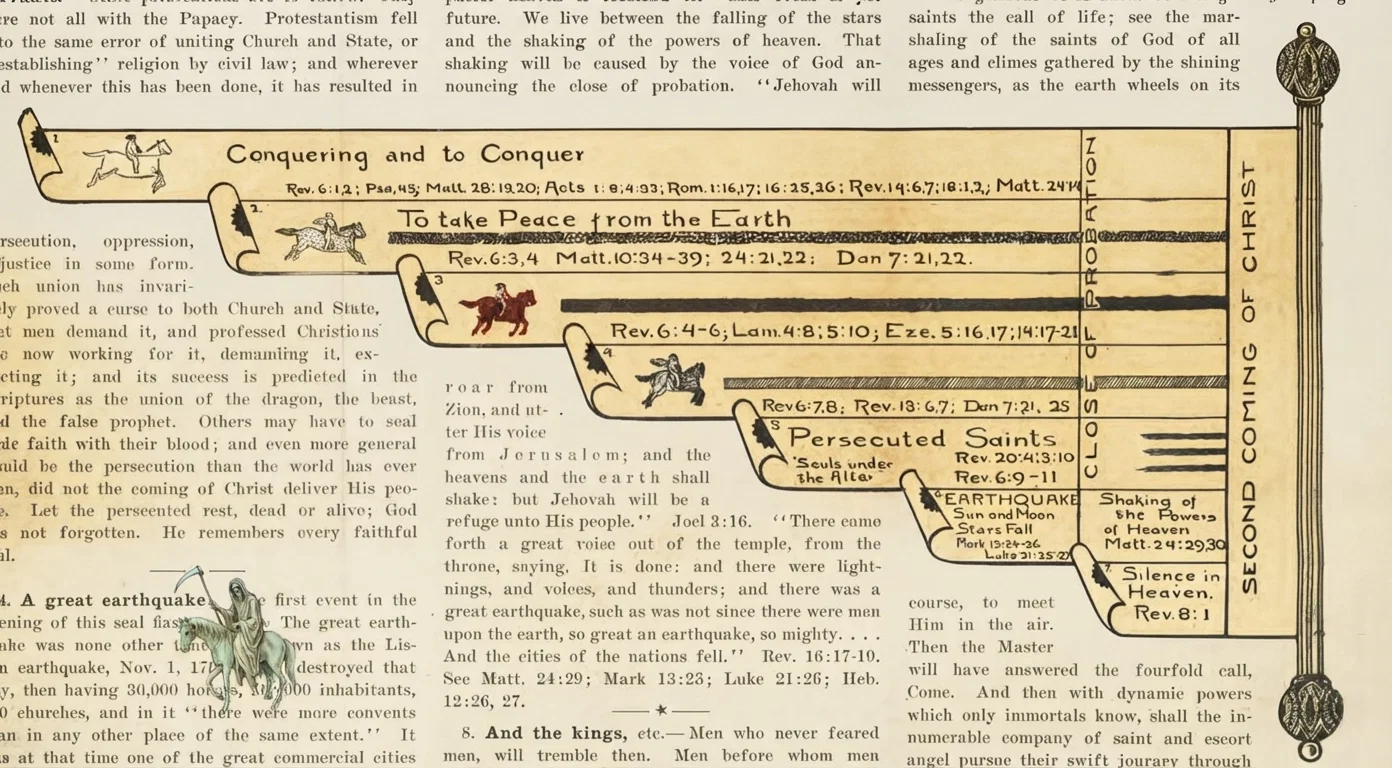
1. What did John see when the Lamb opened the fifth seal?
And when He opened the fifth seal, I saw underneath the altar the souls of them that had been slain for the Word of God, and for the testimony which they held.
2. What are these souls represented as saying?
And they cried with a great voice, saying, How long, O Master, the holy and true, dost Thou not judge and avenge our blood on them that dwell on the earth?
3. What response was made?
And there was given them to each one a white robe; and it was said unto them, that they should rest yet for a little time, until their fellow servants also and their brethren, who should be killed even as they were, should have fulfilled their course.
4. What occurred when the sixth seal was opened?
And I saw when He opened the sixth seal, and there was a great earthquake.
5. What followed the earthquake in order?
And the sun became black as sackcloth of hair, and the whole moon became as blood.
6. What followed these signs?
And the stars of the heaven fell unto the earth, as a fig-tree casteth her unripe figs when she is shaken of a great wind.
7. What wonderful manifestation next followed?
And the heaven was removed as a scroll when it is rolled up; and every mountain and island were moved out of their places.
8. What effect does this have upon humanity?
And the kings of the earth, and the princes, and the chief captains, and the rich, and the strong, and every bondman and freeman, hid themselves in the caves and in the rocks of the mountains; and they say to the mountains and to the rocks, Fall on us, and hide us from the face of Him that sitteth on the throne, and from the wrath of the Lamb: for the great day of their wrath is come; and who is able to stand?
9. What occurs when the seventh seal is broken?
And when He opened the seventh seal, there followed a silence in heaven about the space of half an hour.

Note and Comment

1. Underneath the altar.—Not the altar in heaven, for the altar of incense is the only altar mentioned as in the heavenly temple. Rev. 8:3. The vision pertains to earth. There go forth the horses, there rides Christ in His Gospel, and War, and Famine, and Death. The term "altar" is a symbol of sacrifice, for on the altar of sacrifice the souls who died for their faith bore witness. Souls.—Not disembodied, intangible entities, a conception of which the Bible knows nothing; but persons who died for their faith in a thousand different ways, dead upon or within the earth. "Person" is the primary meaning of the word "soul," and so is used to-day. See 1 Peter 3:20; Gen. 2:7; Joshua 10:28, 30, 32, etc. For the Word of God and the testimony which they held.—For this John was banished to Patmos. Rev. 1:9. For this died the noble witnesses of Christ during the pagan persecutions. For this died the multitudes of the Dark Ages under the fierce persecutions of mistaken Roman Catholics. They cried.—Not literally; for they are dead, and "the dead know not anything. . . . Also their love, and their hatred, and their envy, is now perished." Eccl. 9:5, 6.
2. How long, O Master, . . . dost Thou not judge and avenge our blood?—If these souls were in happiness in heaven, we could not conceive of their making such request. They would rather thank their murderers for slaying them. Then as Christians, they never would pray for vengeance, for many of them died praying for their persecutors. The meaning of the passage is that eternal justice calls to God in their behalf as truly as tho their voices were so lifted. So parts of a building are represented as crying out against the wickedness and oppression which erected it. Hab. 2:11, 12. So Abel's blood is said to cry out of the ground against Cain's crime. Gen. 4:10. So the earth and all creation cries to God against its load of sin and evil. Rom. 8:22. The martyrs are sleeping in Jesus, but justice still cries out against their persecutors. And the holy and true Master remembers, tho He seems to wait.
3. Rest yet for a little time.—When these souls died they died as heretics to some human creed, enemies to some abnormal State. Their memory was covered with obloquy and shame. God's judgment is different from man's. They died for Christ and His truth; white robes await them. Nay, more, under the influence of the Reformation and Biblical enlightenment men have come to see that these noble witnesses for truth were enemies to neither the Church nor the State; and impartial history has clothed them in robes of honor Until their fellow servants.—Other persecutions are to follow. They were not all with the Papacy. Protestantism fell into the same error of uniting Church and State, or "establishing" religion by civil law; and wherever and whenever this has been done, it has resulted in persecution, oppression, injustice in some form. Such union has invariably proved a curse to both Church and State. Yet men demand it, and professed Christians are now working for it, demanding it, expecting it; and its success is predicted in the Scriptures as the union of the dragon, the beast, and the false prophet. Others may have to seal their faith with their blood; and even more general would be the persecution than the world has ever seen, did not the coming of Christ deliver His people. Let the persecuted rest, dead or alive; God has not forgotten. He remembers every faithful soul.
4. A great earthquake.—The first event in the opening of this seal fixes its date. The great earthquake was none other than that known as the Lisbon earthquake, Nov. 1, 1755, which destroyed that city, then having 30,000 houses, 200,000 inhabitants, 120 churches, and in it "there were more convents than in any other place of the same extent." It was at that time one of the great commercial cities of Europe, and one of the richest. More than a fourth of the people were destroyed, and much of its immense treasure buried. Letter after letter before us, dated from six to seven days after the catastrophe, does not in any wise minimize the awful calamity. In this earthquake, Lisbon was but the center. That mighty temblor reached its mighty fingers far into Africa, covering the continent of Europe, and extending unknown distances at sea. A work before us, written by a "gentleman of the University of Cambridge," and published in 1756, says:
"By the accounts hitherto received, this extraordinary earthquake has continued for the space of two months, and has been felt with more or less violence from the eastern shores of America to the heart of Germany, and from the frozen clime of Iceland to almost the Tropic of Cancer, about 4,000 miles one way, and 2,000 the other; so that considering its duration, extent, and mischievous effects, it seems to be one of the greatest calamities that has befallen the world in almost any age."
Had science possessed at that time its sensitive seismometers in all parts of the world, the mighty quake would have been recorded everywhere. The only things of record in 1775 were shakes so vigorous that the human being himself was very sensible to them.
5. Sun became black.—The remarkable darkening of the sun, May 19, 1780, known as "The Dark Day," came at the very time in the history of the world predicted by our Lord, as recorded in Matt. 24:29; Mark 13:24. The moon was darkened the night following, till one writer says that the darkness was so great "that a sheet of white paper held within a few inches of the eye was equally invisible with the blackest velvet," altho the moon was at that time in the full. This is predicted in the prophecy we are studying by "the whole moon." As blood.—Whenever the moon appeared that night we are told "it had the appearance of blood." It is sometimes said that these things occurred at the destruction of Jerusalem, A.D. 70, but the Revelation was written more than a score of years after that event.
6. The Stars.—The meteors, formerly commonly known as shooting stars. The prediction is that of the well-known and often recorded meteoric shower of Nov. 13, 1833. It is said to be periodic, but in all later occurrences it has been a minor affair compared with that of 1833.
7. The heaven was removed.—The atmospheric heaven is referred to. This event is yet future. We live between the falling of the stars and the shaking of the powers of heaven. That shaking will be caused by the voice of God announcing the close of probation. "Jehovah will roar from Zion, and utter His voice from Jerusalem; and the heavens and the earth shall shake: but Jehovah will be a refuge unto His people." Joel 3:16. "There came forth a great voice out of the temple, from the throne, saying, It is done: and there were lightnings, and voices, and thunders; and there was a great earthquake, such as was not since there were men upon the earth, so great an earthquake, so mighty. . . . And the cities of the nations fell." Rev. 16:17-19. See Matt. 24:29; Mark 13:25; Luke 21:26; Heb. 12:26, 27.
8. And the kings, etc.—Men who never feared men, will tremble then. Men before whom men bowed will then bow and cry in fear. Men who scorned to pray to God, will pray to insensate rocks to cover them. Bondmen and freemen will all be on the same level then. See Isa. 24:1-5. Hide us.—There is no hiding from God. Men have not seen Him, and thought Him absent, but they have not been hidden from Him. Every deed and motive has been faithfully recorded. If they had admitted God into the heart, they could stand in the light of the glory of His face, before which all sin and all identified with sin shall perish. Wrath of the Lamb.—Not wrath as men know it, but wrath against sin; the infinite justice of the God of love, and of the Lamb who died that our iniquity might be put away. In all the manifestations of God's wrath against sin in the past there has been the intermixture of mercy. The wine has been mixed. Ps. 75:8. But when men have rejected to the uttermost His mercy, He can do no more; justice must do its work. Rev. 14:10. Then will the God of infinite love do "His work, His strange work, and bring to pass His act, His strange act, . . . a decree of destruction . . . from the Lord, Jehovah of Hosts, upon the whole earth." Isa. 28:21, 22. Love to His own demands it. Justice to His own demands it. Love and justice to the incorrigibly wicked demand that sin shall be swept from the earth. Those who have not received God's glory internally will be consumed; but those who have Christ within, will be changed "from glory to glory."
9. A silence in heaven.—A strange thing is silence in heaven in the presence of God when sinless, countless messengers delight to do Him honor, and ceaseless praise ever ascends. How can there be silence there for a half hour, prophetic hour, doubtless, one forty-eighth of a prophetic day (or year), or a little over a week? Silence for a week in heaven! Here is the answer: Jesus declares that when the Son of Man shall come in His glory and the glory of the Father, "all the angels" shall be with Him. Matt. 16:27; 25:31. Heaven will be emptied at that supernal event. It will be grand, glorious privilege for the messengers of God in body of cherubim or seraphim, in company and singly, to escort the Triumphant Lamb when He calls to immortality and glory the sons of God, an event for which the ages have waited; and the Eternal One gives them a week's glad holiday for the event. Through shining galaxies and hosts of suns and shining constellations, shall the armies of God, superior to all matter, escort Him on His way; hear the mighty trump, whose vibrations will wake to life and create anew the holy living and dead; thrill to His glorious voice shout to living and sleeping saints the call of life; see the marshaling of the saints of God of all ages and climes gathered by the shining messengers, as the earth wheels on its course, to meet Him in the air. Then the Master will have answered the fourfold call, Come. And then with dynamic powers which only immortals know, shall the innumerable company of saint and escort angel pursue their swift journey through archways of glory, through celestial avenues of light, to the center of God's universe, the crystal sea, before the throne of the ineffable God. There such songs as the universe never heard shall be sung to Him who is Love's victor forever. But the earth lies desolate. Of that hereafter.

Let the Revelation Speak

"Let the Revelation speak and tell what is truth. . . . Uplift Jesus as the center of all hope."

Scripture Lesson

Common Version

9. And when He had opened the fifth seal, I saw under the altar the souls of them that were slain for the Word of God, and for the testimony which they held:
10. And they cried with a loud voice, saying, How long, O Lord, holy and true, dost Thou not judge and avenge our blood on them that dwell on the earth?
11. And white robes were given unto every one of them; and it was said unto them, that they should rest yet for a little season, until their fellow servants also and their brethren, that should be killed as they were, should be fulfilled.
12. And I beheld when He had opened the sixth seal, and, lo, there was a great earthquake; and the sun became black as sackcloth of hair, and the moon became as blood;
13. And the stars of heaven fell unto the earth, even as a fig-tree casteth her untimely figs, when she is shaken of a mighty wind.
14. And the heaven departed as a scroll when it is rolled together; and every mountain and island were moved out of their places.
15. And the kings of the earth, and the great men, and the rich men, and the chief captains, and the mighty men, and every bondman, and every freeman, hid themselves in the dens and in the rocks of the mountains;
16. And said to the mountains and rocks, Fall on us, and hide us from the face of Him that sitteth on the throne, and from the wrath of the Lamb:
17. For the great day of His wrath is come; and who shall be able to stand?
8:1. And when He had opened the seventh seal, there was silence in heaven about the space of half an hour.

The Folly of Delay

"What thou doest, do quickly," has been advice which, in its melancholy sarcasm, has been followed for eighteen hundred years when any special evil has been afoot in the dark. And yet surely the words apply still more urgently when the doing that is premeditated is good. What thou doest, do quickly, for even while we speak, those to whom we feel tenderly, grow old and gray, and slip beyond the reach of human comfort. Even while we dream of love, those whom we love are parted from us in an early hour when we think not, without so much as a rose to take with them out of the garden of roses that was planted and fostered for them alone. And even while we tardily forgive our friend, lo! the page is turned, and we see that there was no injury, as now there is no compensation for our lack of trust.—Mary Cholmondeley.

Friends and Foes Reveal Character

"GIVE me the character and business of a man's friends and foes, and I will paint his portrait and warrant its accuracy."

The Soul’s Hidden Endurance

“THE soul possesses faculties of endurance concealed from itself, until awakened from its slumbers by the grace of God.”

Studies on the Sabbath

VII. What About the Change of the Sabbath?

Forever, O Lord, Thy Word is settled in heaven. Ps. 119: 89.
IT is often asked, "Who changed the Sabbath?" We might better inquire, "Who has attempted to change the Sabbath?" During the "falling away" of the early church from apostolic teaching and practise many innovations were introduced into the church by the pagan converts, and as a result of these corrupting influences a change of practise by many in the observance of the Sabbath was brought about. However, in reality, no change has been made by the Author of the Sabbath, and no other could make a change. Any change made by man could only lead men to forsake the command of God, and to accept a man-made substitute for a divine institution. Of Christ, the Author of the Sabbath, it is said, "He will magnify the law, and make it honorable." Isa. 42: 21. Christ could not magnify and make honorable a law by changing or abolishing any part of it.
Of that law we read in the Scriptures:
And it is easier for heaven and earth to pass, than one tittle of the law to fail. Luke 16: 17. He that turneth away his ear from hearing the law, even his prayer shall be abomination. Prov. 28: 9. My covenant will I not break, nor alter the thing that is gone out of My lips. Ps. 89: 34. And why call ye Me, Lord, Lord, and do not the things which I say? Luke 6: 46.
Christ made the law and constitution of the government of the great God, including the Sabbath, most honorable by dying to satisfy its demands upon the transgressor.

A Fearful Assumption

One has set up the claim that he is able to make a change in the law, and has undertaken the task. Man was warned of this long ago by the prophets.
And he shall speak words against the High One, and shall crush the saints of the Most High; and he shall THINK HIMSELF ABLE to change times and laws, and they shall be delivered into his hand until a time, and times, and half a time. Dan. 7: 25, Douay Version.
In assuming the right and the power to forgive sins, the papal church has in this placed itself on an equality with Christ (Luke 5: 24). Christ and His Word are the only source of salvation.
Neither is there salvation in any other: for there is none other name under heaven given among men, whereby we must be saved. Acts 4: 12. But these are written, that ye might believe that Jesus is the Christ, the Son of God; and that believing ye might have life through His name. John 20: 31.
But in the claim of possessing the power to change the Sabbath law, the papal church exalts itself above the Lord Jesus Christ, who is the Author of the Sabbath of the Decalogue. Listen to the prophecy:
Let no man deceive you by any means: for that day shall not come, except there come a falling away first, and that man of sin be revealed, the son of perdition; who opposeth and EXALTETH HIMSELF ABOVE ALL THAT IS CALLED GOD, or THAT IS WORSHIPED; so that HE AS GOD sitteth in the temple of God, SHOWING HIMSELF THAT HE IS GOD. Remember ye not, that, when I was yet with you, I told you these things? 2 Thess. 2: 3-5.
The apostle refers to his previous warning of this apostasy which would develop into the man of sin.
For I know this, that after my departing shall grievous wolves enter in among you, not sparing the flock. Also of your own selves shall men arise, speaking perverse things, to draw away disciples after them. Acts 20: 29, 30.
A power was to arise out of the very church, that would exalt itself above Christ, and assume the authority of God, "showing himself that he is God." Listen to the claim put forth in the name of the pope by Archbishop Manning:
"I claim to be the supreme judge and director of the consciences of men, of the peasant that tills the field, and the prince that sits on the throne; of the household that lives in the shade of privacy, AND THE LEGISLATURE THAT MAKES LAWS FOR KINGDOMS. I am the sole last supreme judge of what is right and wrong."— Vide Letters of Quirinus, Appendix 1, page 322.
Hear Antoninus, the archbishop of Florence: "The pope's power is greater than all other created power, in some sense reaching unto things in heaven, things in earth, and things in hell; so that of that power the words may be verified which are written by the prophet David, 'THOU HAST PUT ALL THINGS UNDER HIS FEET.'" Hear the voice of the Lateran councils: "All power is given to thee [the pope] in heaven and in earth." Hear the decretals from popes themselves: "It is idolatry to disobey his commands." "We, who, according to the plentitude of our power, have right to dispense above law or right." "We declare, say, define, pronounce it to be necessary to salvation for every human creature to be subject to the Roman pontiff." And, finally, hear Cardinal Bellarmine himself: "If the pope should err by enjoining vices or forbidding virtues, the church should be BOUND TO BELIEVE THE VICES TO BE GOOD AND THE VIRTUES TO BE EVIL, unless it would sin against conscience."—"Romanism and Anglo-Catholicism," J. Sortain, A.B., London, 1841, pages 84-87.
[For the above the author quotes the original Latin, but we omit it as not necessary to the general reader.— Ed. S. of T.]
It is a remarkable fact that the papal church sets up the claim to have changed the Sabbath law, and presents this as an evidence of its power to institute laws that the church must observe under the penalty of sin.
Note what Cardinal Gibbons says:
"A rule of faith, or a competent guide to heaven, must be able to instruct in all the truths necessary for salvation. Now the Scriptures alone do not contain all the truths which a Christian is bound to believe, nor do they explicitly enjoin all the duties which he is obliged to practise. Not to mention other examples, is not every Christian obliged to sanctify Sunday, and to abstain on that day from unnecessary servile work? Is not the observance of this law among the most prominent of our sacred duties? But you may read the Bible from Genesis to Revelation, and YOU WILL NOT FIND A SINGLE LINE AUTHORIZING THE SANCTIFICATION OF SUNDAY. The Scriptures enforce the religious observance of Saturday, a day which we never sanctify."—"Faith of Our Fathers," page 111.
I quote from "Doctrinal Catechism:"
"Q. Have you any other way of proving that the church has power to institute festivals of precept? A. Had she not such power, she could not have done that in which all modern religionists agree with her:—she could not have substituted the observance of Sunday, the first day of the week, for the observance of Saturday, the seventh day, a change for which there is no Scriptural authority."—Page 174.
Again, in the Douay Catechism we have the following:
"Q. How prove you that the church hath power to command feasts and holydays? A. BY THE VERY ACT OF CHANGING THE SABBATH INTO SUNDAY, which Protestants allow of; and therefore they fondly contradict themselves, by keeping Sunday strictly, and breaking most other feasts commanded by the same church. Q. How prove you that? A. Because by keeping Sunday, they acknowledge the Church's power to ordain feasts, and to command them under sin: and by not keeping the rest by her commanded, they again deny, in fact, the same power."—Page 58.
Many similar statements from the standard works of the Catholic Church can be found, but this is sufficient to show the source of the authority for keeping Sunday as a Sabbath.
Reader, what would be your verdict if you were called to act as a juror or judge in a case where a man was accused of the crime of theft, and the following points were proved?
  1. The theft had been committed.
  2. Numerous witnesses pointed out the guilty man.
  3. The accused did not deny the charge, but confessed he had done the deed.
  4. The guilty party, instead of being penitent, gloried in the crime, and defied any State or court the right to judge the case.
  5. The guilty party set up the claim that the very fact of his committing the theft was proof in itself of the right to steal.
Regardless of our desire to act as judge in the case of controversy between the Creator and the one who exalts himself above the Lord Jesus Christ, we are compelled to decide to whom we will give our allegiance. There is no way of evading the responsibility of our decisions, nor is it possible for us to be neutral in the controversy. The lines are drawn, and the nature of the case is such that every living soul must decide for himself to whom he will give loyal support. The Papacy asks the world to concede to its claim to the right to change the Sabbath and to dictate in matters of conscience, regardless of the Word of God.
Reader, are you undecided as to whom you will obey? If so, "How long halt ye between two opinions? if the Lord be God, follow Him: but if Baal, then follow him."

Lessons in Liberty

VIII. God's Law a Law of Liberty

So speak ye, and so do, as they that shall be judged by the law of liberty. James 2: 12.
VERSES 10-12 of this chapter teach that this "law of liberty" is the law by which we "shall be judged." It is also said to be the law forbidding murder, adultery, etc.; from which we know that the Ten Commandments, the Decalogue, is the law referred to as the "law of liberty."
How can the Ten Commandments be a "law of liberty"? No law could be more positive in its declarations, or more authoritative in its commands, its language being "Thou shalt" and "Thou shalt not." While the law thus strongly requires obedience, there is nothing in the law compelling any one to observe it.
The purpose of civil government is to make and enforce laws securing and protecting the rights of its subjects. To accomplish this it must compel obedience, which is done by means of a penalty for the violation of the law. The strength and force of human government is not in the law itself, but in the penalty that is attached to the law, to be enforced upon the violator of the law. It may be a fine, or imprisonment, or any means of inflicting suffering; but its object is to secure obedience, and if possible prevent disobedience.
The law of the divine government has no penalty attached by which to compel the would-be transgressor to be law-abiding, and prevent his disobedience. The fifth commandment requires that we shall honor our parents if we would possess long life. The second commandment states that God visits the iniquity of the fathers upon the children of them that hate Him, unto the third and fourth generation. These are in the nature of consequences which follow certain acts, but they allow perfect freedom to do or not to do.
God says, "Rejoice, O young man, in thy youth, . . . and walk in the ways of thine heart, and in the sight of thine eyes: but know thou, that for all these things God will bring thee into judgment." Eccl. 11: 9. Notice that the utmost liberty is given to choose and to act in harmony with or contrary to God's law. The young man may begin in his youth to disregard God and His law, and the Lord does not interfere with his course. He has his own way, in matters of obedience or disobedience, all through his life; after which there is a judgment. "It is appointed unto men once to die, but after this the judgment." Heb. 9: 27.
This judgment is not for the purpose of inflicting some penalty to compel or even to induce obedience; because the person is dead, and no longer capable of obedience or disobedience. The work of the judgment is to determine what the future shall be, by what the past has been. God will choose the future according to the choice the person has made in the past. The reaping will be according to the seed sown.
In providing penalties to compel obedience, the civil government shows that it expects some of its subjects will desire to disobey, that they will not choose to keep the law, and therefore must be compelled to do so, for the protection of others.
Civil law may give liberty of choice, but not of action; a man may choose to kill his neighbor, but the law of any civilized government would call out the forces of the government to prevent the act.
The law of God presumes that all the subjects of the kingdom are obedient, and it forbids disobedience.
All the subjects of God's kingdom do obey Him. To disobey Him is simply to lose citizenship. God gives perfect liberty both to choose and to act in harmony with or contrary to His law. James calls it "the perfect law of liberty." James 1: 25. The liberty that it allows is perfect, complete.

A Kingdom of Love

The kingdom of heaven is a kingdom of love. God is love. All His subjects obey Him through love, and never through compulsion. Of the banner of God's government Solomon sings in his song, "He brought me to the banqueting house, and His banner over me was love." Cant. 2: 4. All His subjects are under this banner.
Any earthly government that would remove the coercive features from its laws, allowing its subjects to go, as long as they should live, in obedience or disobedience, without any interference from the government, could not maintain its authority for a day.
What would be the condition in the United States, or any other earthly government, if all coercive measures were removed, and its citizens were asked to obey the laws out of love for the lawmakers? All the power and force of the government would be gone.
God's government, and it only, is on this plan of love for the Lawgiver and His law; and in it and its laws is perfect liberty.
All that a man has he owes to God. "It is He that hath made us, and not we ourselves." But God will permit a man to spend the substance that belongs to the Lord, in open rebellion to Him; and yet He will let His sun shine and His rain fall upon that man's land, and give him abundant harvests, blessing him so that his "eyes stand out for fatness."
Has this God of love and liberty, delegated authority to men to make laws to compel others to worship Him? Has He authorized them to make a Sunday law, and inflict punishment upon those who do not observe it? No, No! All such work is contrary to every principle of His government of love and liberty.

Our Bible Reading

The Hope of His Coming

1. What is the second coming of Christ called?
Looking for that blessed hope, and the glorious appearing of the great God and our Saviour Jesus Christ. Titus 2: 13.
2. What hope cheered the patriarch Enoch?
And Enoch also, the seventh from Adam, prophesied of these, saying, Behold, the Lord cometh with ten thousands of His saints, to execute judgment upon all, and to convince all that are ungodly among them of all their ungodly deeds which they have ungodly committed, and of all their hard speeches which ungodly sinners have spoken against Him. Jude 14, 15.
3. In what great event was Job comforted?
For I know that my Redeemer liveth, and that He shall stand at the latter day upon the earth: . . . whom I shall see for myself, and mine eyes shall behold, and not another; tho my reins be consumed within me. Job 19: 25, 27.
4. In what did David find cheer?
Our God shall come, and shall not keep silence: a fire shall devour before Him, and it shall be very tempestuous round about Him. Ps. 50: 3.
Before the Lord: for He cometh, for He cometh to judge the earth: He shall judge the world with righteousness, and the people with His truth. Ps. 96: 13.
5. How did Isaiah express his hope?
Thy dead men shall live, together with my dead body shall they arise. Awake and sing, ye that dwell in dust: for thy dew is as the dew of herbs, and the earth shall cast out the dead. Isa. 26: 19.
6. What did Jesus say regarding that coming?
For the Son of Man shall come in the glory of His Father with His angels; and then He shall reward every man according to his works. Matt. 16: 27.
7. How did Paul echo the hope?
For our conversation is in heaven; from whence also we look for the Saviour, the Lord Jesus Christ: who shall change our vile body, that it may be fashioned like unto His glorious body, according to the working whereby He is able even to subdue all things unto Himself. Phil. 3: 20, 21.
8. What is the testimony of another apostle?
For we have not followed cunningly devised fables, when we made known unto you the power and coming of our Lord Jesus Christ, but were eye-witnesses of His majesty. 2 Peter 1: 16.
9. With what consoling words did James, the Lord's brother, comfort his oppressed brethren of these days?
Be patient therefore, brethren, unto the coming of the Lord. Behold, the husbandman waiteth for the precious fruit of the earth, and hath long patience for it, until he receive the early and latter rain. Be ye also patient; stablish your hearts: for the coming of the Lord draweth nigh. James 5: 7, 8.
10. What cheering words does the beloved disciple hand down to us?
Beloved, now are we the sons of God, and it doth not yet appear what we shall be: but we know that, when He shall appear, we shall be like Him; for we shall see Him as He is. 1 John 3: 2.
11. In what inspired declaration may we all heartily join?
He which testifieth these things saith, Surely I come quickly. Amen. Even so, come, Lord Jesus. Rev. 22: 20.
Continue reading: Union of Methodist Bodies