Your ShelfYour Projects

Signs of the Times, Vol. 24, No. 43.

THE POWER OF THE TRUTH IN THE DAILY LIFE

Signs of the Times

Oct 27, 1898

Pacific Press Publishing Company · Oakland, California · Oct 27, 1898

THE POWER OF THE TRUTH IN THE DAILY LIFE.

The truths contained in the Word of God must not be received merely as a theory. Through the reception of Christ as our personal Saviour, the precious truths which that Word contains will become as threads of gold to bind us to Christ and to one another. As the penetrating power of the leaven produces an entire change in the meal, so the power of the Word of God, through His grace, will work a transformation in the soul. The question arises, Why are there so many, claiming to believe God’s Word, in whom we do not see a reformation in words, in spirit, and in character? Why are there so many who can not bear opposition to their purposes and plans, who manifest an unholy temper, and whose words are harsh, overbearing, and passionate? The answer is, They are not converted. They need to be born again. The Word of God has not had the opportunity of doing its work upon the heart. The sunshine of Christ’s righteousness has not been permitted to shine into the soul temple. Their natural and cultivated tendencies to evil have not been worked upon by the transforming power of the truth, and as the result, preconceived opinions are retained.
The truths of the Word of God meet in one grand practical necessity,—the conversion of the soul through faith. When the believer is united with Christ, that faith is manifested in holiness of character, in consistent obedience to every word that proceedeth out of the mouth of God. The grand principles of the Word of God are not to be thought too pure and holy to be brought into the daily life. The truths of the Word of God are truths which reach to heaven and compass eternity; and yet their vital influence is to be woven into the human life. The influence of the Word of God is to have a sanctifying effect on our speech, our actions, our associations with every member of the human family. It must bring under its control the temper and the voice. The apostle exhorts us: “As He which hath called you is holy, so be ye holy in all manner of conversation; because it is written, Be ye holy; for I am holy.”
It is a mistake for any to suppose that they can with safety pass by the little things with indifference. In the home and in the church there are matters which are looked upon as “little things.” But it is these “little things” that have the great results. It is the “little things” that discipline the soul, and prepare men to act with lowly-mindedness under large responsibilities. The leaven of truth is a living principle. This principle is to be practised in the little things, and exert an influence over the daily life. The large and small things are always linked together. It is because the “little things” are not always seen and linked with those of higher interest that so many professed Christians fail. Many whose characters are now being weighed in the balances of the sanctuary are pronounced wanting, because they do not bring the truth into the practical life.
As members of the royal family, we are in solemn covenant with God to promote piety in the home and in the church. But many act as if the truths of God’s Word did not exist. The same love of self, the same selfish indulgence, the same temper and hasty speech are seen in their lives as in the life of the worldling. The same sensitive pride, the same yielding to natural inclination, the same perversities of character, are seen as if the truth were totally unknown to them. They close the windows of the soul and shut out the righteousness of Christ, and then complain that they have no joy, no assurance and happiness in believing the truth. But the sin lies at their own door; for they have not hidden the leaven of truth in the heart. When the waters of life flow in pure, sweet currents to the parched soil of the heart, there will be a development of fruit to the glory of God. Then the truth will not be brought into disrepute by the perverse disposition, the defective hereditary and cultivated tendencies now revealed in word and action.
The leaven of truth must have life in itself, or it will not work out of the heart the deadly errors that are there. The Word of God enjoins upon believers: “Whatsoever things are true, whatsoever things are honest, whatsoever things are just, whatsoever things are pure, whatsoever things are lovely, whatsoever things are of good report; if there be any virtue, and if there be any praise, think on these things. Those things which ye have both learned, and received, and heard, . . . do; and the God of peace shall be with you.”
Should not the consideration of these matters arouse every Christian to the solemn resolution to be more faithful? The words of inspiration should have weight with us: “Gird up the loins of your mind, be sober, and hope to the end for the grace that is to be brought unto you at the revelation of Jesus Christ.” This scripture is given to us to heed and to practise. As men and women who profess godliness, we need to ask ourselves, Are we obeying the Word of God? Is the leaven of truth hidden in the heart, working in the character, and conforming the entire being to the will and ways of God? We need the converting power of God. The leaven of evil which works in disobedience and denial of the truth must be eradicated, and the leaven of the Word of God implanted in the heart, to work with its vital properties to restore the lost image of God in man. And, the transformation having taken place through the leaven of truth, a work is intrusted to us. Christ commissions us: “All power is given unto Me in heaven and in earth. Go ye therefore, and teach all nations, baptizing them in the name of the Father, and of the Son, and of the Holy Ghost; teaching them to observe all things whatsoever I have commanded you; and, lo, I am with you alway, even unto the end of the world.” MRS. E. G. WHITE.

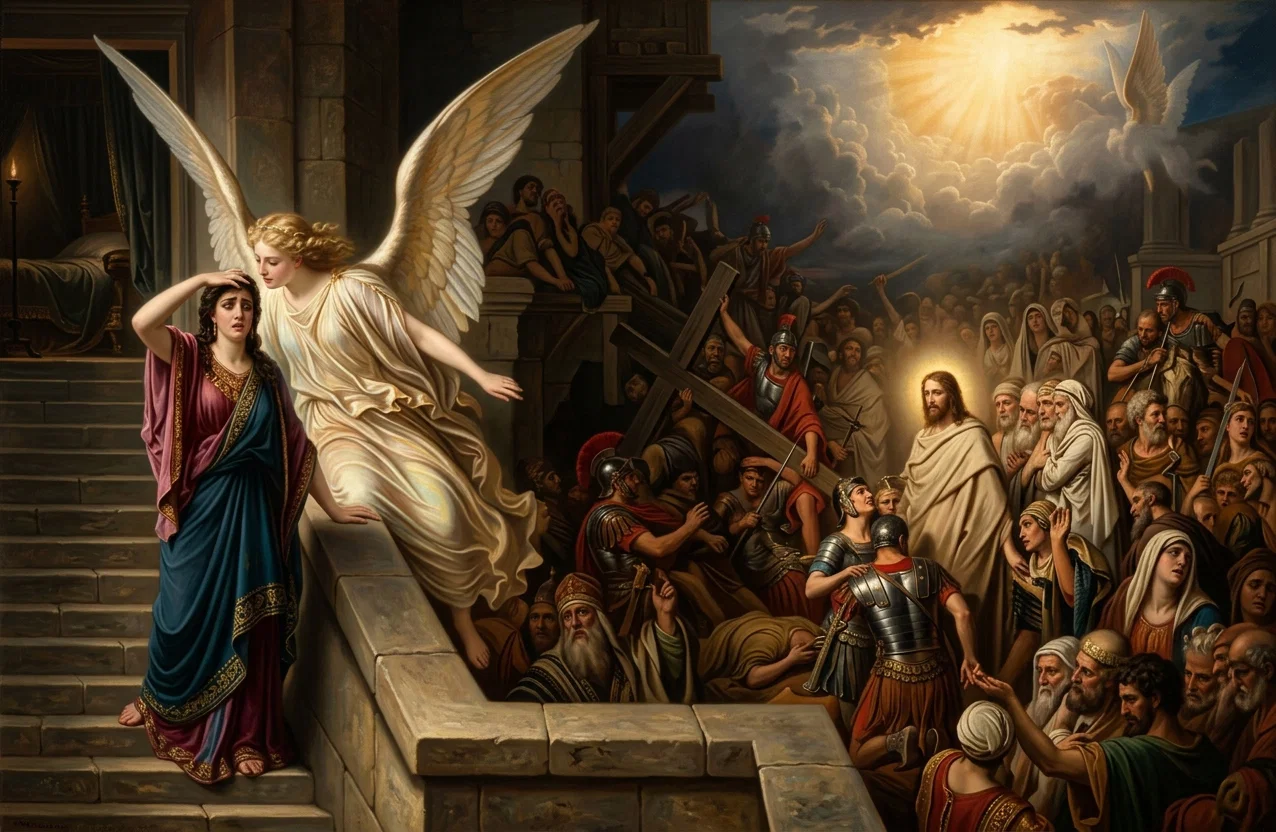
DREAM OF PILATE’S WIFE.

It was not sleep that bound my sight Upon that well-remembered night; It was not fancy’s fitful power Beguiled me in that solemn hour; But o’er the vision of my soul The mystic future seemed to roll, And in the deep, prophetic trance, Revealed its treasures to my glance.
Before my wondering eyes there stood A vast, a countless multitude; The hoary sire, the prattling child, The mother, and the maiden mild, The gladsome youth, and man of care— All tribes, all ages, mingled there; And all, where’er I turned to see, In humble silence bent the knee.
As o’er the crowded scene I gazed, Against the lurid eastern sky I saw the shameful cross upraised, I saw the Sufferer doomed to die. ’Twas He whom late with sorrowing mien, In Zion’s streets I oft had seen; And now in blood and agony, He turned a dying look on me.
Then softly from that gathering throng Arose the sound of solemn song; And while I caught the swelling lay, The myriad voices seemed to say— “And we believe in Him that died, By Pontius Pilate crucified— That He shall come, when time is fled, To judge the living and the dead.”
I woke; thou wast not by my side; I heard a loud, exulting cry; I heard the scornful priests deride, The elders murmur, “Crucify!” O Pilate! hadst thou marked my prayer, That guiltless blood to shield and spare, That deed of horror would not be A stain to thine—a curse to thee!
Our early days of joy are past; Our youthful spring is withered all; Afar from Rome our lot is cast, Beneath the sunny skies of Gaul; The thoughts that memory treasures yet Of other days, begin to flee; But never shall my heart forget The Crucified of Galilee.
—Anon.

The Lord Never Designed

The Lord never designed that His church should seek the aid of civil power, or work through the devices of political expediency. He gave her His own all-power of the Spirit, and the wisdom of the Eternal One. Walking in His way, trusting in His power, she can not fail.

THE INVIOLABLE SANCTITY OF THE MARRIAGE RELATION.

“And the Lord God said, It is not good that the man should be alone; I will make him an help meet for him.” “And Adam said, This is now bone of my bones, and flesh of my flesh. . . . Therefore shall a man leave his father and his mother, and shall cleave unto his wife; and they shall be one flesh.” Gen. 2:18, 23, 24.
“From the beginning” this principle was laid down, without any penalty attached to its infringement, except with regard to the rights of the “head” of the family. No law was given, nor any penalty written, by which a man might know that he must not take as many mistresses to his heart and home as he chose, except this one first principle, and the added warning and admonition of Prov. 5:18–21, which classes all women except “the wife of thy youth” as “strangers.” God, in His infinite wisdom, foreknew that only by actual contact and heart experience could man ever be made to realize the hideousness of sin, and to shun its fearful results; so He left man to interpret that law for himself. The eternal principles of purity, loyalty, indissoluble unity (Matt. 19:6), and inviolable sanctity—the perfection of love—were all in that law; for whatever God does is holy; when He creates a union, it is holy; any other must be profane, common. But man could not see all this until his eyes were “opened.”
If God had drawn the line on this principle in the beginning, without a clear demonstration of the evils of its violation, there would have been “spiritual” adultery, if not actual and rebellious accusations against the justice of the Creator’s decree. And all the way down the ages, till Christ came “to set judgment in the earth,” He let man work out this problem for himself; that is, that the slightest infringement of that sacred relation is fatal to the purity, love, confidence, and unity of spirit which God made possible to exist between the “head” and the “body” of the marriage union. See Christ’s judgments. Eph. 5:22–33.
There is in the marriage law, when in perfect operation, a miniature of the government of the kingdom of God. But when man took it upon himself to establish the promise that he could be “one-in-the-flesh” and the “spirit” with any other noble and admired woman beside his wife, and undertook to demonstrate that promise, he found himself, not only a double-bodied monstrosity, but a disunited, disorganized, ruined kingdom; the seeds of anarchy and internal revolt were sown then and there. The only foundation principle upon which a truly prosperous government can exist, the willing, cheerful, and loyal obedience of its subjects, was gone. For only in the mutual law of compensations—reciprocity, the blessing of giving and receiving—can true happiness exist. The joy and pride of the “head,” is the happiness and loyal love of his subjects, as shown by their acts of loving self-sacrifice and glad obedience to his least requirements. And, flowing back to its source, the “head,” with added blessing at each new impulse, the pride and joy of the wife and children are the happiness and loyal love of their “head.”
In the noble plan of the Father, perfect happiness was made possible, and perfect happiness is an overflowing cup. Prov. 5:15–18. It requires no more; it desires no more, and it blesses all that are near it.
But when, for any fault or lack of response in the love of either, the heart of the husband and father can so far turn from the first source of his consolation as to even wish to take to his heart and home a “stranger,” however good or lovable, just at that point the seeds of disunion and estrangement are sown. Isa. 54:6, 11. And when, by the natural reflow of the heart to old and dear associations, he turns back to comfort and solace the true wife, there is disunion and suffering from the other side, unless, indeed, their hearts have become “hardened” (Matt. 19:8), and indifferent to the sense of bereavement and loss.
The “spiritual” heart is the seat of intelligence, the “head.” When any part of the heart supply of love and sympathy that made husband and wife one in the beginning is diverted into a new channel (whether it is made a legal one or not), it must follow that the “body” suffers loss to just the extent of that diversion; and loss of vitality produces stagnation—disease. The germs are soon sown, and jealousy springs into life. It becomes a fever—a fire—which catches up every inflammable material, and fast merges into a conflagration.
The husband is literally between two fires now; and when he turns to quench the one, the other burns the more fiercely. And even when these fires can be partially subdued, there is a wasting away. There is a lingering consumption for lack of sufficient vital nourishment; for no spiritual “head” is capable of supporting two or more bodies with the powers given for the support of one. The wife who enjoys the most of her husband’s loving favor leads the most natural and healthful existence, tho necessarily a selfish one; for the measure of her heart content is the measure of the other’s pain and loss. But it is all unnatural, impure, revolting—the most subtle delusion that the author of evil ever betrayed mankind into, and a fertile hot-bed for the hatching of every evil imagination and work.
The dual husband finds himself subjected to an internal warfare with himself. He is a dismembered, disorganized ruin of manhood; the royalty of his kingdom is gone; he is committed to spiritual adultery at either turn, and, worst of all, compels the temporarily or permanently forsaken one to the same unnatural commitment. Matt. 5:29, 32.
Where is now the “crown” of pride, the free step, the high and noble bearing, the manly boast of a proud, glad husband of a happy and contented wife, king of his realm? And the wife is no longer sole queen of her lord’s heart and home, and rejoicing in his undivided confidence, and in his joy and pride in the children she has borne him, the seal of their union. Where is she as the wife of a dual husband?—She is a dethroned queen, her crown a “crown of thorns” in very truth; the very thought of her husband and children is a pain that is just in proportion to her love for them.
Each of the patriarchs in his turn grappled with the free-love monster, to his bitter sorrow and humiliation. Jacob conquered in wrestling with the angel before he could claim the blessing of God, and there were no more children after Rachel’s Ben-oni (son of my sorrow) was born. There were not many wives then, tho there was a sacred obligation; but I believe there were some unselfish “friends,” in the truest, noblest, highest sense of the word; for “even Christ pleased not Himself,” but spent Himself unreservedly for those He loved.
Abraham acknowledged the evil when he sent away the bond-maid Hagar, with his heart yearning for his first-born son. Here was the type of a purely mercenary marriage, of all marriages that are contracted for any other than the true motive. God did not “join them together,” and any union that God does not make holy by true, unselfish love, is profane, common—“spiritual” adultery—whether there be any other union or not.
David acknowledged the wrong of plural marriages when he saw deadly hate and usurpation break out between the rival claimants to his throne, and when Tamar rent her robe of a virgin princess, and covered her head with the ashes of her humiliation, and the brother-avenger arose to destroy the brother-seducer. But he reaped his bitterest harvest when, with bare feet, his royal head crownless and covered with the ashes of mourning, he climbed Mt. Moriah, weeping as he went—a heart-broken fugitive from a traitor son. Was not this a thorny crown for a king to wear? O, read in 2 Samuel and the Psalms his experience with the many-headed monster! His bowels yearned for his children—all sons of the same father, yet strangers at heart. He was a large-hearted and loving father; but how could he bring up his many-bodied household in the fear of the Lord, with the home circle divided by partition walls stronger and more formidable than walls of iron,—the partition walls of enmity, jealousy, emulations, wrath, and strife, with father a visitor, and mother more widow than wife. He could not be many fathers any more successfully than he could be many husbands.
No wonder that Solomon exclaimed, at the conclusion of his colossal experiment, “One man among a thousand have I found; but a woman among all those have I not found.” He never had but one whole heart, and he had to learn, after a wasted lifetime of folly, that that one true, loyal love was worth more than his kingdom; and thus he appeals to her in that wonderful “song of songs:” “Set me as a seal [no one dare break a seal] upon thine heart [the spiritual espousal], as a seal upon thine arm [the outward sign, or form]; for love is strong as death; jealousy is cruel as the grave: the coals thereof are coals of fire, which hath a most vehement flame. Many waters can not quench love, neither can the floods drown it; if a man would give all the substance of his house for love, it [the price] would utterly be contemned.” Solomon’s Song 8:6, 7.
“Now all these things happened unto them for ensamples [margin, “types”]; and they are written for our admonition, upon whom the ends of the world are come.” 1 Cor. 10:11. And so the law of types and precedents was established and hung up as living chart lessons in God’s great schoolroom, with the index finger of Jesus pointing to them “for our admonition.” Mark 10.
But some one will say, “What has all this to do with us in this Christian age of a confessedly Christian nation, where society lines are drawn by the pure principles of Christ’s doctrine, and the sanctity of marriage is protected by the laws of every State in the Union?”
True, the legal standard is right and good; but, tho it punishes infringements, yet it grants divorces for the most unworthy causes; and tho society would scorn the “letter” of adultery, and scandalize the perpetrators, yet is not adultery in the spirit rampant in the highest society circles? Is not the goddess of free-love winked at, patronized, even courted, in all places where fashionable society holds sway? Does the society woman dress to shine in the eyes of her “lord” and “master”? Is it that she may enthrone herself the sole queen in her husband’s heart of hearts, that she may so entwine her lovely ways into the very fibers of his being, that naught but death can sever them—is it for this that she studies “charm”? Or is it that she may reign queen of hearts, and bring “strangers” to her feet to worship her beauty and the power of her charms?
On the other hand, how many husbands esteem the one faithful heart the pearl above price, above which no earthly pleasure or honor is preferred as even worthy of consideration?
Shall we, then, allow the high license of society etiquet to rule in our heart and life? Jude 7. Shall the goddess of free-love invade our home kingdom, and cast down its holy altar, profaning and scattering its precious gifts? Whenever she does, in whatever guise you admit her, let the “king” take off his crown, and come down from his throne; let the “queen” lay aside her royal robes, and the jewels wherewith he has decked her pure beauty; for the royalty, the true sovereignty of love is perished, and the dove of peace and joy has taken her flight from the window, never to return.
God grant that we may learn the fulness of blessing that was in that law that accompanied His first and best of all earthly gifts to man. Gen. 2:23, 24. And when we have learned it, I believe we shall know something of the “fellowship” of that holy unity of the Father and Jesus, the Lord in whom and by whom He created all things—of His delight in crowning Him and His children also with “all spiritual blessings,” and exalting His name above every name that is named, because of the full proof of His love, loyalty, and singleness of heart—the oneness of Christ in God, and God in Christ—His “only-begotten” Son. RUTH.

FORGIVENESS

To FORGIVE an offense or an injury is to forego all feeling of resentment, to consider the wrong as if it had not been done, to hold the offender innocent, and to reverence all claims for reparation or retribution. Not long since one of the vilest men, deeply touched by the Spirit of God, in a mission service pleaded with his associates to avoid the terrible fate to which he was hastening. When asked to seek forgiveness of God for his deep-dyed sins, he exclaimed: “Forgive! Ah, you don’t know who you are talking to! God forgive sin?—No, no!” The sweet thought of pardon had never entered his mind. To him, punishment or revenge was the only adequate offset to such sins as his. In another service the people were urged to believe that every sin, past or future—each offense that had been or could be committed—was fully forgiven two thousand years ago, ages before it was committed.
Between these two opinions on the subject of divine forgiveness, there is certainly a very wide difference. One is the hopeless reasoning of fatalism. It contemplates a barren future, overhung by the dark cloud of irrevocable fate. The whispers of mercy or the gleams of hope never cheer the gloomy prospect. Surely this is not the view presented by the Gospel of peace. But it presents one extreme of the question, that which borders on the regions of despair. We turn from it, therefore, with grateful hearts, knowing that it does not represent our case.
The other view represents the extreme of levity, and sets a snare for unwary souls, who, in its light, will never come to see their sins in their hideous character.
Human feeling is so like a pendulum that in recoiling from one extreme, we need to be careful that we do not sway to the opposite extreme. Are sins unconditionally forgiven, and penalties unquestioningly remitted, even before the sins have an existence? Now, sin is not merely an abstraction, a quality existing apart from its agent. It is concrete. Before it exists, there is nothing to forgive. Indulgence may be granted for contemplated or possible sins, and forgiveness in advance is but the granting of indulgence.
It is true that we, as Christians, are to be constantly so possessed of a forgiving spirit that the desire or purpose of retribution will have no place in our hearts, no matter what the offense may be. But Christian forgiveness and divine forgiveness are not in all respects parallel. We are enjoined, “Avenge not yourselves; but rather give place unto wrath; for it is written, Vengeance is mine; I will repay, saith the Lord.” Of Jesus it is said that when He was reviled, He “reviled not again; when He suffered, He threatened not; but committed His cause [margin] to Him that judgeth righteously.” The fact that we forgive, or are called upon to forgive, does not imply that God forgives the same offense, at the same time, and upon the same conditions. Two judges ought not to adjudicate upon the same case. We can not judge impartially; therefore God says, Leave the matter with Me; you forgive and renounce all vindictive feelings; I will see to the matter in due time.
The conditions upon which God forgives sin are clearly laid down,—repentance and reformation (Isa. 1:16–18); confession (1 John 1:9); forsaking (Prov. 28:13). Jesus did not shed His blood to make sinning possible and practicable, but to make escape from it possible. This is not done by removing the embargo on transgression, and offering wholesale and indiscriminate pardon and indulgence, but by opening a way of escape through the valley of contention and repentance. The way of the transgressor is still hard. He who sins against God wrongs his own soul, and inflicts an injury that is not easily eradicated. Purity, if ever acquired, will have to be agonized for. So, then, while salvation is free to all, and pardon and mercy await every sin-sick soul, let us remember that the prodigal is far away from his Father’s house, and he must travel the journey if he would return. G. C. TENNEY.

GO THY WAY.

Go thy way, but let that way Be ever worth the going; Know thy way, and never stray In ways not worth the knowing; Leave the way that goes astray, And seek a better path, Straight and narrow all the way, To realms unknown to sin and wrath, Thus, “go thy way.” —Clark W. Bryan.
Continue reading: AN ASTRONOMICAL VIEW OF OUR FATHER'S HOUSE