LET us pause for a moment upon the outermost member of our sun's great family before we take our flight across the vast gulf that separates us from our sun's nearest neighbor, a Centauri, a star that is less than half the distance to the next nearest star—61 Cygni. Looking back, the human mind is overwhelmed by the immense magnitude of the worlds we have passed; the enormous distances that lie between them are incomprehensible to the human mind, and we shrink from the eternity of space before us. Vast as is the system comprised within the orbit of Neptune, it is, as we shall soon see, only as a grain of sand on the shore of this ocean of eternity upon which we are now to launch ourselves.
Until now we have been counting the time of our journey, flying with the speed of light, as we are, by seconds, minutes, and hours. But now this will not suffice us; we must deal with days, weeks, months, years, and centuries, for our very next stopping-place will require over four years for us to reach.
The solar system is itself enough to declare the glory of God and quicken our sluggish thoughts to contemplate His omnipotent power and wisdom. No boundary can be set to our Father's House; the awful grandeur, the amazing aggregations of thousands and thousands and millions of suns (for each star is a sun), arranged in pairs, groups, and clusters, held in place by God's great laws, all moving in the most perfect harmony, all in their appointed places, not in a state of rest, of stagnation, for all nature is at work—for the stars are flying in their appointed paths with a velocity that is startling; thus, Arcturus and Alpha Lyræ are approaching us at the rate of fifty miles every second; others are receding with equal velocity; yet so vast is the gulf between us that hundreds, maybe thousands, of years must elapse before we could detect the slightest increase or decrease of their light by the unaided eye.
The naked eye, under the most favorable conditions, can not see over five thousand stars in all the sky. A good opera-glass will increase this number to an astonishing degree, while a powerful telescope—say of a diameter of five inches or more—will bring forth millions from the depths of space. In the constellation Hercules there is a little spot of light, barely visible to the sharpest eye, apparently only a tenth part as large as the moon, and yet this little speck is a cluster of fourteen thousand suns! These suns may be smaller or dimmer than our own sun, but they may surpass him in size and splendor. The astronomers can not tell anything about it in this case, but there are stars that are known to be immensely superior to ours, while others are not nearly so great. It is believed that our sun is far less than the average of the stars in size and brightness.
Astronomers are wont to deal with incomprehensible distances by comparing the speed of railroad trains, cannon-balls, and the like; but while these are capable of giving us some idea of the solar system, they are useless when we deal with stellar space.
I will endeavor to give a comparison that may clearly bring to our minds one of these vast intervals between the stars—that separating our star, the sun, and our next-door neighbor, a Centauri. This star, tho the very nearest of them all, is about twenty-five millions of millions of miles away. This is absolutely meaningless to the mind of either the layman or the astronomer. The human mind breaks down at this point as completely as if the distance were a thousand times as great. We can understand it, but we can not comprehend it.
For illustration, let us imagine our sun reduced from a vast globe eight hundred and sixty-four thousand miles in diameter, to a ball only nine feet in diameter; next let us imagine that all the planets and all space should dwindle down to just the same proportions; then would our earth be less than a thousand feet from the sun, and it would be only one inch in diameter, while our near neighbor, a Centauri, would, on this same scale, be nearly fifty thousand miles away!
Another way of expressing the same thought would be to say that the distance from our sun (or Earth) to the nearest fixed star is just as many times fifty thousand miles away as our earth is larger than a good-sized marble; or, for every marble that it would take to make a world as large as ours, a Centauri is fifty thousand miles away. Do the heavens begin to show the glory of God as we look into His treasure-house?
We will continue our journey now, and again on the wings of light we are speeding away at the rate of six hundred and sixty-nine million six hundred thousand miles an hour. A few hours, and the last vestige of the solar system has passed from light, excepting only our sun, and he at this point outshines every other body in all the visible universe. In about two and one-quarter years we will be at the half-way point, and then if our sun and a Centauri are of equal size and brightness, both would appear the same. The bright star, Sirius, and all the rest of the stars would appear about as they do from the earth. In a little over four years (late measures make the distance somewhat greater than this) we would be in the midst of the system of a Centauri.
We would see our sun as a first-magnitude star, but the planets would be entirely invisible, even in the most powerful telescope man has yet constructed; and, according to Young, it would require a telescope twenty-four feet in diameter (and it would be about four hundred feet long) to show even the giant Jupiter from such a distance. This being the case, we can readily understand just why we can not actually see the planets circling round their central suns. Should the question be asked, How then do the astronomers tell of other worlds around other suns? I can not enter into an explanation here, but they know it without seeing them! Indeed, the companion to Sirius was discovered years before it was seen, by the motions (perturbations, astronomers call them) of his majestic primary, and its position exactly computed. Again, Procyon has a companion that has never yet been seen, altho its existence is known as certainly as if the telescope brought it to our view.
Were we to continue our journey, we would see our sun dwindle away into a mere glimmering point of light, and finally it would vanish altogether.
Only about one hundred stars give anything like satisfactory evidence of their distance, and not more than forty furnish measures that place the question beyond dispute. All the remaining millions are plunged into the vast eternity of space we call the universe, to a distance that the astronomer has as yet been unable to penetrate with certainty.
Here one is tempted to dwell upon how vastly the stars vary among themselves in size and light, and we will linger a moment to see what are the latest conceptions of the beautiful star Arcturus, based upon the exquisitely delicate measures of Dr. Elkin, whose reputation for accurate work is world-wide, and he probably stands at the head of this most intricate and difficult branch of astronomy—the measurement of stellar distances. The result, eighteen-one-thousandths of a second of arc, is the smallest reasonably reliable result ever obtained, and fairly astonished astronomers. Assuming it is correct, and astronomers do not appear to doubt it, this star, the theme of song and story since history was writ, twice mentioned in the oldest of records, the book of Job, is at such a distance that the light that leaves him requires 181 years to span the gulf that separates us. He is so much brighter than our sun that, could we remove our sun to an equal distance, it would require a fairly powerful telescope to show it as a faintly glimmering star of about the tenth magnitude. Could we be removed one hundred and forty thousand times farther from our sun than we are now, then would our sun appear to us about as bright as Arcturus, while if we increased our distance the same amount from this stellar giant, the difference in his brightness would probably not be appreciable, for Arcturus is eleven and one-half millions of times farther away than one hundred and forty thousand times ninety-three million miles. His brightness has been computed (assuming that a given area of his surface gives out the same amount of light as an equal area of our own sun) to be about five hundred and fifty-eight thousand times as bright, and that in size he is more than a million times as large as our own sun. His heat is about proportionate to his light, and, if we were placed as near Arcturus as we are to our own sun, the very rocks and metals would melt and turn to vapor like a drop of water in a sea of fire.
In addition to all this, Arcturus is a runaway. That is, his velocity is so great (nearly 400 miles per second) that the combined attraction of all the stars we know can not stop him or swerve him from his course; no, not even if the universe is many times larger than the wildest conceptions of astronomers. And this magnificent globe, with his attendant worlds, is sweeping majestically on, passing through our universe for the first time. How grand the words we find in Holy Writ: “Canst thou guide Arcturus with his sons?” Job 38:32.
We have scarce begun our journey, reader; but we have learned this great fact, that only in an eternity of time can we pass through an eternity of space, only with infinite time can we comprehend infinite works, and at the5snail's pace of 186,000 miles a second, it would require from tens of years to centuries to visit our near neighbors of the star depths, while it would require thousands and thousands (estimated at 50,000) of years to reach the stars that lie at the limit of vision of our greatest visual and photographic telescopes. And is this the universe? is this our Father's House? are the stars barely visible in our great telescopes on the outskirts? Every increase of telescopic power has increased our power of penetration, and every thinker finally reaches the unphilosophical and incomprehensible conclusion that there is no end,—no bounds, no center, no circumference!
To show that our journey, even though it could be carried on under the conditions we have imagined, would end in failure, let me give a few brief results of recent work in astronomical photography, which has in the last fifteen years revolutionized the study of the star depths. A photograph in my possession of the central parts of the great constellation of Orion shows thousands upon thousands of stars where only eight are visible to the unaided eye. In the square formed by the three stars in the belt, the star μ, and the upper star in the sword, where the naked eye sees nothing but a blank space, is an incredible number of stars. I have never had either the time or the curiosity to count them. This photograph would be counted as poor work compared with some of the marvelous productions.
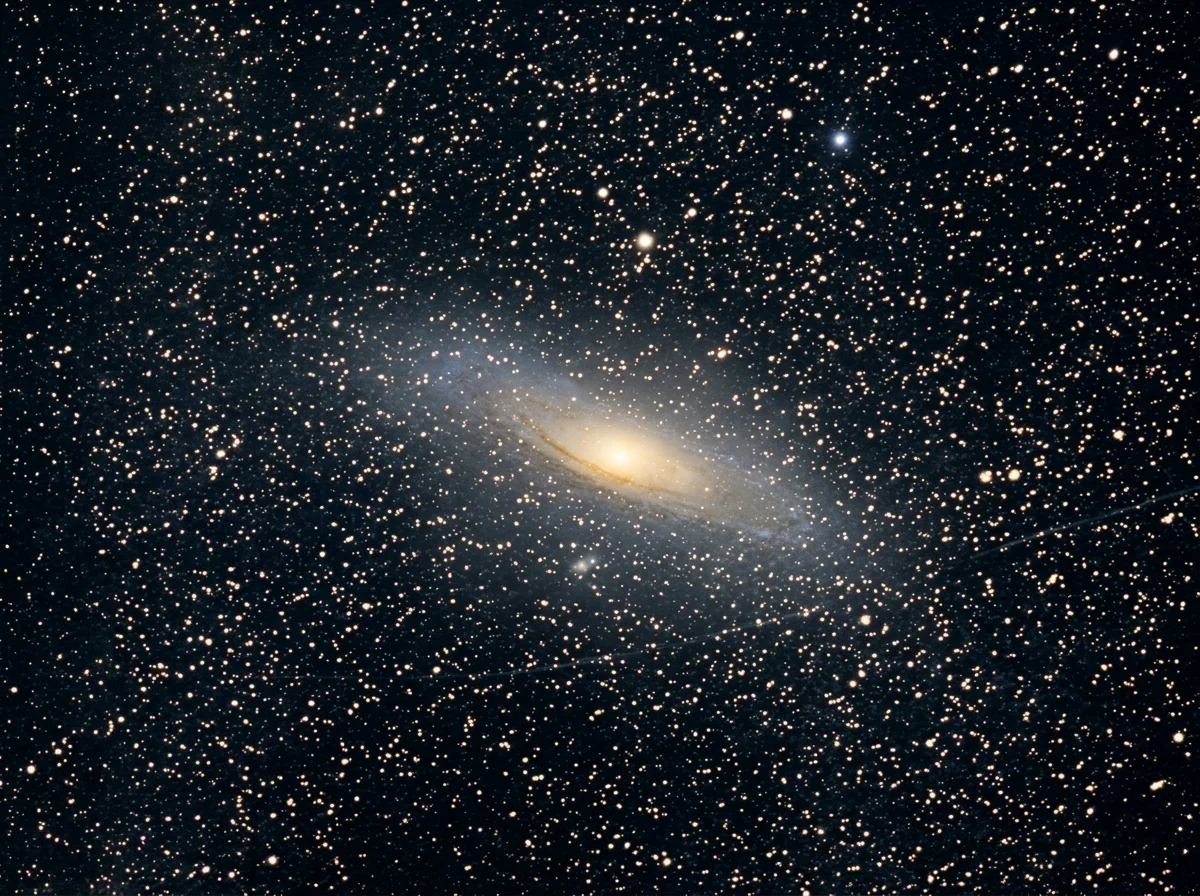
One of the astronomers of the Lick Observatory recently photographed, with only a six-inch lens, that portion of the constellation of Andromeda in which is situate the great nebula. The space on the sky covered by the photographic plate was about ten degrees square; to the ordinary observer two stars are visible (μ and ν Andromeda); the keen-eyed astronomer could perhaps see six, while the photographic plate shows sixty-four thousand running together in one unbroken blaze. (See illustration.)
Another plate exposed to one of the richer portions of the Milky Way shows so many stars that it is impossible to count them. The plate may show five hundred thousand or a million and five hundred thousand. There are simply clouds of stars, each one of which would be invisible even on the photographic plate unless it were a sun, for they are photographed by their own light!
And now for the most astounding conception it has ever been my lot to know: assuming that one-tenth of the light we receive at night comes from the stars (and we can see well enough to follow roads and distinguish objects, etc., at night, without the aid of the moon, and of course this is starlight), a recent computation shows that we receive this light from no less than sixty-six milliards (sixty-six thousand millions) of stars, counting only stars as faint as the seventeenth magnitude, and our greatest telescopes will show us stars to the eighteenth or even less. Verily, "the heavens declare the glory of God; and the firmament showeth His handiwork," and it is the fool who saith in his heart, "There is no God."
Our wildest dreams and conceptions of the power of the Creator shame us with their insignificance. The reality overwhelms us, and our minds and hearts grow sick with the knowledge of this infinity of greatness. Lo, this is the God of the astronomer! Utterly dazed and overwhelmed with the grandeur and immensity of our Father's House, bewildered and hopelessly cast down with the thought of our nothingness, we read with a new understanding the words of the Hebrew poet: "When I consider
From a photograph of the great Nebulae of Andromeda, taken by Prof. E. E. Barnard, formerly of Lick Observatory, now of Yerkes Observatory. Time of exposure, 4 hours 18 minutes. During these exposures the eye of the photographer is kept constantly fixed on some star bisected by cross wires in the eye-piece.
Thy heavens, the work of Thy fingers, the moon and the stars, which Thou hast ordained; what is man, that Thou art mindful of him? and the son of man, that Thou visitest him?" But what a comfort it is to know that even a sparrow can not fall to the earth without His knowledge, and that we are more than many sparrows!
How strange it seems that God should consider us worthy of the sacrifice of His Son! But God's ways are not our ways, and after the thoughts with which we have been dealing, we perhaps more fully realize what is meant when God tells us: "My thoughts are not your thoughts, neither are your ways My ways, saith the Lord. For as the heavens are higher than the earth, so are My ways higher than your ways, and My thoughts than your thoughts."
How strange it seems that men whom God has endowed with minds to grasp these mighty problems, can lightly pass or entirely ignore the laws of the great Creator and the sacrifice of His Son, for the frivolity and sin that everywhere surround us. They are mad. "Father, forgive them, for they know not what they do."
I can do no better than to quote the words of the German poet Richter in his sublime thoughts on this subject: "God called up from dreams a man into the vestibule of heaven, saying, 'Come thou hither, and see the glory of My house.' And to the servants that stood around His throne, He said, 'Take him, and undress him from his robes of flesh; cleanse his vision, and put new breath into his nostrils; only touch not with any change his human heart—the heart that weeps and trembles.' It was done; and, with a mighty angel for his guide, the man stood ready for his infinite voyage; and from the terraces of heaven, without sound or farewell, at once they wheeled away into endless space. Sometimes with the solemn flight of angel wing they fled through Zaarrahs of darkness, through wildernesses of death, that divided the worlds of life; sometimes they swept over frontiers, that were quickening under prophetic motions from God. Then, from a distance that is counted only in heaven, light dawned for a time through a sleepy film; by unutterable pace the light swept to them, they by unutterable pace to the light. In a moment the rushing of planets was upon them; in a moment the blazing of suns was around them. "Then came eternities of twilight, that revealed, but were not revealed. On the right hand and on the left towered mighty constellations, that by self-repetitions and answers from afar, that by counter-positions built up triumphal gates, whose architraves, whose archways—horizontal, upright—rested, rose—at altitudes by spans—that seemed ghostly from infinitude. Without measure were the architraves, past number were the archways, beyond memory the gates. Within were stairs that scaled the eternities below: above was below—below was above, to the man stripped of gravitating body: depth was swallowed up in height insurmountable, height was swallowed up in depth unfathomable. Suddenly, as they rode from infinite to infinite, suddenly, as thus they tilted over abysmal worlds, a mighty cry arose—that systems more mysterious, that worlds more billowy,—other heights and other depths,—were coming, were nearing, were at hand.
"Then the man sighed, and stopped, shuddered, and wept. His overladened heart uttered itself in tears; and he said: 'Angel, I will go no farther. For the spirit of man acheth with this infinity. Insufferable is the glory of God. Let me lie down in the grave and hide me from the persecution of the Infinite; for end, I see, there is none.' And from all the listening stars that shone around issued a choral voice, 'The man speaks truly: end there is none, that ever yet we heard of.' 'End is there none?' the angel solemnly demanded. 'Is there indeed no end?—and is this the sorrow that kills you? But no voice answered, that he might answer himself. Then the angel threw up his glorious hands to the heaven of heavens, saying, 'End is there none to the universe of God. Lo, also there is no beginning!''
Let us end our journey now, reader, and return to our little present home we call Earth, and let the distant stars, with their attendant worlds, whirl and wheel and roll and shine in the boundless empire of space, while a new light—the light of God's universe—shines upon His word, that carries us backward to the time when "in the beginning God created the heaven and the earth," and when the "morning stars sang together," and forward to the time when there will be a "new heaven and a new earth," and the overcomers shall inherit the kingdom.
"In My Father's House are many mansions."
GAMMA BETA.
LIFE'S HARMONY.
By M. L. Upton
They tell me that in Pisa's old cathedral
All noises harsh and loud—
Grating of ponderous doors, shrill tones, the trampling
And murmur of the crowd—
Are caught up, softened, harmonized, and blended
Within the lofty dome,
Then echoed back in one great wave of music
Sweet as a dream of home.
So all the harsh notes in life's mingled music—
The burden and the wo,
The stroke that almost snaps the quivering heartstrings,
The loss that grieves us so—
In heaven's o'erarching dome of perfect wisdom,
Power, and love, shall be
Gathered and blended in divinest marvel
Of matchless melody.
—M. L. Upton.
A MISSIONARY HEROINE.
By Rev. Henry Haigh
At Rangoon I attended a service at the chapel of the American mission. Over one thousand adults were present, and the preacher, twenty-two years of age, who had arrived at Rangoon the day before, preached with marvelous fluency. He was a missionary’s son. As a child, he lived with his father and mother in the jungles of Burma, where it was the business of the father to follow the Karens, who were nomads, on their wanderings. Cholera came, and the missionary died. It seemed the plain duty of the widow to return to America with her only child, that he might be educated. But the thought came, “If I leave these Karens, who is going to look after them?” She saw it to be her duty to let her son go home by himself, while she remained in the jungle to carry on the work. For seven years and a half she toiled, doing herself the full work of a missionary all alone. She preached, baptized; buried the members when they died, administered the sacrament, and saw a great harvest. All the time she prayed, “God save my boy.” One day a letter came. He was converted; he wrote, “I think I will be a missionary.” She replied, “That is what I want; come and take up your father’s work.” The day before she had welcomed her boy, and now she sat hearing him preach. I said to myself, “If ever Christ had a heroine, this is one.”—Rev. Henry Haigh.
GOD’S EFFORT TO SAVE PILATE.
“Who willeth that all men should be saved, and come to the knowledge of the truth.” 1 Tim. 2:4, R.V.
“As I live, saith the Lord God, I have no pleasure in the death of the wicked; but that the wicked turn from his way and live; turn ye, turn ye from your evil ways; for why will ye die?” Eze. 33:11.
The God of love desires to save all men, the rich and the poor, the high and the low, those in official position and those in private life; for “God is no respecter of persons.” Of this desire He has given us abundant evidence.
It is ever true that “the common people,” if uninfluenced by evilly-disposed or blinded leaders, have heard Christ “gladly,” whether the message reached them direct from His own lips or through the lips of His chosen servants. They are not so filled with other things that they have no time to listen. But men occupying high social or official positions are more difficult to reach. A multitude of state duties or social functions prevent them from listening or reading. And yet they must be warned. Sometimes the Lord does this through the interest or conversion of their prized servants or relatives; and sometimes by a new translation of His Word.
When other means fail, God suffers His servants to be persecuted, apprehended, prosecuted, imprisoned, that rulers may hear. From the time when Abraham and Isaac and Joseph went down into Egypt till Moses and Aaron appeared before the Pharaoh of the oppression, it was God’s desire to save Egypt. Some of the kings learned to know God. When a change of dynasty took place, about the time of Moses’ birth, the new king knew not Joseph and his God. But all the Lord’s efforts through Moses and Aaron were to teach Pharaoh and his people that Jehovah was God. And if Pharaoh had acceded to the Lord’s request, the glory of God’s name would as truly have been spread abroad through the earth as it was by Egypt’s humiliation and defeat. Before the throne of Babylon was brought the Gospel by Daniel and his companions. Nebuchadnezzar at last heeded it and was saved; Belshazzar rejected it, and was lost. Before the Medo-Persian rulers did the Lord proclaim His saving power by Mordecai, Daniel, Nehemiah, and others. The translation of the Scriptures into Greek, and the vision of the high priest at Jerusalem, caught the attention of the learned Grecian world and the haughty Alexander.
Before great Rome God presented His Gospel in its glorious perfection. Rome was represented by Pontius Pilate; the Gospel, by Jesus Christ. Read the record of how Jesus was brought before the governor: (1) By the malignant priests and scribes clamoring for His death over unproved charges; (2) Pilate’s conversation with Jesus, in which he finds no evidence of crime; (3) the dignified bearing of Christ, so unlike the criminals or men Pilate was used to seeing, trusting in some power higher than Pilate knew; (4) Pilate’s endeavor to escape the responsibility and turn Jesus over to Herod, and Herod finding Him worthy of no punishment; (5) the further malignity of the Jews in choosing Barabbas, and this calling forth no word of retaliation from Jesus; (6) the repeated efforts to release the innocent Man always being met with fresh outbursts of malignity on the part of the Jews, who would yield neither to law nor justice in the declarations of both Pilate and Herod, nor to pity at the sight of the scourged, beaten, bruised, bleeding Man, unresentful and unresisting under every indignity and insult. All these convinced Pilate that before him stood One more than man, and appealed more strongly to the heart of the Roman to do the right, whatever the consequences, than any sermon could have done. But Pilate was yet undecided. He feared the Jews.
And yet the Lord could not leave him. One more effort must be made. Pilate had a loved wife, Claudia Procula by name, tradition tells us; and the Lord endeavors to reach the will and choice of the governor through her. On that day of days she sleeps, and God gave her a dream, a vision, of the Christ; and she gave to Pilate the solemn warning, “Have thou nothing to do with that righteous Man; for I have suffered many things this day in a dream because of Him.” It is Pilate’s last chance. Once more he endeavors to induce the priests to withdraw their charges, but they refuse. And Pilate also refuses to identify himself with the suffering Innocent One, hoping to escape responsibility and ease conscience by delivering Jesus to the mad mob and washing his hands in water. Poor Pilate! our heart pities him; but what more could God do?
There are other rulers—a multitude—who know not God. They have never heard that Gospel in its purity and power which will fit men for Christ’s coming. They must hear it and see its power. Some of them will heed it and be saved. Some will reject it, but all must be left without excuse. Jesus Christ suffered and died that He might bring it before Pilate and the world. His servants before that time and since have suffered with Him for that same purpose. If you are faithful, this may be a part of your mission. “They shall deliver you up to councils; and in synagogs shall ye be beaten; and before governors and kings shall ye stand for My sake, for a testimony [witness] unto them.” What a privilege would this be—to preach the Gospel to kings and rulers!
Are you witnessing for Christ now, in your every-day life before the world? You can not witness for Him unless you know Him; and you can not know Him unless you have His Spirit. “If any man have not the Spirit of Christ, he is none of His.” “But ye shall receive power when the Holy Spirit is come upon you; and ye shall be My witnesses.” Ask for that Spirit. Receive of that Spirit; God is more willing to give it than is a father to give that which is good to his children. Then “ask, and ye shall receive.” Then shall you witness with your mind and heart full of His Spirit and Word. And then, if brought before rulers or kings, you need not prepare your address, need not that some specially learned person shall write your speech. “Be not anxious beforehand what ye shall speak; but whatsoever shall be given you in that hour, that speak ye; for it is not ye that speak, but the Holy Ghost.”
GIFTS OF THE SPIRIT.
Apostles.
“THE gift [singular] of the Holy Ghost,” or the Holy Spirit, is for every believer, it matters not who that believer may be; “for the promise is unto you, and to your children, and to all that are afar off, even as many as the Lord our God shall call.” This is the Word of the Lord to every soul, and to every soul the promise will be fulfilled if he will but accept it by faith.
That Spirit if received will cleanse, sanctify, purify, overcome, blot out, obliterate, sin in the heart and life. It fits the soul for the family of God. It makes him capable of serving in God’s household. It prepares him as a soldier in Christ’s army; it furnishes full equipment for all required service in the gifts bestowed. But the gifts are as the Spirit will, not as the man will. They are bestowed upon the church, the body of Christ, divided among its members, that the body may rightly represent the Head.
Only a complete body can properly represent a head, let it be the body of man or beast. From the brain go impulses to every part of the body, to every member, to incite to united and perfect action. The eye is to see, the hand is to grasp. If the hand or the foot is wanting, the body fails to represent the heart.
Bear these self-evident truths in mind as we consider what God has said concerning His church and her equipment for service. “God hath set some in the church, first apostles, secondly prophets, thirdly teachers, then miracles, then gifts of healings, helps, governments, divers kinds of tongues. Are all apostles? are all prophets? are all teachers? are all workers of miracles? have all gifts of healings? do all speak with tongues? do all interpret?” 1 Cor. 12:28–30. The evident answer to each one of these questions is negative. All are not apostles, or prophets, or teachers, or miracle-workers. And yet just as truly as all are not, it is God’s design that some of the all shall be apostles, and some prophets, and some miracle-workers, and some teachers; that each of the all shall possess some one or more of the gifts God has “set in the church.”
“Apostles.”
“And He gave some, apostles.” An apostle is “one sent forth.” In the case of the chosen twelve, it was necessary (1) that they should be eye and ear witnesses of Christ’s work and resurrection (John 15:27; Acts 1:21, 22; 1 John 1:3); (2) they were called, chosen, and sent by our Lord Himself (Luke 6:13; Gal. 1:1); (3) they had the Spirit of God, and were endowed with gifts sufficient for their work (John 16:13; Mark 16:20; Acts 2:43; Rom. 15:18, 19; 2 Cor. 12:12; Heb. 2:4).
But these mighty powers were not confined to the apostles alone, as we shall see later.7Neither was apostleship confined to the twelve first chosen by our Lord. Paul and Barnabas were apostles (Acts 14:14); so were Epaphroditus, and others (2 Cor. 8:23; Phil. 2:25; the word rendered by messenger is apostolos). The great apostle of all is Jesus Christ. Heb. 3:1.
From the above considerations we may conclude that an apostle is one chosen of God to lead out in the presentation of His message to the church and to the world, and one who always bears a message in advance of the people of God at the time he goes forth. This was true of Jesus, of the twelve, of Paul, of Barnabas.
Have there been no apostles since? Let us not be deceived. God has had His chosen messengers for advance work in every age. The gift is set in the church. John Wycklif was God’s apostle of the Reformation in England, Martin Luther in Germany, Ulric Zwingle in Switzerland. John Wesley was an apostle for vital, heaven-born Christianity in the Church of England. And how many apostles in mission fields has God called and chosen and sent forth such, as Peter Heiling to Abyssinia in 1632; Ernst Von Welz, of Germany, to Guiana a quarter of a century later; John Elliot, among the Indians of America; Hans Egede, to Greenland; the Nitzschmann brothers (Moravian), to the West Indies; and others, elsewhere; and Carey, “the Cobbler,” of the nineteenth century, to India!
William Miller was truly an apostle in the great advent movement of 1840 to 1844, to arouse a people to the importance of Christ’s coming. And there are yet apostles of God leading out in grand latter-day reformations, their messages ever based on the truth of the Word of God, backed home by the Holy Spirit.
God calls those whom He can use. He endows them according to their ability, and He gives to every one of His people the grand privilege of catching up the message of the apostle and bearing it to those who sit in ease and darkness. Blessed gift of God! All may not be apostles, but all may be blessed and builded up by the gift.
THE GENERAL SITUATION.
The general situation in the world to-day is anything but cheering. Our large cities are controlled by rings and cliques, not in the interest of the people, but for the sake of “boodle.” To a large extent the police are bribed to keep their official eyes closed so that they may not see the crimes that are being committed. Politicians keep themselves and their friends in office, and it is an open secret that they make free to loot the public treasury at their will.
And with the guardians of the law and public peace so grossly corrupted, is it any wonder that murders and robberies are of hourly occurrence? And is it any wonder that it is so difficult to apprehend and bring these criminals to justice? Why, our cities have become schools of crime. And no longer is the mature man the only pupil in this debasing study, but even little boys and girls are apt scholars, and soon become adepts in the evil arts.
It has been proved that officers of the law in some of our largest and most influential cities, are under regular pay from thieves and robbers, and instead of being on the alert to catch these villains, they do everything they can to assist in their escape. Even the house of prostitution is guarded by the police, and a stated sum is paid over each month to the city watchman, for his care and protection of these dens of vice. Is it any wonder, then, that some large cities have as many as 40,000 fallen women in them? And when a city has so many prostitute women who support themselves by their life of shame, who will venture the estimate of the thousands of fallen men who are polluting themselves in lust? The picture is surely not very pleasing.
Then we have the conflict between capital and labor. The laborers are combining and striking, on the one hand, and the capitalists are preparing to resist by combines and various other methods, on their part. There is a terrible crash just ahead of us between capital and labor. No human pen can trace the awful details of what will be manifested in that conflict. Inspiration says:—
“Go to now, ye rich men, weep and howl for your miseries that shall come upon you. Your riches are corrupted, and your garments are moth-eaten. Your gold and silver is cankered; and the rust of them shall be a witness against you, and shall eat your flesh as it were fire. Ye have heaped treasure together for the last days.” James 5:1–3.
“Weep and howl,” says the Word of God, “for your miseries that shall come upon you.” And all men who persist in piling up wealth, in the face of the discontented spirit that is in the world to-day, are simply piling up “miseries” for themselves. The spirit that would loot and destroy houses and property is very wrong indeed, but fully as great is the evil of a comparatively few men getting control of the world’s wealth, and hoarding it up without any possibility of either needing it or using it, except it be in gratifying some personal whim or ambition. Wealthy men will not be able much longer to keep down or suppress the spirit that is rising against them. And when the crash does really come, it will be terrible. O, that men on both sides of this controversy would heed the Word of God, and be saved from the awful trouble into which they are violently rushing!
A spirit of lawlessness in general has taken possession of the world. This is being manifested in so many different ways. But especial mention should be made of the social disease called anarchy. If it has been true in the past that “uneasy lies the head that wears a crown,” it is more intensely true now. The high rulers of earth to-day can hardly make a journey without being closely followed by the Anarchist assassin, who is watching a chance to kill him. So great has this evil become that there is strong talk of the powers combining to crush these Anarchists out.
But the roots of the disease spread outside the ranks of openly-avowed Anarchists. That spirit of violence is the ruling spirit of the age. In the first place, men are prepared by the training of militarism to look upon human slaughter as being all right, if only done in the interest of what they consider a good cause. And it is only another step for large combines of men to espouse a cause at variance with the government, and begin wholesale destruction in its interests. And it is especially easy for them to do this when they are persuaded that their governments are corrupt and oppressive.
And there is another great underlying cause for all this spirit of anarchy. Much of the science (“falsely so called”) of this age has been insidiously working to undermine faith in the Bible, the great bulwark and standard of morals. The most pronounced types of Anarchists are fatalists, and have no fear of God before their eyes, while those afflicted with the milder forms of the social malady, look upon the Bible as simply a myth. And yet the Bible is all the time pointing out these evils of our age and telling what they signify.
But only a part of the distressing evils of this time have been mentioned. The war fever is another great malady that has spread all over the world. Every nation is involved in this military evil. The eastern portion of the world has been converted into one vast military camp. And now the direful craze has caught the Western Hemisphere, and the whole world is equipping and drilling for the last great battle.
And then here are the unsettled elements of nature. It would seem that earth and sea and air had joined in the discontent. One day we read of great hail-storms in Kansas. Then there are cyclones in New York, Canada, California, and so on. Great hurricanes sweep the West Indies; earthquakes are causing the solid land to tremble; and thus the whole earth, social, political, and physical, is in a regular boil.
All of these things have been seen in the past, but only in a very limited degree, and in places here and there. But now the evil has spread all over the world. Every locality is being permeated with it. And the earth will not be able to survive these conditions of crime, corruption, and pending revolution a great while longer.
If you have not fully cast off the Word of God, then turn to its sacred pages and read the meaning of all this. But if you have left the Bible out of your reckonings altogether, you are in fearful darkness. And this darkness will grow deeper and deeper. Turn to your only Source of help while the opportunity still lingers.