Your ShelfYour Projects

Review and Herald, Vol. 85, No. 46.

Life's Promise
Earlier text: MRS. E. G. WHITE

Guatemala, Central America

E. L. CARDEY
It has been some time since we have reported through the REVIEW the progress of the work in this country. Sometimes we who are in the mission fields get so interested in our duties that we almost forget that we owe a duty to our brethren in the home land. Since the time of our camp-meeting held in the Bay Islands in March, we have been working hard to press the message onward into new countries, and reach the dark places in our territory.
In May we moved the headquarters of the conference from Belize, British Honduras, to the present location, Guatemala City. We are now in the very heart of darkened Catholic Central America. Here is the nucleus of the superstitions that have made slaves of the countries over which Rome has held sway.
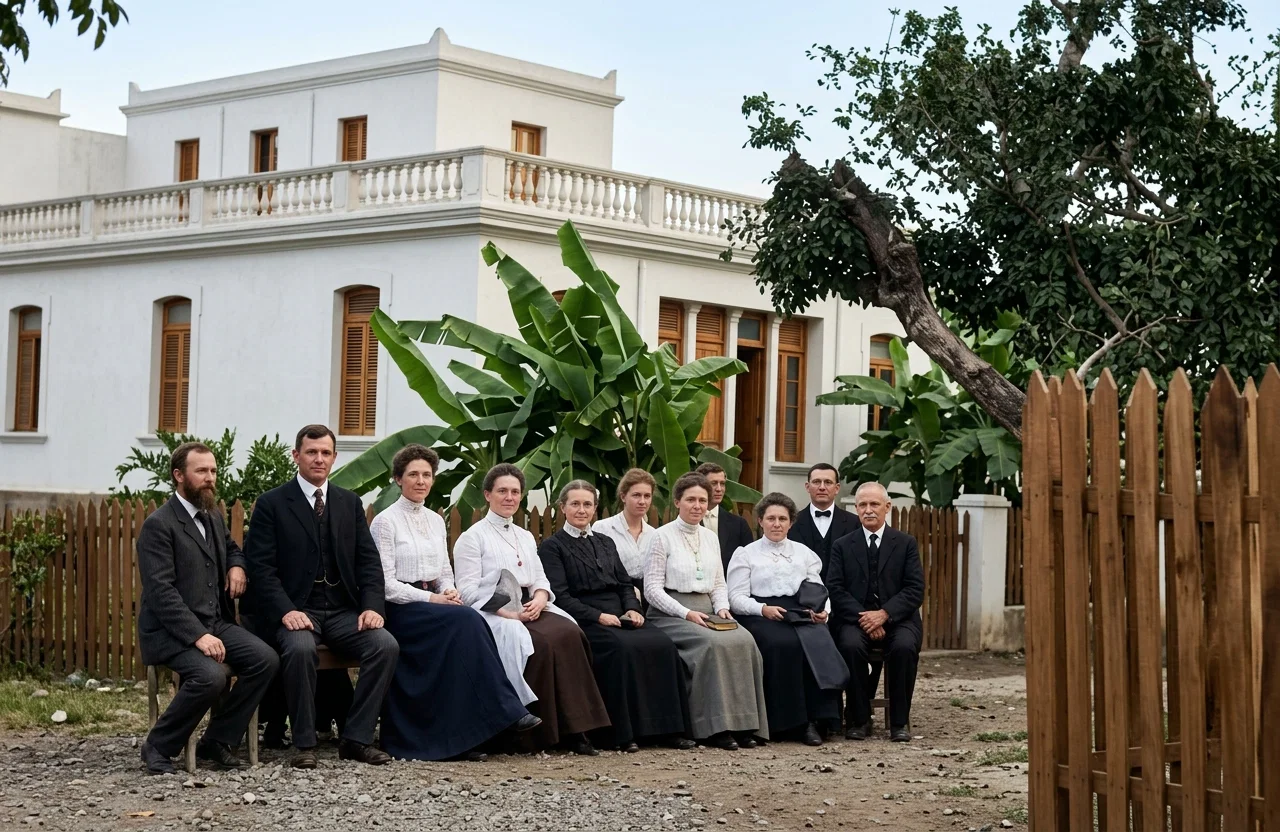
VILLA BLANCA AND THE MISSION WORKERS, GUATEMALA CITY
The Lord went before us in entering this country, and in locating in this city, which is the capital of the republic, as well as the largest city in Central America. We have rented, as mission headquarters, a large house in the best part of the city. In locating here we have endeavored to place ourselves in a position where we could have an influence with the wealthier class as well as with the poorer. This good location has been a help to us in accomplishing this object. We have a company of workers here now, but the mission house is large enough for us all to live in. The accompanying picture is of the mission house, known as Villa Blanca.
This is a very delightful country to live in; the climate is perfect, neither too hot nor too cold. One can wear heavy clothing the year round, or wear light clothing with comfort. Practically every kind of fruit and vegetable is grown here, and they can be had the year round.
Our work in this city, of course, will move slowly at first. There must be a seed-time before a harvest, and now we are in the seed-time in this republic. Yet the Lord has wonderfully opened the way for us to reach the people. He has told us that in many of the dark places of the earth the way is being opened for the quick advance of this message. When we thought of entering this republic, we had in mind opening a school here for our young people in this conference, and making it a missionary factor by admitting outside pupils.
To open such a school one would have to get a permit from the government; and this would not be the easiest thing, as these people are not very favorably inclined toward mission work. After coming here we met an American missionary who has been conducting an English mission school in this city for six years. On account of failing health and overwork, she desired to sell the school to some mission society. A mission society here tried to buy it some time ago, but she did not sell to them.
However, from the first, she has wanted to sell to us, because, she said, she felt we would carry on the work that she had been trying to do. She seems to have been well acquainted with our work in Michigan. Almost as soon as we spoke of buying, the other missionaries tried to influence her not to sell to us, saying it would be a “terrible thing” for us to get started here. After praying much over the matter, and counseling with others, we decided that it would be a good opening for us. From the first, we have felt that the Lord was in this matter, but it means a great deal to take over a school like this, not having the money to buy, nor having the teachers to carry on the work. Yet we have taken hold of the promises of God, and on the tenth of September we closed the deal for the Guatemala English School. In all, we pay four hundred dollars for the school. This includes desks for seventy pupils, tables, chairs, maps, and such supplies as go with a school. The influence that the school has gained in the past six years we felt would be worth a great deal to us. The enrolment at present is about fifty, and these are of the best class in the city. The president of Guatemala has shown the school many favors in the past. There is no reason why it should not be self-supporting with good management. It has been in the past, and we believe that it will be in the future. The Lord has sent us teachers sufficient to carry on the work for a time (with the music teacher we now have four), but we need three hundred dollars to finish paying for the school property. We paid one hundred dollars down.
If there are those who would like to help start this school, the offering would be greatly appreciated at this time. We have walked out by faith in buying this school, but we are sure that when the Lord makes an opening like this, he has also somewhere the means to pay for it. It is true that at this writing we do not know where the money is coming from to finish paying for this school, but it will come; of that we are
sure. Any one wishing to help in this work, may remit to the writer by New York draft, addressed Box 218, Guatemala City, Central America. Be sure to get a duplicate draft, as we frequently have trouble getting money that has been sent to us through the mails.
We are now teaching in the school in connection with the old teachers, in order to get the confidence of the patrons. January 1 we shall take full charge, as the new term begins then. We are now getting out the calendar for 1909, and will be glad to send it to any who wish to see how a mission school can be carried on in a Catholic country.
The work is onward throughout our conference. We have just concluded a two months’ trip through Honduras and the Bay Islands, which was attended with the Lord’s blessing. One church was organized in Ruatan, and a new church building dedicated at Coxen Hole, where the camp-meeting was held last spring.
The conference is now having a gasolene launch built in Ruatan for our work along the coast and through the islands. It is thirty-two feet long and eight feet beam. The work will be much better organized in this field when this boat is in operation. We have been able to raise nearly all the money needed to build it without calling for donations from any one.
We rejoice to see the progress of the message in all the world, as it is an omen to us that the work is almost finished, and we can soon lay down the burdens and meet with friends and loved ones in the new earth: Remember the work here in your prayers, and work while you pray.
Guatemala City.

The Look of a Child

“The greatest lesson I ever learned in my life,” said a gentleman, speaking on the subject of temperance, “was pointed out to me by my little daughter. I had never been a drinking man; but sometimes, I am ashamed to confess, I came home slightly the worse for liquor. The habit grew on me, in spite of tearful entreaties of my wife. I took a bottle of whisky home one afternoon. After dinner I made for the bottle, which I had left in my study, poured out a glass and raised it to my lips, when I caught a reflection in the polished woodwork of the wall. I turned quickly, and there was my little daughter standing in the doorway looking at me. I could never describe the expression on her face. If one might say it of a child, it was a commingling of reproach, pity, and disgust. Probably she had overheard conversations between her mother and myself; perhaps it was instinct. I have not taken another drink from that day to this.”—Selected.

A Meeting With Russian Priests

J. T. BOETTCHER
DURING the latter part of July and the first of August, the Russian orthodox church held a missionary congress in Kief. This city is called the Jerusalem of Russia, and has a great many churches and convents. About one hundred fifty thousand pilgrims come here every year to worship. The Lawra is a famous large convent, with underground caverns containing about one hundred open coffins of the so-called “saints.” The pilgrims and people kiss these, and lay their beads upon them, hoping thereby to receive power to overcome sin and evil, or wishing to be cured of some disease.
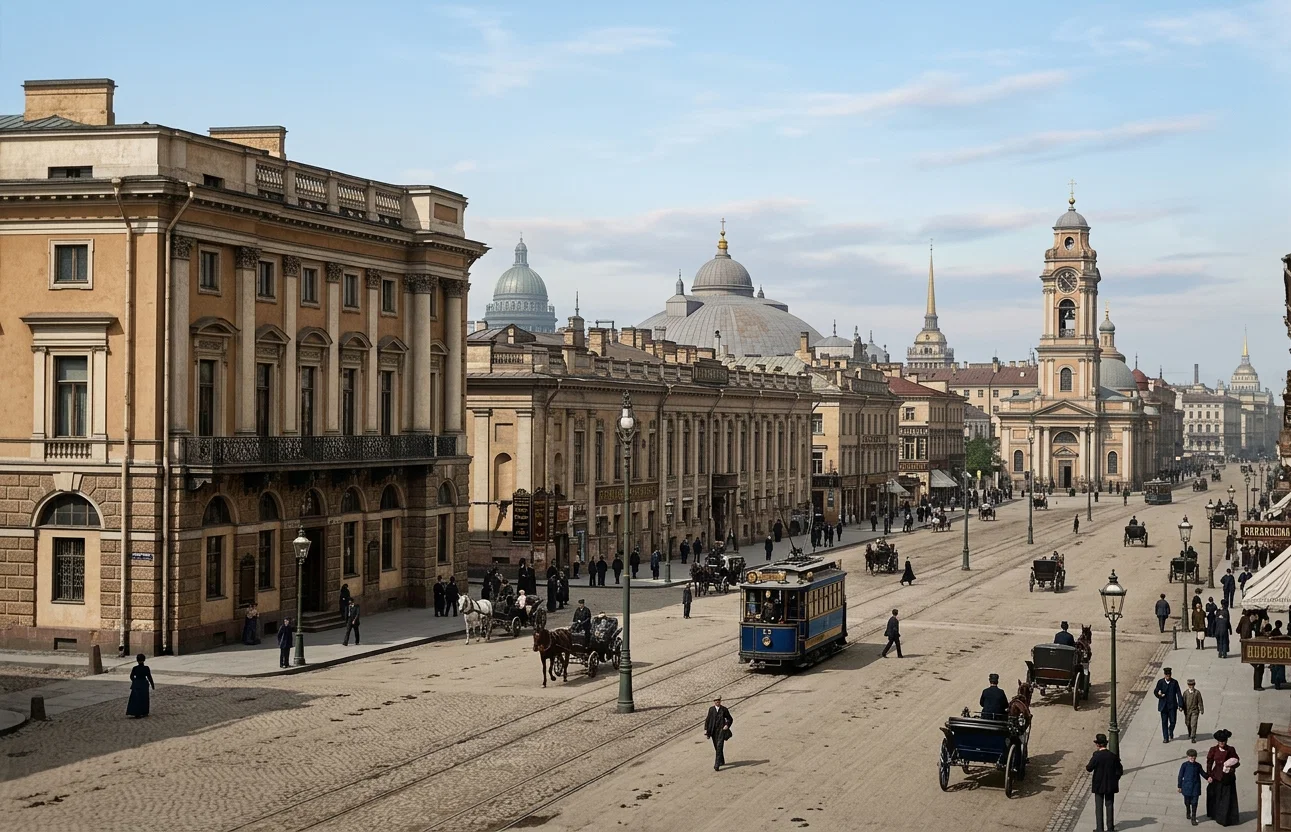
A VIEW ON MAIN STREET, ST. PETERSBURG
It was because of the great sanctity of the city that it was chosen as the place where the missionary congress should be held. About one thousand priests and missionaries were reported as in attendance. The metropolit (there are three of these officers in Russia—one in St. Petersburg, one in Moscow, and one in Kief) also participated in the meeting. Various questions of religious interest were considered, and among the resolutions was one against Seventh-day Adventists, declaring us to be an especially dangerous sect, and advising that a premium be offered to the person writing the best book against us.
It seems they are studying our books and papers very carefully; for they are well posted as to what we are doing, not only in Russia, but elsewhere. Upon hearing about the position the congress was taking toward our special truths, I went to Kief, in order to get an interview with them, and to present before them the true principles of Seventh-day Adventists. As the sessions were not open to the general public, it was quite hard for me to gain an entrance. I introduced myself to the secretary, telling him what I wished to do, but he told me abruptly that they were well informed and thoroughly acquainted with our Russian books and papers. I answered that we had very little literature in the Russian language, and therefore from these alone it was impossible to get the right idea of our cause, and so I would like personally to address the congress. Just then the metropolit came, and I was told to call again the next day at nine o’clock, and I would be informed as to whether my request would be granted.
When I went the next day, and the secretary was called out to speak with me, he said they had no time, as the congress was to close in a few days, and there were still many things to consider; still, if I would wait, he would present the matter to the chairman. He went in, and after a few minutes returned and invited me to go into the meeting with him. There were all the dignitaries of the Russian church assembled, with an archbishop acting as chairman. I was introduced to the assembly, and was asked what I wanted. I replied that it was my desire to present before this congress the fundamental truths taught by Seventh-day Adventists, and that as I did not wish in any way to interrupt or disturb their program, I desired that a time might be appointed for this purpose. I was told that the congress would proceed to hear what I had to say immediately.
With my heart uplifted to God in prayer, I was permitted for an hour and a half to testify to the truth of God’s Word. At the close some came forward and thanked me for what they had heard. The secretary also came, and said that he would arrange another appointment for me to speak to the congress the next day from three to six in the afternoon, my subject to be “The Immortality of the Soul.” Accordingly, at the appointed time I was there, and found the wide corridors of the ecclesiastical seminary filled with people waiting to go into the meeting. At first all were admitted; but later, as the crowd became too great, only the priests or missionaries who had admission tickets could get in.
I must say that I felt much as the Reformers must have felt in their day, when they were called upon to present the truths of the Reformation; and never in my life did I experience the presence and help of the Lord more than on this occasion. He put the words into my mouth so rapidly that it was not at all difficult to speak. The chairman permitted the meeting to last only one hour. However, at the close the missionaries invited me to take tea with them, so that they could hear more concerning the matter. This invitation I gladly accepted, and thanked God for his wonderful leading. The city newspaper also printed quite a full and favorable account of the meeting.
We feel sure that the influence of these meetings will be felt all over Russia; and right now we ought to send out more workers in this great field. So far we have not a single native Russian preacher. I believe this is the only union conference without a school or an institution of any kind. We are doing the best we can with the few workers we have, and God is blessing richly. It is true that there are many difficulties here to overcome. One of our Bible workers is at present under indictment, being charged with having spoken against the orthodox church. We have sent quite a large sum of money to bail him out till the trial comes off. If found guilty, the sentence will be Siberia or six years in the chain-gang. Several of our soldiers have already been sentenced to longer terms of imprisonment. In many places our meetings are being forbidden; but the fact that souls accept the truth gives us new courage. We hope that we may soon have a school where our young people can be trained for the work. May God grant that the message may go more rapidly than ever before.
Riga.

ED. F. FORGA

A Plea for the Inca Indians of Peru—No. 3

ED. F. FORGA

I WILL now present to our readers a single document from among many similar ones which in different epochs have been handed to the authorities of Peru. This was presented five years ago (Oct. 12, 1903) to the president of Peru by Moriano Charaja, an Indian of the community of Llacutura, a district of Acora, in the province of Puno:—
“EXCELLENT SIR: I present myself before you to explain that I am one of the aged Indians who have always advised the young people of my race to be prudent and patient in regard to the constant injustice of the local authorities. Our sad experience has been, however, that this has proved futile in our effort to get justice done to us. For the first time, now in my advanced age, I have been obliged to come to Lima, the victim of the most violent exploitation and injustice that I have ever suffered. If it is true that I have always willingly suffered in the past unjust fines, forced labor, taxation, etc., it has been because, notwithstanding the great injustice, I have never been deprived of all I had; a little of something has been left in my hand. Never has the unjust exploitation been so extreme in the past as completely to deprive me of all my little capital and lands, leaving me without subsistence for my family.
“Excellent sir, the crime that I have committed is that of having received from my forefathers the lands of Ccanahua, which are bounded on one side by the farm of ‘Caruma,’ which belonged to the richest man in Acora, with whom I established a modus vivendi, which existed between us as long as he lived. A short time ago the owner of Caruma died, which entirely changed matters; for his son, who inherited the hacienda, has displayed a systematic hostility toward me, and has tried to bring about my ruin. I have always defended myself and my liberty, not allowing him to change the state of things previously existing. He, however, planned a fierce attack against me to rob me of what I possessed, and this actually took place on Monday, the third of August, 1903.
“On the evening of that day, the time when we gather our flocks and go to our rest, the overseer of Caruma put Cirilo Pedraza and others at the head of fifteen men armed with clubs and long leather thongs, some on foot and others on horseback, and all yelling ferociously. These destroyed the walls which divided our property, scattering what I possessed, clubbing us, and using their thongs, and threatening my wife and me with death. They stole my flocks, consisting of llamas and other animals, numbering about two hundred head, which they drove onto their own property, and my wife and myself were obliged to escape to the mountains.
“Now what has been the pretext for committing such violence against property, against the law which considers such crimes as highway robbery, distortion by cruel force, the violation of guaranty of personal security as punishable by imprisonment?—It is simply this: The owner of the hacienda, Meliton Aroyo, putting aside the modus vivendi which had been established between his father and myself, made me a debtor for things which I never received; arbitrarily sought to settle our imaginary accounts, constituting himself judge in his own case; and ordered me to pay him three hundred soles [one hundred fifty dollars].
“I told him that this demand was unjust, because, since I had served his father as a shepherd over three hundred head of cattle, llamas, and alpacas for thirteen years, it was just that my work should be put against his supposed debt. If I earned only the insignificant sum of twenty cents a day, it would amount to over nine hundred soles [four hundred fifty dollars]. Then his flocks were pastured on my lands, and if he paid me at the rate of fifty cents a head annually, he would owe me nearly two thousand soles [one thousand dollars] more, making a sum total of about three thousand soles [fifteen hundred dollars]. When I told him that any man of common sense would easily see that justice was on my side, he became indignant, and sentenced me to the unjust punishment indicated.
“After that sad night of the third of August, I and my family were left in absolute misery, going from place to place over the deserts of Titicaca, without the means of life and without our animals—the most loyal and humanitarian companions upon which we can count in our sad and desolate life.
“To whom could I appeal, most excellent sir, to secure justice and better my position? It was impossible for me to present myself in Caruma to reclaim my animals, for that would be equal to delivering myself up to my enemies, from whom I was providentially saved. Besides, I could not but recall the terrible crime committed on the eleventh of October last in the same hacienda, where the unfortunate Miguel Aro presented himself with the object of reclaiming, as I wished to do, three hundred llamas and alpacas that had been sequestered as a punishment, it is said, for pushing the curé of Acora off his horse on the road that passes through Scopapujio and through the lands belonging to the said Miguel Aro. On the twelfth of October, the body of Aro (the Indian) was found hanging on one of the trees near by. If I had presented myself to the local authorities, it would have been equal to giving myself up to the proprietor of the hacienda already mentioned.
“Under these circumstances, my wife, Patrona Huaraya, without any other companion than her little daughter, and without any other defense than her weakness, and without any other arms than her tears, tried to escape in order to save herself from hunger and misery; but her attempt was futile. She received cruel treatment and humiliation at the hands of the enemy, besides which, by their invectives and threats, they finally obliged her to promise to discover my hiding-place, and present me to the authorities of Caruma, saying that until she did so, the animals would not be returned. But I had escaped, and in the desert I met Mariano Istana, who, as a messenger representing thirty-three lots of land, was on his way to the city, escaping from persecution, like myself. He was able to give me some hope of salvation from my sad condition. He finally brought me to Lima, the capital of the republic, where I have just arrived after a tedious and hard journey, and where I am now, with many other Indians, trying to secure justice from the authorities. “Lima, 12th October, 1903.”
LAKE TITICACA, IN PERU, 12,000 FEET ABOVE SEA-LEVEL

The Southeastern Union Conference

In response to a call from the union conference committee, I came to this field about the first of June, and through the summer I spent the time at the various camp-meetings in the union, getting acquainted with the situation here in the Southland, and coming in touch with the laborers in the several conferences, and also studying the institutional conditions,—their needs and advantages.
I have been enabled to appreciate, as never before, the Testimonies which relate to the duty of this people to the problems presented by the great Southern field, and I believe that if our people could realize the situation here, there would be a greater effort made in behalf of this part of the Master's vineyard than has ever been attempted. But while we see the crying need for both men and means, we are deeply impressed that there will be a great response to the efforts put forth, when we do all that the Lord has said should be done. We have never met a more hospitable people, ready to listen to the message when they hear it. But our efforts have been so feeble, and the work has been touched, as it were, by our fingertips! Here are large cities, scores of them, which have never been entered by our workers. Our efforts have been confined to small limits and along beaten tracks, with a world waiting for the first sound of the message.
Our canvassing work is daily demonstrating that books can be sold here as well as anywhere, and many families have been blessed by coming here from the North and living the truth before their neighbors. Statistical reports show that here in the Southeastern Union Conference, capital invested is yielding a far greater return than in many sections considered advantageous from a commercial standpoint, yielding an average of from twelve per cent to twenty-six per cent profits. We believe that our brethren and sisters will do well to study conditions here, and settle where they can daily bring the blessed light of truth to the millions sitting in darkness.
In my work throughout the conferences I have been impressed with the zeal and courage which prevail among our people. While there have been perplexities and difficulties to meet in each conference, it has been with gratitude that we have seen the guiding hand of the Lord, and our people have united in pressing forward as never before to do a mighty work for the Master. Plans have been laid for enlarging our work, and steps taken to do our share in all the great onward movements, such as the ten-cent-a-week plan, the Thanksgiving week ingathering, besides a liberal response, in proportion to their ability, in aid of foreign missions. With but a limited equipment in the various conferences, it has also been needful to raise large sums for home work, and we feel to thank the Lord for the spirit of sacrifice and liberality which has been shown in all parts of our union conference.
The work in this new union is onward, and I believe that it has been a great benefit to this portion of the vineyard to be brought into closer touch with the organized work, and to unite in aggressive service in the last gospel message.
We shall be glad at any time to correspond with any who are desirous of uniting with us in this South country in finishing the work which the Lord has given us to do, and shall be glad to give whatever help we can to all inquirers. WM. A. WESTWORTH.

In the Field Again

AFTER two years of manual labor, of rest, and treatment at the Graysville Sanitarium, we are sufficiently recovered to enter once more into active field labor. This rejoices our hearts; and although Mrs. Webster is not well, we hope by the Lord's blessing to be able to do some earnest work for the Master this winter.
By invitation of the Florida Conference, we are located in Tampa for the winter. We find here a neat cement-block church-building, and a church which stands ready to co-operate with us in doing what we can to acquaint the people of this city with the truths of the third angel's message. They are supplying us with a good club of the Watchman, with the "Family Bible Teacher," and with tracts for our work and are helping personally in various ways.
Dr. Elsie M. Martinson is located in the city, and Brother and Sister Bickford have treatment-rooms in close connection with the doctor's office. We hope that this branch of the message will be a great help to the work here.
There are many Cubans here, and clean Spanish papers and tracts, as well as English, sent to us, post-paid, will be of great service. We hope for a good response to this call.
Many tourists come here for the winter. If any who read this have friends here now, or who will be here later, whom we can seek to interest in present truth, we will gladly do what we can for them, on receiving their names and addresses.
Any canvassers who have sold our denominational books in this city recently will do us a favor by sending us the names and addresses of those who have purchased, also stating what book was delivered. We wish to follow up such interests if possible.
Allow us to suggest that all our canvassers keep a list of the names and addresses of persons to whom they have sold books, and the name of the book, especially in the cities, and furnish the same to the State agent or conference secretary for the use of Bible workers and tent companies in such territory.
Remember us and our work at the throne of grace.
E. W. WEBSTER, R. E. WEBSTER.

China

J. N. ANDERSON
On all sides we see in this land of age-long exclusiveness and inertia, evidences of an awakening. Though it be in a conservative way, the government is seeking to introduce reforms and measures of improvement for the benefit of the people. A constitutional form of government, after the manner of Europe and America, has been promised to the people, and the existing government only waits the day when education and general intelligence shall have prepared the way for such a great change. Within the last two or three years the old educational system has been set aside, and modern methods and matter have been introduced. On the part of the people there is an unrest, in fact, a seething, that not only calls for, but positively demands, the breaking up of the old forms and systems once so honored and all-powerful.
The present condition of the Chinese nation, but imperfectly hinted at in the foregoing paragraph, is full of significance to us in our missionary plans for this land. Everywhere there are signs showing that the foreign missionary is not favorably received by the native Christians of China as a leader and director in the shaping of the movement to evangelize this empire. This spirit is not necessarily anti-foreign in any bad sense, but the people of this land feel that the time has come for them to assert themselves as members of a race capable of self-government and self-direction. We can scarcely blame them for this; but when we remember that our work in China is young and scarcely yet founded on a strong basis, we can not fail to see how urgent it is that we also awake to the situation, and see that this is our time to lay a foundation in China. Do we wish this message to be one and the same the world over? Shall the believers in the advent message here in this land of China be possessed of the same hope that those of America and Europe have? Is it our ardent hope and earnest endeavor that our Chinese brethren be an organic and vital part of this final movement in the earth? Shall Chinese Seventh-day Adventists practise and teach the same truth that we all hold? Will they do this if the influence of the foreign missionary is wanting? Will our end be accomplished if we delay to lay hold of this work until the independent spirit leads this people to stand aloof from us? Beyond question this is our day of opportunity in China. Canton.

Indiana

LAGRANGE AND WOLCOTTVILLE.—My wife and I came to the first-named place, June 13. We pitched our tent, and continued the effort until July 14, when a local camp-meeting was held. At the close of the camp-meeting a church of eighteen members was organized.
August 6 we pitched the tent at Wolcottville, where we held meetings for six weeks. Eight adults accepted the truth at this place. All points of present truth were fully investigated by all, and were gladly accepted.
Both these companies will unite in one church. Nearly one hundred dollars in tithes and offerings has been paid into the treasury of the Lord by this new company. We praise the Lord for the privilege of having a part in this blessed work of pointing souls to this truth. We are of courage in the Lord.
B. HAGLE.

The Cumberland Camp-Meeting

THE eighth annual meeting of the Cumberland Conference was held just preceding the camp-meeting, at Cleveland, Tenn., beginning August 26. The camp was beautifully situated in an orchard about a block from the depot. Over fifty delegates were present to participate in the business of the conference sessions. One church was admitted to the sisterhood of churches.
Last January the Cumberland Conference, comprising eastern Tennessee and eastern Kentucky, was divided. Kentucky was organized into a conference, and eastern Tennessee is now known as the Cumberland Conference. It consists of twelve organized churches, three companies, and a number of scattered Sabbath-keepers. During the past year three new church-buildings have been erected, and another is under construction. Our working force on the pay-roll of the conference consists of two ordained ministers, besides the president, one licentiate, and two Bible workers.
The Educational Department reported four church-schools, situated at Cleveland, Copper Ridge, Mission Ridge Valley, and Brayton, and a family school at Knoxville, and an intermediate school at Daylight. The children of the Graysville church attend the normal department of the Graysville Academy. Our field missionary agent reported a steady growth in the canvassing work, showing a most encouraging increase, month by month, in the number of agents, and a corresponding increase in the sales made.
The committee on plans brought in some important resolutions, which were unanimously adopted. Officers for the coming year were elected as follows: President, J. F. Pogue; vice-president, Cyrus Simmons; conference and mission secretary, Mrs. J. F. Pogue; treasurer, R. L. Williams; Sabbath-school and Missionary Volunteer secretary, Mrs. A. F. Harrison, and assistant, Miss Francis Kennidy; field missionary agent, S. F. Reeder; medical secretary, R. A. Lovell; religious liberty secretary, Cyrus Simmons; educational secretary, J. F. Pogue, and assistant, Prof. H. S. Miller. Conference committee: J. F. Pogue, Cyrus Simmons, W. L. Bird, S. F. Reeder, R. L. Williams, A. D. West, and H. S. Miller. New members of the legal association: R. L. Williams, A. D. West.
The following-named persons were granted conference papers:— Ministerial credentials: J. F. Pogue, W. L. Bird, E. L. Sanford; honorary credentials: W. W. Williams, C. G. Howell, Dr. J. E. Caldwell, O. C. Godsmark; ministerial license: Cyrus Simmons, R. A. Lovell; missionary license: Miss Maude Dortch, Mrs. Anna Agee Hall, Mrs. A. F. Harrison, Mrs. W. W. Williams, S. F. Reeder, R. L. Williams, Lewin Jacobs, Mrs. Bertha Jacobs, Mrs. J. F. Pogue; canvassers' missionary license: C. M. Emmerson, Ernest Haskell, D. W. Dillen, J. A. Caldwell, F. B. Sedore, J. W. Slade.
Elder W. A. Westworth, our union conference president, was with us during the meeting, rendering valuable service in our business sessions, as well as taking an active part in our preaching services. His labor was highly appreciated by all. Prof. B. G. Wilkinson was also present doing valuable work with the young people, and preaching some excellent and timely discourses on the message for these times. The other laborers outside the conference, whose presence was much appreciated, were R. T. Dowsett, V. O. Cole, L. A. Hansen, Prof. M. B. Van Kirk, and A. F. Harrison.
This camp-meeting was the largest ever enjoyed by the Cumberland Conference, despite the division of the territory. Nearly two thousand dollars was given in cash and pledges to different branches of the work. Besides this, a number pledged to give the proceeds of a week's work to the Thanksgiving ingathering.
The harmonious spirit that prevailed was refreshing to all; and as this conference enters upon another year's work, it is with the prayer that God may give wisdom and strength to accomplish great things in his work on earth.
Mrs. J. F. Pogue, Secretary.

India

MUSSOORIE.—Yesterday was the Sabbath, and a good day for our little church in Mussoorie. Friday evening we celebrated the ordinances, thirty-four taking part. Some time was spent in studying the character of Christ as a servant of servants. An excellent social meeting followed the ordinance of humility, and the presence of God was manifested in a marked way.
Some of the best meetings we have had this season as church-members have been those held on Friday evening, in which we have studied the Testimonies. A week ago Brother Jewell held a study on selfishness, from the Testimonies. All seemed to derive benefit from the clear, plain instruction the Lord has given on this subject. I am sure the Testimonies afford an open door of help to our people in India, as they learn to study them and carry out in their lives the wholesome instruction which the Lord has given us through this medium.
The week spent by our church-members and workers in coming in contact with people in house-to-house work was very helpful, and the Lord has blessed the efforts. It was most encouraging to see new members taking our literature and going from house to house. Some had never done this kind of work before, but their own faith was strengthened, as well as that of those with whom they came in contact.
We are planning for our general meeting. It should be the best and most helpful occasion of its kind which we have ever had in India, working out definite and permanent results in the advancement of the message in this land. The Burma meeting will be held October 9-19. Dr. Ollie Oberholtzer reached Mussoorie last week. We believe that some time spent in the Himalayas will tone her up for another effort in Burma. From a recent telegram, we understand that Sister H. H. Votaw will soon leave for America. J. L. SHAW.
Continue reading: Our Later Experiences in Australia